
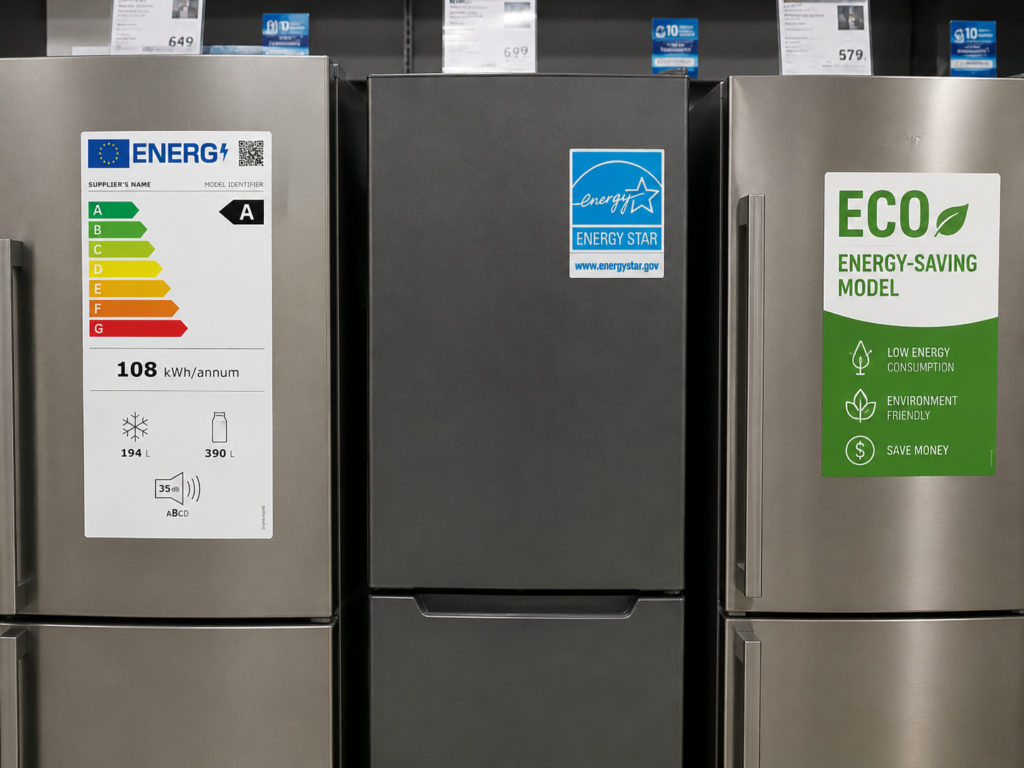
Have you ever had this experience: picking a fridge at the supermarket or on an e-commerce platform, one marked with EU Grade A, one with an ENERGY STAR label, and another labeled “eco energy-saving model”—which one actually uses less electricity? If you pay an extra hundred dollars for a high-efficiency model, how long will it take to earn that back through electricity savings? Why is a cheap air conditioner bought cross-border not allowed to be installed locally, or has a much higher electricity bill than the label says after installation?
The core of these questions is all energy efficiency standards—a set of rules closely related to everyone’s electricity bills, product compliance, and even the environment. But most people have only seen the letters or stars on the label, without knowing what it actually regulates, how to read it, and how to use it to avoid pitfalls. Whether you are buying home appliances, renting or buying a house, or doing cross-border business, understanding energy efficiency standards can help you avoid wasting money and steer clear of compliance risks.
1. Basic Understanding: What Energy Efficiency Standards Are, What They Cover, and What They Don’t
1.1 Plain Language Definition: A “Public Ruler” for Product Energy Consumption Efficiency
Many people think energy efficiency is just “how small the power is”, but that’s not the case at all—the core of energy efficiency is to see how much energy a product uses to complete the same work. It is “work efficiency”, not “absolute value of power consumption”.
To give a few common examples: under the same brightness, LED lights consume much less electricity than incandescent bulbs because they have higher luminous efficacy; for two refrigerators of the same capacity, the one with lower annual electricity consumption usually has lower operating costs; a high-power air conditioner is not necessarily inefficient—if it has higher cooling/heating output and better seasonal energy efficiency performance, it may instead be a more energy-saving high-efficiency product.
Energy efficiency standards are essentially a set of technical regulations and a commonly used tool for sustainable development. Their core role is to reduce energy consumption across society, reduce emissions, and standardize market order. The types of energy they cover are not limited to electricity, but also include gas, fuel oil, thermal energy, and even some water use indicators directly related to energy consumption.
1.2 Scope of Application: What Energy Efficiency Standards Usually Cover
The coverage objects of energy efficiency standards are mainly standardized energy-using products, common ones include home appliances, air conditioners, heat pumps, lighting, televisions, monitors, water heaters, boilers, motors, water pumps, commercial refrigeration equipment, etc.
Its management content is very clear, mainly including: minimum energy efficiency thresholds, energy efficiency rating classification, energy efficiency label rules, standby power consumption requirements, unit output efficiency indicators, unified testing methods, product filing requirements, and market spot-check mechanisms.
In real life, energy efficiency standards are everywhere: new product sales, product import, e-commerce platform listing, government procurement, subsidy applications, and even rental housing compliance requirements in some regions all use energy efficiency rules. Here, a premise must be specially remembered: talking about “high energy efficiency” must be combined with product category, place of sale/use, standard version, and testing method. Comparisons without these conditions are inaccurate.
1.3 What Energy Efficiency Standards Usually Do Not Cover
Energy efficiency standards are only a ruler for measuring energy use efficiency, not a universal product evaluation system, and there are many areas they do not cover:
They do not directly evaluate the appearance, brand premium, or user experience of smart functions of products;
They are not completely equivalent to safety certification, and cannot replace safety standards such as electric shock prevention, fire prevention, overheat protection, and material flame retardancy. Compliant products usually need to meet both energy efficiency and safety requirements;
They do not guarantee that the actual electricity bill will be equal to the value on the label. Real power consumption is also affected by local climate, house insulation, usage frequency, installation and maintenance quality and other factors;
They do not necessarily cover second-hand, refurbished, antique, niche custom or industrial-specific equipment. Whether these products are subject to energy efficiency rules requires checking local specific regulations;
They are also not equal to full-life-cycle environmental protection. Energy efficiency standards do not cover the environmental impact of product manufacturing, transportation, maintenance, scrapping and recycling.
1.4 Clarifying Easily Confused Concepts at Once
Many people can’t figure out various statements related to energy efficiency. Here, we explain the most easily confused groups of concepts clearly at once:
- Energy efficiency standards vs energy efficiency labels: Standards are the rules and thresholds behind them, and labels are the carrier for displaying information to consumers, equivalent to the difference between “exam rules” and “report cards”.
- Minimum Energy Performance Standards (MEPS) vs energy efficiency ratings: MEPS is the minimum threshold for a product to be legally sold, equivalent to the “pass line”; energy efficiency ratings are grades divided by efficiency level among passing products, used to distinguish which is better.
- Energy efficiency standards vs safety standards: The former regulates whether energy is used sparingly, the latter regulates whether it is safe to use. The two are completely independent requirements and cannot replace each other.
- Energy efficiency labels vs energy-saving marketing words: Words like “eco”, “green”, “energy-saving model” printed on products are mostly brand marketing slogans and cannot replace official energy efficiency labels, filings or certifications.
- Energy efficiency standards vs carbon emission labels: Energy efficiency mainly looks at energy consumption during the product use phase, while carbon labels may cover emissions throughout the entire life cycle such as raw materials, manufacturing, transportation, use, and recycling, with a wider scope.
- Energy efficiency standards vs quality standards: High energy efficiency does not mean the product is more durable, quieter, or easier to repair. These belong to the category of quality and experience, and have no direct relationship with energy efficiency.
1.5 Core Terms for Beginners (Chinese-English Comparison)
When first coming into contact with energy efficiency labels, you often encounter a bunch of English abbreviations. Here, we explain the most commonly used terms in plain language to help you compare with overseas products:
- Minimum Energy Performance Standards (MEPS): The minimum efficiency threshold that products must meet to be legally sold, also known as the “pass line”.
- Energy Efficiency Class/Rating: Grades divided by efficiency level for products of the same category, common forms include A-G, 1-5 levels, star ratings, etc.
- Energy Label/EnergyGuide/EnerGuide: An information card affixed to the product or displayed on the product page, used to mark the rating, power consumption, operating cost or performance parameters.
- Test Conditions: Test conditions uniformly specified by the laboratory, such as temperature, load, operation mode, test cycle, etc., to ensure all products are compared in the same environment.
- Annual Energy Consumption, kWh/year: Estimated annual electricity consumption under standard working conditions, which can only be used for horizontal comparison of products of the same specification.
- Energy Efficiency Ratio/Coefficient of Performance (EER/COP): How much cooling or heating capacity can be generated per unit of energy input. The higher the value, the more efficient it is. It is commonly used for products such as air conditioners and heat pumps.
- Seasonal Energy Efficiency Ratio/Seasonal Coefficient of Performance/Heating Seasonal Performance Factor (SEER/SCOP/HSPF): Comprehensive efficiency considering seasonal temperature changes, which is closer to actual use than the energy efficiency ratio under a single working condition, suitable for evaluating seasonally used equipment such as air conditioners and heat pumps.
- Standby Power: Power consumption when the device is plugged in but not actively working, which is often called “standby power consumption”.
- Networked Standby: Power consumption when smart devices are connected to the network and on standby. With the popularization of smart homes, it is becoming an increasingly important regulatory focus.
2. Why It Matters: From Personal Electricity Bills to Regulatory Compliance and Sustainable Development
You might say, it’s just a few dollars difference in the electricity bill every month, is it necessary to make it so complicated? In fact, the impact of energy efficiency goes far beyond personal electricity bills.
For Ordinary Users: Energy Efficiency of Frequently Used Products Directly Determines Long-Term Expenses
If you are buying a hair dryer or an oven that is used occasionally, a slight difference in energy efficiency really doesn’t matter. But for products that are plugged in 24 hours a day and used every day, the difference in energy consumption will accumulate into a considerable amount over several years:
Refrigerators run 365 days a year. For two refrigerators of the same capacity, the difference in annual electricity consumption between high and low efficiency models can range from tens to hundreds of kWh; calculated based on local electricity prices and the product’s service life, the long-term accumulated cost difference can range from tens to hundreds or even higher, depending on regional electricity prices and usage habits.
For high-energy-consuming equipment such as air conditioners, heat pumps, and water heaters, in scenarios with high electricity prices, long equipment operation time, poor house insulation or large capacity, the cost difference corresponding to annual energy consumption may be obvious; the specific value needs to be estimated based on the nominal energy consumption on the label, local energy prices and actual usage time.
The total standby power consumption of lights that are often on at home, routers that are always plugged in, and televisions can also cost a lot of extra money a year.
So when buying such frequently used products, you can’t just look at the selling price, you have to calculate “purchase price + energy costs within the expected service life + maintenance costs“, which is the total cost of ownership. Of course, it’s not that high energy efficiency is always cost-effective. The key depends on the price difference, annual electricity consumption difference, local electricity price, service life, and whether there are subsidies.
For Safety and Protection: Reduces Energy Use Pressure, But Cannot Replace Safety Compliance
High-efficiency equipment wastes less energy to complete the same task, and usually generates less waste heat, which can reduce grid load to a certain extent, but this is completely different from “safer”.
Risks such as fire, electric shock, and overheating are mainly determined by the product’s safety design, safety certification, installation quality, line capacity and daily maintenance. The correct statement is: energy efficiency compliance is part of product compliance, but “high energy efficiency” is by no means equal to “safer”.
When purchasing, be sure to check separately: local safety certification, voltage and frequency, plug specifications, installation qualifications, after-sales maintenance—these are separate from energy efficiency, and you can’t ignore safety just because of high energy efficiency.
For Homes and Buildings: Equipment Energy Efficiency Must Match Housing Conditions
Many people buy the most energy-efficient air conditioner, but the electricity bill is still very high. The problem often lies in the house itself. In household energy consumption, heating, cooling, and hot water account for the majority, and the efficiency advantage of equipment will be offset by the shortcomings of the house:
If the house has poor insulation, leaky windows, or severe west-facing sun exposure, no matter how efficient the air conditioner is, it has to run at high load all the time;
If the hot water pipes are not insulated, heat is dissipated on the way, and no matter how high the energy efficiency of the water heater is, it’s useless;
In extremely cold or extremely hot climate zones, the gap between actual energy consumption and the label value will be larger.
A typical misunderstanding is “only replacing equipment without renovating the house”: spending a lot of money on a Grade A air conditioner, but the room is leaky and the filter hasn’t been cleaned for half a year, the actual electricity bill is not much different from a Grade C one. When renting or buying a house, you can also take a look at the building’s energy efficiency certificate, window type, insulation condition, hot water system and the state of old home appliances—these reflect the real living cost better than just looking at equipment energy efficiency.
For the Market and Industry: Eliminating Backward Products and Reducing False Publicity
Without energy efficiency standards, the market would be full of “low-priced but particularly power-hungry” products—cheap to buy, expensive to use, and consumers can easily fall into traps due to information asymmetry.
MEPS (Minimum Energy Performance Standards) will directly eliminate the least efficient products and prevent them from entering the market;
Unified energy efficiency ratings and testing methods allow consumers to compare horizontally, without having to listen to manufacturers “each saying their own piece”;
Standards are usually regularly reviewed or updated irregularly with technological progress, changes in energy prices, emission reduction targets and consumer protection requirements. The update cycle depends on the region and category, and cannot be fixed as a certain number of years. Every time standards are tightened, manufacturers are forced to upgrade technology, and old low-efficiency models gradually cannot be sold or imported as new products.
For the Environment and Sustainable Development: Energy Efficiency Is One of the Core Tools for Emission Reduction
According to recent building sector reports from the International Energy Agency (IEA), the building operation phase accounts for about 30% of global final energy consumption. If building construction and building material production are added, related carbon emissions account for more than one-third of global energy-related carbon emissions.
Energy efficiency improvement is one of the core measures in the 2030 emission reduction, energy security and net-zero pathways—reducing end-use energy demand can reduce fossil energy consumption, ease grid peak pressure, and reduce the need for new power plants and power transmission and distribution facilities. Of course, we should also pay attention to the boundary: high energy efficiency is not equal to zero carbon, nor is it equal to the most environmentally friendly in the full life cycle—after all, the environmental impact of production, transportation, and recycling is not covered by energy efficiency standards.
3. Operational Logic: The Three-Tier Structure of MEPS, Energy Efficiency Ratings, and Energy Efficiency Labels
Energy efficiency standards seem complicated, but the core is a three-tier structure, which respectively solve the three problems of “can it be sold”, “which is more efficient”, and “what can consumers see”. Once you understand these three tiers, you can understand the underlying logic of energy efficiency systems in all regions.
3.1 First Tier: Minimum Energy Performance Standards (MEPS), Which Determine “Whether It Can Be Sold”
MEPS is the bottom line of the energy efficiency system and is a mandatory requirement: products that do not meet the minimum energy efficiency threshold are usually not allowed to be produced, imported or sold.
It mainly constrains manufacturers, importers, brand owners, distributors and e-commerce platforms. Ordinary consumers rarely see MEPS provisions directly, but are indirectly affected through the products available on the market and the labels affixed to products.
MEPS thresholds vary by country/region, climate zone, and product category. For example, the minimum energy efficiency requirement for heat pumps in cold regions may be different from the standard in temperate regions.
Of course, there are exceptions: whether second-hand products, refurbished products, products imported for personal use, spare parts for maintenance, and industrial-specific equipment are subject to MEPS should be judged according to local regulations, and cannot be generalized.
3.2 Second Tier: Energy Efficiency Ratings, Which Determine “Which Qualified Product Is More Efficient”
After passing the MEPS pass line, it’s the turn of energy efficiency ratings to distinguish the efficiency level of products.
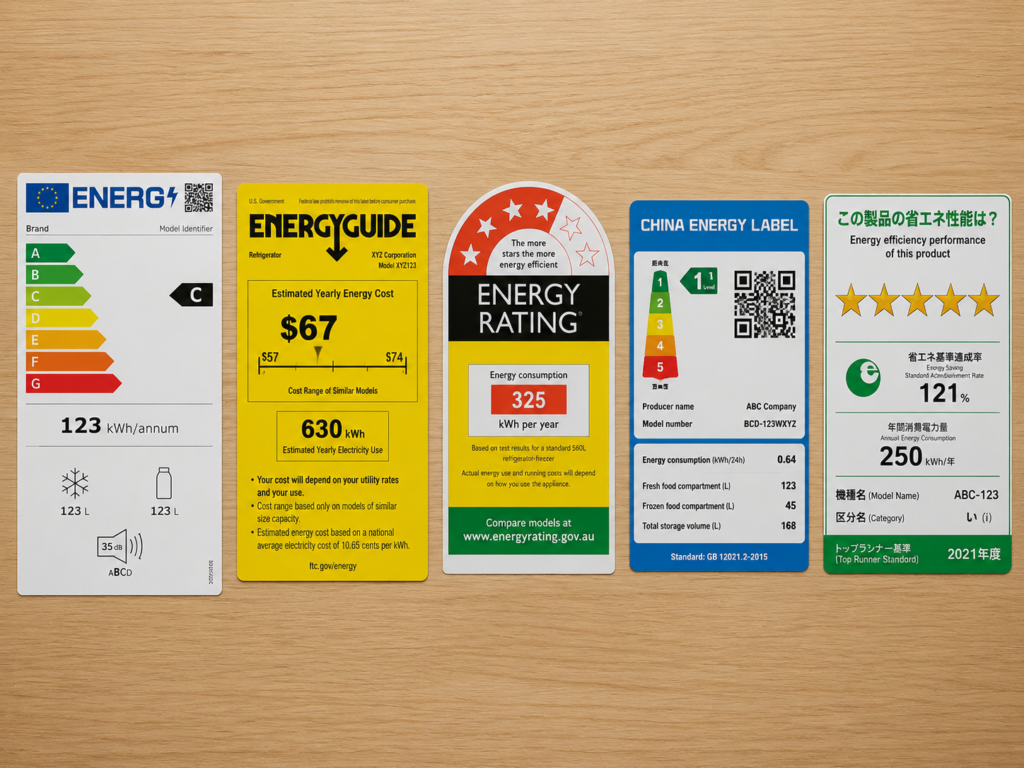
Different regions have different rating forms: the EU uses seven grades from A to G, the U.S. EnergyGuide displays the energy consumption range of similar products, Australia and New Zealand use star ratings, China commonly uses 1-5 levels or 1-3 levels, and Japan uses the Top Runner achievement rate. In essence, they all rank qualified products.
Here, special attention should be paid: energy efficiency rating is a relative attribute, which can usually only be compared between products of the same category, same specification range, and same standard version. For example, a Grade A large refrigerator may consume more electricity than a Grade B small refrigerator, because the capacity is different, and they are not in the same comparison dimension at all.
There is also a common phenomenon called “rescaling”: when standards are tightened and the overall product efficiency improves, high-grade products under the old version may be downgraded in the new version of the label. For example, an old EU A+++ refrigerator may only be Grade B in the new label after rescaling in 2021. This is not because the product has become worse, but because the evaluation criteria have become stricter.
For ordinary consumers, ratings can be used for quick screening, but for detailed comparison, you still need to look at annual electricity consumption and specific efficiency values.
3.3 Third Tier: Energy Efficiency Labels, Which Determine “What Consumers Can See”
Energy efficiency labels are the part that consumers contact the most, and their role is to transparently display energy efficiency information to everyone.
Formal energy efficiency labels usually contain these core contents: energy efficiency rating, annual electricity consumption, estimated operating cost, key performance parameters, test standard number, QR code or filing number, etc.
Its display scenarios are not limited to the product body: you can find corresponding energy efficiency information on shelves in offline stores, online shopping product detail pages, product information sheets, manuals, and official filing databases.
There are two types of energy efficiency labels: mandatory and voluntary. Mandatory labels are required by regulations and belong to compliance disclosure; voluntary certification labels (such as ENERGY STAR) are used to identify higher-efficiency products, and are usually linked to subsidies and government procurement.
Many people only look at the color or letters when reading labels, which is the most common misinterpretation—you must look at it together with capacity, annual electricity consumption, and standard version, otherwise it is easy to make a wrong judgment.
3.4 The Complete Chain of Formulation, Testing, Declaration, and Spot Check
Energy efficiency standards are not set arbitrarily. There is a complete process from formulation to implementation:
The formulation entities are usually the energy departments, market supervision agencies, and standardization bodies of various countries, such as the European Commission, the U.S. Department of Energy (DOE), etc. During the formulation process, industry opinions and technological development levels will be referenced.
Testing methods usually refer to local regulations, and also draw on international standards such as IEC/ISO, but note: international standards do not automatically replace local regulations. To enter which market, products must follow the testing methods of that market.
Compliance models vary from place to place, and may be a combination of manufacturer self-declaration, accredited laboratory testing, third-party certification, official filing, and market spot checks. Not all regions require third-party certification.
The division of responsibilities is also very clear: manufacturers/importers are responsible for preparing technical documents, test reports, labeling and filing, and are responsible for the authenticity of the product’s energy efficiency; retailers and e-commerce platforms are responsible for correctly displaying energy efficiency information and cannot sell non-compliant products; regulatory authorities are responsible for random spot checks and penalties.
If there is a violation, the consequences usually include sales ban, fines, recall, platform removal, public notification, cancellation of subsidy eligibility, etc. The specific penalty standards are stipulated by local regulations, and the intensity varies greatly from region to region.
3.5 The Relationship Between Mandatory Requirements and Voluntary Certification
Many people can’t figure out the difference between mandatory standards and voluntary certification. In fact, it can be explained in three sentences:
First, mandatory MEPS is the minimum threshold, which determines whether a product can enter the market; mandatory labels are information disclosure requirements, which determine what data must be displayed to consumers.
Second, the threshold for voluntary high-efficiency certification (such as ENERGY STAR) is usually higher than the mandatory minimum standard. The specific threshold is formulated by category and updated regularly. Many subsidies, government procurement, and grid discounts require products to reach a specific grade or be included in a designated certification database.
Third, voluntary certification is not the highest grade in all regional mandatory systems, and absolutely cannot replace local mandatory compliance requirements—even if a product has an ENERGY STAR label, you must first confirm that it meets local mandatory MEPS and label requirements.
4. Global Mainstream Energy Efficiency Systems: How to Understand Overseas Labels and Compliance Rules
Since energy efficiency standards are set locally, what are the differences between the systems of different countries? When buying things overseas, how do you understand the local labels? Let’s first talk about a general principle, then introduce by region.
General Principle: The Rules of the Place of Sale/Use Prevail
This is the most core rule for cross-border purchasing, don’t get it reversed:
A product that is qualified in Country A does not mean it is qualified in Country B, and the standards of the country of origin cannot be automatically applied to the place of use;
Cross-border e-commerce pages may display labels from multiple regions at the same time, so be sure to confirm which one applies to your market;
Products of the same brand and same series may use different compressors, refrigerants, and voltages in different markets, and their energy efficiency performance is also different;
The priority for judging compliance is: local regulations > official database > product label > merchant description > marketing words.
Energy Efficiency Systems in Common Regions
To facilitate your quick comparison, here is a table organizing the core information of mainstream systems:
| Country/Region | Core Mandatory Label | Rating Format | Main Regulatory/Query Channels |
|---|---|---|---|
| European Union | EU Energy Label | A-G (rescaled since 2021, covering refrigerators, washing machines, dishwashers, monitors, light sources and other categories) | EPREL database (for covered products that require registration, you can scan the QR code on the label to query) |
| United States | EnergyGuide (yellow label) | Energy consumption range comparison of similar products | U.S. Department of Energy (DOE), ENERGY STAR Product Finder |
| Canada | EnerGuide | Energy consumption value + comparison with similar products | Natural Resources Canada |
| Australia/New Zealand | Energy Rating Label | Star rating (more stars mean more energy saving) | Energy Rating official website |
| Japan | Energy Efficiency Label | Top Runner benchmark + achievement rate | Ministry of Economy, Trade and Industry (METI) |
| South Korea | Energy Efficiency Label | 1-5 levels (Level 1 is the highest) | Korea Energy Public Corporation (KECO) |
| China | Energy Efficiency Label | 1-5 levels or 1-3 levels (Level 1 is the highest) | China Energy Efficiency Label Network |
Below, we pick several of the most common systems and explain a few details you need to know:
EU System
The EU’s energy efficiency label now uses seven grades from A to G. Since 2021, key categories such as refrigerators, washing machines/washer-dryers, dishwashers, electronic displays, and light sources have been rescaled, canceling the previous A+, A++, and A+++, in order to avoid overcrowding at the highest grade and allow consumers to re-distinguish efficiency differences.
The EU also has two important rules related to energy efficiency:
- EPREL database: All covered products that require registration must be filed in this database. Consumers can scan the QR code on the label to check the detailed information of the product and verify whether it is truly compliant;
- Ecodesign: It not only manages energy consumption, but also requires standby power consumption, repairability, spare parts supply years, software updates, resource efficiency, etc., which is equivalent to more comprehensive product sustainability requirements. For products covered by Ecodesign, relevant requirements will be included in the CE conformity assessment, but note: CE marking is not equal to energy efficiency rating, nor can it replace energy efficiency labels.
In addition, the EU requires that online shopping product pages for many covered products must display energy efficiency labels and product information sheets as required. If you can’t see the label when buying, you should instead pay attention to whether it is non-compliant.
United States and Canada
The U.S. energy efficiency system has mandatory minimum standards set by the Department of Energy (DOE), covering many categories such as home appliances, HVAC, water heaters, lighting, and commercial equipment.
- The common yellow EnergyGuide label is mandatory. It will write the estimated annual electricity consumption, annual operating cost, and the energy consumption range of similar products. You can see at a glance where this product ranks among similar products; note that the annual operating cost on the label is calculated based on assumed electricity prices, and the actual cost needs to be calculated by replacing it with local electricity prices and your own usage patterns.
- ENERGY STAR is a voluntary high-efficiency certification jointly launched by the EPA and DOE. Its threshold is usually higher than the mandatory minimum standard. Specific requirements are set by category and updated regularly, and it is often linked to subsidies and government procurement lists.
- The U.S. also has state-level differences. For example, California may have stricter efficiency requirements, building codes or subsidy rules. When buying, pay attention to local requirements.
Canada’s mandatory label is EnerGuide, with a logic similar to that of the U.S., and it also has the voluntary high-efficiency certification of ENERGY STAR Canada.
Other Common Systems
- Australia and New Zealand: Use star rating labels. The more stars, the more energy-efficient. Some products also display annual electricity consumption and capacity information, which is intuitive and easy to understand;
- Japan: Uses the “Top Runner” system, which takes the most efficient products already on the market as a reference to set future efficiency goals, forcing the entire industry to upgrade;
- South Korea: The mandatory energy efficiency rating is 1-5 levels, with Level 1 being the highest. At the same time, there are requirements for standby power consumption limits and high-efficiency equipment certification;
- China: The energy efficiency label is 1-5 levels or 1-3 levels, with Level 1 being the most efficient. Different categories implement different national standards.
The underlying logic of these systems is the same: “minimum threshold + label/rating + regulatory spot check”, only the grading methods and testing methods are different.
Pitfall Avoidance Rules for Cross-Region Comparison
If you want to compare products from different countries, remember these points and you won’t fall into traps:
- Never directly convert ratings: EU Grade A is not equal to China’s Level 1, nor is it equal to the highest star rating in Australia and New Zealand. The testing methods, climatic conditions, and grading rules are all different, so forced comparison is meaningless;
- Prioritize comparing core parameters of the same specification: For example, annual electricity consumption, cooling/heating seasonal energy efficiency, luminous efficacy, standby power consumption, capacity—these hard parameters are more reliable than ratings;
- Confirm the test version: Old and new labels in the same region may not be directly comparable. For example, the old EU A+++ may only be Grade B in the new version;
- Check official databases: EU EPREL, U.S. ENERGY STAR Product Finder, DOE compliance database, and national energy efficiency filing systems are the most authoritative sources of information;
- Final judgment criteria for cross-border purchase: Whether it can be used locally, whether it is compliant, whether there is local warranty, and whether there is local safety certification—these are much more important than “overseas labels look high-grade”—especially for products that require installation and are compatible with local grid/gas systems, such as air conditioners, heat pumps, and water heaters. Don’t buy them casually just because they are cheap overseas. Later installation, maintenance, and compliance issues may cost more.
5. Must-Learn for Beginners: How to Read Energy Efficiency Labels and Which Indicators to Focus on by Category
After understanding the system logic, we come to the most practical part: when you get an energy efficiency label, how should you read it? For products of different categories, what indicators should you focus on?
5.1 General Five-Step Method: From Quick Screening to Accurate Judgment
No matter which region or which category of energy efficiency label it is, you can read it in this order to ensure you don’t miss the key points:
Step 1, first align the basic specifications. Confirm that the product type, capacity, size, core functions, and applicable climate zone are consistent, otherwise there is no basis for comparison at all—for example, a 200-liter refrigerator and a 500-liter refrigerator cannot be directly compared no matter how high the energy efficiency rating is.
Step 2, look at the energy efficiency rating. Use the rating to quickly judge the approximate position of this product among similar products, and first filter out obviously inefficient products.
Step 3, look at absolute parameters. Don’t just stare at the rating. Focus on hard indicators such as annual electricity consumption, operating cost, core efficiency value, and standby power consumption—these are the key factors that determine how much you actually spend.
Step 4, check filing and certification. Use the official database to verify whether the model, label, and parameters are consistent, to avoid buying falsely labeled products.
Step 5, combine with usage scenarios. For products that are frequently used, in high electricity price areas, and have a long service life, it is more worth spending extra money on high energy efficiency; if it is a small appliance that is used occasionally, you don’t need to worry too much about the rating.
5.2 Plain Language Explanation of Core Label Parameters
Various parameters and units on the label look complicated, but each has a clear meaning. Here, we explain them in the most straightforward words:
- kWh/year (degrees/year): Estimated annual electricity consumption under standard working conditions, which can only be used for horizontal comparison of products of the same specification, not your actual annual electricity bill.
- Operating cost: Estimated annual/monthly cost based on a certain assumed electricity price. When actually using it, you need to replace it with the local electricity price for calculation, and it can only be used as a reference.
- EER/COP: Cooling/heating efficiency under specific working conditions. The higher the value, the more efficient. It is commonly used for air conditioners and heat pumps, but can only reflect performance at a certain fixed temperature.
- SEER/SCOP/HSPF: Seasonal comprehensive efficiency, considering temperature changes in different seasons, which is closer to actual use than EER/COP under a single working condition, suitable for evaluating the annual performance of air conditioners and heat pumps.
- Lumens per watt (lm/W): How much light a lamp can produce per watt of electricity. To judge lighting efficiency, you can’t just look at wattage. The higher the luminous efficacy, the more power-saving it is under the same brightness.
- Liters per cycle, kWh per cycle: Water consumption and electricity consumption of products such as washing machines and dishwashers when running a standard program once; if you often use programs such as energy-saving wash or quick wash, it is best to look at the parameters of commonly used programs correspondingly, which is more reference value.
- Standby/networked standby power consumption: Power consumption when the device is plugged in but not working. It seems small, but over the years, it will also generate a lot of electricity bills. The networked standby power consumption of smart devices is receiving more and more attention now.
5.3 Key Points for Energy Efficiency Judgment of Common Categories
For products of different categories, the core influencing factors of energy efficiency are different. Grasping the key points can save a lot of detours:
- Refrigerators/freezers: Prioritize annual electricity consumption, effective volume, climate type, and door seal condition. Refrigerators are products that run all year round, and annual electricity consumption directly determines long-term costs; the capacity should match the number of family members. If it is too large, long-term low load will waste electricity instead.
- Air conditioners/heat pumps: Prioritize SEER (cooling seasonal energy efficiency), SCOP (heating seasonal energy efficiency), HSPF (heating seasonal performance factor), low-temperature heating capacity, applicable area, and installation quality. In cold regions, you can’t just look at the COP at normal temperature, because the efficiency of heat pumps will decrease at low temperatures; installation quality has a great impact on actual efficiency, and may even offset the advantage of high energy efficiency.
- Water heaters: The key points vary by type: electric water heaters look at heat loss and capacity, heat pump water heaters look at COP and low-temperature performance, gas water heaters/boilers look at thermal efficiency and exhaust method. Hot water is a major part of household energy consumption. Choosing the right type and energy efficiency rating can save a lot of money in the long run.
- Washing machines/dishwashers: Prioritize power and water consumption per cycle, rated capacity, and energy consumption of commonly used programs. Long-term half-load use will lower actual efficiency, so the capacity should match the family population; the energy consumption of commonly used programs is more reference than the parameters of standard programs.
- Clothes dryers: Heat pump types are usually more power-saving than traditional resistance types, but they are more expensive, take longer to dry, and require regular cleaning and maintenance. For families that use them frequently, the long-term benefits of heat pump types are higher; if they are used less, there is no need to pay too high a premium for high energy efficiency.
- Lighting: Prioritize luminous efficacy (lm/W), color rendering index, color temperature, and lifespan. You can’t judge brightness only by wattage. The luminous efficacy of LEDs is much higher than that of incandescent and fluorescent lamps, and the power consumption is only a fraction under the same brightness.
- Televisions/monitors/computers: Prioritize power consumption at the same size, power consumption in HDR/high-brightness mode, and standby power consumption. Large-size, high-brightness screens may consume much more power during actual use than the nominal value; if they are on standby for a long time, the accumulated power consumption is also a lot.
- Motors/water pumps/fans: Prioritize efficiency rating, load matching, and variable frequency control. If the model is too large, long-term low-load operation will lead to low overall system efficiency, so it must match the actual demand.
- Cooking equipment: For low-frequency household use, there is no need to blindly pursue the highest energy efficiency, because the cooking time is short, and the accumulated cost of energy efficiency difference is not high; but if it is a long-term commercial scenario, you should pay attention to operating costs and ventilation heat load.
5.4 Why There Is a Gap Between Label Values and Actual Electricity Bills
Many people buy high-efficiency products and find that the actual electricity bill is different from what’s on the label, so they think it’s a false label. But that’s not necessarily the case—the label value is an estimated value under unified laboratory conditions, and it’s normal to have a gap with real use. The main reasons are as follows:
First, the test conditions are fixed laboratory conditions, such as fixed ambient temperature, humidity, load, and operation mode, while each family’s environment and usage habits are different, so there will naturally be differences.
Second, usage frequency, set temperature, load amount, number of door openings, and cleaning and maintenance habits will all change actual energy consumption. For example, the more frequently the refrigerator door is opened, the higher the power consumption; if the air conditioner filter is clogged, the efficiency will decrease.
Third, the impact of installation location is great: the refrigerator is close to a heat source, the air conditioner outdoor unit has poor ventilation, and the heat pump is installed in the wrong position—all of which will greatly reduce actual efficiency.
Fourth, equipment aging will gradually reduce efficiency, such as aging door seals, dust accumulation on the condenser, and reduced compressor performance. Equipment that has been used for several years will have higher energy consumption than when it was new.
Finally, the electricity price structure will also affect the bill, such as peak-valley electricity prices, tiered electricity prices, and gas price fluctuations, which will make the actual cost different from the estimated value on the label.
6. Practical Decision-Making: Choosing Cost-Effective Products Using Energy Efficiency Standards
Understanding labels is only the first step. When actually buying, how do you choose the most suitable and cost-effective one? After all, high energy efficiency is often more expensive, and not everyone needs to buy the highest grade.
General 5 Steps for Buying High-Efficiency Products
Follow this process, and you basically won’t fall into traps:
- First determine the required specifications: According to the number of family members, room area, local climate, and usage frequency, determine the capacity and performance you need. Don’t buy too big or too small—if the capacity is too large, long-term low-load operation will waste electricity instead; if the capacity is too small, running at high load all the time is not power-saving either.
- Compare energy efficiency of the same specification: Only compare ratings and core parameters between products of the same category, same capacity, and same function. Don’t compare across categories, and don’t force comparison of products of different specifications.
- Calculate total cost of ownership: Don’t just look at the purchase price. Calculate “purchase price + energy costs within the expected service life + maintenance/consumable costs”—this is the total amount you will spend on this product. If it is gas, fuel oil or thermal energy equipment, replace the electricity consumption with the consumption of the corresponding energy, and replace the electricity price with the unit price of the corresponding energy.
- Verify official information: Go to the local official database (such as EPREL, ENERGY STAR Product Finder, local energy efficiency filing database) to check the model, confirm that the label, parameters and filing are consistent, to avoid buying falsely labeled products.
- Superimpose non-energy efficiency factors: Energy efficiency is only one indicator. You also need to consider noise, reliability, after-sales warranty, repairability, installation conditions, and spare parts supply—no matter how power-saving a product is, if it breaks and no one repairs it, or it breaks after two years of use, it’s not cost-effective.
How to Calculate the Payback Period: The Core of Judging Whether It’s Worth Buying
Many people struggle with “when can I earn back the extra money I spent”. In fact, the calculation is very simple:
Basic payback period = Premium of high-efficiency product ÷ (Annual energy consumption difference × Local electricity price)
If there is a subsidy: Payback period = (Premium of high-efficiency product – Subsidy/deduction) ÷ Annual electricity savings
For example: for refrigerators of the same capacity, the high-efficiency model is $100 more expensive than the ordinary model, uses 100 kWh less per year, and the local electricity price is $0.25 per kWh. Then you can save $25 per year, and the payback period is 100 ÷ 25 = 4 years. If the refrigerator can be used for 10 years, the remaining 6 years are pure savings, so it’s very worth buying.
The simplified judgment standard is: if the payback period is significantly shorter than the expected life of the product, it is usually worth buying; if it is close to or even exceeds the life, there is no need to spend the money.
It should be noted that the expected life of different products is different: lamps may last 3-5 years, refrigerators can last 10-15 years, air conditioners and heat pumps can last 10-20 years, and cannot be generalized.
Selection Principles for Different Usage Scenarios
Not all situations require buying the highest energy efficiency. Choosing according to your own usage scenario is the most cost-effective:
- Products that run frequently and for a long time: Such as refrigerators, air conditioners, heat pumps, water heaters, and lights that are often on. Prioritize medium-high or high energy efficiency, and you will save a lot of money in the long run.
- Products used infrequently and for short periods: Such as hair dryers, ovens used occasionally, and small kitchen appliances. There is no need to pay too high a premium for the highest grade, and the money saved may not even make up for the price difference.
- High electricity price areas: The weight of energy efficiency rating and annual electricity consumption difference is higher, the payback is faster, and it is worth buying better ones.
- Rental scenarios: Prioritize home appliances with valid local energy efficiency labels, and pay attention to building energy efficiency certificates, heating methods, window types, hot water systems and the condition of old home appliances at the same time; if the old unlabeled equipment provided by the landlord is too power-hungry, you can roughly judge the energy consumption based on the production year, power, and maintenance status, you can’t directly determine it is unqualified, and you can discuss with the landlord to replace it if it’s too power-hungry.
- Old home appliances: Don’t rush to replace them first. First check the door seals, filters, condensers, temperature control settings, and installation positions. Many times, cleaning and adjusting settings can save a lot of electricity; if the annual electricity consumption is indeed significantly high, then consider replacing.
How to Use Subsidies, Tax Incentives and Trade-Ins
Many regions have subsidies for high-efficiency products, and using them well can save a lot of money. Common types include: purchase subsidies, tax credits, grid company rebates, trade-ins, and low-interest loans.
These subsidies usually have conditions, such as reaching a specified energy efficiency rating, having a specified certification, being in a specified model list, having a formal invoice, finding a qualified installer, providing a proof of old machine recycling, etc.
Pitfall reminder: Don’t just listen to the salesperson’s verbal promise of subsidies. Before buying, be sure to go to the local energy department, grid company, government subsidy website or brand official website to confirm that the model you want to buy is indeed in the subsidy list, to avoid not getting the subsidy after buying.
Precautions for Cross-Border Purchase
If you want to buy products from overseas, in addition to the aforementioned “the rules of the place of use prevail”, you should also pay attention to the following points:
- Confirm whether the voltage, frequency, plug, refrigerant, and gas type are compatible with local ones, otherwise you can’t use it after buying it back, and you will have to pay for modification costs;
- Find out the customs and market supervision requirements for personal use imports, second-hand products, and refurbished products, to avoid being detained or unable to use them legally;
- Confirm whether there is local warranty, maintenance spare parts, and installation services, especially for products that require professional installation such as air conditioners, heat pumps, and water heaters. If you buy cross-border, it is very likely that no one will take care of after-sales;
- For equipment with high energy consumption and high installation costs, such as air conditioners, heat pumps, and water heaters, it is not recommended to buy cross-border just because the overseas price is low. The later compliance, installation, and maintenance costs may be much higher than the money saved.
7. Intermediate Advanced: Common Misconceptions, False Label Identification, and Boundary Judgment
After understanding the basics and purchase methods, you also need to avoid some common pitfalls, learn to judge the authenticity of information, and make reasonable decisions when encountering complex scenarios.
7.1 Clarification of 9 Common Misconceptions
There are many rumors and misconceptions about energy efficiency. Here, we clarify the 9 most common ones at once:
- Misconception: The higher the energy efficiency rating, the more money you save
Clarification: Whether to spend extra money on high energy efficiency also depends on the price difference, usage frequency, local electricity price, product life and subsidies. If the price difference is too large and it’s used less, you may not earn back the premium before the product is eliminated. - Misconception: The smaller the power, the more energy-efficient
Clarification: The key is the total energy consumption to complete the same task. A low-power but low-efficiency product may take longer to complete the work, and the total power consumption is higher instead. For example, a low-power old refrigerator may consume more electricity than a high-power new inverter refrigerator. - Misconception: The annual electricity consumption on the label is the actual electricity bill
Clarification: The label is an estimated value under standard working conditions. Actual power consumption is affected by the environment, usage habits, installation and maintenance. It’s normal to have a gap with the label value. The role of the label is horizontal comparison of the same specification, not predicting an accurate bill. - Misconception: Energy efficiency ratings of different countries can be directly compared
Clarification: Testing methods, climatic conditions, grading rules, and standard versions vary from region to region. EU Grade A is not equal to China’s Level 1, nor is it equal to the highest star rating in Australia and New Zealand. Forced comparison is meaningless. - Misconception: High energy efficiency must be more environmentally friendly
Clarification: High energy efficiency only saves energy during the use phase. It also depends on product life, maintenance difficulty, materials, and environmental impact of manufacturing, transportation and recycling. It is not equal to the most environmentally friendly in the full life cycle. - Misconception: Having words like eco/green/energy-saving means compliance
Clarification: These are mostly brand marketing slogans and cannot replace official energy efficiency labels, filings or certifications. Whether they are valid depends on local official rules. - Misconception: No energy efficiency label means unqualified
Clarification: Some categories, second-hand, refurbished, and industrial-specific equipment may not have mandatory label requirements. It depends on local regulations and cannot be generalized. - Misconception: Buying the largest capacity is more cost-effective
Clarification: If the capacity is too large, long-term no-load or low-load operation will waste electricity instead. For example, a family of three buys a 500-liter refrigerator, most of the space is empty, but it consumes more electricity than a 400-liter one. It should match your real needs. - Misconception: New products must be more power-saving than old products
Clarification: New standards for the same category are usually stricter, but it still depends on the model parameters and maintenance status. Some old high-efficiency products may be more power-saving than new low-efficiency models; well-maintained old equipment may also be more efficient than poorly maintained new equipment.
7.2 Methods for Identifying False Energy Efficiency Labels and Misleading Publicity
Now there are indeed some products with falsely labeled energy efficiency on the market. Learn these tricks, and you can basically avoid most risks:
- Check official filing: This is the most reliable method. Verify whether the product’s model, brand, capacity, annual electricity consumption, and energy efficiency rating are completely consistent with the information in the local official database. If any item doesn’t match, be careful.
- Check label completeness: Formal energy efficiency labels usually mark the standard version, QR code or filing information, and key performance parameters. They won’t just have the word “energy-saving”, nor will they be blurry or incomplete in information.
- Check parameter logic: For products of the same capacity and same technical route, if the difference in power consumption is abnormally large, for example, for 500-liter frost-free refrigerators, others have annual power consumption of around 200 kWh, but this one is labeled 100 kWh, you should be more vigilant and verify further.
- Check channel qualifications: Brand official websites, authorized dealers, and regular large platforms have higher credibility; low-price white-label products, product pages with chaotic parameters and even unclear models have a higher risk of false labeling.
- Check user reviews: If a large number of users report “abnormally high electricity bills, model not found, label inconsistent with the actual product”, you should be cautious to buy no matter how low the price is.
- Keep evidence: When buying, take screenshots of the energy efficiency information on the product page, product labels, invoices, and model nameplates. In case of false labeling, these are important vouchers for complaints or returns and exchanges.
7.3 When You Don’t Need to Pursue the Highest Energy Efficiency
Not all scenarios require buying the highest energy efficiency products. In the following situations, choosing compliant medium-high energy efficiency is more cost-effective:
- Extremely low usage frequency: For example, ovens and hair dryers that are used only a few times a year, the electricity saved is not enough to cover the high premium, so there is no need to buy the highest grade.
- Very small annual electricity consumption difference: For two products of the same specification, the annual electricity consumption difference is only a few kWh or tens of kWh, and you can’t save a few dollars a year. It’s better to prioritize comparing factors that affect the user experience more, such as reliability, noise, and after-sales service.
- Limited budget: As long as the product meets the local minimum energy efficiency standard (MEPS), it is a qualified product. If the budget is insufficient, choose medium-high energy efficiency, and don’t pay too high a price for a tiny efficiency difference.
- Extreme environments: In scenarios such as extreme cold, extreme heat, humidity, and high altitude, first confirm the applicable performance and reliability of the product, then consider energy efficiency. Otherwise, no matter how high the energy efficiency is, it’s useless if it breaks after a short time of use.
- Poor basic housing conditions: If the house is leaky, has poor insulation, or old wiring, improving these basic conditions first is more effective and cost-effective than simply replacing high-efficiency equipment.
- Non-standardized products: Custom industrial equipment or special-purpose equipment cannot be judged by the energy efficiency ratings of ordinary home appliances. They should be selected according to actual needs and professional parameters.
7.4 Degraded Decision-Making Method When Information Is Incomplete
Sometimes when shopping, you will encounter situations where labels are incomplete, parameters are missing, or cross-system comparison is difficult. At this time, you can use the degraded decision-making method to reduce risks step by step:
- Missing annual electricity consumption: At least find the energy efficiency rating of products of the same specification, core efficiency values and parameters in the user manual for comparison, and make a rough judgment, which is better than only looking at marketing words.
- Only marketing words: Downgrade the credibility of the merchant’s marketing propaganda, prioritize finding official labels or filing information. If you can’t find them, choose cautiously, and don’t spend extra money on the gimmick of “energy saving”.
- Difficult to compare across systems: Don’t force conversion of ratings from different regions. Go back to the core of “estimated operating cost to meet the same demand” for comparison. For example, calculate the approximate annual electricity bill for both, which is much more reliable than ratings.
- Model not found: If the corresponding model cannot be found in the official database, be cautious to buy, especially for products with high energy consumption and high installation costs. If it is non-compliant or falsely labeled, the loss will be great.
- Really unable to judge: Choose medium-high energy efficiency products that are locally compliant, have complete parameters, and clear after-sales service. Although it may not be the most cost-effective, it has the lowest risk and won’t fall into big traps.
8. The Linkage Between Energy Efficiency Standards, Regulations, and Sustainable Development
Energy efficiency standards are never isolated technical rules. They are deeply bound to market supervision, building policies, and sustainable development goals, and are one of the core tools for countries to implement energy security and emission reduction goals. For ordinary users and cross-border entry-level practitioners, understanding these linkage relationships can not only avoid compliance risks, but also better utilize policy benefits.
8.1 Basic Logic of Regulatory Enforcement
Energy efficiency standards are essentially technical regulations, part of market access and consumer information disclosure. The enforcement chain covers all links from production to sales:
- Enterprise responsibility: Manufacturers and importers are responsible for completing testing in accordance with local standards, preparing complete technical documents, issuing a declaration of conformity, submitting official filings, affixing compliant labels, and ensuring that the energy efficiency performance of mass-produced products is consistent with that of test samples.
- Channel responsibility: Retailers and e-commerce platforms cannot sell non-compliant products. Offline stores must ensure that products for sale have compliant labels, and online platforms must display energy efficiency labels and product information sheets on product detail pages as required.
- Regulatory means: Regulatory authorities mainly supervise through three methods: market random spot checks, official database verification, and consumer report verification, and will not notify enterprises in advance. The consequences of violations usually include sales ban, fines, recall, platform removal, public notification, cancellation of subsidy eligibility, etc. The specific penalty standards are stipulated by local regulations, and the intensity varies greatly from region to region.
- Consumer role: You can verify product information through official databases, complain about falsely labeled products, and support high-efficiency products with your purchase choices, which is also an important part of market supervision.
8.2 Relationship with Building Regulations, Procurement Policies and Subsidy Policies
Energy efficiency standards do not exist alone. They are linked with many public policies:
- Building energy efficiency codes will put forward minimum performance requirements for heating, cooling, and hot water systems, otherwise the house may not pass acceptance. In some regions, rental or sale of houses also requires disclosure of building energy efficiency certificates, and even requires meeting the minimum energy efficiency level.
- Government procurement usually requires products to reach a specific energy efficiency rating, or be included in high-efficiency certification lists such as ENERGY STAR, and prioritize the procurement of efficient products.
- Subsidy policies from grid companies and local governments will promote the popularization of high-efficiency air conditioners, heat pumps, and water heaters, and also support building insulation renovation. These subsidies are often directly linked to energy efficiency ratings.
8.3 Global Future Development Trends
With technological iteration and the upgrading of sustainable goals, several obvious trends are emerging in global energy efficiency regulation, which are related to every consumer and practitioner:
- Covered categories continue to expand: From traditional large home appliances and HVAC equipment, gradually expand to more categories such as small home appliances, consumer electronics, commercial equipment, data equipment, and new energy-related equipment.
- Minimum energy efficiency thresholds are constantly tightening: With technological progress, old low-efficiency technologies will gradually withdraw from the new sales market, standards will be regularly reviewed and updated, and overall requirements are getting higher and higher.
- Evaluation indicators continue to expand: From only looking at energy consumption during the use phase, gradually expand to more comprehensive sustainability indicators such as right to repair, spare parts supply, disassembly ability, resource efficiency, and full-life-cycle carbon information.
- **Digital
9. Study Summary: Judgments You Should Be Able to Make After Reading
At this point, all content about energy efficiency standards from beginner to intermediate proficiency has been fully covered. You do not need to rote-memorize the rules of all regions or the parameters of all product categories. As long as you can make the following 8 judgments, it will be enough to handle the vast majority of daily scenarios such as product purchasing, renting and renovation, and cross-border entry-level practice:
- Can explain the differences between energy efficiency standards, MEPS, energy efficiency grades, energy efficiency labels, and voluntary certifications, and will not treat marketing terms such as “eco”, “green”, and “energy-saving model” as official compliance certificates.
- Can judge what energy efficiency standards cover and what they do not, no longer equate high energy efficiency with safety, quality, or zero carbon, and are clear about their applicable boundaries.
- Can understand the core logic of mainstream systems such as the EU A-G label, U.S. EnergyGuide/ENERGY STAR, Canada’s EnerGuide, the Australia-New Zealand star rating, and China’s energy efficiency label, and know that all rules are subject to those of the place of sale / place of use.
- Can use the method of “same-specification comparison + annual power consumption + local electricity price + payback period” to calculate total cost of ownership and select cost-effective products.
- Can grasp core judgment indicators by product category: for refrigerators, look at annual power consumption and volume; for air conditioners/heat pumps, look at seasonal energy efficiency; for lamps, look at luminous efficacy; for water heaters, look at COP or thermal efficiency; for electronic devices, look at standby power consumption, so as not to be misled by irrelevant marketing parameters.
- Can identify false labeling and misleading publicity, know to prioritize checking official databases instead of believing marketing terms, and also know to keep evidence to protect their own rights and interests.
- Can handle complex scenarios such as cross-border purchasing, incomplete information, old home appliance replacement, and subsidy applications, and will not make decisions based on feeling.
- Can understand the role of energy efficiency standards in energy security, regulatory compliance, consumer protection, and sustainable development, and know that every purchase you make is a vote for a more efficient market.
Next time you choose home appliances, lamps, or any energy-related products, you might as well take two more minutes to look at the energy efficiency label and calculate the long-term cost — what you save is not only your own money, but also real energy consumption.