
Introduction
When shopping for electrical wires for home renovation, phone charging cables, or replacement cords for small appliances, most people only care about gauge thickness or fast charging support and pay little attention to the outer layer of the cable. This seemingly unimportant jacket not only determines a cable’s durability, temperature resistance and service life, but also directly affects escape safety during fires, daily health impacts, and environmental friendliness across its entire lifecycle. This article breaks down the core knowledge of eco-friendly cable materials in plain language to help everyday consumers understand and choose the right products.
1. What Are Eco-Friendly Cable Jacket Materials?
1.1 Core Definition
The cable jacket is the protective outer layer that covers the internal metal conductors, serving as the first barrier against abrasion, moisture, and high temperatures. Eco-friendly cable jacket materials refer to a category of coating materials that meet basic protection performance while offering environmental benefits such as low toxicity, low pollution, recyclability, and low carbon emissions.
1.2 Key Differences From Traditional Jackets
The most common traditional jacket material is standard PVC (polyvinyl chloride). It is low-cost and easy to process, but has notable environmental and safety drawbacks:
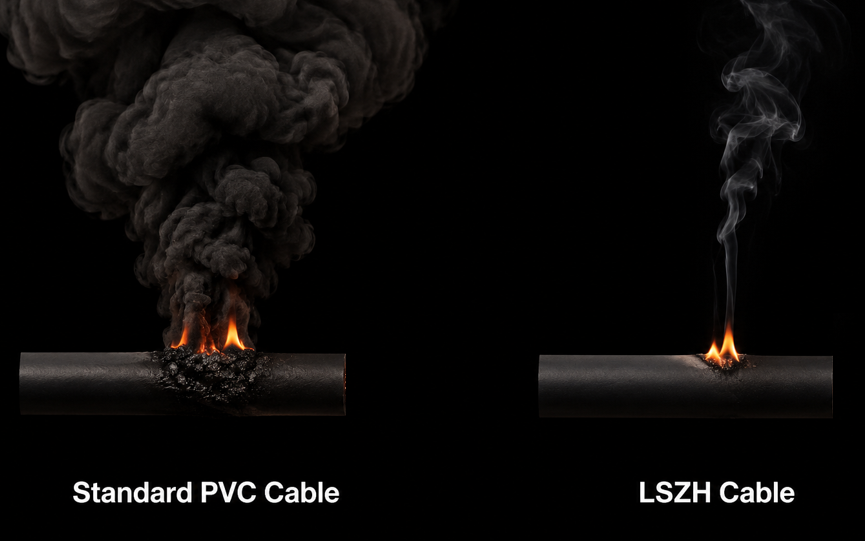
- It contains chlorine (a type of halogen), which releases large amounts of acrid black smoke and highly corrosive hydrogen chloride gas when burned. This not only blocks escape visibility but also damages respiratory tracts and electronic equipment.
- Traditional formulas often use heavy metal stabilizers (lead, cadmium) and harmful plasticizers, which may leach out over time and degrade indoor air quality.
The core feature of eco-friendly cable materials is that they solve these problems at the formula level: they eliminate or strictly restrict harmful halogens, heavy metals and toxic additives, produce low smoke and low toxicity when burned, and greatly reduce negative impacts on human health and the environment throughout their lifecycle.
1.3 3 Reasons Everyday Consumers Should Care
- Fire Safety Baseline: In enclosed indoor spaces, high-rise buildings and crowded areas, toxic smoke from burning cables is a leading cause of casualties in fires. Low-smoke eco-friendly materials can significantly extend safe escape time.
- Daily Health Protection: Odors and trace harmful substances released by low-quality cables can affect indoor air quality over the long term, and sensitive groups, children and pregnant women are more vulnerable.
- Environmental Responsibility: Cables are produced and discarded in enormous volumes. Eco-friendly materials effectively reduce the ecological footprint from production to disposal.
2. 6 Main Types of Eco-Friendly Cable Jacket Materials
Today, there are 6 widely used eco-friendly jacket materials in consumer and industrial applications, each with different positioning and strengths. The table below provides a straightforward comparison:
| Material Category | Key Advantages | Eco-Friendliness Level | Common Applications |
|---|---|---|---|
| Low Smoke Zero Halogen Polyolefin (LSZH/LSOH) | Low smoke when burned, no toxic gas, good flame retardancy | High (halogen-free, low smoke, low toxicity) | Home wiring, high-rise buildings, subways, malls, data centers |
| Cross-Linked Polyethylene (XLPE) | Excellent heat resistance, great insulation, long service life | High (halogen-free) | Power transmission cables, solar PV wiring, automotive harnesses |
| Thermoplastic Elastomers / Thermoplastic Polyurethane (TPE/TPU) | Flexible feel, abrasion-resistant, recyclable | High (halogen-free, no harmful plasticizers) | Phone charging cables, headphone cords, wearable device wires |
| Eco-Modified PVC | Lower cost, performance similar to standard PVC | Medium (still contains chlorine; heavy metals removed) | Budget consumer wiring, entry-level cables |
| Silicone Rubber | Wide temperature tolerance, odorless, excellent aging resistance | High (halogen-free, good biocompatibility) | Small appliance internal wiring, medical devices, high-temperature environments |
| Bio-Based Polymers | Renewable raw materials, extremely low carbon footprint | Very high (biomass feedstock, biodegradable/recyclable) | Consumer electronics wires, EV wiring harnesses (emerging category) |
Below is a plain-language breakdown of each:
2.1 Low Smoke Zero Halogen Polyolefin (LSZH/LSOH) — The Mainstream Safety Choice
This is currently the most popular eco-friendly cable material on the market. It is based on polyolefin plastics such as polyethylene and EVA, and achieves fire resistance by adding mineral flame retardants like aluminum hydroxide and magnesium hydroxide.
- Its most outstanding feature is that it produces almost no toxic corrosive gases and very little smoke when burned. During a fire, it maintains higher light transmittance, giving people more time to escape.
- Its formula contains no heavy metals such as lead or cadmium, complying with major global environmental regulations.
- It is the top choice for home renovation and public space wiring.
2.2 Cross-Linked Polyethylene (XLPE) — Durable High-Temperature Material
A special process creates a three-dimensional molecular network structure, greatly improving heat resistance and service life.
- Naturally halogen-free with excellent electrical insulation properties, it can withstand higher operating temperatures.
- Commonly used in service entrance power cables, solar photovoltaic circuits, and automotive internal wiring harnesses where durability is critical.
2.3 Thermoplastic Elastomers (TPE/TPU) — Flexible Material for Consumer Electronics
Many soft-touch charging cables and headphone wires use this type of material.
- It is flexible, abrasion-resistant and tear-resistant, and achieves good elasticity without harmful plasticizers.
- As a thermoplastic material, it can be melted and recycled, with lower pollution during manufacturing.
- It is the mainstream eco-friendly choice for consumer electronics cables.
2.4 Eco-Modified PVC — Low-Cost Transition Option
By replacing harmful plasticizers and heavy metal stabilizers in traditional PVC, its toxicity is reduced, but the base material still contains chlorine.
- It is cheaper than halogen-free materials and is a reduced-harm rather than a truly halogen-free eco-friendly material.
- It still releases toxic chlorine-containing gas when burned, and is only suitable for general scenarios with no mandatory halogen-free requirements.
2.5 Silicone Rubber — Specialized Material for High-Temperature Scenarios
A special material with a siloxane molecular backbone, it has an extremely wide temperature tolerance range.
- Non-toxic and odorless, with good biocompatibility and no halogens.
- It can operate long-term in temperatures from -60°C to 200°C, with excellent aging resistance.
- Mostly used inside small appliances like rice cookers and ovens, as well as medical equipment and high-temperature industrial settings.
2.6 Bio-Based Polymers — Next-Generation Low-Carbon Materials
Instead of relying on petroleum, raw materials come from renewable biomass such as castor oil, agricultural straw, and seashells.
- Their carbon footprint is 30%–60% lower than traditional petroleum-based materials, and some types are biodegradable.
- Commercial applications already exist: Sumitomo Electric in Japan has launched bio-based cables filled with seashell powder, with a long-term heat resistance of 125°C; BASF in Germany has developed castor-oil-based polyamide used in new energy vehicle wiring harnesses.
- They will gradually become more common in consumer scenarios in the future.
3. Global Environmental Standards and Certifications
Faced with all kinds of eco-friendly marketing claims, everyday consumers can judge authenticity by the following globally recognized standards and certifications:
3.1 Hazardous Substance Restriction Regulations
- EU RoHS 2.0 Directive: One of the most widespread environmental regulations in the world, it strictly limits the content of 6 hazardous substances in cables, including lead, cadmium, mercury, and hexavalent chromium.
- EU REACH Regulation: With a broader scope, it continuously updates the SVHC (Substances of Very High Concern) list to restrict the use of chemicals harmful to human health and the environment.
3.2 Combustion and Halogen-Free Performance Standards
- International IEC Standards: IEC 60754 (halogen acid gas content test), IEC 61034 (smoke density test), and IEC 60332 (flame retardancy test) are globally accepted technical benchmarks.
- US UL and NFPA Standards: UL 1581 cable safety specification, UL 94 flammability rating, and NFPA 262 smoke density test are the core benchmarks for the North American market.
3.3 Common Authoritative Certification Marks
- CE Marking: The market access mark for the European Union, indicating that a product meets EU environmental, safety and health directives.
- UL Certification: Certification from Underwriters Laboratories in the US, the most recognized proof of safety and environmental performance in the North American market.
- TÜV Certification: Third-party testing certification from Germany, providing comprehensive verification of a product’s environmental, mechanical and electrical performance.
When shopping, if a product clearly displays the above certifications and is labeled Low Smoke Zero Halogen / LSZH, you can generally confirm it is a compliant eco-friendly cable.
4. 3 Core Benefits of Eco-Friendly Cables
4.1 Life Safety Value in Fire Scenarios
Fire statistics show that over 80% of casualties in building fires are caused by toxic smoke, not open flames.
- When standard PVC burns, it releases hydrogen chloride gas equal to 15%–20% of its own weight. This gas turns into hydrochloric acid when it meets moisture, burning respiratory tracts and eyes. At the same time, thick black smoke can reduce visibility to just a few meters instantly.
- When low-smoke zero-halogen materials burn, smoke light transmittance can reach over 60%, and toxic gas release is less than 1/30 of standard PVC, greatly extending escape time.
- Additionally, with no corrosive gases, they do not cause secondary chemical damage to indoor appliances and building structures, reducing post-fire losses.
4.2 Health Value in Daily Use
- Eco-friendly formulas remove heavy metal stabilizers and harmful plasticizers, so no toxic substances leach out during daily use and no unpleasant plastic odors pollute indoor air.
- The health advantages are even more noticeable in sensitive settings such as food-contact areas, nurseries and medical environments.
4.3 Environmental Value Across the Full Lifecycle
- Production: Bio-based and other eco-friendly materials reduce reliance on fossil resources like petroleum and lower carbon emissions.
- Usage: Eco-friendly materials generally have better aging resistance and longer service life, reducing replacement frequency and waste generation.
- Disposal: Halogen-free materials produce no toxic fumes when incinerated, and thermoplastic materials can be recycled, lowering the environmental burden of landfills and incineration.
5. Practical Guide for Everyday Consumers to Choose Eco-Friendly Cables
You don’t need to memorize complex chemical formulas. Master these few points to choose the right product easily:
5.1 Check Labels for Key Terms
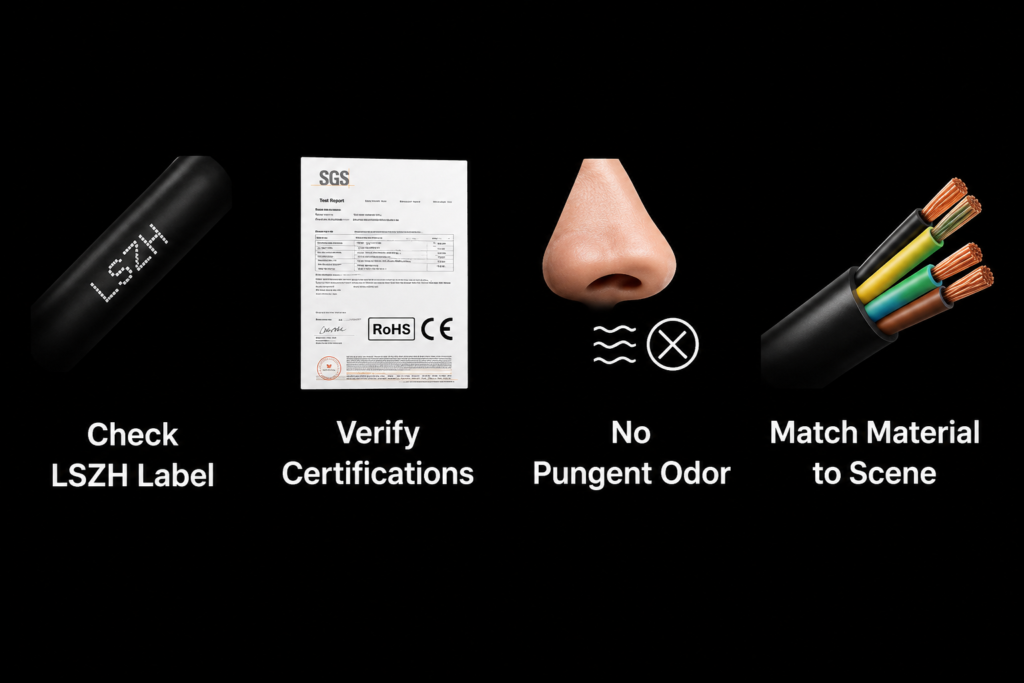
- Prioritize products with clear LSZH or Low Smoke Zero Halogen labeling on packaging or spec sheets.
- Look for authoritative certification marks such as RoHS, CE and UL — certifications are the basic guarantee of environmental performance.
5.2 Check Materials and Understand Grades
- Top tier (high eco-friendliness): LSZH polyolefin, TPE/TPU, XLPE, silicone rubber.
- Second tier (reduced harm): Eco-modified PVC. Note that it is not the same as halogen-free eco-friendly and is only suitable for non-critical scenarios with a limited budget.
5.3 Simple Identification Tips
- Smell test: If there is a strong, pungent plastic odor when you open the package, it is most likely low-quality PVC or non-compliant material. High-quality eco-friendly cables have almost no noticeable smell.
- Safety note: We do not recommend ordinary consumers do burn tests themselves, as they pose a safety risk. Rely on labels and certifications first.
5.4 Scenario-Based Buying Recommendations
- Home renovation wiring: Prioritize LSZH polyolefin cables, especially for enclosed spaces like bedrooms and living rooms.
- Phone and digital device charging cables: Prioritize TPE/TPU jackets for flexibility, durability and eco-friendliness.
- Kitchens, balconies and other high-temperature/sun-exposed areas: Prioritize silicone rubber or weather-resistant LSZH cables.
6. Common Misconceptions Clarified
Misconception 1: Flame-retardant cables are eco-friendly cables
Many sellers use flame retardant to confuse eco-friendly. In reality, flame retardancy is just a fire performance feature. Traditional PVC can also be made flame-retardant by adding additives, but it still contains halogens, releases toxic gas when burned, and is not an eco-friendly material. Simply put: most eco-friendly cables are flame-retardant, but not all flame-retardant cables are eco-friendly.
Misconception 2: Eco-friendly cables have worse flame retardancy
Some people believe halogen-free means not flame-retardant, which is completely wrong. LSZH materials achieve fire resistance through a mineral flame-retardant system, with an oxygen index of over 32% — better flame retardancy than standard PVC. They fully meet fire safety requirements for residential and most industrial scenarios.
Misconception 3: Eco-friendly cables are too expensive for home use
Early LSZH materials had high costs, but with technology advances, they now cost only 10%–30% more than standard PVC cables. For home renovation, cables make up a very small share of total renovation costs, so the overall price increase is minimal. The long-term safety and health benefits make it well worth the cost.
Misconception 4: Light-colored or transparent jackets mean eco-friendly materials
Jacket color has nothing to do with environmental performance. Traditional PVC can also be dyed white, transparent or other light colors with color masterbatch, and high-quality LSZH materials can also be black. The only way to judge eco-friendliness is by material labeling and certification — never by color.
7. Future Trends in Eco-Friendly Cable Materials
7.1 Growing Adoption of Bio-Based Materials
As technology matures, bio-based materials will gradually move from high-end industrial applications to consumer electronics, home wiring and other civilian scenarios. Raw materials will also expand to non-food sources such as agricultural waste and marine biomass, further reducing carbon footprints.
7.2 Advances in Circular Recycling Technology
The industry is developing closed-loop recycling technologies for cable materials, so discarded cable jackets can be regenerated and reused. The EU Circular Economy Action Plan is also pushing for higher recycled content in the cable industry. In the future, recyclable will become a standard feature of eco-friendly cables.
7.3 Low-Carbon and Carbon Neutrality as New Benchmarks
Full-lifecycle carbon footprint accounting will gradually become an industry standard. Leading global cable manufacturers have already launched carbon-neutral cable products, controlling emissions from raw material extraction to production, transportation and disposal.
7.4 Multifunctional Composite Materials
Future eco-friendly materials will combine multiple properties — environmental protection, oil resistance, abrasion resistance, weather resistance and more — so one material can adapt to more scenarios, lowering production and usage costs.
8. Frequently Asked Questions (FAQ)
Q1: Is LSZH cable mandatory for home renovation?
Most countries do not mandate it for residential buildings, but it is highly recommended for safety. This is especially true for high-rise apartments, enclosed floor plans, and households with elderly people or children. LSZH cables significantly improve fire escape safety at a very modest cost increase.
Q2: Do eco-friendly cables last longer than regular cables?
Most eco-friendly materials have better aging and temperature resistance than standard PVC. Under normal use, cables with LSZH, XLPE or silicone rubber jackets generally have a service life 30% longer than standard PVC cables.
Q3: Are bio-based cables less durable because they are biodegradable?
No. Most commercially available bio-based cable materials are bio-based sourced, not biodegradable. Their mechanical performance and aging resistance are comparable to petroleum-based materials. Only a few special types are biodegradable, and those are used for disposable or short-term applications. You don’t need to worry about durability for everyday home use.
Q4: How can I tell if a seller’s eco-friendly cable claim is real?
The most reliable method is to check three things: first, whether it clearly states Low Smoke Zero Halogen / LSZH material; second, whether it has authoritative certifications like RoHS, CE or UL; third, ask for corresponding test reports — genuine products can provide test data for key indicators like halogen acid content and smoke density.
Q5: Can discarded eco-friendly cables be recycled? How should I dispose of them?
Yes, they can. Thermoplastic eco-friendly cable jackets (such as TPE and polyolefin) can be melted and remolded for reuse. Do not throw discarded cables in regular trash. Place them in the appropriate recyclables bin, or hand them over to licensed waste recycling services. Never burn them privately, as this causes pollution.