
If you have ever shopped for electrical wire, Ethernet cable, or audio leads, you have probably seen terms like OFC, tinned copper, CCA, and silver-plated copper thrown around as premium features. In reality, there is no single “best” conductor material. Each type is engineered to make specific tradeoffs between cost, weight, conductivity, corrosion resistance, high-frequency performance, and long-term reliability.
This guide is built for tiered reading. Start with the 60-second summary for a quick decision framework, stay in the beginner sections for practical buying advice, and dive into the engineering section if you need detailed specification and selection guidance.
60-Second Quick Summary
- Five main conductor types: Bare copper, tinned copper, copper-clad aluminum (CCA), silver-plated copper (SPC), and oxygen-free copper (OFC). Each is optimized for different scenarios; none is universally “the best.”
- Priority rule of thumb: For mains-frequency power, choose by wire gauge first. For high-frequency signals, choose by surface plating first. For damp or outdoor environments, choose by corrosion protection first. For temporary or lightweight builds, CCA can be a valid option. Do not automatically pay a premium for “high purity” or “high-end materials” without matching them to your actual use case.
- Real-world bottom line: For most residential and general commercial applications, compliant bare copper or tinned copper is more than sufficient. Silver-plated copper and oxygen-free copper deliver measurable value almost exclusively in harsh industrial and specialized high-performance environments.
Part 1: Absolute Beginner Basics
1.1 The Five Common Conductor Types At a Glance
| Conductor Type | Biggest Advantage | Biggest Limitation | Recommended For |
|---|---|---|---|
| Bare Copper (ETP) | Best all-around balance of performance and cost | Surface oxidizes over time; average long-term contact stability | Residential wiring, general power distribution, internal equipment wiring |
| Tinned Copper | Best cost-to-corrosion-protection ratio; reliable termination | Slightly worse high-frequency performance than bare copper | Outdoor, underground, marine, and humid environment wiring |
| Copper-Clad Aluminum (CCA) | Very light weight and significantly lower material cost | Higher DC resistance; poor performance at high continuous current | Lightweight devices, some coaxial RF use, consumer electronics, code-permitted temporary wiring |
| Silver-Plated Copper (SPC) | Lowest high-frequency loss; excellent high-temperature compatibility; stable contact resistance | Highest material cost; tarnishes in sulfur-containing environments | RF communications, aerospace, high-temperature industrial, precision test equipment |
| Oxygen-Free Copper (OFC) | Superior hydrogen embrittlement resistance; highest long-term reliability in harsh environments | Minimal benefit in civilian applications; significantly more expensive than standard copper | Vacuum / hydrogen processes, precision industry, long-life critical infrastructure |
1.2 Why Are There So Many Different Conductor Materials?
Copper is the dominant conductor material in the cable industry, but plain copper has weaknesses: it tarnishes, it is heavy, it is relatively expensive, and its high-frequency performance can be improved.
The industry has developed multiple variants by adding surface platings, using bimetallic composite structures, and applying special refining processes. Each variant trades performance in one area for improvement in another — cost, weight, temperature rating, high-frequency loss, or corrosion resistance.
The core rule for good conductor selection is simple: match the material to the actual requirements of the application. Avoid both underspecification and unnecessary performance overkill.
1.3 Quick Profile of Each Conductor
Bare Copper (ETP / Electrolytic Tough Pitch)
- What it is: Standard electrolytic tough-pitch copper, the industry baseline conductor.
- Key traits: Balanced conductivity, moderate cost, no additional protective plating.
- Position: The default choice for the vast majority of general-purpose applications.
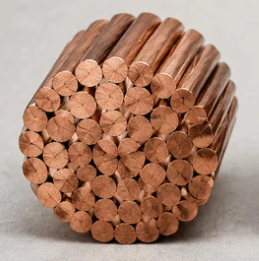
Tinned Copper
- What it is: A copper core with a uniform thin coating of tin added to the surface for protection.
- Key traits: Oxidation and moisture resistant, easy to solder and crimp, slightly more expensive than bare copper.
- Position: The go-to protected conductor for damp, outdoor, and underground environments.
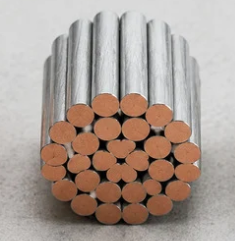
Copper-Clad Aluminum (CCA)
- What it is: A bimetallic conductor with an aluminum core and a metallurgically bonded outer copper layer.
- Key traits: Much lighter and cheaper than pure copper, but notably lower DC conductivity.
- Position: A lightweight, economical alternative to solid copper — appropriate only in specific use cases.
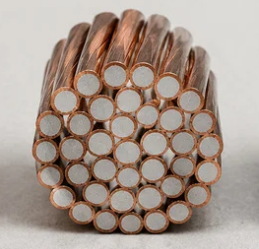
Silver-Plated Copper (SPC)
- What it is: A copper core with an electrochemically deposited silver surface layer, optimized for high-frequency and high-reliability performance.
- Key traits: Low high-frequency loss, excellent high-temperature compatibility, very stable contact resistance, significantly higher cost.
- Position: A premium functional conductor for RF, high-temperature, and high-reliability connection scenarios.
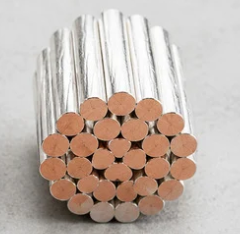
Oxygen-Free Copper (OFC)
- What it is: High-purity copper melted and cast under vacuum or inert atmosphere to minimize oxygen and internal oxide inclusions.
- Key traits: Excellent resistance to hydrogen embrittlement, higher long-term reliability under harsh conditions, higher cost than standard ETP copper.
- Position: A high-reliability industrial material for high-temperature vacuum, precision manufacturing, and long-life infrastructure.
Part 2: Head-to-Head Performance Comparison (Intermediate Level)
2.1 Electrical Performance (20°C, standard laboratory conditions)
DC Conductivity
- Baseline: Bare ETP copper is defined as the 100% IACS (International Annealed Copper Standard) reference.
- Top tier — effectively identical: Silver-plated copper and oxygen-free copper. High-quality grades differ from bare copper by roughly 1% or less; the difference is not perceptible in ordinary use.
- Second tier — slightly lower: Tinned copper. The tin layer adds a small amount of lower-conductivity material, but the difference is negligible for most practical applications.
- Third tier — notably lower: Copper-clad aluminum. Typical grades range from approximately 63% to 65% IACS, per ASTM B566. DC current-carrying ability is meaningfully lower than solid copper at the same cross-section.
Important note: For mains-frequency high-current applications, stepping up one AWG gauge size delivers a far larger reduction in resistance than upgrading conductor material.
High-Frequency Performance (MHz range and above)
At high frequencies, the skin effect causes an increasing proportion of the current to flow near the conductor surface. For this reason, the surface material has a much larger effect on performance than the bulk core material.
- Silver-plated copper: Typically delivers the lowest high-frequency loss. Silver has higher conductivity than copper, and the advantage grows as frequency increases and skin depth decreases.
- Bare copper / oxygen-free copper: Benchmark level. OFC can offer slightly better manufacturing consistency, but the improvement is much smaller than what is gained by changing surface plating.
- Copper-clad aluminum: When the copper cladding is thicker than the effective skin depth at the operating frequency, high-frequency current flows mostly in the outer copper layer. For this reason, CCA can approach solid copper performance in some RF and CATV coaxial applications. At mains power frequencies, however, the skin effect is negligible, current distributes across the full cross-section, and CCA performs much worse than solid copper. It should never be treated as a direct equal-cross-section replacement for solid copper in building wiring.
- Tinned copper: Performs worse than bare copper at high frequencies. It is generally not chosen for loss-critical RF applications.
Long-Term Contact Stability
- Silver-plated copper: Best in class. Maintains low and very stable contact resistance over time.
- Tinned copper: Very good. The tin layer isolates the copper from oxidation and supports reliable crimped and soldered terminations.
- Oxygen-free copper: Under identical termination practices and long-term harsh exposure, it typically offers slightly better stability than standard ETP copper, due to fewer internal oxide inclusions.
- Bare copper: Moderate. Surface oxidation causes contact resistance to drift upward over time.
- Copper-clad aluminum: Similar to bare copper when the copper layer is intact. If the cladding is damaged, aluminum oxidation causes rapid performance degradation.
2.2 Mechanical, Environmental & Processing Properties
Density & Weight
- Solid copper family (bare, tinned, silver-plated, oxygen-free): All have very similar density, approximately 8.89 g/cm³.
- Copper-clad aluminum: Density is roughly 3.3 to 3.6 g/cm³, or about 40–45% the weight of solid copper for the same volume. The exact ratio depends on copper cladding thickness and product specification. The weight savings are very large and are one of CCA’s primary advantages.
Strength & Flexibility
- Solid copper family: In the soft annealed state, excellent ductility, elongation, and flexibility.
- Copper-clad aluminum: Mechanical properties fall between pure aluminum and pure copper. Flexibility is generally lower than the solid copper family.
Flex Fatigue Life
Flex life is primarily determined by filament diameter, stranding geometry, and temper condition, not by plating or alloy variant alone.
- Multi-strand solid copper conductors generally offer excellent flex life. Tin plating can help reduce surface oxidation during repeated bending.
- CCA has higher risk of degradation with repeated flexing, including copper cladding cracking or aluminum core fracture.
Temperature Compatibility
Important principle: The maximum operating temperature of a cable is almost always determined by the insulation system, not by the conductor itself.
- Approximate melting points: silver ~961°C, copper ~1083°C, tin ~232°C, aluminum ~660°C. All are well above the temperature limits of common cable insulations.
- High-temperature suitability: Silver-plated copper and oxygen-free copper are the standard choices paired with PTFE, FEP, and similar high-temperature insulation systems for 150–200°C rated cables. CCA degrades faster at elevated temperatures and is not suitable for high-temperature reliability applications.
Oxidation & Corrosion Resistance
- Tinned copper: The tin layer and its surface passivation film provide a physical barrier. It offers the best balance of corrosion protection and cost.
- Silver-plated copper: Very good oxidation resistance in clean dry air. It darkens in sulfur-containing environments, but the effect on electrical performance is usually minor.
- Oxygen-free copper: Fewer internal oxide inclusions give it better long-term bulk stability in harsh environments than standard bare copper. Surface tarnish rate, however, is not dramatically different.
- Bare copper: Prone to oxidation and tarnish; forms copper patina in humid environments.
- Copper-clad aluminum: Similar to bare copper when the cladding is intact. If damaged, aluminum corrodes much faster than copper.
Hydrogen Embrittlement Resistance
At high temperatures in hydrogen-containing atmospheres, oxygen trapped inside copper reacts with hydrogen to form water vapor. The vapor expands, creating internal micro-cracks and making the conductor brittle. This is called hydrogen embrittlement.
- OFC and silver-plated OFC: Extremely low oxygen content gives them excellent resistance to hydrogen embrittlement.
- Standard bare copper, tinned copper, and CCA: Subject to hydrogen embrittlement at high temperatures. Not recommended for hydrogen-process environments.
Solderability & Termination
- Solderability ranking: Silver-plated copper and tinned copper are the easiest to solder cleanly. Bare copper is next. CCA requires careful temperature control to avoid overheating and melting the aluminum core.
- Crimping rules: Solid copper conductors work with standard copper terminals. CCA requires dedicated bimetallic copper-aluminum terminals and must never be direct-twisted with plain copper conductors.
Part 3: Engineering Deep Dive: Selection, Use Cases & Pitfalls
If you are a general consumer shopping for cables, you can skip this section and go directly to the FAQ. The material below is intended for engineers, specifiers, and industrial buyers.
3.1 Application Matchmaking By Scenario
Power Distribution & Building Wiring
- Primary choice: Bare copper or tinned copper, selected to NEC/UL requirements.
- Note on CCA: CCA may be used in certain lightweight, non-building fixed-wiring or specific signal applications when designed in accordance with applicable standards. It should not be used as a like-for-like cross-section replacement for solid copper in building power circuits.
- Not recommended: Silver-plated copper and high-purity oxygen-free copper. They represent severe performance overkill for this use case.
Communications & RF
- High-end precision: Silver-plated copper for coaxial inner conductors and test cables.
- Economical high-frequency: Copper-clad aluminum for CATV coaxial and general RF drop cables.
- Precision instrumentation: Oxygen-free copper for laboratory calibration standards and high-end equipment internal wiring.
- Avoid: Tinned copper in loss-critical high-frequency paths.
Grounding & Shielding Systems
- General grounding: Bare or tinned copper stranded conductor.
- Underground / damp grounding: Tinned copper stranded conductor.
- High-frequency shielding: Silver-plated copper braid (premium) or CCA braid (economy).
High-Temperature & Specialized Industrial
- Primary choices: Silver-plated copper for furnace and aerospace applications; oxygen-free copper for vacuum and hydrogen-process environments.
- General industrial: Tinned copper.
- Do not use: CCA. It degrades rapidly at high temperature and offers insufficient reliability.
Consumer Electronics & Appliances
- General internal wiring: Bare copper or tinned copper.
- High-end RF accessories: Silver-plated copper. Some professional equipment internal conductors use oxygen-free copper for manufacturing consistency and long-term reliability.
- Low-cost short signal cables: CCA for basic speaker wire and video cables, where power and distance limits are modest.
Military & Aerospace
- Standard selections: Silver-plated oxygen-free copper and oxygen-free copper, commonly specified under standards such as MIL-W-16878.
3.2 Core Selection Principles
- For mains-frequency high-current: Select by AWG gauge first. Purity upgrades deliver minimal return.
- For high-frequency signals: Prioritize surface plating (silver) over purity upgrades. The performance gain is much larger.
- For damp / outdoor / underground: Choose tinned copper first. It offers the most cost-effective corrosion protection.
- For temporary wiring / lightweight needs: CCA can be appropriate, provided you upsize the cross-section to meet ampacity requirements.
- For high-temperature / vacuum / hydrogen environments: OFC or silver-plated OFC is a hard requirement, not a luxury.
3.3 Common Marketing Traps to Avoid
- “OFC home wiring saves electricity”: Marketing hype. The conductivity difference is well under 1% at mains frequencies and is undetectable in normal household use.
- “Monocrystalline / OFC audio cables transform sound quality”: Largely price-premium marketing. In typical mid-range consumer systems, controlled blind tests generally do not find statistically significant audible differences.
- CCA sold as solid copper: Non-compliant and potentially unsafe. It can be identified quickly by weight, resistance, and scratch testing.
- Unverified ultra-high purity claims: “6N / 8N copper” claims without third-party certification lack standardized official definitions and should be treated with caution.
3.4 Quick Identification Methods
- Weight test: For the same gauge and length, CCA weighs roughly 40–45% as much as solid copper. The difference is obvious when compared side by side.
- Resistance test: If DC resistance at a given AWG is significantly higher than the standard value, the product is likely CCA or low-quality copper.
- Scratch test: Lightly scrape the conductor surface with a sharp blade. CCA will reveal a silvery aluminum core underneath.
Side-by-Side Star Comparison
| Property | Bare Copper | Tinned Copper | CCA | Silver-Plated Copper | Oxygen-Free Copper |
|---|---|---|---|---|---|
| DC conductivity | ★★★★★ | ★★★★☆ | ★★★☆☆ | ★★★★★ | ★★★★★ |
| High-frequency performance | ★★★☆☆ | ★★☆☆☆ | ★★★☆☆ | ★★★★★ | ★★★☆☆ |
| Corrosion / moisture resistance | ★★☆☆☆ | ★★★★★ | ★★☆☆☆ | ★★★☆☆ | ★★☆☆☆ |
| Long-term contact stability | ★★☆☆☆ | ★★★★☆ | ★★☆☆☆ | ★★★★★ | ★★★☆☆ |
| High-temperature compatibility | ★★★☆☆ | ★★★☆☆ | ★★☆☆☆ | ★★★★★ | ★★★★☆ |
| Hydrogen embrittlement resistance | ★★☆☆☆ | ★★☆☆☆ | ★☆☆☆☆ | ★★★☆☆ | ★★★★★ |
| Cost (lower = better) | ★★★★☆ | ★★★☆☆ | ★★★★★ | ★★☆☆☆ | ★★☆☆☆ |
| Weight (lower = better) | ★★☆☆☆ | ★★☆☆☆ | ★★★★★ | ★★☆☆☆ | ★★☆☆☆ |
FAQ
Which conductor is best for home electrical wiring?
Bare copper or tinned copper that meets NEC and UL standards is fully sufficient. Oxygen-free copper and silver-plated copper provide no perceptible performance benefit in residential wiring and represent performance overkill. There is usually no reason to pay the premium.
Can copper-clad aluminum completely replace solid copper wire?
No. It offers good value in high-frequency signal, temporary wiring, and lightweight applications. It should not be used as an equal-cross-section direct replacement for solid copper in DC high-current, permanent concealed wiring, or high-reliability installations, as this can lead to overheating, excessive voltage drop, and reliability risks.
Is silver-plated copper better than ordinary copper for everything?
No. Its advantages are concentrated in high-frequency, high-temperature, and high-reliability connection scenarios. For mains power and ordinary household use, there is no meaningful performance benefit, and the cost is several times higher.
What is the real difference between oxygen-free copper and regular copper?
The most important difference is resistance to hydrogen embrittlement, which is essential for industrial high-temperature hydrogen and vacuum processes. In civilian applications, the improvements in conductivity and surface oxidation are very small, and the term is often used more as a marketing concept than as a meaningful performance upgrade.
Why do cheap Ethernet and speaker cables use so much CCA?
Because these products prioritize cost and weight reduction, and over short distances at low power levels, CCA can meet basic performance requirements. However, when used for high-power PoE or long-distance high-current transmission, it can cause overheating and excessive voltage drop. For twisted-pair Ethernet, many industry standards and certification programs do not accept CCA as a replacement for solid copper conductors; always verify against the applicable standard.
For damp environments, should I choose OFC or tinned copper?
Choose tinned copper first. Its physical barrier corrosion protection is more direct and effective, and it costs less than OFC. It is the best value choice for damp, outdoor, and underground installations.
What industry standards apply to these conductor materials?
- General conductor standards: ASTM B8 (concentric-lay-stranded copper conductors), IEC 60228 (conductors for insulated cables).
- Material-specific standards: Bare copper — ASTM B3, ASTM B49; Tinned copper — ASTM B33; CCA — ASTM B566; Silver-plated copper — ASTM B298; Oxygen-free copper — ASTM B170, ASTM B224.
- Product & safety standards: UL 758, UL 44, NEC (NFPA 70), MIL-W-16878.
Final Summary
- There is no universally best cable conductor. Bare copper, tinned copper, CCA, silver-plated copper, and oxygen-free copper each make different tradeoffs between cost, weight, performance, and reliability.
- For most general-purpose and residential applications, compliant bare copper or tinned copper delivers all the performance you need. Premium materials are rarely justified.
- For high-frequency applications, surface plating matters much more than bulk copper purity. Silver-plated copper delivers the lowest loss, while CCA can be a cost-effective choice at moderate performance levels.
- For corrosion resistance and damp environments, tinned copper offers the best balance of protection and cost. It is almost always a better practical choice than upgrading to oxygen-free copper.
- Oxygen-free copper solves a specific and genuine engineering problem — hydrogen embrittlement at high temperatures. It is indispensable in vacuum, hydrogen-process, and extreme-reliability industrial environments. In everyday consumer use, however, it is predominantly a marketing label.
- The best selection strategy is to match the conductor to the actual application requirements — neither under-specifying for safety and reliability nor paying extra for performance you will never use.