
Introduction
Today, the Type-C port has become standard on nearly all digital devices, and the USB PD fast charging protocol is the “universal language” of the entire USB charging ecosystem. It eliminates the problem of chargers from different brands being incompatible, allowing one charger to power phones, tablets, laptops and more.
In the PD 2.0 era, fast charging worked with fixed voltage levels. But for smartphone charging, this approach gradually showed drawbacks: lower efficiency and noticeable phone overheating. That’s why the USB standards body added PPS as a core upgrade in PD 3.0 — an optional feature built to improve fast charging for phones and portable devices.
1. Basic Definitions and Technical Roles
1.1 Standard USB PD and Fixed PDO
Standard USB PD is a universal fast charging standard set by the USB official organization. Its core power logic is based on fixed power levels, called Fixed PDO.
Simply put, chargers come with preset combinations of voltage and current from the factory — like the common 5V, 9V, 12V and 20V options. When charging, your device picks the closest matching level. It works much like a home air conditioner: you can only switch between preset temperature settings, with no fine-tuning in between.
1.2 PPS Features and Its Place in the PD 3.0 Specification
Short for Programmable Power Supply, PPS is not a separate fast charging protocol. It is an optional enhanced feature built right into the USB PD 3.0 specification — essentially the “advanced mode” of standard PD.
It removes the limits of fixed power levels. The charger can dynamically adjust its output voltage and current based on the device’s real-time power needs. Optimized for smartphones, which demand high efficiency and good heat control, PPS is an upgrade to standard PD specifically for phone fast charging.
2. Voltage and Current Regulation Compared
2.1 Regulation Precision: Fixed Steps vs. 20mV / 50mA Fine Tuning
With standard USB PD, voltage can only jump between a few fixed levels with no values in between, so adjustments are fairly coarse.
PPS supports much finer control: voltage can be adjusted in steps as small as 0.02V, and current in steps as small as 0.05A. Think of it as upgrading from “preset speed levels” to “stepless adjustment” — it matches the device’s current power needs much more accurately.
2.2 Output Range: Discrete Fixed Levels vs. 3.3V–21V Continuous Adjustment
Standard USB PD outputs power at discrete fixed levels — mainly 5V, 9V, 12V, 15V and 20V. It cannot output any voltage outside these presets.
PPS supports continuous adjustment across a range from 3.3V to 21V. Within this range, the charger can output any voltage value to match the battery’s needs at different charge levels.
2.3 Difference Between PDO and APDO
PDO, or Power Data Object, is the “power menu” for standard USB PD. The charger uses it to show the device all its available fixed power levels. Both sides pick a preset option and stick with it throughout charging.
APDO, short for Augmented Power Data Object, is exclusive to PPS. It not only tells the device the adjustable voltage and current range, but also lets the device send adjustment requests to the charger at any time. Charging parameters can be changed on the fly, like customizing your order at any time during a meal.
For a quick side-by-side overview, the table below summarizes the core differences between the two technologies:
| Category | Standard USB PD | PPS |
|---|---|---|
| Core Working Mechanism | Fixed power levels based on Fixed PDO | Programmable dynamic output based on APDO |
| Voltage Output | Discrete fixed levels: 5V, 9V, 12V, 15V, 20V | Continuous adjustable: 3.3V – 21V |
| Adjustment Precision | Coarse stepping between fixed levels | 20mV voltage / 50mA current fine tuning |
| Charging Efficiency | Lower, with extra internal step-down loss | Higher, with less internal conversion loss |
| Main Heat Source | Concentrated inside the phone body | Mainly shifted to the charger |
| Device Compatibility | All Type-C devices (phones, laptops, peripherals) | Primarily flagship Android smartphones |
| Ideal Power Range | 65W+ high-power scenarios (laptops, tablets) | 18W–45W smartphone fast charging |
| Activation Requirement | Works with any PD-compatible device | Requires support from both charger and device |
3. Charging Architecture and Efficiency Differences
3.1 Standard PD Charging: Loss and Heat From Internal Buck Conversion
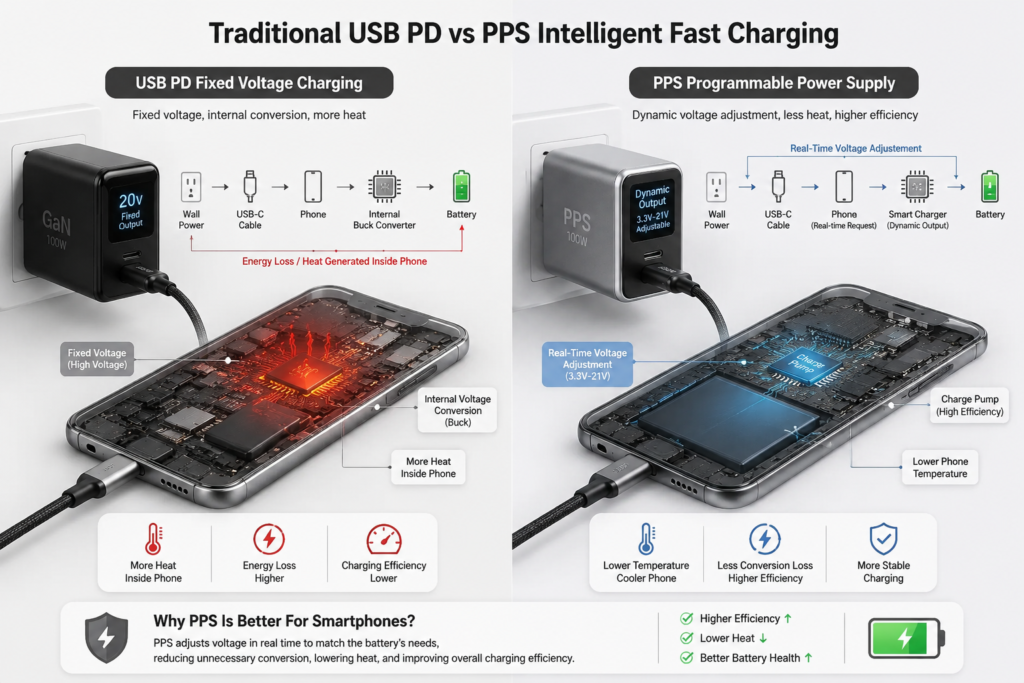
When charging a phone with standard USB PD, the fixed voltage from the charger is usually much higher than the phone’s actual battery voltage. The phone’s internal circuit has to step the voltage down to a level safe for the battery.
This secondary step-down process wastes some energy, and all the heat generated stays inside the phone. That’s why you can clearly feel the phone get warm during high-power charging.
3.2 PPS Charging: Dynamic Charger Regulation + Charge Pump for Efficient Direct Charging
In PPS mode, the phone can tell the charger exactly what voltage it needs at that moment, and the charger delivers it. Combined with charge pump technology inside the phone, this greatly reduces how much voltage step-down has to happen inside the device.
Essentially, the voltage conversion work that used to happen inside the phone is moved to the charger instead. This cuts down energy loss inside the phone and makes charging more efficient overall.
3.3 Heat Distribution: Shifting Heat From the Phone to the Charger
With standard PD charging, most heat comes from the phone’s internal power conversion circuit, so heat builds up in the phone body and is easy to feel when you hold it.
With PPS charging, most of the heat from power conversion moves to the charger. The phone body stays much cooler, so it stays comfortable to hold even while charging.
4. Compatibility and Real-World Power Output
4.1 Wide Device Compatibility of Standard PD (Laptops, Tablets, Phones, Peripherals)
Standard USB PD works with the broadest range of devices. Everything from wireless earbuds and smartwatches to phones, tablets and laptops supports standard PD as long as it has a Type-C port. It is the foundation for cross-brand, multi-device charging.
4.2 PPS Requires Support on Both Charger and Device
PPS cannot work on its own. Both the charger and the device being charged must support PPS to activate PPS fast charging mode.
If only the charger supports PPS but your phone does not, charging will automatically fall back to regular standard USB PD mode, and you won’t get any of PPS’s benefits.
4.3 Typical Power Range Fit: 18W–45W Phone Charging vs. 65W+ Fixed-Level Needs
PPS shines brightest in the 18W to 45W range for smartphone fast charging, where its fine voltage control makes the biggest difference.
For higher-power scenarios above 65W — like powering a laptop — standard PD with fixed voltage levels is still the main solution, offering better stability and broader compatibility.
5. Charging Experience and Safety Features
5.1 Charging Speed and Sustained Power (No Slowdown During Screen-On Use)
With standard PD charging, phones often trigger thermal protection early because of internal heat buildup, which cuts charging power ahead of time. High-power charging doesn’t last very long.
Because PPS keeps the phone cooler, it can maintain high-power charging for longer. Even when you’re using the phone with the screen on — browsing or gaming — the charging speed doesn’t drop noticeably, for more consistent performance from start to finish.
5.2 Control Split Between Constant-Current and Constant-Voltage Stages
In standard PD mode, once a fixed voltage level is agreed on at the start of charging, all subsequent current adjustment is handled by the phone’s own power management chip. The charger just keeps outputting a steady fixed voltage.
In PPS mode, the phone can actively ask the charger to adjust voltage and current based on the battery’s real-time status. This matches the three-stage lithium-ion charging pattern (constant current, constant voltage, trickle charge) more precisely for a more optimized charging process.
5.3 Differences in Over-Voltage, Over-Current and Ripple Protection
Both standard PD and PPS include full over-voltage and over-current protection, so they won’t damage your devices.
Standard PD sets protection limits based on fixed voltage levels, with simple and reliable logic. Because PPS uses dynamic regulation, it adds finer control over voltage fluctuations and real-time parameter checks to keep charging safe even while making continuous adjustments.
6. Real-World Examples
6.1 Samsung 25W / 45W AFC and Its Link to PPS
Samsung’s 25W and 45W AFC fast charging is built on PPS specifications. Only chargers that support the correct PPS profiles will trigger full-speed charging on Samsung phones. Regular standard PD chargers will only deliver basic fast charging speeds.
6.2 High-Power Proprietary Extensions From Brands Like Xiaomi
Many high-power fast charging solutions from domestic Android brands such as Xiaomi are built as custom extensions on top of standard PPS. They work with regular PPS chargers, and also deliver even higher power when paired with the brand’s own official charger.
6.3 Laptops and High-Voltage Devices Still Rely on Fixed PD Levels
Devices that need steady high-power delivery for long periods, like laptops, still mainly use standard USB PD with fixed levels. Fixed voltages like 20V reliably meet laptops’ power needs, with strong universality and dependability.
7. Summary and Outlook
7.1 PPS and Standard PD Are Complementary, Not Competitive
PPS and standard USB PD are not rivals that replace one another — they work together. Standard PD is the foundation of the USB fast charging ecosystem, ensuring universal compatibility across all devices. PPS is an enhanced add-on for smartphone charging, built to boost efficiency and thermal performance.
7.2 PD 3.1 (EPR) Expands Fixed Levels, and PPS Will Coexist Alongside It
With the launch of the USB PD 3.1 EPR specification, standard PD’s maximum power has increased to 240W. Its fixed-level high-power capability is growing stronger, and it will continue to power laptops and other high-power devices.
Meanwhile, PPS will keep growing in smartphone fast charging. The two technologies will coexist long-term, each serving different device needs.
7.3 Practical Buying Advice for Consumers
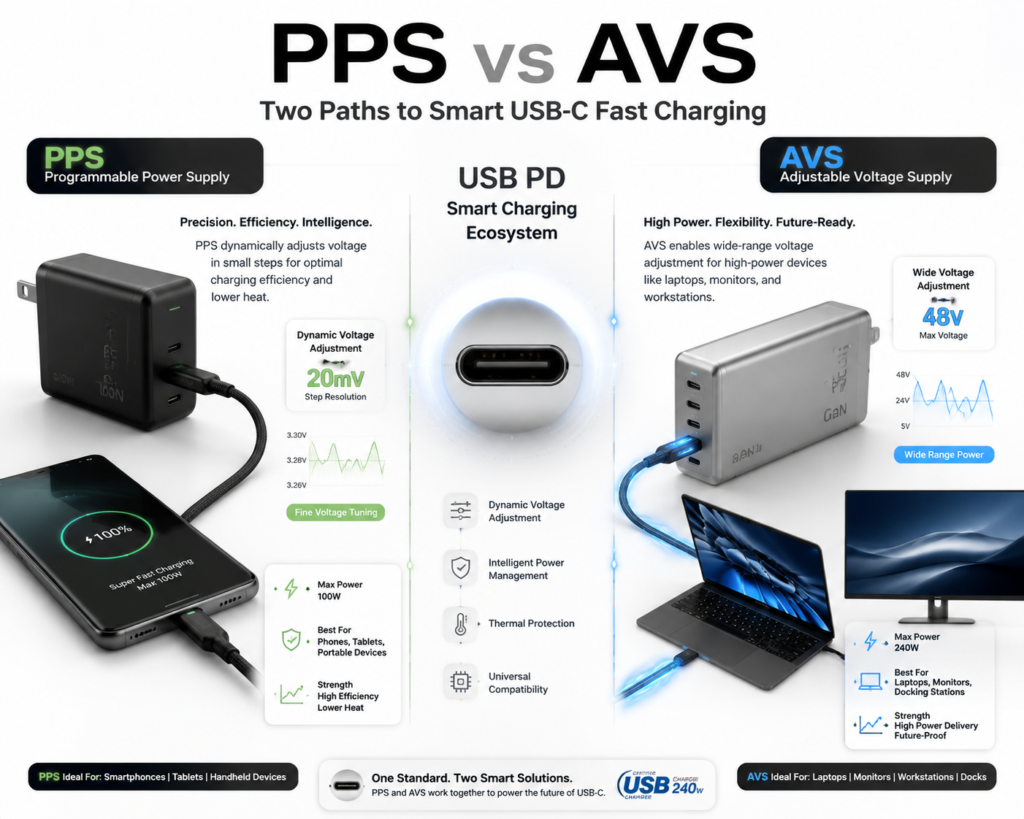
If you mainly charge laptops and tablets, or need a charger that works with many different brands of devices, a standard USB PD charger is all you need — it offers the most reliable broad compatibility.
If you mainly charge a flagship Android phone that supports PPS, and you care about phone heat and charging speed while using the device, choose a charger with PPS support for a better fast charging experience.