
1. Introduction: Why Do We Need Fast Charging?
Nearly everyone has been there: you’re about to head out in the morning and notice your phone is at 10% battery, so you plug it in for just 10 minutes before you have to leave. Between work breaks, coffee runs, and short stops at home, most of us rely on fragmented charging sessions rather than long, uninterrupted charges. This growing need for quick top-ups is exactly why fast charging technology has become such an important feature in smartphones.
Most people know that higher wattage means faster charging, but few understand the basic formula behind it: Power (P) = Voltage (U) × Current (I). Simply put, to increase charging power, you can either raise the voltage or increase the current. This has given rise to two main fast charging approaches in smartphones: high-voltage low-current charging, and low-voltage high-current charging. What’s the real difference between these two technologies? How do they feel in daily use? We’ll break it all down in simple terms anyone can understand.
2. Fast Charging Basics – How Does Phone Charging Work?
Before we dive into the two technologies, let’s cover the basics of how smartphone charging works – no technical background required.
First, the battery charging process. Modern smartphones use lithium-ion batteries, and charging one is a lot like filling a water tank. When the tank is empty, you can open the tap wide to fill it up quickly – this is the constant current phase, the fastest part of charging. Once the tank is mostly full, you turn the tap down to fill it slowly without overflowing – this is the constant voltage phase, where charging speed gradually slows down. The common claim of “80% charge in 30 minutes” almost always refers to the fast constant current phase.
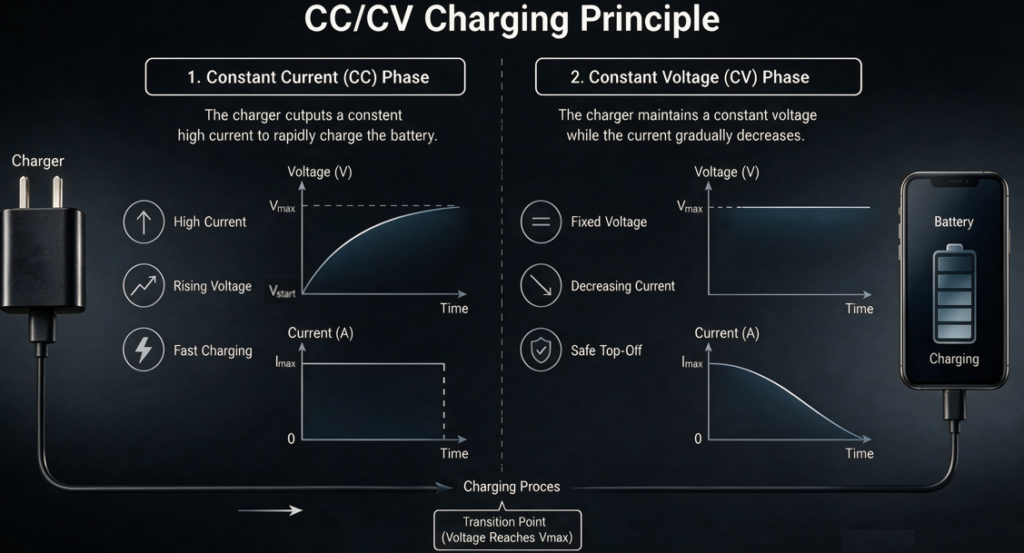
Now let’s look at the full charging path. Electricity travels from the wall outlet, through the charger, the charging cable, the charging chip inside your phone, and finally into the battery. Think of it like water flowing from a water plant, through a pump, pipes, a pressure regulator in your home, and finally into your water tank. Every part of this chain affects charging speed and heat. To boost power, you either increase the “water pressure” (voltage) or widen the “pipe” to let more water flow (current).
3. High-Voltage Fast Charging – The Classic Voltage-for-Power Approach
3.1 How It Works
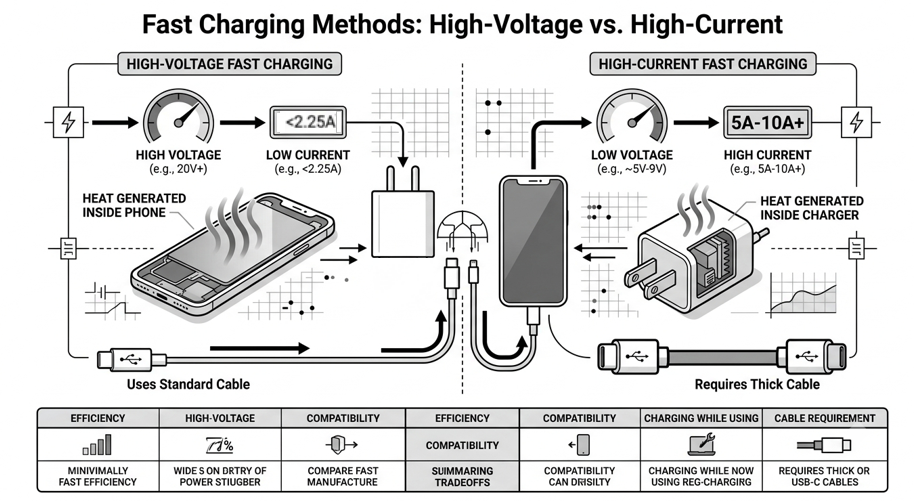
High-voltage fast charging is the earliest and most classic fast charging technology. Its core idea is simple: keep the current steady, and raise the output voltage of the charger to achieve higher power.
Using our water pipe analogy: with the same pipe size, you can deliver more water by increasing the water pressure – faster flow means more water per minute.
However, smartphone batteries can only handle very low voltage, usually around 4V. High-voltage chargers often output 9V, 12V or even higher. Before this electricity can charge the battery, the charging chip inside the phone has to step the voltage down. This step-down process is the source of all the pros and cons of high-voltage charging.
3.2 Advantages
First, it works with standard cables. Because the current is low, regular charging cables can handle it with no problem. You don’t need a special thick cable, and almost any borrowed cable will work when you’re out and about.
Second, chargers are low-cost and widely compatible. High-voltage charging technology has been around for years and is very mature. Chargers are affordable, and most use universal protocols that work across different phone brands.
Third, less power loss over long cables. Higher voltage means lower current, so less electricity is lost as heat during transmission through the cable. Even with a longer charging cable, you won’t see a big drop in charging speed.
3.3 Disadvantages
First, the phone itself gets very hot. The voltage step-down process generates a lot of heat, just like a pressure regulator gets warm when reducing water pressure. All this heat builds up inside the phone, so you’ll often feel the back of the phone get warm during high-voltage charging.
Second, charging slows down a lot when the screen is on. Phones have built-in temperature protection. When the phone gets too hot, it automatically lowers charging power to cool down. If you use your phone while charging, the processor also generates heat. Combined with charging heat, the temperature rises quickly, and charging speed drops drastically – sometimes no faster than regular slow charging.
Third, lower conversion efficiency. During the high-to-low voltage conversion, some electricity is wasted as heat. Overall energy efficiency is usually around 80% to 85%.
3.4 Common Examples
Well-known high-voltage charging solutions include Qualcomm Quick Charge (QC 2.0/3.0), early USB-PD standards, and MediaTek Pump Express. The 18W and 24W chargers common on Android phones a few years ago mostly used this approach.
4. High-Current Fast Charging – The Experience-Focused Current-for-Speed Approach
4.1 How It Works
High-current fast charging takes the opposite approach: it keeps the output voltage low, close to the battery’s own voltage, and increases the current significantly to boost power.
Again with the water pipe analogy: keep the water pressure the same, but use a wider pipe. More water flows through, so you get more water per minute.
Because the charger output voltage is very close to what the battery can handle, the electricity doesn’t need a big voltage step-down inside the phone – in some cases it can charge the battery directly. By cutting out the internal step-down process, heat inside the phone is greatly reduced at the source.
4.2 Advantages
First, very little heat inside the phone. Most of the voltage regulation work happens in the charger instead of the phone. Since the phone doesn’t have to handle high voltage, heat stays mostly in the charger. The phone itself only feels slightly warm, which is much more comfortable.
Second, stable charging speed even when the screen is on. Because the phone generates so little heat, temperature protection rarely kicks in – even if you stream videos or play games while charging. The charging speed barely drops, making for a much better experience than high-voltage charging.
Third, higher charging efficiency. Without the energy loss from a big voltage step-down, energy efficiency reaches over 90%, meaning more of the electricity actually goes into charging the battery.
4.3 Disadvantages
First, cables are more expensive. High current requires thicker copper wires and extra contact points in the cable. Regular cables can’t handle high current at all, so you need special thick cables that cost more than standard ones.
Second, poor cross-brand compatibility. Early high-current charging systems mostly used proprietary protocols owned by each manufacturer. They rarely worked across brands – if you used an OPPO charger with a Huawei phone, you’d probably only get basic slow charging.
Third, more power loss over long distances. Higher current means more heat and energy loss as it travels through the cable. That’s why high-current chargers usually come with short cables. Using a long third-party cable will noticeably slow down charging.
4.4 Common Examples
OPPO’s VOOC/SuperVOOC flash charging, early Huawei SCP super fast charging, and vivo’s original dual-engine flash charging are all classic high-current solutions. The famous slogan “Five minutes of charging, two hours of talking” comes from the early days of high-current fast charging.
5. Side-by-Side Comparison – What’s the Real Difference?
To make the differences even clearer, here’s a simple comparison of the two charging approaches:
| Category | High-Voltage Fast Charging | High-Current Fast Charging |
|---|---|---|
| Main Heat Location | Inside the phone body | In the charger |
| Charging with Screen On | Slows down significantly when hot | Stable speed, minimal slowdown |
| Cable Requirement | Works with standard cables | Requires special thick cables |
| Protocol Compatibility | Mostly universal, works across brands | Mostly proprietary, poor cross-brand support |
| Conversion Efficiency | Lower, ~80–85% | Higher, over 90% |
| Impact on Battery Life | Slightly higher impact from heat | Gentler on battery thanks to low heat |
| Overall Cost | Lower | Higher |
6. Real-World Experience – How Do They Feel in Daily Use?
Spec differences only matter if they show up in real life. Let’s look at the most common charging scenarios and how the two technologies compare.
First, charging with the screen off. At the same peak power – say 20W – the top charging speed of both solutions is similar, but the overall speed differs. High-voltage charging gradually slows down in the later stages due to heat, while high-current charging maintains high speed for longer. So for a full charge, high-current solutions are usually a bit faster.
Second, charging while using the phone. This is where the biggest experience gap is. With high-voltage charging, using the phone while charging adds processor heat on top of charging heat. Temperature protection kicks in quickly, cutting charging power in half or more. You might charge for ages and barely see the battery go up, and the phone gets uncomfortably hot. With high-current charging, the phone stays cool, power barely drops, and charging stays fast – the experience is far better.
Third, charging in hot summer weather. When the room temperature is already high, phones have a harder time dissipating heat. High-voltage charging performs much worse in summer: temperature controls become stricter, charging takes noticeably longer, and sometimes it even gets slower the longer you charge. High-current charging is much less affected by ambient temperature, and stays more consistent even in hot weather.
Fourth, quick top-ups before going out. For short 10–30 minute charging sessions, high-current solutions also have a clear advantage. They run at full power right away without waiting for the phone to cool down, so they add more battery in a short time. High-voltage charging heats up quickly and slows down early, so you get less charge in a quick top-up.
7. Industry Today – The Two Paths Have Already Merged
You might be wondering: today’s phones have 100W, 200W charging – which category do they fall into? The answer is: modern high-power charging is no longer purely high-voltage or high-current – it’s a fusion of both.
Why the merge? Because each single approach has limits. If you only raise voltage, the phone gets hotter and hotter, ruining the user experience. If you only increase current, the cables get thicker and thicker, expensive and inconvenient to carry. To reach 100W+ super fast charging, manufacturers have to raise both voltage and current together.
Charge pump technology has been the key to this shift. Simply put, a charge pump is a much more efficient voltage step-down solution. It converts high voltage into low-voltage high current with much higher efficiency and far less heat than traditional charging chips. With this technology, manufacturers can use high-voltage transmission to reduce cable loss, then use an efficient charge pump inside the phone to convert it to high current for the battery. This keeps the low cable requirement of high-voltage charging while delivering the cool, fast experience of high-current charging.
Today’s 100W, 120W and even 200W super fast chargers almost all use this merged approach: high-voltage input, charge pump step-down, and high-current direct charging. At the same time, the industry is moving toward unified protocols. USB-PD 3.1 has become the universal industry standard, and more and more manufacturers are adding support for common PD protocols. Cross-brand charging is getting better every year.
8. Buying Guide – What Should Regular Users Choose?
With all this information, how should regular shoppers choose a phone or charging accessories? Here are some practical tips.
First, choose based on how you use your phone.
If you often use your phone while charging – streaming shows, playing games on the couch, and so on – prioritize phones with high-current or merged charging solutions. They run cool and deliver a much better charge-while-using experience.
If you own devices from many different brands – phone, tablet, earbuds from different makers – and often share chargers, prioritize phones that support universal USB-PD protocols. They work with more accessories, so you don’t have to carry multiple chargers.
Second, don’t fixate only on the peak wattage number.
Many shoppers only look at numbers like “120W” or “200W” and assume bigger numbers always mean faster charging. That’s not true. Peak wattage is usually only maintained for a few minutes. What really determines charging speed is the full charging curve. Some phones have a very high peak wattage but only hold it for a short time, and end up charging slower overall than a phone with slightly lower peak power that sustains it longer. Instead of just looking at specs, check real-world charging tests.
Third, stick to original or reputable third-party accessories.
Charging accessories make a huge difference in your experience – especially for high-current and high-power charging. Original chargers and cables are the best way to guarantee full-speed charging. If you buy third-party accessories, choose well-known brands with official safety certifications. Avoid cheap, no-name chargers and cables – they won’t deliver fast charging, and they can even be unsafe.
9. Common Myths Debunked
There are a lot of common misconceptions about fast charging. Let’s clear up the most frequent ones.
Myth 1: Higher wattage always means faster charging
False. Peak wattage is just the maximum speed the charger can reach – it doesn’t mean it stays at that speed the whole time. How long the peak power lasts, temperature controls, and battery size all matter. For example, two 100W phones might charge from 0 to 50% in 5 minutes or 8 minutes – the real-world difference can be big.
Myth 2: High-voltage charging damages batteries more than high-current charging
This isn’t quite right. What really affects battery lifespan is heat and high current, not high voltage itself. High-voltage charging generates more heat inside the phone, and that heat can speed up battery aging over time. But well-designed high-current charging – even with high current – includes battery optimization and temperature controls. And since it runs cooler, it’s actually gentler on batteries. That said, all official manufacturer charging systems include full safety protections, so normal use won’t cause noticeable battery damage with either approach.
Myth 3: Any high-wattage charger will give you full-speed charging
No. Fast charging works as a complete system. The charger, cable, and phone all have to support the same charging protocol to reach full speed. For example, if you use a 120W OPPO charger with a Huawei phone, the protocols won’t match, and you’ll probably only get basic 10W slow charging. Even if the protocols match, a cable that can’t handle the required current or voltage will also prevent full-speed charging.
Myth 4: All third-party fast charging accessories are unsafe
This is a common misconception. Third-party accessories from reputable brands with official safety certifications are perfectly safe to use. The unsafe products are cheap, unbranded, uncertified no-name items. They often cut corners on materials and skip safety protection circuits, which can lead to problems.
10. Conclusion
To sum up, high-voltage and high-current fast charging are two different paths in the development of smartphone charging. They differ in how they boost power, and they deliver very different user experiences.
High-voltage charging is low-cost, widely compatible, and works with regular cables, but it makes the phone hot and offers a mediocre charge-while-using experience. High-current charging runs cool in the phone, is more efficient, and works great while you use your phone, but it costs more and has worse cross-brand compatibility.
Today’s high-power chargers have merged the two approaches. Charge pump technology combines the advantages of both, and the industry is moving toward higher power, lower heat, and better universal compatibility.
For regular users, you don’t need to worry about which technology is “better.” Just pick the product that fits how you use your phone, pair it with reliable charging accessories, and you’ll get a great fast charging experience.