
Why We Ditched Old Silicon Chargers
For decades, every charger used silicon—the same material that powers computer chips. Silicon is cheap and well-studied, but it could not keep up as we demanded faster charging for phones, laptops, drones, and game consoles:
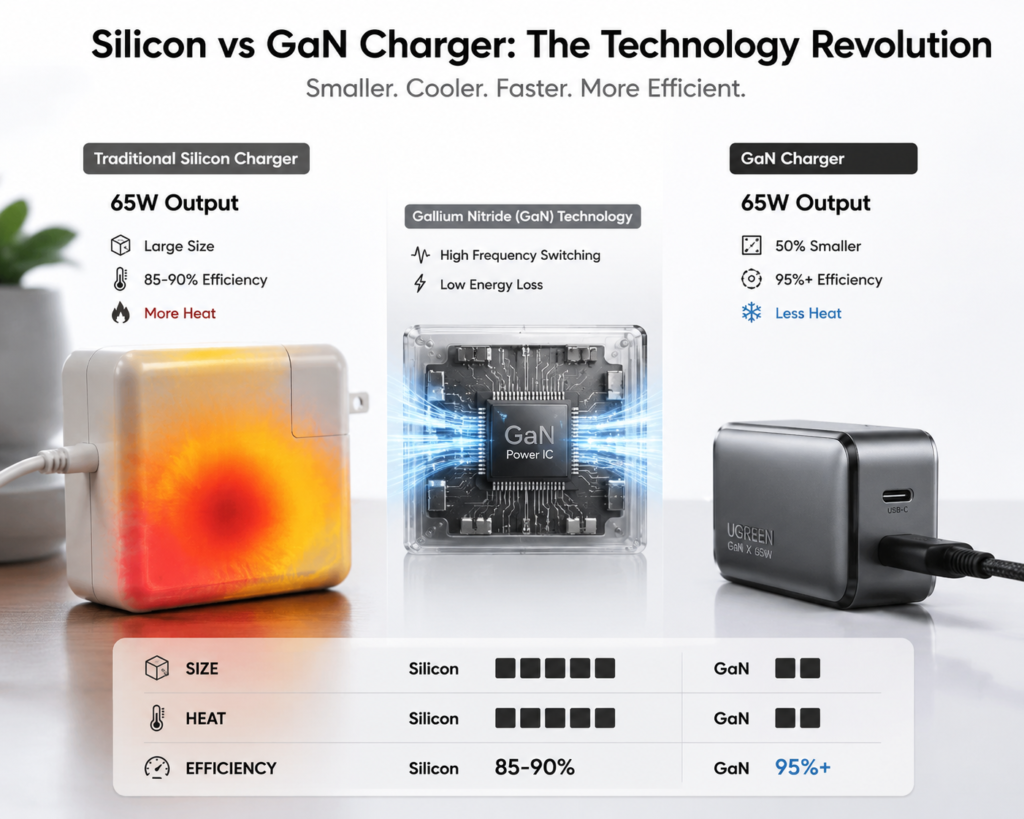
- Too big and heavy: A standard 65W silicon charger was bulky enough to take up half a laptop bag pocket.
- Wasted power as heat: 10–15% of electricity was lost as heat, which made chargers so hot they automatically slowed down to avoid damage.
- Low efficiency: Only 85–90% of power from the wall actually made it to your device.
These flaws pushed the industry to find a better material. In 2023, only 23% of fast chargers used GaN. By 2026, that share jumped to 58.7%—GaN is now the global mainstream for fast charging.
What Is GaN, Anyway?
GaN (short for Gallium Nitride) is a new-generation semiconductor material that is naturally better suited for chargers than silicon, for three simple reasons:
- It handles far higher heat and voltage (3x the heat/voltage tolerance of silicon), so it can run at full power for hours without breaking down.
- It resists power surges better, making charging more stable and less likely to damage your devices.
- Electrons move through it much faster, so less energy is wasted as heat, and the charger responds instantly when you plug in a device.
Silicon chargers cannot run at high internal switching speeds, which forces their internal parts (like transformers) to be large. GaN fixes this with two core tricks:
- It runs at much higher internal speeds, so internal components can be shrunk to a fraction of their old size.
- It has almost no electrical resistance, so barely any power is lost as heat.
| Item | Silicon Charger | GaN Charger |
|---|---|---|
| Power Efficiency | 85–90% | Over 96.5% |
| Body Size | Bulky at the same power | 30–50% smaller |
| Heat Performance | High heat loss, easy to slow down | Low heat, stable full-speed charging |
| Typical Use | Old low-power devices | Fast charging for phones, laptops and high-power devices |
How GaN Took Over: A Quick Timeline
GaN did not replace silicon overnight:
- Early 2010s: Lab-only technology: GaN was too expensive and hard to manufacture, limited to research labs with no consumer products available.
- 2018–2020: First consumer launch: Navitas Semiconductor released the first mass-market GaN chargers, which were less than half the size of same-power silicon chargers. Buyers immediately noticed the portability difference.
- 2020–2024: Mass market boom: GaN charger power jumped from 30W (only good for phones) to 65W and 100W (enough for lightweight laptops). Every major phone and accessory brand launched GaN products, prices dropped sharply, and GaN started being used for industrial equipment too.
- 2025–2026: Full mainstream adoption: GaN has almost replaced silicon for consumer electronics, and is now used for high-power jobs like electric vehicle charging and data center power supplies.
| Time Period | Stage | Key Milestone |
|---|---|---|
| Early 2010s | Lab phase | High manufacturing cost; no consumer products available |
| 2018–2020 | Market debut | First mass-market GaN chargers; half the size of silicon equivalents |
| 2020–2024 | Rapid popularization | Power upgraded to 100W; prices dropped sharply; widely adopted by brands |
| 2025–2026 | Full mainstream | 240W+ high-power support; becomes the global mainstream fast charging solution |
What’s New in 2025–2026 GaN Tech?
The latest 5th-generation GaN chips are a massive upgrade from models released just two years ago:
Smaller, More Powerful Chips
- 8–12% higher efficiency: Less wasted power, less heat, and gentler charging for your device batteries.
- 240W+ power support: These chips can handle enough power to charge gaming laptops and professional workstations, not just phones and tablets.
- All-in-one designs cut costs and failures:
- Infineon’s new CoolGaN G5 chip packs all core power parts into a 6×8mm package, cutting internal components by 50% and making chargers cheaper to build.
- Navitas’s GaNFast chips integrate power drive, control, and safety protection on a single chip, so there are fewer parts to break and chargers are far more reliable.
Faster, More Stable Performance
- Higher switching speeds: Old silicon chargers ran at 150kHz; new GaN models run at 300kHz–1MHz. This ultra-fast internal switching is the key to making high-power chargers so small.
- 96.5%+ peak efficiency: High-end GaN chargers turn more than 96% of wall power into device power, with barely any waste.
- Improved circuit design: New half-bridge and AHB layouts fix common old problems like charging cutouts, power jumps, and automatic slowdowns at high power.
Better Cooling, No Noise
- Even heat spreading: New chargers use heat-conductive thermal glue inside to spread heat evenly, eliminating hot spots that can burn users or damage components.
- AI temperature control: Built-in sensors track heat in real time. Chargers run at full speed when cool, and dial back power slightly if temperatures rise—balancing fast charging and long-term safety.
- Fanless, heat-sink free design: The latest GaN chargers run at full power without bulky metal heat sinks or noisy cooling fans, so they are lighter and totally silent.
Charging Upgrades That Make Your Life Easier
New universal charging standards have fixed most of the old “this charger won’t fast-charge my phone” headaches:
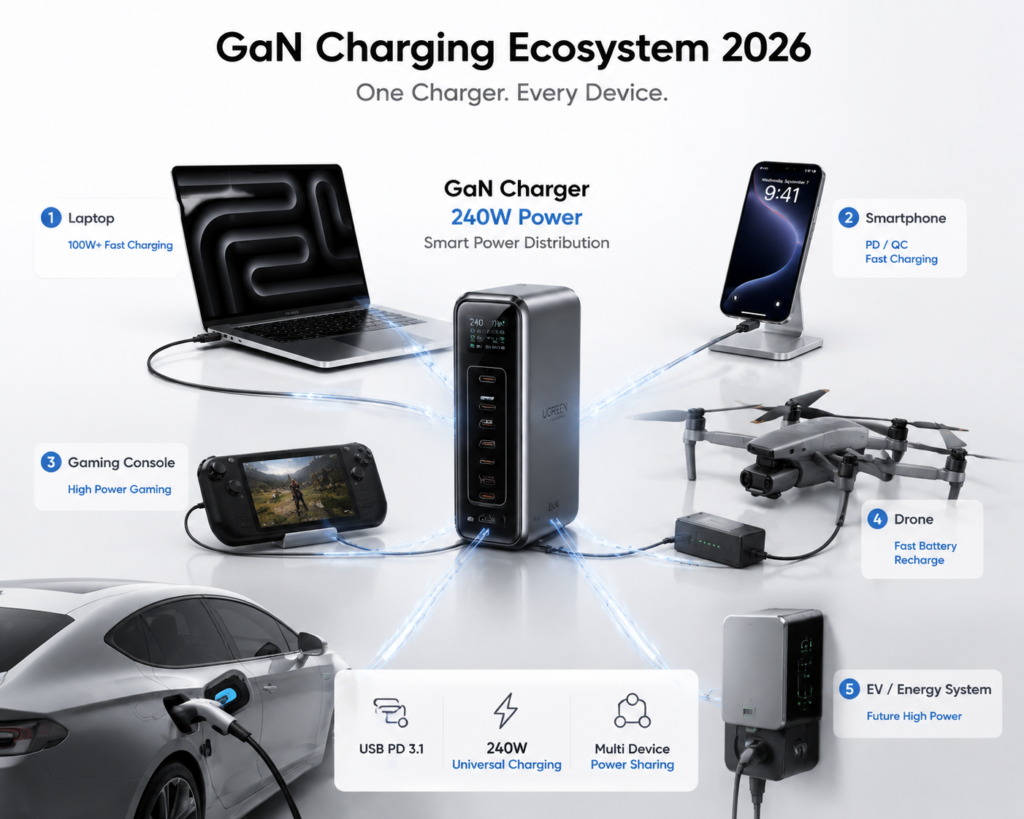
- USB PD 3.1 EPR (240W universal standard): This update raises the maximum consumer charging power from 100W to 240W, with 28V/36V/48V power levels to match everything from phones to gaming laptops.
- USB PD 3.2 (smoother, safer charging): Launched in late 2023, this rule requires all chargers over 27W to adjust voltage in tiny 100mV steps (instead of only using fixed power levels), so it matches your device’s exact needs, runs cooler, and extends battery life. It also standardizes multi-port power distribution (no more random power jumps when you plug in a second device) and supports reverse charging (e.g., your phone charging your earbuds, or your laptop topping up your phone).
- Near-universal compatibility: New GaN chargers work with every major fast charging standard (PD, QC, Samsung AFC, Huawei FCP/SCP, and more). China’s UFCS cross-brand Android fast charging standard now covers 75%+ of devices, so you do not need a brand-specific cable or charger for fast charging across different Android phones.
- Smart multi-port power: Modern 2–6 port GaN chargers automatically detect device types and power needs, reallocating power instantly when you plug or unplug devices—no more massive slowdowns when charging multiple gadgets at once.
GaN Products You Can Buy in 2026
There are reliable GaN options for every use case:
- Everyday consumer models:
- DJI 140W GaN Charger (June 2026): Built for drones and professional camera gear, for ultra-fast top-ups on the go.
- Honor 360W Ultra Charger: The highest-power consumer charger on the market, which can fully charge a flagship phone in minutes.
- Baseus GaN5 Pro 160W: A top-selling multi-port charger balancing high power, small size, and cool operation.
- 65W GaN chargers now cost less than ¥80 (~$11), with 85% market penetration—they are the default budget choice for everyday charging.
- Work and industrial use:
- Renesas 500W GaN solutions are now widely used for industrial equipment and small home energy storage.
- Major data centers are switching to GaN power supplies to cut electricity costs and improve server reliability.
- Ugreen 500W Charging Station: 5 USB-C + 1 USB-A port, with a 240W main port, ideal for studios or offices with many devices.
All modern multi-port GaN chargers work with phones, tablets, laptops, drones, game consoles, and smartwatches—one charger for every device you own.
Why GaN Is Straight-Up Better Than Old Chargers
These tech upgrades add up to clear, real-world benefits:
- Better value: Entry-level GaN chargers are now cheaper than same-power silicon chargers, thanks to mass production of large 300mm wafers and simpler integrated designs. You get better performance for less money.
- Faster, cooler charging: GaN hits 95%+ efficiency (vs 85–90% for silicon), so it wastes less power and saves on electricity bills. It runs far cooler, so no more burning your hand on a hot charger, and no more automatic slowdowns from overheating. It also responds twice as fast when you plug in a device.
- Radically more portable: Same power = 30–50% smaller than silicon chargers. Power density (how much power fits in a cubic centimeter) jumped from 0.8W to 1.2–2.5W. A 65W GaN charger can be as thin as a credit card, easy to slip into a jeans pocket.
- No more charger clutter: One GaN charger works with almost every smart device you own.
Safety, Market Stats, and Remaining Flaws
Are GaN chargers safe?
Qualified GaN chargers are safer than old silicon models:
- They include full safety protections: over-voltage, over-current, over-temperature, short-circuit, surge, and static protection, cutting power instantly if something goes wrong.
- They meet strict global electromagnetic rules (CISPR 32 Class B), so they will not interfere with your phone, laptop, or other electronics.
- All legitimate models pass CE, FCC, RoHS, PSE, and KC global safety certifications, with a failure/repair rate of less than 0.3%—far more reliable than old silicon chargers.
How big is the GaN market?
- The global GaN charger market hit $1.3 billion in 2024, and is projected to reach $1.5–1.68 billion in 2026, growing to $3.7 billion by 2030 (20.8% annual growth).
- China’s domestic GaN market will top ¥5 billion (~$690 million) in 2026, with local chip makers breaking foreign monopolies on core components.
- 214 million GaN charging chips shipped in Q1 2026 alone, up 28.9% year-over-year.
- Chinese accessory brands Anker, Baseus, and Ugreen make over 70% of the world’s consumer GaN chargers.
What’s still not perfect?
GaN is not flawless yet:
- Tech limits: Super high-frequency operation still creates small amounts of electromagnetic interference requiring extra shielding, and efficiency drops slightly at extreme ultra-high power. GaN chips also require extremely precise manufacturing.
- High-end cost: Chargers over 300W are still expensive, as high-end GaN wafer yields remain lower than mature silicon wafers.
- Market junk: Cheap fake GaN chargers with fake power ratings and no safety protections flood online marketplaces, posing fire risks. Some niche use cases still lack unified quality standards.
- Slow brand rollouts: Some flagship phones still ship with old silicon chargers, or no charger at all, even though GaN tech is affordable and mature.
What’s Next for GaN?
GaN is still in its early days of growth:
- Tech upgrades: Vertical GaN designs will break the current 650V limit, opening up even higher power uses. 500W+ consumer chargers will become common, and AI-powered digital control will make charging even more efficient. Bi-directional charging will let GaN systems power homes from electric cars, or send power back to the grid.
- New use cases: GaN will expand far beyond phone chargers. 800V high-voltage electric vehicle platforms will be the industry’s biggest growth driver, and AI data centers will drive massive demand for high-voltage GaN power supplies to cut energy use.
- Better regulation: Stricter standards will eliminate cheap knockoffs, domestic Chinese chip production will continue to catch up to global leaders, and the market will keep growing rapidly.
Quick Summary
After more than a decade of development, GaN has fully replaced the old silicon charger standard. It is smaller, cooler, faster, more efficient, safer, and now even cheaper than the bulky bricks we used to rely on.
While there are still small kinks to work out, GaN will keep improving. In the next few years, it will power everything from your pocket gadgets to your car to the data centers running AI, making all our electronics more portable and energy-efficient.