
Have you ever had this experience: when you want to pick a magnetic wireless charger for your new iPhone, the products you find are labeled Qi2, some MagSafe, and others “MagSafe Compatible”, with prices ranging from over ten dollars to forty or fifty dollars. They all seem to stick to the back of the phone, so what’s the difference exactly?
Many people think Qi2 is for Android and MagSafe is for Apple, only to find after buying that either the magnet is not strong enough, or the charging is slow, and some even think their phone is broken. In fact, the relationship between the two is far from as simple as “Android vs Apple”. Today we will start from the most basic concepts, and fully explain compatibility, charging speed, and pitfalls to avoid when buying. Whether you’re buying a magnetic charger for the first time, or want to understand the details to avoid mistakes, you can find the answers here.
First, Understand the Basics: 3 Types of Wireless Charging and Easily Confused Terms
Many people get confused because they don’t distinguish a few most basic concepts at the beginning. Let’s clarify these first, so the rest will be easy to understand.
Core Differences Between 3 Types of Wireless Charging
You may have heard the three terms Qi, Qi2, and MagSafe. They all seem related to wireless charging, but they are actually three completely different things:
- Regular Qi: The most basic wireless charging standard, with no mandatory magnetic requirements. The phone has to align with the coil on its own; if placed crookedly, it may slow down, overheat, or even stop charging, just like old wireless charging pads that require repeated adjustment to find the right position.
- Qi2: A new generation of wireless charging standard launched by the WPC, with its core being a set of rules called MPP (Magnetic Power Profile) — simply put, it unifies the position of the magnetic ring, alignment method, and power matching logic. As long as it is a certified product, it will automatically snap into alignment when placed, no need to find the right position. Its charging efficiency and stability are much better than regular Qi, and the current mainstream power level for mobile devices is 15W.
- MagSafe: A complete magnetic system built by Apple based on the magnetic ring on the back of the iPhone. It not only includes wireless charging, but also covers all accessories that can use magnetism, such as phone cases, card holders, car mounts, power banks, camera grips, etc. It is a complete ecosystem, not just a charging standard.
Comparison Table of 6 Most Easily Confused Marketing Terms
When buying, there are often all kinds of fancy terms on the packaging, many of which are marketing tricks. We have organized them into a plain-language comparison table so you can tell them apart at a glance:
| Marketing Term | Plain Language Explanation | Can It Guarantee Fast Charging/Stable Experience? |
|---|---|---|
| Qi2 Certified | Qi2 products officially certified by the WPC, fully complying with the unified standard | Yes, you can also check the model on the WPC official website for verification |
| Made for MagSafe | MagSafe accessories officially certified by Apple, meeting Apple’s requirements | Yes, compatible with the full magnetic experience of iPhone |
| MagSafe Compatible | Only matches in shape/magnetism, not certified by Apple | No, power, suction strength, and stability are not guaranteed |
| Qi2 Ready | Marketing term, meaning “looks similar to Qi2”, not officially certified | No, it does not necessarily meet the standard requirements of Qi2 |
| Magnetic Fast Charging/Magnetic 15W | May just be a regular Qi charging pad with a magnetic ring added, no certification | Not necessarily, you must check for official certification again |
| MPP | The magnetic power matching rule in Qi2, which is the core technical standard of Qi2 | Not a product certification, but part of the standard |
Core Relationship Between the Two: Same Technical Origin, Different Positioning
Many people are curious: why can Apple’s iPhone support WPC’s Qi2? In fact, the magnetic design concept of Qi2 has technical origins with MagSafe. The position of the magnetic ring and the adsorption method of the two are very similar. Therefore, iPhone 12 and later models (which come with a built-in MagSafe magnetic ring) can use a Qi2 charger for normal magnetic charging as long as the system is updated to the corresponding version. MagSafe-certified magnetic phone cases can also be used with Qi2 chargers.
But their positioning is completely different:
- Qi2 is an open cross-brand standard, focusing on “universality” — whether you use Apple or Android, it works as long as it is certified. In the future, all brands’ magnetic wireless chargers will move toward this standard.
- MagSafe is Apple’s exclusive ecosystem, focusing on “experience” — it creates a full range of magnetic accessories around the iPhone, with closer integration with the iOS system and more use cases.
There is also a key boundary to remember: iPhones that support Qi2 can get the corresponding Qi2 power when using a compliant Qi2 charger; but even if Android devices can attach to MagSafe accessories, most can only charge at regular Qi speed or via their own brand’s proprietary protocol, and cannot use MagSafe fast charging.
Core Dimension Comparison: What Exactly Is the Difference?
First, here is an overview table for quick comparison:
| Comparison Dimension | Qi2 (Certified Products) | MagSafe (Certified/Official Products) |
|---|---|---|
| Positioning | Cross-brand universal magnetic charging standard | Apple’s exclusive magnetic ecosystem |
| Mainstream Power | 15W (currently the highest for mobile devices) | 15W for older models, up to 25W for new models paired with iPhone 16 |
| Compatible Devices | All Qi2-enabled phones, including iPhone 12+ and Android Qi2 models | Only iPhone 12+ supports MagSafe fast charging, other devices only support regular Qi |
| Accessory Ecosystem | Mainly charging products, cross-brand universal, growing fast | Full category coverage, including cases, card holders, mounts, power banks, camera grips, etc., with high maturity |
| Price | Many choices, wide range, high cost-effectiveness | Official/certified products are expensive, high budget threshold |
| Suitable For | Multi-device users, budget-conscious users, those who value universality | Heavy Apple users, users with full Apple ecosystem, those who need a wide range of magnetic accessories |
Below we elaborate on the details of each dimension:
Positioning and Core Advantages
The core advantage of Qi2 is universality: as an open standard, all brands can produce it, and they are compatible with each other as long as they pass certification. If you have both an iPhone and an Android device at home, buying one Qi2 charger will work for both. There are many third-party options, with prices ranging from entry-level to high-end, suitable for different budgets.
The core advantage of MagSafe is ecosystem: it is not just charging, but an entry point for a full set of magnetic accessories. You can use the same magnetic ring to attach a charging dock, card holder, car mount, power bank, camera grip, or even a tripod. And because it is Apple’s official standard, it integrates better with iOS — for example, when a MagSafe power bank is connected, the phone will display the exact charging status, and accessory compatibility is more mature.
Simple judgment: choose Qi2 if you only need charging, use multiple devices, or are budget-conscious; choose MagSafe if you have the full Apple ecosystem, use many accessories, or want official stability.
Charging Speed and Power Boundaries
This is the issue everyone cares about most. Let’s go straight to the conclusions:
- The highest power level of current mainstream Qi2-certified mobile charging products is 15W; higher power requires the joint fulfillment of subsequent WPC standard updates, device-side support, and product certification, which cannot be achieved by just any Qi2 charger.
- Older MagSafe chargers paired with iPhone 12-15 series also have a maximum of 15W; among them, small-screen models such as iPhone 12 mini and 13 mini have lower peak power, around 12W.
- New MagSafe chargers can only reach a 25W peak when paired with the iPhone 16 series and using a 30W or higher USB-C charger; older iPhones using the new MagSafe still have a maximum of 15W.
- Key reminder: For compliant products in the same 15W level, under the same phone, same environment, and same power supply conditions, the average charging speed difference is usually small, maybe only a few minutes, with little noticeable difference. The differences come more from the product’s own heat dissipation design and magnetic ring alignment accuracy, rather than the standard difference between “Qi2 or MagSafe”.
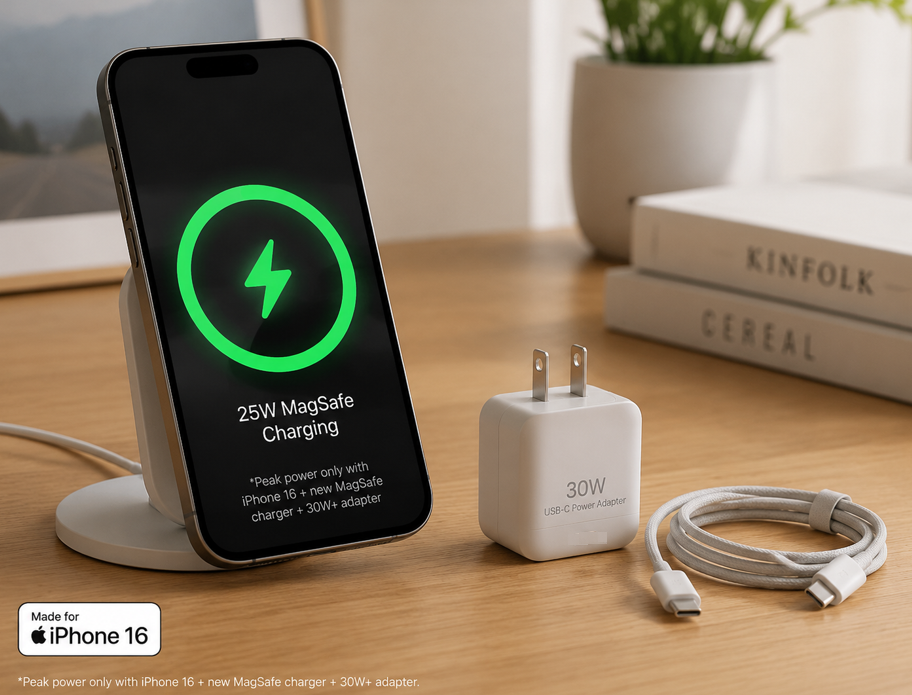
Don’t be misled by marketing: 25W is only the peak of the specific combination of “iPhone 16 + new MagSafe charger + 30W+ charger”, and does not mean all MagSafe products are faster than Qi2.
Device Compatibility Range
Let’s go through them one by one by device type:
- iPhone 12/13/14: Natively supports MagSafe 15W; Qi2 support requires updating to iOS 17.4 or later, and after updating, it can reach 15W via a Qi2 charger.
- iPhone 15: Supports both MagSafe 15W and Qi2 15W. In pure charging scenarios, the experience of the two is similar, so just choose the one with higher cost-effectiveness.
- iPhone 16: Supports Qi2 15W and also the new MagSafe’s 25W, making it the generation with the most obvious speed difference so far.
- Android Qi2 phones: For example, some new Android flagships can get a standard magnetic charging experience with a Qi2-certified charger. For specific support, you need to check the official phone parameters.
- Regular Android Qi phones: Android models that only support regular wireless charging may be able to attach to MagSafe-shaped accessories, but the charging power is at most regular Qi level (usually 5W-10W), or only supports the manufacturer’s own proprietary fast charging, and cannot reach MagSafe/Qi2 power levels.
- Small devices such as AirPods: Can be used on Qi2/MagSafe charging positions, but the power is low. Focus on placement stability, no need to pursue high power. Note that Apple Watch requires a dedicated charging module, not all wireless charging positions can charge it. Confirm separately when buying a multi-in-one dock.
- Backward compatibility: Both Qi2/MagSafe chargers can charge regular Qi devices, but there is no magnetic alignment. If placed crookedly, they may still slow down, with the same experience as a regular Qi charger.
Magnetic Experience
Whether it’s Qi2 or MagSafe, the magnetic alignment experience is far superior to regular Qi. You basically don’t need to find the right position; it automatically snaps into alignment when placed, and rarely stops charging due to crooked placement.
But there are differences in suction stability: Made for MagSafe certified products usually have more consistent suction strength due to Apple’s strict requirements, and the adsorption effect is more stable when paired with MagSafe-certified phone cases.
Qi2 products have greater differences in suction strength: Qi2 certification only specifies basic magnetic alignment rules. The number of magnets, strength, shell material, and mount structure of different brands vary, some stick very firmly, some slide easily.
Here’s a reality check: there is no such thing as a magnetic mount that “absolutely never falls off”, especially in car or sports scenarios. No matter how strong the suction is, it may fall off when encountering bumpy roads or sudden braking. For car mounts, it’s best to choose styles with auxiliary fixation, or reasonable suction and angle design. Don’t believe the “never falls off” marketing.
Accessory Ecosystem
MagSafe has a very obvious advantage in this area: after years of development, from phone cases, card holders, car/desktop mounts, 3-in-1 docks, power banks, to camera grips, tripod adapters, magnetic coolers, almost every magnetic accessory you can think of has MagSafe-certified products, most of which are produced by official or well-known third-party brands, with mature compatibility.
Qi2’s accessory ecosystem is still growing rapidly, mainly concentrated in charging products (chargers, car mounts, power banks, multi-in-one docks, etc.). Cross-brand universality is its core advantage, but non-charging accessories (such as card holders, camera grips) are fewer, and many only adopt a magnetic form and do not require Qi2 certification.
If you are a user of the full Apple ecosystem and want a multi-in-one dock that charges iPhone, Apple Watch, and AirPods at the same time, MagSafe ecosystem products have more mature compatibility, but are also more expensive; if you only need charging products, Qi2 has more choices and higher cost-effectiveness.
Price and Choice Range
Official and certified MagSafe products are generally priced high: Apple’s official MagSafe charger costs about $39, and third-party Made for MagSafe products (such as Anker, Belkin) are mostly over $30. The advantage is that you don’t have to bother screening; if you recognize the certification, you basically won’t make a mistake, but the budget threshold is higher.
Qi2 products have a wider range of choices, from entry-level models of over ten dollars to high-end models of forty or fifty dollars, with more prominent cost-effectiveness. But the problem is that the market is mixed — many no-name brands use the banners of “magnetic 15W” and “Qi2 Ready”, but in reality they are just regular Qi with a magnetic ring added, and have not passed certification at all, requiring users to distinguish on their own.
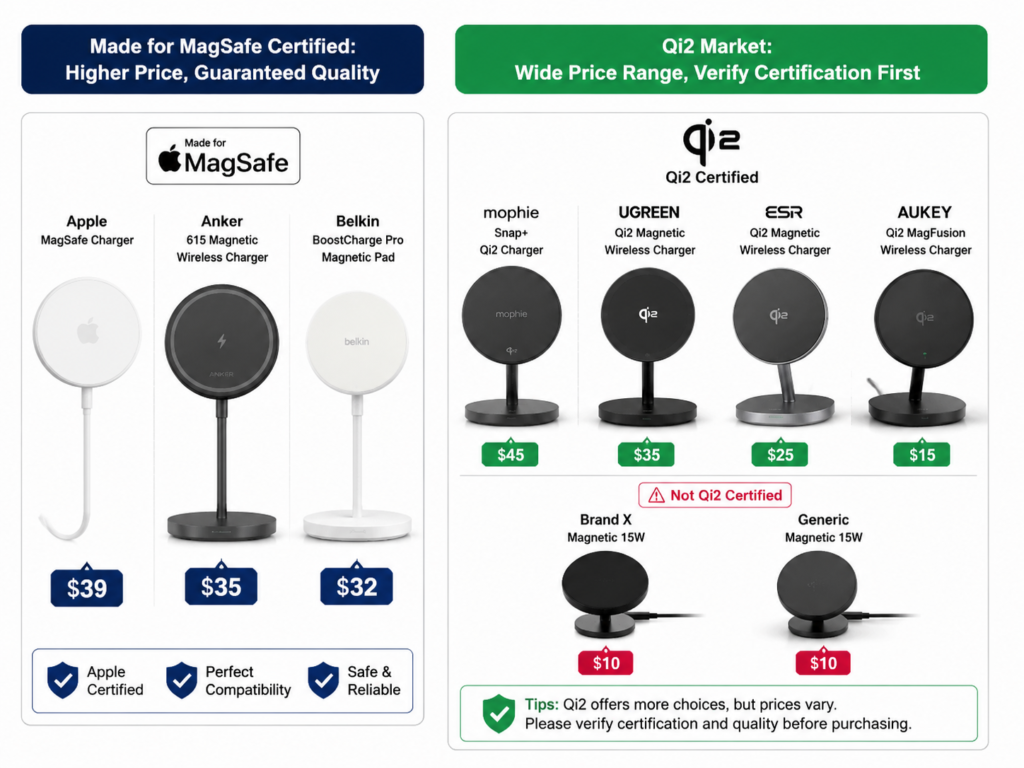
A reminder: don’t just buy by sorting by wattage, and don’t be greedy for cheap “magnetic 15W” products that cost over ten dollars. Many have an actual power of only 5W-10W, and may even overheat and damage the phone. When buying, be sure to check if there is Qi2 Certified or Made for MagSafe certification, and at the same time verify the power supply requirements, heat dissipation design, warranty, and real reviews.
Safety, Heat Generation, and Battery Impact
Many people worry that wireless charging damages the battery. In fact, as long as it is a compliant certified product, whether Qi2 or MagSafe, it has basic safety functions such as foreign object detection, over-temperature protection, over-voltage protection, and over-current protection, so there is no problem with normal use.
The main source of heat generation is not “Qi2 or MagSafe”, but coil alignment accuracy, ambient temperature, phone load, phone case thickness, and charger heat dissipation design. For example, playing games while charging, or charging in a car exposed to the sun in summer, will cause severe overheating no matter what standard wireless charger you use.
As for the impact on the battery: wireless charging does generate heat more easily than wired charging, but what really damages the battery is long-term high temperature, not wireless charging itself. As long as you don’t cover the phone with bedding while charging, or charge for a long time in high temperatures, the impact of compliant wireless charging on the battery is not much different from wired charging, so there’s no need to worry excessively.
Several high-risk scenarios should be avoided as much as possible: exposure to the sun in the car, charging while using navigation in summer, playing large games while charging, charging under pillows or quilts, and having metal cards clipped to the back of the phone. These can easily lead to high temperatures or charging interruption. In high-temperature or high-load scenarios, it is recommended to reduce charging power, remove thick cases, or switch to wired charging.
Match Directly According to Your Device
After reading the comparison, some people may still not know what to choose. We give you direct suggestions according to different device types:
iPhone 12/13/14 Users
First update the system to iOS 17.4 or later to support Qi2 15W.
- Users who already have a full set of accessories such as MagSafe phone cases, card holders, and car mounts can continue to use the MagSafe ecosystem, it’s hassle-free and no need to switch.
- Users who only need basic magnetic charging on the bedside or office desk and have no other MagSafe accessories will get higher cost-effectiveness by choosing compliant Qi2 15W products.
- Note for mini model users: the MagSafe peak power of your phone is inherently lower than standard models, so there’s no need to buy too expensive high-power chargers — if you can’t reach the upper limit, it’s a waste of money.
iPhone 15 Users
iPhone 15 supports both MagSafe 15W and Qi2 15W. In pure charging scenarios, the experience of the two is similar, so just prioritize comparing price, heat dissipation, and certification.
- If you need accessory linkage such as card holders, camera grips, car mounts, 3-in-1 docks, etc., choose MagSafe ecosystem products, which have more choices and better compatibility.
- If you don’t pursue the official accessory experience, a Qi2-certified charger is a more balanced choice.
iPhone 16 Users
- For those who pursue the highest wireless fast charging and are willing to pay a premium for speed: choose the new MagSafe charger, paired with a 30W or higher USB-C PD charger.
- For daily top-ups and overnight bedside charging: 15W Qi2-certified products are completely sufficient, there’s no need to spend extra money for the 25W peak — after all, the peak only appears briefly when the battery is low, and the difference is negligible most of the time.
- For car scenarios: the 25W advantage is not obvious. In summer, the high temperature in the car plus the navigation load makes the phone prone to overheating and frequency reduction. Stable heat dissipation is more important than peak power, so don’t blindly pursue 25W.
Android Users
The first step is to check the official parameters: confirm whether the phone explicitly supports Qi2, not just labeled “supports wireless charging”.
- For models that support Qi2: prioritize Qi2 Certified products to get a standardized magnetic charging experience, and cross-brand universality is also convenient.
- For models that only support regular Qi: there’s no need to pay a premium for Qi2 or MagSafe certification, unless you just want the magnetic mount form, just buy a regular magnetic wireless charger.
- For models with manufacturer-proprietary wireless fast charging (such as some Samsung and Google flagships): if you want full speed, you still have to buy the original dock, which has poor universality but is faster.
- Don’t buy MagSafe-certified accessories for Android: even if they can attach, you can’t use MagSafe fast charging, it’s a pure waste of money.
AirPods and Small Device Users
Small devices don’t need to pursue high power. Focus on placement stability, whether it triggers false overheating, and whether it’s easy to pick up and put down.
- When buying a multi-in-one dock, be sure to confirm the power and certification of each charging position separately: whether the iPhone position is Qi2/MagSafe certified, whether the AirPods position can charge stably, and whether the Apple Watch position is a dedicated charging module. Don’t assume all wireless charging positions are universal.
- Apple Watch must use a dedicated magnetic charging module; regular wireless charging pads cannot charge it. Be sure to pay attention to this point.
Choose According to Usage Scenarios, More Practical
The core needs of different scenarios are completely different. Don’t just look at parameters, choose according to your own usage habits:
Bedside Charging
The core need is not speed, but low heat generation, soft indicator light, no fan noise, easy one-handed placement, and no frequent charging interruption at night.
- iPhone users can use both types of products. Choose Qi2 if you are budget-conscious, and choose a MagSafe ecosystem multi-in-one dock if you need to charge multiple devices at the same time.
- Remember: overnight charging doesn’t need to pursue peak power at all, it will be fully charged overnight anyway. Stability, quietness, and good temperature control are the key. Models with fans may instead affect sleep.
Office Desk/Study Desk Charging
The core need is adjustable angle, convenient switching between portrait and landscape mode, no blocking of notifications, the dock doesn’t take up space, and reasonable layout for multiple devices.
- Single iPhone users can choose MagSafe mounts, which have more accessory forms, such as adjustable angle mounts, phone + earphone dual charging docks, etc.
- For households or offices with mixed multi-brand devices, Qi2-certified docks have stronger universality.
- Note: When hanging the phone on a mount for a long time, pay attention to heat generation, especially when the screen is always on, which may cause charging frequency reduction. Try to choose models with good heat dissipation.
Car Navigation Charging
Car use is one of the most common scenarios for magnetic wireless charging. The core need is firm installation, sufficient suction, good heat dissipation, stable power supply, and not blocking air vents or affecting operation.
- For pure iPhone users, choosing a Made for MagSafe car mount usually provides a more stable experience, with better suction and alignment when paired with a MagSafe-certified phone case.
- For mixed iPhone + Android use, Qi2-certified car mounts have stronger universality.
- In high-temperature areas, prioritize models with good heat dissipation design, such as those with heat sinks or that can be fixed to the air vent. Don’t just look at the 15W or 25W rating — in a car exposed to the sun in summer, no matter how high the power is, it will reduce frequency, and poor heat dissipation may even cause charging interruption.
Business Trip/Power Bank
The core need for magnetic power banks is light weight, suitable capacity, support for pass-through charging, good heat control, and no impact on grip after attachment.
- Multi-device users choose Qi2 power banks, which have stronger universality and can charge phones of different brands magnetically.
- Pure iPhone users have a better experience with MagSafe power banks, with more stable adsorption, and iOS can display the exact charging status. Some products also support lock screen battery level display.
- Note: Small-sized magnetic power banks are prone to overheating due to limited heat dissipation space, and the actual sustained power may be much lower than the rated peak. When buying, don’t just look at capacity and power, pay more attention to heat feedback in real reviews.
Multi-in-One Charging Dock
Multi-in-one docks are suitable for desktop or bedside use, can charge multiple devices at the same time, and save space. The core need is that each charging position has sufficient independent power, the Apple Watch module is compliant, the AirPods position is stable, and there is no mutual interference between coils.
- For users of the full Apple ecosystem, choosing a MagSafe-certified multi-in-one dock has more mature compatibility, can charge iPhone, Apple Watch, and AirPods at the same time, and has better system integration, but the price is generally high.
- For mixed iPhone + Android use, Qi2 multi-in-one docks are more universal, and the phone position works for both systems, but Apple Watch still requires a dedicated module. Confirm whether it is included when buying.
- Pitfall reminder: Many 3-in-1 docks only have high power (15W) at the phone position, while the earphone and watch positions have very low power. Even some watch positions can only charge earphones. Be sure to check the parameters of each position when buying, don’t assume all three positions are fast charging.
Pitfall Avoidance, Troubleshooting, and Decision-Making Methods
7 Most Common Misconceptions
Avoid these pitfalls first, and you basically won’t buy the wrong thing:
- MagSafe is definitely faster than Qi2: Wrong. The speed difference between compliant products in the same 15W level is very small. Only iPhone 16 paired with the new MagSafe has the 25W advantage.
- Qi2 is exclusive to Android: Wrong. Qi2 is a cross-brand standard, and iPhone 12 and later models also support it after system update.
- Having magnets means it’s Qi2 or MagSafe: Wrong. Magnetism is just a form. Without official certification, power and stability cannot be guaranteed. Many no-name brands are just regular Qi with a magnetic ring added.
- MagSafe Compatible equals Made for MagSafe: Wrong. The former is just a “can attach” compatibility marketing claim, no Apple certification, no guarantee of fast charging; the latter is Apple’s official certification.
- Wireless charging damages the battery more: Wrong. Long-term high temperature is the real culprit of battery damage. The impact of compliant wireless charging on the battery under normal use is not much different from wired charging.
- The higher the charger power, the faster the charging: Wrong. The charging upper limit is determined jointly by the phone, charger, protocol, and temperature control. A high-power charger only provides the condition, and will not exceed the phone’s maximum upper limit.
- 25W MagSafe is suitable for all iPhones: Wrong. It can only be achieved by the iPhone 16 series paired with the new MagSafe charger. Older iPhones using the new MagSafe still have a maximum of 15W.
Genuine Certification Identification Methods
Don’t just look at “15W”, “25W”, “MagSafe” in the title, verify according to these points:
- Qi2 products: Look for the “Qi2 Certified” logo. You can enter the model number in the WPC official product database to query; only those that can be found are truly certified.
- MagSafe products: Look for the “Made for MagSafe” logo, or directly buy MagSafe products sold by Apple official or authorized channels; third-party brands must clearly mark the Made for MagSafe certification.
- Check on the packaging: product model, certification name, input power requirements, list of supported models. Don’t just look at the big “15W” “25W” words.
- Be wary of vague marketing terms: “magnetic fast charging”, “MagSafe same style”, “compatible with MagSafe”, “Qi2 Ready”, “up to 15W”. Most of these have no certification, don’t take them seriously.
Pre-Purchase Checklist
Go through this list before buying, and you basically won’t fall into pitfalls:
- Device: Does your phone support Qi2/MagSafe? What’s the maximum supported power? Does the system version meet the requirement?
- Charger: Does it have Qi2 Certified or Made for MagSafe certification? Is it a new or old MagSafe model?
- Power supply: For the 15W level, do you have a 20W or higher USB-C PD charger? For the 25W level, do you have a 30W or higher USB-C charger? Is the cable compliant?
- Phone case: Is it a magnetic case? Is the magnetic ring aligned? Is it too thick? Is there a metal sheet or card holder clipped to the back?
- Scenario: Mainly used at bedside, desktop, car, or business trip? Different scenarios have different priorities. For example, for car use, prioritize firmness and heat dissipation; for bedside use, prioritize quietness and low heat generation.
- Reviews: Don’t just look at the positive review rate. Focus on whether negative reviews mention problems such as overheating, charging interruption, weak suction, whistling noise, loud fan noise, poor after-sales service, etc. These are the key factors affecting experience.
Troubleshooting Order for Slow Charging, Charging Interruption, and Overheating
Don’t rush to return when you encounter problems. Check step by step in this order, and most problems can be solved by yourself:
- Remove the phone case, card holder, and metal sheets, test with the bare phone to rule out foreign object detection or alignment deviation caused by accessories.
- Replace with a compliant power adapter and cable to rule out insufficient power supply.
- Confirm whether the phone model, system version, charger certification, and power level match.
- Move to a normal temperature and ventilated environment, close high-load applications such as games, navigation, and hotspots to rule out frequency reduction caused by high temperature or high load.
- Check whether the coil and magnetic ring are aligned, and whether the mount angle is too steep causing the phone to slide.
- Test with another compliant charger to determine whether it is an individual product problem or a usage condition problem.
Three-Step Purchase Decision Method
Finally, here is the simplest decision logic for everyone, just follow it:
- Look at the device: If you have an iPhone 16 and pursue 25W wireless fast charging, directly choose the new MagSafe; if you have an iPhone 12-15 or an Android phone that supports Qi2, proceed to the next step; for devices that only support regular Qi, there’s no need to pay a premium for magnetic certification, unless you just want the magnetic mount form.
- Look at the needs: For pure charging, multi-device sharing, or budget-conscious, choose Qi2-certified products; for heavy Apple users, full Apple ecosystem, need for rich magnetic accessories, or priority for official experience, choose MagSafe-certified products.
- Look at the product: Recognize official certification, verify power supply requirements, confirm phone case compatibility, pay attention to heat dissipation and after-sales service, and avoid no-name brands with vague marketing.
Final Summary
The essence of Qi2 and MagSafe is the difference between “open standard” and “closed ecosystem”. There is no absolute good or bad, only whether it is suitable for you.
If you value universality and cost-effectiveness, have devices of different brands at home, or just want a good magnetic charger, Qi2-certified products are a better choice; if you are a heavy iPhone user, have the full Apple ecosystem, and want the complete experience of a full set of magnetic accessories, the MagSafe ecosystem is more suitable for you.
Don’t overthink the peak number for charging speed: for iPhone 12 to 15 users, the experience of 15W Qi2 and MagSafe is similar, just choose the one with higher cost-effectiveness; only when iPhone 16 users pursue extreme wireless fast charging do they need to consider the new MagSafe’s 25W.
By now, you should be able to distinguish the easily confused concepts of Qi, Qi2, MagSafe, and Made for MagSafe, won’t be fooled by the “15W” “25W” on the packaging, can choose the right product according to your phone model, usage scenario, and budget, and can also troubleshoot the causes of slow charging, charging interruption, and overheating step by step by yourself.
One final reminder: when buying, be sure to check for official certification. Qi2 Certified and Made for MagSafe are the most reliable judgment standards. Don’t be fooled by fancy marketing terms.