
If you often shop for USB-C fast charging accessories, you must have seen abbreviations like PPS, AVS, PD3.1, and EPR: some merchants claim AVS is the latest generation of fast charging, some say PPS is the standard for universal mobile phone fast charging, and many brands also label their own proprietary fast charging with the name AVS, making it more confusing the more you look. You may have encountered similar pitfalls: you bought a 100W PD charger to charge a Samsung phone that supports 45W fast charging, but the speed was only 25W, and after checking for a long time you found out the charger didn’t have a PPS profile at all; or you bought a “PD3.1 charger” for a 140W laptop, but it couldn’t reach full power, only to discover it doesn’t even support EPR high power.
Before the formal comparison, let’s clarify a few basic concepts to avoid confusion as you read on:
First, the “AVS” on the market is not the same thing. One is USB PD 3.1 EPR AVS in the USB-IF official standard (referred to as “standard AVS” in this article), which is a public adjustable voltage power supply specification; the other is a proprietary voltage regulation scheme customized by some manufacturers (referred to as “proprietary AVS” in this article), which is a brand-exclusive fast charging or power management strategy. The two are completely incompatible. To tell which kind of AVS is in a merchant’s promotion, you can’t just look at the abbreviation; you must check the specific parameters. All references to PPS later in this article refer to Programmable Power Supply within the USB PD system.
Second, neither PPS nor standard AVS is an independent fast charging protocol faster than USB PD — they are both enhanced adjustable power supply capabilities under the USB PD framework, and without the basis of PD negotiation, they cannot take effect in a standard way at all. Although proprietary fast charging may also use a USB-C interface, it is not equivalent to standard PPS or standard AVS.
Third, “fast charging speed” is not equal to high peak wattage. The daily perceived fast charging experience includes four levels: peak power (the highest wattage that can be reached in a short time, usually only maintained for a few minutes), average power (the overall speed of mid-stage charging from 20% to 80%, which most affects daily experience), full charge time (affected by trickle protection and battery strategies, not just peak power), and stability (no frequent power reduction due to heat or cable issues). All comparisons in this article will be combined with actual experience, not just stacking peak parameters.
The core comparison scope of this article is PPS and standard AVS in the official USB PD standard, while supplementing the commonly encountered proprietary AVS, to help you distinguish various concepts in merchant promotions. All content is targeted at wired USB-C fast charging for consumer electronics, including mobile phones, tablets, handheld consoles, laptops, monitors, docking stations, and power banks; it does not involve industrial power supplies, automotive high-voltage power supplies, wireless fast charging, or non-USB-C dedicated power interfaces.
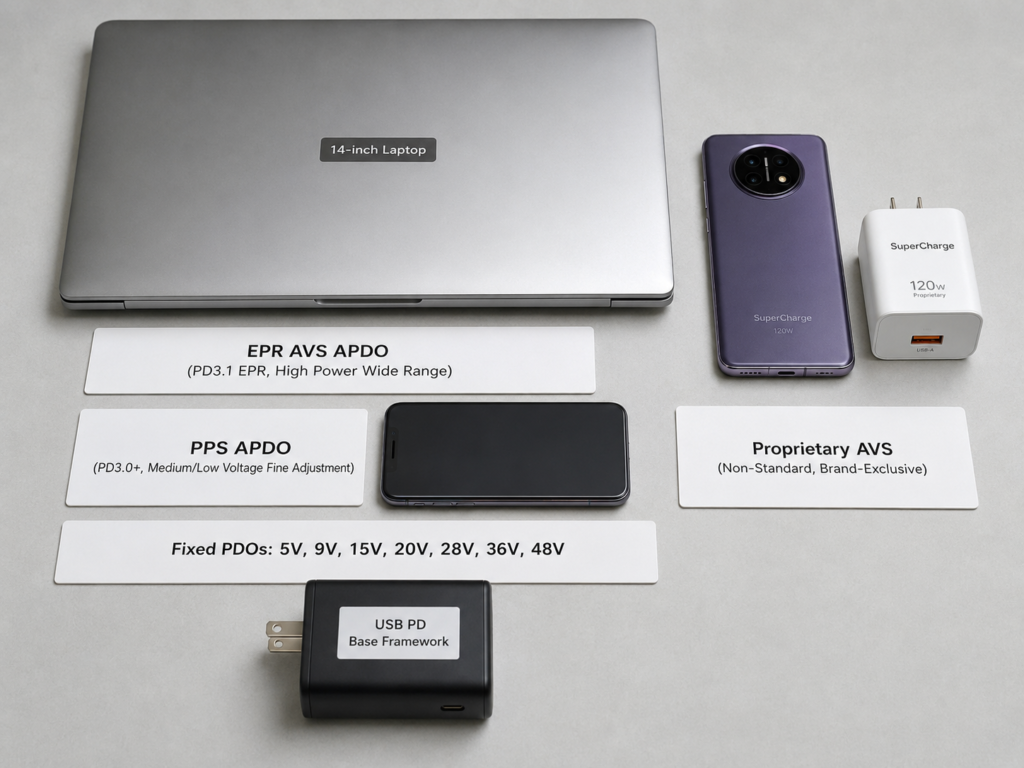
If you compare the USB fast charging system to a building, you can understand the levels of different capabilities like this: the bottommost basic framework is USB PD, and all standard fast charging must operate based on PD negotiation; above that are fixed PDOs (fixed voltage profiles), such as discrete profiles like 5V, 9V, 15V, 20V, 28V, 36V, and 48V, like the steps of a staircase; further up are enhanced APDOs (adjustable power profiles), among which PPS APDO is an optional capability of PD3.0 and later versions, focusing on fine voltage regulation at medium and low voltages, while EPR AVS APDO is an optional capability of the PD3.1 EPR system, focusing on wide-range voltage regulation for high power; as for proprietary AVS, it is completely outside the building of USB PD public standards, and can only take effect with the combination of exclusive devices, chargers, and cables of the corresponding brand. It is especially important to remember here: PD3.1 does not necessarily mean EPR is included, and EPR does not necessarily mean AVS is supported; all capabilities must be confirmed by checking the specific APDO declarations.
Plain Language Introduction: What Problems Does Adjustable Voltage Fast Charging Solve?
To understand the value of adjustable voltage fast charging, we must start with the most basic fixed voltage profiles. As mentioned earlier, fixed PDOs are like the steps of a staircase, and the charger can only output several preset discrete voltage values. However, the charging demand of devices changes dynamically: higher current is needed when the battery is low, power must be reduced when the temperature is high, and the optimal voltage is different for different charging stages. If the charger only has fixed profiles, it’s fine if they match exactly; if not, the device has to perform another voltage conversion internally to change the charger’s output to the value it needs. This conversion will produce additional losses, which may make the device body heat up more obviously.
However, this does not mean that fixed voltage profiles are an outdated solution. Many laptops and tablets have undergone in-depth power optimization specifically for common fixed PD profiles like 20V, with high conversion efficiency, making them stable and efficient to use, with no need for adjustable voltage at all.
The core value of adjustable voltage fast charging is to turn “steps” into “gentle slopes”: the charger can continuously adjust the output voltage and current within a certain range, as close as possible to the current actual demand of the device, reducing the conversion pressure on the device side. The device can dynamically request different voltages and currents according to battery status, temperature, and load, thereby improving charging efficiency and controlling heat generation. Of course, adjustable voltage does not necessarily mean faster; if the device does not support it, the profiles do not match, or temperature control is triggered, it still will not reach the expected power.
The three types of adjustable voltage schemes have different focuses: PPS is mostly used in medium and low voltage scenarios within 100W, such as mobile phones, tablets, and handheld consoles, focusing on fine adjustment, so that third-party universal chargers can also achieve high-efficiency fast charging; standard AVS is for high-power devices of 140W and above, such as high-performance laptops and professional monitors, focusing on wide-range high-voltage regulation to reduce current losses in cables and interfaces; proprietary AVS is an exclusive scheme for full-speed fast charging of corresponding brand mobile phones, with poor versatility, and usually only original or certified accessories can trigger the highest power.
From the perspective of heat generation and efficiency, the value points of the three are also different: for mobile phones and tablets, PPS mainly makes the input voltage closer to the battery’s current stage demand, reducing the internal conversion pressure of the device body and lowering heat generation; the core value of standard AVS on high-power devices is to use higher voltage to reduce current losses in cables and interfaces at the same power, improving the stability of high-power power supply; the efficiency and heat performance of proprietary AVS are highly dependent on the manufacturer’s multi-cell, charge pump, custom cable, and temperature control strategies, with great differences between brands. Of course, actual heat generation is also affected by factors such as ambient temperature, whether a case is worn, and screen-on load, and the protocol is only one of the variables.
Negotiation Mechanism: Why Supporting the Protocol Does Not Mean It Is Being Used
Many people buy chargers and mobile phones marked with PPS and think they must be running PPS fast charging, but that’s not necessarily the case. Fast charging mode cannot take effect with unilateral support; it requires successful negotiation among the charger, device, and cable.
Complete Process of USB-C Fast Charging from Plug-in to Activation
We can imagine the entire negotiation process as ordering food:
- The charger (restaurant) first hands over the “menu”, telling the device all the PDOs (fixed profiles) and APDOs (adjustable profiles, including PPS and AVS) it can provide.
- After getting the menu, the device (customer) selects the most suitable profile based on its current battery level, temperature, and maximum acceptable power.
- At this time, the cable (waiter) also states its “carrying limit”: for example, whether it can carry up to 3A or 5A current, and whether it can withstand the high voltage of EPR. If the cable can’t handle it, even if the restaurant can make it and the customer wants to eat it, the profile has to be downgraded.
- The device sends the final “order” to the charger, and after the charger confirms there is no problem, it outputs the corresponding voltage and current.
- During the charging process, the device can also adjust the “order” at any time: for example, reduce it a little when the temperature is high, pull it to full when the battery is low. This dynamic adjustment is especially common in PPS scenarios.
5 Necessary Conditions for Negotiation to Take Effect
For PPS or standard AVS to work properly, all five conditions are indispensable:
- The charger must clearly declare the corresponding PPS or AVS APDO profile, with sufficient parameters.
- The device must support this mode and actively request the corresponding profile.
- The cable must meet the target current, voltage, and power levels.
- The current state of the device allows high power: for example, too low/too high battery level, too high temperature, or high-load operation may trigger power reduction.
- If it is a multi-port charger, when multiple ports are used at the same time, the available profiles and power of a single port may be dynamically adjusted, and some adjustable profiles may even be canceled.
Cable Capability Boundaries: 3A, 5A, and EPR Are Not the Same Thing
Cables are a shortcoming that many people easily overlook. Here, we explain the three common types of USB-C cables clearly:
- 3A USB-C cable: Common in scenarios within 60W, usually without an E-Marker chip, and generally understood as a maximum of 60W (20V/3A) in common USB PD SPR charging scenarios.
- 5A E-Marker cable: There is an electronic marker chip called E-Marker inside the cable, which can tell the device that it supports 5A current, with a maximum power of 20V/5A, that is, 100W. This is the upper limit of the traditional USB PD standard power range (SPR), and this type of cable is also required to run 5A PPS profiles.
- 240W EPR cable: A dedicated cable that supports PD3.1 Extended Power Range (EPR), which can carry higher voltages (up to 50V). Common labels are 240W, 50V/5A, EPR, with a maximum supported power of 240W.
It is important to remember here: A 100W 5A E-Marker cable does not mean it can run EPR high power. For 140W, 180W, and 240W EPR scenarios, you must use a dedicated EPR cable; don’t buy the wrong one.
Plain Language Explanation of Key Terms
We mentioned many abbreviations earlier, here we explain them all in plain language for your future reference:
- PDO: Power Data Object, the official term for fixed voltage profiles. For example, 5V/3A and 20V/5A are all PDOs.
- APDO: Augmented Power Data Object, the official term for enhanced adjustable power supply capability. It is not a fixed profile, but an adjustable voltage and current range. Both PPS and standard AVS fall into the category of APDO.
- PPS APDO: An APDO specifically used to declare PPS programmable power supply capability, commonly found in medium and low voltage fast charging scenarios within 100W.
- AVS APDO: An APDO specifically used to declare PD3.1 EPR adjustable voltage power supply capability, existing only in the EPR high-power system.
- E-Marker: An electronic marker chip in the cable, used to tell the device its carrying capacity and type.
- SPR: Standard Power Range, the standard power range of traditional USB PD, up to 100W (20V/5A).
- EPR: Extended Power Range, the extended power range of USB PD 3.1, up to 240W, specifically serving high-power devices.
Judgment Formula for Full Fast Charging
In fact, the logic for judging whether fast charging can reach full power is very simple: Actual power is equal to the minimum value among the four factors: device support upper limit, charger single-port profile, cable capability, and current state. Whichever is the short board determines the final power.
Here are three of the most common examples:
- A mobile phone supports 45W PPS, but the charger’s PPS profile is only 3.3-11V/3A, with a maximum of about 33W. It definitely can’t reach 45W.
- A laptop supports 140W EPR, but you use a regular 100W 5A cable. Then it can only run up to less than 100W, and may even fall back to a lower fixed profile.
- You bought a 240W high-power charger to charge a mobile phone that only supports 25W PPS. The phone will only run at 25W at most, it won’t get faster just because the charger has higher power, it’s a complete waste.
Core Differences Between PPS, Standard AVS, and Proprietary AVS
To let you distinguish the differences between the three more intuitively, the following table organizes the comparison of core dimensions:
| Comparison Dimension | PPS | Standard AVS | Proprietary AVS |
|---|---|---|---|
| Standard Attribute | USB-IF public standard, optional capability of PD3.0 and above | USB-IF public standard, optional capability of PD3.1 EPR system | Manufacturer-customized proprietary scheme, no unified public standard |
| Common Voltage Range | 3.3-11V, 3.3-16V, 3.3-21V (declared by the charger) | 15-28V, 15-36V, 15-48V (declared by the charger) | No unified range, defined by the manufacturer |
| Voltage Regulation Step | Usually 20mV voltage step, 50mA current step, suitable for frequent fine adjustment | Usually 100mV voltage step, focusing on point selection within the high voltage range | Step, algorithm, and handshake rules are not public, no unified standard |
| Typical Devices | Mobile phones, tablets, handheld consoles, thin-and-light laptops/power banks within 100W | High-power laptops, monitors, docking stations of 140W and above | Corresponding brand’s 100W-level full-speed fast charging mobile phones |
| Versatility | Strong cross-brand versatility, rich choices of third-party accessories | Depends on PD3.1 EPR ecosystem, fewer accessories than PPS | Only compatible with corresponding brand/series devices, basically incompatible across brands |
| Core Limitation | Most consumer applications are concentrated within 100W, difficult to cover EPR high power | Ecosystem is still being popularized, only necessary for high-power devices | Requires original/official certified accessories, poor cross-device reusability |
It should be noted that a smaller voltage regulation step does not mean faster charging, nor does it directly mean better battery protection; battery charging speed and lifespan are more affected by temperature control, cell design, charging curve, and BMS (Battery Management System) strategies, so there is no need to blindly pursue smaller step parameters.
From the perspective of cost and popularity, the differences between the three types of schemes are also obvious: the PPS charger ecosystem is the most mature, with a very rich selection of products in 30W, 45W, 65W, and 100W profiles, usually with higher cost performance; PD3.1 EPR/AVS products are still in the popularization stage, and are often more expensive than ordinary PPS chargers under the same brand and positioning, and the price is also affected by factors such as USB-IF certification, GaN solutions, power density, and multi-port design; proprietary AVS accessories usually rely on original or official certified kits, with generally high prices, few third-party compliant options, and cross-device reusability is far inferior to universal PD/PPS products.
Parameter Identification: Quickly Understand PPS/AVS Labels and Parameters
Many people can’t understand the parameter tables of chargers and cables, and can only judge by merchant promotions, which is easy to fall into pitfalls. In fact, as long as you master a few core identification methods, you can quickly judge the actual capability of a product.
Label Identification of Three Types of Adjustable Voltage Fast Charging
Different types of adjustable voltage fast charging have different common expressions in parameter tables, so pay attention to the distinction:
- Common labels for PPS: Usually written as PD PPS, USB PD PPS, USB PD 3.0 PPS, Programmable Power Supply, and will also be marked with a specific voltage and current range (such as 3.3-11V/5A).
- Common labels for standard AVS: Usually paired with words like USB PD 3.1, EPR, AVS, Adjustable Voltage Supply, and power labels of 140W/180W/240W PD. But note: just writing PD3.1 or EPR does not mean AVS is supported; you must see a clear AVS APDO voltage range (such as 15-28V/5A) to confirm.
- Common labels for proprietary AVS: Usually brand-exclusive fast charging names, such as SuperVOOC, FlashCharge, HyperCharge, TurboPower, etc. The specific definition is determined by the brand itself, and is not equivalent to USB-IF standard AVS.
Pitfall reminder: If the product only has vague expressions like “PD fast charging”, “Type-C fast charging”, “Fast Charging”, “PD Compatible”, it does not mean it supports PPS or AVS. It only counts if you see the specific profile range and protocol name.
Disassembly of Typical Parameter Examples
When you see a specific voltage and current range, you can judge the actual capability as follows. Note that all theoretical powers are limited by the charger’s total power (PDP), device request, and cable capability, so you can’t just look at the voltage range:
- PPS 3.3-11V/3A: The maximum theoretical power is about 33W, suitable for 25W to 30W-level PPS devices, and cannot meet the full speed of devices that require 5A PPS.
- PPS 3.3-11V/5A: The maximum theoretical power is about 55W, often used for some 45W-level mobile phones that require 5A PPS profiles.
- PPS 3.3-21V/5A: Theoretically covers higher voltage and current combinations, commonly found in high-specification 100W-level PPS chargers, but the actual output is still limited by the charger’s total power, device support, and cables, and may not reach the maximum value.
- AVS 15-28V/5A: Corresponds to a maximum 140W-level EPR capability, compatible with 140W-level devices that support PD3.1 EPR.
- AVS 15-36V/5A: Corresponds to a maximum 180W-level EPR capability.
- AVS 15-48V/5A: Corresponds to a maximum 240W-level EPR capability.
Core judgment logic: Look at the voltage range, current upper limit, single-port power, and device support, not just the protocol name or total wattage.
Understanding Method for Real Device Models
The fast charging strategies of different devices vary greatly, and cannot be generalized by brand:
- Some Samsung 45W PPS models: Usually require the charger to provide a 3.3-11V/5A PPS profile, paired with a 5A E-Marker cable to reach full speed; for Samsung models that only support 25W-level PPS, ordinary 3A PPS chargers can meet the demand, no need to deliberately pursue high specifications.
- Google Pixel series: Some models support USB PD/PPS, but the maximum input power of different generations ranges from 18W to 45W, so they cannot be generally classified as 45W-level. Be sure to check official specifications or reliable actual test data according to the specific model.
- High-power laptops: For high-power laptops that support PD3.1 EPR, some only use fixed EPR PDO profiles such as 28V and 36V, and may not request AVS APDO. As long as the power meets the standard, they can run at full speed normally, and there is no need to insist on AVS function.
- Proprietary fast charging mobile phones: 100W-level proprietary fast charging mobile phones usually require an original charger, dedicated cable, and built-in certification chip to cooperate to trigger full power. Third-party PD/PPS chargers usually only operate in universal fast charging profiles, with power much lower than the official peak.
Certification and Label Risks
Certification and labels can only be used as a reference, and cannot be directly equated with capability. Pay attention to these common traps:
- USB-IF certified products are relatively more compliant, but certification does not mean supporting all PPS or AVS profiles. You still need to check the APDO range in the specific output parameter table.
- Regular EPR cables usually have labels such as EPR, 240W, 50V/5A on the packaging or cable body. Cables only marked with PD3.1 or high power are not enough to confirm EPR support.
- Common label traps include false parameter labeling, dynamic power distribution of multi-port chargers causing single-port PPS/AVS profiles to shrink or disappear, only marking total wattage without marking specific single-port profiles, and promotional pages marking PD3.1 but actually not providing AVS APDO or even not supporting EPR high power.
Method for Querying Device Support Status
To confirm which fast charging capabilities your device supports, prioritize checking the official website’s technical specification page, product manual, or consulting official customer service. Don’t just rely on e-commerce promotional images or general descriptions of third-party reviews. When searching, you can use the format “[model name] + charging specification / USB PD / PPS / EPR / AVS / input power” to find accurate parameters more easily.
It should be noted that models of the same series may have different fast charging strategies due to different sales regions, carrier versions, and battery capacities, so you cannot judge directly by the series name. In addition, many mobile phones that support proprietary fast charging will prioritize triggering the proprietary protocol when connected to the original kit, and only run in PPS or fixed PD mode when connected to a third-party charger.
Search Keyword Reference for Overseas Users
If you are shopping for accessories on overseas platforms, you can directly use the following precise keywords to avoid finding vague general products:
- Buying PPS chargers: USB-C PD PPS charger 45W / 65W / 100W
- Buying Samsung 45W-level PPS accessories: USB-C PD PPS 45W 5A charger
- Buying PPS accessories suitable for Pixel: USB-C PD PPS charger for Pixel (remember to combine with the power demand of the specific model)
- Buying high-power AVS/EPR chargers: USB PD 3.1 EPR charger 140W / 180W / 240W AVS
- Buying 100W-level cables: 100W USB-C 5A E-Marker cable
- Buying 240W EPR cables: 240W USB-C EPR cable
Note: Expressions like Fast Charging, PD Compatible, and Type-C Charger are too vague and cannot replace specific profile and protocol descriptions. Try to add specific parameters when searching.
Real Scenario Selection: Which One Is More Suitable for You
There’s no need to worry about which protocol is “better”; the key depends on your devices and usage scenarios. The following gives selection suggestions according to common scenarios, you can directly match them to your situation.
Daily Mobile Phone Fast Charging
If you want to use a third-party USB-C charger to achieve universal fast charging for multiple devices such as Android phones, tablets, earphones, and power banks, then a charger that supports PPS is the most cost-effective choice, with strong versatility and many accessory options.
But be clear: PPS can only provide universal fast charging speed, and may not reach the brand’s official maximum full power — especially for 100W+ proprietary fast charging mobile phones, using a third-party PPS charger may only run at 30W-65W. To get full speed, you can only choose the original or certified kit of proprietary AVS.
As for standard AVS, at this stage, mobile phones almost never use EPR AVS as the main charging method, so there is no need to deliberately pursue this function when buying mobile phone chargers.
Tablets, Handheld Consoles, Thin-and-Light Laptops Within 100W
For some tablets, handheld consoles, and power banks, PPS can improve charging efficiency and compatibility, which is a good bonus. But many thin-and-light laptops within 100W mainly rely on 20V fixed PD profiles for power supply, and do not necessarily need PPS. As long as the fixed profile power is sufficient, they can charge at full speed.
Standard AVS is basically not a rigid demand for devices within 100W, so there’s no need to spend extra money specifically for AVS.
When buying chargers for these types of devices, the key points to confirm are: what is the maximum input power of the device, whether a 20V fixed profile is needed, whether PPS is supported, and whether a 5A cable is needed. Just choose according to your needs.
High-Power Laptops and Devices Above 140W
The power range of most consumer-grade PPS APDOs usually cannot cover EPR high-power demands above 140W. For such scenarios, you should focus on checking PD3.1 EPR-related capabilities; both EPR fixed profiles and AVS APDO can meet the demand.
PD3.1 EPR is an important direction for USB-C power supply above 140W; specific devices may use EPR fixed profiles or AVS APDO. When purchasing, you should check the official declarations of both the device and the charger.
To meet high-power EPR power supply, all three necessary conditions are indispensable: the charger, device, and cable all support the corresponding level of EPR capability, and the cable must be a dedicated EPR cable.
When judging, note: don’t assume that a device supports high-power EPR just because it has a USB-C interface. You must check whether the official specifications clearly mark USB PD 3.1, EPR, and the corresponding input power. Otherwise, it may only run at a maximum SPR power of 100W.
Multi-Device Mixed Use and Travel
The advantage of PPS is good compatibility. It can be used with mobile phones, tablets, handheld consoles, power banks, and some thin-and-light laptops, making it the foundation for multi-device mixed use.
The advantage of standard AVS is: a high-power PD3.1 EPR charger can both power high-power laptops and be backward compatible with ordinary PD/PPS devices. Carrying one charger when going out can cover most needs, provided that you confirm the power distribution rules when using multiple ports.
The disadvantage of proprietary AVS is poor cross-brand reusability. If you have multiple devices of different brands, you often have to carry additional original kits, which is very inconvenient when traveling.
If you use multiple devices mixed or often travel for business, prioritize choosing a charger that has both PPS and PD3.1 EPR, and clearly marks single-port/multi-port power distribution, which has the highest practicality.
Multi-Port Charger Scenarios
The most common pitfall when buying multi-port chargers is only looking at the total power, not the single-port capability and multi-port distribution rules.
First of all, remember: The nominal single-port power is not equal to the single-port power when multiple ports are used at the same time. For example, a 200W dual-port charger can reach 140W EPR on single port C1, but when both ports are used at the same time, C1 may only have 100W and C2 only 65W. At this time, the PPS or AVS profiles may also shrink accordingly, or even fall back to fixed voltage profiles.
When buying a multi-port charger, you must look at three pieces of information: the single-port output parameter table, the multi-port power distribution table, and whether each USB-C port independently supports PPS/EPR/AVS.
Other common pitfalls include: only port C1 supports full high power and adjustable profiles, port C2 only has low power; when a second device is plugged in, the high-power port will disconnect and renegotiate, causing power supply fluctuations to the laptop that is being charged.
Misconceptions and Troubleshooting: Common Reasons for Underperforming Fast Charging
When many people encounter underperforming fast charging, their first reaction is that the charger or cable is broken. In fact, most of the time it’s a matching or status problem. Let’s first sort out the 7 most common misconceptions, then talk about how to troubleshoot.
7 Common Misconceptions
- PPS must be faster than AVS: The two serve completely different power segments. PPS is biased towards medium and low voltages, and standard AVS is biased towards high power. The speed depends on the matching degree between the device and the protocol. For example, PPS is sufficient for mobile phones, and AVS is useless for them.
- AVS is an upgraded replacement for PPS: The two have different positioning. PPS is responsible for fine voltage regulation at medium and low voltages, and standard AVS is responsible for wide-range voltage regulation for high power. They can completely coexist — many high-power chargers support both PPS and AVS, for use with different devices respectively.
- All PD chargers have PPS/AVS: Both PPS and AVS are optional functions of PD. Many entry-level PD chargers only have fixed voltage profiles and no adjustable voltage capability. You must check the specific APDO parameters.
- Higher wattage means faster charging: According to the short board logic, the device will only request the power it supports and that its current state allows. Using a 240W charger to charge a 25W mobile phone will still only charge at 25W at most, it won’t be faster, it’s a complete waste.
- Finer voltage regulation is better for battery protection: Battery lifespan is mainly affected by temperature, cycle count, charging curve, and BMS strategy. The impact of voltage regulation steps is negligible, so don’t be misled by merchant promotions.
- If the parameter table has PPS/AVS, it must be in use: The actual mode used is determined by the joint negotiation of the charger, device, cable, and current state. If one condition is missing, it can’t be used.
- Fixed voltage profiles must generate more heat: Only in scenarios where the voltage demand does not match the fixed profile will the device-side conversion loss be higher; many devices have optimized power design specifically for fixed profiles, with high conversion efficiency and even less heat generation.
8 Common Reasons for Underperforming Fast Charging
If your fast charging does not reach the expected power, you can check one by one against the following reasons:
- The device itself does not support the target protocol or target power.
- The charger does not have the corresponding PPS/AVS profile, or the current upper limit is insufficient.
- The cable capability is insufficient to carry the target current or voltage.
- The multi-port charger is connected to multiple devices at the same time, and the power is shunted.
- The battery level is too high (for example, over 80%), entering the power reduction or trickle charging stage, which is normal battery protection.
- The ambient temperature is too high or the device is severely heated, triggering temperature control protection to reduce power.
- The device is running under high load (such as screen-on gaming, navigation, turning on hotspot), and the system prioritizes power supply to the load.
- The mobile phone prioritizes triggering the proprietary protocol, and third-party PD/PPS chargers can only run at universal fast charging power.
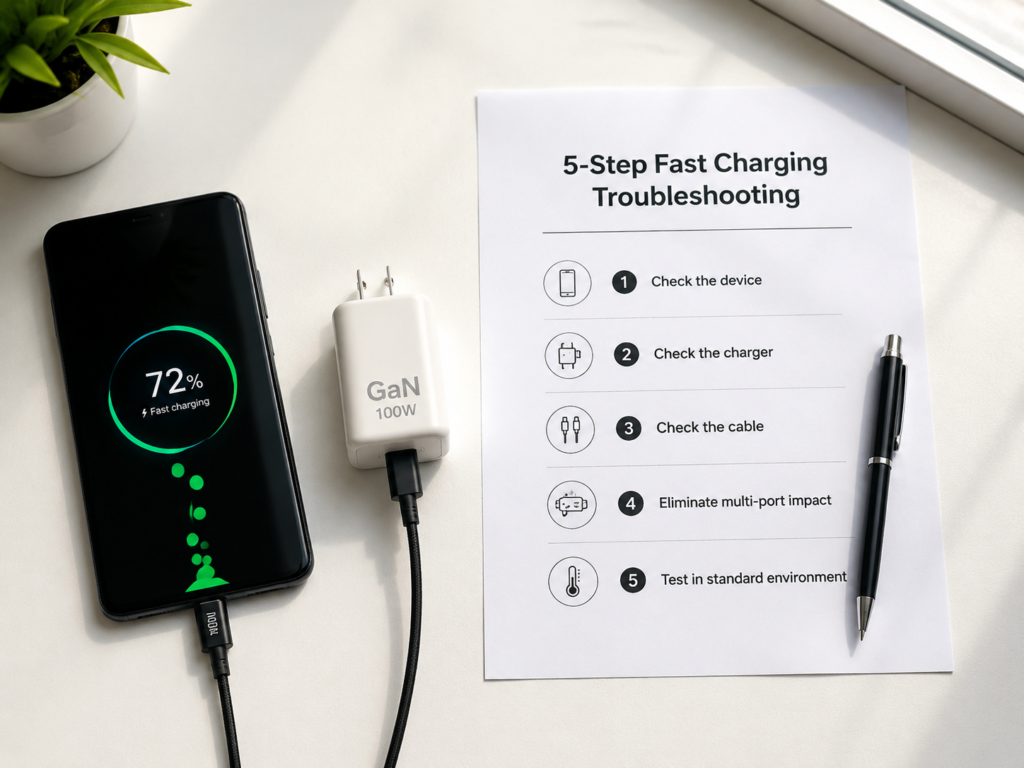
5-Step Troubleshooting Method Without Tools
If you don’t have professional testing tools, follow these 5 steps, and you can basically find the reason for underperforming charging:
- Check the device: First go to the official website to check the maximum input power and supported fast charging protocols of the device, to confirm whether your expectations are in line with reality.
- Check the charger: Find the single-port output parameter table of the charger, and confirm whether there is a corresponding PPS/AVS voltage range and current upper limit.
- Check the cable: Confirm the specification of the cable, whether it is 3A, 5A E-Marker, or 240W EPR cable, and whether it meets the requirements of the target power.
- Eliminate multi-port impact: Test with only one device connected, unplug all other devices to eliminate the impact of power shunting.
- Test in standard environment: Test when the battery is 20%-50% charged, the room temperature is around 20-25°C, the screen is off, and there is no background high load — this is the state where it is easiest to reach full power. If it can’t reach full power even at this time, then consider the problem of accessory matching.
Troubleshooting Method With Tools
If you have USB-C testing tools, you can judge the problem more accurately:
- Ordinary USB-C power meters can check real-time voltage, current, and power, and can roughly judge whether the expected wattage is reached, but cannot directly prove whether PPS or AVS is being used, and can only judge indirectly through whether the voltage changes dynamically.
- If you want to confirm the specific PDO/APDO profiles and detailed information of protocol negotiation, you need to use a tester or trigger that supports PD protocol reading.
- When testing, note: avoid charging while using, using multiple ports at the same time, or high-temperature environments, otherwise the test results will not be representative.
Purchase Decision: Reverse Inference Based on Devices, Don’t Order Based on Terms
Many people first check “whether it has PPS/AVS” when choosing a charger. In fact, the correct logic is the reverse: first look at what your device needs, then find the corresponding parameters. Don’t spend extra money on functions you can’t use.
Parameter Comparison Table Inferred from Devices
You can directly compare with your main device to see what parameters of charger you need:
- Some Samsung 45W PPS models: Prioritize choosing a charger with a 3.3-11V/5A PPS profile, paired with a 5A E-Marker cable; models that only support 25W-level PPS do not need to deliberately pursue a 5A PPS profile.
- Pixel and other PPS mobile phones: The maximum input power varies by generation. After confirming according to the specific model, just choose a compliant PD/PPS charger. There’s no need to blindly pursue high wattage and waste money.
- Thin-and-light laptops/tablets within 100W: Prioritize checking whether the power of the 20V fixed PD profile is sufficient, then check PPS support. Many thin-and-light laptops can charge at full speed without PPS.
- Handheld consoles/power banks: Confirm whether the device supports PPS, as well as the supported PPS voltage range and current, just match them.
- High-performance laptops above 140W: Prioritize checking whether they support PD3.1 EPR. Both AVS and fixed EPR profiles are fine, and must be paired with a dedicated EPR cable.
- 100W-level proprietary fast charging mobile phones: If you pursue full speed, choose the original/official certified kit; if you pursue universal convenience, choose a third-party charger that supports PPS, which is sufficient for daily use.
Key Points for Purchasing for Multi-Device Mixed Use
If you have multiple devices and need one charger to cover all, choose according to the following ideas:
- For core configuration, prioritize choosing a charger that has both PPS + PD3.1 EPR + clear single-port/multi-port power distribution, which can fast charge mobile phones and tablets, and also power high-power laptops, with the highest practicality.
- If you have many mobile phone/tablet devices, focus on checking the matching degree of PPS profiles.
- If you have a high-power laptop, focus on checking EPR profiles, AVS capability, and whether an EPR cable is included.
- If you often charge multiple ports at the same time, be sure to check the independent capability of each USB-C port, not just the total power — for example, for the same 200W dual-port charger, some have 100W per port, some have 140W for C1 + 60W for C2. Choose according to your own needs.
- For travel scenarios, prioritize choosing a charger that can cover the main device’s full speed (or close to full speed) and is compatible with mobile phone PPS, to minimize the number of accessories carried.
3 Questions You Must Ask Before Purchasing
Ask yourself these three questions before placing an order, and you basically won’t buy the wrong one:
- Does my main device support PPS, fixed PD, EPR AVS, or proprietary fast charging? What is the maximum power?
- Do I mainly use a single device, or often charge multiple devices at the same time? Do I need single-port full speed or multi-port stable power?
- Can my existing cable support the target power, current, and voltage levels? Do I need to change the cable additionally?
Situations Where Purchase Is Not Recommended
For products with the following situations, it is recommended to skip them directly, as there is a high probability of pitfalls:
- Only marked with total power, no single-port output profiles and parameters marked.
- Only written “PD fast charging”, no specific voltage range and current upper limit of PPS/AVS written.
- Promoted to support PD3.1, but does not specify whether it supports EPR or AVS.
- Multi-port chargers that do not provide a multi-port power distribution table.
- High-power kits that do not specify whether the included cable is 5A or EPR cable.
- E-commerce pages with contradictory parameters, no brand certification information, and prices significantly lower than products of the same specification are most likely falsely labeled.
Summary
One-Sentence Core Conclusion
PPS and standard AVS are not in a relationship where one replaces the other: PPS is suitable for fine fast charging at medium and low voltages within 100W for mobile phones, tablets, handheld consoles, etc., with strong versatility; standard AVS is suitable for USB PD 3.1 EPR high-power devices, covering scenarios above 140W; proprietary AVS is an exclusive scheme for full-speed fast charging of corresponding brand mobile phones, with poor reusability.
Quick Selection Mnemonic
- For mobile phones, look at PPS plus proprietary protocol
- For within 100W, look at PD/PPS profiles plus cable current
- For above 140W, look at PD3.1 EPR/AVS plus EPR cable
- For multi-port chargers, look at the distribution table, not total wattage
- If parameters are not clearly written, don’t expect full speed by default
After reading this article, you should already be able to distinguish the differences between PPS, standard AVS, and proprietary AVS, and not be confused by various abbreviations; you can understand that PD3.1 does not mean EPR is included, and EPR does not necessarily mean AVS is supported; you can understand the actual meaning of parameters like PPS 3.3-11V/5A and AVS 15-28V/5A; you can understand why high-wattage chargers don’t necessarily make mobile phones faster; you can troubleshoot common reasons for underperforming fast charging by yourself; and you can choose suitable fast charging accessories according to your own devices, cables, and usage scenarios, no longer being led by the vague promotions of merchants.