
You may have seen claims like “eco-friendly materials”, “recycled plastic housing”, “PCR raw materials” when shopping for chargers and data cables. While you think supporting environmental protection is a good thing, you can’t help but wonder: are electrical products made from recycled waste unsafe? Is it just a marketing gimmick for merchants to raise prices under a different name?
In fact, the answer is neither “recycled materials are definitely inferior” nor “anything with the word eco-friendly is better”. Recycled materials themselves are neutral; their safety and real environmental value depend entirely on source control, processing technology, testing and certification, and transparency of declarations. This article starts with basic concepts, helping you understand the differences between PCR/PIR, recycled plastics, and recycled copper, clarify the boundaries of safety, environmental protection, and compatibility certifications, learn to identify greenwashing, and finally know how to choose and dispose of old accessories.
Basic Understanding: What Recycled Materials Are and Are Not
Before discussing safety and environmental protection, let’s first explain the most basic concepts thoroughly to avoid being confused by various terms at the beginning.
Plain-Language Definition and Basic Premises
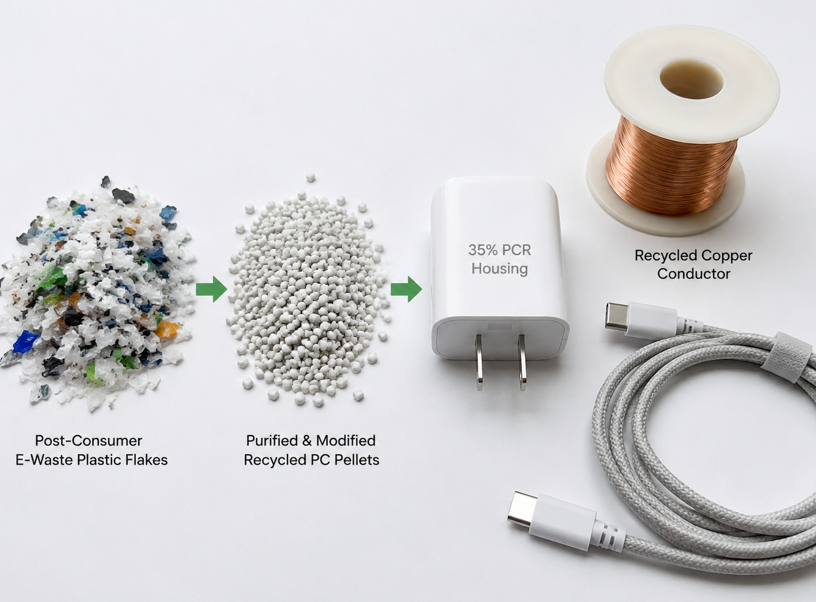
Recycled materials are not just old garbage directly stuffed into new products. Its complete process is: collect materials from sources such as old products, discarded packaging, electronic waste, and factory production offcuts, go through sorting, cleaning, crushing, melting, granulation, refining, or multi-step reprocessing, and after confirming that the performance meets standards, they are reused to manufacture new products.
To use a common analogy: compliant recycled metal is like melting old iron pots back into standard-compliant iron ingots, then making new hardware; compliant recycled plastic is like cleaning, crushing, and re-granulating waste plastic bottles, adjusting the formula to make new plastic housings, instead of cutting old bottles and gluing them directly into products.
For electrical products like chargers and cables, there is a bottom line that must be clarified first: Environmental attributes can never replace electrical safety requirements. Even if 100% recycled materials are used, as long as they fail to meet safety standards such as flame retardancy, insulation, and heat resistance, they are unqualified products.
Common Classifications: Distinguished by Source, Circular Path, and Process
Recycled materials are not a single category. Recycled materials from different sources and processes have great differences in performance stability and environmental value. Common classifications are as follows:
By Source: PCR and PIR
- PCR (Post-Consumer Recycled): Refers to materials from waste after consumer use, such as old electronic product housings, waste cables, waste plastic bottles, and old packaging. This type of recycled material directly treats consumer-side waste, which has higher environmental narrative value, but due to complex sources, it is also more difficult to sort, purify, and trace.
- PIR (Pre-Consumer/Industrial Recycled): Refers to materials from offcuts, scrap, and runner materials generated during factory production, such as excess plastic cut off when producing charger housings, which are recycled and reused before reaching consumers. This type of recycled material has more controllable composition and usually better performance stability, but essentially reduces factory waste and does not necessarily solve the problem of electronic waste generated by consumers.
By Circular Path: Closed-Loop and Open-Loop
- Closed-loop recycling: Refers to the recycling of similar materials back to similar uses, for example, copper from waste cables is re-refined to make new cable conductors, and PC housings of old chargers are recycled to make new charger housings. This model has clear traceability, high matching between material performance and use, and is a more efficient cycle.
- Open-loop recycling: Refers to cross-industry reuse of materials after recycling, for example, waste packaging plastic is modified for some non-critical plastic parts or packaging components; if used for parts with flame retardant and heat resistance requirements such as charger housings, they must still meet the requirements of flame retardancy, heat resistance, insulation, and structural strength – at present, the more common recycled plastic systems for charger housings are still PC, ABS, PC/ABS, etc. Making product manuals from old packaging paper is also a typical open-loop recycling. This model is flexible in application, but due to large changes in use, it is also more difficult to adjust performance and trace.
By Processing Technology: Mechanical Recycling and Chemical Recycling
- Mechanical recycling: Re-processes materials through physical methods such as sorting, cleaning, crushing, remelting, and granulation. It is currently the most common method for plastic and metal recycling, with relatively low costs. However, the performance of plastics may gradually decline due to impurity contamination and increased number of cycles, and formula adjustment is usually required to compensate.
- Chemical recycling: Breaks down organic materials such as plastics into monomers, oils, or basic chemicals, then re-synthesizes new materials. Theoretically, the performance of materials obtained by chemical recycling can be close to that of virgin materials, but currently the cost is higher, energy consumption and scale vary, and the real carbon reduction effect must be judged in combination with specific processes, and cannot be generalized.
Six Groups of Easily Confused Concepts
Many merchants use similar concepts to play edge cases. We clarify them one by one in the context of chargers and cables:
- Recycled materials vs. recyclable materials: Recycled materials mean that used materials are already incorporated in the product, for example, the charger housing contains 30% recycled PC; recyclable materials mean that the product can theoretically be recycled and reused after use, for example, the housing is recyclable virgin PC plastic, but no recycled materials are used itself. The two are completely different things, and “recyclable” cannot be regarded as “containing recycled materials”.
- Recycled materials vs. bio-based materials: Bio-based materials come from biomass such as corn, sugarcane, and straw, for example, plastic housings made of corn starch. Their raw materials are of biological origin, but they are not necessarily recycled, nor necessarily recyclable, and may not even meet the flame retardant and insulation requirements of electrical products.
- Recycled materials vs. biodegradable materials: Biodegradable materials are materials that can be decomposed by microorganisms under specific conditions. However, the core requirements of chargers and cables are long-term durability, insulation, and flame retardancy. If biodegradable materials are used in parts that require long-term stability such as cable jackets and charger housings, they may instead bring safety hazards due to premature aging and cracking. Of course, non-critical packaging and decorative parts are another matter, but core live parts are not naturally suitable for biodegradable materials.
- Recycled materials vs. refurbished products: Recycled materials are reuse at the material level, for example, making old plastic into new housings, with internal circuits and components all new; refurbished products are secondary sales at the whole machine/accessory level, for example, repairing and testing old chargers before reselling them. The two are completely different concepts.
- Regenerated materials vs. recycled materials: In daily context, the two have similar meanings. Regenerated materials emphasize “re-entering the production link after processing”, such as recycled plastic and recycled copper, which essentially belong to the category of recycled materials.
- Products using recycled materials vs. brand recycling programs: Products using recycled materials refer to the material composition of new products, while brand recycling programs refer to the old product recycling and disposal services provided by brands – the two cannot prove each other: some brands have old product recycling programs, but new products do not use recycled materials at all; some products use recycled materials, but the brand does not have supporting old product recycling channels.
Common Recycled Materials in Chargers and Cables
Not all recycled materials can be used in electrical products. At present, common recycled materials in charging accessories mainly include the following categories:
- Recycled plastics: The most common type, which can be used for charger housings, cable connector housings, cable jackets, packaging inner trays, etc. Common types include recycled PC, ABS, PC/ABS alloys (mostly used for hard housings), as well as recycled PVC, TPE, TPU, nylon (mostly used for soft parts such as cable jackets, sheaths, and braided layers).
- Recycled metals: Copper, aluminum, and steel can all be recycled and reused. For example, recycled copper is used for cable conductors and shielding layers, and recycled aluminum or steel is used for charger prongs and housing metal structural parts. The technical maturity of metal recycling is usually higher than that of complex plastics, and the performance is easier to control.
- Recycled paper and auxiliary materials: Recycled paper, FSC-certified paper, soy ink, water-based ink, etc., are mostly used for product outer boxes, paper trays, manuals, and labels. These are environmental protection measures at the packaging level and cannot be directly equated with the use of recycled materials in the charger or cable body.
Which Parts Are Suitable for Recycled Materials, and Which Require Caution
Not all parts are suitable for high-proportion recycled materials. The core principle is: Safety, lifespan, and consistency always take priority over recycling ratio.
Suitable and Cautious Parts for Chargers
- Parts suitable for recycled materials: housings, decorative parts, packaging, and some non-load-bearing metal structural parts – these parts are usually more suitable as a starting point for recycled material applications than internal key insulating parts. However, the charger housing itself may still undertake functions related to fire protection, impact resistance, and accessible insulation, and must meet safety requirements such as flame retardancy, heat resistance, dimensional stability, and structural integrity after falling, and does not have lower safety standards.
- Parts where high-proportion recycled materials should be used with caution: plastic parts close to high-temperature components (such as transformers, power chips), key insulating parts, internal support brackets, and structural parts that affect creepage distance and electrical clearance. These parts have extremely high requirements for heat resistance, insulation, and dimensional stability. If recycled materials have many impurities and insufficient heat resistance, they may cause leakage or short circuit risks due to deformation and reduced insulation, and must pass strict testing and verification before use.
Suitable and Cautious Parts for Cables
- Parts suitable for recycled materials: outer jacket, braided layer, connector housing, packaging, and some non-core metal structural parts – these parts mainly play a protective and decorative role, and have little direct impact on electrical performance.
- Parts where high-proportion recycled materials should be used with caution: stress areas with long-term bending, conductors carrying large currents, shielding layers, solder joint coatings, and precision terminals. For example, if high-current conductors use recycled copper with insufficient purity, the resistance will be higher, and it is prone to abnormal heating during high-power charging; if recycled plastic with insufficient toughness is used in long-term bending areas, it is easy to crack and expose internal conductors, bringing safety hazards. If recycled materials are to be used in these parts, they must undergo strict lifespan, conductivity, and bending tests.
Common Beginner Misconceptions
Finally, let’s correct a few most common cognitive pitfalls to help you establish a basic judgment framework:
- Recycled materials are definitely inferior and unsafe: Wrong. As long as the source is controllable, the formula is reasonable, the testing is sufficient, and the mass production control is in place, recycled materials can fully meet the same safety standards as virgin materials.
- Eco-friendly products must use recycled materials: Wrong. The scope of environmental protection is very wide. Packaging reduction, carbon emission reduction, recyclable design, and old product recycling programs are all environmental protection measures, which do not necessarily mean that the product uses recycled materials.
- Green leaves and eco-friendly icons represent safety: Wrong. Eco-friendly icons are only related to environmental protection declarations and cannot replace electrical safety certifications. The safety of electrical products is always the first priority.
- The higher the recycling ratio, the better: Wrong. The significance of the recycling ratio should be considered together with the use part, material type, and product lifespan. If a high ratio is used in key safety parts and the product lifespan is greatly shortened, it is neither safe nor environmentally friendly.
Core of Safety: Do Recycled Materials Affect Charging Safety?
The first question many people care about most is: are chargers and cables made of recycled materials more prone to safety problems than those made of virgin materials? In fact, the answer is the same as “whether virgin materials are definitely safe” – whether it is safe never depends on the label of “recycled” or “virgin”, but on whether the materials meet the standards, whether the design has been verified, whether mass production is controlled, and whether it has passed the corresponding safety certification. In this section, we will explain the logic of safety judgment thoroughly to help you avoid the core risks.
Safety Bottom Line: Environmental Protection Cannot Replace Safety, Certifications Must Cover Actual Materials
First of all, we must emphasize again the iron rule of all electrical products: Environmental attributes can never replace electrical safety requirements. Even if a product claims to use 100% recycled materials, as long as it fails to meet safety standards such as flame retardancy, insulation, heat resistance, and mechanical strength, it is an unqualified dangerous product.
Compliant recycled materials must meet exactly the same product safety requirements as the corresponding virgin materials, including flame retardancy, heat resistance, insulation, mechanical strength, durability, and hazardous substance limits. There is no saying that “standards can be lowered because it is recycled material”.
There is a key pitfall that the vast majority of consumers do not know: safety certification is not “one certificate for life”. The certification of a product is bound to the material grade, flame retardant system, plastic formula, color, additives, supplier, and production process it actually uses. If the sample originally made of virgin plastic passed the safety certification, but the mass production secretly replaced it with recycled plastic, or changed the supplier of recycled materials, adjusted the recycling ratio, but did not re-do the test and update the certification, then the original certification certificate does not cover the actual products on sale – which means the certification logo you see is for another “virgin material version” and has nothing to do with the recycled material product in your hand.
You may ask: what exactly needs to be tested for a housing made of recycled materials to be considered safe? You don’t need to memorize complex standard numbers, we will explain the risks corresponding to each test in plain language:
- Flame retardant test: To see if the material will extinguish quickly when exposed to open flame, and whether the fire will spread, to prevent the housing from burning more and more after catching fire.
- Glow wire test: Simulates when internal heating parts (such as resistors, heating wires) touch the plastic housing, whether it will ignite the housing, which is equivalent to adding a fire barrier to internal faults.
- Ball pressure/heat deformation test: To see if the housing and key insulating parts will soften and deform in high-temperature environments – if the housing softens at high temperatures, the live parts inside may be exposed, or the original safety distance may be damaged, which is easy to cause electric shock.
- Comparative Tracking Index (CTI): Measures whether the surface of the plastic housing is prone to leakage traces when damp or dusty. Over time, insulation failure may cause short circuit or leakage.
- Aging resistance test: Simulates whether the plastic will become brittle or crack after long-term exposure to heat, light, and humidity, to prevent the housing from breaking after one or two years of use and exposing live parts.
- Structural integrity test after drop: To see if the housing will crack and expose live parts after the product falls from a common height, and whether the internal electrical safety distance will be damaged.
- Dimensional stability test: To see if the plastic parts will expand or contract too much when temperature and humidity change, causing loose interfaces and internal parts displacement, affecting safety.
- Hazardous substance test: Ensure that restricted substances such as lead, cadmium, mercury, and harmful flame retardants in the material do not exceed the standard, to avoid long-term contact or environmental pollution after scrapping.
In short: recycled materials have to pass exactly the same safety checks as virgin materials, and none can be missing.
Common Risks of Unqualified Recycled Materials
If the source, processing, and testing of recycled materials are not in place, they may indeed bring safety hazards. Common ones are the following categories:
The first category is risks caused by excessive plastic impurities. If recycled plastic is mixed with too many different types of plastics, metal debris, oil, or insufficient flame retardants, there will be problems such as reduced flame retardant grade, poor heat resistance, and brittle material that is easy to crack. In severe cases, it may cause the housing to fail to block the flame in case of internal short circuit, or the housing to deform and crack at high temperatures, causing electric leakage, melting, or even fire.
The second category is risks caused by substandard metal purity or wire diameter. For example, the purity of recycled copper is insufficient, mixed with too many impurities, or merchants use thinner copper wires to save materials but falsely mark the current, which will lead to high conductor resistance. During high-power charging, places with high resistance will heat abnormally, which may reduce charging efficiency at best, or burn the connector at worst, or even break the conductor and cause a short circuit.
The third category is risks of hazardous substance residues. If the source of recycled materials is unknown, such as from electronic waste that has not been properly treated, it may contain residual lead, cadmium, mercury, hexavalent chromium, or excessive harmful flame retardants and phthalate plasticizers, which may not only affect product performance, but also contact the human body during use, or pollute the environment after scrapping.
The fourth category is risks of poor batch consistency. Some small factories use good recycled materials for the first batch of goods, and after obtaining certification, they replace subsequent batches with cheaper, more mixed waste materials, resulting in decreased performance and safety of subsequent products, which consumers cannot see at all when buying.
The fifth category is risks of fake environmental protection combined with jerry-building. This is the most vigilant: some merchants under the banner of “recycled materials” and “environmental protection” actually use inferior waste to reduce costs, while falsely marking power, reducing wire diameter, and having no safety certification, using environmental protection rhetoric to cover up the core safety problems, which is more deceptive than ordinary inferior products.
Five Conditions for Controllable Risks
Of course, not all recycled materials have risks. As long as the following five conditions are met, the safety of recycled materials can be completely equal to that of virgin materials:
The first condition is controllable sources. Recycled materials must come from formal electronic waste dismantling systems, qualified industrial offcut suppliers, or recycling supply chains with complete traceability chains, and cannot be “foreign garbage” or mixed waste of unknown origin.
The second condition is proper sorting and purification. The collected waste must undergo strict sorting, cleaning, and purification to remove mixed foreign plastics, metal impurities, oil, halogen-containing pollutants, and additives of unknown origin, so as to ensure the purity and consistency of the base material.
The third condition is reasonable formula modification. Because the performance of recycled materials may be different from that of virgin materials, it is necessary to adjust the performance of the material by adding flame retardants, toughening agents, stabilizers, compatibilizers and other components, so that it fully meets the requirements of the target part – for example, to make a charger housing, the flame retardant grade, heat resistance, and strength must be adjusted above the safety standard.
The fourth condition is sufficient testing. In addition to the basic tests mentioned above such as flame retardancy, insulation, heat resistance, mechanical strength, aging, and hazardous substances, tests should also be carried out in combination with the actual use scenarios of the product: for example, cables need to be bent tested, conductors need to be tested for conductivity, and abnormal use scenarios (such as overload, short circuit) should also be simulated to ensure that there will be no problems.
The fifth condition is strict mass production control. You can’t just use good materials for the samples submitted for inspection; every batch must be controlled during mass production. Whenever the supplier is changed, the batch of recycled materials is changed, the color is changed, the recycling ratio is adjusted, or the production process is changed, re-verification must be carried out to ensure that the performance of each batch of products is consistent and meets safety requirements.
Which Experience Problems Are Not Necessarily Caused by Recycled Materials
Many people who buy charging accessories with small problems will blame recycled materials as long as they are eco-friendly models. In fact, many experience problems have nothing to do with recycled materials at all, don’t attribute them randomly:
- Slow charging: This is the most common misunderstanding. Charging speed is mainly determined by the output power of the charger, the current carrying capacity of the cable, the matching degree of the fast charging protocol, and the charging strategy of the device itself. It is usually not directly determined by whether the housing uses recycled plastic or whether the outer jacket is recycled TPE. However, the conductor specification, internal structure design, and heat dissipation performance of the cable will affect the temperature rise and power stability during long-term use of large current, so it is still necessary to refer to the rated current, e-marker, and certification information marked on the product. If your eco-friendly charger charges slowly, first check the power, protocol, and compatibility, don’t blame the recycled material first.
- Appearance color difference: PCR (Post-Consumer Recycled) plastic, due to its complex source, may indeed be more difficult to achieve exactly the same color in each batch than virgin plastic. Slight color difference is normal and does not mean there is a safety problem. But if there are obvious impurities, black spots, or cracks, that is a problem of quality control or material quality, which is not necessarily related to whether it is recycled material – virgin materials with poor quality control will also have these problems.
- Hand feel too hard or too soft: The hand feel of the cable jacket is mainly related to the material system (for example, PVC, TPE, TPU have different hand feels), the formula of plasticizers or elastomers, the internal structure of the cable (such as whether there is a braided layer, how many layers of shielding there are), and the ambient temperature (plastic will harden in winter), and has no direct relationship with whether it is recycled material.
- Slight odor: It is normal for a newly unpacked charger or cable to have a slight plastic smell, glue smell, or ink smell, which may come from plastic, glue, or packaging printing, and will dissipate after a few days of ventilation, not necessarily a problem of recycled materials. But if the smell is pungent, lasts for a long time and does not dissipate, or is accompanied by heating and deformation during use, stop using it immediately and contact the merchant for after-sales service.
Safety Information That Ordinary Users Can Understand
You don’t need to check complex standard documents. As long as you understand the following types of information on the product and the detail page, you can make a basic safety judgment:
Information to check for chargers: Input voltage range (whether it adapts to the voltage in your area), total output power, maximum output power per port, power distribution when multiple ports are used at the same time, PDO/PPS fast charging gears, product model, manufacturer/responsible party name, safety certification logo.
Information to check for cables: Rated current, rated voltage, USB version, supported PD fast charging power, whether it supports 5A high current, whether there is a built-in e-marker chip, and the workmanship of the connector.
Regarding the boundaries of certification, you don’t need to memorize too much, just distinguish these categories:
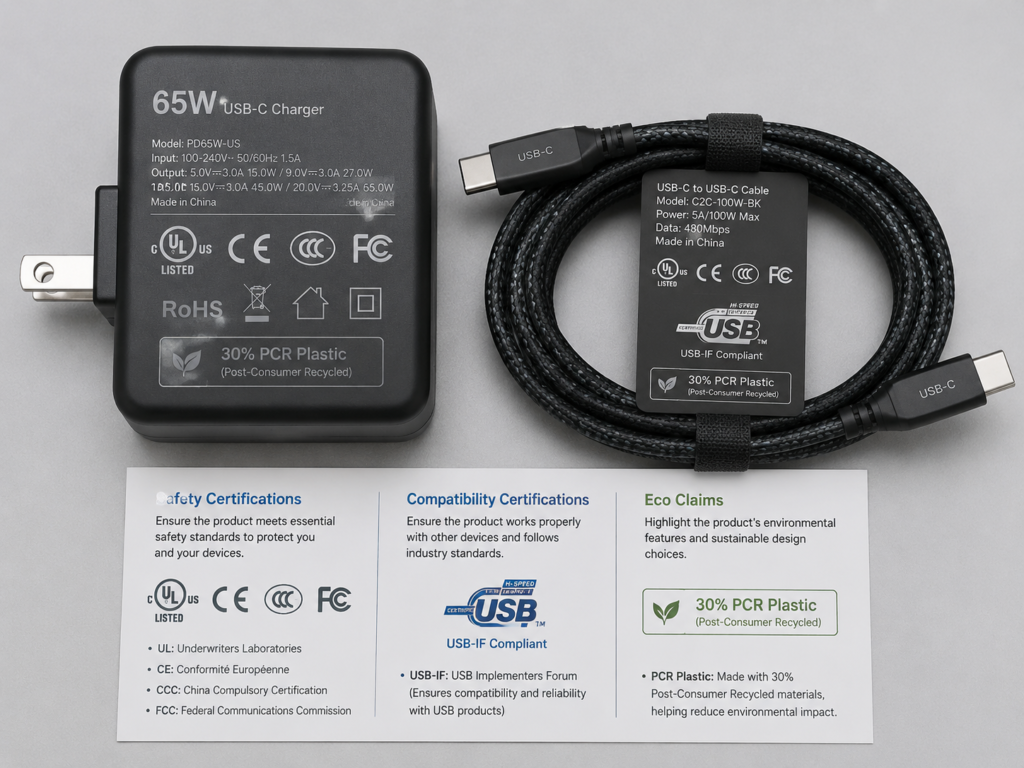
- CE, UKCA, CCC, PSE, RCM, KC are basic compliance access marks for the target market, which are the basic requirements for entering the local market. Among them, CE is usually the manufacturer’s self-declaration of conformity, which is not equal to a safety certification issued by a third-party institution. When purchasing, it needs to be judged together with the manufacturer’s DoC (Declaration of Conformity), product model, responsible party information, and sales channel.
- UL, ETL are high-credibility third-party safety certifications, which are stricter than ordinary access marks, but be sure to check that the product model on the certificate is exactly the same as the product you buy, otherwise it is invalid.
- FCC mainly manages electromagnetic compatibility/radio frequency compliance, does not prove electrical safety, nor does it prove environmental protection, don’t confuse it.
- USB-IF, MFi are compatibility certifications, which mainly manage whether fast charging can match and whether it will damage the device, and cannot replace safety certification.
- As for standard numbers such as IEC/UL 62368-1, ordinary users don’t need to memorize them, just confirm that the product meets the safety requirements of the target market and the certificate model is consistent with the product.
Remember a core point: Products with no model, no manufacturer, blurred certification marks, and no corresponding certificates can be found, no matter how eco-friendly they are boasted, absolutely do not buy.
Sustainability Question: Are Recycled Materials Really More Environmentally Friendly?
After confirming the premise of safety, let’s return to the topic of environmental protection: are chargers and cables made of recycled materials really more environmentally friendly than ordinary products? There is no absolute answer to this question, it depends on many factors.
Potential Environmental Value of Recycled Materials
From a general perspective, recycled materials do have certain environmental benefits, but the differences between different materials are very large:
The emission reduction effect of recycled copper and aluminum is widely recognized, because the mining and smelting of virgin copper and aluminum require a lot of energy, and the energy consumption of recycled metals is much lower – of course, how much can be reduced depends on the smelting process, power structure, waste purity, and transportation distance, and cannot be generalized.
Mechanically recycled plastics can usually reduce the consumption of virgin petrochemical raw materials, and can also reduce carbon emissions in many scenarios, but the processes of cleaning, drying, granulation, and modification also consume energy and water, and the benefits are not absolute.
Recycled paper can reduce some wood pulp demand and reduce waste pressure, but deinking, transportation, and strength adjustment will also bring environmental impacts, not necessarily much better than virgin paper.
Here is a reminder: any claim of “XX% carbon reduction” or “XX times more environmentally friendly” without explaining the calculation boundary, functional unit, region, year, and data source is not rigorous and is likely to be marketing rhetoric. The so-called LCA (Life Cycle Assessment) system boundary, in plain language, is whether this environmental assessment only counts the stage of “making recycled materials into products”, or counts the whole process of raw material collection, transportation, factory manufacturing, consumer use, and scrapping and recycling. Different boundaries may result in carbon reduction numbers that differ by several times, which cannot be directly compared at all.
Special Significance of Using Recycled Materials in Chargers and Cables
Why do many brands start to use recycled materials in charging accessories? Because this type of product has several characteristics:
First, the shipment volume is particularly large. Even if each product only saves a few grams of virgin materials, the total amount is very considerable.
Second, the cable has a high degree of complexity, with copper, plastic, shielding layer, terminals, and rubber inside. Formal dismantling and recycling can recycle multiple resources at the same time, reducing waste.
Third, copper has high resource value. Formal recycling can not only reduce mineral mining, but also avoid pollution caused by illegal dismantling (such as burning wires to get copper).
Fourth, if brands are willing to publicly disclose the PCR/PIR ratio, material sources, and certifications, it can promote the entire supply chain to be more transparent, which is itself a kind of progress.
Key Factors Affecting Real Environmental Friendliness
Not all products using recycled materials are really more environmentally friendly, it also depends on these conditions:
The first is whether the recycling process is compliant. If recycling is done by open-air dismantling, burning waste wires to get copper, or using untreated pickling processes, it will cause more serious pollution instead, which is not sustainable at all.
The second is transportation distance and energy structure. If recycled materials have to be transported across continents several times, or the recycling processing uses high-carbon electricity, the carbon reduced may be offset again.
The third is product lifespan. If the lifespan of products using recycled materials is significantly shorter than that of virgin materials, for example, ordinary cables can be used for two years, while recycled material ones can only be used for half a year, then calculated over the entire life cycle, it is even less environmentally friendly.
The fourth is recycling ratio and part. Packaging containing 30% recycled paper, the housing containing 30% PCR plastic, and the conductor containing 30% recycled copper have completely different environmental meanings, you can’t just look at the ratio number.
The fifth is substitution relationship. It depends on whether recycled materials really replace virgin materials, rather than launching “eco-friendly models” that stimulate consumers to buy even when they don’t need to, which instead creates more waste – after all, the most environmentally friendly product is the one you are already using.
Common Pseudo-Environmental Protection Propaganda
Many merchants’ environmental protection propaganda is adulterated. Be vigilant when encountering the following situations:
- Only saying “eco-friendly materials” or “recycled materials”, without specifying what material it is, which part it is used in, and what the proportion is.
- Calling “recyclable” as “containing recycled materials”, swapping concepts.
- Taking packaging environmental protection such as recycled paper and soy ink for packaging as the environmental protection of the product itself.
- Claiming “100% environmentally friendly”, “zero pollution”, “zero-carbon charger”, but cannot provide life cycle assessment, carbon accounting reports or third-party verification.
- Using “high recycling ratio” to cover up the problems of poor product quality, short lifespan, and no safety certification.
Map of Regulations and Standards: Safety, Chemicals, Environmental Declarations, and E-Waste Should Be Viewed Separately
When it comes to the authenticity of environmental protection propaganda, it is inseparable from the regulations and rules of various markets – many people think that “environmental protection” is just the moral consciousness of merchants, but in fact, different countries and regions have clear requirements for green declarations, electronic waste, and hazardous substances, and these rules belong to different categories and cannot be confused. This is like buying food: food safety standards control whether eating will make you sick, nutrition labels control ingredient content, and eco-friendly packaging controls whether the box can be recycled. The three are completely independent and cannot prove each other. The same is true for the regulations of chargers and cables.
Three Types of Rules Cannot Prove Each Other
The rules related to recycled material charging accessories can be roughly divided into three categories, each of which manages completely different things:
The first category is safety compliance rules: They manage requirements directly related to personal safety such as electric shock, overheating, fire, electromagnetic compatibility, and structural strength. For example, the safety regulations corresponding to UL, CCC, and CE that we often talk about belong to this category.
The second category is chemical and hazardous substance restriction rules: They manage which excessive substances cannot be contained in products, such as lead, cadmium, mercury, hexavalent chromium, polybrominated biphenyls (PBB), polybrominated diphenyl ethers (PBDE), and some phthalate plasticizers. RoHS, REACH, and China RoHS all belong to this category.
The third category is environmental declaration and e-waste responsibility rules: They manage whether merchants’ green propaganda has a basis, whether the recycled material content is true, and whether producers should bear the responsibility of recycling and disposing of old products. For example, WEEE, FTC Green Guides, GRS/UL 2809 and other recycled content verifications are related to this category.
Here we must emphasize the core boundary again: Environmental protection certification does not mean safety certification, and safety certification does not mean that the product really contains recycled materials. You can’t think that a product is both safe and environmentally friendly just by seeing a CE mark, nor can you think that a product must meet safety standards just by seeing a GRS certification.
How to View EU Rules
The EU is one of the regions with the most complete regulations on electronic and electrical products in the world. The rules related to recycled material charging accessories mainly include the following:
- WEEE (Waste Electrical and Electronic Equipment Directive): Requires producers of electronic products to bear the responsibility for recycling, disposal and labeling of waste products. The crossed-out trash can icon you see on many chargers is the label required by WEEE. However, the implementation details of each EU member state are different, and the specific recycling methods and producer obligations shall be in accordance with local rules.
- RoHS (Restriction of Hazardous Substances Directive): Restricts the content of lead, mercury, cadmium, hexavalent chromium, PBB, PBDE and some phthalates in electronic and electrical products. There is a key point directly related to recycled materials: Recycled materials cannot be a reason for excessive hazardous substances. Even if recycled plastic or recycled metal is used, it must meet the limit requirements of RoHS.
- REACH (Registration, Evaluation, Authorization and Restriction of Chemicals): Involves the registration, restriction of chemicals and information transmission of substances of very high concern (SVHC). If additives and residual pollutants in recycled materials fall within the scope of REACH restrictions or substances of very high concern, they also need to meet the corresponding requirements and cannot be used casually.
- CE mark: Many people think that CE is a safety certification issued by a third party, but it is not – CE is usually the manufacturer’s self-declaration of conformity, meaning that the manufacturer itself declares that the product complies with all applicable EU regulations. When buying products from the EU market, you can’t just look at the CE mark, you also need to judge together with the manufacturer’s DoC (Declaration of Conformity), product model, responsible party information, and sales channels to avoid buying products with forged CE marks.
- USB-C universal charging requirement: The EU promotes the unified use of USB-C interfaces for mobile phones, tablets and other devices. One of the goals is to reduce the repeated purchase and waste of chargers, but this is only a requirement for interfaces and charging specifications, it does not mean that a unified recycled material ratio is set for chargers or cables, don’t be fooled by the rhetoric that “meeting EU USB-C requirements makes it more environmentally friendly”.
- ESPR (Ecodesign for Sustainable Products Regulation): This is the EU’s new ecodesign framework. In the future, it may promote more requirements for repairability, recyclability, and recycled content disclosure of products. But specifically for chargers and cables, it still depends on the corresponding product group implementation regulations. At present, there is no unified mandatory recycling ratio requirement, and you cannot generally say that “complying with ESPR means using recycled materials”.
How to View US Rules
The US regulatory system is different from that of the EU. There is no unified federal-level mandatory environmental protection requirement for electronic products, but there are several key rules to understand:
- FTC Green Guides: This is the core rule for green marketing in the US, requiring that green claims such as “recycled content”, “recyclable”, and “eco-friendly” must have a reasonable basis, and cannot be vague, exaggerated, or misrepresented. For example, only saying “eco-friendly charger” without explaining where it is eco-friendly, or calling “recyclable” as “containing recycled materials”, may be misleading publicity and violate FTC requirements.
- FCC (Federal Communications Commission): FCC mainly covers electromagnetic compatibility and radio frequency compliance, that is, the product will not interfere with other electronic devices and meets radio frequency radiation requirements. It does not prove electrical safety, nor does it prove material safety or environmental attributes. Don’t think that a product is safe and environmentally friendly just by seeing the FCC mark.
- UL/ETL certification: UL and ETL are both high-credibility third-party safety certifications, but they are usually not federal mandatory requirements for all electronic products. However, many retail channels and corporate procurement will take UL/ETL as access conditions. Like all certifications, when buying, be sure to check that the product model on the certificate is consistent with the one you buy, otherwise it is invalid.
- State-level rules: The regulation of e-waste recycling, consumer protection, and green declarations varies greatly from state to state in the US. For example, California has stricter regulation of misleading environmental protection propaganda and also has its own e-waste recycling system. The specific rules shall be in accordance with the state where you are located.
Differences in Markets Such as Japan, Australia/New Zealand, the UK, and China
In addition to the EU and the US, the rules of other common markets are also different. Special attention should be paid when purchasing cross-border or sourcing:
- Japan: PSE is Japan’s electrical product safety certification, covering the specified range of electrical products, but not all cables are within the scope of mandatory PSE; e-waste recycling is mainly based on the Small Home Appliance Recycling Law, and specific obligations should also be confirmed according to product categories.
- Australia/New Zealand: The RCM mark is the local compliance mark, involving electrical safety and electromagnetic compatibility requirements; e-waste recycling is jointly promoted by national policies, state-level rules and industry plans, and recycling channels and requirements vary from region to region.
- UK: After Brexit, UKCA has become the main compliance mark in the UK. Although WEEE and RoHS rules have continuity with the EU system, the specific requirements shall be subject to the current local rules of the UK, and cannot be directly applied to EU CE rules.
- China: CCC certification applies to some power adapters and other products, and ordinary data cables may not be within the mandatory scope of CCC; China RoHS focuses on the restriction of hazardous substances; green product and recycled material declarations also need to comply with relevant national standards, advertising laws and anti-unfair competition requirements, and cannot be exaggerated casually.
Finally, a reminder for friends who buy or source cross-border: in addition to certification, plug specifications, input voltage, warranty policy, and local recall channels should be confirmed in advance to avoid buying products that cannot be used or having no after-sales service when problems occur.
Common Regulatory Misconceptions
Many people have deviations in their understanding of regulations. Here are the most common ones corrected:
- Not all countries mandate the labeling of recycled material ratio: At present, the rule in most regions is “if you claim to use recycled materials, you must have evidence”, rather than mandating how much recycled materials all products must use and that the ratio must be labeled.
- Regulations will not require products to use all recycled materials: Even if there are minimum recycled content requirements in the future, they will be implemented in stages according to different categories and different materials, and will not require “100% recycling” across the board.
- Various certifications/marks cannot replace each other: CE, FCC, RoHS, GRS, UL 2809 these manage completely different things. Having one does not mean having another. For example, having RoHS certification does not mean using recycled materials, and having GRS certification does not mean the product is safe.
- Products from informal channels have high risks: Parallel imports, three-no products, and products from informal channels may not only fail to comply with local regulations, but also be difficult to find after-sales or recall channels when problems occur. Try not to buy them.
Declaration Identification: How to Understand Recycled Material Propaganda?
After understanding the basic boundaries of regulations, let’s talk about how ordinary consumers can distinguish the true from the false in the face of merchants’ various recycled material propaganda. In fact, as long as you grasp a few core points, you can avoid most pitfalls.
First Find Three Things: Part, Material, Proportion
A reliable recycled material declaration will definitely make three things clear: which part it is used in, what recycled material is used, and what the proportion is.
For example, “the charger housing uses 30% PCR PC plastic”, which is very clear: the part is the housing, the material is recycled PC (polycarbonate), the proportion is 30% of the housing plastic, and it is also PCR (Post-Consumer Recycled).
If the product page only writes “uses eco-friendly recycled materials” or “made with recycled materials”, but does not say the part, material, and proportion, it can basically be judged as vague propaganda, and most likely only the packaging uses some recycled paper, which has nothing to do with the product itself.
The Calculation Caliber of the Proportion Must Be Clarified
The same “30% recycled materials” has different calculation calibers, and the actual meaning is vastly different. Common calibers are the following:
- Calculated by part weight: For example, 30% of the housing plastic is recycled material, which is the most practical and can directly reflect the material composition of the part.
- Calculated by whole machine weight: Including transformers, circuit boards, and metal parts in the charger, the recycling ratio will naturally be very low, and cannot be directly compared with the part proportion.
- Calculated by total plastic weight: That is, the recycling ratio of all plastic parts of the product added together, excluding metals and electronic components.
- Calculated by packaging weight: Only counts the recycling ratio of the packaging, which has nothing to do with the product body at all.
In addition, many people will struggle with which is better between PCR and PIR: from the perspective of environmental narrative, PCR deals with waste generated by consumers, and the value is more intuitive; but PIR, because it is industrial offcuts, has more controllable sources and more stable composition, and may have better product performance. You can’t simply say that PCR is definitely better than PIR, it depends on the specific application scenario.
How to View Common Environmental/Recycling Certifications?
Many merchants use various certifications as endorsements, but different certifications have completely different functions. Common ones are the following:
- GRS (Global Recycled Standard): This certification focuses on recycled material content, supply chain traceability, social and environmental management requirements. But note that GRS certificates have different coverage scopes, some are certificates of material factories, some are certificates of assembly factories, some are certificates of specific product models. You must confirm that the certificate covers the material, part, factory and model of the product you buy, otherwise it cannot prove that this product really uses qualified recycled materials.
- UL 2809: This is UL’s recycled content verification program, specifically used to verify whether the product’s recycled material declaration is true – but it is not UL’s electrical safety certification, it is only verification of recycled content, don’t confuse it.
- SCS Recycled Content, TÜV Recycled Content Certification: These also belong to third-party verification of recycled content or environmental declarations. Similarly, you need to check the coverage object, validity period and declaration caliber, don’t believe it just by seeing the logo.
- FSC certification, recycled paper certification: Most of these are for packaging paper materials, and have nothing to do with the body materials of chargers and cables, and cannot prove that the product itself uses recycled materials.
Here we must emphasize a boundary: material certificates, factory certificates, product model certificates, and batch declarations are completely different things. You cannot use the certificate of the upstream material supplier to directly replace the recycled content declaration of the final product.
Four Types of Certifications Are Completely Independent and Cannot Replace Each Other
At this point, we can divide common certifications into four categories. Be sure to remember their boundaries clearly and don’t be fooled by merchants’ “multiple certifications”:
- Safety certification/compliance: Manages safety issues such as electric shock, fire, and overheating, such as safety regulations corresponding to UL/ETL, CCC, PSE, RCM, CE.
- Hazardous substance compliance: Manages the content of restricted substances, such as RoHS, REACH, China RoHS.
- Environmental/recycling certification: Manages whether recycled materials are used, how much is used, and whether the source is traceable, such as GRS, UL 2809, SCS recycled content certification.
- Compatibility certification: Manages fast charging and ecological adaptation, such as USB-IF, MFi, QC.
These four types of certifications are completely independent. Having one does not mean having another, and they cannot replace each other. For example, having GRS certification does not mean the product is safe, and having UL safety certification does not mean the product uses recycled materials.
What Does a Complete Evidence Chain Look Like?
A truly reliable recycled material product should have a complete evidence chain, not just a slogan:
- The product-side declaration should be clear: material type, use part, proportion caliber, whether it is PCR or PIR, all are clearly stated.
- Supported by third-party documents: the model, material, part, factory or batch covered by the certificate is consistent with the product on sale, and within the validity period.
- Traceable supply chain: can explain the source channel of recycled materials, for example, from a formal electronic waste dismantling factory, or an industrial offcut supplier.
- Consistency control: when materials, suppliers, ratios, and colors change, re-verification will be carried out to ensure that each batch is the same.
For ordinary users, you don’t need to be so complicated, just ask three questions: Which part is the recycled material used in? What weight caliber is it calculated by? Is there an official website disclosure or third-party verification link for the same model? If these three questions cannot be answered, it is basically vague propaganda.
Five-Step Verification Checklist
You can check step by step according to these five steps, and you can basically judge more or less:
Step 1: First check whether the product page clearly states the type of recycled material, use part, and proportion caliber. If nothing is written, eliminate it directly.
Step 2: Check whether it is stated whether it is PCR or PIR, and whether there is third-party recycled content verification, such as GRS, UL 2809, etc.
Step 3: Check the certificate information: whether the product model, SKU (specific sales model/stock keeping unit), factory, and material are consistent with the ones on sale, and whether the certificate has expired.
Step 4: Confirm whether the product has the safety, electromagnetic compatibility, and hazardous substance compliance information required by your market. Safety is always the first priority.
Step 5: Compare whether the information on the brand’s official website, packaging, manual, and e-commerce page is consistent, and whether there is a clear after-sales and recall channel.
Types of Rhetoric to Be Vigilant About
Finally, be more vigilant when encountering these rhetoric:
- “100% fully recycled”: It depends on whether it refers to packaging, housing, plastic parts or the whole machine. Because chargers have electronic components and magnetic materials, 100% recycling of the whole machine is almost impossible, and it is most likely a concept swap.
- “Zero-carbon environmental protection”, “zero pollution”: If there is no carbon accounting boundary, emission reduction measures and third-party verification, it is basically exaggerated propaganda.
- “Eco-friendly materials”: “Eco-friendly materials” without specific materials, parts, and proportions is equivalent to saying nothing.
- “Biodegradable cables”: The core requirements of cables are durability, insulation, flame retardancy and long-term bending reliability. The concept of biodegradability is not naturally suitable for the core parts of live cables; if merchants only emphasize biodegradability but do not explain the corresponding electrical safety, flame retardant grade, durability test results and specific applicable parts, you should be highly vigilant.
- “Passed RoHS certification so uses recycled materials”: This is a completely wrong statement. RoHS manages hazardous substances and has nothing to do with whether recycled materials are used.
Scrap Disposal: How to Recycle Old Chargers and Cables?
Choosing a reliable eco-friendly product is only the first step. To truly achieve sustainability, the correct scrapping and disposal of old products is equally important. Many people think that buying new products made of recycled materials is enough, but in fact, the formal recycling of old accessories is the key to the cycle.
First Try to Extend the Lifespan
The most environmentally friendly product is the one you are already using. Old chargers and old cables that can be used safely, don’t rush to replace them, they can be used as spares, or used in a fixed place. Usually pay attention to reducing bending and pulling, avoid high temperature and humidity, regularly check the connector, outer jacket and heating situation, use as long as possible – extending the product lifespan has much more direct environmental benefits than frequently buying new eco-friendly models.
These Situations Must Be Eliminated
If the following situations occur, do not use them again, and do not give them to others, they must be eliminated:
- Chargers: housing deformation, cracking, bulging, loose prongs, burnt smell, water ingress, abnormal heating during use.
- Cables: damaged outer jacket exposing internal structure, loose connector, intermittent charging, abnormal heating, crushed or bitten.
Accessories with safety hazards, even if they can still be used in appearance, should not be kept as spares to avoid accidents.
Correct Recycling Channels
Old accessories that are eliminated should not be thrown away casually, try to go through formal recycling channels:
- Brand official recycling programs: Many brands have mail-back recycling and trade-in services in stores and online, and some have special small accessory recycling boxes.
- Large retailer or operator recycling points: Electronic stores, mobile phone operators, home appliance retailers, many have e-waste recycling services.
- Municipal e-waste recycling points and community recycling days: Many regions will set up municipal e-waste recycling points or regular community recycling days, but the coverage, accepted categories and delivery requirements vary greatly according to national, state/provincial, and municipal rules; before delivery, it is best to check the instructions of local government departments, formal retailers or brand official websites to confirm that they meet the requirements before delivery.
- For batch replacement by enterprises, schools, and hotels, they should be handed over to qualified e-waste recyclers, and should not be thrown away as garbage casually.
If there is no special e-waste recycling channel in your area, first contact the brand official for consultation, and do not mix it with ordinary domestic garbage casually.
Small Reminders Before Scrapping
- First tear off personal marks and asset labels on old products to avoid information leakage.
- Do not disassemble the charger yourself. The internal capacitor may retain electricity, and there are sharp parts, which are easy to cause injury.
- Cables can be sorted and bundled before delivery to reduce entanglement problems in the recycling process.
- Never burn cables to get copper, do not use pickling, do not peel and process them yourself. These practices will cause serious pollution and also have safety risks.
- Do not mix chargers and cables into ordinary domestic garbage; if there is no special e-waste recycling channel in the local area, first consult the brand official, retail merchants or municipal recycling departments to confirm the correct delivery method.
Several Recycling Misconceptions
Finally, correct several common recycling misconceptions:
- Throwing into ordinary recyclable trash cans is not equal to formal e-waste recycling. The recyclable system in many places does not handle electronic waste, and may instead be landfilled or incinerated.
- A product claiming to be a recyclable material does not mean that your local recycling system has the ability to process it. Whether it can be recycled depends on local facilities.
- Old cables contain copper and plastic. Formal recycling can not only reduce resource waste, but also reduce pollution caused by illegal dismantling. Don’t think it’s troublesome.
- Buying new products made of recycled materials does not mean that old products can be disposed of casually. The formal recycling of old products is equally important, otherwise a closed loop cannot be formed.
Final Summary: Pitfall Avoidance Points and Common Questions
At this point, you should have a relatively comprehensive understanding of recycled materials in chargers and cables. Finally, we will sort out the most common pitfalls and the most frequently asked questions to help you review quickly.
Six Most Common Pitfalls
- Taking “recyclable” as “using recycled materials”, being fooled by merchants’ concept swap.
- To support environmental protection, buying chargers or cables without safety compliance information, putting the cart before the horse.
- Completely denying recycled materials, thinking that all recycled materials are inferior products. In fact, compliant recycled materials can fully meet safety requirements.
- Only looking at the recycling ratio number, not looking at which part it is used in, what material, what caliber it is calculated by, and what the product lifespan is.
- Taking environmental protection certification as safety certification, thinking that having GRS means the product is safe.
- Taking packaging environmental protection as product body environmental protection, thinking that using recycled paper packaging means it is an eco-friendly charger.
Frequently Asked Questions
You may still have these questions, here are unified answers:
- Are products made of recycled materials easier to break? Not necessarily. The key depends on how well the formula verification, aging test and mass production control are done. Well-made recycled material products can have the same lifespan as virgin material products.
- Will recycled material products be cheaper? Not necessarily. High-quality PCR/PIR materials, supply chain traceability, and third-party certification may instead increase costs, and some eco-friendly models are even a little more expensive than ordinary models.
- Is the higher the recycling ratio, the more environmentally friendly? Not necessarily. It should be considered together with product lifespan, transportation distance, processing technology, the proportion of replacing virgin materials, and the disposal method after scrapping. If the ratio is high but the lifespan is short, it is even less environmentally friendly.
- Is color difference normal for recycled plastics? Slight color difference is normal, especially for PCR plastics, because of complex sources, it is difficult to achieve complete consistency. But if there are obvious impurities, pungent odor, cracking and deformation, it is not normal.
- Will recycled material products have odor? Slight odor may come from plastic, glue or packaging, it is fine if it dissipates quickly after ventilation. If the odor is pungent, lasts for a long time, or is accompanied by heating and deformation, you should be alert to inferior recycled materials.
- Why do many brands start with packaging using recycled materials? Because packaging has low safety risks, the supply chain is mature, consumers can easily perceive it, and it may indeed bring real waste reduction value; but it can only prove
Five Key Judgments You Can Master
After studying this section, you will be able to make the following five practical judgments:
- Distinguish core sustainability categories You can clearly tell the difference between recycled materials, recyclable materials, bio-based materials, biodegradable materials and refurbished products, and identify common greenwashing ambiguities.
- Evaluate safety risks of recycled-material chargers and cables You know what critical indicators to check when assessing the safety of charging accessories made with recycled materials, including retained insulation performance, flame retardant compliance, long-term aging resistance and structural integrity.
- Read and verify material declarations You can interpret product labels and documentation by identifying which components use recycled content, the specific material type, the percentage of recycled content, whether it is PCR or PIR, applicable certifications, and the validity of the chain of custody evidence.
- Differentiate types of certifications You can accurately distinguish between safety certifications, environmental certifications, hazardous substance compliance and compatibility certifications, understanding the scope and limitations of each instead of treating all certifications as equivalent.
- Choose appropriate products and handle old ones correctly You can select safe, reliable charging accessories with a suitable level of environmental performance based on actual usage scenarios. You will also know how to properly dispose of end-of-life products through formal recycling channels to maximize real environmental benefits.
One-Sentence Conclusion
Recycled materials represent a vital pathway for the sustainability upgrade of chargers and cables, but the priority order for product selection always puts safety and regulatory compliance first, followed by specific and traceable material claims, clear recognition of certification boundaries, and a holistic view of both product lifespan and formal end-of-life recycling.