
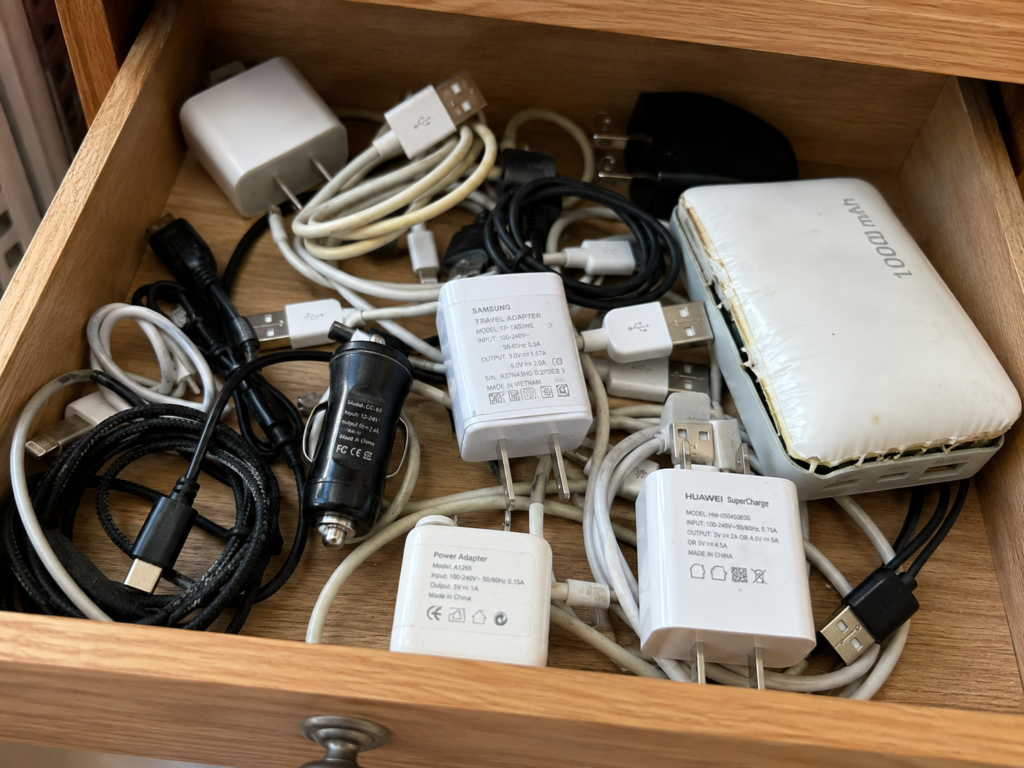
If you open the junk drawer at home, chances are you’ll find a few old charging cables you haven’t used in ages, several chargers left over from phone upgrades, and maybe one or two swollen power banks you dare not use anymore. Keeping them takes up space, throwing them away feels wasteful, and you might not even know which trash bin to put them in — these unassuming small accessories are exactly the most easily overlooked part of global e-waste governance.
The “universal charging” and “unified USB-C interface” we often hear about in recent years are not just about letting people carry fewer cables. Behind them lie issues related to e-waste reduction, consumer rights, and even global sustainable development goals. This article starts with the most basic concepts, helping you understand the relationship between e-waste and universal charging, make sense of relevant regulations around the world, and learn how to start with small daily things to reduce the charging-related e-waste you generate.
1. Basic Understanding: First Get Clear on E-Waste, Universal Charging, and the Relationship Between the Two
Before talking about specific waste data and regulations, let’s first clarify two most basic concepts — what e-waste is, what real universal charging is, and how these two seemingly unrelated things are connected. After all, for people new to this topic, it’s easy to directly equate “old chargers” with waste, or treat “having a USB-C port” as universal charging. Drawing clear boundaries first will make the following content easier to understand.
Plain-Language Definition and Judgment Criteria for E-Waste
Many people think that anything old with a battery or plug is called e-waste, but that’s not the case. In plain terms, e-waste refers to powered devices, products containing electronic components, and their accessories that have been discarded, left idle for a long time, and have no clear plan for reuse.
Its core judgment criterion is very simple: these items cannot be directly mixed with ordinary household waste and thrown away; they must enter specialized e-waste recycling or disposal channels — because they may contain harmful substances and also have recyclable resources, and random landfill or incineration poses environmental risks.
The charging-related e-waste we come into contact with most in daily life mainly falls into the following categories: old mobile phone chargers, old charging cables with various interfaces, discarded or swollen power banks, power adapters left over from obsolete devices, old car chargers, and unused wireless charging pads.
Of course, there are a few easily confused boundaries that need to be clarified in advance:
- Accessories that are still in normal use, or that you clearly plan to give to friends or circulate through formal second-hand channels, are not e-waste. Don’t casually throw away still-usable items directly as trash;
- Accessories that have been left in drawers unused for a long time, have worn-off parameter labels, and have unclear safety status are “potential e-waste”. It’s best to sort them out regularly: keep those that can be tested and reused, and send useless ones for formal recycling;
- Power banks and portable power supplies containing lithium batteries carry higher risks than ordinary charging cables and chargers. If they are swollen, leaking, water-damaged, or severely broken, they must never be thrown into ordinary trash bins, and must be handled in accordance with local battery recycling, hazardous waste recycling, or e-waste regulations.
Core Meaning of Universal Charging and How to Tell Real vs. Fake
Let’s talk about the “universal charging” we often hear about. Many people think universal charging is just the USB-C interface, but that’s actually only part of it.
Explained in plain language, universal charging refers to a small number of chargers, cables, or wireless charging devices that meet public unified standards, which can be compatible with most devices of different brands and types under the premise of safety, thereby reducing the trouble of people having to buy new accessories every time they change devices.
At present, mainstream universal charging is divided into two categories: one is wired universal charging, and the current direction promoted by global policies and the market is the USB-C interface; the other is wireless universal charging, with the mainstream standard being Qi/Qi2, but there are still differences in power, magnetic structure, and compatibility experience across different devices, and its degree of unification is not as high as that of wired charging.
A special reminder here: “being able to plug in” does not equal true universality, and “being able to charge” does not equal qualified universal charging. Real universal charging must meet several conditions at the same time: matching interface form, matching charging protocol, matching power range, matching cable specification, and meeting safety and compliance requirements. Summarized into three easy-to-remember sentences:
Being able to plug in does not equal true universality;
Being able to slow-charge does not equal being able to fast-charge;
Being able to charge does not equal long-term safety.
As for how to specifically check these conditions, we will break them down when we talk about parameters later. Just have a general impression for now, and don’t be fooled by merchants’ “universal fast charging” marketing terms.
Direct Logical Connection Between E-Waste and Universal Charging
Some people may ask: It’s just a charger, how is it related to e-waste governance? In fact, the connection between the two is closer than you think.
First, small accessories like chargers and charging cables have a feature that is easily overlooked: they are large in quantity and small in size. Users either toss them in a drawer to sit idle, or throw them into ordinary trash bins casually, making it difficult for them to enter formal recycling channels. They are a type of small e-waste that is easily ignored in e-waste governance in terms of quantity and misplacement probability.
Second, for a long time in the past, charging interfaces of different brands and devices were not unified, private fast charging protocols were varied, and cable specifications were chaotic. As a result, many still-usable chargers and cables were thrown away early just because they couldn’t match the interface of new devices or were incompatible with protocols, turning into e-waste for no reason.
The core significance of universal charging is to reduce this waste at the source: there is no need to equip every new device with a new charger, no need to repeatedly buy accessories just because the interfaces are different, allowing qualified charging accessories to continue to be used across brands, devices, and generations — which is equivalent to producing a lot fewer things that could have been avoided at the production end.
So you see, this topic is actually not just as simple as “environmental protection”. It also involves sustainable design, e-waste reduction, consumer rights, and product regulations, making it an intertwined comprehensive issue.
2. Real Pain Points: Why Charging-Related E-Waste Is a Global Sustainability Issue
You might think: It’s just a few old chargers and old charging cables, they don’t take up much space, how much impact can they have? In fact, the accumulated waste and disposal difficulties of these unassuming small accessories have become a practical problem that cannot be ignored in global e-waste governance. We can understand the ins and outs of this matter from three perspectives: actual scale, actual hazards, and disposal difficulties.
2.1 The True Scale of Global E-Waste and Charger Waste (With Data Caliber Notes)
To talk about the scale of charging-related e-waste, we must first start with the overall background of global e-waste. According to the United Nations’ Global E-waste Monitor 2024 statistics, the global e-waste generated in 2022 was approximately 62 million tons, and the growth rate of e-waste generation is significantly faster than the improvement rate of global formal collection and recycling capacity — this means the gap in formal recycling is still widening, and the specific destination of e-waste that does not enter formal channels varies by country and statistical caliber.
An important data caliber must be clarified first here: global e-waste reports are usually counted by large device categories, such as “small IT and telecommunications equipment” and “small household appliances”. Extremely small accessories like chargers and charging cables may not be separately listed as an independent statistical category. Therefore, we cannot directly equate the total weight of “small IT/telecommunications equipment” with the generation volume of charging accessories, to avoid exaggerating the data.
For specialized statistics on charging accessories, the European Commission’s estimate is currently more referential: approximately 11,000 tons of discarded and idle chargers are generated each year within the EU, which is also one of the important policy backgrounds for the EU to promote universal charging regulations.
In addition, pay attention to several boundaries for data interpretation:
- The “generation volume” and “idle volume” we often refer to are usually total amounts estimated by weight, and do not mean all these accessories will end up in landfills. Some of them will enter formal recycling channels, some may flow into informal dismantling or second-hand export, and many are just left idle in users’ drawers for a long time, not yet truly entering the waste disposal system.
- E-waste data varies greatly across countries and regions, which is related to local device ownership, consumption habits, and the perfection of the recycling system. Data from one region cannot be directly applied to the whole world.
In short, the total amount of global e-waste is very large, and chargers and cables are just a small but high-frequency, easily idle category among them; when discussing them, we must both recognize their reduction value and not directly use large-category e-waste data as charging accessory data.
2.2 Multiple Core Hazards of Charging-Related E-Waste
Don’t underestimate these small charging accessories. If they are not properly disposed of, they will cause several layers of problems:
First is environmental harm. The plastic shells of chargers, the plastic sheaths of charging cables, internal electronic components, and flame-retardant materials are mostly difficult to degrade in the natural environment. If they are randomly discarded in ordinary waste and eventually end up in landfills, they will occupy land resources for a long time; if they flow into informal channels and are privately dismantled or incinerated, they may also release harmful gases and persistent pollutants, polluting air, soil, and water sources.
Second is hazardous substance risk. Some charging accessories may contain substances harmful to human health and the environment, such as lead, cadmium, and brominated flame retardants, in their electronic components, solder, and shell materials. However, a common misconception must be clarified here: harmful substances like mercury are more commonly found in old display devices and lighting e-waste, so don’t simply generalize “mercury-containing” to all chargers and charging cables.
Third is safety hazard. If old chargers with damaged shells or loose prongs, low-quality cables with cracked outer skins or exposed copper, or swollen/leaking power banks continue to be used, there may be risks of short circuit, overheating, or even fire. In addition, if old charging peripherals with storage functions (such as charging docks with built-in storage) are discarded at will, they may also cause personal privacy leakage problems.
Fourth is resource waste. Producing even a small charger consumes plastic, copper, aluminum, tin, magnetic materials, as well as a small amount of precious metals and various electronic components. If these accessories are discarded early due to incompatibility, it is a senseless waste of resources. Conversely, if they are disposed of through formal recycling channels, these valuable metals can be extracted and reused, making them part of the “urban mine”.
Fifth is carbon emission impact across the full life cycle. Many people think the environmental impact of e-waste only occurs at the moment of disposal, but that’s not true — the entire chain from raw material mining, component manufacturing, product packaging, to transportation, warehousing, and sales generates carbon emissions. Producing one more charger that didn’t need to be bought increases the environmental burden from the very start.
2.3 Core Reasons Why Charging-Related E-Waste Is Difficult to Dispose Of
Since charging-related e-waste has so many problems, why isn’t it properly disposed of? The core reason is that the recycling and disposal difficulty of these small accessories is higher than many people think:
First is too small in size. An old charging cable or a mini charger is light in weight and small in size. Many users throw them away along with ordinary household waste when sorting trash, never thinking to send them to a recycling point separately. And municipal ordinary waste disposal systems also have difficulty sorting out these tiny electronic accessories from massive amounts of household waste, so they end up being landfilled or incinerated along with other waste.
Second is too diverse in category. Charging accessories on the market have a wide variety of interfaces, and their power, protocols, and cable specifications also vary. When mixed together, recycling requires a lot of manpower for sorting and testing to determine which are still usable, which have recycling value, and which are hazardous waste, resulting in very high disposal costs.
Third is limited recycling value per unit. Many small charging accessories have low material value themselves. For example, the copper wire in ordinary charging cables is very light, and the revenue from dismantling and extraction may not even cover the labor and equipment costs of collection, transportation, and dismantling. Therefore, many formal recycling institutions are not very enthusiastic about recycling such small accessories.
Fourth is insufficient user awareness. Many people only know that old mobile phones and old computers are e-waste, but they don’t know that charging cables, chargers, car chargers, wireless charging pads, and even old power banks are all e-waste and cannot be casually thrown into ordinary trash bins. This cognitive blind spot directly leads to a large number of charging accessories failing to enter formal recycling channels.
Fifth is large regional differences. E-waste recycling systems vary greatly across countries and cities: in some places, there are small e-waste recycling bins downstairs in communities; in others, you have to drive dozens of kilometers to find a recycling point; some places accept all types of electronic accessories, some don’t accept power banks containing lithium batteries, and others only accept large household appliances and complete devices, not small accessories. This difference also brings difficulties to the unified governance of charging-related e-waste.
3. Core Logic: How Universal Charging Reduces E-Waste at the Source
Many people think universal charging is just “convenient”, but its core value is reducing waste at the source, mainly achieved through three paths:
The first path is no longer forcing new devices to come with chargers, directly reducing unnecessary production, packaging, and transportation;
The second path is extending the service life of accessories: after old devices are phased out, qualified chargers and cables can still be compatible with new devices, so they don’t have to be thrown away together;
The third path is reducing unnecessary purchases: after unifying interfaces and protocols, users don’t have to buy a bunch of spare accessories due to incompatibility.
More Than Waste Reduction: Full Life Cycle Value of Universal Charging
From the perspective of sustainable development, the benefits of universal charging are across the entire chain:
It can reduce carbon emissions, because it reduces emissions from raw material mining, component manufacturing, packaging, and transportation. Of course, the exact amount of reduction depends on the boundaries of the life cycle assessment, and numbers cannot be made up casually;
It can save resources: copper, aluminum, plastic, tin, electronic components, and packaging materials do not need to be consumed repeatedly;
It can reduce consumer costs: there is no need to buy a new charger every time you change devices, which can save a lot of money on accessories in the long run;
It can improve convenience: you don’t have to carry a lot of different chargers and cables at home, in the office, or when traveling;
It can also improve safety: public standards and compliance labels make it easier for users to identify safe products — of course, the premise is that you buy qualified products from formal brands.
Waste Reduction Effect Is Not Inevitable: These Five Conditions Are Indispensable
Here’s a problem many people don’t realize: universal charging does not necessarily reduce waste. Its effectiveness requires meeting five key conditions:
First is unified interface: both the device end and the charger end must use widely compatible interfaces, such as the current USB-C;
Second is protocol compatibility: devices and chargers must support universal fast charging protocols, such as USB-PD, otherwise even if the interfaces are the same, they can only slow-charge;
Third is power matching: the output power of the charger and the carrying capacity of the cable must be able to cover the needs of the device;
Fourth is qualified quality: products must meet local safety, electromagnetic compatibility, and environmental compliance requirements, otherwise they will break after a few uses, instead increasing waste;
Fifth is users actually reusing old accessories: if after canceling bundled chargers, users instead buy more new ones, the waste reduction effect will be directly discounted.
In These Scenarios, the Waste Reduction Effect of Universal Charging Will Be Greatly Reduced
In reality, many situations will offset the benefits of universal charging, the most common of which are five:
First, manufacturers retain private fast charging protocols, and users still have to buy brand-specific chargers or cables to achieve full-speed charging;
Second, users blindly hoard cheap “universal accessories”, and the number of idle items at home instead increases;
Third, old and new interfaces coexist for a long time, and during the transition period, old interface devices and old accessories are phased out in a concentrated manner, instead generating a wave of waste;
Fourth, product quality is too poor, low-priced accessories break after not long use, and frequent replacement instead increases waste;
Fifth, users repeatedly buy too many sets of accessories for scenarios like travel, car use, and office work, completely offsetting the waste reduction benefits brought by universalization.
Don’t Exaggerate: Universal Charging Cannot Solve All E-Waste Problems
Finally, the boundary of universal charging’s role must be clarified: it mainly reduces the waste of accessories like chargers, cables, and adapters, and cannot solve all e-waste problems.
The main sources of e-waste also include complete device scrapping, battery aging, screen damage, too high repair costs, software support discontinuation, and more. To truly reduce waste, full-chain cooperation of “less production, less purchase, extended lifespan, repairable design, second-hand circulation, formal recycling” is needed, and universal charging is just one part of it.
4. Global Regulations: The Relationship Between Universal Charging Policies and E-Waste Governance
Since universal charging is an important part of waste reduction, why can’t it be unified by the market itself, and instead needs to be promoted by regulations? What is the current progress of universal charging policies around the world, and what is their relationship with e-waste governance? Let’s clarify this matter next.
Why Universal Charging Needs Regulatory Promotion
Many people think that good standards will naturally be accepted by the market, so why must they be forcibly unified by regulations? In fact, this matter is far from as simple as it seems.
First is insufficient motivation for spontaneous market unification. For many manufacturers, private interfaces, private fast charging protocols, and exclusive accessory ecosystems can not only form product differentiation, but also bring considerable accessory sales revenue — if all devices use universal interfaces and universal protocols, users won’t have to repeatedly buy brand-specific chargers and cables, and manufacturers’ accessory revenue will be directly affected. In this situation, it is unrealistic to expect all manufacturers to voluntarily give up their private ecosystems and spontaneously unify standards.
Second, the benefits of universal charging have a strong public interest attribute. Reducing e-waste, lowering consumers’ long-term purchase costs, and improving cross-brand and cross-device compatibility are all public benefits that benefit all users and the whole society, but such public benefits are difficult to achieve through the market behavior of a single enterprise, and require public policy to promote from a global perspective.
Third, the implementation of universal charging requires extremely high cross-stakeholder coordination costs. From the shape of the interface and pin definitions, to fast charging protocols, cable specifications, safety standards, and packaging labels, making products of different brands, categories, and regions compatible requires unified coordination across manufacturers, industries, and countries. Without public institutions or regulations taking the lead, it is difficult to reach a broad consensus.
Finally, a common conceptual confusion must be clarified: universal charging regulations are related to but not the same as the “Extended Producer Responsibility (EPR)” we often hear about. The core of universal charging regulations is to solve the problem of “interface and accessory compatibility”, reducing unnecessary accessory production and waste from the design and consumption ends; while the core of EPR is to make producers or importers responsible for the environmental impact of products throughout their life cycle, for example, bearing the cost of recycling and disposal, and designing products that are easier to recycle. The two are mutually supportive: universal charging reduces waste at the source, and EPR provides a backstop at the end, jointly serving the goal of e-waste governance.
EU Universal Charging Regulation: The Most Representative Case
Among all universal charging-related regulations in the world, the EU’s rules are currently one of the most representative cases with a large impact on the global market. Its core goal is to reduce charger waste and lower consumer costs by unifying the charging interface.
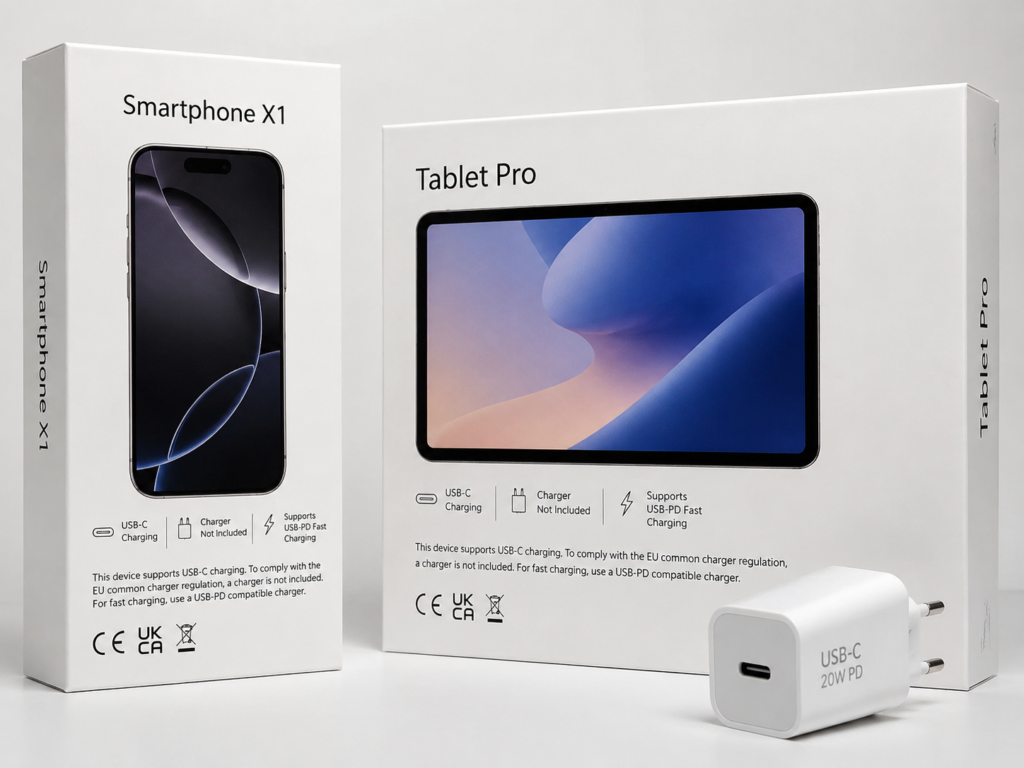
According to EU requirements, multiple categories of portable radio devices must use USB-C as the charging interface starting from December 28, 2024; laptops, which have a wider coverage scope, will be subject to this requirement starting from April 28, 2026.
Specifically, devices that need to meet the requirements include mobile phones, tablets, digital cameras, earphones, headphones, handheld game consoles, portable speakers, e-readers, keyboards, mice, portable navigation devices, and other portable electronic devices that meet the regulatory definition. Relevant portable radio devices sold in the EU market, falling within the scope of the regulation, and chargeable via wired means need to meet the USB-C universal charging requirements; the specific applicable scope is still subject to the official EU regulatory text and product category definitions.
In addition to interface unification, this regulation also has several key requirements: First, devices that support fast charging above a certain power must be compatible with unified charging communication requirements, the core of which is the USB Power Delivery (USB-PD) universal fast charging protocol, to avoid the situation of “same interface but slow charging”; Second, consumers have the right to choose not to buy a new charger with the device, and manufacturers cannot force bundled sales; Third, the product’s packaging or instructional materials must clearly indicate whether a charger is included, the device’s charging capability, and required power, so that consumers can understand clearly before buying.
Of course, this regulation is not omnipotent, and several common misunderstandings need to be clarified: it does not force all brands to have exactly the same charging speed, and manufacturers can still retain their own private fast charging technology on the basis of being compatible with universal protocols; it also does not require all devices to be fully charged at full speed with the same charger, and the specific charging speed still depends on the power and protocol matching between the device and the charger; more importantly, it only solves the problem of charging accessory compatibility, and does not directly solve all e-waste problems, which require more supporting policies to cooperate.
Progress in Other Regions and Query Principles
In addition to the EU, many countries and regions around the world are also promoting policies related to universal charging, but the progress, coverage scope, and legal enforceability vary greatly, and cannot be generalized.
For example, markets like India have proposed or are advancing requirements for devices such as smartphones and tablets to adopt a unified USB-C charging interface, but the specific implementation time, covered categories, and enforcement details are subject to the latest announcements of local regulatory authorities. Brazil, South Korea, the UK, some US states, and some Southeast Asian markets have also seen relevant regulatory discussions, standardization promotion actions, or policy trends referencing EU rules, but the legal level, implementation pace, and coverage scope of these policies vary, and some are still in the discussion stage and have not been formally implemented and enforced.
For ordinary consumers, especially overseas users, this point is particularly important: the same device sold by the same brand in different regions may have different charging interfaces and different policies on whether a charger is included, due to differences in local regulatory requirements, inventory cycles, or product line planning. For example, a certain brand’s mobile phone must use USB-C and is not forced to include a charger in the EU market, but in other regions, it may still use the old interface or include a charger because there are no relevant local regulations. Therefore, when buying devices cross-border, don’t just look at vague terms like “international version”, “EU version”, or “latest version” in e-commerce titles. Be sure to check the announcements of local regulatory authorities, parameter descriptions on the brand’s official website, detailed configurations on the product page, labels on the packaging, and after-sales instructions, and confirm clearly before buying.
What Universal Charging Regulations Usually Cover and What They Don’t
Many people think universal charging regulations will cover all powered products, but that’s not the case. Its scope of application has clear boundaries, which we can understand from two perspectives: “what is covered” and “what is not covered”.
Generally speaking, the coverage scope of universal charging regulations is mainly concentrated on portable consumer electronic devices, and the core requirements include several aspects: first, the external charging interface of the device must be unified; second, information such as charging power and supported protocols must be clearly marked; third, it must be clearly disclosed whether a charger is included, to protect consumers’ right to know and right to choose.
However, many special categories of electronic devices are not within the coverage scope of universal charging regulations, such as high-power household appliances, medical electronic devices, industrial equipment, specially sealed professional equipment, special power supply systems, etc. — these products either have special power requirements, or have strict safety, protection, or professional functional requirements, so it is impossible to uniformly charge them with consumer-grade USB-C interfaces, and they are also not within the coverage scope of universal charging regulations.
In addition, there are two easily confused boundaries that need to be explained: First, regarding wireless charging, although Qi/Qi2 is the current mainstream wireless charging standard on the market, most universal charging regulations still focus on wired interfaces, and the unification of wireless charging has not yet entered the mandatory regulation stage. There are still differences in wireless charging power, magnetic structure, and compatibility across different brands; Second, regarding fast charging, the role of regulations is to promote the compatibility of universal fast charging protocols, so that users can get a good charging experience with universal accessories, but it will not make all private fast charging disappear. Manufacturers can still retain their own private fast charging technology, as long as they are also compatible with universal standards.
Supporting Sustainable Policy Tools
Universal charging regulations do not exist in isolation. To truly achieve the goal of waste reduction, they also require a series of supporting sustainable policy tools to cooperate together, forming full-chain governance from production, consumption to recycling. These tools may sound a bit unfamiliar, but they are actually closely related to our daily lives.
First is the e-waste recycling system (such as the EU’s WEEE Directive), which in plain terms means “e-waste must have specialized recycling channels”. Such systems require all regions to establish classification, collection, recycling, and disposal systems for e-waste. For example, small e-waste recycling bins in communities, recycling points at electronics retailers, and municipal large-scale e-waste recycling projects are all implementations of such systems. For small charging accessories, with convenient recycling channels, users won’t casually throw them into ordinary trash bins, which can greatly improve the formal recycling rate.
Second is Extended Producer Responsibility (EPR), which is what we often call “whoever produces is responsible”. According to this system, producers or importers must bear certain responsibility for the environmental impact of their products throughout the life cycle. For example, they must pay to participate in e-waste recycling and disposal, and must consider recyclability and repairability at the product design stage, instead of ignoring the product after producing and selling it. If universal charging reduces waste from the perspective of “producing less at the source”, EPR puts pressure from the perspective of “providing a backstop at the end”, and the two cooperate with each other.
Third is hazardous substance restriction rules (such as the EU’s RoHS Directive). These rules restrict the use of harmful substances such as lead, mercury, cadmium, and brominated flame retardants in electrical and electronic products. In this way, even if the product eventually becomes e-waste, the harm to the environment and human body will be much smaller, which is consistent with the waste reduction and risk reduction goals of universal charging.
Fourth is information transparency requirements, which require manufacturers to clearly mark key information such as the product’s charging interface, power, supported protocols, and whether a charger is included on the product page, packaging, and instruction manual. Don’t underestimate this point: the more transparent the information, the easier it is for consumers to judge whether their old accessories can be reused, which can reduce unnecessary additional purchases and truly realize the waste reduction value of universal charging.
Fifth is the construction of retail and municipal recycling networks. For example, in many countries, electronics retailers, large supermarkets, community service centers, and municipal recycling points will set up specialized small e-waste recycling bins to recycle small accessories like old charging cables, old chargers, and old power banks for free. Only when there are enough recycling points and they are convenient enough will users be willing to take the time to send old accessories for formal recycling instead of casually throwing them into the trash bin.
5. Must-Learn for Beginners: Key Parameters of Universal Charging and Practical Judgment Methods
Many people only look at the word “fast charging” or only the interface shape when buying charging accessories, and as a result, either the charging is slow or it’s unsafe after they buy it. In fact, as long as you understand a few key parameters, you can avoid most pitfalls.
USB-C Interface: First Look at the Shape, Then the Actual Capability
USB-C, which we often call Type-C, is an oval interface that can be plugged in either way, and is also the most mainstream universal interface in current mobile phones, tablets, laptops, and peripherals.
But there is a biggest misconception here: even with the same USB-C interface, the capabilities can be vastly different — some only support slow charging, while others support high-power fast charging; some only transmit low-speed data, while others can transmit high-speed data and also output video.
Therefore, to judge the capability of USB-C accessories, you must never only look at the appearance of the interface. You must check the power, protocol, data rate, and certification information marked on the packaging, instruction manual, or product page.
Charging Power: Higher Wattage Is Not Necessarily More Suitable
Power is a basic indicator for measuring charging speed, and the basic formula is very simple: Power (watts W) = Voltage (volts V) × Current (amps A).
Many people always like to buy the highest wattage charger, thinking “high power is definitely fast and can be compatible with all devices”, but that’s actually unnecessary. A qualified charger will negotiate power supply with the device, and the device will only draw the power it needs, and will not burn out just because the charger has a high wattage. However, excessively high power is completely wasted for low-power devices, and also increases cost and volume.
You can refer to the power range of common devices below, and choose a power that can cover the needs of your main devices:
| Device Type | Common Charging Power Range | Remarks |
|---|---|---|
| Earphones, bands, watches | 5-10W | Low power, old chargers can also meet it |
| Smartphones | 15-65W | Some brands’ private fast charging can be higher |
| Tablets | 20-45W | Universal fast charging can basically cover it |
| Thin and light laptops | 45-100W | High-performance gaming laptops may be higher |
Fast Charging Protocol: The “Conversation Language” That Determines Whether Fast Charging Is Possible
Why is it that sometimes the interface is the same and the power is sufficient, but the charging is just not fast? The problem is most likely with the fast charging protocol.
The fast charging protocol is the rule for devices, chargers, and cables to “negotiate” voltage, current, and power, equivalent to their common language. Only when the language matches can fast charging be achieved.
At present, the most important universal fast charging protocol is USB Power Delivery (USB-PD for short), which is supported by many USB-C interface mobile phones, tablets, laptops, and accessories; but whether a specific device supports it and up to what power it supports still depends on the parameters marked by the brand, the regional sales version, and the product manual. In addition, there are many brand-specific private protocols. For example, some mobile phone brands’ own fast charging requires dedicated chargers and cables to achieve the advertised maximum speed.
For ordinary users, prioritizing chargers that clearly support universal protocols such as USB-PD and PPS will usually result in better compatibility. But also note: supporting USB-PD does not mean all mobile phones can reach the highest private fast charging power advertised by the brand, after all, private protocols are the brand’s own technology.
Charging Cables: Overlooked But Very Critical
Many people carefully choose when buying chargers, but just grab any cable to use, which is actually a big problem. Cables are not just for connection; they also directly affect the bearable power, data transmission speed, heating situation, and stability.
Common USB-C cables have several power levels:
- Ordinary USB-C cables are mostly 3A, usually supporting a maximum power of about 60W;
- High-power USB-C cables generally need to support 5A and have an electronic marker chip (e-marker), usually marked with 100W or higher power;
- There are also higher-power USB-C extended power specifications, but ordinary consumers don’t need to worry about them, just look at the clearly marked power of the product.
There is another common misconception here: high-power cables are not necessarily high-speed data cables, and high-speed data cables are not necessarily suitable for high-power charging — the capabilities of the two are separate. Therefore, when using for high-power devices such as laptops and tablets, be sure to choose cables that clearly mark power, current, and compliance information, and don’t just grab any old cable to make do.
Wireless Charging: Convenient But Not a Universal Waste Reduction Solution
Now wireless charging is becoming more and more popular, and the mainstream standards are Qi and Qi2, which are what we often call the Wireless Power Consortium standards. Its advantage is reducing interface plugging wear, and it is very convenient to use on desks and bedside tables, but its limitations are also obvious: charging efficiency is usually lower than wired, heating and placement position will affect charging speed, and the magnetic structure, power, and phone case compatibility of different devices are also different.
From the perspective of waste reduction, wireless charging pads themselves are also electronic products. If you blindly buy several to place in different places at home, even one in each room, that will instead increase e-waste and not play a role in waste reduction at all.
Compliance Labels and Safety Certifications: Must-Read for Overseas Users
When buying charging accessories overseas, you must learn to read compliance labels and safety certifications. These labels are used to prove that the product meets the safety, electromagnetic compatibility, or environmental protection requirements of the local market.
Common labels include EU CE, UK UKCA, Japan PSE, US UL/ETL, Germany TÜV, etc. Their meanings and mandatory nature vary by region and category. A very common misunderstanding must be corrected here: CE is a mandatory compliance requirement for entering the market of relevant regulated products in the EU/European Economic Area, but it is usually a self-declaration of conformity by the manufacturer, and is not always a certification issued by a third-party institution; while UL, ETL, TÜV and others are closer to third-party testing and certification, often used by retailers or consumers to assist in judging safety.
No matter which region you are in, do not buy “three-no” accessories with no brand, no parameters, no certification/compliance labels, and abnormally low prices. Such products are not only easy to break, but may also have safety hazards.
For your quick identification, here is a quick reference table of common labels:
| Label | Main Applicable Region | Nature Description |
|---|---|---|
| CE | EU/European Economic Area | Compliance label for relevant regulated products, usually a declaration of conformity by the manufacturer; whether third-party participation is required depends on the product category and regulatory requirements |
| UKCA | United Kingdom | Compliance label for relevant regulated products in the UK market; the specific mandatory scope and applicable categories are subject to local current regulations and product categories |
| PSE | Japan | Japan’s electrical product safety-related certification, divided into specified/non-specified categories; the specific applicable scope and requirements are subject to local regulations and product categories |
| UL / ETL | US/North America | Common third-party safety testing and certification in the North American market; the specific applicable categories and testing requirements depend on the product category |
| TÜV | Germany/Europe | A common third-party safety and quality certification institution in Germany/Europe; the specific certification scope depends on the product category and local requirements |
These labels cannot be simply ranked by level. The key is to see whether they apply to your local market and specific product category; third-party testing and certification help judge safety, but cannot replace local mandatory compliance requirements.
6. Rational Pitfall Avoidance: Cognitive Misconceptions and Applicable Boundaries of Universal Charging
After understanding the basic parameters of universal charging, many people are still easily led astray by various marketing claims, or have unrealistic expectations about the capabilities of universal charging. In this chapter, we will systematically sort out the most common cognitive misconceptions, applicable boundaries, and the judgment criteria for “whether old chargers at home should be thrown away” that everyone cares about most, to help you build an independent pitfall avoidance framework.
6.1 The Most Common Cognitive Misconceptions
Let’s first talk about the six most common cognitive misconceptions, from which many people’s misunderstandings about universal charging stem:
- Misconception 1: Universal charging means all devices use the same charger
When many people first come into contact with universal charging, they think “in the future, I only need to bring one charger when going out, and it can charge my phone, computer, earphones, and even all household appliances”. In fact, this is an excessive expectation of universal charging. The core of universal charging is that “accessories meeting public standards can be compatible with most commonly used consumer electronic devices”, but it does not mean that a single charger can cover all devices — after all, the power requirements of different devices differ by dozens of times. For example, a 5W charger for earphones definitely cannot fast-charge a high-performance laptop. To adapt to multiple devices, you still need to match power, protocol, and cable specifications, but you don’t have to buy a separate set of dedicated accessories for each device. - Misconception 2: Same interface means true universality
This is the most common marketing trap: many merchants directly equate “USB-C interface” with “universal fast charging”, but in fact, USB-C is just the physical shape of the interface, like the shape of a socket. There is a huge difference in how much power it can supply and what protocols it supports. Chargers with the same USB-C interface: some can only output 5V2A slow charging, while some can support 100W or even higher fast charging; some can only transmit low-speed data, while some can connect to a monitor to transmit video. Therefore, to judge whether it is truly universal, you can’t just look at the interface shape, you must look at the parameters. - Misconception 3: Not including a charger is definitely more environmentally friendly
When many manufacturers cancel bundled chargers, they use “environmental protection” as a reason, but this is not absolute. The premise of universal charging waste reduction is that “users have reusable old accessories”. If you are buying a USB-C device for the first time and don’t have any usable old chargers at home, you still have to buy one separately after the bundled charger is canceled, which instead adds an extra step of separate packaging and separate transportation, which may be more wasteful than including it with the device. Therefore, to judge whether “not sending a charger is environmentally friendly”, it depends on whether the user has reusable accessories and whether they will buy additional ones as a result. - Misconception 4: Universal charging will definitely be slower
Many people think “universal ones are not as fast as dedicated ones”, and even think that using a universal charger can only slow-charge, but that’s not true. As long as your device, charger, and cable all support the same universal fast charging protocol (such as USB-PD, PPS) and the power matches, universal charging can also be very fast — for example, many mainstream mobile phones can reach fast charging speeds of 20 to 30 watts or higher with a charger that supports USB-PD, which is completely sufficient for daily use. Of course, if you want to achieve the highest speed of a brand’s private fast charging, you may still need dedicated accessories, but this does not mean that universal charging “will definitely be slow”. - Misconception 5: The more expensive and higher the wattage, the better
When buying chargers, many people think “buy the highest wattage one, it can be used for all devices in the future, getting it done once and for all”, but in fact, power that is sufficient is good. For example, if you usually only need to charge your phone, earphones, and tablet, choosing a multi-port charger of around 45W is sufficient. Buying a 200W high-power charger is not only expensive and heavy, but also wastes production materials, and has no additional benefits for low-power devices. Of course, if you have high-power devices such as laptops, it is necessary to choose a suitable high-power charger, but there is no need to blindly pursue the highest wattage. - Misconception 6: Wireless charging is more environmentally friendly
With the popularity of wireless charging, many people think that wireless charging doesn’t need to be plugged in, is more convenient and more environmentally friendly, but that’s not necessarily true. Wireless charging pads themselves are electronic products. If you buy one for every room in your home, office, and car for convenience, and the number of idle ones is more than wired accessories, it will instead increase e-waste. In addition, the energy efficiency of wireless charging is usually lower than wired, which consumes more electrical energy. Its environmental benefit depends on whether you really use it to replace excess wired accessories, not that “wireless is inherently more environmentally friendly”.
6.2 Applicable Boundaries and Limitations of Universal Charging
Although universal charging has many benefits, it is not omnipotent and has its own applicable boundaries and limitations. Understanding these can help you view its value more rationally:
First, many professional scenarios are not applicable or difficult to unify. The universal charging we often talk about is mainly aimed at consumer-grade portable electronic devices. For high-power professional equipment, medical electronic equipment, industrial equipment, specially sealed professional equipment, special outdoor power supply systems, etc., they either have extremely high power requirements, or have strict safety, protection, or professional functional requirements. It is impossible to uniformly charge them with consumer-grade USB-C interfaces, and they are also not within the coverage scope of universal charging regulations.
Second, there is a risk of technological iteration. The current mainstream universal interface is USB-C, and the mainstream universal protocol is USB-PD, but technical standards are constantly upgraded — for example, new specifications with higher power and faster transmission speed may appear in the future. At that time, there will be a coexistence period of old and new specifications, and some old accessories may be eliminated because they do not support new functions. Universal charging is not a once-and-for-all solution.
Third, the controversy over unified interfaces and innovation has always existed. Some people worry that unified interfaces will reduce the differentiation space for manufacturers and make products lose their characteristics; but there are also views that after unifying interfaces, manufacturers no longer need to spend energy on private interfaces and accessory ecosystems, and instead can invest more resources in the progress of common technologies such as safety, charging efficiency, and compatibility, and ultimately consumers will benefit. This is a controversial point at the industry level, with no absolute right or wrong.
Fourth, regional differences will affect the actual waste reduction effect. The waste reduction effect of universal charging not only depends on the unification of interfaces and protocols, but also is related to the progress of local regulations, the perfection of recycling facilities, and the maturity of the second-hand market. For example, in areas with dense recycling points and smooth second-hand circulation, the reuse rate of old accessories is high, and the waste reduction effect is good; in areas with imperfect recycling systems where people are used to casually throwing away old accessories, even if the interfaces are unified, many broken accessories will still enter ordinary waste, and the waste reduction effect will be discounted.
6.3 Judgment Criteria for Whether to Eliminate Old Chargers (Semi-Proficient Level)
Many people struggle when sorting out old charging accessories at home: this charger looks like it can still be used, but I’m afraid it’s unsafe, and it’s a pity to throw it away. You can judge according to the following four-level criteria, no need to struggle anymore:
- Can continue to use: If the accessory has no damaged appearance, stable and non-loose prongs, no abnormal heating or odor during use, clear and complete parameter labels, power and protocol that can match your commonly used devices, and has compliance labels that meet local requirements, then you can completely rest assured to continue using it, no need to deliberately replace it with a new one.
- Can be used for lower-level purposes: If the old charger has relatively low power and cannot fast-charge a new phone or laptop, but its appearance and condition are very good and there are no safety hazards, then it can be downgraded for use with low-power devices — for example, charging small-power devices like earphones, bands, smart watches, and e-readers is completely sufficient, no need to throw it away.
- Needs careful testing: If the accessory’s parameter label is worn off, you don’t know the specific power, or there is occasional poor contact, the cable’s outer skin is slightly aged but no copper is exposed, the interface is a bit loose but still usable, do not use such accessories directly for long-term use with high-power devices like mobile phones and laptops. You can first test with low-power devices like earphones and bands, and after confirming there are no problems such as heating or poor contact, only use them to charge low-power devices, and regularly check the condition. Once abnormalities occur, eliminate them in time.
- Must be eliminated and recycled: If the accessory has a damaged shell, loose prongs, abnormal heating during use, a burnt smell, exposed copper on the cable, a swollen or leaking power bank, as well as no parameter labels at all, or has been idle for more than a year and no one uses it, don’t keep it anymore. It must be sent to a formal e-waste recycling point for disposal. Absolutely do not throw it into an ordinary trash bin, and don’t casually give it to others, to avoid safety hazards.
7. Daily Actions: An Operable Framework for Ordinary People to Reduce Waste with Universal Charging
After saying so much, what exactly should ordinary people do to reduce charging-related e-waste? In fact, you don’t need to do big things, just start with small things in daily purchase, use, and disposal.
Before Buying New Devices: First Check Whether Old Accessories at Home Can Be Reused
Many people directly buy new chargers and cables without thinking when changing devices, but in fact, you can first check whether the existing accessories at home can be used, just follow these five steps:
- Check the interface: Is the new device a USB-C interface, or does it support Qi/Qi2 wireless charging? Can the interface of the old accessories match?
- Check the power: Can the output power of the old charger meet the basic needs of the new device?
- Check the protocol: Do the old accessories support USB-PD, PPS, or the fast charging protocol required by the new device?
- Check the cable: Does the cable have marked power and current, and can it be used for high-power devices?
- Check the condition: Are the cable skin, interface, prongs, and shell damaged? Will it overheat during use?
If the old accessories can meet the needs, there is no need to buy new ones at all, which saves money and reduces waste.
Beginner Tips for Buying Charging Accessories
If you really need to buy new charging accessories, remember these beginner tips, which can both save money and avoid pitfalls:
First is the three-look principle: look at whether the interface is universal (prioritize USB-C), look at whether the power and protocol can cover your commonly used devices, and look at whether there are labels that meet local safety and compliance requirements.
Second is buy on demand: just configure according to real usage scenarios such as bedroom, office, and travel. Usually, 2-3 high-quality multi-port chargers are more practical and space-saving than hoarding a bunch of single-port chargers.
Third is prioritize choosing: formal brand products that support USB-C, USB-PD/PPS, have clear power markings, and clear multi-port power distribution descriptions.
Finally, pay attention to avoiding pitfalls: don’t buy cheap accessories with no parameters, no brand, and no compliance labels, and don’t just look at marketing terms like “fast charging” and “super fast charging”, be sure to look at the specific parameters.
Classification and Disposal Methods for Old Charging Accessories
Don’t casually throw away the sorted old charging accessories, handle them by category:
- Usable category: Accessories with universal interfaces, intact appearance, no abnormal heating, up-to-standard power, and clear parameters can continue to be used, or can be given to friends or circulated through formal second-hand channels, don’t waste them.
- To-be-confirmed category: Accessories with unclear parameters, occasional poor contact, and slightly aged cables should be tested before deciding whether to keep or recycle them. Don’t hoard them indefinitely, the more you hoard, the more useless they become.
- Recycling-needed category: Accessories that are damaged, have abnormal heating, loose prongs, exposed copper on cables, or dedicated interfaces that no one uses must be sent to a formal e-waste recycling point, don’t throw them into ordinary trash bins.
- Battery-containing category: If power banks or accessories with batteries are swollen, leaking, or broken, absolutely do not continue to use them, and do not throw them into ordinary trash bins. They must be handled in accordance with local special rules.
Another reminder: don’t sell old accessories to unqualified mobile recyclers, otherwise many low-quality accessories may be refurbished and re-enter the market, instead bringing more safety hazards.
Practical Small Strategies for Household Charging Waste Reduction
If you want to reduce charging-related waste at home, you can try these simple small methods:
- Fixed configuration: Use 2-3 high-quality universal cables plus 1-2 multi-port chargers, which can meet the daily needs of most families, no need to equip each device with a full set.
- Scenario configuration: Just keep the necessary quantity for desktop, bedside, and travel, no need to put a bunch of chargers in every room.
- Carry when going out: A multi-port fast charger + a universal cable + necessary plug converters are enough to cope with most travel scenarios, no need to bring several sets.
- Regular self-check: If there are more than 3 charging accessories that have been idle for more than 6 months at home, it’s time to sort them out: reuse those that can be reused, give away those that can be given away, and recycle those that should be recycled.
- Label management: Make simple marks on high-power cables and low-power cables, for example, wrap them with different colored tapes, to avoid slow charging or heating caused by wrong use.
Exclusive Notes for Overseas Users
If you live overseas, there are a few more points that require special attention:
- Recycling channels: You can inquire about local municipal recycling projects, recycling programs of electronics retailers, community recycling points, or official brand recycling services. Many places have free small e-waste recycling points.
- Cross-border phone purchase: Prioritize choosing devices that meet the interface standards and power specifications of your region, and minimize long-term reliance on adapters; inferior or mismatched adapters may bring risks of poor contact, overheating, or certification mismatch. Compliant travel conversion plugs still need to be used with wide-voltage chargers and appropriate power.
- Travel scenarios: Plug converters only solve the shape problem of prongs, not the problems of voltage, power, protocol, and safety certification. Don’t think that with a converter you can use anything casually.
- Voltage reminder: Most modern chargers support 100-240V wide voltage, but still remember to check the product nameplate. Devices that do not support wide voltage must never be used across borders casually.
- Battery-containing accessories: Swollen, leaking, or water-damaged power banks and battery devices must be handled in accordance with local battery recycling or hazardous waste rules. Don’t throw them away casually, and don’t take them on planes.
8. Semi-Proficient Judgment: How to Evaluate the True Waste Reduction Value of Universal Charging
At this point, you can already handle daily purchase and use. If you want to more deeply judge the true waste reduction value of a universal charging policy or a product, you can evaluate it from the following dimensions.
Core Indicators for Evaluating Waste Reduction Effect
Don’t just believe it when manufacturers or media say “environmental protection”. The real waste reduction effect depends on the entire chain:
- Market end: Has the proportion of new devices bundled with chargers decreased? Has the sales volume of standalone chargers decreased synchronously? Or has the number of additional purchases by users instead increased after canceling bundling, offsetting the waste reduction effect?
- User end: Has the number of idle charging accessories in ordinary families decreased? Has the cross-device reuse rate increased?
- Product end: Has the average service life of chargers and cables been extended? Has the failure rate decreased?
- Recycling end: Has the formal recycling rate of small e-waste increased? Has the cost of sorting and disposal decreased?
- Life cycle end: We can’t just look at how much production has been reduced. We must also include reduced transportation, reduced packaging, additional purchase rate, and recycling rate in the evaluation to get the real waste reduction effect.
Core Dimensions for Evaluating Consumer Benefits
In addition to waste reduction, universal charging also depends on whether consumers truly benefit, mainly in five aspects:
- Convenience: Can multiple devices share multiple devices share compatible chargers and cables, cutting down the number of accessories carried and stored in daily life, office work and travel.
- Cost savings: Reduce long-term household expenditure on repeated purchases of chargers, cables and adapters, avoiding unnecessary consumption caused by interface and protocol incompatibility.
- Safety improvement: Standardized universal charging specifications and certified compliant products effectively lower safety risks such as short circuits, overheating and fires caused by mismatched accessories and unqualified low-quality charging equipment.
- Consumer sovereignty: Consumers are freed from mandatory bundled charger sales, gaining the independent right to choose whether to purchase matching charging accessories according to their own stock and actual needs.
- Information transparency: Standardized labeling rules enable users to quickly grasp key parameters including device interface type, charging power, supported fast-charging protocols and accessory packaging configuration, eliminating information asymmetry in consumption.
Identification Methods for Exaggerated Publicity
- In the consumer market, many marketing claims overstate the effect of universal charging and its environmental value. Ordinary users can distinguish false publicity and exaggerated statements through the following core judgment standards:
- First, refute the claim that unified charging can completely solve the e-waste crisis. Universal charging only targets the waste of small charging accessories such as chargers and cables. It cannot tackle mainstream e-waste sources including whole-device scrapping, battery aging, screen damage, high maintenance costs and discontinued software support. It is only a partial solution for source reduction rather than a panacea for global e-waste governance.
- Second, correct the misconception that USB-C equals universal full-speed fast charging. A unified USB-C interface is only a unified physical form. Real universal fast charging requires the simultaneous matching of fast-charging protocols, power output range, cable current-carrying specifications and product safety compliance. Devices with identical USB-C interfaces may only support low-speed charging due to protocol or power limitations.
- Third, judge the environmental authenticity of “no bundled chargers”. Canceling charger bundling does not equate to environmental protection. The real environmental benefit is only realized when users can fully reuse existing qualified accessories. If most users purchase additional new chargers due to no available stock, the extra production, packaging and transportation links will instead offset the waste reduction effect.
- Fourth, distinguish the differences between different certification labels. Various safety and compliance certifications such as CE, UKCA, UL and PSE have different applicable regions, testing mechanisms and mandatory attributes. It is impossible to simply rank their safety level or equate all certifications with absolute product qualification.
- Fifth, recognize the limitations of wireless charging’s environmental value. Although Qi/Qi2 wireless charging improves usage convenience, its lower energy efficiency compared with wired charging and the tendency of users to purchase multiple wireless charging pads for different scenarios will easily generate new idle e-waste. It cannot be simply defined as a more environmentally friendly charging method.
9. Conclusion: Core Competencies You Gain from This Guide
- After systematically learning the above content, you can independently complete accurate judgment and practical operation in daily scenarios, forming a scientific cognition system for universal charging and e-waste reduction:
- You can clearly distinguish the boundaries between reusable second-hand accessories, potential idle e-waste, and formally disposable charging waste, avoiding random discarding or blind hoarding.
- You can identify real universal charging and pseudo-universal charging that only has a unified interface but mismatched protocols and power parameters, and stay away from false marketing of “universal fast charging”.
- You can accurately understand the core functions and matching logic of USB-C interface, USB-PD universal protocol, charging power, high-spec cables and Qi/Qi2 wireless standards, as well as the practical significance of mainstream safety compliance labels.
- You can scientifically judge the service status of household old chargers, cables and power banks, and formulate reasonable solutions including continuous use, downgraded use and formal recycling.
- You can grasp the core logic and implementation details of the EU USB-C universal charging regulation, and master the query method of local policies in different regions worldwide.
- You can realize standardized classified disposal of charging electronic waste, and effectively find formal municipal, retail and brand recycling channels.
- You can accurately identify common false propaganda and exaggerated claims in the industry, and establish a rational view of universal charging environmental protection.
- Ultimately, you can practice the sustainable life principle of less blind purchase, longer product service life, maximum accessory reuse and standardized formal recycling, and effectively reduce the charging-type electronic waste generated by personal and household daily use.