
Introduction
Many cross-border sellers, purchasers, and even ordinary consumers who are entering the Korean market for the first time have heard the term “KC certification”, but most only have a superficial understanding: some think KC is a “Quality Gold Award” issued by the Korean government; some believe that just getting a certificate with a KC mark from a supplier is enough to list products on Coupang; others ship products directly to South Korea with CE reports, only to have their goods detained, listings removed, and face fines.
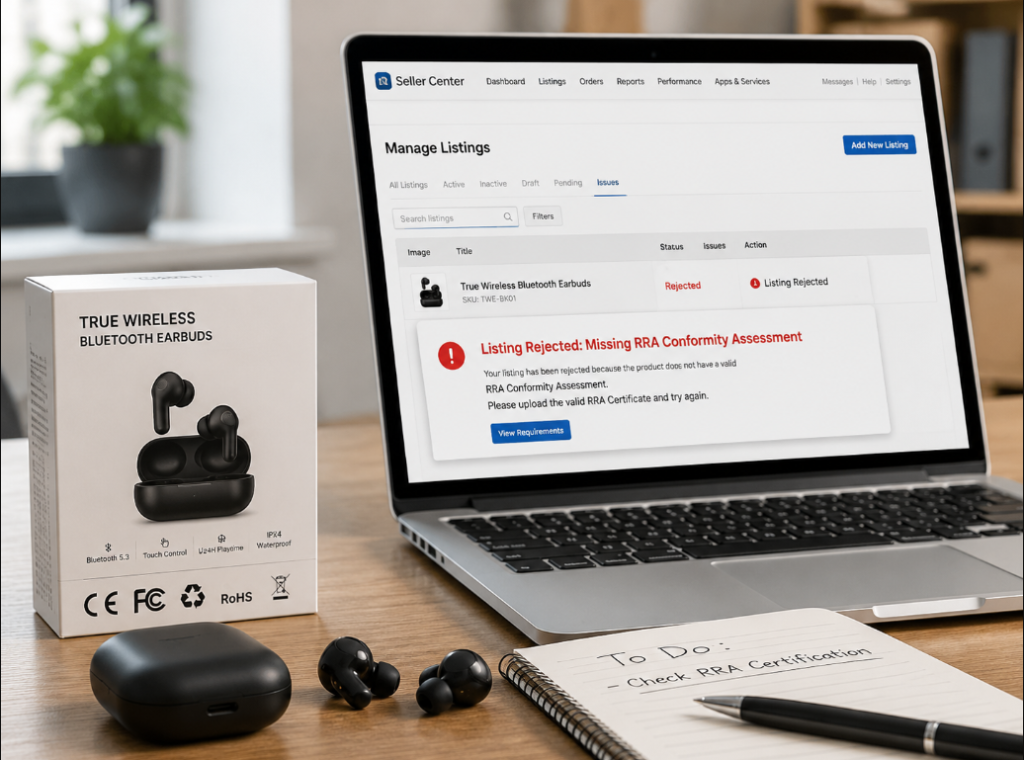
A very common pitfall in cross-border e-commerce is: sellers prepare to list Bluetooth earphones with existing CE and FCC documentation on Korean platforms, only to have their applications rejected after the goods are shipped to overseas warehouses, due to the lack of RRA conformity assessment records. Many people only wonder at this point: aren’t they all safety and wireless certifications? Why don’t CE and FCC work?
In fact, KC is far from being as simple as “a single certificate”. It is the core market access compliance system for South Korea, covering multiple categories such as electrical appliances, wireless products, children’s products, and daily necessities. The requirements, processes, and fees for different products vary vastly. The first sentence you need to remember is: KC is not a single certificate issued by a certain institution, but a unified access mark shared by multiple different regulatory systems in South Korea — the rules for different categories may be completely different. Understanding KC will not only help you avoid pitfalls in customs clearance and listing, but also save a lot of unnecessary costs.
1. First, Figure Out: What Exactly is KC?
Plain Language Definition: What Exactly is KC Certification?
You can think of KC as a “market access ticket” issued by South Korea for specific products. Its full name is Korea Certification, and it is essentially a conformity assessment system for South Korea to control risks such as product safety, electromagnetic compatibility, wireless performance, and child safety. It is not a “quality award”, but just the basic threshold for entering the Korean market.
As long as you plan to sell products in South Korea, go through customs clearance, list them on e-commerce platforms, conduct offline distribution, or even supply goods commercially to Korean enterprises, you mostly need to pass the KC requirement first. From small items like Bluetooth earphones and power banks to large items like home appliances and power tools, as long as they are in the official South Korean control catalog, the corresponding compliance procedures must be completed before they can be legally circulated.
Important Correction: KC is Not a Single Institution, Single Certificate, or Single Process
Many people think KC is a certificate issued by a single institution, but that is not the case. KC is just a unified mark, backed by several independent regulatory systems that manage different types of products respectively:
- Products directly related to personal safety, such as plug-in electrical appliances, daily necessities, and children’s products, are mainly supervised by the Korea Technology and Standards Agency (abbreviated as KATS). Relevant certificate information can be queried on the official Safety Korea (Korea Product Safety Integrated Information System);
- Products with wireless functions such as Bluetooth, Wi-Fi, and mobile communications are managed by the National Radio Research Agency (RRA) of South Korea, following the RRA conformity assessment system, which is responsible for the compliance assessment of wireless communication, electromagnetic compatibility, and broadcast communication equipment products;
- Institutions we often hear about such as KTL, KTC, and KTR are testing and certification laboratories officially recognized by South Korea, and are also among the common KC issuing institutions. They are responsible for specific testing, auditing, and certification work, but they are not the “sole competent authority”, let alone represent the entire KC system.
Therefore, the first step in judging KC requirements is never to ask “how much does it cost”, but to first figure out which regulatory line your product falls under: electrical safety? Children’s products? Or wireless EMC? It may even need to cover multiple lines.
KC Certification ≠ KC Mark ≠ Automatic Customs Clearance
These three concepts are the most easily confused, so they must be explained clearly:
- KC certification/conformity assessment: It is the entire compliance process from product testing, document review, factory inspection to declaration and certification issuance. It is a complete set of processes, not just a piece of paper;
- KC mark: It is the “KC” graphic mark that is allowed to be affixed to products, packaging, and manuals after passing the compliance procedure. It is the visual manifestation of compliance, but having the mark does not necessarily mean actual compliance — after all, it is easy to print a KC mark casually;
- KC number/certification number: It is the key identification information for querying and tracing certificates, declaration or registration information. It should usually be consistent with the corresponding model, applicant, manufacturer, certification category, and physical product information. The number format may vary across different systems and historical periods. It is not recommended to judge authenticity only by prefix or format; the query results of official systems such as Safety Korea and RRA shall prevail.
There is another common misconception: can you get automatic customs clearance with a KC certificate? Of course not. In addition to checking certificates, South Korean customs, e-commerce platforms, and market supervision departments will also verify Korean labels, importer information, product use, import quantity, tax documents, etc. If any item does not match, the goods may be detained or the listing may be removed.
Also note that KC only applies to the South Korean market, and is not mutually recognized or interchangeable with certification systems of other countries such as EU CE, US FCC, Japan PSE, and UK UKCA.
Why Do All Roles Need to Understand KC?
KC is not something only sellers need to care about. Understanding KC can help all roles avoid pitfalls:
- For cross-border sellers and brand owners, KC directly affects whether customs clearance can be passed, whether products can be listed on platforms, whether advertisements can be run, how to handle complaints, and even whether products will be recalled. It can also help screen out unreliable factories when selecting suppliers;
- For local South Korean importers, you are the primary responsible entity as stipulated by law. If there is a compliance problem with the product, the regulator will contact you first. You must be responsible for the authenticity of the certificate and product consistency;
- For purchasers, being able to check KC certificates can avoid supply chain risks such as fake certificates, misappropriated certificates, uncovered models, and reused old certificates, so you won’t spend money on genuine products but receive non-compliant goods;
- For ordinary consumers, KC means the product meets South Korea’s basic safety requirements, but it does not mean the best performance or highest quality. Don’t be fooled by merchants’ claims of “KC certified top quality”.
Plain Language Comparison of Must-Know Terms for Beginners
People who are new to KC are often confused by a bunch of professional terms. I have sorted out the most common ones in plain language, just refer to this when you encounter them:
| Commonly Heard Term | Plain Language Explanation |
|---|---|
| Conformity assessment | The entire verification process from testing to obtaining a certificate, proving that the product meets South Korean regulatory requirements, not just a one-time test |
| Safety certification | Mandatory requirement for high-risk products, such as 220V adapters. It requires both product testing and factory inspection to check production consistency |
| Safety confirmation/self-regulatory safety confirmation | Requirement for medium-risk products; some categories are also called self-regulatory safety confirmation. It mainly involves sample testing and document review for filing, no need to go to the factory every time, and supervision is slightly looser than safety certification |
| Supplier’s conformity confirmation/self-declaration | Compliance method for low-risk products. Enterprises confirm compliance by themselves, but must keep test reports and technical documents properly. Failure to provide them during spot checks is considered a violation |
| RRA conformity assessment | South Korean wireless and electromagnetic compatibility compliance procedures required for products with Bluetooth, Wi-Fi, or wireless functions |
| Series certification | Several models with consistent core structure, use, and risk can be included in one certificate, no need to test each one separately |
| Model coverage | Whether the certificate includes the specific model and specification you are currently selling. Even a slight difference (such as different capacity or wireless module) may mean it is not covered |
| South Korean local responsible entity | A responsible party in South Korea that can liaise with regulators, such as importers or local agents. Many KC applications require this role |
2. Quick Judgment: Does Your Product Need KC?
You don’t have to go through hundreds of pages of official catalogs right away. Just ask yourself four questions first to get a rough judgment:
- Is the product entering South Korea for commercial sale/listing/import? Whether it is listed on e-commerce platforms, distributed offline, or supplied to Korean enterprises, as long as it is for commercial use, you must follow South Korean regulations first. Don’t take a chance with the idea that “I’m only sending 10 samples, no one will check”.
- Is the product powered, rechargeable, connected to mains electricity, or has wireless functions? Whether it is plugged into 220V mains, uses batteries, is rechargeable, or has wireless functions such as Bluetooth and Wi-Fi, as long as it involves “electricity” or “wireless”, the probability of requiring KC is much higher.
- Is the product intended for children or promoted as for children’s use? If the product is designed for children under 13 years old (South Korea’s children’s product safety related regulations often use 13 years old as an important reference threshold), or if there are children’s use scenarios in packaging or promotion, then extra attention should be paid to the safety rules for children’s products. However, whether it actually falls under children’s product safety requirements must be judged in combination with product definition, intended use, packaging and promotion, age labeling, sales page description, and specific category standards, and cannot be mechanically judged only by the age number.
- Is the product included in South Korea’s latest official control catalog? The first three are just preliminary screening. Whether it is ultimately required depends on the latest official catalog, the corresponding HS code of the product, and the professional prediction of the certification agency — after all, South Korea’s control catalog is also updated regularly.
Correct Judgment Path: First Divide by Regulatory Line, Then Look at Risk Level
To make an accurate judgment, you can’t just look at whether the product is powered. You must first classify by regulatory line, then look at the requirements of the corresponding risk level. South Korea’s KC mainly covers four regulatory lines:
- Electrical product safety line: Manages all plug-in, battery-powered, and electrically risky products, such as power adapters, chargers, home appliances, wires and cables, plugs and sockets, lighting equipment, power tools, etc.;
- Daily necessities safety line: Manages daily necessities with mechanical, physical, and chemical risks, such as some protective equipment, pressure appliances, specific consumer goods, etc.;
- Children’s product safety line: Specially manages products for young children, such as toys, strollers, child seats, children’s furniture, children’s textiles, children’s accessories, etc.;
- RRA wireless/EMC line: Manages all products with wireless communication and electromagnetic radiation, such as Bluetooth earphones, Wi-Fi devices, mobile phones, routers, smart watches, wireless remote controls, smart devices with communication modules, etc.
Special note: Many products fall under multiple lines at the same time and require multiple compliance items. For example, a smart socket with Wi-Fi requires both electrical safety KC and RRA wireless conformity assessment; missing either one is non-compliant.
Understanding Common KC Types by Risk Level
Products within the same regulatory line are also divided into different control types according to risk level, with very different requirements:
- High risk: Safety certification category
These products are usually connected to 220V mains, have high power and high heat generation, high risk of electric shock and fire, and have a great impact on public safety, such as major home appliances, power cord assemblies, plugs and sockets, power adapters, chargers, power tools, some high-risk lighting products, etc.
The requirements are also the strictest: not only product testing is required, but also inspection of the production factory to confirm that mass production can maintain consistency with samples. After obtaining the certificate, regular or irregular supervision is also required. - Medium risk: Safety confirmation/self-regulatory safety confirmation category
These products have medium risk, such as some small home appliances, some LED products, some battery and charging products, some daily necessities, etc.
The supervision intensity is lower than that of high-risk products, mainly based on sample testing, document confirmation, and declaration. Generally, factory inspection is not required every time, but you cannot directly classify products into this category just based on “low voltage, low power”; you must check the official catalog and corresponding standards. - Low risk: Supplier’s conformity confirmation/self-declaration category
These products have very low risk, such as some simple daily necessities, non-electrical consumer goods, etc.
Enterprises can confirm by themselves that the products meet the requirements, and do not need to find a special institution to issue a certificate, but must keep materials such as test reports, technical documents, label samples, and consistency certificates properly. Once spot-checked, failure to provide them is considered a violation. Don’t think that self-declaration means “doing nothing”; when it is actually checked, the responsibility is no less heavy.
Special Categories: Common Products That Require Multiple Compliance Items
Some products seem simple, but actually require several KC-related compliance items at the same time, which are the easiest to miss:
- Wireless/communication products: As long as they have functions such as Bluetooth, Wi-Fi, 2G/3G/4G/5G, wireless remote control, etc., in addition to their own electrical safety (if powered), they must undergo RRA wireless/EMC conformity assessment. This is a high-incidence area: many sellers only do electrical safety and miss RRA, resulting in their listings being removed by the platform.
- Products with lithium batteries: Power banks, lithium battery packs, portable electronic products, energy storage devices, etc., not only need to consider the safety requirements of the whole machine, but also check whether the lithium battery itself meets South Korea’s safety standards. Sometimes the battery and the whole machine need to be evaluated separately. Individually sold lithium batteries and power banks usually fall under the control scope of the electrical product safety line, and need to complete the corresponding level of KC compliance separately.
- Products with power adapters: If the adapter is sold separately, the adapter itself must have KC; even if sold together with the whole machine, the adapter must also meet the requirements, you can’t just look at the certificate of the whole machine.
- Children’s products: As long as the product’s design, packaging, promotion, or use scenarios are targeted at children, even if it looks exactly the same as the adult version, it must follow the safety requirements for children’s products, and cannot directly apply the rules for adult products. For example, for the same Bluetooth speaker, the compliance requirements for the adult version and the children’s toy version are completely different.
- Medical devices, food, cosmetics, and pharmaceuticals: These categories are not under the management of the ordinary KC system, and are supervised by other departments such as the Ministry of Food and Drug Safety (MFDS) of South Korea respectively. KC cannot replace the corresponding access requirements.
Scenarios That May Not Require KC or Are Exempt
Of course, not all products need KC. The following situations may be exempt, but you must keep good evidence, not just rely on words:
- Inbound products for personal use, in reasonable quantities, and not for resale, such as mobile phones and power banks you bring when traveling to South Korea, generally will not be checked for KC according to commercial sales requirements, but the specific situation is subject to the judgment of South Korean customs.
- R&D samples, test samples, exhibition samples, and non-sale items may have specific exemption or simplified procedures, but they must never be sold in disguised form. Once found to be sold as commodities, the punishment will be more severe.
- For industrial special equipment, parts, and semi-finished products, whether KC is required depends on the specific use: if they are sold to factories as production equipment and not directly sold to ordinary consumers, they may not be required; but if they are sold to consumers as independent products, they must be done.
- Pure software, online services, and products without physical delivery generally do not fall within the scope of KC product certification.
Key reminder: All exemptions must have written evidence, such as sample agreements, non-sale certificates, purchase contracts, and use descriptions. Otherwise, customs or regulatory authorities will not recognize them, and you will have no way to defend yourself.
Boundary Cases That Are Easy to Misjudge
There are also some boundary cases that are most easy to misjudge, so you must pay attention:
- Accessories sold separately: Power adapters, batteries, charging cables, plugs, wireless modules, etc., even if sold separately as accessories, may require separate KC or RRA assessment. Don’t think that accessories don’t need it.
- The whole machine uses certified parts: For example, if you use a battery with KC to make a power bank, it does not mean that the whole power bank is automatically compliant. The whole machine still needs to be evaluated according to the requirements of the final product. A certificate for parts can only help you save some testing time, but cannot replace the whole machine certification.
- OEM/ODM private labeling: The certificate must cover your brand, model, manufacturer, production factory, and legal authorization relationship. You cannot casually use old certificates made by suppliers for other brands; that is misappropriation of certificates, and you will be fined directly if found. I have seen many sellers fall into this pit: they ask the factory for a KC certificate and list their own brand, only to be found by the platform’s spot check that the brand on the certificate is the factory’s, with no authorization, and all related products in the store are directly removed.
- Same appearance but different target groups: As mentioned earlier, the rules for adult versions and children’s versions are different. Even if they look exactly the same, as long as the target groups are different, different compliance paths must be followed.
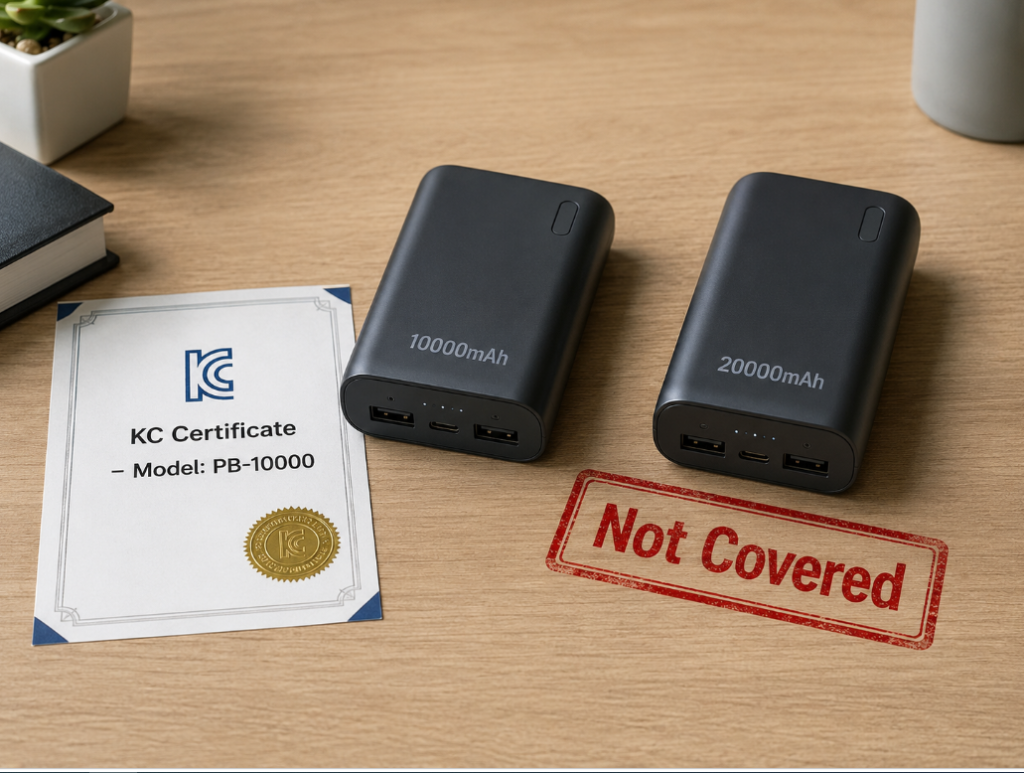
- Same model but different configurations: Even if the model names are similar, changes in battery capacity, adapter, wireless module, power, circuit board, or shell material may affect the coverage of the certificate. You cannot take it for granted to use the same certificate. For example, if the certificate says 10000mAh power bank, but you sell 20000mAh, even if the appearance is exactly the same, it is not considered covered.
- Second-hand, refurbished, and modified products: As long as they are sold commercially, they must bear compliance responsibility. Especially for products with modified electrical or wireless components, the original certificate is directly invalid and must be re-evaluated, and cannot continue to be used.
3. Core Rules of KC Certification: Types, Validity Period, and Invalidation Conditions
Comparison of Common Compliance Types
For everyone’s quick distinction, I have sorted out the most common types of compliance requirements under the KC system into a table, which is clear at a glance:
| Compliance Type | Applicable Product Risk | Core Requirements | Supervision Focus |
|---|---|---|---|
| Safety certification | High risk (such as high-voltage electrical appliances, high-power products) | Product testing + factory inspection + official certification issuance | Mass production consistency, regular/irregular factory inspections |
| Safety confirmation/self-regulatory safety confirmation | Medium risk (such as some small home appliances, batteries) | Sample testing + document confirmation/declaration | Authenticity of test reports, product consistency |
| Supplier’s conformity confirmation/self-declaration | Low risk (such as simple daily necessities) | Enterprise self-confirmation + retention of technical documents | Whether valid proof can be provided during spot checks |
| RRA conformity assessment | Wireless/communication/EMC products | Radio frequency + EMC testing + registration/certification, which may be divided into different paths such as conformity certification, conformity registration, and provisional certification, depending on the product type | Wireless parameters, model, module consistency |
| Children’s product safety compliance | Children-related products | Mechanical/chemical/combustion testing + corresponding level requirements | Child safety items, warning labels |
Validity Period and Subsequent Management: There is No Unified “Valid for X Years”
Many people ask “How many years is the KC certificate valid for?” In fact, there is no unified answer. The requirements vary across different systems and types. Everything shall be subject to the markings on the certificate, the status of the official system, applicable regulations, and notifications from the certification agency.
For example, for high-risk safety certification products, some certificates or confirmation records may indicate the validity period, while others emphasize more on official status, supervision and inspection, standard updates, and product consistency; but the key is never “how many years is the validity period”, but whether you can always maintain product consistency, whether the factory’s quality control can meet the standards, and you must also accept regular or irregular supervision and inspection. If the inspection fails, it may be suspended or revoked even before expiration.
For medium-risk safety confirmation or declaration products, there may be a clear validity period, or re-confirmation and updated declaration are required after standard updates, and renewal or re-confirmation must be completed as required before expiration.
For RRA-related certifications or registrations, the most important thing is whether the wireless parameters of the product have changed. For example, if the wireless module is replaced, the firmware is modified, the output power is adjusted, or the antenna is changed, the original registration will become invalid and needs to be redone.
To sum up: No matter what type of KC it is, as long as there are situations such as expiration, regulatory update, standard version change, certificate suspension/cancellation, or product structure change, the original certificate or declaration record may no longer be usable. You cannot just get the certificate and be done with it forever.
What Situations Will Cause KC Certificate or Declaration to Become Invalid?
Many sellers obviously have KC certificates, but still have their listings removed and are fined, mostly because the certificate has expired or is not covering. Common invalidation situations include the following:
- Model inconsistency: The model you actually sell is not within the scope of the certificate or declaration, or the model name differs by one letter or one suffix, and you cannot prove that it is the same product, then it is not considered covered.
- Change of key components: If core parts such as power boards, batteries, cells, adapters, wireless modules, antennas, motors, heating elements, and protection devices are replaced without applying for a change in advance, the original test will be invalid.
- Factory change: If the production factory relocates, changes to a new factory, or adds a new production base, without applying for a change or re-inspection as required, who knows whether the products made by the new factory meet the requirements?
- Specification change: Parameters such as power, voltage, current, battery capacity, wireless frequency band, output power, structural materials, and shell size that exceed the original test range are definitely not acceptable.
- Change of brand and applicant: For example, if you are a brand owner and use a certificate made by the factory for another brand without a legal authorization chain, this is a typical misappropriated certificate, which is directly invalid.
- Label change: If the KC mark, number, Korean warning text, importer information, and manufacturer information on the product are inconsistent with those on the certificate, it will also be deemed non-compliant.
- Regulatory change: If the corresponding standard or regulation is updated, and the certificate update is not completed after the transition period, sales cannot continue.
Boundaries Between KC and Other South Korean Compliance Requirements
In addition to KC, South Korea has many other compliance requirements, don’t confuse them:
- KC vs KCs: KCs is a certification related to occupational safety and health in South Korea, mainly for industrial protective equipment, factory equipment, etc. It is not the same as KC for ordinary consumer goods, and they cannot replace each other.
- KC vs medical devices: Medical devices are supervised by the Ministry of Food and Drug Safety (MFDS) of South Korea, and have a special access system. Ordinary KC cannot replace them.
- KC vs food/cosmetics/pharmaceuticals: These categories have their own independent supervision systems. KC is not their main access basis, don’t confuse them.
- Electrical safety KC vs RRA wireless/EMC: Both are under the KC system, but they manage different contents. Many electronic products require both. For example, a smart socket needs to pass both electrical safety and Wi-Fi RRA assessment; missing either one is not allowed.
- KC vs energy efficiency/environmental protection/battery recycling: Some products also need to meet additional requirements such as energy efficiency labels, RoHS (Restriction of Hazardous Substances), resource circulation, packaging labeling, and battery recycling. These are parallel to KC and not part of KC. Don’t think that doing KC will get everything done.
4. KC Mark and Certificate Identification: How to Check Authenticity and Coverage?
What Information Does a Formal KC Mark Usually Contain?
Don’t think a KC mark is real just because you see one. A formal KC mark (including marks on product nameplates and packaging) usually contains the following information:
- Unified KC graphic mark, which is the logo composed of K and C;
- Certification/declaration number: This is the most core. The number format of different systems is different, but it is the only basis for querying authenticity. A KC mark without a number is highly likely to have compliance problems;
- Basic product information: product name, model, rated voltage/current/power, manufacturer, importer, country of production, etc.;
- Korean information: Products sold in the South Korean market usually need to have Korean labels, Korean safety warnings, Korean manuals, and contact information of the importer. Products all in English or Chinese definitely have problems;
- Certification category information: The corresponding certification type can be seen on the number or mark of some products, such as whether it is safety certification or safety confirmation, whether it is RRA registration or certification.
It should be noted that not all KC marks of compliant products have all information printed on the body. Small products may only mark the KC mark and number, with detailed information placed in the packaging or manual, but the number is indispensable.
KC Mark Affixing and Display Requirements
The KC mark cannot be affixed casually; there are basic requirements:
Generally speaking, the mark should be clear, durable, not easy to be wiped off or blurred, and easily found by consumers and regulators. Common affixing positions are the nameplate on the product body, the minimum sales package, and the manual. Some smart products with screens can also display it with electronic labels.
Of course, there are exceptions. For example, for very small products (such as Bluetooth earphones, smart bracelets), the body is too small to affix the mark, or the product material is special and cannot be labeled, the mark can be placed in the packaging, manual, or electronic interface, but the specific situation must meet the requirements of the corresponding regulations.
Here is a reminder: if a product only says “KC certified” on the product detail page, but no KC number can be found on the product body, packaging, or manual, then it is basically a high-risk signal: either there is no certificate, or it is a misappropriated certificate.
Check These 8 Items First When You Get the Certificate to Avoid Pitfalls
Whether it is a certificate given to you by a supplier or a certificate you applied for yourself, check these 8 items first when you get it. Missing any one may cause problems:
- Is the product name consistent? The product name on the certificate must match the use and function of the actual product. For example, if the certificate says “power adapter” but the actual product sold is “power bank”, that is definitely not acceptable.
- Are the models fully covered? Confirm that all models and specifications you sell (including color, capacity, power, wireless version, set configuration, etc.) are within the coverage of the certificate. Even a missing suffix may mean it is not covered.
- Does the applicant/certificate holder have authorization? The holder of the certificate must have a legal authorization relationship with your supplier, brand owner, and importer, otherwise you cannot use this certificate.
- Are the manufacturer and production factory consistent? The manufacturer and production factory on the certificate must be consistent with the factory you actually get goods from, not affiliated or drop-shipped.
- Does the certification category match? High-risk products cannot be impersonated with low-risk self-declarations. For example, power adapters must be safety certified; a supplier’s conformity declaration is definitely useless.
- Are the standard version and test items applicable? Confirm that the standard used in the certificate is currently valid, and the test items cover all risk points of the current product.
- Is the valid status normal? Confirm that the certificate has not expired, been suspended, cancelled, or revoked, and there are no unprocessed change records.
- Is the KC number queryable and consistent? The number must be queryable in the corresponding official system, and the query results must be completely consistent with the information on the certificate and the physical product.
Official Query Channels and Query Ideas
To check KC certificates, you must go to official channels, don’t just look at the screenshots given by the supplier. The query channels for different systems are different, don’t go to the wrong place:
- Product safety category (electrical, daily necessities, children’s products): Prioritize using the official product safety information system of South Korea’s Safety Korea for query, which can check information such as certificates, models, applicants, status, etc.;
- Wireless/EMC category (RRA related): Prioritize using South Korea’s RRA conformity assessment query system to verify registration or certification information.
When querying, don’t just enter the number and be done when you find it. Carefully check the information such as applicant, product name, model, manufacturer, certification category, valid status, and issuance date. Only when all match is it considered valid.
When actually querying, you can pay attention to several practical details: first judge whether the product belongs to the product safety category or RRA category, and select the corresponding official system correctly; when entering, try to use the complete number on the certificate or nameplate, and also try to use the model and applicant name for auxiliary retrieval; pay attention to spaces, hyphens, case, Korean/English name differences in the number or name, which may all lead to no results found; after querying valid information, it is recommended to take a screenshot to save the query date and result page, for use in case of spot checks by platforms or customs.
If you can’t find it, it is not necessarily all fake certificates. You can check one by one in the following order:
- Whether the number is entered correctly, whether there are missing characters, wrong characters, or symbol errors;
- Whether the query system is selected correctly. For example, if you take the RRA wireless number to check in the Safety Korea system, you definitely won’t find it;
- Whether the certificate has expired, been revoked or suspended; some historical certificates may no longer be publicly displayed;
- Whether it is an old version number or provisional number, you need to contact the certification agency for verification;
- After excluding the above situations, it may be a fake certificate or invalid document.
Common Characteristics of Fake, Misappropriated, and Wrong Certificates
I have sorted out the characteristics of several most common fake, misappropriated, and wrong certificates. You must be vigilant when you encounter them:
- Only the KC graphic mark, no number, or the number is blurry or deliberately pixelated;
- Only certificate screenshots, no information can be found in the corresponding official system;
- The model on the certificate differs from the actual model by one letter or one suffix, or the capacity and configuration are different, but the supplier says it is a “universal model”;
- The holder of the certificate has no relationship with the seller, brand owner, or importer, and cannot provide authorization documents;
- Using old certificates made by suppliers for other brands and applying them to their own brand products, which is a typical misappropriated certificate;
- Wireless products with Bluetooth and Wi-Fi only have electrical safety KC certificates, no RRA wireless/EMC records;
- Only the power adapter has KC, while the whole machine, battery, and wireless module have not been evaluated as required;
- The certificate has expired, been suspended, or cancelled, but is still used for platform listing and customs clearance.
5. Full Process of KC Certification for Overseas Users: From Prediction to Launch
Materials to Prepare Before Application
Before applying for KC, prepare these materials first, which can save a lot of time:
- Basic product information: Product name, model, use, sales target, product pictures, manual, specification sheet, used to help the agency judge which regulatory line the product belongs to and what type of certification is required;
- Technical materials: Circuit diagram, PCB layout, bill of materials for key components, certificates of key components, battery specification sheet, adapter specification sheet, wireless module information (if with wireless), these are the basis for testing and document review;
- Model difference table: If there are multiple models, write clearly the differences between each model, such as differences in color, capacity, power, shell, wireless module, battery, and software functions, used to judge whether series certification is possible;
- Label materials: Nameplate sample, position of KC mark, Korean label, Korean warning text, importer/manufacturer information. The agency will help you review whether the label is compliant;
- Existing reports: If you already have reports such as CB, CE, FCC, IEC, ISO factory system, etc., be sure to give them to the agency in advance. If they meet the requirements, repeated testing can be reduced, saving money and time;
- Supply chain materials: Information of the applicant, manufacturer, production factory, and information of the South Korean local responsible entity (importer, agent, local legal person). Here is a special reminder for overseas sellers: Many KC/RRA projects require the participation of South Korean importers, agents, local legal persons, or other local responsible entities in the links of application, import, after-sales supervision, and recall; whether overseas enterprises can directly act as applicants shall be confirmed according to the specific regulatory line, product category, and requirements of the certification agency. If you do not have a South Korean local entity, be sure to confirm the application path and local responsible entity arrangement with the agency in advance.
Standard Application Steps
The standard process for applying for KC is generally divided into seven steps, none of which can be omitted:
- Regulatory prediction
First, find a professional agency or knowledgeable person to judge which regulatory line the product belongs to: electrical safety, daily necessities, children’s products, RRA wireless/EMC, or multiple superimposed. At the same time, confirm the applicable standards, certification type, test items, required number of samples, and whether factory inspection is required. This step is the foundation; if you judge wrong, all subsequent work will be in vain. - Select an accredited agency or laboratory
Choose a certification agency, testing institution officially recognized by South Korea, or their formal authorized service channels. Don’t just look at the agent’s promotion; be sure to verify the qualification of the agency. Otherwise, if you get a fake certificate or invalid document, the subsequent risks are very high. - Submit application and document review
Submit the prepared application form, product materials, label samples, technical documents, model difference table, and existing reports to the agency. The agency will first review the materials to confirm whether the sample configuration, key components, test standards, and certification path are correct. If there are problems, they will require supplementary materials. - Sample testing
Send the qualified samples to the laboratory for testing according to the corresponding standards, such as electrical safety, EMC, radio frequency, battery safety, mechanical and physical, chemical items, etc. If the test fails, rectification is required. After rectification, it may be necessary to resend samples or conduct supplementary testing. This part is the most likely to delay time, so try to design according to standards during product development. - Factory inspection or document confirmation
High-risk safety certification products usually require factory inspection, that is, the agency sends people to the production factory to check whether mass production can maintain consistency with samples and whether the quality control system is in place. Medium and low-risk products generally only require document confirmation, declaration, or require enterprises to retain technical documents, without on-site factory inspection. - Issue certificate/complete declaration/obtain registration information
After passing the testing and review, you will get the corresponding certificate, confirmation document, registration number, or declaration record. Be sure to keep the full set of technical documents, test reports, and certificates properly, as they will need to be provided during subsequent spot checks by platforms, customs, and regulators. - Labeling for launch and subsequent maintenance
Produce KC marks, Korean nameplates, manuals, and packaging as required, and confirm that all information is consistent with the certificate before launching. Subsequently, if there are product changes, factory changes, standard updates, certificate expiration, or regulatory spot checks, they must be handled in a timely manner and cannot be left unattended.
Reference for Processing Cycle and Fees
Many people ask right away “How long does KC certification take? How much does it cost?” In fact, there is no unified answer, because the requirements for different products are too different.
First, let’s talk about the cycle: simple medium and low-risk safety confirmation or RRA registration projects can usually be completed in 2-4 weeks if the materials are complete and the testing goes smoothly; but for high-risk projects that require complete safety testing, superimposition of multiple categories such as wireless + battery + electrical, and factory inspection, the cycle may be extended to 1-3 months or even longer, depending on the actual situation.
There is also a lot of time that is not counted in the normal cycle, such as the time you spend supplementing materials, the time for international transportation of samples, the time for rectification after failed testing, the time for scheduling factory inspections, and the time of South Korean holidays. These should all be reserved in advance, don’t schedule it right up to the listing time.
Let’s talk about fees. KC fees generally consist of the following parts: application fee, testing fee, certificate/registration fee, factory inspection fee, sample fee, rectification fee, agency service fee, translation and label review fee.
There are also many factors that affect the cost: product category, number of test items, whether it has wireless, whether it has a battery, whether it is plugged into mains, how many models there are, whether there is a CB report, and whether factory inspection is required, all of which will affect the final price. Generally speaking, the cost of low-risk, single test path projects is usually lower than that of projects with multiple regulatory lines superimposed, requiring factory inspection, or covering multiple models; the specific quotation must be evaluated by the agency based on product category, applicable standards, number of samples, model differences, and existing report conditions, and there is no unified fixed price.
So don’t believe the saying “KC certification has a unified price of XX yuan”; those who say unified price are basically scammers.
Common Pitfalls for Overseas Users
When overseas users apply for KC, they are most likely to fall into these pitfalls, so be sure to avoid them:
- Failing to judge the regulatory line first, resulting in only doing RRA and missing electrical safety, or only doing electrical safety and missing wireless, and still unable to list in the end;
- Finding unqualified black market agents, and the obtained certificate cannot be found in the official system, which is a fake certificate or invalid document;
- The samples sent for testing are different from the mass-produced goods, resulting in failed spot checks and suspended certificates;
- The product nameplate, packaging, and manual have no Korean information, or no information of the South Korean importer, and are stuck during customs clearance or listing;
- The differences between series models are too large, and they are forced to be included in one certificate. After being found out, the entire certificate becomes invalid. For example, for a pair of Bluetooth earphones, one uses a Bluetooth 5.3 module and the other uses a Bluetooth 5.0 module. The core wireless components are different, so they cannot be included in the same RRA certificate;
- Thinking that CE and FCC reports are enough to sell directly to South Korea, ignoring South Korea’s national differences and local declaration procedures, resulting in detained goods;
- Replacing key components such as batteries, adapters, and wireless modules later without applying for a change, resulting in the original certificate becoming directly invalid.
6. Differences Between KC and CE, FCC, CB, PSE: Can They Be Transferred? How to Save Money?
5 Core Dimensions for Comparing Certifications
Many people compare KC with certifications from other countries, wanting to know if they can be used universally or transferred. When comparing different certifications, mainly look at these 5 dimensions:
- Applicable market: KC corresponds to South Korea, CE corresponds to the EU, FCC corresponds to the US, PSE corresponds to Japan. CB is the international electrotechnical product conformity testing and certification mutual recognition system under the IECEE CB Scheme, not a single country’s certification;
- Control focus: KC may cover safety, EMC, wireless, children’s products, etc.; FCC mainly manages US EMC and wireless; CE covers safety, EMC, wireless, environmental protection, etc. according to EU directives;
- Mandatory degree: The mandatory catalogs of different countries are different, and all certifications can only be used in the corresponding market, and cannot be directly replaced across markets;
- Whether factory inspection is required: High-risk KC safety certification may require factory inspection, CE is mostly enterprise self-declaration or notified body participation, while PSE and CB have different requirements depending on product type;
- Whether mutual recognition: In the vast majority of cases, there is no mutual recognition, only part of the test data can be reused, or used as a reference for certificate transfer.
KC vs EU CE Certification
Core difference: CE is the EU’s market access mark, KC is South Korea’s, and the two cannot replace each other at all.
Reusable parts: If you have CE LVD (Low Voltage), EMC (Electromagnetic Compatibility), RED (Radio Equipment Directive) test reports, under the conditions of similar standards, compatible versions, and consistent samples, they may be used as a reference by South Korean agencies to reduce part of the repeated testing.
Key limitation: CE self-declaration cannot be directly converted to KC. South Korean agencies will still review standard differences, samples, and document completeness. What needs to be supplemented must be supplemented, and none of the required procedures can be omitted.
KC vs US FCC Certification
Core difference: FCC is a US certification, mainly covering electromagnetic compatibility and wireless communication requirements, and does not cover electrical safety, so it cannot replace the electrical safety part of KC at all.
Reusable parts: Radio frequency and EMC test data can be used as technical references, but South Korea’s frequency band requirements, output power limits, test standards, label requirements, and declaration procedures are different from those of the US, and must meet the requirements of South Korea’s RRA.
Key limitation: FCC ID must never be used as a South Korean KC/RRA number; if found, it is a violation.
KC vs International CB Certification
Core connection: CB is the international electrotechnical product safety test certificate and test report system under the IECEE system. South Korea participates in the CB system, so CB reports are the easiest to transfer to KC.
Most suitable scenarios for transferring to KC: For electrical safety products such as power adapters, chargers, home appliances, and power tools, if you already have a valid CB certificate and CB test report, transferring to KC will save a lot of time and money. For example: the CB report of a power adapter uses the IEC 62368-1 standard, which has very little difference from the corresponding Korean KC standard. When transferring to KC, it may only be necessary to supplement a few test items unique to South Korea, which may reduce repeated testing and review time. However, whether to supplement testing, how much to supplement, and how much cost can be saved shall be judged by the South Korean accredited agency based on the report version, sample consistency, key components, and South Korean national differences.
Transfer conditions: The CB report must cover your current product model, key components are consistent, the standard version is applicable, and it includes or can supplement South Korea’s national difference tests and materials.
Note: CB is only a part of the test report system, not a KC certificate. It still needs to be reviewed by a South Korean accredited agency, and high-risk products may also require factory inspection or supplementary other materials.
KC vs Japan PSE Certification
Core difference: PSE is Japan’s electrical appliance safety system, which is different from South Korea’s KC in terms of control catalog, standard differences, mark requirements, applicant entities, and supervision methods, and they cannot replace each other at all.
Reusable parts: Test data of some power supply and electrical products can be used as a reference, but usually still need to be confirmed by a South Korean agency, and South Korea’s national difference items need to be supplemented.
Note: The PSE mark cannot be used for sales in the South Korean market, and the KC mark cannot replace PSE for use in Japan.
Semi-Proficient Strategies for Saving Money and Speeding Up
If you want to apply for KC and save money and time, you can try these practical tips:
- Prioritize organizing CB reports: For electrical safety products, if you have high-quality CB reports, they usually have the best chance of reducing repeated testing, which is the most obvious way to save money;
- Unify key components in advance: Products of the same series should try to use the same power board, battery, wireless module, shell material, and protection device, so that series certification is easier and there is no need to test each model separately;
- Plan series in advance: Plan the model naming and difference range during the product development stage. Don’t wait until later to add a model and test it separately, which will cost much more. For example, for the same Bluetooth earphone, only the color is different (black/white/pink), and the battery, motherboard, and Bluetooth module are the same, then series certification can be done, only testing one main model and listing the other models;
- Do a pre-assessment first: Before the official project starts, let the agency do a pre-assessment for you to confirm the certification path, number of samples, and difference items, to avoid detours and rework later;
- Don’t blindly pursue the lowest price: If a low-price agent misjudges the certification path for you, or provides an invalid certificate, the subsequent costs of listing removal, supplementary testing, and redoing will be much more than the little money you saved.
7. KC Compliance Practical Guides for Different Roles
Different roles focus on different KC points. I have sorted out the practical key points respectively:
Cross-border Sellers/Brand Owners
- Confirm the platform requirements before listing. For example, mainstream South Korean e-commerce platforms such as Coupang, Gmarket, and 11Street have very strict KC requirements for electrical, wireless, and children’s product categories, and valid KC numbers must be provided to list;
- Also note: The KC requirements of some South Korean e-commerce platforms may be stricter than local regulations. Even if the product belongs to the low-risk self-declaration category, the platform may require third-party certification documents to be listed. Therefore, be sure to check the latest platform rules of the corresponding category before listing, don’t just look at regulatory requirements;
- When asking suppliers for materials, don’t just ask for a certificate picture. Ask for the complete certificate, key pages of the test report, official query screenshots, authorization letter, and model difference table. Otherwise, you have no way of knowing whether the certificate is real or fake, or whether it can cover your product;
- For own-brand products, don’t directly use certificates made by the factory for other brands. Be sure to confirm that the brand, model, and authorization chain are all covered. Otherwise, it is a misappropriated certificate with great risks;
- When signing a contract with a supplier, be sure to clearly state the ownership of the certificate, authorization scope, notification obligation for model changes, responsibility for fake certificates, obligation to cooperate with spot checks, and the party responsible for recall costs. Otherwise, if the supplier runs away when problems arise, you have to bear all the responsibilities yourself;
- Plan series certification in advance for multi-model products, which can not only reduce testing costs but also facilitate later maintenance.
South Korean Importers/Purchasers
- South Korean importers are usually the local primary responsible entity. If there is a compliance problem, the regulator will contact you first. Therefore, you must establish a supplier access and certificate verification mechanism. Don’t just believe what the supplier says about having a certificate;
- Factory inspection is not the same as KC verification. Be sure to check whether the five items “certificate/declaration record – physical product – nameplate label – packaging manual – purchase contract” are consistent. Otherwise, no matter how big the factory is, it is useless;
- When goods arrive, be sure to conduct spot checks, focusing on checking whether the KC mark, number, Korean label, importer information, model, rated parameters, and production batch are correct;
- If inconsistencies are found, suspend sales first, isolate the relevant inventory, then contact the certification agency and supplier to confirm whether to change, supplement testing, or recall. Don’t continue to sell with a fluke mind;
- For high-risk products, regularly recheck the status of the certificate to avoid continuing to sell when the certificate has been suspended or cancelled.
Ordinary Consumers
- When buying plug-in products, rechargeable products, wireless products, and children’s products, first check whether there is a KC mark and number on the product body, packaging, or manual. Don’t just trust the promotion on the detail page;
- Don’t feel relieved just seeing the four words “KC certification”. Try to check whether the number and model match in the official system;
- Products with abnormally low prices, no brand, no Korean labels, and only English/Chinese packaging must be treated with vigilance, as they are most likely non-compliant;
- If there is a safety problem, be sure to keep the product, packaging, purchase voucher, order screenshot, and KC number, and feedback to the platform, seller, or relevant South Korean regulatory channels;
- View KC rationally: It is just the basic compliance threshold, and does not mean that the product’s experience, lifespan, or performance must be better. Don’t be fooled by merchants’ exaggerated publicity.
Factories/Manufacturers
- Confirm relevant South Korean standards during the product development stage. Don’t wait until mass production to find that labels, structures, materials, and circuit designs do not meet the requirements, as the rework cost is very high;
- Establish a change control process for key components. Before replacing key parts such as batteries, power boards, wireless modules, and adapters, first ask the certification agency whether it can be changed and whether supplementary testing is needed. Don’t change first and then deal with it;
- Keep production consistency records, incoming material inspection, factory inspection, test reports, and batch traceability materials properly, so that they can be quickly provided during spot checks;
- When issuing certificates for OEM customers, clarify the scope of use of the certificate to prevent customers from using it beyond the brand, model, or market. Otherwise, you may also bear joint and several liability;
- When subject to regulatory spot checks, quickly provide evidence of sample consistency and complete technical documents, and actively cooperate with the investigation.
8. Common Misconceptions and Pitfall Avoidance List: Avoid “Having a Certificate But Still Can’t Sell”
The Most Common Cognitive Misconceptions
Many people’s understanding of KC is wrong from the root. Let’s first correct a few of the most common ones:
- Misconception 1: KC certification is valid for life after one application
Correct answer: No. Certificate status, regulatory updates, standard version changes, product changes, and failed factory supervision may all lead to certificate invalidation. It requires continuous maintenance, and you cannot be done forever once you get the certificate. - Misconception 2: With CE/FCC/PSE, you don’t need to do KC
Correct answer: They cannot replace it at all. These certifications can only be used as a reference for part of the test materials. South Korea has its own regulations and procedures, and KC-related compliance must be completed before selling in South Korea. - Misconception 3: If the supplier says there is KC, it must be usable
Correct answer: You must check the model, brand, applicant, manufacturer, factory, authorization relationship, and certificate status by yourself. Don’t believe everything the supplier says; many misappropriated certificates come from this. - Misconception 4: If accessories have KC, the whole machine must be compliant
Correct answer: A certificate for parts does not mean the whole machine automatically meets the requirements. The whole machine still needs to be evaluated according to the use and structure of the final product. A certificate for parts can only save some testing time. - Misconception 5: Small-batch e-commerce sales don’t need KC
Correct answer: As long as it is commercial sale, regardless of the quantity, it must meet South Korea’s regulations and platform requirements. Small batch is not a reason for exemption. On the contrary, it is easier to be spot-checked by the platform because of the small quantity. - Misconception 6: You can sell as long as you affix the KC mark
Correct answer: Privately printing KC marks, misappropriating other people’s numbers, and affixing wrong numbers are all violations, and the punishment may be heavier than having no certificate. - Misconception 7: Passing platform review is equivalent to full compliance
Correct answer: The platform only conducts preliminary data verification. If problems are found in subsequent customs spot checks, market supervision, or consumer complaints, you still need to bear all compliance responsibilities. Don’t think that everything is fine once the listing is successful.
Common Product Compliance Minefields
In addition to cognitive misconceptions, there are also many minefields in the compliance of the product itself, which you can step on if you are not careful:
- Labeling minefield: Only affix the KC mark on the packaging, not on the product body; no number; the font is blurry and comes off when scratched; incomplete Korean information, no warning text or importer information;
- Model minefield: The model on the certificate is inconsistent with the actually sold model, or there is a difference in the suffix but it cannot be explained clearly;
- Configuration minefield: Versions with different batteries, different adapters, and different wireless modules are mixed and sold in the same product link, some