
Have you ever had these daily doubts: when you turn off the TV with the remote control and the indicator light is still on, does it consume electricity at all? After charging your phone, you only unplug the phone and leave the charger plugged into the wall all the time—will it secretly drain power? With so many small plugged-in devices at home, how much extra electricity bill will you pay in a year?
Behind these seemingly insignificant “invisible power consumption” are standby power requirements that regulatory authorities and energy efficiency certification bodies around the world have been promoting. It is not an obscure professional concept; it is related to every household’s electricity bill, electrical safety, and even environmental protection.
This article is written for ordinary overseas users, renters, people in charge of household utility bills, and beginners who like to buy electronic products cross-border—you don’t need to understand electronic engineering, nor do you need to memorize regulatory provisions. After reading it, you will be able to clarify what various “standby” and “shutdown” mean, understand key parameters on product manuals and energy efficiency labels, judge whether a product’s standby power consumption is reasonable, save electricity bills at home with safe and low-cost methods, and avoid the most common cognitive pitfalls.
First, let’s clarify the scope: this article is only for general consumer science popularization and energy saving reference. It does not provide laboratory testing methods, nor does it replace manufacturers’ compliance assessments. It does not involve professional requirements for special equipment such as medical, industrial, and military equipment, nor does it recommend specific brands or products. All content cannot be regarded as legal compliance advice. Standby power limits vary by region, product category, function, and regulatory version; values measured at home with a power meter or smart socket can only be used to estimate electricity bills, and cannot be used as official compliance evidence.
1. What Exactly is Standby Power Consumption
1.1 Plain Language Definition
The standby power we often refer to is the electricity consumed by a device that is plugged in but not performing its main function, in order to maintain auxiliary features. These features usually include waiting for user wake-up, saving settings, displaying time, receiving remote control signals, or maintaining network connections.
It also has many common names: phantom load, vampire power, or ghost load—all referring to the same concept.
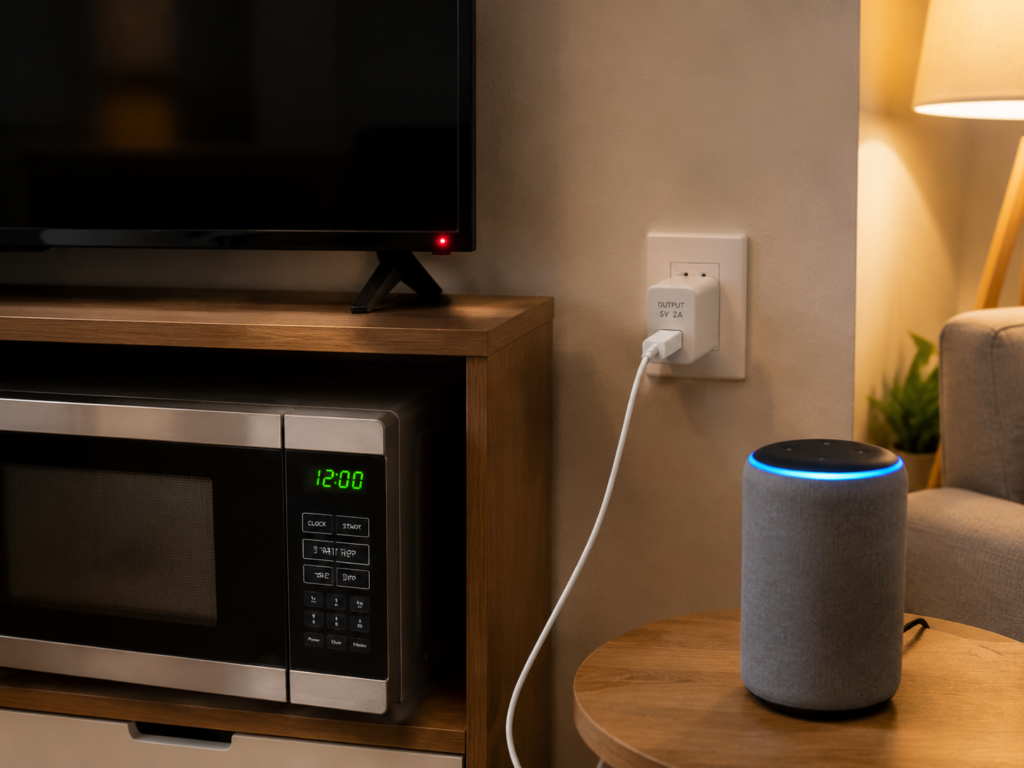
Such scenarios are everywhere in life: a TV whose indicator light stays on after remote shutdown, a microwave oven with a constant clock display, a charger left in the socket after unplugging the phone, a smart speaker waiting for voice commands, or a printer in ready-to-print state. Power consumption in all these states falls within the scope of standby power.
1.2 Why Power Consumption Occurs After “Turning Off”
Many people wonder: I pressed the remote to turn off the device, why does it still use power? In fact, most “shutdowns” via remote control or soft keys do not fully cut off the device’s power supply; they are “soft shutdowns”—the main function stops, but the infrared receiver, control chip, and some power modules remain powered on, waiting for the next power-on command.
Additionally, devices with digital clocks, status indicators, memory settings (such as TV channel memory, air conditioner temperature memory), and network wake-up functions must retain a small amount of power to maintain these features. Otherwise, settings will be lost the next time they are turned on, or they cannot be woken up remotely.
Only unplugging the power plug, toggling a true mechanical power switch on the device (not a soft key), or turning off the main switch of a qualified power strip achieves a near-complete power cut. This is not an encouragement to unplug all devices; we will cover which devices cannot be casually powered off later—safety always comes first.
1.3 Five Easily Confused Low-Power States
To understand standby power, you must first clarify five device power states, otherwise it is easy to mix up power consumption of different modes:
- Complete power off: Unplug the device or turn off the power strip main switch. The device is fully disconnected from the power supply, with theoretically zero power consumption. This is the most thorough power-off state, but not all devices are suitable for frequent plugging and unplugging.
- Off Mode: After the user presses the power button on the device body or remote to shut down, the device stops all main functions and only retains minimal power for basic detection circuits (such as power detection and key wake-up circuits). Off-mode power consumption is often lower than normal standby; some devices cannot be woken up directly by remote control and require a physical button press.
- Standby Mode: The device does not perform its main function, but can be quickly woken up at any time via remote control, body buttons, or timer to resume main function. For example, a TV turned off with the remote and a printer in ready state fall into normal standby—the most commonly referenced “standby” state.
- Networked Standby: The device’s main function has stopped, but it maintains Wi-Fi, Ethernet, or Bluetooth connections, and can receive remote wake-up commands, synchronize data, or update firmware. For example, a smart TV with the screen off that can be woken up by phone screen casting, or a standby smart speaker that responds to voice commands, both belong to networked standby. Power consumption in this mode is usually higher than normal standby.
- Sleep/Hibernate: Common in computers, game consoles, and tablets. The device saves the current running state to memory (sleep) or hard disk (hibernate), then enters a low-power state, and can quickly return to the previous working interface after waking up. Whether this state is classified as “standby” management depends on local regulatory definitions for product categories, and rules may vary by region.
1.4 No-load Power Consumption: A Special Scenario for Chargers
In addition to the low-power states of the devices themselves, there is another very common “invisible power consumption” easily confused with standby power: no-load power.
No-load power specifically refers to the power consumed by external power adapters and chargers when plugged into a socket but not connected to any load (mobile phones, computers, electric toothbrushes, power tools, etc.). The most typical scenario: after charging a phone, people only unplug the phone and leave the charger plugged into the wall; or a laptop adapter stays plugged into a desk socket year-round.
Note that many regions have separate energy efficiency requirements and testing methods for the no-load power consumption of external power supplies. You cannot directly apply standby power standards for home appliances (such as the commonly heard 0.5W) to chargers, as product categories and regulatory rules are completely different.
1.5 What Are “Standby Power Requirements”?
Standby power requirements are not behavioral rules for ordinary consumers, but energy consumption limits, testing methods, or information disclosure requirements set by government regulators or authoritative certification bodies for low-power states of electronic and electrical products.
These requirements mainly constrain manufacturers, importers, and sellers, requiring them to control low-power energy consumption within a reasonable range. Ordinary consumers can buy more energy-saving products through compliant products, energy efficiency labels, and certification information, indirectly reducing household electricity bills and energy waste.
There are four common forms of standby power requirements:
- Mandatory market access requirements: non-compliant products cannot be sold locally
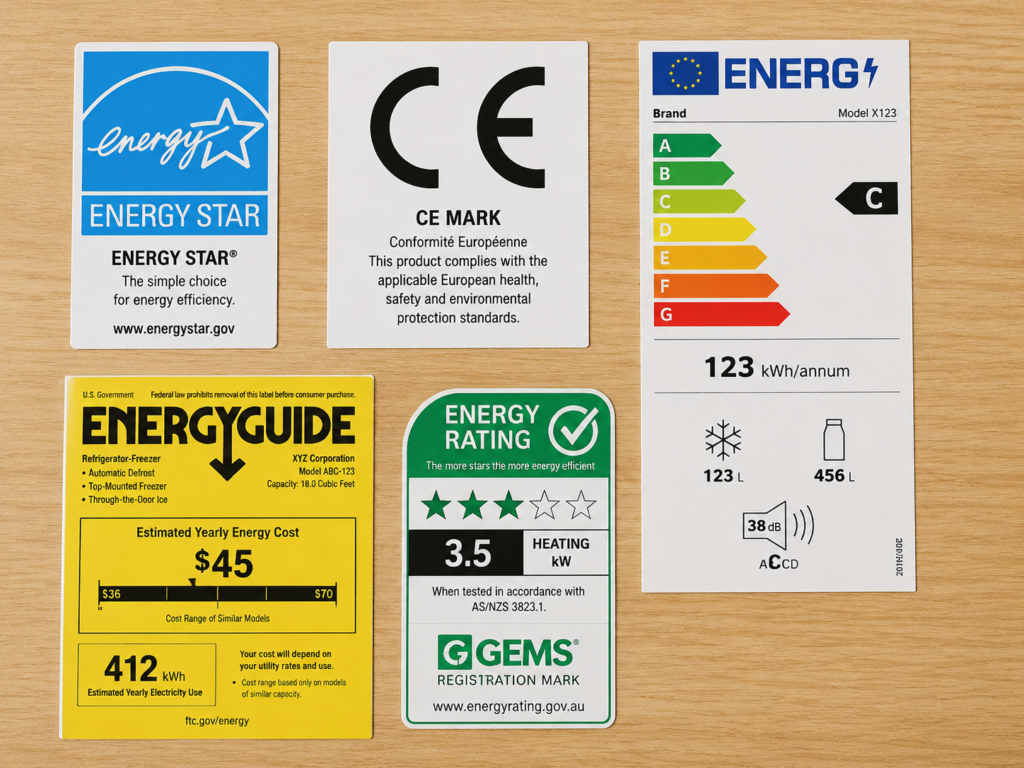
- Voluntary high-energy-efficiency certification (such as Energy Star), with requirements usually higher than mandatory standards
- Energy efficiency label disclosure: requiring products to be labeled to inform users of their energy consumption level
- Official database registration (such as the EU’s EPREL and Australia-New Zealand’s GEMS databases) for user inquiry and verification
The core goal is clear: reduce long-term ineffective energy waste, drive manufacturers to design lower-power products, and ultimately support energy conservation, emission reduction, and sustainable consumption.
2. Why Standby Power Matters: Cost, Waste & Safety
You might say, it’s only a few tenths of a watt of power consumption, is it necessary to be so serious? In fact, the standby power consumption of a single device is indeed not high, but with a large number of devices and long operating hours, the cumulative effect is obvious.
Power Saving: Small Power × Long Time = Visible Consumption
Let’s do a simple calculation: a 1-watt (W) device on standby 24 hours a day consumes about 8.76 kWh of electricity per year. A single device is not much, but when you add up the TV, set-top box, game console, printer, speaker, chargers, microwave oven, and air purifier at home, it adds up to a meaningful amount.
How much you can save depends on how many plugged-in devices you have, how long they are on standby daily, local electricity prices, whether devices are connected to the internet, and whether they are older products. Some old devices, especially older set-top boxes, game consoles, and printers, may have significantly higher standby power consumption when fast startup, networked standby, or background updates are enabled; individual models may reach several watts.
Real-World Household Example
For a typical 2-3 person household with common plugged-in devices:
| Device | Standby Power | Daily Standby Hours |
|---|---|---|
| TV (networked) | 3W | 20 |
| Game console (networked) | 7W | 22 |
| Set-top box | 5W | 24 |
| 5 phone chargers (no-load) | 0.3W each | 24 |
| Microwave oven | 1W | 24 |
| Smart speaker | 2W | 24 |
| Printer | 2W | 22 |
Total continuous standby load: ~21.5W
- Annual standby power consumption: ~188 kWh
- At an electricity price of $0.30/kWh: **~$56 per year in wasted standby electricity**
- At an electricity price of €0.30/kWh: ~€56 per year
This is a conservative estimate for an average household. Homes with more smart devices or older electronics can easily see higher waste.
How to Calculate Your Standby Electricity Bill
The calculation formula is very simple:
Annual electricity bill = Annual power consumption (kWh) × Local electricity price per kWh
Actual amounts will be affected by many factors: tiered electricity pricing, peak-valley rates, included utilities in rent, or home solar installations will all change actual savings.
Sustainability: Reduce Invisible Energy Waste
Standby power consumption is a typical “small per unit, large total” energy waste. According to statistics from different regions, standby power consumption of ordinary households accounts for about 3% to 10% of total household electricity consumption, with proportions varying greatly based on device count and usage habits.
The corresponding carbon emission impact depends on the local grid structure: if local electricity is mainly coal-fired, carbon emissions per kWh are high, and the environmental significance of energy saving is greater; if the proportion of renewable energy is high, carbon emissions will be lower.
Safety: Related but Not to Be Confused
It must be emphasized: standby power requirements regulate energy waste, not electrical safety. Fire prevention, electric shock prevention, and other safety issues are managed by specialized systems such as UL, ETL, CSA, IEC/EN safety standards, and the EU Low Voltage Directive—they are not the same thing.
Of course, if you find a device is obviously hot during standby, has a burning smell, makes a buzzing sound, has a deformed casing, blackened plugs, or the power strip feels hot to the touch, this is not an energy saving problem but a safety problem. Stop using it immediately for inspection.
When Standby Impact Is Amplified
Not all households have the same standby power consumption. These situations will significantly increase the impact:
- Devices plugged in 24/7, such as set-top boxes, game consoles, smart speakers, printers, and chargers
- Fast startup, voice wake-up, remote control, background download, and cloud synchronization functions enabled
- Use of older products with much higher standby power consumption than current new products
- High local electricity prices or an especially large number of plugged-in devices at home
- Product firmware updates that enable new functions by default, resulting in increased standby power consumption
3. Global Regulatory Landscape: Key Rules by Region
Many people have heard scattered statements like 0.5W, CE, and Energy Star, but rules vary greatly across countries and regions—there is no unified global standard. For ordinary users, you don’t need to memorize laws and regulations. Understanding the basic framework of each region will help you judge whether a product’s standby power consumption is reasonable.
Quick Reference Table of Global Standby Power Regulations
| Region | Core Regulatory System | Key Consumer Takeaway |
|---|---|---|
| European Union | Mandatory Ecodesign framework + EU Energy Label | Check the official energy label or EPREL database; the CE mark alone does not guarantee low standby power. |
| United States | DOE mandatory minimum standards + voluntary Energy Star certification | Compare via EnergyGuide labels; Energy Star signals above-average efficiency. |
| United Kingdom | UK-specific Ecodesign rules (post-Brexit) + local energy labels | Verify UK-market product specs; do not rely directly on the latest EU rules. |
| Australia & New Zealand | GEMS/MEPS mandatory standards + energy rating labels | Check local GEMS registration and energy labels for verified data. |
| Japan | Top Runner program + category-specific efficiency rules | Compare energy performance across products in the same category. |
General Regulatory Structure
No matter which country or region, standby power consumption regulation follows a similar logic:
- Regulated objects: Target specific categories of plugged-in electronic appliances, home appliances, office equipment, external power supplies, etc.—not all plugged-in products are regulated.
- Regulated states: Usually cover off mode, normal standby, networked standby, sleep mode, and no-load mode, with different limits for different states.
- Regulation methods: Generally divided into mandatory energy efficiency regulations, ecodesign rules, mandatory energy efficiency labels, and voluntary high-energy-efficiency certification.
- Core principle: There is no single number applicable to all countries, products, and modes. Always verify according to the four dimensions of “local regulations + product category + function mode + current version”.
EU: Ecodesign as the Core Framework
The core of EU standby power regulation is the mandatory Ecodesign framework, a market access requirement—applicable products cannot be legally sold in the EU if they do not meet ecodesign energy efficiency requirements.
Current requirements for standby, off mode, and networked standby have been updated by rules such as Commission Regulation (EU) 2023/826, replacing the old framework, with stricter requirements implemented in phases. Key points for ordinary users:
- Common limits for some normal standby and off modes are around 0.5W, but this is not a unified standard for all products.
- Devices with information displays, networked standby devices, and network equipment such as HiNA may be subject to higher or completely different limits.
- The CE mark is only a manufacturer’s compliance declaration, representing that the product declares compliance with all applicable EU regulations (safety, electromagnetic compatibility, energy efficiency, etc.). It is not a mark of “excellent low power consumption”.
- To check a specific product’s energy efficiency, prioritize the EU energy label or query the EU EPREL product energy efficiency database for far more accurate information than the CE mark.
US: DOE Mandatory Standards + Energy Star Voluntary Certification
The US energy efficiency system has two layers that many people easily confuse:
- Mandatory level: The US Department of Energy (DOE) formulates minimum energy efficiency standards by product category; products that do not meet the standards cannot be sold in the US. Standards for some product categories already include requirements for standby, off mode, or other low-power modes, not just operating power consumption.
- Voluntary level: Energy Star is a voluntary high-energy-efficiency certification, with requirements usually higher than DOE mandatory minimum standards—equivalent to a “top energy efficiency” mark, but not required for all products.
For ordinary users, you can use these channels to check US market products: EnergyGuide energy labels (marking annual power consumption and estimated operating cost for easy comparison), Energy Star mark, Energy Star Product Finder database, and DOE official compliance information. Note: the absence of Energy Star does not mean the product is illegal; it just means it has not applied for this voluntary certification and may only meet minimum mandatory standards.
UK: Retained EU Framework with Gradual Localization
After Brexit, the UK did not directly follow the EU’s latest ecodesign rules, but gradually adjusted to a local ecodesign and energy label system based on the original framework.
If you use or buy products in the UK, check locally applicable energy labels, product manuals, and official UK rules. Do not directly apply the latest EU version. When cross-border shopping, note: EU version products do not automatically meet UK sales requirements, and vice versa.
Australia/New Zealand: GEMS/MEPS and Energy Labels
Australia and New Zealand mainly manage energy efficiency requirements through systems such as GEMS, MEPS, and E3. Rules are formulated separately by product category, including minimum energy efficiency performance requirements, mandatory energy labels, and product registration. Rules for some products cover standby or low-power states.
When purchasing products in Australia and New Zealand, prioritize checking local energy labels, GEMS registration information, and official product databases. Do not assume limits are identical to the EU; product classification and testing methods may vary by region.
Japan: Top Runner System and Category-Based Requirements
Japan’s energy efficiency management has a distinctive system called Top Runner. Simply put, it takes the current leading energy efficiency level among products of the same category as the goal to drive continuous industry improvement, with all requirements formulated separately by product category.
Some products in the Japanese market include standby power consumption, low-power states, or annual power consumption in energy efficiency evaluation, but not all products have an independent unified standby power limit. Japan’s energy efficiency labels are more suitable for comparing energy efficiency of same-category products, and should not be directly horizontally compared with the EU’s 0.5W rule.
Other Markets and Cross-Border Shopping Reminders
In addition to the above major markets, Canada, South Korea, Singapore, and some ASEAN countries also have their own energy labels or minimum energy efficiency requirements, with specific rules determined by local product categories.
If you like cross-border shopping, note: products from different regions may differ not only in plug shape, voltage and frequency, but also in safety certification, energy labels, warranty policies, and even local sales compliance. The safest principle: subject to the regulations, official databases, and local version of the product manual of your actual place of use.
Regulatory Trends
Overall, standby power consumption regulation is developing in a stricter and more detailed direction:
- Power consumption limits for normal standby and off modes will become stricter long-term, with new products generally having lower standby power consumption than old models.
- With the growing popularity of smart home and IoT devices, networked standby and remote wake-up power consumption are becoming regulatory focus areas.
- Regulation no longer only looks at the single number of “standby watts”, but expands to details: automatic low-power entry time, default energy-saving settings, clear energy consumption disclosure, and product repairability and sustainability requirements.
- Consumers will increasingly rely on official databases and digital labels to check energy efficiency information, rather than just paper labels.
4. Which Products Are (and Aren’t) Covered by Standby Rules?
Not all plugged-in products should be judged by “standby power consumption” standards. Power consumption of many devices is required for normal operation and cannot be confused.
Common Civil Products to Pay Attention To
Generally speaking, standby power consumption is worth attention for these categories of civil products:
- Audio-visual entertainment: TVs, projectors, speakers, set-top boxes, streaming media players, game consoles
- Office and IT: monitors, desktop computers, laptops, printers, scanners, routing-related equipment
- Kitchen and home appliances: microwave ovens, ovens, washing machines, dishwashers, coffee machines, air conditioners, air purifiers
- Charging and power supply: mobile phone chargers, laptop adapters, electric toothbrush charging bases, tool battery chargers
- Smart home: smart speakers, smart sockets, networked home appliances, smart home gateways
Devices Not Judged by Normal Standby Rules
Several types of devices either work normally all the time or have special requirements, and cannot be held to normal standby standards:
- Devices that continuously perform main functions: refrigerators, routers, webcams, NAS (Network Attached Storage), and security systems. These devices operate 24 hours a day doing their core work, not “standby”.
- Safety-related devices: smoke alarms, carbon monoxide alarms, medical auxiliary equipment, security alarm main units. These devices cannot be casually powered off to save electricity; safety always comes first.
- Industrial or professional equipment: medical equipment, laboratory equipment, industrial control equipment, professional broadcasting equipment, usually subject to special standards different from civil products.
- Devices with real mechanical switches: some devices have power switches that physically cut off power. After turning off, power is completely cut off, so there is no typical standby state.
How to Distinguish “Networked Standby” from “Always-on Operation”
With more and more smart devices, many people cannot distinguish between “networked standby” and “always-on operation”. There is a simple judgment formula: see whether it is “waiting for instructions to resume the main function” or “continuously performing its own task”.
For example, a smart TV with the screen off waiting to be woken up by phone screen casting—its main function (playing images) is stopped, it is just waiting for instructions, so it is networked standby. A router that forwards network data 24 hours a day is doing its core job, belonging to always-on operation, not standby.
Special Boundaries of Power Adapters
For chargers and power adapters, judgment standards depend on the state:
- When connected to a load (such as charging a mobile phone), conversion efficiency and working-state energy consumption are evaluated.
- When not connected to a load but still plugged into the socket, no-load power consumption is evaluated.
For ordinary users, you don’t need to struggle too much with classification. For chargers and adapters not used for a long time, just unplug them directly or turn off the power strip—it’s the most direct and safest approach.
Why Exemptions and Exceptions Exist
You might ask, why do some devices have high standby power consumption but are not considered non-compliant? This is because regulations take actual situations into account:
- Some devices must maintain power for safety, communication, data storage, or remote monitoring.
- The low-power state of some products is difficult to cover with the general definition of standby.
- Regulations will set exemptions, transition periods, or separate testing methods by product category.
Therefore, ordinary users should not judge a product as non-compliant just because “power consumption is higher than 0.5W”. Always confirm the product category and current working mode first.
5. How to Read Standby Specs, Labels & Official Data
After clarifying the difference between product categories and working modes, many people encounter the next question: where can I check specific standby power parameters? This chapter will help you sort out methods for checking parameters and reading labels, so you can quickly find the information you need without professional knowledge.
Common English Parameter Glossary
When reading overseas product manuals or official specification pages, these are the most common English parameters. You don’t need to memorize them; just reference them when needed:
- Standby Power: Normal standby power consumption—power consumption when the device stops its main function and waits for remote control or key wake-up. Marked on most home appliances with standby functions, it is the main basis for judging daily standby power consumption.
- Off Mode Power: Off-mode power consumption—the extremely low power consumption retained after the user presses the power button or remote to shut down. Many people confuse it with standby power; when buying, you can compare the difference between the two to see if the off state is more power-saving.
- Networked Standby: Networked standby power consumption—only exists in smart devices with Wi-Fi, Bluetooth, or Ethernet. It refers to power consumption when the main function is off but the network connection is maintained for remote wake-up. Usually higher than normal standby.
- Sleep Mode Power: Sleep mode power consumption—common in devices that can save running status such as computers, monitors, and game consoles. Power consumption is lower than during operation but may be slightly higher than normal standby.
- No-load Power: No-load power consumption—only appears in parameters of external power supplies such as chargers and adapters. It is self-consumption when plugged in but not connected to any load.
- Auto Power Down: Automatic shutdown/automatic low-power entry—the device will automatically reduce to a lower power mode after a period of no operation.
- Time to Standby: Time to enter standby—the time required for the device to automatically enter standby mode after completing operations.
- Annual Energy Consumption: Annual power consumption—this parameter is the most practical, usually comprehensively calculating power consumption of various states (operation, standby, shutdown) according to typical usage scenarios.
Three Rules for Parameter Comparison
It’s not enough to understand the meaning of each parameter. Many people draw wrong conclusions after comparing back and forth because they don’t follow these three basic rules:
- Only compare the same mode. Normal standby power cannot be directly compared with networked standby, and charger no-load power cannot be compared with TV standby power.
- Only compare under the same conditions. Many small details change power consumption values: status indicator on/off, Wi-Fi/Bluetooth/Ethernet connection, fast startup enabled, external devices connected, test voltage, and firmware version.
- Only compare products of the same category. TVs, chargers, routers, refrigerators, and printers have different functions and regulatory rules, so reasonable power consumption ranges naturally vary greatly.
How to Read Common Energy Efficiency Marks
In addition to manual parameters, various marks on products are also a quick basis for judging energy efficiency, but many marks are easily misunderstood:
- CE mark: EU market compliance declaration mark. It means the manufacturer declares the product complies with all applicable EU regulations, but it is not a mark of “excellent low power consumption”.
- EU Energy Label: Mandatory only for specific product categories (TVs, refrigerators, washing machines, etc.). The label clearly marks energy efficiency grade (A to G), annual power consumption, and key standby-related energy consumption information.
- EPREL database: EU product energy efficiency registration database. You can query more detailed parameters such as standby, off mode, and annual power consumption by model.
- Energy Star: Voluntary high-energy-efficiency certification used in the US and some markets, with requirements usually higher than local mandatory minimum standards.
- EnergyGuide label: Common US market energy consumption label, clearly marking the product’s annual power consumption and estimated operating cost.
- GEMS/MEPS system: Australia and New Zealand energy efficiency management system, including minimum energy efficiency requirements, mandatory energy labels, and product registration.
Where to Find Accurate Standby Power Parameters
In order of priority from high to low:
- Product manual: The easiest place to find parameters. Search for keywords: standby, off mode, sleep, networked standby, no-load. Note that you should read the local version of the manual for your region, not the global version.
- Manufacturer’s official website specification page: If the manual is lost or you want to check parameters before buying, find the specification sheet for the corresponding model on the official website. Pay attention to selecting your regional site.
- Official energy efficiency database: The most authoritative public query channel. Different regions have different databases: EPREL for the EU, Energy Star Product Finder/DOE resources for the US, GEMS registration platform for Australia and New Zealand.
- Product labels and compliance declarations: Energy efficiency labels and compliance stickers on the product body and packaging clearly mark the model, regional version, and energy efficiency grade.
Hidden Conditions to Note When Checking Parameters
There are several easily overlooked “hidden conditions” when checking parameters:
- Function switch status: fast startup enabled, network connections, status indicators, and connected external devices all increase low-power state power consumption. Manual parameters are usually values under default settings or standard test conditions.
- Temporary states: high power consumption from printer warm-up, refrigerator defrost cycles, background firmware updates, or cartridge maintenance is higher than normal standby and should not be taken as normal standby energy consumption.
- Regional model version: the same model name may have different power supply designs, firmware functions, and certification requirements in different regions.
- Firmware update impact: firmware updates may enable new functions by default or adjust low-power strategies, changing standby power consumption.
6. How to Judge if a Device’s Standby Power Is Reasonable
You don’t need to be a regulatory expert to roughly judge whether a product’s standby power consumption is reasonable. Just follow the “three-layer judgment method”.
Three-Layer Judgment Method (From Accurate to Rough)
- First layer: Official marks and databases (highest priority) Official energy efficiency labels, product databases, and certification query results are usually the highest priority and most reliable public information. They cannot replace manufacturer compliance assessments or complete regulatory tests, and not all products and parameters are fully covered by databases.
- Second layer: Manual and specification parameters (reference) Find standby, off mode, networked standby, and no-load power parameters in the manual, and compare with same-category products and local rules to roughly judge whether they are within a reasonable range. Do not apply a single value to all products.
- Third layer: Home measurement (only for daily reference) Use a power meter or smart socket to measure power consumption in real usage at home. This method can only be used to estimate electricity bills and find big power consumers at home, and cannot be used as legal compliance evidence.
Before You Buy: Quick Checklist
If you don’t want to spend too much time checking regulations, follow this checklist before buying to avoid common pitfalls:
- Confirm the product is a local version for your region, with applicable voltage, plug, certification, and warranty
- Check for locally required energy efficiency labels or compliance information
- Verify standby, off mode, networked standby, and no-load power parameters in the manual
- Compare with other products in the same category, rather than applying a fixed universal value
- Prioritize products searchable in official databases with authoritative high-energy-efficiency certifications
Simple Home Measurement Method
If you want to know the real standby power consumption of your home devices, you can measure it yourself:
- Tools: An ordinary power meter or smart socket with power statistics. Choose one with a low-power measurement resolution of 0.1W or finer for more accurate small-power measurement.
- Steps: Plug the measuring device into the socket, then plug the device to be tested into the measuring device. Set the device to the state you want to test, wait 10 to 30 minutes for the value to stabilize, then record the reading.
- Recommended test states: remote shutdown state, fast startup on/off, Wi-Fi on/off, indicator light on/off.
- Error reminder: For values below 1W, the error of ordinary household power meters may be relatively large; don’t worry too much about differences of a few tenths of a watt.
- Usage boundary: Measured results are only suitable for estimating electricity bills and finding high-power-consuming devices, and should not be used to determine whether a product is illegal.
How to Calculate Annual Power Consumption and Electricity Bill
After measuring power, you can calculate annual power consumption and electricity bill yourself with simple formulas:
- Annual power consumption (kWh) = Power (W) × Daily standby hours × 365 ÷ 1000
- Annual electricity bill = Annual power consumption × Local electricity price per kWh
Two quick examples:
- TV standby power of 0.5W, on standby 20 hours a day: ~3.65 kWh annual consumption, very minimal electricity cost.
- Game console networked standby power of 8W, on standby 20 hours a day: ~58.4 kWh annual consumption, a meaningful amount.
When optimizing, prioritize finding devices with high power, long standby time, and large quantity—these are the real big power consumers, and optimizing them brings the highest benefits.
Common Shopping Pitfalls
Many merchants use “energy saving” and “zero standby” banners in promotions. Here are a few common pitfalls to remind you:
- “Zero standby power consumption”: Most of the time, it just means power consumption is low enough to fall below a certain display or test threshold, not absolute zero power consumption in physics.
- “Smart is more energy-saving”: Smart functions may instead increase networked standby power consumption (voice wake-up, background synchronization). Whether it saves power depends on specific parameters, not just the word “smart”.
- “Cross-border same model is identical”: The same model may have different power supplies, firmware, functions, and certifications in different regions.
7. Common Misconceptions Debunked
Many people’s understanding of standby power consumption is superficial and easily misled. These common misconceptions will help you build more accurate judgment ability.
Misconception 1: Shutdown Must Consume No Power
Correction: Remote shutdown and soft key shutdown usually still have off-mode power consumption, not zero. Only unplugging the plug, toggling a mechanical switch, or turning off the power strip main switch achieves truly near-complete power off.
Misconception 2: All Devices Must Be Below 0.5W
Correction: 0.5W is just a common reference value, not applicable to all regions, products, and modes. Networked standby, devices with display functions, network equipment, and specific home appliances may have different rules and limits. Always verify by product category and operating mode.
Misconception 3: Energy Star or Energy Label Equals Mandatory Compliance Certificate
Correction: Energy Star is a voluntary high-energy-efficiency certification, not a mandatory requirement for all categories. Energy labels may be mandatory disclosure requirements in some regions and specific categories, mainly to help consumers compare energy consumption levels of similar products, but they themselves are not equivalent to a complete compliance certificate.
Misconception 4: Smart Devices Must Be More Energy-Saving
Correction: Smart functions such as voice wake-up, networked standby, and background synchronization will instead increase energy consumption in low-power states. Whether a smart device saves power depends on specific parameters and whether you can turn off unnecessary smart functions.
Misconception 5: The Lower the Standby Power, the Better
Correction: Standby power consumption is not the lower the better. If it is too low, you may lose access to needed functions such as remote wake-up, fast startup, and scheduled tasks. You need to find a balance between safety, convenience, and energy consumption.
Misconception 6: If a Smart Plug Measures Higher Than the Standard, It Is Illegal
Correction: Home measurement conditions, accuracy, and device state are completely different from official laboratory tests, and measured results cannot be used as compliance evidence. Their correct use is to find big power consumers at home, estimate electricity bills, and compare energy consumption differences between different settings.
Misconception 7: You Can Judge a Product’s Environmental Friendliness Only by Standby Power
Correction: A product’s environmental friendliness is comprehensive. In addition to standby power consumption, it also depends on operating energy consumption, service life, repairability, consumable amount, packaging, and recyclability. True sustainable consumption means repairing when possible, reasonably extending device life, and choosing high-energy-efficiency products when natural replacement is due.
8. Practical Action Plan: What You Can Do Today
After reading this article, you have mastered standby power knowledge from beginner to semi-proficient level: you can distinguish different low-power states, understand the difference between mandatory regulations and voluntary certification, judge whether a device is in standby or normal operation, and know which devices are suitable for power off and which are not.
You can do these things right now in less than half an hour, and you will see the effect:
- Check standby settings on your home TV, game console, printer, chargers, and speaker. Turn off unnecessary fast startup, voice wake-up, background download, and remote wake-up functions.
- Equip non-critical devices in the entertainment area, office area, and charging area with a qualified power strip with a switch, and turn off power together when not in use.
- Next time you buy a new product, remember to check the local energy label, official database, and standby parameters in the manual.
- If any long-term plugged-in device at home has abnormal heating, odor, or abnormal noise, do a safety check first—it is much more important than energy saving.
Standby power consumption is never an anxiety problem of “saving to the extreme”, but a life choice of “reducing waste with a little thought”. You don’t need to pursue zero standby, nor struggle over a few tenths of a watt. Just find the balance that suits you.
9. Frequently Asked Questions
Does a plugged-in charger use electricity when no device is connected?
Yes. All chargers and power adapters consume a small amount of no-load power when plugged into the wall but not connected to a device. Modern efficient chargers typically consume 0.1W to 0.5W at no load, while older or lower-quality models may consume more.
Is 0.5W the global standard for all standby power?
No. 0.5W is a common limit for basic standby/off mode in some product categories in some regions, but it is not a universal global standard. Networked standby, devices with displays, and external power supplies often have different limits, and rules vary by country and product type.
Should I unplug all my devices every night to save energy?
It depends. For non-critical devices like TVs, game consoles, and chargers, turning off a power strip is convenient and effective. But you should never unplug safety devices (smoke alarms, security systems), refrigerators, or routers that need to run continuously. Prioritize devices with high standby power and long idle times.
Does a smart TV use power when it’s turned off with the remote?
Yes. Most smart TVs remain in networked standby mode after remote shutdown to support quick startup, voice wake-up, screen casting, and background updates. Power consumption can range from less than 1W to several watts depending on enabled features. You can reduce it by disabling fast startup and network wake-up functions.
Can I use a smart plug to measure standby power accurately?
Smart plugs are good enough for estimating household standby power consumption and identifying high-wattage devices, but they are not precise enough for official compliance testing. For values below 1W, consumer-grade smart plugs may have noticeable measurement errors. Use them for daily reference and bill estimation only.
Does the CE mark guarantee low standby power consumption?
No. The CE mark is a manufacturer’s declaration that a product meets all applicable EU regulations (including safety, EMC, and energy efficiency). It does not indicate exceptional low power consumption. For verified energy efficiency data, check the EU energy label or EPREL database instead.