
Introduction
Cross-border sellers, foreign trade factories, product managers, or compliance personnel operating in the UK market have most likely heard the term “UKCA certification”. Some say it is the UK version of CE, some say you must find a third-party body to issue a certificate, and others say CE has long been unusable — with all kinds of mixed claims, beginners can easily get confused.
First, the most important precaution: the rules for UKCA and CE are heavily affected by post-Brexit policy adjustments in the UK. Currently, most general products under the jurisdiction of the UK Department for Business and Trade (DBT) have long accepted the CE mark for entry into the Great Britain (GB) market, with no unified deadline. However, special categories such as medical devices, construction products, maritime equipment, railway products, and vehicles have separate regulatory rules, transition periods, and requirements from competent authorities. This article helps you build a complete understanding framework for UKCA. Before any practical operation, be sure to follow the latest rules on gov.uk and from the corresponding competent authorities.
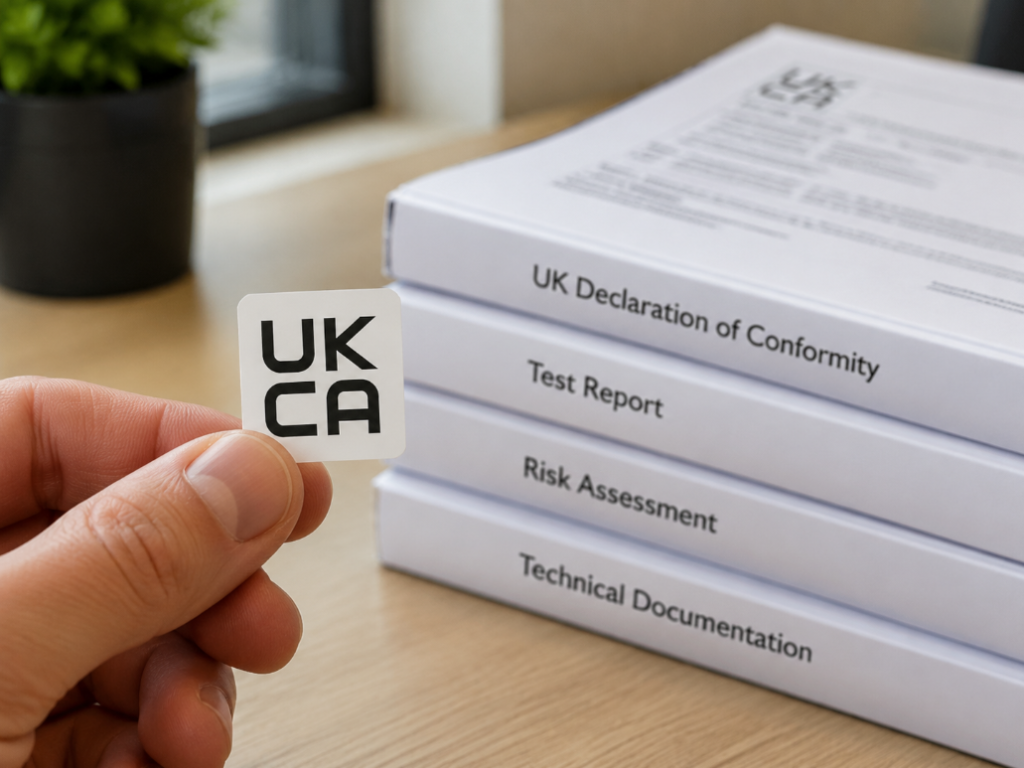
Also, let’s first clarify the most core misunderstanding: although the market commonly refers to it as “UKCA certification”, it is essentially not a single “certificate” uniformly issued by the UK government, but a UK product conformity assessment mark, along with a complete set of compliance processes that support this mark. Just like the familiar CE mark, the sticker itself is worthless; what truly has legal effect is the testing, risk assessment, technical documentation, and declaration of conformity behind it.
First, Understand What UKCA Really Is
When many people first encounter UKCA, their first reaction is “I need to get a UKCA certificate”, which is actually the most common cognitive bias. We start with the most basic definitions, scope of application, and policy boundaries.
UKCA Is Not a Certificate, But a Conformity Assessment Mark
The full name of UKCA is UK Conformity Assessed. It is one of the compliance marks for products entering the UK’s Great Britain market, indicating that the product has completed conformity assessment in accordance with UK regulatory requirements — either the manufacturer has self-declared compliance, or it has been assessed by a UK-accredited third-party body.
What truly supports the legal validity of the UKCA mark is a complete compliance chain: first identify the UK regulations applicable to the product, complete necessary testing and risk assessment, select the correct conformity assessment route, prepare a full set of technical documentation, sign the UK Declaration of Conformity (UK DoC for short), affix the mark correctly, and continue to follow up on compliance after the product is placed on the market.
For low-risk products, in many categories, as long as regulations permit, manufacturers can complete the compliance process on their own, without needing to find a third-party body to “issue a certificate”. Only high-risk products or products explicitly required by regulations must be assessed with the participation of a UK officially accredited conformity assessment body (Approved Body, equivalent to the EU Notified Body in the CE system).
Also note: UKCA only proves that the product meets the minimum safety, health, environmental protection, electromagnetic compatibility and other requirements of UK regulations. It does not mean the product has a higher quality grade, nor is it an official recommendation from the UK government.
UKCA Only Covers These Regions, Don’t Get the Market Wrong
The applicable territory of UKCA is very clear: it only covers Great Britain (GB), that is, the three regions of England, Scotland, and Wales. The following markets cannot directly use UKCA:
- Northern Ireland: applies a compliance system aligned with EU rules, mainly uses the CE mark, and requires the combined use of CE + UKNI marks in specific scenarios;
- EU/European Economic Area (EEA): UKCA is not recognized by the EU, and products sold to the EU still need to be processed in accordance with CE rules.
In short, no single mark can cover all markets of GB, Northern Ireland, and the EU at the same time. First confirm the target market for final sales, then select the corresponding compliance mark — this is the first step of compliance.
Policy Boundary: Most General Products Still Accept CE, No One-Size-Fits-All Approach
Many people have heard the claim that “the CE mark has a deadline in the UK”, but this information is outdated. The current general principle in the UK is:
- Most general products under the jurisdiction of DBT have long accepted the CE mark as a compliance route for market access in GB, with no unified deadline. Common general categories include toys, machinery, electrical equipment, electromagnetic compatibility (EMC), radio equipment, personal protective equipment (PPE), pressure equipment, gas appliances, explosive atmosphere equipment (ATEX), measuring instruments, RoHS-related products, etc.
- Special categories such as medical devices, construction products, maritime equipment, railway products, vehicles, and aviation products are regulated by specialized departments. Their CE recognition rules, conformity assessment requirements, and transition periods are all different, so you must never directly apply the conclusions for general products.
Another reminder: even if regulations allow CE for entry into the GB market, you should also confirm whether your customers, e-commerce platforms, retailers, or bidding documents have additional requirements for the UKCA mark, UK DoC, or local UK compliance documents — commercial requirements are sometimes stricter than regulatory requirements.
The Consequences of Non-Compliance Are Not As Simple As “Affixing the Wrong Mark”
Many beginners think UKCA is just a matter of sticking on a mark, and at worst they can make up for it if caught — this idea is very dangerous. The consequences of non-compliance cover multiple levels from regulation to business:
- Regulatory side: Products may be required to be removed from shelves, recalled, rectified, or stopped from sale; in severe cases, they may be seized or even destroyed;
- Platform side: Platforms such as Amazon UK and eBay UK conduct irregular spot checks on test reports, DoCs, label photos, importer information, and supply chain documents. If you cannot provide them, the lightest consequence is product removal, and the heaviest is account restriction;
- Legal side: Manufacturers, importers, and distributors may all bear administrative penalties and civil compensation. In the event of a serious safety accident, criminal liability may also be incurred;
- Commercial side: Delays in customs clearance, return of goods, unsellable inventory, customer claims, termination of cooperation by channels, and damage to brand reputation — these losses are often much higher than the cost of compliance.
5 Cognitive Misconceptions Beginners Must Correct
We list the most common misconceptions here to help you avoid half the pitfalls first:
- Misconception: UKCA must be issued by a third-party body
Correction: For many low-risk products, as long as regulations permit, manufacturers can self-declare, but this must be supported by real test evidence, risk assessment, and complete technical documentation — you can’t just stick a mark randomly. - Misconception: All products sold to the UK need UKCA
Correction: Only products falling within the scope of UK general product conformity assessment regulations are covered by the UKCA/CE framework. Food, cosmetics, pharmaceuticals, vehicles, etc. are subject to other regulatory systems and do not need to go through the general UKCA process, but they must still meet the compliance requirements of their corresponding fields. - Misconception: With CE, you never have to worry about UKCA
Correction: Most general products can indeed use CE to enter GB currently, but special categories, platform requirements, customer needs, bidding rules, or future policy changes may all require you to provide UKCA or additional UK compliance documents. - Misconception: Products with UKCA are definitely safe
Correction: The mark only means that the required regulatory conformity assessment has been completed. It does not mean the product has no usage risks at all; normal usage precautions and warning labels must still be in place. - Misconception: There is a unified “official certificate” for UKCA
Correction: The core of UKCA is the compliance process and declaration. Third-party bodies may issue test reports, type examination certificates, or audit certificates, but there is no single unified “UKCA certificate issued by the UK government”. Don’t be fooled by various “certificates” on the market.
Don’t Confuse the Three Marks: UKCA, CE, UKNI
Friends operating in the European market are certainly very familiar with CE, and there is also the less familiar UKNI mark. These three correspond to different markets, and confusing them can easily cause problems.
Core Positioning of the Three Marks
First, let’s clarify the function of each mark in one sentence:
- UKCA mark: A UK conformity assessment mark for the GB market, and one of the compliance routes for general products to enter GB;
- CE mark: A conformity assessment mark for the EU, EEA, and Northern Ireland markets. For product categories recognized by the UK, it can also be used for GB market access;
- UKNI mark: An auxiliary mark for specific scenarios in Northern Ireland. It cannot be used alone and must be affixed together with the CE mark.
For easy comparison, we have compiled a core difference table:
| Comparison Item | UKCA Mark | CE Mark | UKNI Mark |
|---|---|---|---|
| Core Applicable Market | Great Britain (GB: England, Scotland, Wales) | EU/European Economic Area (EEA), Northern Ireland; general categories recognized by the UK can also be used for GB | Only for specific scenarios in Northern Ireland, cannot be used alone |
| Regulatory Basis | UK domestic regulations | EU regulations | EU regulations + assessment by UK body |
| Standards Used | UK Designated Standards | EU Harmonised Standards | EU Harmonised Standards (requires participation of UK body in assessment) |
| Third-Party Body Requirements | Use UK Approved Body when third-party is required | Use EU Notified Body when third-party is required | Used when a UK Approved Body participates in the assessment |
| Can Be Used Alone | Yes | Yes | Must be used together with the CE mark |
Core Differences Between UKCA and CE: Don’t Just Look at the Different Logo
Many people think UKCA and CE are just a change of logo, but in fact there are many differences in the logic behind them:
- Different regulatory references: The UK DoC references UK domestic regulations, while the EU DoC references EU regulations. You cannot directly replace the EU DoC’s logo with UKCA and use it as a UK DoC;
- Different standard systems: UKCA uses standards designated by the UK government, while CE uses harmonised standards issued by the EU. Currently, the content of most standards is still highly similar, but they may gradually diverge after Brexit, and you will need to check the latest versions separately in the future. If you want to use CE test data for UKCA, it is easier to reuse only if the harmonised standard used for CE testing is listed as a designated standard by the UK, or if you can prove that the technical requirements are equivalent;
- Different third-party bodies: When third-party participation is required for the UKCA route, you need to find a UK Approved Body; for the CE route, you need to find an EU Notified Body. The qualifications of the two are not interchangeable;
- Different documentation requirements: In addition to different regulations and standards, the consistency of responsible entities, signing information, product models, and batches must be checked separately, and one set of documents cannot be used interchangeably.
Don’t Get It Wrong for the Northern Ireland Market: UKNI Cannot Be Used Alone
Many people are unfamiliar with the UKNI mark, so let’s clarify it specifically here:
- UKNI is only used in specific conformity assessment scenarios in Northern Ireland. It must never be affixed alone and must be used together with the CE mark;
- Products with CE + UKNI cannot be directly sold to the EU market. The EU only recognizes pure CE marks that comply with EU rules;
- UKCA cannot be used as a market access mark for Northern Ireland at all — don’t confuse them;
- The rules for Northern Ireland are heavily affected by adjustments to the UK-EU agreement. Before actual export, be sure to check the latest official rules.
Scenario Judgment for Quick Mark Selection
If you don’t know which mark you should apply for, you can directly compare with the following scenarios:
- Only sell to EU/EEA: Process according to CE rules, no UKCA needed;
- Only sell to GB: First determine whether the product belongs to the general categories for which the UK accepts CE. If yes, you can choose either the CE route or the UKCA route. If customers, platforms, or project documents explicitly require UKCA, prepare materials according to UKCA;
- Sell to both EU and GB: Usually at least CE compliance is required. If you also use the UKCA mark, you need to prepare EU DoC and UK DoC separately, and cannot share one declaration;
- Sell to Northern Ireland: Prioritize judgment according to CE rules. The UKNI mark only needs to be added when the conformity assessment involves a UK body;
- Special categories: For medical devices, construction products, maritime equipment, railway products, vehicles, etc., directly check the rules of the corresponding competent authorities, and do not apply the conclusions for general categories.
Which Products Need UKCA? Scope of Application and Quick Judgment Method
Now that we have clarified the differences between the marks, the next thing everyone is most concerned about is definitely: does my product need UKCA? We will explain it from three dimensions: common categories, exceptions, and judgment methods.
Common Major Product Categories Included in the UKCA/CE Framework
Most industrial and consumer products with certain risks fall within the scope of the general conformity assessment framework. Common categories include:
- Electrical and electronic products: such as chargers, power adapters, small home appliances, lamps, and power tools, which usually involve requirements such as electrical safety regulations, EMC, and RoHS;
- Radio equipment: such as Bluetooth headsets, WiFi routers, smart lamps, and wireless remote controls. In addition to electrical safety, EMC, and RoHS, they must also comply with radio equipment regulations;
- Toys: such as plush toys, building blocks, electric toys, and children’s role-play toys, which are subject to toy safety regulations;
- Machinery equipment: such as processing equipment with dangerous moving parts, lifting equipment, and some power tools, which are subject to machinery safety regulations;
- Personal protective equipment (PPE): such as safety helmets, protective goggles, protective gloves, fall protection equipment, and some protective masks;
- Pressure equipment and gas appliances: such as pressure vessels, boilers, gas stoves, and gas heating equipment;
- Explosive atmosphere equipment (ATEX): electrical and non-electrical equipment used in explosive atmospheres;
- Measuring instruments: such as electronic scales, metering instruments, and fuel dispensers.
An additional note: ordinary manual tools such as manual screwdrivers and wrenches that have no electrical components, no dangerous moving parts, and are not classified as PPE or toys are usually not included in the scope of mandatory UKCA assessment. However, they must still meet general product safety, labeling, and consumer protection requirements — they are not completely unregulated.
One Product May Be Subject to Multiple Regulations Simultaneously
Don’t think that one product only corresponds to one regulation. Many products, due to their multiple functions, need to meet several requirements at the same time. For example:
- Smart lamps: may simultaneously involve requirements such as low-voltage safety, electromagnetic compatibility, radio (if with WiFi/Bluetooth), RoHS, energy efficiency, and labeling instructions;
- Bluetooth children’s toys: may simultaneously involve requirements such as toy safety, radio equipment, battery safety, chemical restrictions, and age warnings;
- Power tools: may simultaneously involve requirements such as mechanical safety, electrical safety, EMC, noise, and instruction manual warnings;
- Products with lithium batteries: in addition to the regulations for the main product, they may also involve battery safety, transportation testing, recycling responsibilities, and labeling requirements.
When making a judgment, you need to break down the product’s functions, risk level, target users, power supply method, wireless functions, material composition, and sales channels, covering all applicable regulations without missing any items.
Products Not in the General UKCA Framework But Still Requiring Compliance
Many products do not need to go through the general UKCA process, but that does not mean they do not need compliance. They have their own regulatory systems:
- Food and food contact materials: regulated by systems such as the UK Food Standards Agency (FSA), subject to food safety, labeling, and food contact material limit requirements, and not part of the general UKCA framework;
- Pharmaceuticals and medical devices: regulated by the UK Medicines and Healthcare products Regulatory Agency (MHRA). Medical devices have separate UKCA/UKNI/CE rules, risk classifications, and transition arrangements, and the general product process cannot be applied;
- Cosmetics: subject to UK cosmetics regulations, usually requiring a UK Responsible Person, SCPN notification, Product Information File (PIF), Cosmetic Product Safety Report (CPSR), and label compliance, and not part of the UKCA framework;
- Childcare products: such as strollers, high chairs, and bed rails for children. They may be subject to specialized safety standards. If they do not fall into the toy category, they are not processed through the toy UKCA route, but must still meet product safety requirements;
- Vehicles and auto parts: subject to specialized systems such as vehicle type approval and road safety, and usually not part of the general UKCA conformity assessment scope;
- Construction products: subject to the UK construction product regulatory system and related rules. You can check the latest transition arrangements from the UK Department for Levelling Up, Housing and Communities (DLUHC, formerly MHCLG) and gov.uk, and the CE recognition rules for general products cannot be applied;
- Maritime, railway, and aviation products: regulated by the Maritime and Coastguard Agency (MCA), Office of Rail and Road (ORR), and Civil Aviation Authority (CAA) respectively. They have their own industry regulatory systems and do not apply the general UKCA process;
- Second-hand, refurbished, antique, and personal-use samples: whether they are exempt depends on the sales behavior, product category, degree of modification, time of first placing on the market, and applicable regulations. You cannot directly assume that no compliance is required.
Conformity Assessment Route: Self-Declaration or Third-Party Body?
Many people ask: does my product need to be done by a third-party body? The answer is not “whether it looks dangerous”, but depends on the conformity assessment modules in the regulations — that is, the types of conformity assessment processes specified by regulations. Some allow manufacturers to do it themselves, while others require third-party participation.
You can judge according to these steps:
- First check the regulations applicable to the product and the corresponding conformity assessment modules;
- If the module allows manufacturer self-assessment (such as the common Module A scenario), you can take the self-declaration route, conduct testing, risk assessment, organize technical documentation, and sign the DoC by yourself or by entrusting a laboratory;
- If the module requires third-party body participation (such as Module B/C/D scenarios), you must find a body with corresponding qualifications;
- Choose a UK Approved Body for the UKCA route, and an EU Notified Body for the CE route;
- For Northern Ireland scenarios where a UK body participates in third-party assessment, it is usually necessary to add the UKNI mark, used together with CE.
Note: Test reports issued by ordinary laboratories are not “universal certificates”. Even if you take the self-declaration route, the manufacturer still bears full legal responsibility for the authenticity of compliance, and must be supported by complete technical documentation.
3-Step Quick Judgment on Whether a Product Involves UKCA
If you have just got a product and don’t know where to start, you can follow these three steps:
- Confirm the target market: whether you are selling to GB, Northern Ireland, the EU, or multiple markets. First confirm the market, then talk about compliance;
- Confirm applicable regulations: according to the product’s functions, check the product safety and metrology page on gov.uk, the official website of the industry competent authority, and the designated standard list to see which regulatory system it belongs to;
- Confirm the compliance route: determine whether CE can be used, whether UKCA is needed, whether third-party body participation is mandatory, and whether it belongs to a special category.
Don’t Apply General Rules to Special Categories
Again, the following categories must never be subject to general UKCA rules. You should directly find the rules of the corresponding competent authority, or entrust a professional compliance agency:
- Medical devices: regulated by MHRA, classified into Class I, IIa, IIb, and III according to risk level. Most high-risk products require third-party assessment, and there are separate transition arrangements for CE recognition;
- Construction products: subject to UK construction product regulations and specialized designated standards/assessment systems. For transition arrangements, check the latest information from DLUHC and gov.uk;
- Maritime equipment: regulated by MCA, subject to maritime equipment regulations, and requires corresponding approval;
- Railway products: regulated by ORR, subject to railway interoperability regulations, with a separate conformity assessment system and mark requirements;
- Vehicles and parts: subject to the type approval system, and not part of the general UKCA conformity assessment scope.
Full UKCA Processing Flow: From Regulation Identification to Post-Market Compliance
If you are sure that your product needs to take the UKCA route, next we will explain the complete processing flow step by step, from preliminary preparation to ongoing post-market compliance — no link can be missing.
Step 1: First Clearly Define the Product and Sales Scenario
Many people immediately ask agencies “how much does UKCA cost”, but they haven’t even clarified the basic product information, so the quotes they get are definitely inaccurate. You need to first clarify these things:
- Basic product information: name, model, variants, accessories, power supply method, whether there is wireless function, main materials, and who the target users are;
- Sales region: whether you only sell to GB, or also sell to the EU and Northern Ireland at the same time — different markets have different requirements;
- Your role: whether you are a manufacturer, brand owner, importer, distributor, or platform seller — different roles have different responsibilities;
- Sales form: whether it is B2C retail, B2B equipment, OEM/ODM, set sales, or sold together with batteries/chargers — different forms have different compliance requirements.
Step 2: Match Applicable UK Regulations and Designated Standards
With the product and market clarified, next you need to sort out all UK regulations applicable to the product. Common regulations include:
- Electrical Equipment (Safety) Regulations 2016
- Electromagnetic Compatibility Regulations 2016
- Radio Equipment Regulations 2017
- Toys (Safety) Regulations 2011
- Supply of Machinery (Safety) Regulations 2008
- Restriction of the Use of Certain Hazardous Substances in Electrical and Electronic Equipment Regulations 2012
Then you need to check the UK designated standards list to confirm whether the standard version you are using is still valid. If you also sell to the EU, you need to separately confirm the applicability of EU harmonised standards.
Don’t just focus on the UKCA mark itself. You also need to cover supporting compliance requirements, such as instruction manual language, warning labels, chemical restrictions, energy efficiency, packaging, batteries, WEEE (waste electrical and electronic equipment recycling), producer responsibility, etc. These are all part of compliance, and missing any one may cause you to fail platform review or regulatory spot checks.
Step 3: Select the Appropriate Conformity Assessment Route
According to the regulations and modules applicable to the product, determine whether to take self-declaration or third-party assessment:
- For low-risk products that allow self-declaration under regulations, manufacturers can organize testing, risk assessment, and documentation preparation by themselves, or entrust a capable laboratory to conduct testing;
- If regulations require third-party participation, be sure to choose a UK Approved Body, and its qualification scope must cover your corresponding product and regulations — you cannot use an unqualified body;
- If you already have CE documentation, you can assess whether test data can be reused, but you need to confirm the product version, standard compatibility, regulatory differences, body qualifications, and report coverage — not all CE documentation can be used directly;
- If testing finds that the product is unqualified, first rectify the design, materials, structure, labeling, or instruction manual, then retest. You must never affix the mark and place the product on the market before completing the conformity assessment.
Step 4: Complete Testing and Risk Assessment
The specific content of testing depends on the applicable regulations. Common test items include electrical safety, EMC, radio frequency, mechanical hazards, chemical migration, flammability performance, pressure safety, protective performance, etc.
In addition to testing, risk assessment is also a very important link and cannot be just a formality. Risk assessment should cover various scenarios such as normal use, foreseeable misuse (for example, children putting toys in their mouths), children or vulnerable users, maintenance, transportation and storage, list all possible risks, and check whether they have been reduced to the range permitted by regulations.
For multi-model products, you need to prove that the test report covers all sold models. Models with large key differences may require supplementary testing. In addition, if key components are replaced, such as batteries, power supplies, wireless modules, motors, or core plastic materials, be sure to re-assess compliance and cannot continue to use old test reports.
Step 5: Prepare Complete Technical Documentation
Technical documentation is the core evidence of compliance, not a few pages of formal materials pieced together randomly. It must be provided as required during regulatory spot checks. A complete set of technical documentation usually includes:
- Product description, model list, variant description;
- Design drawings, circuit diagrams, structural schematic diagrams;
- BOM (Bill of Materials), list of key components and qualification documents;
- Test reports, risk assessment reports;
- Instruction manuals, labels, packaging design drafts;
- Quality control materials for the production process.
The retention period for technical documentation is required to be at least 10 years from the date of placing on the market for most products, and the specific period depends on the applicable regulations. The retaining entity is the manufacturer, which is responsible for preparing and retaining the documentation. If it is an overseas manufacturer, the UK importer needs to ensure that these documents can be provided within the UK as required. During regulatory spot checks, complete documents or summaries must be provided within the specified time limit, which is implemented in accordance with regulations and regulatory requirements.
Step 6: Sign the UK DoC Declaration of Conformity
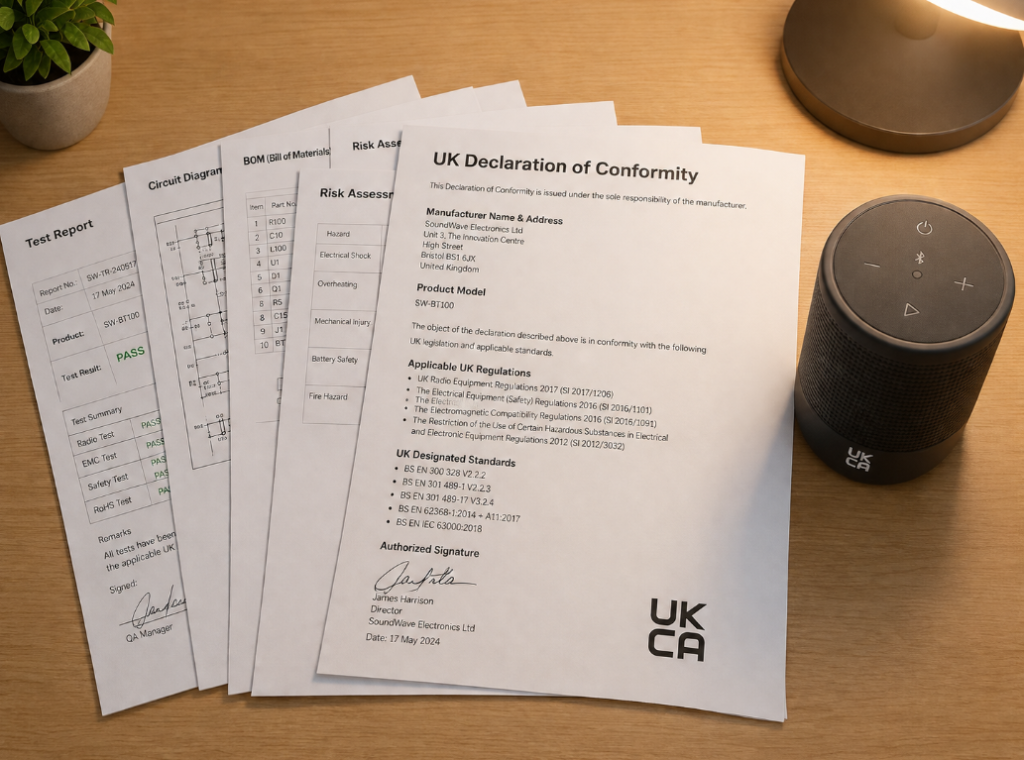
The UK DoC is a compliance declaration signed by the manufacturer or its written authorized entity, and is one of the core documents of the UKCA process. A qualified UK DoC should include the following core information:
- Name and address of the manufacturer;
- Product identification information, such as model, batch, serial number;
- List of applicable UK regulations;
- Number of the UK designated standard used;
- If a third-party body is involved, the information of the Approved Body must be included;
- Name, position, and signing date of the signatory.
You must never directly copy an EU DoC and change the logo to use it as a UK DoC — the EU DoC references EU regulations, while the UK DoC must reference UK regulations and UK designated standards. The basis for the two is different. In addition, one DoC should correspond to specific product models, versions, and sales batches. One DoC cannot cover all unrelated models.
Step 7: Affix the Mark and Launch, Plus Full Lifecycle Compliance
Many people think that after affixing the mark, it’s all done. In fact, compliance is a full-lifecycle matter, and there is still a lot of work to do after launch:
- Pre-launch final inspection: The UKCA mark can only be affixed after all conformity assessments, technical documentation, and DoC are completed. If you choose the CE route to enter GB, ensure that the CE compliance documents are real and valid, and that the product falls within the scope of CE accepted by the UK;
- Post-market monitoring: Continuously track product complaints, adverse events, regulatory updates, standard updates, and product changes — you cannot do it once and for all;
- Response to regulatory spot checks: After receiving a regulatory spot check notice, the responsible entity within the UK shall provide technical documentation as required and cooperate with the investigation;
- Product change assessment: If changes to the product’s design, key components, or software version affect safety or compliance, the conformity assessment must be re-conducted, and technical documentation and DoC updated;
- Risk handling: If a product is found to be non-compliant or has safety risks, immediate corrective measures must be taken, relevant parties notified, and a recall implemented if necessary.
How to Affix the UKCA Mark to Meet Requirements?
The mark is not just a random picture to stick on. There are clear usage rules, and incorrect affixation is also considered non-compliant.
Requirements for the Mark Itself
- The official UKCA graphic proportions must be used, and you cannot change the font, proportions, or shape by yourself;
- Under normal circumstances, the height of the mark must not be less than 5mm. For particularly small products, adjust according to the requirements of specific regulations;
- The mark must be clear, visible, durable, and not easily worn or erased;
- It can be scaled up or down proportionally, but cannot be stretched or deformed;
- You cannot use similar patterns to mislead consumers, nor can you use UKCA as a quality grade or marketing endorsement.
Priority of Affixation Position
- Prioritize affixing to a prominent position on the product body, so that consumers and regulatory personnel can easily see it;
- If the product is too small or the material is not suitable for affixing, it can be affixed to the packaging, label, or accompanying documents as permitted by regulations;
- For some high-risk products, the mark must be affixed to the body or nameplate, and cannot only be placed in the instruction manual;
- UKCA images displayed on e-commerce sales pages cannot replace the compliance mark on the physical product or packaging — the physical product must have it;
- The specific affixation position and temporary convenience arrangements must be confirmed in accordance with specific regulations and the latest policies on gov.uk.
Supporting Information Required Next to the Mark
The mark alone is not enough; necessary information must also be next to it, usually including:
- Product model, batch number, serial number, or other traceable information;
- Manufacturer’s name, registered trade name or trademark, and registered address;
- If a non-UK manufacturer places a product on the GB market, it is usually required to mark the name of the UK importer and the contact address within the UK. The specific marking position can be on the product, packaging, or accompanying documents, confirmed in accordance with applicable regulations and the latest transition arrangements;
- Necessary warning labels, age restrictions, usage restrictions, rated voltage, power, frequency, protection level, etc.
Note: Authorized representative information only needs to be marked when explicitly required by applicable regulations or contracts. Don’t confuse the legal responsibilities of authorized representatives and importers. The importer’s responsibilities are statutory and cannot be simply passed on to the authorized representative.
Absolutely Prohibited Mark Affixation Behaviors
These behaviors are high-risk and must never be done:
- Affixing the UKCA mark without completing conformity assessment, without test evidence, or without a DoC;
- Replacing formal document verification with verbal promises from suppliers;
- Sharing inapplicable test reports, labels, or DoCs across different models;
- Directly changing the logo of CE documents only applicable to the EU and using them as UKCA documents;
- Continuing to use old reports and old labels after product revision.
Who Bears Compliance Responsibility? Division of Labor for Different Roles
Many cross-border sellers are confused: I am a platform seller, is the compliance responsibility mine or the supplier’s? We will clarify the responsibilities of different roles to avoid mutual buck-passing when problems arise.
Manufacturer: Primary Responsible Party
The manufacturer is the first responsible party for product compliance, and bears primary legal responsibility for the product’s design, production, and conformity assessment. Specifically including:
- Responsible for identifying applicable regulations and standards, completing testing, risk assessment, technical documentation, and DoC signing;
- Ensuring that mass-produced products are consistent with test samples, and that compliance marks are correctly affixed;
- Retaining technical documentation, and cooperating with regulatory inquiries, accident investigations, and recall work.
UK Importer: Key Responsible Entity Within the UK
If an overseas manufacturer sells products to the GB market, the UK importer is a very important responsible entity within the UK. Responsibilities include:
- Confirming that the manufacturer has completed the applicable conformity assessment process;
- Verifying that the product’s marks, labels, instruction manuals, DoC, and technical documentation are complete and valid;
- Marking the importer’s name and UK address on the product, packaging, or accompanying documents as required by regulations;
- Not placing obviously non-compliant or safety-risky products on the GB market;
- Responsible for liaising with UK regulatory spot checks, accident investigations, and recall coordination.
Distributors and Cross-Border E-Commerce Sellers
Although distributors and platform sellers are not the primary responsible parties, they also have corresponding compliance obligations:
- Before sales, check whether the product has the necessary compliance marks, labels, instruction manuals, and warning information;
- Verify whether the DoC, test report, model, and product picture provided by the supplier are consistent;
- During platform spot checks, be able to provide complete compliance documents, not just product photos;
- If you know or should know that the product is non-compliant, immediately stop sales and notify relevant parties in the supply chain.
Easily Confused Role Boundaries
There are several other roles that are often confused, so we will specifically distinguish them:
- Authorized representative: Entrusted in writing by the manufacturer, with authority and responsibility derived from the entrustment agreement and applicable regulations. They only bear responsibility within the scope of entrustment and cannot replace all the statutory responsibilities of the importer;
- Importer: The economic operator (that is, the responsible entity in the supply chain) that places overseas products on the GB market. They are the key responsible entity within the UK, and their responsibilities cannot be simply passed on to the authorized representative;
- E-commerce platform: Usually not a manufacturer or importer, but they implement their own compliance review rules, and may require sellers to provide materials such as UK contact person, test reports, UK DoC, and label photos;
- Fulfillment service providers (such as FBA): Mainly provide warehousing and logistics services, and generally do not assume product compliance responsibilities on behalf of manufacturers or importers.
To put it simply, here are a few core rights and responsibilities: Who signs the UK DoC? Usually the manufacturer or its written authorized entity. Who retains the technical documentation? The manufacturer is responsible for preparing and retaining it, and the importer must ensure it can be provided within the UK. Who liaises with regulators? Usually the importer or authorized representative within the UK. Who bears recall costs? It needs to be judged in combination with statutory obligations and contractual agreements.
How to Convert to UKCA If You Already Have CE Documentation?
Many friends who have done CE will ask: I already have CE documentation, can I directly convert it to UKCA? The answer is it depends. Some can be reused, and some must be redone.
Prerequisites for Reuse
CE documentation that meets all the following conditions can be considered for reuse:
- The product’s model, structure, key components, and software version are completely consistent with the CE test sample;
- The EU harmonised standard used for CE testing is consistent in content with the corresponding UK designated standard, or can prove that the technical requirements are equivalent;
- The test report covers all sold models and product variants;
- The qualification of the body issuing the report, testing capability, and report issuance date meet the requirements of UK regulations;
- The EU DoC, labels, and instruction manuals can be used as references, but the UK DoC must be re-prepared in accordance with UK regulations.
Common Situations Where Direct Reuse Is Not Possible
In the following situations, CE documentation cannot be directly reused, and supplementary testing or redoing is required:
- The product has been revised, and key components such as batteries, power adapters, wireless modules, motors, and shell materials have been replaced;
- The CE test report only covers one model, but there are multiple variants actually sold;
- The standard version used in the report is too old to support current compliance judgments;
- The test sample is inconsistent with the mass-produced product;
- There is only a “certificate” from the supplier, without support from complete test reports and technical documentation.
Key Points for Checking EU DoC and UK DoC
If you want to convert CE documentation into UKCA documents, focus on checking these items:
- Regulation names: Whether they reference the regulations of the corresponding market respectively. You cannot copy EU regulations from the EU DoC into the UK DoC;
- Standard numbers: Whether they are valid standards acceptable to the corresponding market, and the version numbers match;
- Product information: Whether the model, brand, batch, and product picture are consistent with the physical product;
- Signing entity: Whether it is an entity authorized to bear manufacturer responsibility. You cannot just find any company to sign;
- Signing date: Whether it is reasonable, and not later than the date of test completion and technical documentation preparation.
General Compliance Document Verification Template
Whether you do it yourself or ask suppliers for documents, you can use this template to verify and avoid getting invalid documents:
- 5 key points for UK DoC verification: The product model/batch is consistent with the sold product; the referenced UK regulations and designated standards are valid; the signing entity is legal; the signing date is reasonable; if third-party assessment is involved, the Approved Body’s qualification is valid and covers the corresponding regulations.
- 5 key points for test report verification: For mandatory third-party routes, verify the qualification of the Approved Body/Notified Body; for self-declaration routes, verify the laboratory’s capability, test methods, and report completeness; the test sample’s model and key components are consistent with the mass-produced product; the test standard is a valid version; test items cover all applicable regulatory requirements.
- 5 key points for label verification: The mark proportion is correct; the model/batch is traceable; manufacturer and importer information is complete; warning labels and instruction language are adapted to the UK market; information on the product, packaging, instruction manual, and sales page is consistent.
Cost, Cycle, and Body Selection: Don’t Be Fooled by Low Prices
Many people are most concerned about cost and cycle. In fact, there is no unified price for UKCA, and the differences between different products are very large. We will clarify the influencing factors and reference ranges to help you avoid being scammed.
Core Factors Affecting Cost
The cost of UKCA is mainly affected by the following factors:
- Product category: Ordinary low-risk products have low costs, while high-risk products or products requiring mandatory third-party assessment have high costs;
- Test items: Products with electricity, wireless, batteries, mechanical movement, contact with children, or contact with skin have more test items and higher costs;
- Number of models: Products with multiple models, colors, sizes, and accessories may require extended assessment, increasing costs;
- Documentation completeness: If you already have valid CE documentation, it may reduce the cost of repeated testing, but it cannot guarantee complete exemption from testing;
- Number of rectifications: If the first test fails, it will increase additional testing, sample, rectification, and time costs.
Reference for Cycle and Cost
We give a rough reference range. The specifics should still be based on product complexity, applicable standards, and body quotations. Don’t take the reference as a fixed price:
- Low-risk, self-declaration products with complete documentation: mainly incur costs for document sorting, label review, and DoC preparation. The cycle is relatively short, and the cost may start from several thousand RMB;
- Conventional electrical and electronic products: usually involve tests such as electrical safety, EMC, and RoHS. The cycle depends on laboratory scheduling, sample preparation, and number of rectifications. The cost may range from several thousand to tens of thousands of RMB;
- Wireless products: usually require additional tests such as radio frequency, spectrum, and electromagnetic compatibility. The cost and cycle are significantly higher than ordinary electrical products;
- Toys, PPE, machinery, pressure equipment: if test items are complex or require participation of an Approved Body, the cost and cycle will further increase.
Advice for cross-border sellers: Start compliance work at least 1-2 months before new product launches. For high-risk products or products requiring third-party assessment, reserve a longer cycle. Don’t rush to do it just before the launch — rushing not only easily leads to mistakes, but may also result in rush fees from the body.
Inspection Standards for Selecting Third-Party Bodies
The market for UKCA bodies is mixed. When choosing, you must keep your eyes open and focus on checking these points:
- Whether it is a UK officially accredited Approved Body, and its qualification scope covers your target product and applicable regulations. Don’t use bodies that operate beyond their scope;
- If it is just an ordinary testing laboratory, confirm its testing capability, qualifications, standard coverage, and report recognition. Don’t treat ordinary test reports as “UKCA certificates”;
- Whether it can clearly explain the applicable regulations, test standards, sample requirements, and document list for the product. If it can’t explain clearly, it is probably unprofessional;
- Whether it can provide verifiable report numbers, body information, and formal seals. Fake reports usually cannot be verified;
- Whether it uses high-risk slogans such as “guaranteed pass”, “test-free”, “same-day certificate issuance” to fool people. Regular bodies will not say such things;
- Whether it can provide supporting services such as rectification suggestions, label review, and DoC review, instead of just “selling certificates”.
Does UKCA Have a Validity Period?
Many people ask how many years the UKCA certificate is valid for. The answer is: there is no official unified validity period for UKCA, and there is no fixed rule that all products are “valid for one year” or “valid for three years”.
When will it become invalid? It mainly depends on three conditions:
- If changes to the product’s design, key components, or software version affect compliance, the old assessment becomes invalid;
- If applicable UK regulations and designated standards are updated, the old standards no longer support the presumption of compliance, and re-assessment is required;
- If the UK government adjusts the conformity assessment policy or CE recognition rules, the original compliance route may no longer be applicable.
In corporate practice, it is recommended to review the status of regulations and standards at least once a year, and re-assess in a timely manner when products change.
Pitfall Avoidance for Beginners: The Most Common Mistakes Leading to Removal, Seizure, and Recall
We have compiled several types of mistakes that beginners most often make, many of which are real cases. You can check whether you have fallen into these pitfalls.
Document-Related Mistakes
- Only have a picture of the UKCA mark, no test report, technical documentation, or UK DoC, and cannot provide anything during platform or regulatory spot checks;
- The model on the DoC is inconsistent with the model on the sales page, packaging, and nameplate, and cannot be matched;
- The relationship between the applicant, manufacturer, and brand on the test report is unclear, with no authorization proof;
- The standard version used in the report is too old to support current compliance judgments;
- For multi-model products, only one basic model is tested, but it is claimed to cover all variants, when in fact the differences are large;
- Applying the rules for general products to special categories such as medical devices and construction products, resulting in completely invalid documents.
Product Change-Related Mistakes
- After replacing key components such as batteries, power supplies, chips, and wireless modules, compliance is not re-assessed;
- After the supplier replaces raw materials or production processes, old test reports are still used;
- After the language or content of packaging, instruction manuals, and warning labels is changed, no compliance review is conducted;
- After software or firmware updates affect wireless, electrical, or safety functions, compliance is not re-confirmed.
Market Region-Related Mistakes
- Directly selling products that only meet UKCA requirements to the EU market, where UKCA is not recognized;
- Treating UKCA as a market access mark for Northern Ireland, where UKCA is not recognized;
- The same batch of goods is sold to both the EU and GB, but only one DoC is prepared, while the regulations and standards on both sides are different;
- When using CE to enter the GB market, not confirming whether the product falls within the scope of CE accepted by the UK;
- Applying the CE recognition rules for general products to special categories, resulting in customs clearance or platform review failure.
Common Mistakes by Platform Sellers
- Credulously believing the supplier’s verbal promise of “having UKCA certification”, not requesting complete compliance documents, and being unable to provide them during platform spot checks;
- Uploading blurry label pictures or reports that do not match the product, which are judged invalid by the platform;
- Using forged test reports or DoCs, resulting in store suspension at best, and goods seizure or even legal liability at worst;
- Only focusing on whether you can pass platform review, ignoring the risks of regulatory spot checks and consumer complaints. Passing the platform review does not mean you are compliant.
Ready-to-Use UKCA Self-Checklist
If you have a product and don’t know whether your compliance work is in place, you can check item by item according to this list:
Market and Product Judgment
□ Clarify whether the product is sold to GB, Northern Ireland, the EU, or multiple markets
□ Determine whether the product belongs to the UKCA/CE general conformity assessment framework, or to other regulatory systems such as food, cosmetics, pharmaceuticals, or vehicles
□ Confirm whether the product belongs to special categories such as medical devices, construction products, maritime equipment, or railway products, which require separate inquiry of competent authority rules
□ Check for high-risk factors such as children, wireless, batteries, mechanical movement, pressure, explosion protection, and PPE
Regulation and Standard Judgment
□ All applicable UK regulations have been listed
□ The corresponding UK designated standards have been confirmed as the current valid version
□ It has been confirmed whether the product falls within the scope of CE accepted by the UK, and whether the CE route can be selected
□ It has been confirmed whether an Approved Body must participate in the conformity assessment
□ It has been verified whether special categories have separate transition periods, separate marks, or separate competent authority requirements
Document Verification
□ The test report is real, complete, and traceable, and the issuing body has corresponding capabilities or qualifications
□ The test report covers all sold models and key variants
□ Technical documentation includes complete content such as design, BOM, risk assessment, instruction manual, labels, and test basis
□ The UK DoC references UK regulations and designated standards, and the signing entity, date, and model are all correct
□ EU DoC and UK DoC are managed separately and not used interchangeably
□ The retention period of technical documentation meets regulatory requirements, and can be provided within the UK as required
Label and Launch Inspection
□ The UKCA or CE mark usage route is correct and meets the requirements of the corresponding market
□ The mark size, proportion, position, and durability meet regulatory requirements
□ Information such as manufacturer, importer, model, batch, and warning labels is complete and accurate
□ Information on the product, packaging, instruction manual, and sales page is consistent
□ Mechanisms for product change, complaint handling, regulatory update tracking, and recall response have been established
Official Source Verification
□ Check the product safety and metrology page on gov.uk
□ Check the UK designated standards list
□ Check the UK Market Conformity Assessment Bodies database to confirm the qualification scope of the Approved Body
□ For medical devices, check MHRA rules; for construction products, check DLUHC and gov.uk rules; for maritime, check MCA; for railway, check ORR; for vehicles, check DVSA or relevant type approval rules
□ Save query records, version dates, and compliance decision basis for easy explanation during platform or regulatory spot checks
Final Words
UKCA looks complicated, but its core logic is actually very simple: it is a product conformity assessment mark for the UK’s Great Britain market, essentially a set of processes to “prove that products meet safety requirements according to rules”, not a certificate that can be bought with money.
For beginners, you don’t have to be scared at first. First figure out where your product is sold, what category it belongs to, and what regulations apply, then proceed step by step. Compliance for most low-risk products is not as difficult as imagined. For friends who already have CE experience, the key is to understand the differences between UKCA and CE, and not directly copy EU experience. Especially for issues related to special categories and policy boundaries, be sure to follow the latest official rules.
Compliance is not a one-time thing, nor is it for coping with platforms or regulators. In essence, it reduces the operational risks of enterprises and avoids large losses caused by small problems. As long as you do the basic work solidly, you can avoid the vast majority of pitfalls.