
Detailed Explanation of PSE Certification
If you do business in electrical products for the Japanese market, or often buy plug-in electrical appliances on Japanese platforms, you have most likely seen the diamond-shaped or round mark printed with “PSE” on products. When many people first encounter PSE, they regard it as “Japan’s CE” or “Japan’s quality certification”. They either randomly find an institution to do a test and then affix the label, or think that having a certificate means everything is fine. As a result, their products are held up in customs clearance, delisted from platforms, or even face fines and recalls.
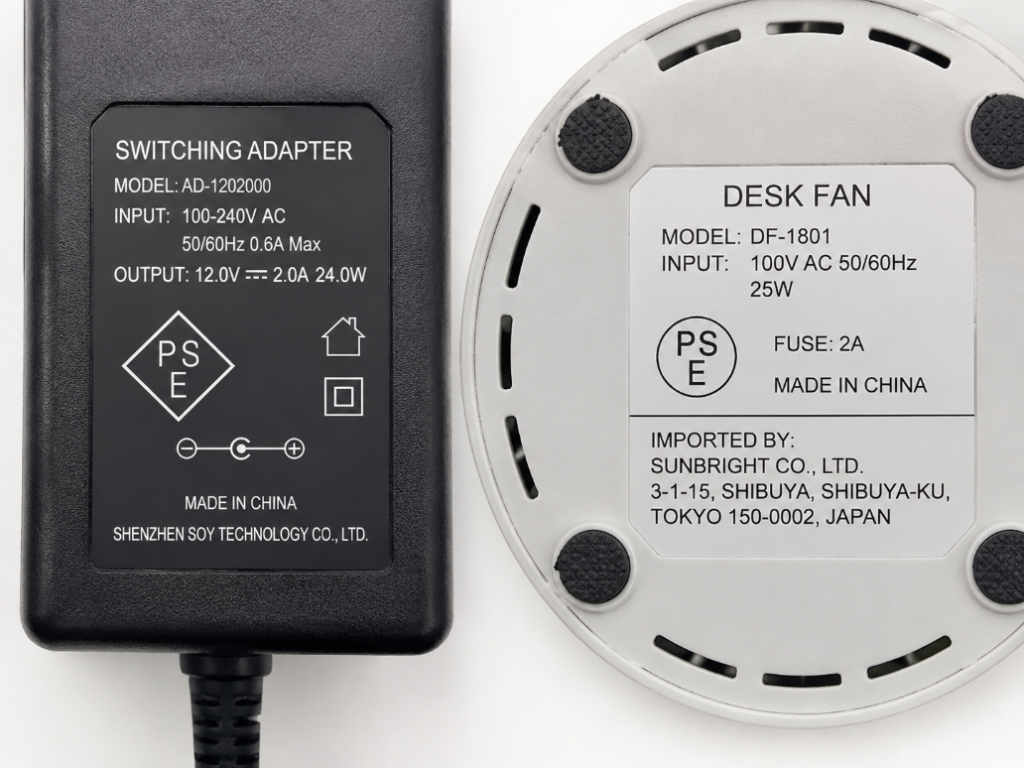
In fact, PSE is not a simple certificate, but a complete set of electrical appliance safety compliance systems in Japan. From product classification, responsible entities, testing requirements to labeling management, every step has clear legal requirements. To understand PSE, you should start with four core links: product classification, responsible entities, testing requirements, and labeling management. Diamond PSE and round PSE correspond to different control categories, and their handling paths, document requirements, and post-launch maintenance priorities also vary. Whether you are a cross-border seller, exporter, procurement staff, or ordinary consumer, you can find practical information for direct reference.
1. Understanding Japan’s Electrical Appliance Safety Compliance in Plain Language
What Exactly is PSE
PSE is an electrical appliance safety labeling system under Japan’s Electrical Appliance and Material Safety Law (hereinafter referred to as DENAN), which is used to indicate that products in the catalog have fulfilled statutory obligations such as conformity confirmation, notification, inspection records, and labeling by the corresponding business operators. It is not a “quality award certificate” issued by the Japanese government to products, nor is it a globally applicable certification, but a market access compliance requirement for electrical appliances in the Japanese market.
The competent authority of this system is the Ministry of Economy, Trade and Industry of Japan (hereinafter referred to as METI), which mainly controls electrical risks that directly threaten personal safety, such as electric shock, fire, overheating, and short circuit. Simply put, as long as your product is an electrical appliance under Japan’s control and you want to sell it in the Japanese market, you must follow the rules of PSE.
The PSE System is Not “Get the Certificate and You’re Done”
Many people think that PSE is just “do a test, get a certificate, and affix a label”. In fact, it is a set of interlocking obligations, and missing any step does not count as compliance:
First is the classification obligation: you must first figure out whether your product is in the control catalog, whether it is “specified electrical appliances and materials” or “non-specified electrical appliances and materials” (the terms high and low risk here are common sayings for easy understanding; the official classification is still subject to “specified electrical appliances and materials” and “non-specified electrical appliances and materials” in the DENAN catalog). If the classification is wrong, everything later will be wrong;
Then is the conformity confirmation obligation: specified electrical appliances and materials must be assessed by a METI-recognized institution, and non-specified electrical appliances and materials must also be confirmed by themselves to meet safety standards;
Next is the business notification obligation: local Japanese manufacturers or importers, as “notifying business operators”, must report to METI and tell the regulatory authority “I am the responsible person for this product in Japan”;
There is also the inspection and record obligation: mass-produced products must continuously meet the requirements, and test reports, inspection records, and technical materials must be kept for inspection, not thrown away after getting the certificate;
Finally is the labeling obligation: before the product is launched on the market, it must be affixed with the PSE mark, the name of the notifying business operator, rated parameters and other information as required, and cannot be affixed randomly.
What PSE Covers and What It Does Not
The control scope of PSE is very clear, and it does not cover all charged products: it covers electrical appliances that are commercially sold, imported or circulated in the Japanese market and are included in the DENAN catalog, and mainly controls electrical safety risks, such as whether the insulation is sufficient, whether it will overheat and catch fire, whether it will short circuit, and whether the mechanical structure will cause electric shock.
There are also many things it does not cover: for example, whether the product is durable, whether the sound quality is good, and how the user experience is, these are not covered; wireless communication performance, whether Bluetooth and Wi-Fi work, that is a matter of Japan’s Radio Law; environmental chemical restrictions, energy efficiency grades, and food contact safety also have their own regulations, which are not under the control of PSE.
It is important to note here that many products require “composite compliance”. For example, a plug-in speaker with Bluetooth requires both PSE for electrical safety and the Radio Law for wireless functions; a plug-in hand warmer with a lithium battery requires both PSE and battery safety considerations. You cannot think that everything is done after getting PSE.
Common Cognitive Pitfalls for Beginners
People who are new to PSE almost always confuse these concepts. Understanding them in advance can save a lot of detours:
First, PSE is not equal to METI business notification. PSE controls whether the product itself is compliant, and business notification controls “who is responsible for this product in Japan”. The two are supporting, not the same thing. Having a test report does not mean that the notification has been done, and doing the notification does not mean that the product is automatically compliant.
Second, PSE is not equal to platform review. Platforms such as Amazon and Rakuten require you to submit PSE materials, which is just their own risk control requirement. Passing the platform review does not mean that you comply with Japanese regulations, and subsequent regulatory spot checks will still be carried out in accordance with regulations; conversely, platform rejection does not necessarily mean that the product is non-compliant, it may just be that the photo is blurry or the model number is written wrong, but you should not take it lightly.
Third, PSE is not equal to CE, UL, or FCC. The regulatory systems, voltage standards, plug specifications, and liability requirements of different markets are different and cannot be directly replaced. At most, some test data can be used as reference, and whether it can be used depends on whether the institution recognizes it.
Fourth, round PSE is not something you can “affix randomly”. Many people think that round PSE is not supervised, and they can just print a mark and stick it on. In fact, non-specified electrical appliances and materials also need to undergo suitability inspection, retain materials, and be correctly labeled. If non-compliance is found, they will still be punished.
Fifth, not all charged products require PSE. Whether PSE is required depends on whether the product is in the METI catalog, what the power supply method is, what the rated parameters are, what the purpose is, and whether it is for sale or for personal use. You cannot do PSE as soon as you see a charged product.
Who Most Needs to Understand PSE
If you fall into the following categories, you’d better understand the basic logic of PSE:
Manufacturers, traders, and brand owners that export electrical products to Japan;
Cross-border sellers operating channels such as Amazon Japan, Rakuten, and Yahoo Japan;
Japanese enterprises that import, sell or distribute electrical appliances in Japan;
Procurers and supply chain managers who purchase compliant products for the Japanese market;
Even consumers who often buy Japanese plug-in electrical appliances, especially when buying high-power heating products and power supply products, knowing something about PSE can avoid many safety hazards.
2. Why PSE Must Be Taken Seriously: The Consequences of Non-Compliance Are More Than Just Delisting
You may think, it’s just a mark, is it necessary to be so serious? Let’s look at the actual impacts of PSE non-compliance from the perspective of different entities.
Risks for Sellers and Importers
First is customs clearance risk: when products arrive at Japanese customs, they may be required to supplement compliance documents. In serious cases, they will be directly returned or detained, and cannot even enter the sales channel.
Then is platform risk: now mainstream e-commerce platforms in Japan are checking PSE more and more strictly. Once you are required to submit certificates, test reports, METI notification materials, and nameplate photos but cannot provide them, the light consequence is delisting of the link, and the serious consequence is account freezing.
Even more serious is administrative and legal risk: Japanese notifying business operators may face improvement orders, sales bans, recalls, fines, and even criminal liability for serious violations.
If the product actually has an accident, such as electric shock, fire, or burns, it will also trigger recall risk, requiring accident reports and user compensation, and the loss may be much greater than the profit of the product itself.
Finally is commercial risk: customer returns, channel claims, and damage to brand reputation will make the cost of entering the Japanese market much higher in the future.
Significance for Consumers
For ordinary consumers, having a PSE mark does not mean that the product “will never have problems”, but at least it indicates that it should have fulfilled Japan’s electrical safety compliance process, which is much more reliable than products without the mark.
Plug-in products without PSE or with wrong PSE labels are likely to have hidden dangers such as insufficient insulation, excessive temperature rise, and insufficient flame retardancy of materials. Especially for high-power heating products, power adapters, power strips, and conversion plugs, the risk is particularly high.
In addition, formal and compliant products can usually be traced back to Japanese importers or manufacturers, and it is easier to protect rights when problems occur, unlike unbranded products where no one can be found when something goes wrong.
Platform Review and Regulatory Compliance Are Not the Same Thing
Let’s talk about the difference between platforms and regulations separately here, which many sellers easily confuse:
Platform requirements are commercial rules. To avoid their own risks, platforms will ask sellers to upload certificates, reports, photos, statements or Japanese responsible entity information. The requirements can be loose or tight and may change at any time;
Regulatory requirements are legal obligations. DENAN requires Japanese business operators to complete classification, notification, inspection, recording and labeling, which must be done regardless of whether the platform checks or not.
Passing the platform review only means that the materials you submitted meet the platform’s rules at that time, and does not mean that the product always complies with regulations, let alone that you will have no problem when the regulatory authority checks you; platform rejection does not necessarily mean that the product is non-compliant, it may be that the document format is wrong, the model number is inconsistent, or the photo is unclear, but it may also be a substantive compliance issue, so you must check carefully.
3. Two Major Types of PSE: How to Distinguish Diamond PSE and Round PSE
The most intuitive difference of PSE is the shape of the mark: one is diamond-shaped, the other is round. This is not designed randomly, but corresponds to two types of products with different risk levels, and the requirements are completely different.
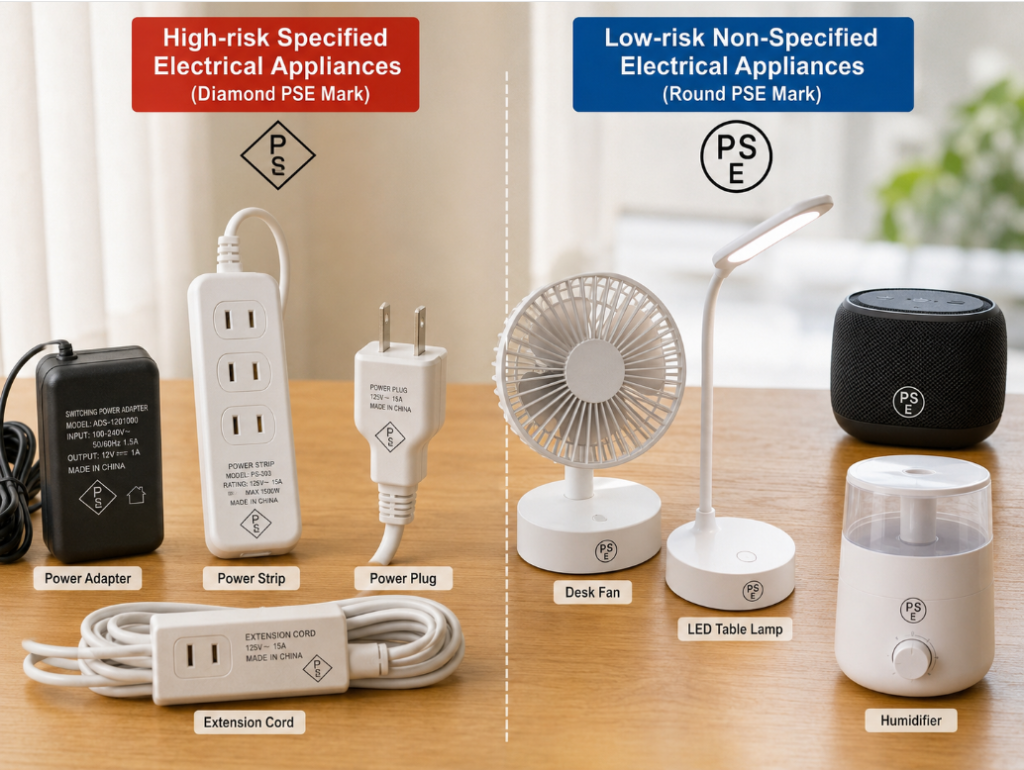
Diamond PSE: Specified Electrical Appliances and Materials
Diamond PSE corresponds to “specified electrical appliances and materials”. These products usually have a higher risk level, such as power cords, plugs, sockets, extension cords, fuses, switches, power adapters, transformers, and some heating or power-related products. The specific scope is subject to the METI catalog.
Due to the high risk of such products, the requirements are stricter: they must be subject to conformity assessment by a METI-recognized registered conformity assessment body (that is, an institution with official qualifications), and a certificate can only be obtained after passing the assessment; usually, the factory’s quality management capability is also reviewed to confirm that you can continuously produce qualified products; the certificate has a validity period, which is usually 3 years, 5 years or 7 years depending on the product category, and the specific period is subject to the certificate and regulatory requirements.
The above are only high-frequency examples, and cannot be judged solely by Chinese product names; the same type of product may be classified differently due to different rated voltages, input and output methods, uses, structures, and sales forms. The final classification shall be subject to the METI catalog and professional judgment.
Round PSE: Non-Specified Electrical Appliances and Materials
Round PSE corresponds to “non-specified electrical appliances and materials”, that is, products that are in the control catalog but have a relatively low risk level, such as some home appliances, lighting, fans, audio-visual equipment, office equipment, etc. The specific scope should also be judged according to the catalog and parameters.
The requirements for such products are looser: it is not mandatory to obtain a certificate from a registered institution, and the Japanese notifying business operator can confirm by itself that the product meets the technical standards and keep the inspection records. However, in practice, both platforms and customers generally require test reports from third-party laboratories, otherwise it is difficult to put on the shelves or sell, so most enterprises will still find a third party to do testing.
Round PSE does not have a unified concept of certificate validity period, but if the product is modified, the standard is updated, the factory is changed, or key components are changed, the compliance must be re-evaluated.
Core Differences Between Diamond PSE and Round PSE
For your convenience in comparison, I have sorted out the core differences between the two into a table:
| Comparison Dimension | Diamond PSE (Specified Electrical Appliances and Materials) | Round PSE (Non-Specified Electrical Appliances and Materials) |
|---|---|---|
| Classification Basis | Belongs to specified electrical appliances and materials in the DENAN catalog | Belongs to the DENAN catalog but not to specified electrical appliances and materials |
| Risk Level | Relatively high | Relatively low |
| Third-party Requirement | Must pass assessment by a METI-registered conformity assessment body | Certification by a registered body is not mandatory; self-confirmation or commissioned testing is acceptable |
| Document Form | Official conformity assessment certificate | Commonly test reports, inspection records, self-confirmation documents |
| Factory Audit | Usually has quality assurance capability audit requirements | Generally no mandatory factory audit requirement |
| Additional Labeling Information | Must indicate the name or symbol of the registered conformity assessment body | No need to indicate institution information |
It should be noted that although round PSE does not require the name or symbol of the registered institution, it must still be marked with the PSE mark, the name of the notifying business operator, rated parameters and other information in accordance with regulations; in addition to this information, diamond PSE must also meet additional requirements such as the name or symbol of the registered conformity assessment body.
Classification Judgment Cannot Be Taken for Granted
Many people like to judge by feeling when classifying, which is the easiest place to fall into pitfalls:
You cannot look at how competitor pages are labeled. Competitors may have wrong labels, borrowed certificates, or used old standard materials. If you follow them, you will only fall into the pit together;
You cannot judge by Chinese product names. The same name “charger” has completely different classifications for one plugged into the mains and one only plugged into USB; the same name “fan” has different requirements for one with 100V plug-in and one with 5V battery power supply;
You cannot choose to do diamond or round PSE by yourself. Whether it is a specified electrical appliance is determined by the regulatory catalog, not something you can choose casually if you want to “do it more strictly”. If the classification is wrong, you either waste money on the more expensive diamond PSE, or miss the high-risk diamond PSE, which will be troublesome if found out.
The correct approach is to send the product’s specification sheet, nameplate, circuit diagram, purpose, power supply method and other materials to the Japanese importer, registered conformity assessment body or professional compliance institution for professional judgment.
In These Cases, the Classification May Change
It is not that the classification will never change once it is determined. When encountering the following situations, you need to reconfirm the classification:
METI updates the electrical appliance catalog or technical standards, and the original judgment may be wrong;
The product adds functions such as mains input, high-power heating, charging, power conversion, etc., and the risk level changes;
Models of the same series have obvious differences in power, structure, power supply scheme, and key components;
It was originally just an accessory of the whole machine, such as a power cord included with a TV, but later it is sold separately, then it needs to be judged separately;
The product was originally a sample for personal use, but now it is sold commercially or imported in batches, it must also be re-judged in accordance with regulations.
4. Scope and Boundary of PSE Application: How to Judge Whether It Is Required
The most common question many people ask is: “Does my product need PSE?” In fact, you only need to ask yourself four key questions to make a preliminary judgment.
Four Key Questions to Judge PSE Application
The first question: Is this product going to enter the Japanese market for commercial sale, import, distribution or platform listing? If it is a sample for personal use or gift, it does not belong to commercial circulation and generally does not need PSE. But if it is for sale, whether online or offline, it must be considered.
The second question: Is it an electrical appliance listed in the catalog of the Electrical Appliance and Material Safety Law? If it is not in the catalog, even if it is charged, it does not need PSE.
The third question: Is it connected to the Japanese mains, or directly related to the mains power supply system? The Japanese mains is 100V/200V, 50/60Hz. If it is purely battery-powered or low-voltage USB input, it is generally not regarded as a product directly connected to the mains, but the matching charger, if plugged into the mains, needs to be considered separately.
The fourth question: Is it sold as an independent commodity, or just an internal component of the whole machine or an accompanying accessory? The responsibility boundaries of internal components of the whole machine, accompanying accessories and separately sold accessories are different. Even if power cords, plugs, AC adapters, etc. are used as accompanying accessories, it should be confirmed whether they need to use compliant components that meet PSE requirements; if they are changed to be sold separately, they usually need to be re-judged as independent commodities.
High-Frequency Categories That Need PSE Verification
There are several types of products that are high-frequency areas under PSE control. When encountering them, you must give priority to verification:
Power connection category: plugs, sockets, power cords, extension cords, conversion plugs, power strips. These products have high risks, and many are diamond PSE;
Power conversion category: AC adapters, chargers, transformers, power supplies. They are also high-risk categories, and most are diamond PSE;
Heating category: heaters, electric blankets, electric irons, electric heating appliances, some kitchen heating appliances. They have high power and are easy to catch fire, so they should be focused on;
Home appliance category: fans, vacuum cleaners, humidifiers, dehumidifiers, some kitchen appliances. The specific parameters and classification need to be checked;
Lighting category: lamps, LED lighting equipment, table lamps, etc. The power supply method and catalog classification also need to be checked;
Audio-visual and information equipment: some speakers, projectors, monitors, routers, etc. Similarly, the power supply method and catalog need to be checked. For example, those plugged into the mains may need PSE, and those purely USB-powered may not.
The above are only examples of high-frequency verification categories, and cannot be judged solely by Chinese product names; the same type of product may be classified differently due to different rated voltages, input and output methods, uses, structures, and sales forms. The final classification shall be subject to the METI catalog and professional judgment.
Common Boundary Situations, Don’t Confuse Them
The boundaries of several types of products are particularly easy to confuse. Let’s talk about them separately here:
Pure battery low-voltage products: If the product body does not have a mains interface, and does not come with or separately sell an AC charger/adapter controlled by DENAN, in most cases it is not judged as a PSE mains product; but if the set includes a mains-plugged adapter, the adapter itself still needs to be separately verified for PSE. Such products may also involve battery safety or wireless regulatory requirements, so they cannot be taken lightly;
Products with USB power supply: Accessories with only low-voltage USB input, such as USB small fans and USB table lamps, are usually not directly judged as mains products, but if the set comes with a mains-plugged AC adapter, the adapter must have PSE;
Products with wireless functions: PSE only manages electrical safety, and the wireless part (such as Bluetooth, Wi-Fi, cellular communication) also needs to consider the certification of conformity with technical standards under Japan’s Radio Law, commonly known as Giteki certification;
Lithium battery products: Batteries themselves have Japanese battery safety requirements, and PSE cannot simply cover all risks, especially for products such as power banks and lithium battery packs, which need to be confirmed separately;
Second-hand electrical appliances: As long as they are second-hand electrical appliances for commercial sale, attention should still be paid to DENAN requirements, labeling and safety confirmation. It is not that second-hand products do not need to be managed;
Modified products: If the power supply, plug, rated parameters, or internal structure are modified, the original PSE materials may become invalid and need to be re-evaluated.
Correct Steps for Quick Judgment
If you want to quickly judge whether a product needs PSE, you can follow these steps:
Step 1: First check METI’s electrical appliance catalog to confirm whether the product is in the catalog;
Step 2: Check the rated voltage, frequency, power, current, input and output methods on the product nameplate to see if it is connected to the mains;
Step 3: Look at the sales form: whether it is sold as a whole machine, sold separately as accessories, or sold as a set. Different sales forms have different responsibilities;
Step 4: If you are still unsure, confirm with the Japanese importer, registered conformity assessment body or compliance service provider, and don’t guess by yourself.
After confirmation, it is best to write down the conclusion clearly: whether it is needed, not needed, or needs further judgment; whether it tends to be diamond or round; what the basis is; and what other regulations need to be checked, so that subsequent work will not be messy.
5. PSE Responsible Entities and Prerequisites for Handling: Who Is Responsible for Compliance
Many people think that PSE is the responsibility of the factory or the brand owner, but it is not. Japanese regulations have clear responsible entities. If you don’t know who is responsible, it is easy to have problems later.
The Japanese Notifying Business Operator Is the First Responsible Person
The main statutory obligations in Japan’s Electrical Appliance and Material Safety Law are borne by manufacturers or importers located in Japan, that is, “notifying business operators”. Their responsibilities include:
Conducting business notification to METI, telling the regulatory authority that they are engaged in such electrical products;
Confirming that the product meets Japanese technical standards;
Keeping inspection records, test materials, certificates, change records and sales-related materials properly, which shall be kept for the prescribed period in accordance with DENAN and related implementation requirements, and longer-term internal archiving shall be established in combination with the needs of platforms, customers and recall traceability; the statutory retention period of different documents may be different, and should not be handled only based on empirical years;
Being responsible for correctly marking the PSE mark, the name of the notifying business operator, rated information, etc. on the product;
If an accident occurs or a regulatory spot check is conducted, they are responsible for explaining the situation, making rectifications, recalling, and cooperating with regulatory work.
Simply put, whoever is the Japanese importer or manufacturer is the first responsible person under the law, and will be held accountable first when something goes wrong.
Responsibilities of Overseas Factories and Brand Owners
Then do overseas factories and brand owners have no responsibility? Of course not. Although you are not the direct notification subject under DENAN, you have to bear the responsibilities of contract, quality, recall, compensation and platform compliance:
You must provide accurate specification sheets, BOM (Bill of Materials), circuit diagrams, key component materials, nameplates and manuals, and cannot provide false materials;
You must provide test samples that meet the requirements, and ensure that the mass-produced products are consistent with the test samples. You cannot have good samples for inspection but cut corners in mass production;
Without the confirmation of the Japanese responsible party or the certification body, you cannot randomly replace key components such as power cords, plugs, fuses, transformers, batteries, heating elements, and shell materials, otherwise you will be responsible if something goes wrong.
Responsibilities of Cross-Border E-Commerce Sellers
If you are engaged in cross-border e-commerce, the responsibility depends on the way you import:
If you import and sell through your own Japanese legal entity company, then you are the importer and must bear all the notification obligations mentioned above;
If you find an agent to import, or cooperate with a Japanese partner for sales, you must clearly write in the contract who is responsible for PSE, who is responsible for METI notification, who makes the labels, who keeps the materials, and who bears the recall and compensation when problems occur. Don’t be muddle-headed and shirk responsibility when something goes wrong.
Another point to note: the materials required by the platform must be consistent with the real regulatory materials. You cannot use mismatched certificates, borrow other people’s certificates, or use fake certificates. Once found out, the consequences will be very serious.
Conditions That Must Be Confirmed Before Handling PSE
Before you start doing PSE, you must first confirm these things, otherwise you are likely to waste money:
First, the product classification has been confirmed. You cannot do it just based on a product name, otherwise if the classification is wrong, the things you make will be useless at all;
Second, the Japanese responsible entity is clear, and they are willing to bear the obligations of notification, labeling and record keeping. Otherwise, even if you do the test, no one will do the notification, and it is still non-compliant;
Third, the model numbers are consistent. The model sold, the model tested, the model on the report, the model on the certificate, and the model on the nameplate must be completely consistent, or have a clear coverage relationship. You cannot test model A but sell model B;
Fourth, Japanese materials can be made. Japanese nameplates, manuals, safety warnings, and packaging information can all be produced in accordance with Japanese requirements, otherwise they cannot pass the review;
Fifth, other compliance has been evaluated. For example, wireless, battery, PSC, energy efficiency, food contact, RoHS, etc., whether there are any that need to be done, you cannot think that everything is fine just by doing PSE.
6. PSE Handling Process: From Classification Judgment to Launch in Japan
After confirming that PSE is required, what is the specific process? The processes for diamond and round PSE are different, so we will talk about them separately.
Diamond PSE Handling Process
Because diamond PSE requires institution certification and factory audit, the process is relatively complicated:
Step 1: First conduct product classification judgment, confirm that it belongs to specified electrical appliances and materials, and determine the applicable technical standards and testing standards;
Step 2: Select a METI-recognized registered conformity assessment body, confirm whether they can do this product, how many samples are needed, how long the cycle is, and how much the cost is. When choosing an institution, pay attention to checking the qualifications, and don’t find one without authorization;
Step 3: Prepare technical materials, including specification sheets, circuit diagrams, BOM, certificates of key components, structural diagrams, manuals, nameplate drafts, etc. The more complete the materials, the smoother the follow-up work will be;
Step 4: Send samples for testing. The institution will test items such as insulation, withstand voltage, temperature rise, abnormal operation, mechanical structure, flame retardancy, and labeling according to Japanese standards. If the test fails, rectification and retesting are required;
Step 5: Accept the factory quality assurance capability audit. The institution will go to the factory to check your quality management system to confirm that you have the ability to continuously produce qualified products. If the factory audit fails, you will not get the certificate;
Step 6: After both the test and the factory audit are passed, the institution will issue you a conformity assessment certificate;
Step 7: The Japanese notifying business operator completes the business notification and suitability inspection, confirms that the labeling is correct, and archives all materials for preservation;
Step 8: Before mass production, check again for the last time. Key components, nameplates, manuals, packaging, and sales pages must be consistent with the certificate materials. Only after confirmation can mass production start.
Round PSE Handling Process
Round PSE does not require mandatory institution certification and factory audit, and the process is simpler, but it cannot be sloppy:
Step 1: First confirm that the product belongs to non-specified electrical appliances and materials. Don’t make a mistake that it is not in the catalog, or that it is originally a specified electrical appliance but is done according to round PSE, which will definitely cause problems later;
Step 2: Determine the applicable technical standards and test items;
Step 3: You can do the inspection by yourself, or entrust a third-party laboratory to test. In practice, third parties are usually found, because platforms and customers recognize third-party reports;
Step 4: After passing the test, sort out the test report, suitability inspection record, self-confirmation materials, and technical documents;
Step 5: The Japanese notifying business operator completes the business notification and keeps all materials properly;
Step 6: Confirm that the PSE mark and notifying business operator information on the product body, packaging, manual and sales materials are correct;
Step 7: Continuous management is required after listing. For example, when standards are updated or products are modified, they must be re-evaluated, and it is also necessary to ensure that each batch of products is consistent with the tested ones.
Common Materials to Prepare
Whether it is diamond or round PSE, the following types of materials are generally required to be prepared:
Basic product information, such as product name, model number, specification sheet, purpose description, sales form, rated parameters;
Technical materials, such as circuit diagrams, PCB diagrams, structural diagrams, exploded views, BOM, key component lists;
Safety materials, such as certification certificates of key components, flame retardant grades of materials, insulation structure descriptions, temperature rise design descriptions;
Labeling materials, such as nameplate drafts, PSE mark positions, Japanese warning texts, packaging labels, manuals;
Subject materials, such as information of Japanese importers or manufacturers, and related materials of business notification;
If it is a series of models, there must also be a series model difference table, a description of the consistency of key components, and a description of model coverage, to prove that the differences between different models do not affect safety.
Cycle Reference
Many people care about how long it takes to do PSE. There is no fixed time, it depends on the product situation:
Round PSE is generally faster, usually 2 to 6 weeks, depending on product complexity, test items, data completeness and rectification times. If the materials are complete, the product is simple, and it passes at one time, it may be done in two weeks;
Diamond PSE is slower, usually 4 to 8 weeks or more. If it involves factory audit scheduling, rectification, or incomplete materials, it may take several months.
There are many factors that affect the cycle, such as unqualified sample testing, missing materials, wrong nameplates, no materials for key components, failed factory audits, and too large model differences. These will delay time, so try to prepare in advance, don’t rush to do it when it’s time to put on the shelves.
Cost Reference and Pitfall Avoidance
Cost is also one of the most concerned issues. There are many factors affecting the cost of PSE, such as product category, test items, whether it is diamond or round, whether factory audit is needed, number of models, rectification times, and which institution is selected, so there is no unified price:
If round PSE is entrusted to a third party for testing, it usually costs from several thousand to over 10,000 RMB, and complex products may be higher;
Diamond PSE usually costs from 10,000 to tens of thousands of RMB. For complex products, many series models, plus factory audit fees, the cost will be higher.
Here is a special reminder of a pitfall: don’t believe those on the market who say “pass without testing”, “buy PSE certificate”, “one universal certificate covers all products in the store”. The risk is extremely high. These certificates are either fake, or borrowed, or simply do not match your product. They will be exposed as soon as the platform or regulatory authority checks. At that time, the money lost from delisting, fines, and recalls will be much more than the test fees you saved.
7. PSE Mark, Nameplate and Document Identification: How to Tell True or False Compliance
Many people judge whether PSE is compliant by just looking at whether there is a PSE mark on the product, which is far from enough. True compliance requires that the mark, nameplate, and documents all match.
Formal PSE Marks Must Meet These Requirements
First, the shape of the mark must be correct: specified electrical appliances and materials use diamond PSE, and non-specified electrical appliances and materials use round PSE. They cannot be confused. For example, if a high-risk power adapter uses a round mark, there must be a problem;
Then the mark itself must be clear and durable, cannot be wiped off easily, and cannot be too small to see;
The name of the notifying business operator, that is, the Japanese responsible entity, must be marked. If there is only a PSE mark without the company name, it is definitely non-compliant;
If it is diamond PSE, the name or symbol of the registered conformity assessment body must also be marked. If not, it is also wrong;
In terms of position, in principle, it should be marked on the nameplate or obvious position of the product body. If the product is too small, such as a small charger, and there is really no place to mark it, it can be marked on the packaging or manual in a way permitted by regulations, but it cannot be just marked on the outer carton casually.
Information Usually Included in the Nameplate
The product nameplate is the core of compliance, and generally has the following information:
Product name or model number;
Rated voltage, frequency, current, power, input and output parameters;
PSE mark, and corresponding additional information (such as institution information for diamond PSE);
Name of the Japanese notifying business operator;
Necessary safety warnings, such as “for indoor use only”, “pay attention to polarity” and other instructions.
The most important point: the model number and parameters on the nameplate must be completely consistent with those on the test report, certificate, and sales page. There must be no discrepancy, otherwise it is likely to be a borrowed certificate or non-compliant.
Key Points of Document Identification
Just looking at the mark is not enough. You also need to check whether the documents are real and whether they match:
If it is diamond PSE, it is necessary to verify whether the certificate is issued by a METI-registered conformity assessment body, whether the certificate number, validity period, product model, factory, applicable standard, and coverage scope are correct, and whether it can be found on the institution’s official website;
If it is round PSE, it is necessary to verify the test report, suitability inspection record, self-confirmation documents, and the information of the notifying business operator, and whether the model can cover the product you sell;
For METI business notification materials, confirm whether the Japanese responsible entity is the same as the one in your sales chain. You cannot randomly use the notification materials of another company;
For materials submitted to the platform, the model numbers and parameters in the certificate, report, nameplate photo, product photo, and sales link must be consistent, otherwise it is easy to be rejected, or even judged as non-compliant.
Quickly Identify High-Risk PSE Problems
If you encounter the following situations, you should be highly vigilant, and there is a high probability that there are problems:
For high-risk power products, such as adapters and power strips, if only round PSE is affixed, it is necessary to focus on reviewing the classification and certificate scope;
There is only the PSE graphic on the nameplate, no name of the notifying business operator, and no rated parameters;
The model number on the certificate is different from the actually sold model number, and there is no description of series coverage, which is most likely a borrowed certificate;
The certificate has expired, or there have been major changes in the factory, key components, or standard version, but it has not been updated;
The other party can only give you a screenshot of the certificate, cannot provide a complete report or nameplate photo, and there is no verification path of the institution;
The same certificate covers a large number of products with obvious structural differences, such as covering both adapters and fans. Such situations are highly suspicious. You should require the provision of complete certificates, reports, model coverage descriptions and institution verification paths, and cannot accept them only based on screenshots.
8. Differences Between PSE and Other Certifications/Requirements: Don’t Use One Report for Everything
Many friends engaged in foreign trade have certificates such as CE, UL, and FCC, and think they can be directly used to sell in Japan. In fact, they cannot. The regulations of different markets are independent and cannot replace each other.
PSE vs CE
PSE is Japanese, and CE is European. The two have different regulatory systems, technical standards, voltage frequencies, plug structures, responsible entities, and labeling requirements. CE cannot directly replace PSE.
Of course, it is not that CE reports are completely useless. If some test data are consistent with the requirements of Japanese standards, the institution may accept them as reference. But whether they can be used and how much can be used shall be judged by the institution doing PSE, not by yourself.
In addition, the self-declaration logic of CE cannot be applied to diamond PSE. Diamond PSE must be certified by a registered institution and cannot be declared by yourself.
PSE vs UL/FCC
UL is mainly a North American safety certification system, which is often required by the market or customers, and is not a statutory access requirement in Japan, so UL cannot replace PSE.
FCC is the US authority for electromagnetic compatibility and wireless, and does not manage electrical safety at all, let alone replace PSE.
Like CE, UL and FCC reports can be used as technical references, but cannot be directly used as PSE.
PSE vs CCC/KC/UKCA
CCC is China’s mandatory certification, KC is South Korea’s, UKCA is the UK’s, and PSE is Japan’s. Each market has different voltages, plugs, standard versions, labels, and responsible entities. Certificates are usually not mutually recognized. To enter which market, you need to do the certification of that market, and you cannot use certificates from other markets to save trouble.
PSE vs METI Business Notification
Let’s emphasize again here that many people still confuse them:
PSE is part of the product conformity and labeling system, which controls whether the product itself is compliant;
METI business notification is a statutory obligation of Japanese manufacturers or importers as business operators, which controls who bears the responsibility;
Having a PSE test report does not mean that the business notification has been completed; completing the business notification does not mean that all your products are automatically compliant. The two are supporting, and compliant sales usually require both.
PSE vs Other Japanese Compliance Requirements
Japan has many other compliance requirements, and PSE cannot cover all of them:
Radio Law: If the product has wireless functions such as Bluetooth, Wi-Fi, and cellular communication, it needs to obtain certification of conformity with technical standards, that is, Giteki certification, which is not managed by PSE;
PSC and other consumer product safety systems: Some consumer products may be separately subject to systems such as PSC. For example, some helmets, mountaineering ropes and other consumer products subject to other systems, whether they are applicable shall be confirmed according to relevant Japanese catalogs, uses and product forms; you cannot default that other consumer product safety requirements are covered just because the product has done PSE;
Battery safety: Products such as lithium batteries and power banks have special battery safety requirements, and you cannot only look at PSE;
Energy efficiency requirements: Products such as air conditioners, refrigerators, and lighting may involve Japan’s Energy Conservation Law or energy efficiency labels, which need to be evaluated separately;
Food contact materials: For electrical appliances that come into contact with food, such as electric kettles and food processors, the parts in contact with food must also meet food hygiene-related requirements;
Environmental requirements: RoHS, recycling, packaging, chemical substance restrictions, etc., also need to be judged separately according to the product, and are not within the scope of PSE management.
9. PSE Validity, Change and Post-Launch Maintenance
Many people think that once they get the PSE certificate, it will be done once and for all. In fact, it is not. The validity of PSE is dynamic, and changes in products or standards may cause it to become invalid.
Validity Cannot Be Judged Only by the Certificate Date
To judge whether PSE is valid, you cannot only look at the validity period on the certificate:
For diamond PSE, it depends on whether the certificate has expired, and also whether the product model, factory, applicable standards, and key components have changed, and whether the certification body’s qualification is valid. Any change may cause the certificate to become invalid;
Round PSE does not have a unified validity period. It depends on whether the test report and inspection records are the latest, whether the standard version has been updated, whether the product has been changed, and whether the materials are complete.
The core judgment standard is actually very simple: whether the product you are selling now is consistent with the product in the compliance materials; whether the responsible entity is still valid; whether the labeling is correct; all key changes have been evaluated. If all are yes, then it is valid; if not, even if the certificate is within the validity period, it is useless.
What Changes Should Be Noted
After the product is produced, it is inevitable to make adjustments. Not all changes affect PSE, but some changes must be careful:
Low-risk changes generally only need to be recorded by yourself, but it is best to confirm internally, for example: changing the color of the shell, which does not affect the material, flame retardancy, heat dissipation and structure; changing the pattern of the packaging, changing the sales name, but the model and technical parameters have not changed; optimizing the language of the manual, but not deleting safety warnings and use restrictions; minor appearance adjustments of non-electrical structures, which do not affect insulation distance, heat dissipation and mechanical safety.
High-risk changes must be re-evaluated, even supplemented with testing and re-certification, for example: replacing key safety components such as power cords, plugs, sockets, switches, fuses, transformers, and AC adapters; replacing heating elements, motors, charging modules, power boards, and the power part of the main control board; changing rated voltage, frequency, current, power, output parameters or protection level; replacing shell materials, insulating materials, flame retardant materials or key suppliers; production factory relocation or new factory addition; adding new models, or changing the set sales method, replacing the matching power supply.
When encountering these high-risk changes, don’t just replace them secretly by yourself. Be sure to confirm with the certification body, laboratory or Japanese responsible entity first, otherwise the loss will outweigh the gain if something goes wrong.
Can Series Models Share Materials
Many enterprises have series models and want to share one PSE material. This is not impossible, but there are conditions:
Typical situations where sharing is allowed, for example, only different colors, small differences in appearance, different non-key configurations, but the electrical structure and key components are completely consistent, this is generally no problem;
Situations that require caution, for example, different power, different heating structures, different power supply schemes, different shell materials, these may affect safety and need to be carefully evaluated;
You cannot default that all series can be shared. The report or certificate must list all covered models, or have a clear difference description to prove that the differences do not affect safety.
Before adding new models, be sure to let the certification body, laboratory or Japanese responsible entity confirm whether they can be covered, don’t just add them by yourself.
Records to Be Kept After Launch
PSE materials cannot be thrown away after getting the certificate. After listing, these records should be kept properly for platform review, customer factory inspection or regulatory spot check:
PSE certificates, test reports, suitability inspection records, self-confirmation materials;
METI business notification materials, and information of the Japanese responsible entity;
Version records of nameplates, manuals, packaging, and sales pages;
Production batches, procurement records of key components, supplier change records;
Records of accident complaints, returns, repairs, recalls and rectifications;
Internal evaluation records of standard updates and regulatory updates.
These materials shall be kept for the prescribed period in accordance with DENAN and related implementation requirements, and longer-term internal archiving shall be established in combination with the needs of platforms, customers and recall traceability; the statutory retention period of different documents may be different, and should not be handled only based on empirical years, to avoid being unable to provide them during regulatory spot checks or platform verification.
10. Common Misconceptions and Risk Check List
The following sorts out common cognitive and operational misconceptions, and attaches a quick self-check list, which can be used to check the compliance status of products.
Cognitive Misconceptions
- Not all charged products require PSE, only electrical appliances within the DENAN catalog and meeting applicable conditions require it;
- Having CE or UL does not mean you can directly sell in Japan, they cannot replace PSE and can only be used as reference materials;
- It is not that round PSE does not need testing, it just does not mandatory require certification by a registered institution, and it still needs to confirm compliance with technical standards and keep records;
- PSE certificates are not permanently valid. The validity period of the certificate, standard updates, product changes, and factory changes will all affect the validity;
- Affixing the PSE mark does not mean compliance. It also depends on whether the classification is correct, whether the notification has been done, whether there are test records, whether the nameplate information is correct, and whether the responsible entity is clear.
Operational Misconceptions
- One certificate cannot cover the entire series. Only models whose structure, parameters, and key components meet the coverage conditions can share it;
- It is not enough to only affix PSE on the outer carton. Usually, the nameplate on the product body should be labeled first, and exceptions must also meet the regulations;
- Passing the platform review does not mean you can ignore it. The regulatory responsibility is still borne by the Japanese responsible entity;
- Changing suppliers does not mean it does not affect PSE. Changes in key components and materials may require re-evaluation;
- Borrowing a supplier’s certificate is not enough. It is necessary to verify whether the model, factory, responsible entity, certificate scope and sales chain match.
PSE Compliance Quick Check List
You can use the following list to quickly check whether your product is compliant:
□ Whether the product enters Japan for commercial sale or import circulation
□ Whether the product belongs to the DENAN electrical appliance catalog
□ Has confirmed whether it is classified as diamond PSE or round PSE
□ The Japanese notifying business operator is clear and has fulfilled necessary notification obligations
□ The test report or certificate covers the actually sold model
□ The parameters on the nameplate, manual, packaging and sales page are consistent
□ The PSE mark shape, additional information and position are correct
□ Changes in key components, factories, materials, power and structure have been evaluated
□ Materials have been archived and can cope with platform review, customer factory inspection and regulatory spot checks
□ Other compliance requirements such as wireless, battery, PSC, energy efficiency, and food contact have been evaluated
If you can tick all the above options, then the basic compliance is no problem; if there are many that you cannot tick, you need to make up for them quickly.
11. PSE Decision-Making Suggestions in Different Scenarios
Different roles should focus on different compliance priorities. The following gives corresponding decision-making suggestions according to common scenarios.
Amazon Japan / Cross-Border E-Commerce Sellers
If you are engaged in cross-border e-commerce, you should focus on the following points:
First, conduct a screening of the SKUs in the store. Prioritize the investigation of mains-powered, power supply, heating, and lighting products. Don’t wait until the platform comes to you to find that there are problems;
Make a judgment table for each SKU, write clearly whether PSE is needed, whether it is diamond or round, and whether other regulations are needed, so that you have a clear idea;
Prepare the documents often required by the platform in advance, such as PSE certificate or test report, METI business notification materials, nameplate photos, product real photos, and manuals. Don’t rush to find them when the platform asks for them;
Before listing, be sure to check the consistency of model numbers. The sales link, packaging, nameplate, report, and certificate must correspond. A difference of one letter may be rejected;
For high-risk categories such as AC adapters, power strips, conversion plugs, and heating products, reserve a longer review and rectification cycle, and don’t do it just in time for the listing time.
Japanese Importers / Distributors
If you are a Japanese importer or distributor, as the first responsible person, you should be more cautious:
Don’t just collect screenshots of supplier certificates. Verify the authenticity and scope of application of the certificates, and it is best to find them on the institution’s official website;
In the contract with the supplier, it is necessary to clearly define the PSE cost, samples, rectification, recall, change notification and compensation liability. Don’t bear it alone when something goes wrong;
Establish a batch inspection system. Check a few pieces from each batch of goods to confirm that the mass-produced products are consistent with the test samples, and prevent suppliers from secretly replacing components;
All technical documents must be completely preserved to ensure that they can be produced during regulatory spot checks and can explain the compliance path of the product clearly.
Overseas Factories / Brand Owners
If you are an overseas factory or brand owner, the focus should be on control from the source:
When quoting and scheduling, you should set aside the time and cost for PSE testing, factory audit, rectification and Japanese label production, so as not to overspend or delay later;
Design according to Japanese requirements at the R&D stage, such as 100V/200V voltage, 50/60Hz frequency, Japanese plug specifications, and flame retardant material requirements. Don’t modify after the design is completed, which will cost more;
For key components, prioritize suppliers with compliance materials, so as to avoid failing the test later and having to replace components;
Freeze the BOM and structure before mass production. Don’t randomly replace components after testing. If you want to replace them, first confirm whether it will affect PSE;
Provide Japanese customers with a series model difference table and change management mechanism, so that customers know that you are standardized and can reduce subsequent disputes.
Procurers
If you are a purchaser of compliant products for the Japanese market, you should pay attention to the following points:
Don’t just look at whether there is a PSE mark on the product. Verify the authenticity and matching degree of the certificate and report;
Check whether the purchased model, nameplate parameters, and product photos are consistent with the coverage scope of the certificate, and don’t buy the wrong one;
Confirm that the Japanese responsible entity is real and traceable, so that no one can be found when problems occur;
Spot check the key components of mass-produced products to prevent suppliers from “passing the inspection but downgrading the configuration in mass production”.
Consumers
If you are an ordinary consumer, when buying Japanese plug-in electrical appliances, you can pay attention to the following points:
When buying plug-in products, check whether there is a PSE mark, rated parameters and information of the Japanese responsible entity. Be cautious if there is none;
For high-risk products such as high-power heating products, power adapters, power strips, and conversion plugs, focus on inspection, and don’t be greedy for cheap to buy unbranded products;
Be cautious about second-hand or modified electrical appliances. Confirm that the labeling is complete and there is no obvious modification trace, otherwise there is no guarantee of safety;
A small number of products brought to Japan for personal use have different requirements from those for commercial sale, but you still have to bear the safety risk yourself. Don’t buy too inferior products.
12. Quick Answers to High-Frequency Questions
The following are answers to high-frequency questions, which can be quickly viewed according to your own needs.
1. How much does PSE certification cost?
For round PSE entrusted to a third party for testing, it usually costs from several thousand to over 10,000 RMB; for diamond PSE, it usually costs from 10,000 to tens of thousands of RMB. The final cost depends on the product category, number of models, test items, selected institution and rectification times. Complex products will be more expensive.
2. How long does it take to get PSE certification?
Round PSE usually takes about 2 to 6 weeks; diamond PSE usually takes about 4 to 8 weeks or more. If there is rectification, factory audit scheduling or data problems, it may be extended.
3. Can CE certification replace PSE?
No. CE applies to the European Union, and PSE applies to Japan. The regulations and standards of the two are different. CE reports may be used as technical references, but whether they can be accepted depends on the institution doing PSE and the differences in standards.
4. Does round PSE need a certificate?
According to regulations, round PSE usually does not mandatory require certification by a registered institution, but in practice, platforms or customers generally require third-party test reports, statements and related records, otherwise it is difficult to put on the shelves or sell.