
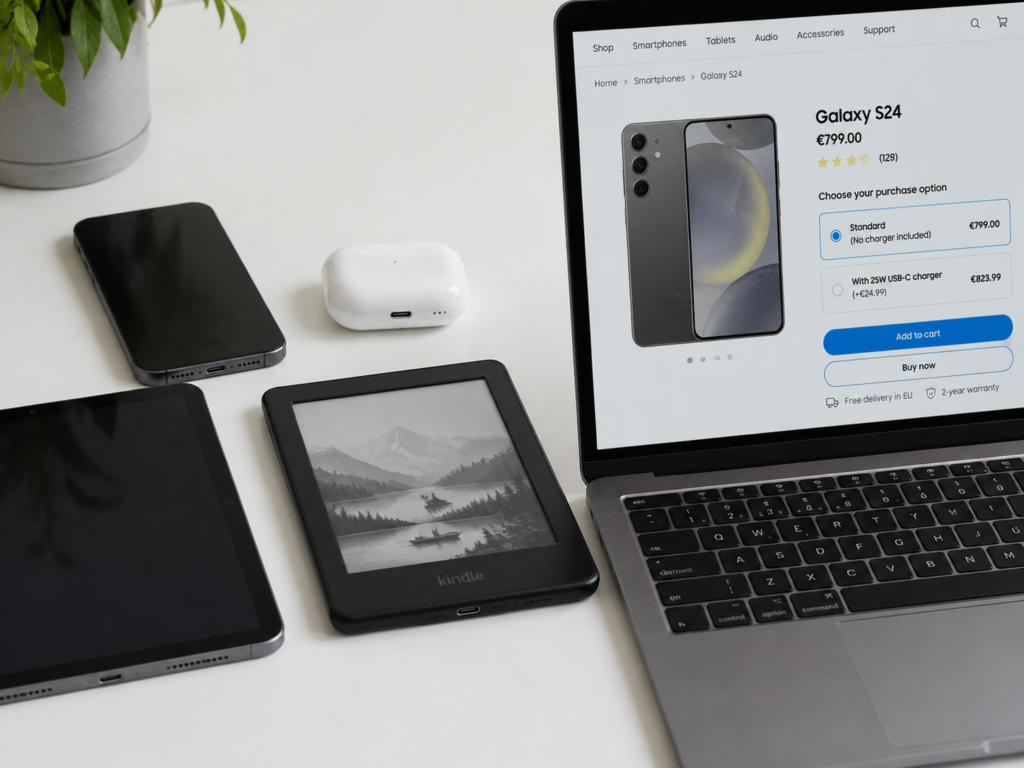
If you have recently bought a new smartphone, earphones, or tablet in the EU, you may have noticed two obvious changes: first, almost all charging ports are the oval, reversible USB-C type; second, you can choose a “no charger included” version when purchasing. This is not because manufacturers have suddenly become considerate, but because there is a mandatory EU regulation driving this — the unified charging port rule.
Many people’s impression of this regulation stops at “all ports must be changed to USB-C”, but in fact its requirements go far beyond just changing the port. It also covers fast charging compatibility, charger sales methods, information transparency, and other aspects, and is relevant to everyone who lives, shops, or travels in Europe.
Quick Start for Beginners: What This Regulation Is and How It Affects Ordinary Users
Plain Language Definition: What Exactly Does the EU’s “Unified Charging Port Regulation” Regulate?
Simply put, this is a mandatory regulation, not an industry initiative: for all designated portable consumer electronic devices placed on the EU/European Economic Area (EEA) market by merchants, as long as they have wired charging functionality, the charging port on the device must be USB-C; if they support fast charging, they must also be compatible with the universal USB PD fast charging protocol; at the same time, merchants must allow consumers to choose a version without a charger.
Its official identity is an amendment to the EU’s Radio Equipment Directive (RED, 2014/53/EU), with the regulation number Directive (EU) 2022/2380, commonly known as the “Common Charger Rule” or EU Common Charger. Ordinary users don’t need to memorize the number at all, just remember five core points: EU-designated new products, wired charging, USB-C port, fast charging compatible with USB PD, option to purchase without charger.
It is also necessary to first clarify what it “does not regulate” to avoid misunderstanding from the start: it does not ban wireless charging, does not unify the shape of wall plugs in each country, does not require all devices worldwide to switch to USB-C, and does not mandate that devices must or must not come with a charger.
3 Core Reasons for Its Introduction: Consumer Rights, Safety Protection, and Sustainable Development
This regulation did not come out of nowhere; it solves long-standing industry pain points:
First is too much trouble for consumers: in the past, devices of different brands and eras had different ports. When you changed your phone, tablet, or earphones, the old chargers and cables at home most likely couldn’t be used, so you had to buy new ones, which was costly and took up space.
Second is environmental protection and waste reduction: a large number of chargers and cables that are left unused or discarded due to port incompatibility become e-waste. The EU’s own assessment shows that about 11,000 tons of e-waste related to discarded and unused charging equipment is generated annually (this is the EU’s assessment caliber), wasting resources and polluting the environment.
Third is market fairness: some brands rely on proprietary ports to create a closed accessory ecosystem. After consumers buy a device, they can only buy its high-priced accessories, with very little choice. After the port is unified, third-party compliant accessories can also be used normally, making competition more sufficient.
Incidentally, there is also safety value: under universal standards, it is easier for consumers to buy compliant chargers and cables, and they don’t have to choose unbranded accessories with unguaranteed quality for the sake of niche ports — of course, safety ultimately depends on all three: the device, the charger, and the cable being compliant.
Direct Benefits for Ordinary Users
Speaking of your own life, the benefits brought by this regulation are tangible:
- Saves money: when changing phones, tablets, or earphones, the existing USB-C/USB PD chargers at home can most likely continue to be used, so you don’t have to repeatedly buy exclusive accessories for multiple brands.
- Convenient: smartphones, earphones, tablets, e-readers, and even some laptops can gradually share USB-C cables and PD chargers, so you don’t have to rummage through boxes to find cables with the corresponding port.
- Transparent information: packaging, user manuals, and online sales pages will clearly indicate the charging power, whether USB PD is supported, and whether a charger is included. You won’t find out after buying that there’s no charger, or that the advertised “fast charging” is actually only slow charging speed.
- Reduces waste: there will be fewer and fewer “cables that can only be used for a certain old device” lying idle at home, and storage is also easier.
Beginner’s First Judgment Mnemonic: Market, Time, Category, Port, Fast Charging
If you want to quickly judge whether a product needs to comply with this regulation, you don’t have to look through the legal text, just go through five key words in order:
- Look at the market: is it a product placed on the EU/EEA market for sale by a merchant? Old devices brought by individuals themselves do not count.
- Look at the time: is it a new product that first entered the EU market after the effective date of the corresponding category?
- Look at the category: is it a portable electronic device listed in the regulation’s list?
- Look at the port: is the wired charging port USB-C?
- Look at fast charging: if the charging power exceeds the basic threshold, does it support the USB PD fast charging protocol?
Scope of Application: Which Devices, When, and Where Must Comply
Many misunderstandings come from “not clarifying the boundaries”. For example, some people say “the whole of Europe must use USB-C” or “all smartphones must have USB-C by the end of 2024”, but neither is accurate.
Applicable Regions: EU and EEA, Don’t Confuse It with “the Whole of Europe”
The mandatory coverage of this regulation is the 27 EU member states, plus the three EEA countries Norway, Iceland, and Liechtenstein, which are included through EEA rules.
It does not mean “the whole of Europe implements it”: non-EU/EEA countries such as the UK and Switzerland will not automatically apply this regulation. It’s just that many big brands may use the same USB-C design for the global market to simplify the supply chain, but this is voluntary by enterprises, not a mandatory requirement.
In addition, the regulation binds operators — that is, manufacturers, importers, distributors, online sellers and other entities that place products on the market for sale, not ordinary individuals. It’s completely fine if you bring your old phone or old earphones to the EU when traveling, or if your old device doesn’t have a USB-C port; no one will bother you.
First Batch of Mandatory Devices: Effective December 28, 2024
The effective date for the first batch of devices included in the mandatory scope is December 28, 2024 — it is important to note that the effective caliber is “new products first placed on the EU/EEA market“, not that all devices with old ports on sale must be removed from shelves on this day. Inventory that has legally entered the EU market before can continue to be sold.
The categories covered in the first batch are all commonly used portable devices:
- Communication and reading: handheld mobile phones, tablets, e-readers
- Audio: earphones, over-ear headphones, true wireless earphones (charging cases with wired charging ports must also meet the requirements)
- Imaging: digital cameras, portable camcorders
- Entertainment: handheld game consoles, portable speakers
- Input and navigation: keyboards, mice, portable navigation devices
Here we specifically correct a common misconception: power banks/portable chargers are not a core category in the official mandatory list of this regulation. Although many portable chargers now have USB-C and PD, you can’t say “all portable chargers are mandatory under the EU’s unified port regulation”. When buying, it is recommended to prioritize USB-C/PD models, but don’t confuse them with mandatory categories like smartphones and tablets.
Second Batch of Mandatory Devices: Laptops Effective April 28, 2026
The effective date for laptops is more than a year later, and they will be included only on April 28, 2026. The reason for the longer transition period is also reasonable: the power range of laptops is too wide, from thin and light models with tens of watts to performance models with hundreds of watts, involving adjustments to heat dissipation, power management, motherboard design, and the entire adapter ecosystem, so manufacturers need more time to modify designs.
The regulation’s requirement for laptops is not to “unify the charging power of all laptops”, but to promote charging with universal solutions such as USB-C and USB PD — for example, your 65W PD charger can charge a thin and light laptop, and a 100W one can charge a performance laptop, so you don’t have to bring a dedicated bulky power adapter.
The old inventory rule also applies to laptops: old laptops that have been legally placed on the EU market before April 28, 2026 can continue to be sold after that date, and only new products placed on the market after the effective date need to meet the requirements.
The Difference Between “First Placement on the Market” and “Continued Sale of Inventory”
This is the most easily misunderstood point. Many people think that “as long as the model was released before the effective date, it never needs to be changed to USB-C”, but that’s not true.
- First placement on the market: refers to the first time a product enters the EU/EEA supply chain by operators such as manufacturers and importers, that is, “a new batch of goods enters the EU for sale for the first time”.
- Continued sale/circulation: inventory that has been legally placed on the market before the effective date can continue to be sold by retailers later, which is not a violation.
For example: a brand released a smartphone with an old port in 2023, and imported a batch to the EU for sale in October 2024. This batch of goods belongs to “inventory placed on the market before the effective date”, and can continue to be sold in 2025. But if the brand produces another batch of the same old-port smartphone in 2025 and newly places it on the EU market, that is non-compliant — even if the model was released in 2023.
For ordinary users, don’t assume that a product is definitely compliant inventory just because the product page says “old model”. If you really want to be strict, it still depends on whether the merchant can prove that this batch of goods was placed on the market before the effective date.
Device Types That Are Clearly Exempt or Not Yet Included
Not all devices with charging functions are on the list. The following categories are currently not subject to mandatory constraints:
- Pure wireless charging devices: products that have no wired charging port at all naturally do not apply to the requirement that “the wired port must be USB-C”, such as some earphone cases that can only be charged wirelessly.
- Wearable devices: smart watches, bands, health trackers and the like are currently not all included in the mandatory list due to their small size, special structure, and category definition reasons.
- Special purpose devices: medical, military, police, and industrial special equipment do not belong to the category of ordinary consumer electronics, and must be judged according to corresponding special regulations.
- Stock and second-hand products before the compliance date: inventory placed on the market before the effective date, and second-hand transactions between individuals, are not managed according to the requirements for “newly placed products”.
- Accessories with charging functions: whether products such as portable chargers, docking stations, and charging phone cases are subject to constraints depends on whether they fall into the official device categories and the definition of radio equipment, which cannot be generalized. It is only recommended to prioritize models compatible with USB-C/PD.
Semi-Proficient Judgment Method: 4 Steps to Confirm Whether a Device Must Comply
If you want to judge more rigorously whether a product needs to comply with the regulation, you can follow these four steps:
Step 1: Look at the sales market: is it placed or sold on the EU/EEA market by an operator? Items carried for personal use do not count.
Step 2: Look at the product category: is it a category on the list such as smartphones, tablets, earphones, e-readers, digital cameras, handheld game consoles, portable speakers, keyboards, mice, portable navigation devices, laptops, etc.
Step 3: Look at the time node: is it first placed on the market after the effective date corresponding to the category?
Step 4: Look at the charging method: does it have a wired charging function; if so, does the port on the device side and the fast charging protocol meet the requirements?
Core Mandatory Requirements: More Than Just Changing the Port, 4 Hard Rules to Recognize
Many people think this regulation is just “changing the port to USB-C”, but it’s far more than that. It has four core hard rules, and missing any one does not count as true compliance.
Port Requirement: The Wired Charging Port on the Device Side Must Be USB-C
The most basic requirement is: if the devices in the list support wired charging, the charging port on the device must be a standard USB Type-C receptacle.
Here, pay attention to the problem of “fake C ports”: it cannot look like USB-C on the outside, but has internal restrictions that only allow normal charging with the brand’s own proprietary charger and proprietary cable — this kind of C port that “looks the same but is not the same in essence” is non-compliant.
In addition, the core of the regulation is charging compatibility, it does not mandate that the USB-C port support high-speed data transmission. Some devices’ C ports can only transmit data at USB 2.0 speed, and as long as the charging meets the requirements, it is not a violation. So when you see that a device has a C port, it only means that the port shape is correct, and it cannot directly prove that its fast charging, power labeling, charger unbundling, etc. are also compliant.
Fast Charging Requirement: Must Support USB PD When Exceeding Basic Charging Capacity
Many people have heard of USB PD, but don’t know what it is. In fact, it can be understood as a universal “fast charging negotiation protocol”: after the device and the charger are plugged in, they will automatically “communicate” — the charger says “what’s the maximum power I can supply”, the device says “what’s the maximum power I can accept”, and then the two sides choose a power that both can accept to charge, instead of forcing it.
The trigger condition of the regulation is very clear: if the wired charging capacity of the device is higher than 5V, higher than 3A, or the total power is higher than 15W, it must support USB PD.
Then can manufacturers’ own proprietary fast charging still be used? Of course. For example, many brands’ “super fast charging” and “flash charging” can be retained, and can even be faster than PD, but the premise is that the proprietary protocol must not hinder the normal and complete function of USB PD — you can’t say that when a third-party PD charger is plugged in, it can only charge at 5W slow speed, or can’t charge at all.
It should also be clarified that the regulation is not to unify the charging power of all devices to 15W or 65W, but only requires devices higher than the basic power to have universal fast charging compatibility, so that users can charge normally with third-party PD chargers.
Of course, PD negotiation only reduces the risk of mismatch, and does not represent absolute safety. You still need to use regular chargers and cables that meet the power requirements.
Unbundled Charger Sales: Users Must Be Able to Choose the Version Without a Charger
This rule is something many people praise: operators must allow consumers to choose a version without a charger when purchasing a device.
Note that it is not “banning the sale of chargers”, let alone “manufacturers cannot include chargers” — manufacturers can completely sell bundles with chargers, or sell chargers separately, but they cannot force consumers to buy a charger. For example, when you buy a smartphone, there must be a “no charger included” option on the page, and you can also pay extra if you want the one with a charger.
The purpose of this is very direct: let users who already have compliant chargers at home reuse old accessories, reduce repeated production, transportation and disposal, which is both cost-saving and environmentally friendly. If you already have a USB-C PD charger with sufficient power at home, it is very cost-effective to choose the version without a charger when buying a new device.
Information Transparency Requirement: Packaging, Manuals, and Online Shopping Pages Must Make It Clear
Hardware requirements alone are not enough; consumers must be able to understand the charging parameters of the product at a glance, so the regulation also requires information transparency:
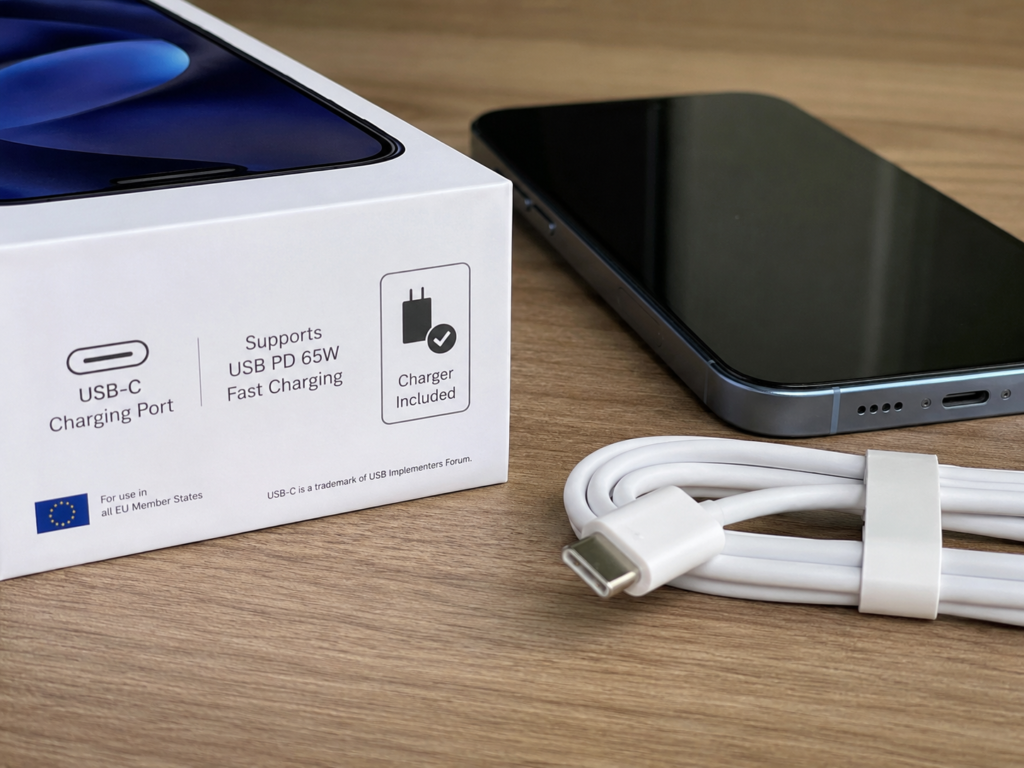
The information that must be clearly displayed includes: whether the device comes with a charger, minimum/maximum charging power, whether USB PD is supported, and the type of charging port of the device.
This information cannot be hidden in a corner; it must be placed in a place easily visible to consumers on physical packaging, user manuals, and online sales pages. The EU also requires the use of unified icons to indicate whether a charger is included in the package — a charger with a check mark means it is included, and a cross means it is not, to prevent consumers from buying the wrong one due to language issues.
Moreover, parameters from different channels cannot contradict each other: for example, if the online detail page says it supports 65W PD, but the packaging says 25W, that is non-compliant.
For ordinary users, just focus on three things before buying: whether it has a USB-C port, what the maximum charging power is, and whether it supports USB PD.
How to Understand the CE Mark: Useful, But Not a Universal Judgment
Many people look at the CE mark when buying European products, but don’t deify it. The CE mark means that the manufacturer declares that the product meets all applicable EU regulatory requirements, including safety, electromagnetic compatibility, radio and other related requirements. It is not a separate “charging compliance certification”, nor does it mean that third parties have tested each item.
Therefore, having the CE mark does not mean that the product’s USB-C port, PD compatibility, and power labeling are definitely okay. The correct approach is to combine the CE mark with charging parameters, PD instructions, packaging icons, and the credibility of the sales channel to judge.
Also beware of fake CE marks: many low-cost unbranded miscellaneous products may print a CE mark themselves and sell them. It’s best not to buy these, and prioritize traceable brands and formal channels.
Semi-Proficient Discrimination: How to Judge “True Compliance” or “Just Looks Like a C Port”
If you are afraid of buying products that “look like C ports but are actually non-compliant”, you can check from these aspects:
- Look at the port: is the wired charging port on the device side a standard USB-C charging port, reversible on both sides?
- Look at the protocol: for devices with charging power higher than 15W, is there a clear indication that it supports USB PD?
- Look at the power: is the specific minimum/maximum charging power indicated, instead of just using vague marketing terms like “fast charging” or “flash charging”?
- Look at accessory information: is there a clear explanation of whether a charger is included in the package?
- Look at compatibility: test with a regular third-party PD charger and a suitable cable to see if it can charge normally, and even reach the corresponding fast charging speed.
- Look at the sales entity: is it a formal channel selling to the EU/EEA market, rather than an overseas version of unknown origin?
Real Impact on Ordinary Users: What Changes Will Happen in Buying, Using, Changing Devices, and Traveling
The regulation will eventually be reflected in your daily life. Let’s talk specifically from the scenarios of buying, using, and traveling.
3 Obvious Changes When Buying New Devices
First is clearer choices: the purchase page and packaging will clearly indicate whether there is a charger, and there will no longer be the pitfall of “only finding out there’s no charger after opening it at home, and having to buy it separately”.
Second is easier reuse of accessories: when changing smartphones, tablets, earphones, or e-readers, the old USB-C PD chargers at home can most likely continue to be used, so you don’t have to change a bunch of accessories every time you change devices.
Third is lower cross-brand costs: whether it’s Apple, Android, or tablets, earphones, they will gradually share the USB-C ecosystem, so you don’t have to prepare different cables and chargers for different brands, saving a lot of money on exclusive accessories.
In the past, when buying devices, you might only look at “whether a charger is included”, but now you can directly judge whether you can use the existing charger at home through the power and PD markings, and the probability of stepping into a pit is much lower.
Can Old Chargers and Cables at Home Still Be Used?
This is the question everyone is most concerned about. Let’s talk about it in several situations:
- Situations where they can be used normally: regular chargers with USB-C ports, supporting USB PD, and with power meeting the device’s needs can all continue to be used. For example, your previous 20W PD charger can charge new smartphones, earphones, and tablets.
- Situations where they charge slowly but can be used: if the power of the charger is lower than the maximum charging power of the device, for example, using an 18W or 20W PD charger to charge a 65W tablet, in most cases it can charge, just slower. It will not damage the device because the charger’s wattage is low — because PD will negotiate, and the device will only draw the power it needs.
- Situations where they cannot be used directly: old Micro-USB and Lightning cables definitely cannot be plugged into a USB-C port; adapters can be used for emergency, but long-term use on high-power devices is not recommended, as it may affect speed and stability.
- Cable limitations: don’t think that all USB-C cables are the same. Cables that look similar may have very different supported currents and powers. For example, high-power laptops may require cables that support 5A and have an electronic marker chip (commonly called E-Marker), otherwise the charging speed will not increase.
- Pay attention to multi-port chargers: if it is a multi-port PD charger, when multiple devices are charged at the same time, the total power will be shared, and the output power of a single port may decrease. For example, a 65W dual-port charger, when charging a smartphone and a laptop at the same time, the laptop may only get 45W, and the speed will be slow. When charging high-power devices, it is best to plug into a single port alone, or confirm the maximum output capacity of a single port.
Convenience Changes in Daily Use
The most intuitive thing is that you have fewer things to bring when going out: a set of USB-C PD charger and a suitable cable can cover smartphones, earphones, tablets, e-readers, and even thin and light laptops, so you don’t have to bring multiple chargers and multiple cables.
Storage at home is also simpler: you don’t have to keep a bunch of exclusive cables for different devices, and the messy charging cables in drawers will become fewer and fewer.
Office scenarios are also more convenient: shared charging devices in meeting rooms and workstations will gradually be unified into USB-C ports, so you don’t have to borrow cables with different ports everywhere.
Of course, we also have to mention the realistic boundary: the penetration rate of USB-C will get higher and higher, but not all public places can guarantee available USB-C ports. It is still recommended to bring a reliable cable with you when traveling or on a business trip.
Notes on Cross-Border Purchases and Travel
If you often shop cross-border or travel, there are a few points to note:
- EU version and non-EU version may be different: for the same brand’s product, versions in different regions may have differences in ports, charger bundles, and plug specifications. For example, versions in some regions still have old ports, so when buying cross-border, you must check carefully whether it is a version for the EU market.
- Wall plugs are not unified: the unification of USB-C ports does not mean that wall plugs in various countries are also unified. The common one in the EU is the European standard round pin plug. When going to the UK, Switzerland, the United States and other places, you may still need a plug adapter.
- Rights protection issues for overseas online shopping: as long as the merchant sells to the EU market, in principle, it should bear the compliance responsibility, but the actual difficulty of rights protection depends on the seller’s location, platform rules, and consumer protection mechanisms. When buying cross-border, try to choose platforms with local after-sales service.
- Personal use is completely fine: bringing your own old devices when traveling, even if the port is not USB-C, is not illegal. The regulation regulates new products sold by merchants, not old things for personal use.
Safety and Sustainable Value: Why It Belongs to “Safety and Protection” and “Sustainable Development”
Many people think this regulation is just “for user convenience”, but in fact its core value also includes safety protection and sustainable development.
Safety Protection: How Unified Ports Reduce Risks
Charging safety is no trivial matter. Unified ports and universal protocols can reduce risks in several aspects:
First is standardization reduces mismatches: in the past, different brands had different ports and protocols, so users could easily buy the wrong charger, or even use the wrong charger to cause device damage. USB-C and USB PD are universal standards. Devices, chargers, and cables negotiate according to unified rules, and the probability of mismatch is much lower.
Second is reduce dependence on inferior proprietary accessories: in the past, for some devices with niche ports, original accessories were expensive, and users might buy unbranded ones cheaply, with unguaranteed quality. Now that they are universal, there are many compliant third-party PD products that consumers can choose from, and they don’t have to be forced to buy inferior proprietary accessories.
Third is automatic power negotiation is safer: many people worry that “high-power chargers will burn small devices”, but in fact, regular PD chargers and devices will automatically negotiate. The nominal power of the charger is high, which does not mean that it will pour all the power into the device. The device will only request the appropriate power according to its own capacity. For example, using a 65W charger to charge true wireless earphones, the earphones will only draw the small power they need, and will not be damaged by overcharging.
Of course, it should also be emphasized that USB-C does not equal absolute safety. Low-quality chargers, falsely labeled cables, and damaged ports may still bring risks of overheating, charging interruption, or even device damage. You can’t just buy random unbranded ones just because it’s a C port.
Sustainable Development: Reducing E-Waste and Resource Waste
One of the core reasons for the EU to promote this regulation is to reduce e-waste, which is also why it belongs to the “sustainable development” category.
According to the EU’s assessment, about 11,000 tons of e-waste related to discarded and unused charging equipment is generated annually (this is the EU’s assessment caliber) — many chargers are still usable, but are thrown away just because the device port is incompatible after changing devices.
Producing one less charger means using less raw materials such as plastic and metal, reducing energy consumption during the manufacturing process, as well as carbon emissions from packaging and transportation, which is very direct carbon reduction. Moreover, universal accessories are easier to reuse across devices. One cable and one charger can be used on several devices, with a longer service life, which is more in line with the logic of circular economy.
Of course, whether the waste reduction effect can be truly implemented depends on whether users actually reuse old accessories, whether they buy fewer unnecessary bundles, and whether they correctly recycle waste electronic products. It is not automatically achieved as soon as the regulation is issued.
Environmental Value for Users: No Need to Sacrifice Convenience
Many people think that “environmental protection requires sacrificing convenience”, but the environmental protection of this regulation is tied to convenience and cost savings:
- If you already have a compliant USB-C PD charger at home, choosing the version without a charger when buying a new device not only saves money, but also reduces the production and disposal of a new charger, achieving both environmental protection and affordability.
- Keeping a few high-quality PD chargers at home to cover all devices is not only more convenient, but also more environmentally friendly than each device coming with a low-quality charger that is rarely used.
- Of course, we also have to say objectively: the version without a charger is not necessarily cheaper. The specific price difference depends on the brand, category, promotion, and bundle strategy. Don’t think that you will definitely save a lot of money.
- Finally, when old chargers and cables are no longer used, they must be sent to e-waste recycling channels, and should not be thrown directly into ordinary trash cans, otherwise the environmental protection effect will be reduced.
Semi-Proficient Discrimination: Will Unified Ports Hinder Technological Progress?
People often ask: “Will mandatory use of USB-C make manufacturers stop developing new charging technologies?” In fact, there is no need to worry at all.
First, what the regulation requires is adopting a universal charging solution, not freezing technology. The universal standard itself will also be updated. For example, USB PD has gone from 2.0 to 3.0, 3.1, with higher and higher power and higher and higher efficiency, and the standards cited by the regulation will also be adjusted along with industry development.
Second, proprietary innovation can still exist. Manufacturers can completely continue to develop more efficient, lower heat, and smarter charging technologies, and can even be faster than universal PD, as long as they do not sacrifice the basic compatibility of USB PD — which is equivalent to “universal as the base, proprietary as the bonus”.
Third, the EU has a special technical assessment and adjustment mechanism, which will regularly look at the development of the industry. In the future, it may expand categories, update wireless charging rules, and even if a more advanced and mature universal charging technology than USB-C appears in the future, the regulation will also be revised accordingly.
To put it bluntly, the regulation restricts “closed port ecosystems” — that is, the situation where if you buy my brand’s device, you have to buy my brand’s high-priced accessories, with no choice. It does not restrict technological innovation.
Common Misconceptions and Gray Areas: Don’t Be Misled by These Statements
There are many statements about this regulation on the Internet, many of which are wrong. We have compiled the most common misconceptions and gray areas.
Beginner-Level High-Frequency Misunderstandings
- Misconception: All electronic devices must switch to USB-C
Correction: It only covers designated portable radio devices in the regulation list, such as TVs, refrigerators, desktop computers, etc., which are not regulated. - Misconception: All smartphones sold in the EU after the end of 2024 must have USB-C
Correction: Inventory that has been placed on the market before the effective date can continue to be sold, and only related products newly placed on the market after the effective date must be compliant. - Misconception: Having a USB-C port means it can definitely fast charge
Correction: It also depends on whether the device supports USB PD, the device’s power limit, the charger’s output capacity, and the cable’s specifications. Some C-port devices can only charge slowly. - Misconception: The regulation bans the sale of chargers
Correction: The regulation requires that consumers can choose a version without a charger, not that the sale of bundles with chargers is prohibited. You can completely buy the one with a charger if you want. - Misconception: A 65W charger will damage small earphones
Correction: Regular PD devices will automatically negotiate power. Small devices will only draw the small power they need, and will not be damaged by overcharging.
Semi-Proficient Level Gray Areas
Some situations are not so black and white, and belong to gray areas:
- Parallel imports: If a merchant places products from other regions on the EU/EEA market for sale, in principle, they still need to comply with applicable EU regulations; but if an individual buys it from abroad and brings it back for personal use, it does not count.
- Second-hand products: Second-hand transactions between individuals, as well as existing second-hand products that have been placed on the market before the effective date, are not handled according to the requirements for newly placed products.
- Accessories with charging functions: Whether products such as charging phone cases, docking stations, and portable chargers are subject to the regulation depends on whether they belong to the official device categories and the scope of radio equipment, which cannot be generalized.
- Proprietary fast charging: It is allowed to exist, but if the device’s charging power is higher than 15W, it must support USB PD at the same time, and cannot deliberately weaken PD compatibility.
- Wireless charging: The regulation does not ban wireless charging, nor does it mandate a standard for wireless charging; but if the device also has a wired charging port, the wired part must still meet the requirements of USB-C and PD.
Distinction of Easily Confused Concepts
Many people confuse several related concepts, so we have compiled them into a table for your comparison:
| Easily Confused Concepts | Core Difference |
|---|---|
| USB-C vs USB PD | USB-C is the shape of the port (oval, reversible), USB PD is the fast charging negotiation protocol; having a C port does not necessarily mean supporting PD |
| Can charge vs full-speed charge | Being able to charge only means basic compatibility. To achieve the fastest charging speed of the device, the power and protocol of the charger, cable, and device must all match |
| Compliance vs same model globally | EU-compliant design will push manufacturers to unify hardware globally, but different regions may still have different plug, packaging, and accessory strategies |
| CE mark vs charging compliance | CE is the manufacturer’s declaration of overall product compliance, and does not separately represent that the charging port, PD protocol, and power labeling definitely meet the requirements |
| No charger included vs unable to charge | No charger included is to allow users to reuse existing accessories. As long as there is a compliant USB-C PD charger, it can charge normally |
Practical Judgment Tools: What to Do Before Buying, After Delivery, and for Rights Protection
After saying so much, finally we give you a set of tools that can be used directly, just check them when shopping.
5-Minute Self-Check List Before Buying
Spend 5 minutes checking these 8 items before buying, and you basically won’t step into a pit:
- [ ] Market version: Is it a version sold for the EU/EEA, and is there local after-sales and return/exchange channels?
- [ ] Product category: Is it a device in the regulation list (smartphone, tablet, earphone, e-reader, digital camera, handheld game console, portable speaker, keyboard, mouse, portable navigation, laptop, etc.)
- [ ] Port type: Is there a clear indication of a USB-C wired charging port?
- [ ] Protocol support: If the device’s charging power exceeds 15W, is there a clear indication that it supports USB PD?
- [ ] Power parameters: Is the minimum/maximum charging power stated, instead of just using vague marketing terms like “fast charging” or “flash charging”?
- [ ] Accessory description: Does the packaging or product page clearly state whether a charger is included?
- [ ] Icon label: Is there the EU’s unified charger included/not included icon?
- [ ] Sales entity: Is the seller a traceable formal brand or platform merchant, and is there EU consumer protection guarantee?
Compliance Verification Method After Delivery
After receiving the goods, you can simply verify whether it is truly compliant from the following aspects:
First look at the appearance: is the wired charging port on the device side a standard USB-C, reversible on both sides?
Then check the parameters: are the information such as power, protocol, and whether a charger is included consistent on the packaging, manual, and online shopping page, and is there any contradiction?
Then actually test: plug in your regular third-party USB-C PD charger at home and a suitable cable to see if it can charge normally.
If it charges slowly, it is not necessarily non-compliant. It may be that your charger’s power is insufficient, the cable specification does not support high power, or the multi-port charger is charging other devices at the same time, resulting in power sharing.
But you should be vigilant if these situations occur: it can only be charged with the original charger, third-party PD chargers cannot charge normally at all, or the page and packaging do not mark power and protocol at all.
How to Protect Your Rights When Encountering Suspected Non-Compliant Products
If you really buy a suspected non-compliant product, follow these three steps:
Step 1: First save all evidence: screenshots of the sales page, photos of the packaging, photos of the manual, records of charging tests, order information, save all of them, so you don’t be unable to explain clearly later.
Step 2: First contact the merchant or platform to apply for return and exchange, explaining that the product is suspected of not meeting the relevant requirements of the EU Common Charger Rule (for example, no USB PD labeling, third-party PD chargers cannot charge normally, no clear explanation of no charger included, etc.).
Step 3: If the merchant refuses, you can complain to the consumer protection agency or market regulatory agency of your country, or go through the platform’s compliance complaint channel.
Pay attention to the boundary: if you buy it for personal use via overseas online shopping from a non-EU region, or buy a personal second-hand product, the rights protection path may be different, and you cannot directly apply EU retail rules.
Product Selection Pitfall Avoidance Tips
Finally, here are a few practical product selection suggestions to help you spend less wrong money:
- Prioritize devices with USB-C + USB PD, which have the best cross-brand compatibility and can be used for a longer time in the future.
- Before buying high-power devices (such as tablets, laptops), first confirm whether the maximum single-port output of your charger at home can meet the device’s needs, and then consider buying a new one if it is not enough.
- Don’t just look at marketing terms like “super fast charging” and “flash charging”. Be sure to check whether there is a clear indication of support for USB PD and what the specific power is.
- When buying a high-power laptop, check the specifications of both the charger and the cable at the same time. Substandard cables will limit the charging speed.
- Don’t stock up on accessories with old ports. In the future, mainstream portable devices will continue to concentrate on the USB-C ecosystem, and stocking up will be a waste because you can’t use them later.
Global Impact and Future Trends: More Than Just the EU Will Change
Although this regulation was introduced by the EU, its impact goes far beyond Europe, and will gradually change the global consumer electronics market.
Spillover Effect on the Global Market
The most obvious is that manufacturers will gradually unify global hardware design: big brands will not maintain a separate production line with different ports just for the EU market, as the cost is too high. Therefore, the EU’s rules will push global models to switch to USB-C. For example, many smartphone brands have already changed the ports of their global versions to USB-C, which is the reason.
Second is changes in the accessory ecosystem: there will be more and more USB-C PD chargers and cables, price competition will be more sufficient, and accessories with old ports will gradually decrease, or even stop production.
Third is other regions will follow up: currently, markets such as India and South Korea are already promoting or discussing similar universal charging port requirements, and some US states also have related discussions. Unified ports may become a global trend.
Finally is changes in consumer habits: in the past, people first looked at “whether a charger is included” when buying devices, but in the future, they will pay more attention to “how much power, whether it supports PD, whether the cable specification matches”, and consumption will be more rational.
Possible Future Adjustment Directions
This regulation is not static, and may be adjusted in several aspects in the future:
- Expansion of device scope: More portable devices may be included in the unified port or compatibility requirements, such as wearable devices and more accessory products.
- Wireless charging specifications: In the future, more attention may be paid to the interoperability of wireless charging, to avoid wireless charging forming a new closed ecosystem and repeating the old path of wired ports.
- Standard updates: USB-C is not the answer forever. If a more advanced and mature universal charging technology appears in the future, the regulation will also adjust the cited standards.
- Strengthened information disclosure: In the future, consumer labels, online displays, and environmental statements may be more standardized and transparent, making it easier for consumers to judge.
Semi-Proficient Prediction: How to Prepare Now to Avoid Waste
Faced with these changes, what can you do now to not waste money and keep up with the trend? Here are a few practical suggestions:
- Prioritize USB-C and USB PD for newly bought devices, which have a longer compatibility cycle and are not easy to be eliminated quickly.
- You can configure a small number of high-quality PD chargers at home, for example, a 20W one to carry with you, and a 65W one to keep at home, which can basically cover the needs of smartphones, earphones, tablets, and thin and light laptops, so you don’t have to buy a bunch.
- For high-power devices, prioritize cables from regular brands. Don’t just look at the port shape. Cheap cables may have falsely labeled power, which is not only slow but also unsafe.
- Continue to use devices with old ports until the end of their lifespan. There’s no need to eliminate them early just for the regulation, which would be a waste instead.
- You can pay attention to the EU’s subsequent assessment results, especially the adjustments to laptops, wireless charging, and new device categories, to prepare in advance.
Summary
Overall, the EU’s unified charging port regulation essentially uses universal standards to solve the “chaos of charging ports” pain point that consumers have had for many years, while taking into account safety and environmental protection. It is not to restrict manufacturers, but to give users more choices and less waste.
After reading this article, you should be able to judge by yourself whether a device sold in the EU/EEA is within the scope of the regulation, distinguish the difference between the two key time points of December 28, 2024 and April 28, 2026, know that “first placement on the market” and old inventory are not the same thing, and will not confuse the USB-C port with the USB PD protocol.
When buying new devices in the future, you can use the pre-purchase self-check list to quickly judge whether it is reliable, and know how to save evidence and protect your rights when encountering suspected non-compliant products. More importantly, you can choose the charging solution that best suits you between cost savings, convenience, safety, and environmental protection, without being tied down by a closed accessory ecosystem.