
For anyone shopping for electronics online, selling products across Europe, or sourcing goods from international suppliers, the CE mark is one of the most recognisable — and most misunderstood — labels on consumer and industrial products. Many people mistake it for a quality award or an official EU test stamp, while others assume it applies universally to every item sold in Europe. In reality, CE marking is a structured regulatory system with clear legal rules, multiple compliance paths, and important limitations. This guide breaks down how CE marking works, which products require it, how the compliance process runs, and how you can verify whether a CE mark is legitimate.
Quick Summary
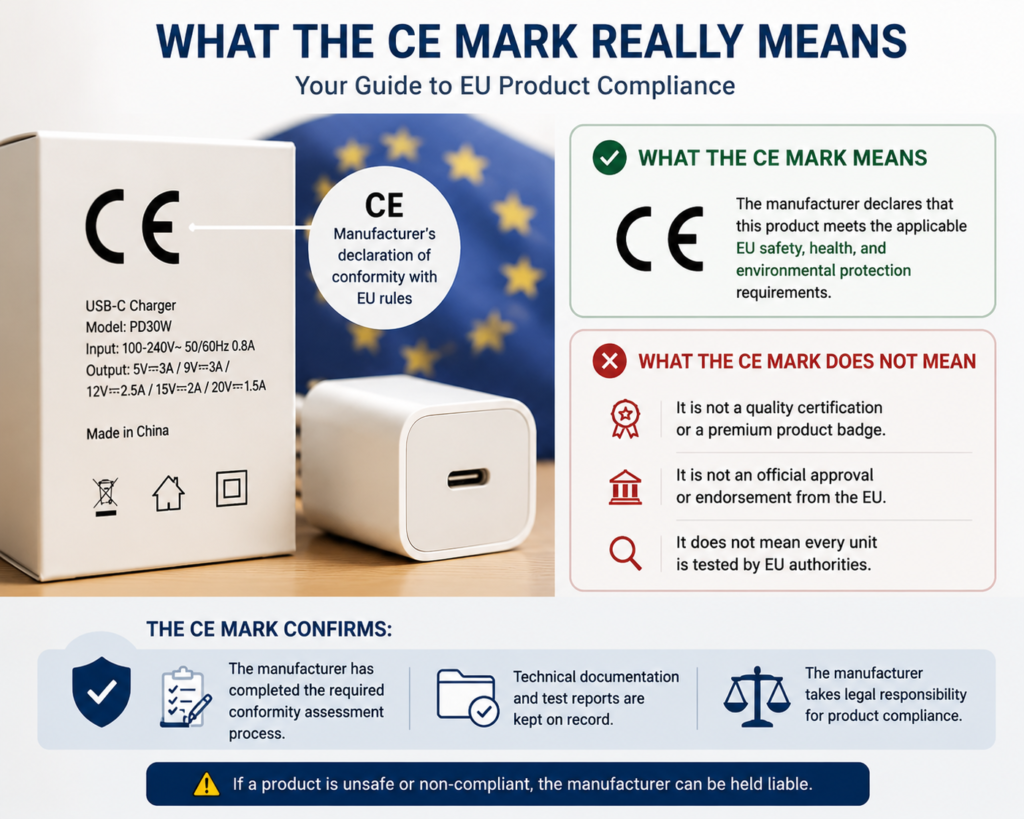
- CE marking is not a quality certification issued or tested by the European Union.
- It is a legal declaration from the manufacturer that a product meets applicable EU safety, health, and environmental rules.
- A CE mark does not mean every single unit was inspected by officials, or that the product is premium, indestructible, or officially endorsed.
- It confirms the manufacturer has followed the required compliance process for that product category.
- Rules vary by product type: low-risk goods often use self-declaration, while high-risk items require independent third-party assessment.
1. CE Marking Fundamentals: What the CE Mark Actually Is
1.1 CE Marking Explained in Plain English
The letters “CE” come from the French phrase Conformité Européenne, which translates to “European Conformity.”
In simple terms, the CE mark is a compliance label placed on products sold in the European Union and European Economic Area. When a manufacturer adds the CE mark, they are legally declaring that the product meets the EU rules that apply to that product category — covering areas like electrical safety, electromagnetic performance, chemical restrictions, and consumer protection.
In official EU terminology, this system is called “CE marking” or “CE conformity assessment.” The phrase “CE certification” is widely used but can be misleading, because most products do not require a formal third-party certificate to legally carry the mark.
1.2 What the CE Mark Means — and What It Doesn’t
The CE mark confirms one core fact: the product has gone through the required conformity checks and can lawfully be sold across the EU/EEA market. It sets a mandatory baseline for safety, covering risks such as electric shock, electromagnetic interference, hazardous materials, mechanical hazards, and choking risks for children’s products.
What it does not represent is equally important. The CE mark is not a guarantee of higher quality, longer lifespan, or better performance. It is not an official endorsement from the European Commission. It also does not promise absolute safety under all conditions — counterfeit marks, improper use, product aging, unauthorised design changes, or outdated standards can all leave a CE-marked product with real risks.
1.3 4 Core Concepts Every Beginner Must Distinguish
Four pairs of terms cause most confusion for people new to CE rules:
- CE mark vs. CE certification: The CE mark is the physical label on the product. “CE certification” is a casual term — most products follow a self-declaration route, not a formal certification process.
- Laws vs. technical standards: EU directives and regulations are binding legal requirements. Harmonised EN standards are voluntary technical guidelines; following them gives manufacturers a legal presumption of compliance.
- Self-declaration vs. notified body review: Many low-risk products can be assessed entirely by the manufacturer. Higher-risk products require review by an independent, EU-accredited Notified Body (NB).
- Test report vs. DoC vs. NB certificate: A test report is lab evidence of performance. A Declaration of Conformity (DoC) is the manufacturer’s signed legal statement. An NB certificate is a third-party assessment document only required for certain high-risk products.
Real-World Example: Why Your Phone Charger Has a CE Mark
Take a standard USB-C phone charger sold across Europe. The CE mark on its casing does not mean the European Union tested that exact charger in a lab.
Instead, the manufacturer declares that the charger has passed the required checks for electrical safety, electromagnetic compatibility, and restricted hazardous materials. The manufacturer keeps test reports and technical files on record, and takes legal responsibility if the product fails to meet those standards.
2. CE Marking Scope: Which Products Require CE Marking?
2.1 Applicable Regions and Special Boundaries
CE marking is mandatory for covered products placed on the market in the 27 EU member states plus Norway, Iceland, and Liechtenstein (the EEA).
Regional boundaries require careful attention:
- Northern Ireland: Under the Windsor Framework, EU product rules remain in force, so CE marking is fully valid. If assessment is done by a UK-approved body, the product must carry both CE and UKNI marks.
- Great Britain (England, Scotland, Wales): For most consumer goods, CE marking is now indefinitely recognised, and UKCA marking is optional. Exceptions include medical devices and construction products.
- Turkey, Switzerland and other neighbours: These countries may have partial alignment with EU rules but do not automatically accept CE for all products. Always verify local regulations.
The key takeaway: CE is a European market access mark, not a global passport.
2.2 Common Product Categories That Mandate CE Marking
CE marking applies to more than 30 product families. The most widely encountered categories include electrical and electronic goods, wireless devices, machinery, toys, personal protective equipment, medical devices, and specialised industrial products like pressure equipment and gas appliances.
2.3 Products That Do Not Need or Cannot Replace CE Marking
CE marking is not universal. Several common product categories fall outside its scope:
- Food, pharmaceuticals, and cosmetics, which fall under separate dedicated EU regulations.
- Ordinary furniture, standard clothing, and low-risk everyday items not covered by any CE legislation.
- Non-commercial samples and personal second-hand items not sold as commercial products.
- Standalone internal components used only within a supply chain, not sold directly to end users.
The core test for applicability is whether the product is sold as an independent item on the EU market, whether it falls within CE legislation, and whether its marketing claims change its regulatory classification.
2.4 3-Step Quick Check for Beginners
You can run an initial CE assessment in three simple steps:
- Define the product clearly: Note its intended use, target user, power supply type, wireless features, moving parts, and any marketing claims.
- Confirm the target market: Specify whether you are selling to the EU/EEA, Northern Ireland, Great Britain, or a country that only partially references CE rules.
- Match regulations by risk: Electrical products map to safety and EMC rules; wireless products to radio equipment rules; children’s products to toy safety rules, and so on.
Borderline cases are common. A low-voltage USB fan may not need formal high-voltage safety testing, but it can still be subject to electromagnetic rules, chemical restrictions, and general product safety laws. A fabric mask sold as a fashion accessory is not protective equipment, but one marketed as respiratory protection is.
3. Core CE Marking Rules: Responsibilities, Regulations, and Assessment Paths
3.1 Who Bears Legal Responsibility for CE Compliance?
CE compliance responsibility is distributed across the supply chain, with clearly defined roles under EU law:
- Manufacturer: Holds ultimate legal responsibility for product conformity, no matter where the company is located.
- EU importer: When bringing products from outside the EU into the market, must verify that the manufacturer has completed proper compliance procedures.
- Authorised representative: Appointed in writing by the manufacturer to hold compliance documents and liaise with regulators.
- Distributors and sellers: Must exercise reasonable care and cannot sell products that are clearly non-compliant, unlabelled, or missing documentation.
For online marketplace sellers, the platform does not take over CE responsibility. Sellers and their supply chain partners remain legally liable for placing non-compliant goods on the market.
3.2 The Line Between Self-Declaration and Notified Body Involvement
There are two main conformity assessment routes, and choosing the wrong one is a top compliance error.
- Self-declaration route: Where permitted by law, the manufacturer may conduct or commission testing, compile the technical file, perform risk assessment, and sign the DoC internally. This applies to most low-risk electrical goods and general consumer products.
- Notified body route: Required by law for higher-risk products, where an independent, EU-accredited NB must review the design, audit production, or issue a type examination certificate.
A critical rule of thumb: “No NB number” does not equal “fake CE.” Many fully compliant products use the self-declaration path. At the same time, self-declaration is not a free pass — it requires proper risk assessment, test evidence, technical documentation, and ongoing production control to be legally valid.
3.3 Quick Reference for Common CE Directives and Regulations
The table below summarises the most widely applicable CE-related regulations, followed by brief details:
| Regulation Abbreviation | Simple Definition |
|---|---|
| LVD | Electrical safety for mains-powered products |
| EMC | Limits electromagnetic interference and immunity |
| RED | Safety, EMC, and spectrum rules for wireless products |
| RoHS | Restricts hazardous substances in electronics |
| Toy Safety | Mechanical, chemical and electrical rules for children’s toys |
| PPE | Safety rules for personal protective equipment |
| MDR / IVDR | Strict rules for medical and diagnostic devices |
| GPSR | General consumer product safety and traceability rules |
In slightly more detail:
- Low Voltage Directive (LVD): Covers electrical equipment operating between 50–1000 V AC and 75–1500 V DC, addressing shock, fire, and thermal hazards.
- EMC Directive: Ensures devices do not emit excessive electromagnetic interference and work reliably in normal electromagnetic environments.
- Radio Equipment Directive (RED): Applies to all devices with radio functions (Bluetooth, Wi-Fi, cellular, NFC). It covers both safety and EMC for radio products.
- RoHS Directive: Restricts lead, mercury, cadmium and other harmful substances in electrical and electronic equipment.
- Toy Safety Regulation: Governs mechanical, chemical, electrical and hygiene risks for products intended for children under 14.
- PPE Regulation: Classifies protective equipment by risk level, with higher categories requiring notified body involvement.
- MDR / IVDR: Strict regulations for medical and in-vitro diagnostic devices, with heavy NB oversight.
- GPSR: Not a CE directive, but applies to almost all consumer products, reinforcing labelling, traceability and EU responsible person requirements.
3.4 Multi-Regulation Overlap Rules
A single product can fall under multiple CE regulations at once — and all must be satisfied before the CE mark may be applied.
For example, a children’s toy with Bluetooth connectivity, a rechargeable battery, LED lights, and small detachable parts must comply with toy safety rules, RED, RoHS, battery legislation, and choking hazard requirements.
Important boundary rules:
- For wireless products, RED typically covers both electrical safety and EMC for the radio function.
- Electronic toys do not automatically fall under the LVD; the Toy Safety Regulation is the primary legal framework.
4. CE Marking Process: 8 Practical Steps
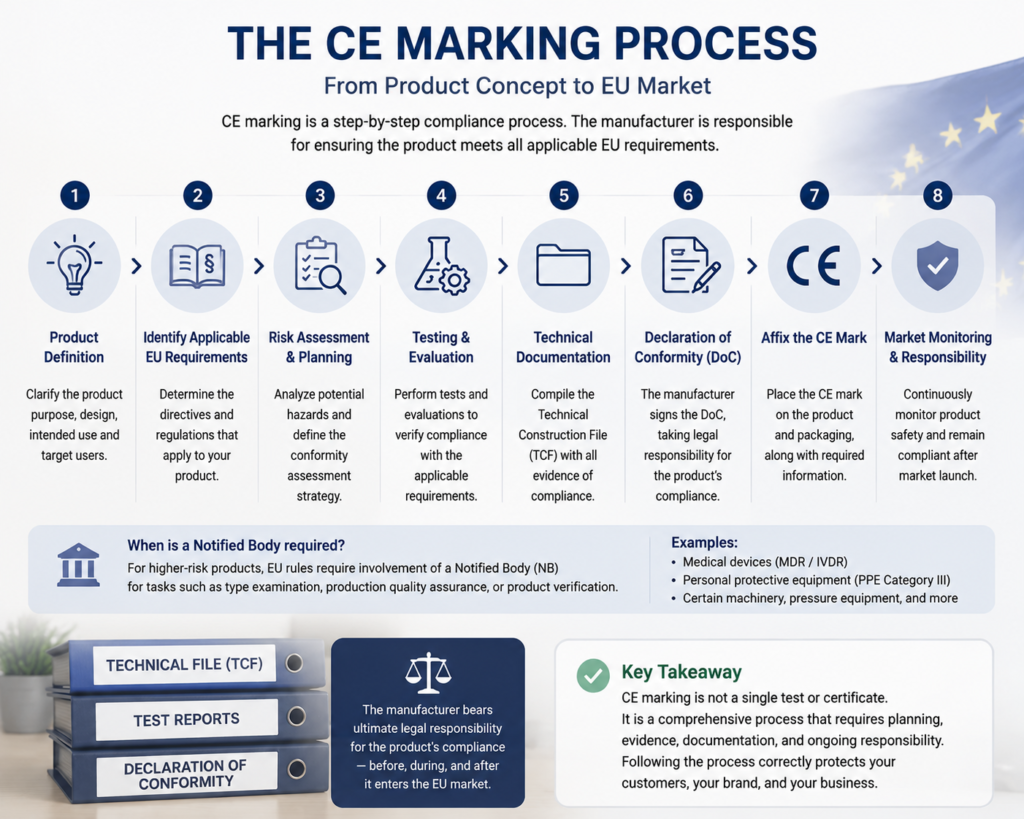
4. Step 1: Define Product and Model Boundaries
Start by documenting the full product identity: name, model numbers, series variations, key technical parameters, power supply, software version, wireless module, battery type, accessories, and packaging.
Do not assume visually similar models can share compliance documentation. Differences in internal components or power ratings can invalidate shared test results.
4.2 Step 2: Match Regulations and Confirm Applicable Standards
List every applicable directive and regulation, with a written justification for each inclusion or exclusion. Then identify the relevant harmonised EN standards and their current version numbers.
Standards are updated regularly, and reports based on old versions may not be legally valid at the time of market placement.
4.3 Step 3: Select the Conformity Assessment Module
Determine whether the product qualifies for self-declaration or requires a notified body assessment. This decision depends on the applicable legislation, product risk class, and intended use environment.
4.4 Step 4: Risk Assessment and Safety Design
Identify all reasonably foreseeable hazards across the product lifecycle: normal use, foreseeable misuse, transport, storage, maintenance, access by children, and component aging.
Apply the risk-reduction hierarchy: eliminate hazards through design first; reduce remaining risks through guards and protective features; and document residual risks in warnings and user instructions.
4.5 Step 5: Sample Testing and Remediation
Testing may be performed by a competent in-house laboratory or an accredited third-party lab. For products requiring NB involvement, the notified body must oversee or perform the relevant assessment.
If testing fails, document the root cause, design modifications, and retest results. Remember: a passing sample report proves compliance for that specific sample only, not automatically for all mass-produced units.
4.6 Step 6: Prepare the Technical Construction File (TCF)
The Technical Construction File is the complete compliance dossier that proves why the product is lawful. It is the primary document market surveillance authorities will request during checks.
A complete TCF typically includes product description, design drawings, circuit diagrams, bill of materials, critical component certificates, risk assessment, test reports, user instructions, and label artwork. It must be retained for 10 years after the last unit is placed on the market.
4.7 Step 7: Sign the EU Declaration of Conformity (DoC)
The EU Declaration of Conformity is the manufacturer’s formal legal document stating that the product complies with all applicable EU legislation.
It must include clear product identification, manufacturer name and address, a full list of applicable rules, references to standards used, and a dated signature from an authorised representative. For multi-regulation products, the DoC must cover all applicable rules — listing only the easiest one to pass is a common and serious error.
4.8 Step 8: Affix the CE Mark Correctly and Maintain Compliance
The CE mark must be at least 5 mm high, maintain its official proportional shape, and be applied visibly, legibly, and indelibly to the product or its packaging.
If a notified body is involved in production control, its four-digit NB number must be placed alongside the CE mark. Post-market obligations include maintaining production consistency, monitoring regulation updates, retaining documentation, and handling safety incidents or recalls when necessary.
5. CE Marking Verification: How to Check If CE Documentation Is Valid
5.1 First Identify Which CE Path Your Product Follows
Verification starts with classifying the compliance route:
- Self-declaration products: Focus on whether the DoC, technical file, test report, labelling, and instructions are complete, consistent, and technically credible.
- NB-involved products: In addition to the above, verify the NB number, certificate type, scope, and current validity status.
A universal red flag: a glossy “CE certificate” with no accompanying DoC and no technical file is almost never reliable.
5.2 Key Checks for Core Documentation
- DoC check: Confirm product model, brand, manufacturer identity, regulation list, standard versions, and signing date match the physical product.
- Test report check: Verify sample photos, model numbers, key parameters, test standards, and test items cover the product’s core risks.
- Label check: Verify CE mark proportions, product traceability information, manufacturer/importer details, warning text, and language appropriateness.
5.3 How to Verify a Notified Body (NB)
The official EU database for verifying notified bodies is called NANDO. It is free to use and allows you to look up any four-digit NB number.
Enter the four-digit number, then confirm the organisation name, authorised regulation modules, product category scope, and current accreditation status. NB authorisations are granted per regulation and per product scope — an NB accredited for PPE cannot automatically assess medical devices.
5.4 Common Cases of Invalid or Counterfeit CE Marking
These are the most frequent reasons CE marking is deemed invalid:
- Only a generic “CE Certificate of Compliance” exists, with no DoC and no technical file.
- The CE mark is incorrectly proportioned, blurry, or uses a fake “China Export” style mark.
- The NB number is forged, revoked, or used outside the body’s authorised scope.
- FCC, CCC, UL, or RoHS-only declarations are presented as full CE compliance.
- Test reports from different models or brands are reused without reassessment.
- Mass production changes — swapping power adapters, wireless modules, batteries, or materials — are made without updating compliance documentation.
5.5 Quick Verification Tips for Different Roles
- Consumers: Check for a credible brand, local-language instructions, clear safety warnings, and a properly formed CE mark.
- Online sellers: Request from suppliers the DoC, full test reports, label photos, and NB certificates where applicable.
- Importers: Build a formal document audit checklist, confirm the EU responsible party, and verify production consistency.
6. Costs, Timelines, Validity and Post-Market Compliance
6.1 Does CE Marking Have an Expiry Date?
There is no universal, fixed expiration date for CE marking. Compliance remains valid as long as the product design, supply chain, and applicable regulations remain unchanged.
Reassessment is mandatory when product structure changes, core components are replaced, or harmonised standards and regulations are updated. NB-issued certificates may have their own validity period and surveillance audit requirements.
6.2 What Actually Determines CE Marking Costs?
CE pricing varies widely based on four factors:
- Product complexity: More functions, higher risk, and more model variants increase testing and documentation work.
- Number of applicable regulations: Stacking electrical, wireless, toy, PPE, or medical requirements raises costs significantly.
- Notified body involvement: NB assessment almost always increases both cost and timeline compared to self-declaration.
- Test failure and remediation cycles: Design fixes and retesting add time and expense.
Beware of unusually cheap, ultra-fast CE services. They often rely on template certificates, no actual testing, or fake NB numbers — and can result in customs detention, product recalls, and legal penalties.
6.3 Factors Affecting CE Marking Timelines
- Simple low-risk products with mature designs and complete documentation can be completed relatively quickly.
- Wireless and complex electronic products require RF, EMC, safety, battery, and RoHS testing, lengthening the process.
- Highly regulated products such as medical devices involve NB scheduling, technical file review, and quality system audits.
- Supply chain issues — missing component certificates and frequent supplier changes — are a common cause of delays.
6.4 Ongoing Post-Market Compliance Requirements
CE compliance does not end at market launch. Ongoing obligations include maintaining production consistency, updating documentation when designs or regulations change, monitoring regulatory updates, and being prepared to submit files to authorities during surveillance checks. If safety risks are identified, manufacturers must evaluate corrective measures, user notifications, and product recalls.
6.5 GPSR and Special Requirements for E-Commerce
The EU General Product Safety Regulation (GPSR) has strengthened rules for online sales. Online product pages must clearly display the manufacturer’s contact details, the EU responsible person’s information, product identification, and safety warnings. Non-EU sellers must designate an EU-based responsible person to hold documentation and liaise with authorities.
7. CE Compliance Focus by Product Category
7.1 Chargers and Power Adapters
Common regulations: LVD, EMC, RoHS, plus ecodesign, energy efficiency, and plug safety rules.
Key checks: input/output parameters, insulation distances, temperature rise, dielectric strength, short-circuit protection, and label warnings.
Common pitfall: Low-cost unbranded adapters frequently use copied test reports, mismatched internal components, and counterfeit CE marks.
7.2 Wireless Electronics and Smart Devices
Common regulations: RED, RoHS, plus battery safety and chemical restrictions.
Key checks: operating frequency bands, transmit power, antenna design, EMC performance, and human exposure assessment.
Common pitfall: A pre-certified wireless module does not automatically make the finished product compliant. Antenna design, enclosure material, power supply, and software all affect final performance.
7.3 Smart Home Products and Bundles
Common regulations: RED, applicable EMC/LVD rules, RoHS, and GPSR.
Key checks: wireless module compliance, power adapter suitability, sensor safety, battery compliance, and how software updates affect safety and radio performance.
Common pitfall: Swapping power adapters, wireless modules, antennas, or battery suppliers after initial compliance almost always requires reassessment.
7.4 Children’s and Electronic Toys
Common regulations: Toy Safety Regulation, RoHS; wireless models add RED.
Key checks: small parts, sharp edges, pinching points, flammability, phthalates and heavy metals, age grading, and warning statements.
Common pitfall: Labelling a product as a “gift” or “decoration” does not remove it from toy rules. Regulators look at design and intended user, not just marketing wording.
7.5 Personal Protective Equipment (PPE)
Common regulations: PPE Regulation (EU) 2016/425.
Key checks: protection target, protection category, intended use scenarios, applicable standard numbers, NB certificate details, and user instructions.
Common pitfall: Marketing claims — such as particle filtration, virus protection, or impact resistance — can escalate the product into a higher risk category requiring NB assessment.
7.6 Medical Devices
Common regulations: MDR or IVDR, with risk class determining NB involvement.
Key checks: intended medical purpose, clinical evaluation, biocompatibility, sterility requirements, software validation, and post-market surveillance plans.
Common pitfall: General wellness products can be reclassified as medical devices if they make claims about diagnosing, preventing, monitoring, or treating disease.
7.7 Machinery and Power Tools
Common regulations: Machinery Regulation, EMC, RoHS; wireless control systems add RED.
Key checks: moving part guarding, emergency stop functions, interlocks, noise and vibration levels, and control system safety.
Common pitfall: Electrical testing alone does not satisfy machinery safety rules. A documented mechanical risk assessment is a core legal requirement.
7.8 Specialised Industrial Products
Construction products, pressure equipment, and gas appliances follow specialised, product-specific rules and cannot be handled with a standard consumer electronics CE process. Construction products require a Declaration of Performance (DoP); pressure equipment and gas appliances almost always require notified body assessment based on hazard level.
8. CE Marking vs. Other Certifications and Regulations
8.1 CE vs. UKCA
CE covers the EU/EEA and Northern Ireland. UKCA was designed as the UK’s post-Brexit mark for Great Britain. For most consumer goods, CE marking is now indefinitely recognised in Great Britain, making UKCA optional. Exceptions include medical devices and construction products.
8.2 CE vs. FCC
CE is the EU’s comprehensive compliance framework covering safety, health, environment, EMC, and radio spectrum. FCC is the United States’ regulatory framework, focused primarily on electromagnetic compatibility and radio equipment authorisation. There is no mutual recognition between the two.
8.3 CE vs. RoHS
RoHS is the hazardous substances restriction framework for electrical and electronic goods. In most cases, RoHS compliance is one component of overall CE compliance. RoHS has no separate market access mark, and a RoHS test report alone cannot replace full CE marking.
8.4 CE vs. CCC / UL
CCC is China’s mandatory certification system. UL is a widely recognised North American third-party safety certification. Neither is equivalent to the CE mark’s legal status in the EU. More certification marks do not automatically mean better compliance — what matters is matching the requirements of the target market.
8.5 CE vs. GS / TÜV / CB
The GS mark is a voluntary German safety certification, and TÜV refers to specific testing organisations. The CB scheme enables international conversion of electrical test results, but cannot directly replace CE marking. Third-party test reports serve as supporting evidence for CE compliance, but ultimate legal responsibility rests with the manufacturer.
9. Common CE Marking Misconceptions
- Myth: CE is an official certificate issued by the EU.
Reality: Most products follow a manufacturer self-declaration model. There is no single central EU “CE certificate.” - Myth: Every product sold in Europe needs CE.
Reality: Only products covered by CE-mandating legislation may and must bear the mark. Affixing it to ineligible products is illegal. - Myth: No NB number means the CE mark is fake.
Reality: Many low-risk product categories do not require notified body involvement at all. - Myth: A passing test report is enough to use the CE mark.
Reality: Testing is only evidence. Full compliance requires risk assessment, a complete technical file, a signed DoC, and correct labelling. - Myth: Sellers have no liability if the supplier provided CE documents.
Reality: Importers, distributors, and online sellers all have defined legal obligations under EU product safety law. - Myth: CE certification lasts forever.
Reality: Product design changes, component swaps, standard updates, and regulation changes all trigger a need for reassessment. - Myth: Rebranding a product lets you reuse the original supplier’s CE documents.
Reality: Rebranding requires an updated DoC and traceability verification. Significant design changes require full reassessment. - Myth: Low-voltage products have no safety requirements.
Reality: Even low-voltage products can be subject to EMC, RoHS, battery safety, chemical, and mechanical hazard rules.
10. Frequently Asked Questions About CE Marking
Is CE marking an official certificate?
No. CE marking is primarily a manufacturer’s legal declaration of compliance. Most products do not require an official EU-issued certificate. Only certain high-risk categories involve independent assessment by an accredited notified body.
Does every product sold in Europe need CE marking?
No. CE marking only applies to products covered by specific EU directives and regulations. Items like ordinary clothing, basic furniture, food, and pharmaceuticals do not require CE marking and fall under other regulatory frameworks.
How long is CE marking valid?
CE marking does not have a fixed universal expiry date. It remains valid as long as the product design, components, and applicable regulations remain unchanged. If standards are updated or the product is modified, reassessment is required.
Is CE marking accepted in the UK?
For most consumer goods sold in Great Britain, CE marking is indefinitely recognised and UKCA marking is optional. Northern Ireland continues to follow EU product rules, where CE marking remains fully valid. Exceptions apply to medical devices and construction products.
Can I always trust a CE mark on online marketplaces?
Not automatically. While legitimate sellers use CE marking correctly, counterfeit marks, reused test reports, and incomplete documentation are common on third-party platforms. For high-risk products like chargers and toys, it is wise to verify the brand and request compliance documentation when possible.
Final Takeaway
CE marking is the foundation of EU product market access, but it is neither a quality guarantee nor a one-size-fits-all certification. Understanding the difference between self-declaration and notified body assessment, knowing which regulations apply to your product, and being able to spot invalid documentation will help you shop, sell, or source with greater confidence.