
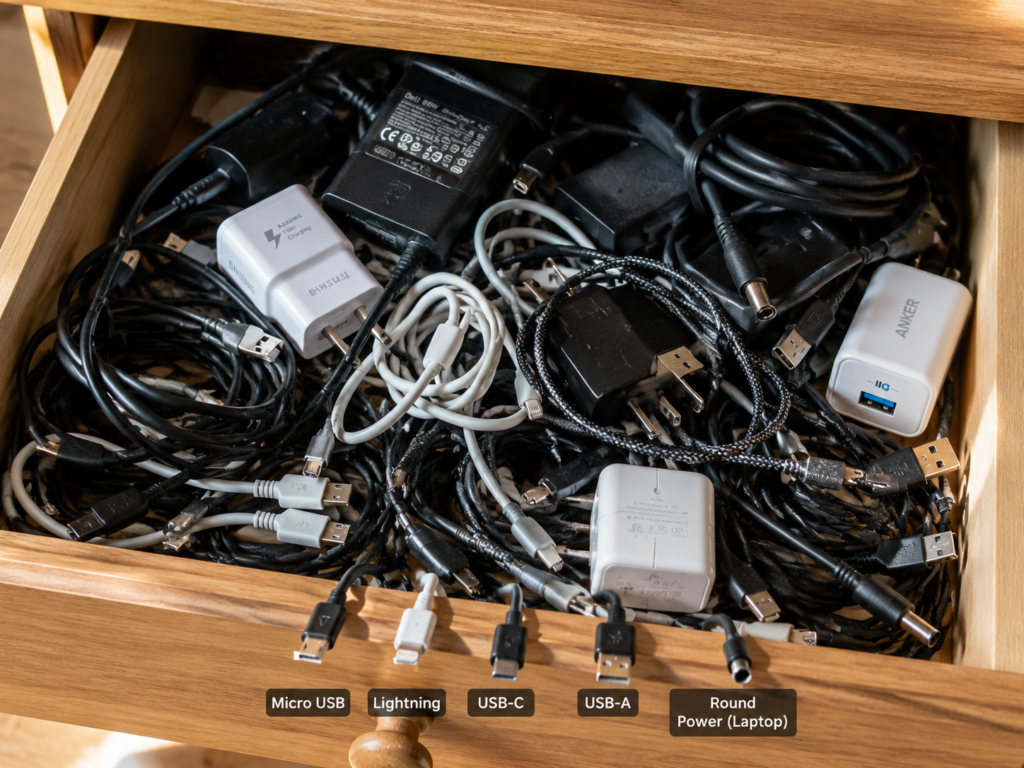
If you open the drawer at home, there is a high chance you can find several different charging cables: Micro USB for old Android phones, Lightning for Apple devices, round power ports for laptops, and USB-C from recent years. You have to carry three or four cables every time you go out, buy new cables again when switching phone brands, and half a box of idle old chargers piles up — it’s a pity to throw them away, but useless to keep.
The “USB-C charging regulation” that has been often heard in recent years is designed to solve this trouble. But many people have many misunderstandings about it: Will old phones become unusable immediately? Do all USB-C devices charge at the same speed? Will wireless charging be banned? How to judge compliance when shopping overseas?
This article will explain the context, scope of application, and common pitfalls of the USB-C charging regulation from the perspective of ordinary users. Whether you are just changing to a new phone, or often shop overseas or make cross-border purchases, you can find useful information.
Let’s Start with the Conclusion: What Exactly Does the USB-C Charging Regulation Change?
Simply put, the USB-C charging regulation is a requirement of some countries and regions: newly launched designated portable electronic devices that support wired charging must adopt a USB-C interface, and unified requirements are also made for fast charging interoperability, packaging information labeling, and whether chargers are included. For ordinary users, the most intuitive feeling is that in the future, products such as new mobile phones, tablets, headphones, cameras, handheld game consoles, and e-readers will increasingly use USB-C charging uniformly.
A key point to draw first: it does not require all devices to switch interfaces immediately, but is gradually promoted for products newly launched on the market, of specific categories, and in specific regions. 2025 is the year when ordinary users clearly perceive changes — the EU rules for most portable devices officially took effect on December 28, 2024, while the requirements for laptops will not be implemented until April 28, 2026.
Three Core Goals of the Regulation
The starting point for launching such rules is very practical and relevant to every user. First is to improve convenience, reduce the trouble caused by mixed interfaces of different brands and devices, and eliminate the need to buy a bunch of new cables every time you change devices. Second is to improve safety, promote users to use chargers and cables with clear parameters and compliant design and testing, and reduce the risk of overheating, short circuit, and device damage from low-quality accessories. Finally, it supports sustainable development and reduces idle accessories and e-waste caused by repeated purchase of chargers and cables.
First, a Reassurance: What the Regulation Is NOT
Many people feel anxious when they first hear about the regulation, but it is completely unnecessary. Let’s clarify a few common misunderstandings first:
Your old mobile phones, old headphones, and old chargers can all continue to be used. The regulation will not retroactively apply to products that ordinary consumers have already bought home. It also does not ban wireless charging, magnetic charging, or dedicated dock charging, but only makes requirements for wired charging interfaces.
In addition, having a USB-C interface does not mean that all devices charge at the same speed, nor does it mean that data transmission speed, video output capability, Thunderbolt or USB4 functions are unified, let alone that any USB-C cable can charge a laptop at full speed — these are all basics that will be explained in detail later.
How to Tell If a Device Will Be Affected
To quickly judge whether a device is subject to USB-C regulations, just look at four core conditions: first is the sales region — currently the EU has the clearest rules, and progress varies in other places; second is the device category — common portable devices such as mobile phones, tablets, headphones, and cameras are most likely within the coverage; third is the time of launch on the market — the regulation only applies to new products first sold in the local market after the effective date, and old models already launched before do not count; finally, it depends on whether the device supports wired charging — pure wireless charging devices, and special equipment such as medical/industrial/military equipment, are generally not judged according to the rules of ordinary consumer electronics.
There are also several common boundaries to note: personal second-hand transactions, replacement parts for repair, and inventory products already launched before the regulation takes effect are usually not judged according to the compliance requirements for new products.
Regulatory Basis and Boundaries: Which Devices Are Regulated, and Which Are Not
Currently, the most mature and influential USB-C charging regulation in the world is in the EU, and rules in other countries and regions are mostly in the stage of promotion or reference. Therefore, we first take the EU as the core reference to clarify the boundaries of the rules.
The EU’s USB-C regulation is formally based on the Common Charger Directive (Directive (EU) 2022/2380), which amends the original EU Radio Equipment Directive (RED 2014/53/EU). Technically, it adopts the internationally universal USB-C interface standard (EN IEC 62680-1-3) and USB Power Delivery fast charging standard (EN IEC 62680-1-2). Compliance responsibility is borne by entities that sell products to the EU market, such as brands, importers, and distributors. They need to retain technical documents and declarations of conformity, and complete packaging labeling and manual information as required. Ordinary consumers do not bear compliance responsibility.
Common Categories Already Covered by the EU
From December 28, 2024, the following categories of devices newly launched on the EU market that support wired charging need to meet USB-C related requirements: handheld mobile phones, tablets, digital cameras, over-ear headphones/earbuds and corresponding charging cases, handheld electronic game consoles, portable speakers, e-readers, wireless keyboards and mice within the scope of radio equipment, and portable navigation devices.
Of course, specific applicability shall be subject to official EU regulatory texts, harmonized standards and member state implementation rules, and shall be comprehensively judged based on the actual function of the device, sales region, launch time and charging method, not just the product’s marketing name.
Key Category to Be Included Only in 2026: Laptops
The mandatory application time for laptops is more than a year later, and will officially take effect on April 28, 2026. So in 2025, you may still see many laptops with dedicated round ports or magnetic ports. Even if some laptops already have a USB-C interface, they may not support full-speed USB PD charging, and may only be used for low-power emergency charging. Especially for high-performance gaming laptops, dedicated power ports may still be retained in the future, as long as they meet the relevant requirements in the regulation. In other words, dedicated round or magnetic ports can exist as additional power solutions, but after the EU laptop application date, models newly launched on the market and falling within the scope of the rules cannot avoid the application requirements of USB-C/USB PD by only using dedicated ports; the specific situation is still subject to whether the device is within the RED scope, whether it supports wired charging, and official compliance documents.
Devices Generally Not Within the Core Coverage Scope
Several types of devices are generally not included in the core scope of ordinary USB-C charging regulations: small wearable devices such as smart watches and fitness bands — because of their small size, high waterproof requirements, and common use of magnetic contact charging, many rules do not directly include them in the same batch; medical devices, industrial devices, and military devices have separate industry safety standards and are not handled according to consumer electronics rules; large home appliances and fixed installation devices are also not the target of portable consumer electronics interface unification; pure wireless charging devices without wired charging interfaces naturally cannot apply the rule of “must have a USB-C port”.
Of course, regulations may gradually expand in the future. Whether buying or selling, please refer to the latest official local announcements.
How to Define the Boundaries of “New Sales”, “Inventory”, and “Second-Hand”
Many people care: can old inventory before the regulation takes effect still be sold? Is there a problem buying second-hand devices? In fact, the core target of the regulation is “newly launched” products, that is, brand-new products that enter the local market for sale for the first time after the effective date.
For inventory that was already launched before the compliance date, law enforcement standards vary by region. Some regions allow continued sales, depending on local rules. Second-hand circulation between ordinary individuals is usually not equivalent to new product launch and is not subject to such rules. Interfaces, cables, and accessories for repair are not necessarily handled according to the rules of new complete machines, but they still need to meet basic safety standards.
For ordinary users, it is usually no problem to buy old devices for personal use through overseas shopping, but if it is bulk import, resale, or commercial sale on platforms, it needs to meet local compliance requirements.
Why Promote the USB-C Regulation: The Dual Logic of Safety and Waste Reduction
Many people think “unified interface” is a trivial matter, but in fact there are two core logics behind it: safety and sustainable development, which are closely related to everyone.
Safety Level: Reduce Low-Quality Accessories and Incorrect Matching
In the period of chaotic interfaces, users can easily buy charging heads and cables of unknown origin, unclear parameters, and no protection circuit. Low-quality accessories may bring risks such as overheating, short circuit, sparking, shell damage and electric leakage, and device damage. Everyone should have seen a lot of such news.
The core value of USB-C and USB PD is to allow devices, chargers, and cables to “negotiate before power supply” in a standardized way, agreeing on the voltage and current supported by both parties, greatly reducing the probability of incorrect power supply. Of course, it should be noted that the regulation can only reduce risks and cannot replace users’ basic safety habits — for example, buying accessories from regular brands, not using damaged cables, and not charging in humid environments, still need to be paid attention to.
Sustainable Development Level: Reduce Idle Products and Repeated Purchases
EU policy documents have long focused on the e-waste problem caused by discarded or idle chargers, and a commonly cited estimate is that the EU generates about 11,000 tons of such e-waste every year. If users can reuse their existing USB-C chargers and cables when changing devices, repeated purchases can be reduced. In the long run, it can reduce the consumption of copper, plastic, aluminum and other materials, and also reduce carbon emissions in production, packaging, and transportation links.
Of course, the waste reduction effect is not absolute: it is affected by the scope of regulation, user reuse habits, product life and recycling system. If users hoard more chargers and cables because of “unified interface”, the waste reduction effect will be largely offset.
Direct Benefits for Ordinary Users
Back to the practical benefits that everyone cares most about: first, carry fewer cables when going out — one or two USB-C cables can cover multiple types of devices such as mobile phones, tablets, headphones, and cameras. Second, it is cheaper to change devices — no need to buy a bunch of dedicated cables and chargers every time you change brands. Third, purchasing is more transparent — the regulation requires packaging and product detail pages to clearly indicate whether a charger is included, the minimum/maximum charging power of the device, and whether it supports USB PD, so you don’t have to rummage through the detail page for parameters for a long time. Finally, it is easier to judge when buying overseas — because of the requirements of the EU and other markets, many brands’ global versions will switch to USB-C simultaneously, so you don’t have to worry about different interfaces in different regions.
USB-C Regulation Updates in Major Global Regions: Understand by Level of Certainty
Currently, the progress of USB-C regulations varies greatly across regions. You don’t need to memorize complex provisions, just understand them by level of certainty. For everyone’s convenience, I have compiled a simple table:
| Region | Is It Mandatory? | Effective Date | Covered Categories | Are Laptops Included? | Is USB PD Required? | Is Packaging Labeling Required? | Notes for Ordinary Users |
|---|---|---|---|---|---|---|---|
| EU | Yes | Small and medium portable devices: December 28, 2024; Laptops: April 28, 2026 | Mobile phones, tablets, cameras, headphones, handheld game consoles, portable speakers, e-readers, wireless keyboards and mice, portable navigation, etc. | Yes (from 2026) | Applicable devices that support wired fast charging higher than 5V, 3A or 15W shall support USB PD; proprietary fast charging shall not impair PD interoperability | Yes (need to indicate whether charger is included, power range, PD support status) | Newly launched compliant products basically use unified USB-C, and versions without chargers are available |
| UK Mainland | Not fully mandatory for now | No clear unified implementation date yet | No complete unified list yet | Not yet clear | Not yet clear | No mandatory unified requirement yet | Subject to the latest announcement of the UK government, pay attention to UKCA marking and plug specifications |
| Northern Ireland | Depends on product type and sales channel, some rules may align with the EU | To be confirmed in combination with applicable rules, no unified implementation date | To be judged based on product type and sales rules | To be confirmed in combination with applicable rules | EU alignment requirements may apply, need to check CE/UKNI/UKCA markings and sales region rules | EU alignment requirements may apply, need to check local rules and product markings | Confirm sales region version, compliance markings, plug specifications and after-sales policy before purchase |
| United States | Not mandatory at the federal level for now | None | None | None | None | None | Popularization is driven by brands and the market, pay attention to FCC certification and plugs when shopping overseas |
| India | In progress | To be officially confirmed | Proposed to cover portable devices such as mobile phones | To be confirmed | To be confirmed | To be confirmed | Subject to the latest notices from MeitY and BIS |
| South Korea, Japan | Mainly driven by the industry | No full mandatory date yet | No unified mandatory list | None | None | None | Most global models of leading brands adopt USB-C simultaneously |
| Saudi Arabia, Brazil, Australia, etc. | Policy research / phased promotion | Varies by region | Varies by region | Varies by region | Varies by region | Varies by region | Check local official announcements and product detail pages before purchase |
Here are some additional details for key regions:
As of 2025, the UK mainland (England, Scotland, Wales) has not fully adopted the EU’s Common Charger Directive, and specific rules are subject to the latest announcements of the UK government and relevant competent authorities; due to post-Brexit arrangements and the Windsor Framework, some product rules in Northern Ireland will align with the EU. When purchasing, confirm CE, UKNI, UKCA markings and sales region requirements.
As of 2025, there is no unified USB-C mandatory regulation at the US federal level that has fully taken effect like the EU. Some states have related discussions or proposals, but they have not become officially effective compliance requirements. The popularization of USB-C in the US market is mainly driven by brands’ global strategies, industry standards and consumer demand. When shopping for US products overseas, pay attention to FCC certification, electrical safety certification, plug specifications, voltage range and warranty, but these are not the same as the USB-C unified interface regulation.
The progress of Asian markets such as India, South Korea and Japan varies: the Indian government has clearly promoted the unification of USB-C interfaces for portable devices such as mobile phones, but the specific applicable categories, mandatory time and implementation details are subject to the latest official notices; South Korea and Japan are more driven by industry standards, policy initiatives and the synchronization of brand global supply chains, and there are temporarily no regulations with the same scope and mandatory force as the EU. For ordinary users, the most intuitive impact is that leading brands, in order to unify design and supply chain, will usually gradually adopt USB-C for global models, even if local regulations are not as strict as the EU.
More markets such as Saudi Arabia, Brazil and Australia are currently mostly in the stages of policy consultation, standard research or phased promotion, with great differences in implementation time, applicable categories and law enforcement methods. Ordinary users should not only look at news headlines, but refer to product sales pages and announcements from local regulatory or standard-setting bodies; if you are a cross-border seller, you need to confirm local compliance responsibilities item by item, including product testing, labeling, manuals, import documents and platform rules.
Must-Know Basics: Don’t Confuse USB-C, USB PD, Power, and Cables
Many people make mistakes when buying accessories because they mix up these concepts. In fact, they are completely different things, and it is very simple to understand them separately.
USB-C: Just the Interface Shape
USB-C is the oval interface that can be plugged in either way. It is just a physical interface shape that can be used for charging, data transfer, and connecting to a monitor, but the specific functions it supports depend entirely on the device’s design. Having a USB-C port does not mean it necessarily supports fast charging, high-speed data, or external monitors, let alone Thunderbolt or USB4 — these are common pitfalls for many people.
USB PD: The Negotiation Protocol for Universal Fast Charging
USB Power Delivery, abbreviated as USB PD, can be understood as a set of “charging negotiation rules”: after the device and charger are connected, they will first communicate with each other about the voltage and current they support, then select a power that both parties can accept for power supply, instead of forcing too high voltage and current. It is both safe and cross-brand compatible.
The EU regulation binds wired fast charging above the base power (5V/3A or 15W) to USB PD, in order to improve cross-brand interoperability and avoid the problem of incompatible proprietary protocols of various brands. Of course, the regulation does not prohibit brands from additionally supporting their own proprietary fast charging protocols, as long as the proprietary protocols do not interfere with the universal fast charging capability of USB PD.
In addition, PPS, which is often heard, is the programmable power supply function in the USB PD system. Some mobile phones’ fast charging experience depends on PD PPS support. You don’t need to remember the details. When buying a charger, if you want to fast charge your phone, you can pay attention to whether it supports PPS.
Power (W): An Important Indicator That Determines Charging Speed
The unit of power is watt (W). Generally speaking, the higher the power, the faster the theoretical charging speed, but the premise is that the device, charger, and cable all support the corresponding power — none is dispensable.
Here is a reference for common power ranges: common fast charging range for mobile phones is 20W-45W, and some brands’ proprietary fast charging can be higher; common for tablets is 30W-65W; common for thin and light laptops is 45W-100W; high-performance laptops may require more than 100W, and even retain dedicated power ports.
The most reliable way to judge is not to look at the “peak fast charging” on the promotional page, but to look at the “input power”, “minimum charging power”, and “maximum charging power” marked on the device manual or packaging.
Cables: The Most Easily Overlooked Short Board
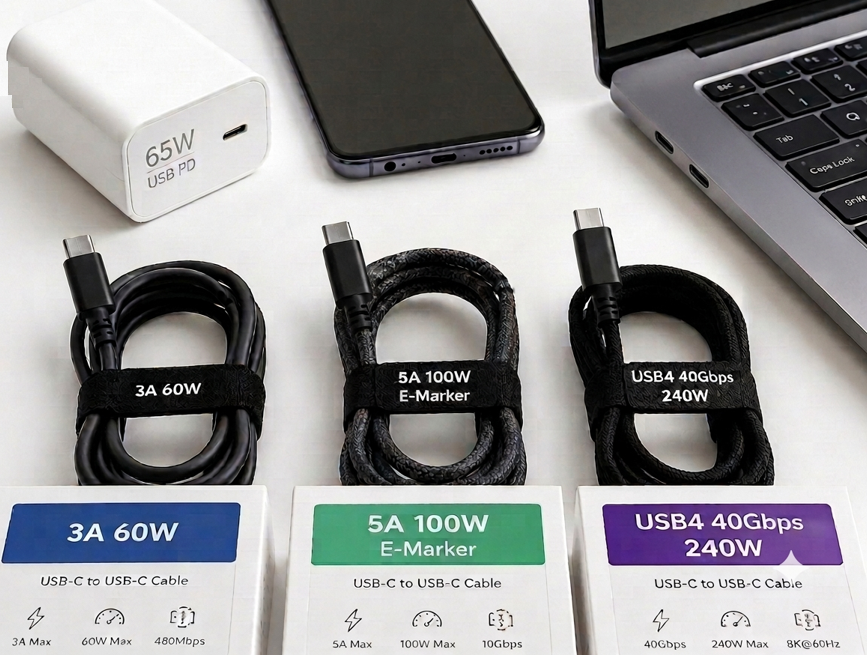
Many people buy high-power chargers but find that charging is not fast, and the problem is often with the cable. Not all USB-C cables are the same. Low-spec cables can only safely carry lower power: common 3A USB-C cables usually support up to 60W power; high-power charging such as 100W, 140W, 240W usually requires 5A cables, and the cable must have a built-in E-Marker chip to identify power capability.
In addition, there are cables that only support charging, and their data transfer speed may be very slow; cables that support USB4 or Thunderbolt have different prices and markings, so don’t buy the wrong one.
Ordinary users have three simple ways to identify cable specifications: look at the power/current marking on the packaging, look at the parameters printed on the cable body, check the specification page on the brand’s official website. Never judge power only by “thick cable”. Many low-priced cables use thick outer sheaths to feel good, but the internal wire cores simply cannot meet high-power requirements. When buying a cable, at least look at three items: maximum power, data speed, and whether there is regular brand information or relevant certification instructions.
Actual Charging Speed Is Determined by the “Shortest Board”
Charging is like filling a bucket with water — how much it can hold depends on the shortest board. For example, if your phone supports up to 25W charging, using a 100W regular PD charger will only charge at 25W, it will not force the full 100W, let alone damage the phone. If you use a 65W charger with an old cable that only supports 3A, you may not be able to charge the laptop at full speed.
Also, the “total power” of a multi-port charger is not equal to the maximum power of a single port. When multiple devices are plugged in at the same time, the single-port power may decrease dynamically. For example, a dual-port charger with a total power of 65W may not reach the 65W peak per port when charging a phone and a tablet at the same time.
In addition, when the battery is nearly full, the temperature is too high, or system protection is activated, the device will actively reduce speed. This is a normal battery protection strategy, not necessarily a broken charger or cable.
Real Changes Ordinary Users Can Feel
After talking so much about the rules, you may still ask: what does this have to do with my usual use of devices and shopping? In fact, changes are already happening, you just may not have noticed.
When Buying New Devices
First, in markets where rules such as the EU have taken effect, newly launched devices in applicable categories will gradually be unified to USB-C interfaces. The packaging box may no longer include a charger, but as required, it should clearly indicate whether there is a charger in the box, so you don’t have to open the box to guess. Product detail pages will also emphasize charging power, USB PD support status and recommended charger specifications more, and the information will be much more transparent than before.
It should be noted that different regional versions of the same brand may differ in plug specifications, whether a charger is included, compliance markings, manual language, and after-sales policy. Don’t just place an order because the interface is the same.
When Using Old Devices
There is no need to worry at all. Your old devices with Lightning, Micro USB, round power ports, etc. can all continue to be used. The regulation does not require individual users to eliminate old devices. If old interface cables are intact, safe, and still have corresponding devices in use, you can keep a small number for backup; but if they are damaged, overheating, unmarked, or of unknown origin, it is recommended to eliminate them and send them to regular e-waste recycling points, don’t keep them with safety hazards.
When Using Old Chargers
Don’t rush to throw away old USB-A chargers at home. They can be used to charge many new devices through A-to-C cables, but usually the charging speed will be relatively slow. If the old charger does not support USB PD, it may not trigger fast charging of new devices, but it is fine for emergency use.
As long as the voltage range, power, certification and cable match, old chargers can continue to be used. If you travel across countries frequently, remember to confirm in advance whether the charger supports 100-240V wide voltage to avoid problems when using it abroad.
When Buying New Accessories
When buying charging accessories in the future, don’t just ask “is it USB-C” anymore, but also ask three clear questions: how many watts of power, does it support PD/PPS, can the cable carry the corresponding power.
Here is a practical reference (specifically subject to the device manual): for devices such as headphone charging cases and e-readers, chargers above 10W are usually sufficient; mobile phone users can prioritize PD chargers above 20W-30W to meet basic fast charging; users with phones + tablets can consider 45W-65W multi-port PD chargers; users with phones + thin and light laptops can consider those above 65W-100W, and at the same time confirm whether the single-port output power is sufficient.
No matter what you buy, it is not recommended to buy high-power chargers with no brand, no parameters, no certification, and abnormally low prices, as the safety risk is too high.
Compliance Judgment Methods and Pitfall Avoidance Guide
If you often shop overseas or have high requirements for compliance, mastering these judgment methods can avoid most pitfalls.
Three Steps to Quickly Judge If a New Product Is Likely Compliant
Note that this method only applies to brand-new products newly launched after the regulation takes effect. Second-hand, old inventory, and repair parts do not apply to this logic:
First step: look at the region, whether it is sold in markets that have implemented relevant rules such as the EU; second step: look at the category and time, whether it belongs to the applicable category and is newly launched after the regulation takes effect; third step: look at the packaging and instructions, whether it is marked with USB-C interface, USB PD support, minimum/maximum charging power, and whether a charger is included.
If all three points are met, it is likely to be compliant; if any point is not met, you should be more careful.
Certification Markings Cannot Be Simply Mixed Up
Many people think that having a certain certification means complying with USB-C regulations, but that’s not the case at all. There is no globally universal “exclusive certification for USB-C regulations”, and it needs to be comprehensively judged in combination with sales region, interface type, power marking, and compliance markings:
- CE is the market access mark of the EU, a mark for manufacturers or importers to self-declare that products comply with applicable EU regulations. But you cannot judge specific fast charging capability only by the CE mark. You also need to see whether the product is within the RED scope, and whether there are corresponding technical documents and product markings.
- UKCA is the market access mark of the UK mainland, with a similar nature to CE, but its scope of application is different from EU CE, and it cannot be directly equated with compliance with EU USB-C regulations.
- FCC is the certification of the US Federal Communications Commission, mainly involving electromagnetic compatibility and radio frequency requirements, which is completely different from the USB-C charging interface unification regulation.
- UL/ETL are common electrical safety certifications in North America, which can indicate that the product has passed relevant safety tests, but are not equivalent to complying with the unified charging interface regulation.
- USB-IF certification is the certification of the USB Implementers Forum, which helps to judge whether devices, chargers or cables comply with USB-related specifications, but it is not the only proof of market access or regulatory compliance in a certain country.
The correct approach is to combine certification markings, safety parameters, sales regions, product descriptions, packaging icons, and brand specification pages to look at together, don’t just look at one marking to draw a conclusion.
Priority of Official Information
When checking information, the credibility of different sources varies a lot. Ranked from highest to lowest priority: first priority is the specification page on the brand’s official website, product manual, packaging photos, declaration of conformity; second priority is official announcements from local regulatory agencies, standard-setting bodies, customs or market supervision agencies; third priority is e-commerce detail pages and customer service replies; the least credible are short videos, forum rumors, and news reprints without marked sources.
When in doubt, prioritize the most official sources.
Common Misconceptions and Truths
Here are some of the most easily misunderstood misconceptions that everyone has, don’t fall into the trap again:
- Misconception: USB-C is fast charging → Truth: USB-C is just the interface shape. Whether it can fast charge depends on whether there is USB PD support, power level and cable specifications.
- Misconception: USB-C is USB4 or Thunderbolt → Truth: USB-C is a physical interface, USB4/Thunderbolt are data and expansion capability standards, there is no necessary connection between the two.
- Misconception: The regulation requires all devices not to come with chargers → Truth: The core requirements are information disclosure and allowing consumers to choose not to buy chargers, not that all products are prohibited from being included.
- Misconception: Old Lightning devices are illegal and cannot be used → Truth: Old devices already purchased by ordinary users are not subject to retroactive effect and can be used normally.
- Misconception: All USB-C cables can charge laptops → Truth: Laptop charging requires cables with sufficient power, commonly 60W, 100W or higher specification cables are needed.
- Misconception: A 100W charger will damage the phone → Truth: Regular PD devices will negotiate power, the phone will only draw the power it supports. The risk mainly comes from low-quality chargers and cables.
- Misconception: Having CE/FCC/UL certification means it must meet USB-C regulations → Truth: Different certifications have different assessment scopes, and cannot be judged independently of sales region, category and technical requirements.
Risks of Non-Compliant or Low-Quality Products
If you buy non-compliant or low-quality products, you may encounter these problems: first, safety risks, such as overheating, short circuit, sparking, shell rupture; second, device risks, such as unstable charging, inability to fast charge, damage to battery or interface; there are also after-sales risks, problems caused by non-regular accessories may affect warranty judgment; if you import or sell non-compliant products in bulk, they may also be intercepted by customs, market supervision or platforms. Personal overseas shopping may also encounter problems such as mismatched plugs, inconsistent certification, and no after-sales guarantee.
Charging Safety Self-Check List
Finally, here is a simple charging safety self-check list for everyone, pay more attention when using it normally: if the interface is obviously hot, has peculiar smell, smokes, or sparks during charging, stop using it immediately; cables with damaged outer sheath, deformed plugs, or loose interfaces should not be used continuously; for multi-port chargers, look at the single-port power and simultaneous output power, don’t just look at the total power; public USB ports should only be used for emergency charging as much as possible, and use your own charger and cable first in sensitive scenarios; charging in humid environments, charging while covered on the bed, and connecting multiple chargers in series with low-quality power strips will all increase safety risks.
Sustainable Development Perspective: What the Regulation Can and Cannot Do
Many people bind the USB-C regulation to environmental protection when discussing it, but in fact its role is limited. Objectively understanding its boundaries can help us view it more rationally.
Areas That Can Be Directly Improved
First, it can reduce repeated purchases of cables and chargers with different interfaces, improve the reuse rate of accessories, and reduce idle old charging heads in drawers; second, it can reduce accessory waste caused by interface replacement; also, it promotes brands to more clearly disclose whether chargers are included and power requirements in packaging, reducing information asymmetry.
The EU often cites the estimate that after unifying the interface, about 11,000 tons of e-waste from discarded or idle chargers can be reduced every year. This statistic is mainly limited to the EU region.
Areas That Cannot Be Achieved
The regulation is not omnipotent, there are many problems it cannot solve: for example, it cannot solve bigger e-waste problems such as short machine life, non-replaceable batteries, and high repair costs; it cannot make all brands’ proprietary fast charging completely unified; it cannot guarantee that all USB-C cables are durable or environmentally friendly; it also cannot prevent users from overbuying multi-port chargers, high-power cables and backup accessories.
As for the global waste reduction amount, because the coverage of regulations and user behavior habits vary greatly from place to place, there is no unified authoritative estimate data for the time being.
Real-World Controversies
The USB-C regulation is not supported by everyone, and there are some real controversies: for example, the transition period may cause the problem of concentrated elimination of old interface cables, which instead increases waste in the short term; some people worry that standard unification will affect interface innovation, but in fact USB-C and USB PD themselves are also continuously evolving; some small devices have increased design difficulty when adopting USB-C due to waterproofing, size, magnetic structure and other reasons; in addition, regulations vary from region to region, and global unified implementation will take a long time.
Low-Waste Practices for Ordinary Users
Regardless of the regulation, we can also do some simple things to reduce waste: before buying new accessories, first take stock of the chargers and cables you already have at home, don’t blindly buy new ones; prioritize reusing intact, safe, and clearly parameterized USB-C accessories; when buying a charger, you can choose one with a power slightly higher than the main device’s demand, to avoid having to change the head when you change devices later; sort and dispose of old accessories, keep a small number of backup cables for commonly used old devices, send damaged and unknown origin ones to regular e-waste recycling points, don’t throw them directly into household garbage.
Purchase Decision Checklist for Users in Different Scenarios
Finally, I have compiled simple decision references for users with different needs. Following these will basically not go wrong.
If you are just an ordinary user changing your phone, first check if the new phone has a USB-C interface, then check the recommended charging power of the new phone (such as 20W, 25W, 30W or higher). If you already have a PD charger with sufficient power at home, you can completely reuse it first; if you only have an old USB-A charger, it can also be used for emergency charging, usually cannot trigger USB PD fast charging, and the charging speed may be slower; whether a few brands’ proprietary fast charging works depends on whether the phone, charger and cable support the same protocol.
If you are a user with a phone + tablet + headphones, prioritize a 45W-65W multi-port USB-C PD charger, prepare at least two reliable USB-C cables to avoid one cable being easily damaged after long-term high-intensity use; the power demand of the headphone charging case is very low, no need to buy a separate high-power charger. When charging multiple devices at the same time, remember to confirm whether the charger’s power distribution can meet the fast charging demand of the tablet.
If you use both a phone and a laptop, thin and light laptops usually focus on the 45W, 65W, 100W levels; for high-performance laptops, look at the power of the original adapter, USB-C may only be for auxiliary charging. Choose cables with at least 60W or 100W specifications, and if necessary, choose high-power cables with E-Marker chips. Don’t buy cables that “look very thick” but have no parameter markings.
If you travel frequently, choose a charger that supports 100-240V wide voltage, and prepare the corresponding plug converter according to the destination — unified interface does not mean unified plug. Multi-port chargers can reduce the number of items to carry, but depends on whether the simultaneous output power is sufficient. It is recommended to bring a high-power C-to-C cable and a spare short cable, which can be used for both phones and laptops.
If you like overseas shopping or cross-border phone purchase, be sure to confirm the sales region, plug specifications, and whether a charger is included. EU version, US version, UK version, Japanese version may have the same interface, but packaging, certification, warranty policy, and manual language may all be different. Also note that second-hand or old inventory models may not be subject to the new regulations, cannot be judged only by production year, you need to carefully check the interface parameters and the first launch time. If it is bulk purchase or resale, you also need to additionally confirm local compliance responsibilities.
Finally, let’s talk about the sorting method of old accessories at home: intact, reliable brand, clear parameters, PD-supporting USB-C chargers and cables can be kept; Lightning and Micro USB cables that are still used for old devices can be kept a few for backup; chargers and cables that are damaged, obviously overheating, unmarked, with loose plugs, or of unknown origin should be directly eliminated; eliminated old accessories should be sent to regular electronic product recycling points, don’t throw them away casually.
If you are a cross-border seller, there is also a simplified verification checklist: first confirm whether the target market has effective USB-C mandatory rules, and whether your product belongs to the applicable category; prepare product specifications, test reports, declaration of conformity, manuals, packaging icons and power markings; confirm whether it is necessary to provide sales options without chargers; check the requirements of e-commerce platforms, customs, and market supervision departments for labels, certification, language and after-sales; don’t take “supplier says it supports USB-C” as compliance proof, require the other party to provide traceable compliance documents.
Frequently Asked Questions
Finally, I have compiled the most searched questions by everyone, and answered them together:
Can iPhone Lightning cables still be used?
Of course. The Lightning interface iPhone you have purchased can be used normally. The regulation mainly affects applicable category devices newly launched on the market, and will not retroactively apply to products users have already bought home. If you change to a USB-C interface phone in the future, just keep the old Lightning cables for old devices.
Did the EU USB-C new regulation start only in 2025?
Strictly speaking, the rules for most applicable categories have taken effect since December 28, 2024, but 2025 is the first year that consumers clearly feel the changes in new product sales, packaging labeling and accessory choices, because more and more compliant new products will be launched. The EU application time for laptops is April 28, 2026.
Will wireless charging be banned?
No. The USB-C regulation focuses on the unification of wired charging interfaces, and does not ban wireless charging at all. Devices that support wireless charging can still continue to provide wireless charging functions.
Will compliant USB-C devices definitely charge faster?
Not necessarily. The regulation emphasizes interoperability and information transparency, and does not guarantee that the peak charging speed of all devices is consistent. The actual charging speed depends on the device itself, power adapter, cable, battery temperature and current charge level.
Can I use a 100W charger to charge my phone?
Regular USB PD chargers are usually fine. The phone will negotiate with the charger and only get the power it supports, it will not force the full 100W just because the charger’s maximum is 100W. The premise is that the charger and cable are of reliable quality and clear parameters. Low-quality products are hard to say.
Why can USB-C cables charge phones but not fast charge computers?
It is most likely a cable problem: the cable may only support low power, such as up to 60W or even lower, which cannot meet the laptop’s charging demand; or the cable does not have an E-Marker chip and cannot support high current and high power. In addition, it may also be that the charger’s single-port output is insufficient, or the power decreases after multiple ports are used at the same time.
Can USB-C devices bought overseas definitely be used locally?
Not necessarily. The interface may be the same, but plug specifications, voltage support, certification, warranty, network frequency bands and packaging language may all be different. Be sure to check the sales region version and local after-sales policy before purchasing.
Can old inventory devices before the regulation takes effect still be bought/sold?
It is usually not restricted for individual consumers to buy old inventory devices for personal use. Law enforcement standards for inventory sales vary by region. The EU usually focuses on whether the product was launched before the compliance date, and the specific situation is subject to local rules. Second-hand transactions between ordinary individuals usually do not apply to the regulatory requirements for new products.
Are USB-C interfaces more easily damaged than old interfaces?
Not necessarily. Interface life depends on product workmanship, usage habits and number of insertions and removals. Qualified USB-C interfaces usually have a design insertion and removal life of about 10,000 times, but low-priced and low-quality products may not meet this standard. Frequent violent insertion and removal, cable pulling, dust and water ingress will all shorten the interface life.
Judgment Abilities You Should Master After Learning
You don’t have to memorize all regulatory provisions and technical parameters. After reading this content, as long as you can master the following 9 practical judgment abilities, you can cover most scenarios of daily purchase, use, overseas shopping and even small cross-border sales, and you don’t have to be led by various rumors and marketing gimmicks.
- Can independently judge whether newly launched devices are subject to local USB-C regulations: No need to memorize regulation numbers, just quickly check the four dimensions of “sales region, device category, first launch time, whether it supports wired charging”, you can judge whether a brand-new portable electronic device is likely to need to comply with local USB-C rules, and will not misjudge old inventory, second-hand products, and pure wireless charging devices as non-compliant.
- Can clearly explain the compliance boundary between old and new devices: Can accurately explain why personally purchased old devices, ordinary second-hand circulation goods, and inventory products launched before the regulation takes effect are not subject to retroactive new regulations, and can also distinguish different compliance requirements for personal use and commercial sales, and will not be misled by rumors such as “old interface devices are illegal and cannot be used”.
- Can distinguish the differences between core USB-related concepts: Will no longer mix up USB-C interface shape, USB PD fast charging protocol, PD PPS programmable power supply, charging power, and cable specifications. Can quickly say basic judgments such as “having a USB-C port does not mean supporting fast charging” and “USB-C is not equal to Thunderbolt/USB4”, and will not ask wrong questions when buying accessories.
- Can use the “short board principle” to judge actual charging speed: Know that the lowest specification among the device, charger, and cable determines the actual charging speed, and can also consider influencing factors such as dynamic power distribution of multi-port chargers, battery temperature protection, and speed reduction in high charge level intervals, and will not be easily fooled by promotional gimmicks such as “peak 100W fast charging”.
- Can quickly identify common cognitive misconceptions: Can immediately distinguish common wrong statements such as “the regulation requires all devices not to come with chargers”, “100W chargers will damage phones”, and “all USB-C cables can charge laptops”, and avoid marketing traps and safety hazards.
- Can correctly view the role of different certification markings: Will not take a single certification such as CE, FCC, UL, USB-IF as proof of “complying with USB-C regulations”, clearly understand the differences in assessment scopes of different certifications, and will comprehensively judge compliance in combination with sales region, product category, and parameter markings.
- Can select suitable charging accessories according to usage scenarios: Whether it is just changing a phone, mixing multiple devices, frequent business trips or overseas shopping for phones, you can choose a charger with matching power and cables with appropriate specifications according to your device needs, neither wasting money on excessive high-power accessories nor being unable to use fast charging due to insufficient specifications.
- Can do daily management from the perspective of safety and waste reduction: Will use basic charging safety self-check methods to investigate risks, and can also develop the habit of taking stock of existing accessories before buying new ones, know how to sort and dispose of old accessories, and reduce unnecessary waste and safety hazards.
- Can establish a basic compliance verification checklist for cross-border purchase or sale: Whether it is personal overseas shopping for personal use, or small cross-border sellers stocking goods, they know to check item by item from the dimensions of target market rules, product applicable categories, compliance markings, packaging information, after-sales policy, etc., to avoid stepping on compliance red lines.
After mastering these abilities, you don’t have to chase every regulation news and be anxious, and you can quickly choose safe, suitable, and non-wasteful options among the various charging products, and truly enjoy the convenience brought by the unified interface.
Overall, the unification of USB-C charging interfaces is a general trend, and the regulation is just one of the forces driving this trend. For ordinary users, there is no need to worry at all. Use old devices as you should, pay attention to a few parameters when buying new devices and accessories, you can enjoy the convenience of unified interface, avoid safety and compliance pitfalls, and also contribute a little to reducing e-waste.