
Introduction
If you often shop for digital accessories on cross-border platforms, you’ve most likely seen products like this: advertised as 100W GaN fast chargers, priced at only three to five dollars, with all kinds of certification marks printed on the product images. When you get it, it charges your phone and powers your laptop, so many people think “it works, that’s fine” — until one day it’s scalding hot to the touch, or you even smell a burning odor, and then you start to panic: is this thing actually safe?
Many people’s understanding of charger safety still stops at usage tips like “don’t get it wet, don’t yank the plug out randomly”. But in reality, most of a charger’s safety defenses are built before it leaves the factory — that’s what we’re going to talk about today: charger safety design. It’s not about teaching you how to use a charger, but about helping you understand how much protection a charger comes with out of the factory, and whether it’s worth your trust. Especially for overseas users, grid voltages, plug standards, and certification systems vary from country to country, and cross-border platforms often have issues with fake or exaggerated labeling. Learning to judge safety design is much more reliable than just looking at “original, weight, or whether it supports fast charging”.
1. First, Clarify the Boundaries: What Is Charger Safety Design?
Plain-Language Definition: What Problems Does It Actually Solve?
Charger safety design refers to the protective mechanisms built in by manufacturers during the circuit design, material selection, structural design, and factory testing stages — it’s a separate thing from user usage habits. Its core goals are clear: prevent electric shock, prevent overheating and fire, prevent damage to devices or batteries, and prevent risks from escalating after mechanical damage.
Essentially, a charger’s job is to convert high-voltage alternating current (AC) from a wall outlet (for example, 120V in North America, 230V in the EU) into low-voltage direct current (DC) that phones and laptops can use (common voltages are 5V, 9V, 12V, 20V, etc.). The role of safety design is to reduce the risks in this conversion process to the range allowed by local regulations and standards.
These protections are usually divided into two categories: one is resettable protection, for example, automatically reducing power when the temperature is too high, and resuming normal charging after the short circuit is resolved; the other is non-resettable protection, such as a blown fuse, or complete power cut-off after a serious fault — this is not poor quality, but a way to avoid greater danger by “stopping use completely”. Of course, we must also clarify the boundary first: safety design does not mean “absolutely nothing will go wrong”, but rather significantly reduces the probability of danger under normal use and abnormal conditions specified by standards. If you throw it in water, take it apart and modify it randomly, or deliberately block the heat dissipation, even the safest design won’t hold up.
Which Chargers Are We Talking About?
What we’re discussing today are the most common civilian wired wall-plug AC-DC chargers: for example, phone chargers, tablet chargers, USB-C laptop chargers, multi-port desktop charging stations, and travel chargers. The input of these products is usually 100-240V wide voltage, or fixed voltage for specific regions, and the output is all low-voltage DC. Later we will also mention special types such as fast chargers, multi-port chargers, GaN (gallium nitride) chargers, and cross-border travel chargers.
However, car chargers, wireless chargers, industrial power supplies, electric vehicle charging piles, and laboratory power supplies are not within our scope of discussion — although their protection logic has some similarities, their applicable standards and risk scenarios are very different, so they cannot be lumped together.
Why Should Ordinary Users Understand This?
The risks of inferior chargers are greater than many people think: at best, the outlet overheats, the cable gets hot, or the device is damaged by charging; at worst, it can cause electric shock or fire. For overseas users, this problem is even more prominent: grid voltages, plug shapes, and certification systems vary from country to country, and cross-border platforms are full of unbranded products with exaggerated power ratings and forged certifications.
Take a very common example: an unbranded charger advertised as 100W but without any formal certification, priced at only a few dollars with free shipping, seems to work fine for charging phones and laptops normally, but it may have cut corners on internal heat sinks, insufficient isolation distance between the high-voltage and low-voltage sides, and a reduced protection circuit. It works fine under normal use, but once there is grid fluctuation, cable short circuit, or long-term full load, problems may occur. Learning to read parameters and certifications helps you filter out these invisible risks in advance.
Start by Debunking 4 Common Misconceptions
People who are new to charger safety easily have several taken-for-granted wrong ideas. Let’s correct them first so it’s easier to understand later:
The first is “the heavier, the safer”. Old-fashioned linear power supplies were indeed very heavy, with a large iron-core transformer inside, but their efficiency was extremely low; today’s qualified GaN chargers use new materials, are small in size, light in weight, and actually more efficient. Weight has never been a direct criterion for judging safety.
The second is “the higher the power, the more dangerous”. On the contrary, qualified high-power chargers, because they have to withstand high loads, instead have more complete temperature control, overcurrent, overvoltage, and protocol protection. What’s really dangerous are small workshop products with exaggerated power ratings: they can only handle 30W, but dare to label 100W, and the protection circuit is completely reduced.
The third is “if it can charge, it’s safe”. The vast majority of safety protections are “standby”, and only trigger under abnormal conditions such as short circuit, over-temperature, or surge. Being able to charge when plugged in normally does not prove that protection is in place at all — just like a fire hydrant in a building, not being used normally doesn’t mean it can spray water when there’s a fire.
The fourth is “original is always safer than third-party”. Genuine original chargers are usually more reliable, but now the number of fake originals is far more than real ones, especially the “original Apple/Samsung chargers” that cost a few dollars on cross-border platforms, which are basically fakes. On the contrary, third-party products from regular brands, as long as they have passed the corresponding certifications, have the same guaranteed safety.
2. Understand the Working Logic Related to Charger Safety
You don’t need to understand complex circuit principles. As long as you know a few links related to safety, you can understand where the risks come from.
Safety-Related Workflow
When electricity enters the charger from the wall outlet, it has to pass through several safety checkpoints along the way:
First is the input end: as soon as it comes in, it passes through the fuse, surge protection, and filter circuit, which is equivalent to a security check at the door — it first blocks spikes and surges from the grid, and if a short circuit occurs later, the fuse can cut off the power in time.
Then comes the conversion link, which converts high-voltage AC to low-voltage DC. This is the core area of the entire charger. Whether the insulation is sufficient, whether it will overheat, and whether it can stop in time in case of a short circuit basically depend on this part.
Next is the isolation link, which is the key to preventing electric shock: through an isolation transformer, insulating materials, and sufficient safety distance, the high-voltage side connected to the wall outlet is completely separated from the low-voltage output side that users can touch, just like leaving enough distance between the two banks of a river to prevent the high-voltage “water” from overflowing to the user’s side.
Finally, the output end supplies power to the device through USB-A or USB-C interfaces, and it first “negotiates” the appropriate voltage and current with the device (that is, protocol identification), instead of delivering the highest voltage right away.
If any link in the middle goes wrong, the protection mechanism will trigger: either current limiting, power reduction, or intermittent restart attempts like hiccup mode; in severe cases, it will directly shut down the output, or even blow the fuse to cut off power completely.
4 Types of Core Safety Components
If we compare a charger to a company, safety protection mainly relies on the cooperation of four departments:
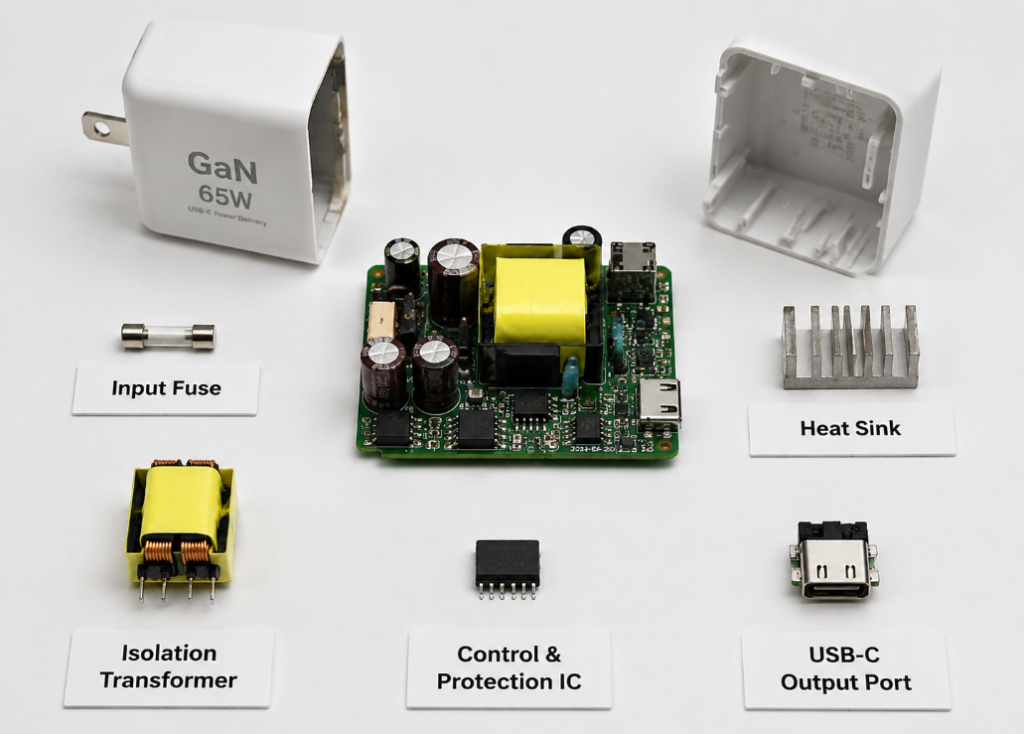
The first type is input protection components, which specifically deal with problems such as grid fluctuations, impact during plugging and unplugging, and rear-end short circuits. They either absorb surges or directly cut off the fault to prevent danger from spreading further.
The second type is isolation protection components, which are the first line of defense against electric shock. They are responsible for completely separating the high-voltage side from the low-voltage side, mainly relying on isolation transformers, insulating tape, insulating baffles, and sufficient spatial distance between high and low voltages.
The third type is control and protection components, which are equivalent to the brain of the entire charger. They are responsible for monitoring the output voltage, current, and internal temperature. Once they exceed the safety value, they trigger protections such as over-temperature, over-voltage, over-current, short circuit, and over-power to ensure stable output.
The fourth type is housing structural components, which are the outer plastic shell and prongs. On the one hand, they prevent people from touching the internal live parts; on the other hand, they also play roles in flame retardancy, impact resistance, fixing the prongs, and assisting heat dissipation.
Isolated, Non-Isolated, and Electric Shock Protection Levels
You may have heard the term “isolated charger”. Let’s make it clear here: the wall-plug phone and laptop chargers we use daily should normally adopt an isolated AC-DC design.
The so-called isolated type means that the high-voltage side and the low-voltage output side are not directly connected, but transfer energy through the magnetic field of the transformer, and the insulation strength and safety distance in between must meet standard requirements. Even if one internal component fails, it is not easy for high-voltage electricity to reach the output end.
But note the boundary: a qualified isolation design only reduces the risk of electric shock under normal use and specified single-fault conditions. It does not mean it is absolutely safe after being cracked by falling, getting water in, being disassembled privately, or if you buy a fake product.
What about non-isolated ones? The high and low voltages of this type of power supply are not completely separated. They must never be used in civilian wall-plug chargers where users can directly touch the output end. They are generally only used inside enclosed equipment or in special low-power scenarios.
Ordinary users don’t need to take it apart to see if it has an isolated structure — taking it apart is itself dangerous. You just need to check if it is a regular brand, if it has the safety certification for the corresponding region, if the markings are complete, and if the housing is damaged, which is enough to judge.
Main Risks Come from 5 Types of Scenarios
Charger safety problems basically fall into these five types of scenarios:
The first type is electric shock risk: for example, insufficient insulation, cracked housing, water ingress, loose prongs, or failure of internal high-low voltage isolation, causing high-voltage electricity to reach the housing, interface, or prongs, and people will get an electric shock when touching it.
The second type is overheating and fire risk: for example, long-term full-load operation, poor heat dissipation design, exaggerated component ratings, non-flame-retardant housing, or poor contact of outlets or cables, causing the temperature to rise higher and higher, eventually igniting plastic or surrounding items.
The third type is device damage risk: for example, output overvoltage, abnormal ripple, wrong protocol identification, or voltage drop and heating caused by inferior cables, which damage phones, laptops, or batteries during charging.
The fourth type is internal short circuit risk: for example, internal component breakdown, poor soldering, metal foreign objects entering the interface, or internal structure displacement after falling, causing high and low voltages or positive and negative poles to touch each other.
The fifth type is mechanical failure risk: for example, prongs breaking off in the outlet, loose interfaces, cracked housing, or worn markings leading to wrong parameter usage — these mechanical problems can also cause safety hazards.
3.Major Safety Design Dimensions Users Can Perceive and Check
Without taking it apart, you can judge whether a charger’s safety design is roughly reliable through its appearance, markings, and usage experience, mainly looking at six dimensions.
Electric Shock Prevention Design: The Most Basic Personal Safety
The core of electric shock prevention is to prevent users from coming into contact with dangerous voltages, especially when electrical energy from the high-voltage side is transmitted to the housing, prongs, or output interface.
Its key designs include: first, double insulation or reinforced insulation, which in plain terms is “two layers of protection” — even if one layer fails, there is a second layer to block it, reducing the risk of electric shock; second, safety isolation, that is, the high and low voltage sides are separated, and energy is transferred through the transformer; third, withstand voltage design, where before leaving the factory, the insulation is tested with a voltage much higher than normal to prove that the insulation is not easily broken down; fourth, output end electric shock prevention structure, for example, the design of the USB interface, under normal circumstances, even if you put your finger in, you can’t touch the dangerous live parts; fifth, prong fixing design, the prongs must not be loose or rotating, must not break off in the outlet, and must not expose live parts.
It’s easy for users to judge: the housing has no cracks, the prongs don’t wobble, there is no large area of exposed abnormal metal in the interface, and there is no continuous tingling sensation during use. Here we need to distinguish: occasional static sensation in a dry environment (for example, a slight tingle when touching it after taking off a sweater in winter) is normal, not electric leakage; but if there is a continuous tingling sensation, which is more obvious in a humid environment, and is accompanied by heat or abnormal noise, you must stop using it immediately.
Overheating/Fire Prevention Design: The Most Watched Safety Point
This is the part everyone cares about most. Its core function is to prevent components from getting too hot, the housing from softening, plastic from burning continuously, or igniting surrounding items.
There are five key designs: first, over-temperature protection (OTP), with an internal temperature sensor. When the temperature exceeds the threshold, it will automatically reduce power, suspend output, or shut down directly; second, over-power protection (OPP), if the load exceeds the rated power, or there is abnormal overload, it limits the output to avoid long-term overloaded operation; third, short circuit protection (SCP), when the output end is short-circuited (for example, the cable is damaged and the positive and negative poles touch each other), it quickly limits current or cuts off power to avoid burning out; fourth, flame-retardant materials, both the housing and internal insulating materials must meet corresponding flame-retardant standards, such as the commonly heard V-0 grade, which means it will quickly extinguish after leaving the fire and will not burn continuously, but note that you can’t just look at the merchant’s promotion, it must be based on certification; fifth, heat dissipation path design, how internal heating components conduct heat out, whether there is thermal conductive material, whether the housing area is sufficient, and whether the internal layout is reasonable, all directly affect the temperature rise.
Here’s a temperature reference for you: at 25°C room temperature, good ventilation, and normal full load, the housing temperature of most qualified chargers is between 40-60°C; small-sized high-power GaN products may have a slightly higher temperature due to their small heat dissipation area.
What is a danger signal? If it’s so hot that you can’t hold it continuously with your hand, the temperature is still rising, the housing is deformed, there is a burning smell, smoke, sparks, or the charger or outlet is locally blackened, there must be a problem — stop using it immediately. A special reminder here: don’t cover the charger under a quilt, pillow, or clothes to do a “heat resistance test” — this is deliberately destroying the heat dissipation conditions, and even qualified products will overheat. It is purely a dangerous operation.
Design to Prevent Damage to Devices and Batteries
The core function of this type of design is to avoid abnormal output, so that phones, tablets, laptops, or battery management systems are not subjected to voltage and current they shouldn’t bear.
Key designs include: first, voltage and current stabilization, the output voltage and current must be stable, not fluctuating up and down; second, over-voltage protection (OVP), if the output voltage rises abnormally, it will immediately shut down or limit it to avoid burning the device; third, over-current protection (OCP), when the output current exceeds the safe range, it limits current or cuts off power; fourth, under-voltage/abnormal recovery logic, when the voltage drops abnormally or restarts repeatedly, it will not cause the device to frequently stop charging and lead to abnormal heating; fifth, protocol identification, such as USB PD, PPS, QC, VOOC and other fast charging protocols, the charger and device negotiate first, and only output higher power after both parties agree, it will not force electricity into the device.
There are two boundaries to clarify here: one is the cable boundary, high-power USB-C charging (such as 100W, 140W) must be used with qualified cables, usually cables that support the corresponding current and have an E-marker chip, otherwise even if the charger supports it, it will not reach the rated power, and may also increase heating; the other is the device boundary, the battery management system (BMS) and charging management chip inside the phone or laptop are the second line of protection. A safe charger does not mean the battery is definitely healthy, and battery aging itself can also cause problems.
For users to judge, just check if the device is abnormally hot, if it frequently stops charging, if it pops up an incompatibility prompt, if the battery is swollen, and if the charging port is blackened.
Abnormal Operating Condition Protection Design
The function of this type of design is to prevent small faults from quickly developing into electric shock, fire, or device damage when encountering abnormal scenarios.
Common abnormal protections include: input over-voltage/under-voltage protection, when the grid voltage is suddenly too high or too low, it stops working to avoid instability of the internal control circuit; surge protection, which deals with lightning induction, plugging/unplugging moments, and grid spikes, but it should be noted that it cannot resist all strong lightning strikes — the kind of strong lightning that directly hits the power line can’t be withstood by ordinary chargers at all; short circuit protection, when metal foreign objects enter the interface or the cable is damaged and short-circuited, it quickly limits current or cuts off power; no-load low power consumption, when plugged into the wall without connecting a device, it maintains low power consumption and low temperature rise, and will not heat up for no reason; electrostatic discharge protection (ESD), which reduces the probability of damaging internal circuits when human static electricity touches the interface.
Different products have different abnormal recovery strategies: some will automatically recover after the fault is resolved, some need to be unplugged and plugged back in to reset. But if the charger restarts repeatedly and is accompanied by heat, that is a bad sign, not normal protection. Here we want to remind users: never use metal objects to short-circuit the interface to test the protection, and never take it apart to measure when it’s powered on — it’s very dangerous.
Mechanical Structure Safety Design
The safety of the mechanical structure is to prevent internal insulation failure or poor contact heating after daily plugging and unplugging, falling, squeezing, or interface wear.
Key designs include: prong bending resistance, the prongs must be firm, not easily loose or rotating, let alone break off in the outlet; housing impact resistance, after falling from a normal height (such as desktop height), it will not crack and expose the internal circuit — of course, this is under standard test conditions, not that it’s fine if it falls from the second floor; interface plugging resistance, the USB port must be fixed firmly, and will not become loose, skewed, or have poor contact after long-term plugging and unplugging; creepage distance/electrical clearance, in plain terms, there is sufficient safety distance between the high-voltage area and the low-voltage area, even if the air is humid or dusty, there will be no sparking or breakdown; internal fixing design, for example, using glue, potting, or buckles to fix components, to prevent components from shaking, solder joints from breaking, and thermal conductive materials from shifting and failing.
It’s also easy for users to judge: pick it up and shake it, there’s no abnormal noise inside; the prongs and interface are not loose; the housing is not deformed, and there are no cracks, curled edges, or burn marks.
Marking, Certification, and Traceability Design
Markings and certifications are not decorations. They are the core basis for users to know where the product can be used, how much power it outputs, who manufactures it, and whether it meets local basic requirements.
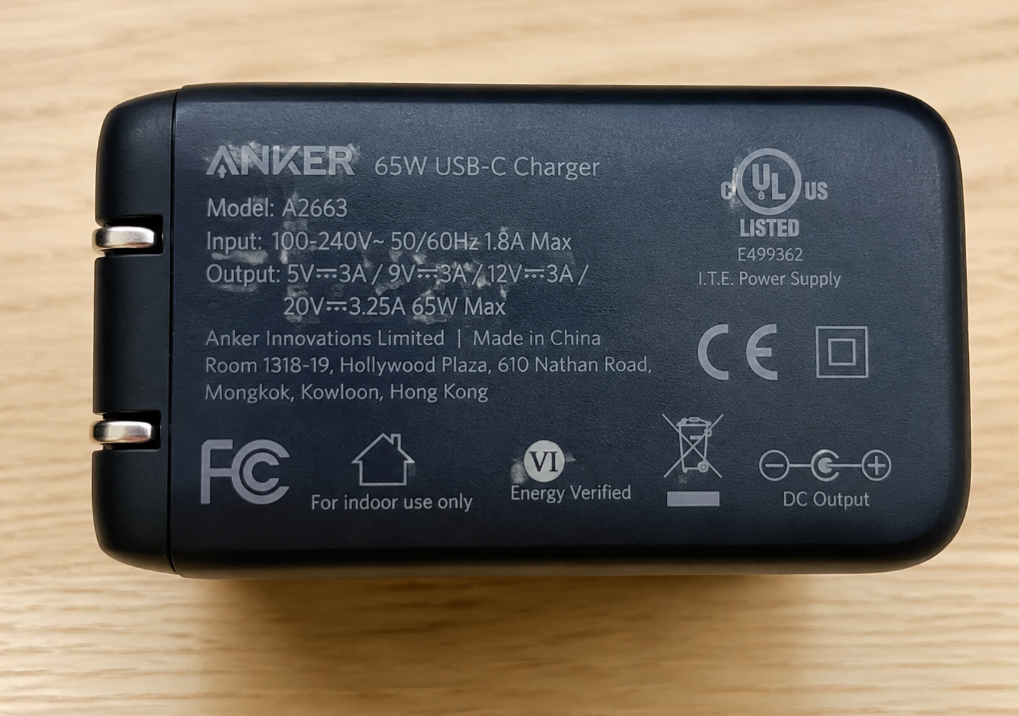
Must-check information includes: input voltage range (such as 100-240V~), output voltage/current/power (such as 5V⎓3A, 9V⎓3A, 20V⎓5A), total power, model, manufacturer or brand, and certification marks. More reliable products will also have traceability information, such as serial number, batch number, certification number, importer or responsible party information.
You should also recognize common safety symbols: the “double square mark” for Class II double insulation (two squares nested together), the house-shaped mark for indoor use only, the DC output symbol ⎓, and the AC input symbol ~.
The quality of the markings is also important: the printing must be clear and wear-resistant, and won’t come off easily when rubbed by hand; and the markings on the actual product must be consistent with the parameters on the packaging and product page. If the actual product is marked 65W but the page says 100W, there must be a problem.
A most basic judgment standard: products without model, manufacturer, input/output parameters, or certification marks, just pass — they are most likely “three-no” products.
4. Safety Key Points for Special Products and Scenarios
The safety logic of ordinary chargers is universal, but there are additional points to note for special situations such as fast charging, multi-port, GaN, and cross-border travel.
Fast Charger Safety Design
Many people think fast charging damages batteries, but in fact, fast charging is not “forcing electricity in” at all. Instead, the charger, device, and cable negotiate through protocols, and output voltage and current that both parties agree on — it’s “mutually consensual”. Common fast charging protocols include USB PD, PPS, QC, VOOC/SuperVOOC, etc. When different protocols are incompatible, it usually falls back to 5V normal charging, and won’t force it.
The safety challenge of fast charging is: high power and small size make temperature rise more obvious, so the accuracy of protocol identification and the quality of heat dissipation design are even more critical. Especially in high-power USB-C scenarios, such as 100W charging, a 5A E-marker cable is usually required. Without a qualified cable, even if the charger supports it, it will not reach the rated power, and may also increase heating.
For users to judge: slight warmth during fast charging is normal; if it’s too hot to hold, frequently stops charging, the cable end is blackened, or the device prompts incompatibility, you should check the charger, cable, and device one by one to find the root cause of the problem.
Multi-Port Charger Safety Design
Multi-port chargers are convenient for charging multiple devices at the same time, but many people have a misunderstanding: they think each port can reach the single-port maximum power at the same time. In fact, the total power is the upper limit. When multiple ports are used at the same time, power is redistributed, and it’s impossible for each port to run at the single-port maximum.
For example, a multi-port charger rated at 65W delivers 65W when only the C port is plugged in, but when the C port and A port are used at the same time, it may become 45W + 18W, with the total power not exceeding 65W. A common risk of this type of product is: when multiple devices are fully loaded at the same time, the temperature rise will be higher than when using a single port; when some products redistribute power, it will cause the device to briefly stop charging and then resume, which is normal, but if it stops charging frequently, that’s not right.
When buying a multi-port charger, you must distinguish between “single-port maximum power”, “dual-port combined power”, and “total rated power”, don’t just look at the biggest number on the promotional page. When using, it’s normal for the temperature to be higher when charging with multiple ports than with a single port, but if the housing, power strip, or a certain interface is locally scalding hot, you should reduce the load or stop using it.
Safety Perception of GaN (Gallium Nitride) Chargers
GaN chargers have been very popular in recent years, and many people think GaN is synonymous with “safer”, but that’s not the case at all. GaN is a material technology for power devices. Its advantages are high efficiency and fast switching speed, so chargers can be made smaller and lighter, but it does not automatically equal safer.
On the contrary, because GaN chargers usually have small size and high power, the requirements for thermal design, insulation layout, control chip protection, and material quality are actually higher. Qualified GaN chargers are of course safe and reliable, but inferior GaN products, which cut corners to stack power, reduce heat dissipation, and forge certifications, actually have higher risks than ordinary chargers.
To judge whether a GaN charger is safe, you still need to look at certification, brand, parameter authenticity, full-load temperature rise, and interface workmanship. Don’t just see the three letters “GaN” and think it’s high-end.
Safety Requirements for Cross-Border Travel Chargers
Overseas users often travel across borders, so this part is particularly practical. First is wide voltage input: prioritize products marked 100-240V~ 50/60Hz, which can adapt to the power grids of most countries and regions, such as 120V in the US, 230V in the EU, and 100V in Japan.
Then is plug adaptation: a travel adapter only changes the shape of the prongs, not the voltage. If your charger only supports 120V, even if you plug it into a 230V outlet with an adapter, it will burn out directly — many people get this wrong.
Also pay attention to reliable contact: try not to stack multiple adapters. The more layers, the greater the contact resistance, and the easier it is for the plug and power strip to heat up.
Certification matching is also very important: it’s best to choose products that meet the requirements of the destination market. For example, choose ones with UL/ETL for North America, CE for the EU (preferably with a trusted brand, because CE is easy to counterfeit), UKCA for the UK, and PSE for Japan.
In addition, when traveling, you often encounter hotel bedside outlets, old outlets, and loose wall outlets. These places are more prone to poor contact. If you find the outlet is loose or hot, be sure to change to a different location to use it.
5. How to Read Certifications and Parameters: A User Safety Checklist
Certifications and parameters are the most direct basis for ordinary users to judge charger safety, but many people either can’t understand them or are fooled by fake certifications.
The Role and Limitations of Safety Certifications
First, it must be clear: safety certification means that the product sample meets local basic safety requirements under specific standards and test conditions. It is one of the bottom lines of safety, not the upper limit.
Its limitations are also obvious: it cannot prove whether the one in your hand is real or fake, cannot guarantee that all batches of products are completely consistent, and cannot cover risks after water ingress, private disassembly, aging, or incorrect use.
So the judgment principle is: products with certification for the corresponding use region, credible brand, formal channels, and reasonable parameters are much more reliable than uncertified unbranded products, but they are not absolutely safe, and must be judged in combination with the usage scenario.
Common Global Certifications and Compliance Marks
Certification systems vary from country to region. The table below lists the most common ones for your reference:
| Certification/Mark | Applicable Region | Nature | Notes |
|---|---|---|---|
| UL/ETL | North America (United States, Canada) | Third-party safety certification/test mark, part of the NRTL (Nationally Recognized Testing Laboratory) system | Relatively strict. Certificates or listing information can be checked on the official website, and the model must match |
| CE | European Union | Market compliance mark, usually a manufacturer’s self-declaration | Not equivalent to third-party safety certification, easy to counterfeit. Need to judge combined with brand credibility |
| TÜV/GS | Europe | Third-party test/safety mark | More reference value than CE alone. The specific meaning depends on the scope covered by the certificate |
| UKCA | United Kingdom | Market compliance mark | Gradually replaces CE after Brexit, and is the access requirement for the UK market |
| CCC | China | Mandatory product certification | Mandatory requirement for sales in the Chinese market, with a unified query channel |
| PSE | Japan | Electrical appliance safety mark | Divided into circular (non-specified electrical appliances) and diamond (specified electrical appliances), different for different product categories |
| KC | South Korea | National certification system | Safety and electromagnetic compatibility requirements for the South Korean market |
| RCM/SAA | Australia, New Zealand | Compliance/safety mark | RCM is the unified compliance mark, SAA is a common safety certification mark |
Note: certifications are not globally universal. When buying cross-border, you must check the requirements of your actual place of use. For example, if you use it in North America, CE is useless — you need to check if there is a North American-recognized safety certification like UL/ETL.
Easily Confused Non-Full Safety Certifications
Many merchants promote these marks as safety certifications, but in fact they have no direct relationship with electrical safety. Don’t be fooled by the “multiple certifications” rhetoric:
- FCC: U.S. Federal Communications Commission certification, mainly focusing on electromagnetic compatibility/radio frequency interference, that is, preventing it from interfering with other devices. It does not mean that electrical safety is qualified.
- RoHS/REACH: Regulations restricting hazardous substances, such as limiting the content of lead, mercury and other harmful substances. They do not mean that electric shock and fire prevention are qualified.
- DoE/ErP/VI Energy Efficiency Grade: Energy efficiency or standby power consumption requirements, which mean the product is power-saving, and have no direct relationship with safety.
- QC 3.0/PD 100W: Fast charging capability or protocol promotion, not a safety certification.
Identifying Fake Certifications and Invalid Promotions
Fake certifications are very common on cross-border platforms. Remember a few characteristics to avoid most of them: blurry marks, spelling errors (such as writing UL as VL), icon proportions that do not match the official marks, no corresponding model, or the webpage promotes certification but the actual product doesn’t have it printed at all.
There are also common word traps: “meets XX standard” is not equal to “passed XX certification” — meeting the standard may be what the manufacturer says itself, without third-party testing; “laboratory tested” is also not equal to obtaining certification for the place of sale — it may just be that the manufacturer found a laboratory to test a certain item, without going through the formal certification process.
If you’re not sure, you can use the brand, model, and certificate number to check on the official website of the certification body. The model must be completely consistent with the actual product, otherwise it is invalid. There is also a simple judgment method: products with high power, small size, claimed to have complete certifications, but priced far below market common sense, are most likely to have fake certifications. For example, a 100W GaN charger sold for 5 dollars can’t even cover the cost — how could it have real certification?
How to Read Parameters Effectively
Looking at parameters is not just about “how many watts”, it must be combined with your own needs and usage scenarios:
First look at the input: whether it covers the grid voltage of your region. For example, the US is about 120V, the EU and UK are mostly 230V, Japan is about 100V. If the charger is only marked 100-120V, it cannot be used in Europe.
Then look at the output: check whether the voltage, current, and power support your device’s needs. For example, USB-C thin and light laptops commonly need 45W or 65W, high-performance laptops may need 100W or higher. You need to confirm that the charger has the corresponding output gear.
If it is a multi-port charger, you must look at the combined output table, not just the advertised maximum power, otherwise you won’t reach the expected level when charging with multiple ports at the same time.
There is also protocol: the device, charger, and cable all support the same fast charging protocol to achieve the corresponding fast charging power. For example, if your phone only supports QC3.0 and the charger only supports PD, then at most it can only do normal charging.
Take two examples: 20V⎓3.25A means a maximum of 65W (20×3.25); 20V⎓5A means a maximum of 100W, but this gear usually requires a 5A E-marker cable to achieve.
6. Practical Guide for Ordinary Users: Purchase, First Use, and Abnormal Handling
After talking so much, let’s finally get to practical operation. Ordinary users don’t need to understand circuits. Just follow the methods below to avoid the vast majority of risks.
1-Minute Quick Judgment When Purchasing
Don’t hesitate too long when buying, just look at these five points:
First, check markings: input and output parameters, model, manufacturer, certification marks — these must be complete. Be cautious if any is missing.
Second, check certification: whether there is a safety or compliance mark recognized by your region of use, and whether the corresponding model can be found.
Third, check workmanship: the housing has no burrs, the prongs don’t wobble, the interface is not skewed, pick it up and shake it — there’s no abnormal noise inside. Abnormal noise means the internal parts are not fixed properly.
Fourth, check price: products with advertised high power but abnormally low prices are most likely to have cut corners on power, materials, or certification. Don’t be penny-wise and pound-foolish.
Fifth, check channel: prioritize regular brands, official stores, and trusted retailers, such as Amazon self-operated and brand official websites. Be cautious when buying unbranded products and “original” products of unknown origin — especially “original” products with extremely low prices, which are basically fake.
30-Minute Observation Method for First Use
When you get a new charger, don’t rush to use it long-term. Observe it for half an hour before you can rest assured:
In the first 5 minutes after plugging in, pay attention to whether there is a burning smell, obvious abnormal noise (such as a buzzing or sizzling sound), sparks, or whether the device frequently stops charging. If there is a problem, unplug it immediately.
Then do a full-load observation: charge a device that supports higher power for about 30 minutes. For example, use a 65W charger to charge a laptop. It’s normal for the charger to be slightly warm. It shouldn’t be so hot that you have to let go immediately — that is, if you can’t hold your hand on it for more than a few seconds, it’s abnormal.
Also check stability: after ruling out problems with the cable and device, the charger should not frequently stop charging or restart, and the device should not pop up an incompatibility prompt.
About odor: a new plastic charger has a slight plastic smell, which will dissipate after a few uses, which is normal; but if it’s a pungent burning smell or burnt plastic smell, it’s absolutely abnormal.
Here we emphasize again the prohibited operations: do not disassemble the charger, do not short-circuit the interface with metal, do not cover the heat dissipation, and do not test in a humid environment.
Daily Usage Checkpoints
Pay attention to these points during daily use, which can reduce many risks:
Placement: keep it ventilated. Don’t cover it under quilts, pillows, or clothes. Don’t put it in a sun-exposed car or a closed high-temperature space.
Environment: try to avoid using it in bathrooms, kitchens with heavy oil fumes, or humid and dusty environments; if you don’t use it for a long time during thunderstorms, it is recommended to unplug it.
Cables: use cables of corresponding specifications for high-power charging. For example, use a 5A E-marker cable for 100W PD charging. Don’t use cheap inferior cables that cost a few dollars.
Outlets and power strips: old and loose outlets and inferior power strips may themselves heat up. Don’t just touch the charger — also touch the plug, cable end, and power strip to see if they are hot. Sometimes the source of heat is the outlet, not the charger.
Regular inspection: check every once in a while whether the interface is blackened, the prongs are loose, the cable is hardened or cracked, and the housing is deformed or yellowed. Replace it in time if there is a problem.
Abnormal Situation Handling Order
Don’t panic when you encounter a problem, follow this order:
Step 1, prioritize unplugging the power from the wall outlet side, don’t just unplug the device end. Cut off the power first to ensure personal safety.
Step 2, after the charger cools down, check its appearance: whether there are cracks, deformation, burning smell, whether the prongs are loose, and whether the interface is blackened.
Step 3, single-variable troubleshooting: replace the cable, outlet, and device respectively to determine whether the heat source comes from the charger, cable, device, or power strip. For example, if it stops being hot after changing the cable, then it’s the cable’s problem, not the charger’s.
Step 4, if there is smoke, sparks, burning smell, water ingress, abnormality after being cracked by falling, continuous tingling sensation, or repeated charging stops with heating, stop using it and replace it directly. Don’t think about repairing it, and don’t make do with it — it’s not worth the risk.
Must-Remember Safety Red Lines
These are the bottom lines that must never be crossed:
- Do not use “three-no” chargers with no brand, no model, no input/output parameters, and no certification.
- Do not use products whose housing deforms when pinched, with loose prongs, or skewed interfaces.
- Immediately stop using products with burning smell, smoke, sparks, deformed housing, or blackened interfaces.
- Do not continue to use after water ingress, cracking from falling, private disassembly, or loose prongs.
- If there is a continuous tingling sensation during use, especially more obvious in a humid environment, stop using it immediately and check the outlet and device.
7. Common Misconceptions and Safety Boundaries
Finally, let’s clarify several high-frequency misconceptions, and also explain the inherent limitations of charger safety. Don’t have unrealistic expectations of it.
Clarification of High-Frequency Misconceptions
The first misconception: chargers will explode if left plugged in unused. Qualified products have very low no-load power consumption and usually do not overheat, so it’s fine to leave them plugged in normally; but inferior or aging products still have risks. If not used for a long time, it is recommended to unplug them, which is both safe and power-saving.
The second misconception: charging small devices with high power will damage them. Qualified chargers will output according to the protocol and device needs, giving as much as the small device needs, and will not force the maximum power in — just like filling a small cup with your home faucet, it won’t break the cup, because you control the water flow.
The third misconception: original is always safe. Genuine original products are usually reliable, but fake originals have higher risks than regular third-party products; qualified third-party products from regular brands have the same guaranteed safety.
The fourth misconception: wireless charging is always safer. Wireless charging also has issues with foreign object detection and coil temperature rise. Inferior wireless chargers may also overheat, so you can’t say wireless ones are safer.
The fifth misconception: heat means it’s broken. Slight warmth during fast charging is normal, after all, the power is high; only when it’s too hot to hold, the temperature keeps rising, or there is a burning smell or deformation, is it a danger signal.
The sixth misconception: the more certification marks, the better. The key is to have certification that corresponds to the region of use, is verifiable, and matches the model; products covered with unfamiliar marks may instead be marketing gimmicks or fake labels.
Inherent Limitations of Charger Safety Design
Charger safety design is not omnipotent; it has its scope of application:
First, service life is not a fixed number. High temperature, humidity, frequent full load, and frequent plugging and unplugging will all accelerate aging, so the service life will be shorter. Experience suggests: for chargers that have been used under high load for several years, pay more attention to temperature rise, abnormal noise, loose interfaces, and housing aging. If abnormalities occur, replace them in advance, don’t wait until they break.
Second, standards are conditional. Most civilian chargers are designed for dry, normal temperature, normal altitude, and well-ventilated environments. In high-temperature, humid, high-altitude, and dusty environments, the risk will be higher.
Third, accessories affect safety. Inferior cables, loose outlets, and overloaded power strips — even if the charger is qualified — will put the entire charging system in danger.
Fourth, human damage will destroy protection. Cracking from falling, water ingress, and private disassembly will all make the original insulation and flame-retardant design ineffective, and even the safest product will be useless.
Problems That Can’t Be Solved by the Charger Alone
Don’t blame the charger for everything. It can’t handle these problems:
For example, battery health: battery aging, swelling, and internal short circuits will all cause the device to heat up. Even if the charger is qualified, it cannot guarantee the battery is absolutely safe — batteries have a service life.
There is also outlet/power strip quality: loose contact, overload, and copper sheet oxidation will all cause local heating. The hot spot may be on the wall outlet or power strip, not the charger’s problem.
There is also cable quality: too thin wire core, oxidized interface, and lack of E-marker chip may all cause abnormal heating during high-power charging, or even fail to reach the rated power.
There are also extreme situations: strong lightning strikes, severe water ingress, fire environments, and use with wrong voltage — these all exceed the protection range of ordinary chargers, and you can’t expect it to withstand them.
Summary
After learning all this, you don’t need to take it apart or understand circuits to make a basic judgment on the safety of a charger:
You can distinguish that “factory safety design” and “user usage safety” are two different things; you can understand the 6 core safety designs: electric shock prevention, overheating prevention, device damage prevention, abnormal protection, mechanical structure, and marking traceability; you can understand basic concepts such as over-temperature, over-voltage, over-current, short circuit, over-power, isolation, and creepage distance; you can initially judge whether a charger is reliable through markings, certifications, parameters, workmanship, and first-use observation; you can understand the meaning and limitations of common marks such as UL/ETL, CE, UKCA, CCC, PSE, KC, and RCM; you can avoid common pitfalls such as weight superstition, original superstition, power superstition, certification stacking, and GaN superstition; you can make safer choices in scenarios such as fast charging, multi-port, GaN, cross-border travel, high temperature, and old outlets; when encountering burning smell, sparks, smoke, deformation, water ingress, cracking from falling, or continuous tingling sensation, you know to stop using it immediately instead of continuing to use it with a fluke mentality.
At the end of the day, charger safety is not some profound knowledge. When it comes to charging, speed is secondary — safety is the first priority. Spend a few more minutes looking at the markings and certifications, don’t be greedy for a few dollars’ cheapness, and you can keep the vast majority of risks out.