
If you’ve ever grabbed a random extension cord to plug in a space heater, string up holiday lights, or power a tool outside, you’ve probably only checked one thing: does the plug fit? Most of us don’t think about the cord’s amp rating until the wire gets too hot to touch, or the plug starts smelling like burnt plastic. The truth is, rated current is one of the most basic (and most overlooked) parts of home electrical safety — understanding it can help you avoid the vast majority of extension cord overloads, overheating, and even fire risks.
This guide is designed for regular household power cords, extension cords, power strips, low-voltage device cables, and entry-level DIY wiring decisions. For fixed in-wall wiring, electrical panel upgrades, EV charging, solar/storage systems, or high-power industrial equipment, always follow local electrical codes and consult a licensed electrician. Do not rely solely on this guide for those applications.
Why Rated Current Matters (And Why Overload Is Riskier Than You Think)
Why Excess Current Causes Damage
When current flows through a conductor, resistance generates heat — and heat is proportional to the square of the current. That means doubling the current produces 4x more heat. Even a small amount of overload can cause a much bigger temperature rise than you’d expect.
Overload damage isn’t always immediate. Mild, long-term overload may not cause visible problems at first, but it slowly softens, brittles, and cracks the wire’s insulation. Over months or years, this leads to leakage, short circuits, electric shock, or even fires. This hidden aging risk is especially dangerous because you’ll never connect the eventual failure to a minor overload from months prior.
Local hot spots are even more dangerous. If a plug is loose, a terminal is oxidized, or a contact surface is low quality, resistance at that point spikes. The local temperature can far exceed the temperature of the wire itself — even if the total current is within the rated limit — and burn through connectors or ignite nearby materials.
Common Everyday Risk Scenarios
Risk patterns vary by region, based on local voltage and common household habits:
- North American 120V systems: For the same wattage, current is roughly double what it is in 230V systems. A 1500W space heater draws 12.5A at 120V, which is very close to the 15A limit of most basic extension cords. Thin cords powering space heaters, toaster ovens, and hair dryers are extremely common sources of overheating.
- Holiday and outdoor light strings: This is a universal problem. People daisy-chain too many strands or power them with thin, low-rated extension cords, leading to overheated wire cores and burnt plugs over time.
- USB-C fast charging cables: These are often overlooked. Thin conductors or cheap connectors can overheat during high-power charging, causing slow charging, voltage drop, or even device damage in severe cases.
- Hidden in-wall wiring: This is the highest-risk category, because you can’t see the heat buildup. Long-term overload slowly degrades insulation until a fire starts — by the time you notice, it’s often too late.
Regional Electrical Notes
Different regions have different voltage and plug standards, so your approach to checking ratings should adjust accordingly:
- North America (120V): Pay extra close attention to extension cord, power strip, and plug amp ratings. Higher current for the same power means insufficient margin is far more likely to cause problems.
- EU/Australia (230V): Current is lower for the same wattage, but that doesn’t mean you can skip checks. Always verify cord, plug, and power strip ratings — “higher voltage” does not equal “no risk.”
- A universal myth: if the plug fits, it’s safe. Travel adapters and universal plugs only match the physical shape of the socket. Their current rating and heat dissipation may be nowhere near enough for high-power devices, and they can burn out in minutes. Even if a plug from another region勉强 fits, it doesn’t mean the current ratings match.
- 50Hz vs 60Hz frequency difference has almost no effect on ampacity for short household cords, and can be ignored for this purpose. Devices themselves still need to match local voltage and frequency, however — don’t mix that up.
Why Breakers Aren’t Enough
Many people think, “I have a breaker, so if it overloads it’ll just trip — no big deal.” This is a dangerous misconception. Breakers are a last line of defense, not a catch-all safety net:
- First, breakers have a time delay. They don’t trip instantly the second current exceeds the rating. The wire may already be hot enough to soften insulation before the breaker activates.
- Second, wall breakers are sized to protect the fixed in-wall wiring, not the thin extension cord, cheap power strip, or adapter you plugged in downstream. The downstream accessory can catch fire before the current reaches the breaker’s trip threshold.
- Most importantly, local overheating from bad contacts may not increase current enough to trip the breaker at all — but the local temperature can still get high enough to ignite surrounding materials.
The correct rule: protection devices, wire size, plugs/outlets, and load type must all match as a complete system. You can’t rely on the breaker to cover for mismatched or undersized components.
How Are Rated Current Values Determined?
Core Logic: Balance of Heat Generation and Dissipation
Rated current sounds technical, but the core idea is extremely simple: it’s the point where heat generation and heat dissipation reach a stable balance.
When current flows through the wire, resistance in the conductor generates heat, just like the heating element in a space heater. That heat travels outward through the insulation and jacket, then dissipates into the surrounding air, wall, conduit, or other material. When the amount of heat produced equals the amount of heat escaping, the wire’s temperature stabilizes.
Rated current is, essentially, the maximum current that keeps the wire’s temperature below the safe limit for the conductor, insulation, and connector parts — under defined test conditions. This is why the same wire has a different safe current if it’s run in open air, pulled through conduit, buried in a wall, or coiled up: the cooling changes, so the stable temperature changes too.
5 Key Factors That Determine Rating
A wire’s rated current depends on five main variables:
- Conductor cross-sectional area: Thicker wire has lower resistance, produces less heat at the same current, and can carry more amps.
- Conductor material: Copper conducts electricity far better than aluminum. A copper wire of the same size has lower resistance and can carry more current than an aluminum wire. Aluminum wire requires a larger gauge for the same load, plus anti-oxidation treatment, compatible terminals, and correct tightening torque — never connect aluminum wire to copper-only terminals.
- Insulation temperature rating: Common ratings include 60°C, 75°C, 90°C, and 105°C — this is the maximum long-term temperature the insulation material can withstand. In practice, you can’t just use the wire’s insulation rating: you have to take the lowest temperature rating from the wire, plug, terminals, and device port as your actual limit.
- Cooling conditions: Open installation with good ventilation cools fast and allows higher current. Conduit, buried walls, bundled wires, cords under rugs, and coiled cords trap heat and reduce allowable current.
- Standards and safety margin: Different countries, product types, and certification bodies use different test methods and safety buffers. You can’t apply one generic gauge-to-amp ratio to every type of wire.
Why Same-Gauge Wires Have Different Ratings
You may have wondered: if two wires are both 14AWG copper, why does one say 15A and the other 20A? The answer is that many factors beyond gauge affect the rating:
- Product type: Solid in-wall wiring, appliance power cords, outdoor rubber extension cords, and high-temperature specialty wire all follow completely different standards, so their ratings differ.
- Insulation and jacket: The type of insulation material, temperature rating, thickness, and the jacket’s water/oil/abrasion resistance all affect allowed temperature rise and use cases, which show up in the final current rating.
- Termination method: Whether plugs and terminals are crimped or screwed on, and the quality of the contact, can limit the actual safe current. Often, an extension cord’s total rating is limited by the plug, not the wire itself.
- Labeling scope: Some ratings apply only to the bare wire itself, while others apply to the fully assembled product (including plugs and outlets). Different standards mean different numbers.
The key takeaway: always prioritize the product’s own label, manual, and certified specs. Gauge reference charts are only a rough aid, not a definitive answer.
Factors That Change Real-World Ampacity
The labeled rated current is only a reference for ideal lab conditions. In real use, safe current capacity depends on many factors.
Wire Properties: The Baseline
The wire’s own specs set the starting point. Keep these points in mind:
- Gauge/cross-sectional area: North America uses AWG (smaller number = thicker wire), EU/Australia uses mm² (larger number = thicker wire). This is the foundation of ampacity, but not the only factor.
- Thick jacket ≠ thick conductor: Many cheap cables use a thick plastic jacket to look heavy-duty, but have tiny copper conductors inside. Always check the printed AWG, mm², or current rating on the wire — don’t judge by feel.
- Copper vs aluminum: Household wiring and cords are almost always copper. Aluminum is mostly used for fixed industrial or utility wiring. If you encounter aluminum wire, never connect it directly to copper-only terminals.
- Solid vs stranded wire: Same material and gauge have nearly identical conductor resistance, but allowable current still depends on insulation, jacket, termination method, and installation standards. Don’t assume they have identical ampacity.
- Insulation temperature rating: Repeat: the actual safe temperature limit is the lowest rating across the wire insulation, plug, terminals, and device port — not just the number printed on the wire.
- Aging and damage: If the cord has cracked insulation, a sticky or melted jacket, oxidized conductors, or discolored/deformed plugs, its safety performance is drastically reduced. Replace severely damaged cords immediately — don’t try to make do.
Higher Ambient Temperature = Lower Safe Current
Ambient temperature is one of the biggest factors affecting cooling. Most ampacity tables use a baseline of ~30°C (86°F), but always check the specific standard or product documentation.
The hotter the surrounding air, the smaller the temperature difference between the wire and its environment, and the worse the cooling. As a rough rule of thumb for entry-level estimates: for every 10°C (18°F) rise in ambient temperature, reduce available current by 10–15%. This is only for quick back-of-the-envelope math — it does not replace official code table calculations.
High-risk high-temperature scenarios include: summer attics, sun-baked garages, outdoor cords in direct sunlight, wires inside closed equipment cabinets, and cords running near heaters or ovens. Be extra conservative with wire sizing in these areas.
Installation and Use Method Directly Affect Cooling
How you run or use the cord determines how well heat escapes, and has a huge impact on safe current:
- Open, well-ventilated installation has the best cooling, and available current is closest to the labeled rating.
- Cords run through conduit, buried in walls, or hidden in ceiling cavities have worse cooling, and must be derated per code.
- Multiple wires bundled together or run through the same conduit heat each other, so every wire in the bundle has a lower allowable current.
- The most overlooked case: coiled extension cords. Many people use retractable cord reels or leave extension cords coiled up while in use. Heat can’t escape, and the cord will overheat very quickly under high load. Always fully uncoil extension cords before using them at high power — never run a coiled cord at its full rated current.
- Cords pressed under rugs, tucked next to insulation, or placed inside closed boxes are high-risk. Avoid running high loads through them long-term, as trapped heat can build up dangerously fast.
Different Load Types Need Different Margins
Different types of devices put different stress on the circuit, so one-size-fits-all margins don’t work:
- Resistive heating loads: Space heaters, ovens, and electric kettles often run at full power for hours on end, and produce a lot of heat. Leave extra margin, and avoid powering them with thin extension cords whenever possible.
- Motor loads: Fridges, AC units, power drills, and water pumps have startup surges several times their running current. The cord and plug must handle that inrush shock — don’t size the wire based only on the running current.
- Continuous loads: Servers, always-on lighting, and EV charging run 24/7. Treat these as continuous duty and use more conservative margins than you would for short-term use.
- Switch-mode power supplies: Computer power supplies and chargers draw inrush current when turned on. If you plug multiple devices into one power strip, add up the maximum current of all devices that could run at the same time — don’t just use average power ratings.
Always Calculate for the Weakest Link in the Chain
To repeat the core rule: when judging if a setup is safe, don’t just look at the wire’s rating. Check every component in the circuit: wall outlet, plug, power strip, extension cord, adapter, wire terminals, and device port.
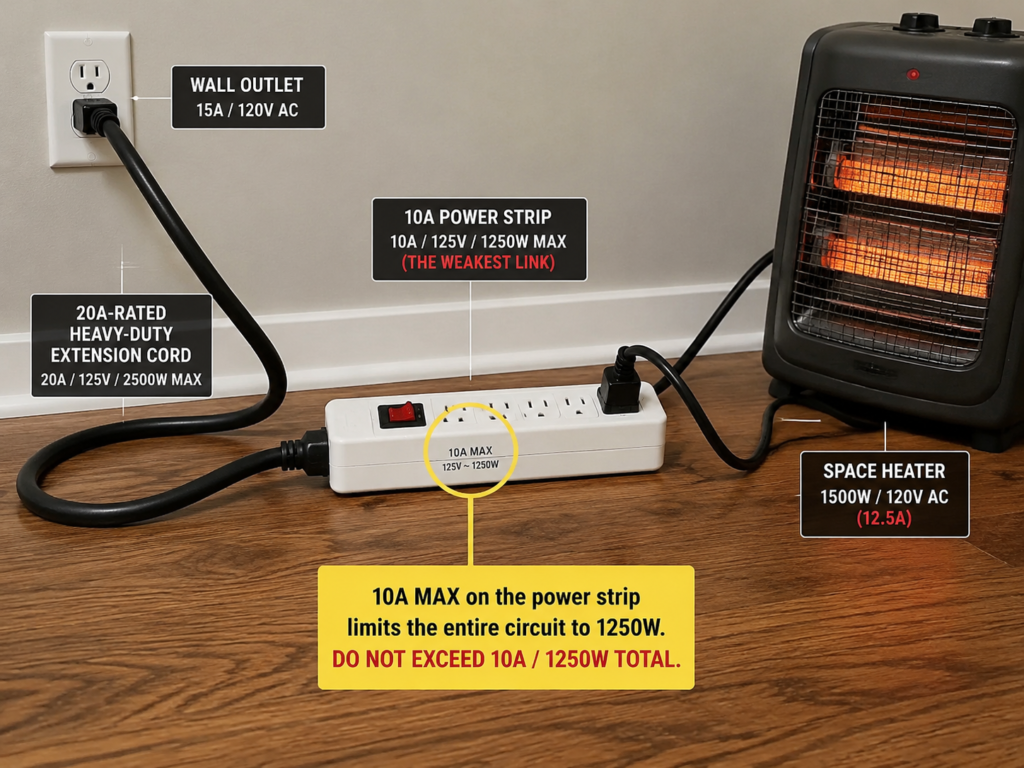
A real-world example: if your extension cord is rated for 20A, but the power strip it’s plugged into is only rated for 10A, the entire circuit’s limit is 10A (or lower). You cannot use the 20A cord rating as your reference.
There’s also an invisible bottleneck: bad contacts. Even if every component has a high enough rating, loose plugs, oxidized terminals, or worn contacts reduce contact area, increase resistance, and cause dangerous local overheating.
Rated Current Only Solves Thermal Safety: Don’t Forget Voltage Drop
Many people don’t realize that rated current only ensures the wire won’t overheat and fail. It does not guarantee the device at the end of the cord will get enough voltage.
For long cords, or 12V/24V low-voltage systems (outdoor LED strips, car accessories, solar low-voltage wiring), current flowing through the wire causes a voltage drop. By the time power reaches the device, the voltage may be too low.
Voltage drop causes all kinds of problems: devices won’t start, lights are dim, charging slows down, and motors run hotter because of low supply voltage. For low-voltage systems, even a small voltage drop has a big impact.
Always check in this order: first confirm thermal safety (rated current is sufficient), then calculate voltage drop. For long low-voltage runs, you’ll often need a thicker wire than what’s required just for thermal safety.
AC, DC, and High Frequency: What’s the Difference?
People often ask if AC and DC have different ampacity. For regular household 50/60Hz AC, short cords, and small gauges, the difference is negligible and can be ignored.
You may have heard of the skin effect: AC current tends to travel near the outer surface of a conductor, which reduces the effective cross-sectional area and lowers ampacity. This effect only becomes noticeable at high frequencies or with very large conductors. For ordinary household AC and small-gauge wire, it’s irrelevant. It only needs to be considered for high-frequency systems, very large conductors, or high-current busbars.
For solar, storage, EV, and high-power DC systems, the main concerns are not skin effect — they are continuous current rating, short-circuit current, overcurrent protection matching, voltage drop, terminal temperature rise, and DC arc risk. These have dedicated design standards, and household rules of thumb do not apply.
How to Read Wire Rated Current Labels
Now that we’ve covered the basics, let’s get practical: how do you read the labels on a wire? First, find the marking, then understand what it says.
Where to Find Labels
Labels are in different places depending on the product. Check these spots first:
- The outer jacket of bare wire or bulk cable usually has parameters printed every few inches/centimeters, including gauge, temperature rating, certification, and model number. Legitimate markings are permanent and won’t rub off easily.
- For finished products like extension cords and power strips, the current and voltage rating is usually printed on the back of the plug, the back of the outlet strip, a product label, or the packaging. This is the easiest rating to find.
- For appliance power cords, check the device nameplate, the plug itself, the adapter label, or the user manual for input current or power ratings.
How to Read Common Overseas Labels
Overseas cable labels come in several common formats:
- Direct current rating: The simplest format, e.g. “15A 125V”. This means 15A rated current, 125V rated voltage.
- Power rating: e.g. “1875W 125V”. You can convert this to current by dividing watts by volts: 1875 ÷ 125 = 15A, which is equivalent to a 15A rating. Always confirm whether the listed power is peak or continuous if you plan to use the cord for long-term loads.
- Gauge marking: e.g. 18AWG, 16AWG, 14AWG, 12AWG, or 1.5mm², 2.5mm². Gauge is only a rough reference — you cannot determine current rating from gauge alone without knowing the product type and installation conditions.
For entry-level estimation only (copper conductor, ~30°C / 86°F ambient, open air ventilation, short length, certified product), use this rough reference:
| AWG Gauge | Rough Allowable Current (A) | mm² Cross-Section | Rough Allowable Current (A) |
|---|---|---|---|
| 18 AWG | ~10A | 1.5 mm² | ~13–20A |
| 16 AWG | ~13A | 2.5 mm² | ~18–27A |
| 14 AWG | ~15A | 4 mm² | ~25–32A |
| 12 AWG | ~20A | 6 mm² | ~32–40A |
Note: These are rough estimates for entry-level reference only. Always follow the product’s labeled rating, manual, and local electrical codes.
- Temperature rating: e.g. 60°C, 75°C, 90°C, 105°C. This is the maximum long-term operating temperature for the insulation. Again, you must use the lowest temperature rating across all components (wire, plug, terminals, device port), not just the wire’s rating.
- Certification marks: These vary by region:
- North America: UL and ETL are third-party safety certifications, and are generally more reliable indicators of safety.
- EU: CE is a manufacturer’s self-declaration of conformity, and is not equivalent to third-party safety testing.
- United Kingdom: Look for the UKCA mark.
- Australia/New Zealand: Check for RCM/EESS compliance.
Remember: certification only means the product meets standards under its labeled use conditions. It does not mean you can safely overload it, run it coiled at full power, or use it in the wrong environment.
What If You Can’t Find a Label?
If there’s no visible rating on the product, first check the user manual, official product page, manufacturer specifications, or ask the seller for exact specs.
Never use unlabeled wire for long-term, high-power, or unattended loads (like space heaters or always-on servers) — the risk is too high. Even if you can guess the gauge by stripping the end, only use it for temporary, low-power applications, not as a permanent safe solution.
Another common mistake: using “it doesn’t feel hot” as a safety test. Human touch is very inaccurate, and internal hot spots, terminal heat, and long-term insulation damage can’t be detected by feel. Never replace a proper rating check with a hand test.
How to Choose the Right Wire: 4 Simple Steps
Now that you can read labels, how do you actually pick the right cord for the job? Follow these four steps, and you’ll avoid almost all common household mistakes.
Step 1: Calculate Total Operating Current
First, figure out how much current your devices will draw. The most accurate method is to check the Input Current listed on the device nameplate — this is more precise than calculating from power.
If only wattage is listed, use this formula:
Current (A) = Power (W) ÷ Voltage (V)
Use 120V for North American estimates, and 230V for EU/Australian estimates.
If multiple devices share a single cord or power strip, add up the current of all devices that could run at the same time. For heating, motor, or continuous loads, use the maximum rated current, not average power or a low setting.
For example: a 1500W space heater draws ~12.5A at 120V. A 15A extension cord might seem like it works on paper, but if the heater runs continuously, the cord is coiled, or the environment is hot, there’s not enough margin. You’ll need a thicker cord.
Step 2: Find the Lowest Rating in the Whole Circuit
Once you know your required current, verify the rating of every component in the circuit: wall outlet, plug, power strip, extension cord, adapter, wire terminals, and device port. Take the lowest rating of all these components as the maximum current for the entire circuit. Never use the thickest wire’s rating as your reference.
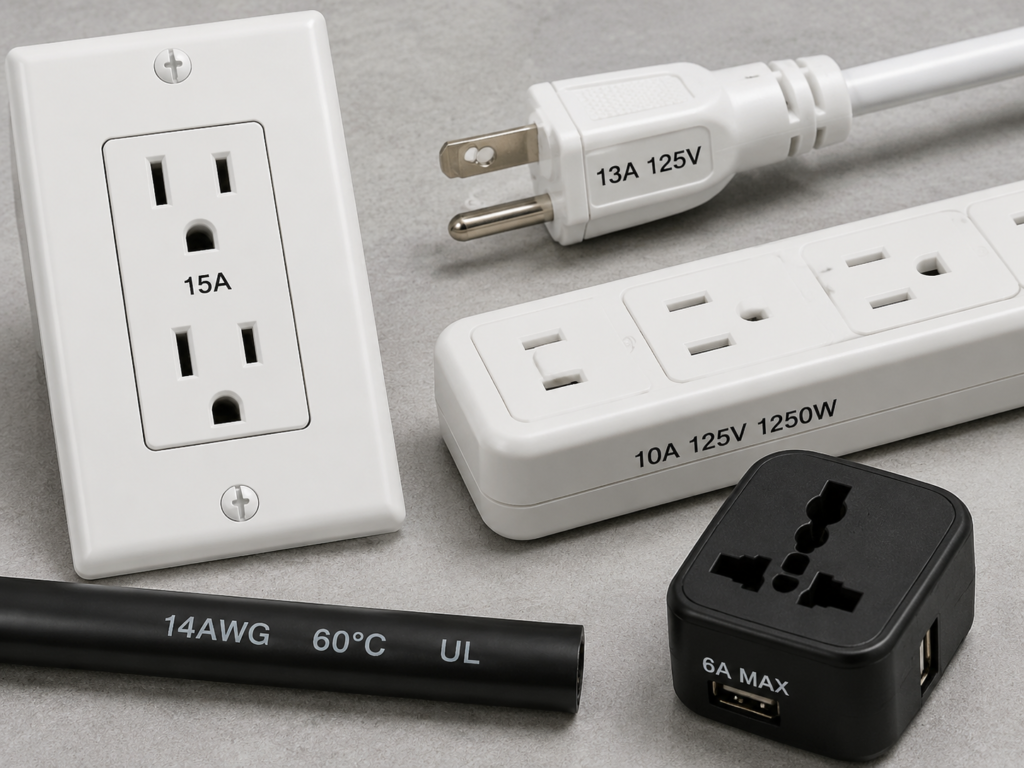
If any component has no visible rating, don’t use it for high-power or continuous long-term loads. It’s not worth the risk.
For continuous loads, leave at least 20% safety margin: actual operating current should be no more than 80% of the circuit’s rated limit. Exact margin requirements vary by local electrical code, so check your regional standards if possible.
Step 3: Derate for Your Use Case
Labeled ratings apply to standard lab conditions. If your use case is harsher, you’ll need to derate (reduce) the allowed current:
- For high-temperature environments, conduit runs, bundled wires, or multiple wires in the same conduit, start with ~80% of the labeled rating for quick entry-level estimates. For formal projects, always use official local code derating tables.
- For coiled or retractable extension cords, fully uncoil the entire length before using high-power loads. Never run a coiled cord at full rated current, even if the label says it’s sufficient.
- For motor loads, account for inrush current. Make sure plugs, cords, and breakers can handle the short surge. If needed, use a thicker gauge or shorter cord.
- For old, damaged cords or discolored/loose plugs, don’t just derate and keep using them. Replace them entirely for high-risk applications — don’t gamble with safety.
Step 4: Safety Check and Next Steps
Combine the results from the first three steps: the adjusted available current must be greater than or equal to your total required current, plus at least 20% margin, for regular long-term use.
If it’s not enough: upgrade to a higher-rated, thicker-gauge, shorter, certified cord, or split the load across separate compliant circuits. Never “fix” an overload problem by installing a higher-rated breaker — breakers must match the wire size and circuit code. A bigger breaker removes the last line of defense and lets the wire overheat.
Also, remember: temporary extension cords are for temporary use. Don’t use them as a replacement for fixed wiring to power high-power devices long-term (like a space heater or window AC unit) — this is a major fire hazard.
For in-wall wiring, panel upgrades, EV charging, water heaters, dedicated AC circuits, or any other permanent high-power installation, always hire a local licensed electrician and follow local electrical codes.
Temporary Troubleshooting Tip
If you’re already using a cord and want a quick sanity check, run the load for 30–60 minutes, then check the cord, plug, power strip, and adapters for unusual heat, softening, discoloration, or burning smells.
Important: if the plug or terminal is hot to the touch but the cord itself is only warm, that’s far more dangerous than a uniformly warm cord. It almost always means a bad contact or underrated connector — stop using it immediately.
If any part is too hot to hold comfortably, smells burnt, or has a sticky/deformed jacket, unplug it right away and do not use it again.
Keep in mind: hand checks or even infrared thermometers can only catch obvious, advanced problems. They cannot replace proper rating checks, derating calculations, or code compliance, and they do not prove long-term safety.
Common Mistakes and Troubleshooting
9 Most Common Myths Debunked
We’ve rounded up the most frequent misconceptions to help you avoid pitfalls:
- “Rated current is a fixed number that works anywhere.” False. Ratings depend on test conditions, environment, and installation method.
- “Thicker wire is always safer.” False. Wire size has to match terminals, plugs, and installation requirements. Wire that’s too thick to fit the terminal properly will cause loose connections and overheating.
- “If the plug fits, it’s safe.” False. Mechanical compatibility does not mean current, temperature, or certification ratings match. Travel adapters and universal plugs are the biggest culprits here.
- “If the breaker hasn’t tripped, everything is fine.” False. Local hot spots and downstream thin-cord overload may not draw enough current to trip the breaker until a fire has already started.
- “If it doesn’t feel hot, it’s safe.” False. Human touch can’t detect long-term insulation damage or internal/terminal hot spots.
- “Higher voltage rating means higher current capacity.” False. Voltage depends on insulation strength, current depends on conductor size and cooling — they are unrelated.
- “Old wire has the same rating as new wire.” False. Aging, oxidation, damage, and loose plugs drastically reduce safety performance.
- “Thick jacket means thick copper.” False. Many cheap cables use thick jackets to look heavy-duty. Always check the printed label.
- “Certified products can be run at full load in any condition.” False. Certification only applies to the labeled use conditions. Misuse (coiled, overheated, wrong environment) is still dangerous.
Warning Signs of Overheating
If you notice any of these, you have an active safety hazard — take it seriously:
- Plug, cord, or power strip is noticeably hot (too hot to hold for more than a few seconds)
- Jacket is soft, discolored, sticky, bulging, or cracked
- Burning plastic smell, buzzing/crackling sounds, or unusually large sparks when plugging/unplugging
- Devices cut out intermittently, the plug feels loose, or the same load runs hotter over time
If you see any of these signs, unplug the cord immediately and stop using it. Don’t take chances.
Beginner Troubleshooting Logic
If your cord is running hot and you’re not sure why, troubleshoot in this order:
- Reduce the load first. Unplug some devices or turn down the power. If the temperature drops significantly, the problem is almost certainly continuous overload or insufficient margin. Upgrade to a thicker cord or split the load.
- Check connections next. If only the plug, port, or adapter is hot (and the cord itself is fine), suspect a bad contact, loose terminal, or underrated adapter. Focus on the connection point.
- Check the environment. If the cord only overheats when coiled, bundled, in a hot space, or under a rug, the problem is poor cooling. Fix the use case (uncoil the cord, move it to a ventilated area) and reduce the load.
- Verify specs last. If none of the above explain the problem, double-check the gauge, rated current, certification, length, load type, and the lowest rating in the whole circuit to find the mismatch.
What to Do If Something Goes Wrong
If you have an overheated, melted, or burnt cord or accessory, follow these steps:
- Unplug immediately. Stop using the faulty cord, power strip, or adapter right away — don’t try to “squeeze a little more use out of it.”
- Don’t tape it and keep using it. Wrapping a melted, burnt, or cracked cord with electrical tape only provides temporary insulation. It does not fix the heat damage or structural issues, and it’s still dangerous.
- Replace with a properly rated product. Use a clearly labeled, certified cord or accessory that matches your required current and voltage. Don’t grab a random unlabeled cord as a replacement.
- Call an electrician for permanent wiring issues. If the problem is with in-wall wiring, frequent breaker trips, burnt wall outlets, or high-power device malfunctions, don’t try to fix it yourself. Contact a local licensed electrician immediately.
Summary: Quick Checklist and Capability Boundaries
What You Should Know Now
After reading this guide, you should be able to:
- Read rated current, rated voltage, AWG/mm², temperature rating, and certification marks on wires and cords
- Estimate operating current from device nameplates or power/wattage calculations
- Explain why you need to derate for high heat, coiled cords, bundled wires, conduit, and long low-voltage runs
- Use the weakest link principle to judge if extension cords, power strips, and adapters are safe
- Identify common signs of overheating, bad contacts, and underrated wires
1-Minute Quick Safety Checklist
If you’re not sure if a cord is safe for your use case, run through this list to avoid most risks:
- □ Total device current is below the lowest rated component in the circuit
- □ At least 20% safety margin is built in (even more for continuous loads)
- □ I’ve accounted for high-risk loads (space heaters, ovens, AC, motors, EV charging)
- □ The cord is not coiled, bundled, in conduit, under a rug, or in an enclosed space
- □ The environment is not excessively hot, in direct sun, near heat sources, or poorly ventilated
- □ For long runs or 12V/24V low-voltage systems, I’ve checked for voltage drop
- □ Plugs, power strips, adapters, and terminals aren’t the weak point in the circuit
- □ The cord and plugs show no signs of overheating, burning, discoloration, damage, or looseness
- □ The product has clear labeling and the correct safety certification for my region
Know the Limits of This Guide
This guide is intended for regular household use, short DIY projects, and low-risk temporary setups. For long-term high-power loads, fixed wiring, in-wall circuits, electrical panels, EV charging, solar/storage systems, or industrial equipment, do not rely on general rules of thumb — use dedicated design standards and consult a professional.
All wire selection, installation, and overcurrent protection setup must follow local electrical codes. When in doubt, be conservative, or contact a local licensed electrician. Safety is always worth the extra time or cost.
Wire rated current might seem like a tiny, technical detail, but it’s the foundation of home electrical safety. You don’t need to memorize complicated formulas — just stick to four simple rules: check the label, audit the whole circuit, account for your environment, and leave extra margin. That will help you avoid almost all common household wiring risks. A two-minute check is always better than dealing with the consequences of an overheated cord or electrical fire.