
Quick Summary
- Core Definition: Overcurrent Protection (OCP) is a critical safety mechanism that automatically limits, cuts off, or reduces electrical current when it exceeds safe thresholds, preventing device damage and electrical fires.
- Key Solutions: Fuses, circuit breakers, PTC resettable fuses, electronic fuses (eFuses), and dedicated OCP integrated circuits.
- Everyday Coverage: Home electrical panels, consumer electronics, USB-C fast charging, automotive systems, industrial equipment, and renewable energy setups.
- 3 Core Rules for Everyday Users: Match rated current to wiring, verify sufficient breaking capacity, and choose products with trusted third-party certifications.
1. The Basics: Understanding Overcurrent Protection in Everyday Life
1.1 You’ve Already Seen OCP at Work
Have you ever had a circuit breaker trip when you plugged too many appliances into one outlet? Or noticed your phone charger shut off unexpectedly when a cable was damaged? That’s overcurrent protection doing its job — acting as your electrical system’s quiet, automatic bodyguard.
From the wall socket in your kitchen to the USB-C charger powering your laptop, OCP works behind the scenes 24/7 to stop abnormal current from destroying your devices or starting fires.
1.2 Core Concepts: Current, Overcurrent, and OCP
To understand why OCP matters, start with the fundamentals:
- Electrical Current: The flow of electrons through a circuit, measured in amperes (amps, A). Think of it as the volume of water flowing through a pipe.
- Overcurrent: Any situation where current exceeds the designed safe limit of a wire, component, or device. Like too much water pressure bursting a pipe, excess current generates dangerous heat.
- Overcurrent Protection (OCP): The system that detects excess current and takes action — either limiting the current, shutting off power entirely, or tripping a disconnect — before damage occurs.
1.3 The 4 Types of Overcurrent Scenarios
Not all overcurrent is the same. They differ in how fast they happen, how much current is involved, and how dangerous they are:
- Overload: Slow, sustained excess current (typically 1.2–2x the rated limit). Think of running a space heater, air conditioner, and microwave all on the same circuit. It doesn’t fail instantly, but it slowly overheats wiring over time.
- Short Circuit: Extreme, instant overcurrent (10x the rated current or more) caused when a live wire touches a neutral or ground path with almost no resistance. It generates massive heat and sparks in milliseconds — the most dangerous and fire-prone type.
- Ground Fault: A partial short where current leaks through an unintended path (like through water or a person’s body). It combines overcurrent risk with serious electric shock hazard.
- Inrush Current: A brief, normal spike of current when devices first turn on (like when a fridge compressor starts or a capacitor charges). Good OCP systems are designed to tolerate these short spikes without false tripping.
1.4 The Real Risks of Missing or Failing OCP
Without reliable overcurrent protection, even small electrical faults can escalate quickly:
- Immediate Device Damage: Circuit boards melt, semiconductors blow up, batteries rupture, and electronics are destroyed permanently.
- Electrical Fire Risk: Overheated wiring melts insulation, ignites dust, plastic, and nearby combustibles. According to the National Fire Protection Association (NFPA), electrical failures are the second leading cause of home fires in the U.S., resulting in hundreds of deaths and billions in property damage every year.
- Safety Hazards: Short circuits and ground faults create arc flashes, electric shock risk, and toxic fumes from burning components.
2. How Overcurrent Protection Works: The Invisible Safety Mechanism
2.1 The 5-Step Protection Cycle
All OCP systems follow the same core logic, whether they’re a simple glass fuse or a smart charging chip:
- Sense: Continuously measure the current flowing through the circuit.
- Compare: Check the measured current against a pre-set safe threshold.
- Judge: Confirm that the excess current is a real fault (not just normal inrush).
- Act: Trigger a protection response — limit current, shut off power, or break the circuit.
- Recover: Either stay permanently disconnected (one-time fuses) or automatically restore power once the fault is cleared (resettable designs).
2.2 Common Current Sensing Methods (Ordered by Everyday Use)
Different applications use different ways to measure current, matched to their size and power level:
- Shunt Resistor Sensing: The most common method in phone chargers, power banks, and USB-C devices. A tiny, precision low-resistance resistor is placed in the current path; the voltage drop across it is measured to calculate current via Ohm’s Law (I = V/R). It’s cheap, accurate, and ideal for low-voltage electronics.
- Hall Effect Sensor: Used in electric vehicles, large battery systems, and high-current setups. It measures current magnetically, with no direct electrical contact — providing full isolation between high-voltage power and low-voltage control circuits.
- Current Transformer (CT): The standard for AC power distribution panels and industrial systems. It steps down large AC currents to measurable levels for circuit breakers and energy meters.
- MOSFET On-Resistance Sensing: Used inside modern eFuse and power management chips. It uses the natural resistance of the power MOSFET switch itself to detect current, eliminating the need for an extra sense resistor and saving space.
2.3 The 3 Core Protection Action Modes
OCP doesn’t always just “turn off.” It uses three main response types matched to the fault:
- Current Limiting: Caps the maximum current at a safe level but keeps the circuit running. Common in USB ports and power supplies — it prevents overload without fully shutting down your device.
- Full Shutdown: Cuts power completely the moment a fault is detected. Used for short circuits and severe faults where any continued current is dangerous.
- Auto-Recovery: Automatically restores power after the fault goes away and the device cools down. Found in PTC fuses and eFuses — perfect for temporary glitches where manual reset would be inconvenient.
3. Common Overcurrent Protection Devices Explained
3.1 One-Time Fuses: The Original Sacrificial Protector
Fuses are the oldest and simplest OCP device — they work by melting a thin metal wire (the fuse element) when excess current heats it past its melting point, physically breaking the circuit.
- Glass / Ceramic Cartridge Fuses: Traditional tube-shaped fuses used in appliances, power supplies, and older automotive systems. Ceramic fuses handle higher voltage and better arc suppression.
- SMD (Surface-Mount Device) Fuses: Tiny, chip-sized fuses soldered directly onto phone, laptop, and charger circuit boards.
- Fast-Acting vs. Time-Delay:
- Fast-acting fuses trip quickly for short-circuit protection, used for sensitive electronics.
- Time-delay (slow-blow) fuses tolerate startup inrush current, used for motors and transformers.
Pros: Extremely reliable, low cost, high breaking capacity.
Cons: One-time use — must be replaced after they blow.
3.2 Resettable Protection: Breakers and PTC Fuses
These devices can be reset and reused after a fault, making them more convenient for frequent use.
- PTC Resettable Fuses (Polyfuse): Made of a polymer with conductive particles. When overcurrent heats it up, the polymer expands and resistance skyrockets, limiting current. It automatically resets when it cools down. Common in USB ports, battery packs, and small electronics.
- Thermal-Magnetic Miniature Circuit Breakers (MCBs): The standard switch in your home electrical panel. They use two mechanisms:
- A bimetallic strip that bends with heat for slow overload protection.
- An electromagnetic coil that trips instantly for short circuits.
- Note on Additional Features: AFCI (Arc-Fault Circuit Interrupter) and RCBO (Residual Current Breaker with Overcurrent) add extra safety layers — arc fault detection and ground fault protection, respectively. Standard RCD/GFCI devices protect against leakage current and electric shock, not traditional overcurrent.
Pros: Reusable, no replacement parts, multi-function options available.
Cons: Larger than fuses, slower response than electronic solutions.
3.3 Electronic Smart Protection: eFuses and ICs
Modern electronics use semiconductor-based OCP for speed, precision, and smart features.
- Electronic Fuse (eFuse): Integrates a power MOSFET, current sensor, and control logic into a single chip. It can be programmed for exact current thresholds, supports soft-start to avoid inrush, and can report fault status to a system controller. Used in USB-C ports, servers, and automotive electronics.
- Current Limiting ICs: Dedicated chips that precisely cap output current, commonly used for USB power switches and power distribution circuits.
- PMIC Integration: Power Management Integrated Circuits in phones and laptops combine OCP with overvoltage (OVP), overtemperature (OTP), and undervoltage (UVP) protection into one chip.
Pros: Microsecond-fast response, fully programmable, auto-recovery, tiny size.
Cons: Lower breaking capacity than mechanical fuses for extreme faults.
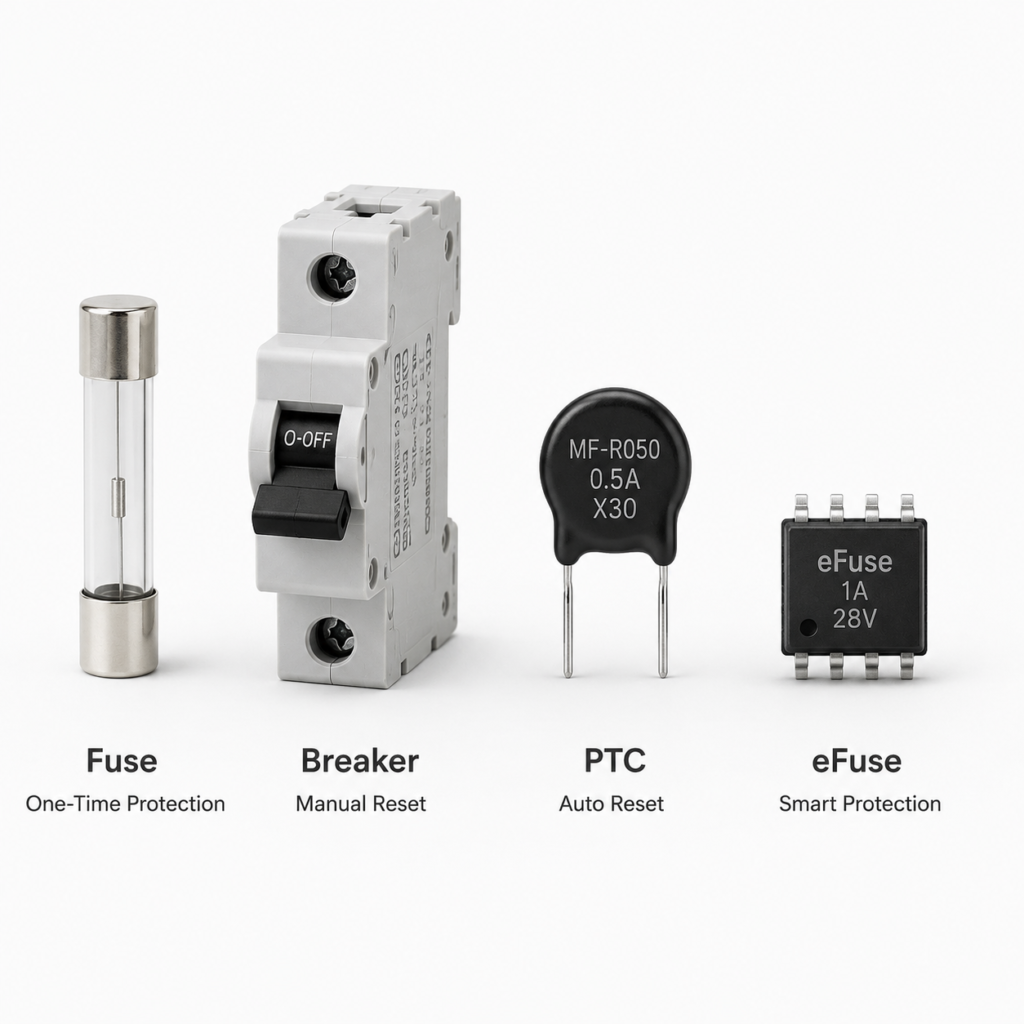
3.4 Side-by-Side Comparison of Core OCP Solutions
| Feature | One-Time Fuse | Circuit Breaker | PTC Resettable Fuse | eFuse / OCP IC |
|---|---|---|---|---|
| Resettable? | ❌ No | ✅ Manual | ✅ Auto | ✅ Auto |
| Response Speed | Milliseconds | Milliseconds | Seconds | Microseconds |
| Cost | Very Low | Medium | Low | Medium-High |
| Precision | Moderate | Moderate | Low | Very High |
| Best For | Severe faults | Home panels | Low-power USB ports | Fast electronics |
3.5 Quick Scenario Selection Guide
| Use Case | Recommended Solution |
|---|---|
| Home main electrical panel | Thermal-magnetic MCB + GFCI/AFCI |
| Inside a phone charger | SMD fast-acting fuse + eFuse |
| USB-C port on a laptop | eFuse / current limit IC |
| Car 12V accessory circuit | Blade fuse / smart eFuse |
| Lithium battery pack (BMS) | PTC + electronic protection + backup fuse |
| Industrial motor | MPCB + thermal relay |
4. Deep Dive: OCP in USB-C Fast Charging & Lithium-Ion Batteries
4.1 How USB PD Fast Charging Handles Overcurrent
USB Power Delivery (PD) — especially the latest PD 3.1 EPR standard that pushes up to 240W — relies on a two-layer OCP system to keep high-power charging safe:
- Protocol Layer Protection: The charger and device negotiate power levels over the CC pin. E-Marker chips inside high-current cables tell the charger how much current the wire can safely handle (3A, 5A, or EPR 5A at 48V). The charger will never deliver more current than the cable and device agree on.
- Hardware Layer Protection: Independent of the protocol, dedicated eFuse or OCP hardware constantly monitors VBUS current. If a short or fault happens mid-charge, it cuts power in microseconds — no software delay.
Programmable Power Supply (PPS) adds another layer, dynamically adjusting current and voltage in tiny steps to keep charging efficient and within safe limits.
4.2 Multi-Stage OCP in Battery Management Systems (BMS)
Lithium-ion batteries are especially sensitive to overcurrent, which can cause overheating, swelling, or thermal runaway. Every modern battery pack uses a BMS with three tiers of overcurrent protection:
- Charge Overcurrent Protection (C-OCP): Stops charging if input current exceeds the cell’s safe charge rate (usually set around 1.2–1.5x the rated 1C charge rate).
- Discharge Overcurrent Protection (D-OCP): Cuts output if the device pulls too much current from the battery.
- Short Circuit Protection (SCP): The final, fastest line of defense — triggers within milliseconds for near-zero-resistance shorts.
4.3 The Full Protection Chain in Consumer Electronics
In a modern laptop or phone, OCP isn’t just one component — it’s a layered chain:
Wall charger fuse → charger eFuse → USB cable rating → device input fuse → PMIC rail protection → battery BMS protection
This cascading design ensures that a fault at any point is caught before it reaches sensitive or dangerous components.
4.4 OCP Challenges for High-Power PD & GaN Chargers
As chargers jump from 65W to 100W, 140W, and now 240W — especially compact GaN (Gallium Nitride) models — OCP becomes more critical and more challenging:
- Higher Current Stress: At 20V, 140W means 7A; at 48V 240W, current hits 5A. Every milliohm of resistance creates more heat, and fault currents rise faster.
- GaN’s Speed Tradeoff: GaN switches on and off much faster than silicon, so fault currents can spike in microseconds. OCP circuits must keep up to protect the GaN devices themselves.
- Density & Heat: Compact GaN chargers pack more power into less space. Heat from OCP components must be carefully managed to avoid false tripping or premature aging.
- USB PD 3.1 Compliance: The 240W EPR standard mandates stricter overcurrent and over-temperature testing, including verification that protection works independently of protocol communication.
5. Real-World Applications: Where OCP Protects You Every Day
5.1 Home Electrical Systems

Your home’s breaker panel is the largest OCP system you interact with regularly:
- Layered Architecture: Main breaker → branch circuit breakers → individual device fuses. Each level is sized to trip first for faults on its branch, keeping the rest of the house powered.
- Dedicated High-Power Circuits: Electric ovens, water heaters, dryers, and Level 2 EV chargers all require their own dedicated circuits with properly rated breakers to prevent overload.
- Power Strips & Extension Cords: Most quality power strips include a built-in overload breaker. Never daisy-chain multiple strips — it bypasses this protection and creates major fire risk.
5.2 Consumer Electronics & Everyday Charging
- Smartphones & Tablets: OCP lives in the charging port, internal PMIC, and battery protection board.
- Laptops: 65W–140W USB-C models have eFuse protection on every power rail, plus input fuses in the adapter.
- Quality Matters: Budget no-name chargers often skip proper OCP design, use undersized fuses, or have inaccurate trip thresholds. A cheap charger is one of the most common causes of burned-out USB ports and battery damage.
5.3 Automotive & Electric Vehicles
- 12V Systems: Traditional blade fuses protect lights, infotainment, and accessories. Newer cars use smart eFuses that can report faults and reset automatically.
- EV High-Voltage Systems: The traction battery pack uses multi-level BMS overcurrent protection, plus high-voltage DC contactors and fuses for severe short-circuit faults.
5.4 Industrial & Motor Applications (Brief Overview)
Industrial motors use specialized OCP designed to tolerate the 5–7x inrush current at startup. Thermal relays and motor protection circuit breakers (MPCBs) match the motor’s heat tolerance curve, preventing nuisance tripping while still protecting against burnout.
6. Practical Buying Guide: How to Choose Safe, Reliable Protection
6.1 For Home Electrical Protection
When upgrading breakers or wiring, follow these rules:
- Match Breaker Rating to Wire Size: This is the single most important rule. In North America, standard NEC guidelines are:
- 14 AWG copper wire → 15A breaker
- 12 AWG copper wire → 20A breaker
- 10 AWG copper wire → 30A breaker Never install a larger breaker without upgrading the wiring — it defeats the whole purpose of protection.
- Check Breaking Capacity: The breaker’s interrupting rating must be higher than the maximum possible short-circuit current at that point in your system.
- Look for Certifications: UL 489 listed breakers are the gold standard for North American residential use.
6.2 For Chargers & USB-C Cables
- Look for OCP/SCP Labeling: Reputable brands clearly list overcurrent protection, short-circuit protection, and other safety features in their specs.
- Verify Cable Current Rating:
- Standard USB-C cables handle 3A (60W at 20V).
- 5A E-Marker cables are required for 100W+ charging.
- 240W EPR cables have extra insulation and E-Marker chips rated for 48V.
- Trust Third-Party Certifications: USB-IF certified chargers and cables pass rigorous OCP and safety testing. Look for UL, IEC 62368-1, and CE marks as well.
- Avoid Ultra-Cheap No-Name Products: If a 140W GaN charger costs $10, it’s almost certainly cutting corners on protection components.
6.3 4-Step OCP Selection for Hobbyists & Beginners
If you’re building or modifying a small project:
- Calculate your normal operating current.
- Identify the worst-case fault current.
- Pick a device with a rated current slightly above normal operation, but a trip current below what your wiring/components can survive.
- Confirm the breaking capacity exceeds the maximum possible fault current.
6.4 Common Selection Mistakes to Avoid
- ❌ Myth: Bigger is safer. An oversized fuse or breaker won’t trip when it should, letting wires burn.
- ❌ Using a fast-acting fuse on a motor. It will trip every time the motor starts.
- ❌ Replacing a fuse with copper wire. This is extremely dangerous — it completely removes all overcurrent protection.
7. Maintenance & Troubleshooting: Simple Checks Anyone Can Do
7.1 Non-Negotiable Safety Rules
- Always power off and lock out circuits before working on them.
- For home panel work, if you’re not a licensed electrician, hire one.
- Never work on wet circuits or with wet hands.
7.2 Signs Your OCP Device Is Failing
- Breakers trip for no obvious reason, or trip with very light load.
- Breakers feel warm or smell burnt at the panel.
- Fuse holders show discoloration or melting.
- PTC fuses that stay high-resistance even after cooling down.
7.3 Standard Troubleshooting for Tripped Breakers / Blown Fuses
Follow this order to safely find the problem:
- Unplug all devices on that circuit.
- Reset the breaker or replace the fuse with the exact same rating.
- Plug devices back in one at a time, turning each on.
- The device that causes the trip is likely the source of the fault.
- If the breaker trips immediately with nothing plugged in, you have a wiring short — call an electrician.
7.4 Maintenance Schedule & Replacement Guidelines
- Home electrical panel: Inspect annually for warm breakers, rust, or loose connections. Test GFCI/AFCI breakers monthly.
- Fuses: Replace immediately when blown — always with the same rating.
- PTC fuses: Degrade over time and after many trip cycles. Replace every 3–5 years in high-use devices.
- Old panels: If your home’s electrical panel is over 20 years old, have an electrician evaluate it for upgrade.
7.5 Quick Home Electrical Safety Checklist
- All breakers match their wire gauge rating
- Kitchen/bath/garage outlets have GFCI protection
- No power strip daisy-chaining
- Chargers and cables don’t get abnormally hot during use
- No fuses have been replaced with wire or wrong-rated parts
- High-power appliances are on dedicated circuits
8. Clear Comparison: OCP vs. Other Electrical Safety Features
8.1 How OCP Fits Into the Full Protection Family
Electrical safety uses multiple independent protection systems — each handles a different threat:
| Protection Type | Abbreviation | What It Protects Against |
|---|---|---|
| Overcurrent Protection | OCP | Excess electrical current |
| Overvoltage Protection | OVP | Voltage that’s too high |
| Overtemperature Protection | OTP | Overheating components |
| Short Circuit Protection | SCP | Extreme zero-resistance shorts (a subset of OCP) |
| Undervoltage Protection | UVP | Voltage that’s too low |
| Ground Fault / Leakage Protection | RCD / GFCI | Current leaking outside the normal circuit (shock risk) |
8.2 Clearing Up Confusing Terms
- Overload vs. Short Circuit: Overload is slow, moderate excess current; short circuit is instant, massive current. Both are types of overcurrent.
- Fuse vs. Circuit Breaker: Fuses are one-time, fast, and cheap. Breakers are reusable, more feature-rich, and better for frequent tripping scenarios.
- OCP vs. SCP: SCP is OCP’s fastest, most extreme mode for dead shorts. Many systems have separate dedicated SCP detection for sub-millisecond response.
8.3 Busting Common Myths
- ❌ Myth: “If the breaker doesn’t trip, it’s safe.” ✅ Fact: If the breaker is oversized for the wire, the wiring can overheat and start a fire without ever tripping the breaker.
- ❌ Myth: “PTC fuses last forever.” ✅ Fact: They degrade with each trip cycle. Severe overcurrent can permanently damage them, leaving them stuck at high resistance.
- ❌ Myth: “All chargers have OCP, so brand doesn’t matter.” ✅ Fact: Cheap counterfeit chargers often have fake or poorly calibrated OCP that fails when you need it most.
9. Safety Standards & Certifications: What to Look For
9.1 Core Consumer Electronics & Charging Standards
- IEC 62368-1 / UL 62368-1: The modern global safety standard for IT and audio/video equipment, including mandatory overcurrent and fault testing.
- USB-IF Certification: The official USB Implementers Forum testing ensures chargers and cables follow PD protocol rules and meet minimum OCP performance requirements.
9.2 Component-Level Standards
- UL 248: North American safety standard for low-voltage fuses, covering ratings, breaking capacity, and performance.
- IEC 60269: The international equivalent standard for low-voltage fuses.
- IEC 60898 / IEC 60947-2: International standards for household and industrial circuit breakers.
9.3 What Certifications Actually Mean for You
A certification logo on the box isn’t just marketing — it means an independent lab tested the product to make sure its protection actually works. For everyday buyers, sticking to UL, CE, TÜV, and USB-IF certified products is the easiest way to avoid dangerous garbage.
10. The Future of Overcurrent Protection
10.1 Solid-State Circuit Breakers (SSCBs)
Traditional mechanical breakers take milliseconds to trip. New solid-state breakers use SiC and GaN semiconductors to shut off faults in microseconds — no moving parts, no arcing, and far longer life. They’re starting to appear in data centers and EV systems.
10.2 Smart & Connected Protection
Next-gen breakers and eFuses connect to Wi-Fi or vehicle networks, giving you real-time current monitoring, fault alerts, and remote control. They can log trip events to help diagnose intermittent problems.
10.3 Higher Integration
More protection features are being packed into smaller chips. Multi-channel eFuses and advanced PMICs combine OCP, OVP, OTP, and reverse polarity protection into tiny packages — perfect for slim laptops and wearables.
10.4 Predictive Protection
AI-powered systems will learn normal current patterns and spot anomalies before they become faults — shifting OCP from purely reactive defense to proactive risk prevention.
11. Frequently Asked Questions (FAQ)
- What does overcurrent protection actually do? It detects when electrical current exceeds safe limits and cuts or limits power to stop components from burning out and prevent electrical fires.
- Are overload and short circuit the same thing? No. Overload is slow, moderate excess current. A short circuit is an instant, massive current spike — the most dangerous type of overcurrent.
- Do all phone chargers have overcurrent protection? Reputable brand-name chargers do. Very cheap no-name chargers often skip proper OCP design or use poorly calibrated components.
- Do higher-wattage chargers have more overcurrent risk? Not if they’re properly designed. Higher power means higher current, so good chargers upgrade their OCP to match. Cheap high-wattage chargers are the risk.
- Is OCP more important for GaN chargers? Yes. GaN’s faster switching means fault currents rise more quickly, making fast, accurate OCP even more critical.
- Is it okay to just flip a tripped breaker back on? Not immediately. First unplug everything on that circuit, then reset. If it trips again right away, you have a fault that needs fixing.
- Which is better: a fuse or a circuit breaker? Fuses are faster, cheaper, and better for severe faults. Breakers are reusable and more convenient. Most good systems use both in layers.
- Do resettable PTC fuses last forever? No. They degrade over time and with each trip. Severe current spikes can permanently damage them.
- Can I replace a blown fuse with a piece of copper wire? Absolutely not. This removes all overcurrent protection and is one of the most dangerous things you can do with electrical equipment.
- Do USB-C cables have current limits? Yes. Standard cables handle 3A. 5A cables with E-Marker chips are required for 100W+ charging. Using an underrated cable can cause overheating.
- How often should I check my home electrical panel? At least once per year for visual inspection. Test GFCI and AFCI breakers monthly.
- Are GFCI and overcurrent protection the same? No. GFCI/RCD protects against electric shock from leakage current. OCP protects against excess current and overheating. Modern homes need both.
12. Final Takeaways & Action Plan
12.1 Key Points to Remember
Overcurrent protection is the unsung foundation of all modern electrical safety. From your phone charger to your home breaker panel, it works silently to prevent damage and fire. The best protection is layered — no single device catches every fault.
12.2 Action Steps For Everyone
- Homeowners: Have an electrician verify your breaker ratings match your wiring. Add GFCI/AFCI protection where missing. Install dedicated circuits for high-power devices and EV chargers.
- Renters: Never daisy-chain power strips. Avoid cheap no-name chargers. If breakers trip frequently, notify your landlord.
- EV Owners: Confirm your home charging circuit and breaker are properly sized. Inspect charging cables regularly for damage or overheating.
- Tech Enthusiasts: When building or modifying projects, always size fuses and breakers correctly. Never skip OCP to save cost or space.
12.3 30-Second Safety Self-Check
- Do you know if your breakers match your home’s wire gauge?
- Are you using USB-IF or UL-certified chargers for your expensive devices?
- Have you ever replaced a fuse with something it wasn’t supposed to be?
If you’re unsure about any of these, taking 10 minutes to check today could prevent a major problem tomorrow.