
Quick Summary
Overvoltage Protection (OVP) is a critical safety mechanism that shields your electronics from damaging voltage spikes and sustained high-voltage events. It works by clamping excess voltage, diverting harmful energy, or cutting off power entirely before damage occurs. From home wiring and smartphone fast chargers to electric vehicles and solar systems, OVP is the unsung hero behind reliable, safe everyday electronics use. When shopping for protection gear, prioritize products with independent safety certifications, matched voltage ratings, and surge capacity suited to your environment.
1. What Is Overvoltage Protection (OVP)?
1.1 Core Definitions & Key Terms
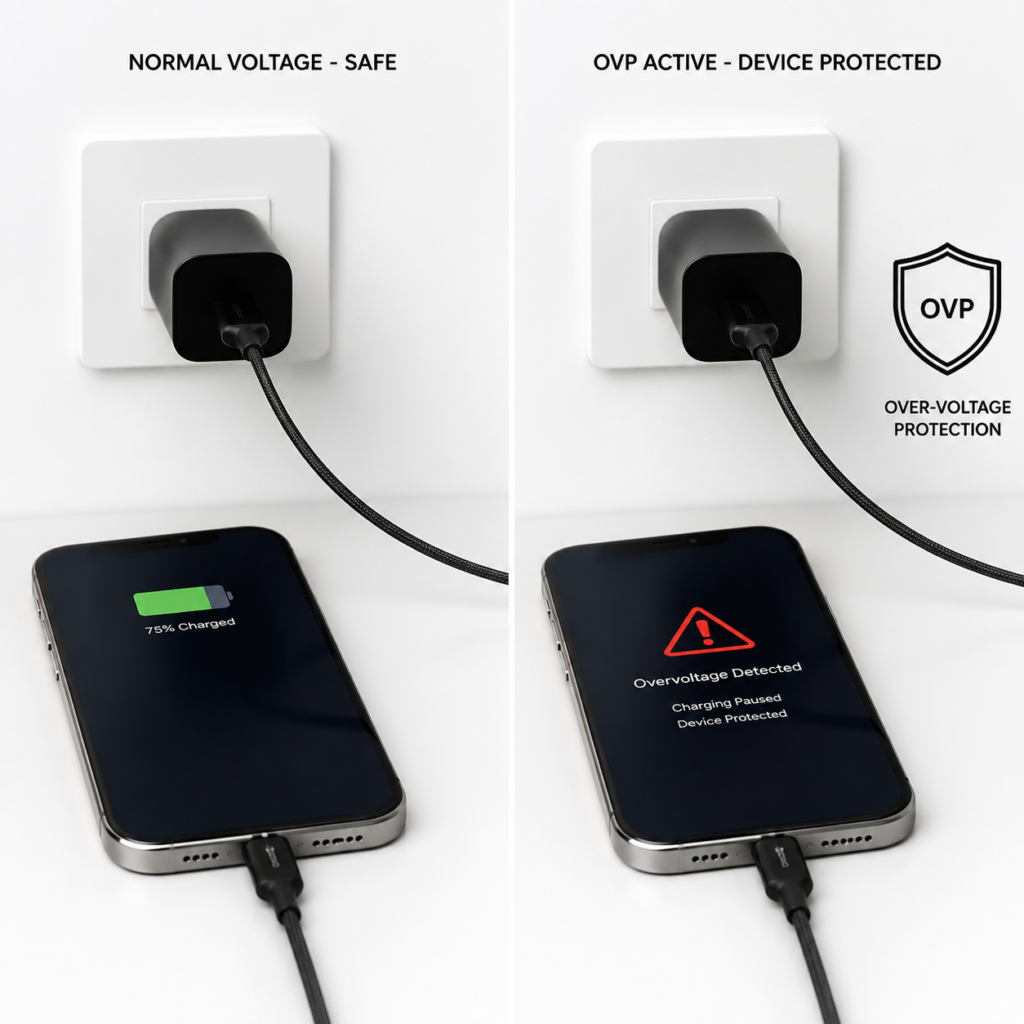
At its simplest, overvoltage describes any situation where electrical voltage rises above the normal, designed operating range of a device. Overvoltage Protection (OVP) is the set of circuits, components, or systems that detect this abnormal condition and intervene to protect downstream equipment.
Many people mix up different types of voltage irregularities. While all fall under the overvoltage umbrella, they behave very differently:
| Type of Voltage Event | Duration | Common Causes |
|---|---|---|
| Voltage Spike | Nanoseconds to microseconds | Switching on motors, static discharge, fast grid transients |
| Surge (Transient Overvoltage) | Microseconds to milliseconds | Lightning induction, utility grid switching, large load disconnects |
| Temporary Overvoltage (TOV) | Seconds to minutes | Broken neutral lines, transformer faults, grid restoration after outages |
OVP systems are engineered to handle all three categories, though different components excel at different event types.
1.2 Where Do Overvoltage Events Come From?
Overvoltage doesn’t just come from thunderstorms. It originates from three broad categories:
- Grid-side external causes: Induced lightning surges, utility equipment switching, downed power lines, and broken neutral faults that can send double the normal voltage into home wiring.
- Internal household causes: Cycling of large appliances like air conditioners, refrigerators and well pumps, loose wiring in older homes, and arcing from degraded connections.
- Device-internal causes: Faulty power supply control circuits, broken feedback loops in chargers, miscommunication in fast-charging protocols, and failing semiconductor components.
2. Why Overvoltage Protection Matters: Real Risks You Can’t Ignore
2.1 Immediate, Catastrophic Damage
A severe overvoltage event can destroy electronics in a fraction of a second. Semiconductor chips inside phones, TVs and computers break down instantly, power capacitors can rupture, and circuit boards can suffer permanent carbonized burn paths. In the worst cases, devices are completely unrecoverable.
2.2 Hidden, Slow-Burn Damage
Not all harm is obvious. Smaller, repeated surges gradually wear down internal components, shortening device lifespan by years. Performance becomes erratic, data corruption becomes more frequent, and devices develop unexplained glitches long before they fully fail. For expensive home theater setups or network storage drives, this silent degradation can cost you hundreds of dollars in premature replacements.
2.3 Safety & Financial Risks
Beyond broken gadgets, uncontrolled overvoltage creates genuine fire hazards. Overstressed components overheat, insulation melts, and faulty surge protectors themselves can become ignition points. For homeowners, a single severe grid fault can wipe out every major appliance in the house, resulting in thousands of dollars in losses that standard home insurance may not fully cover.
3. How OVP Works: The Invisible Bodyguard for Your Electronics
3.1 The Basic Protection Workflow
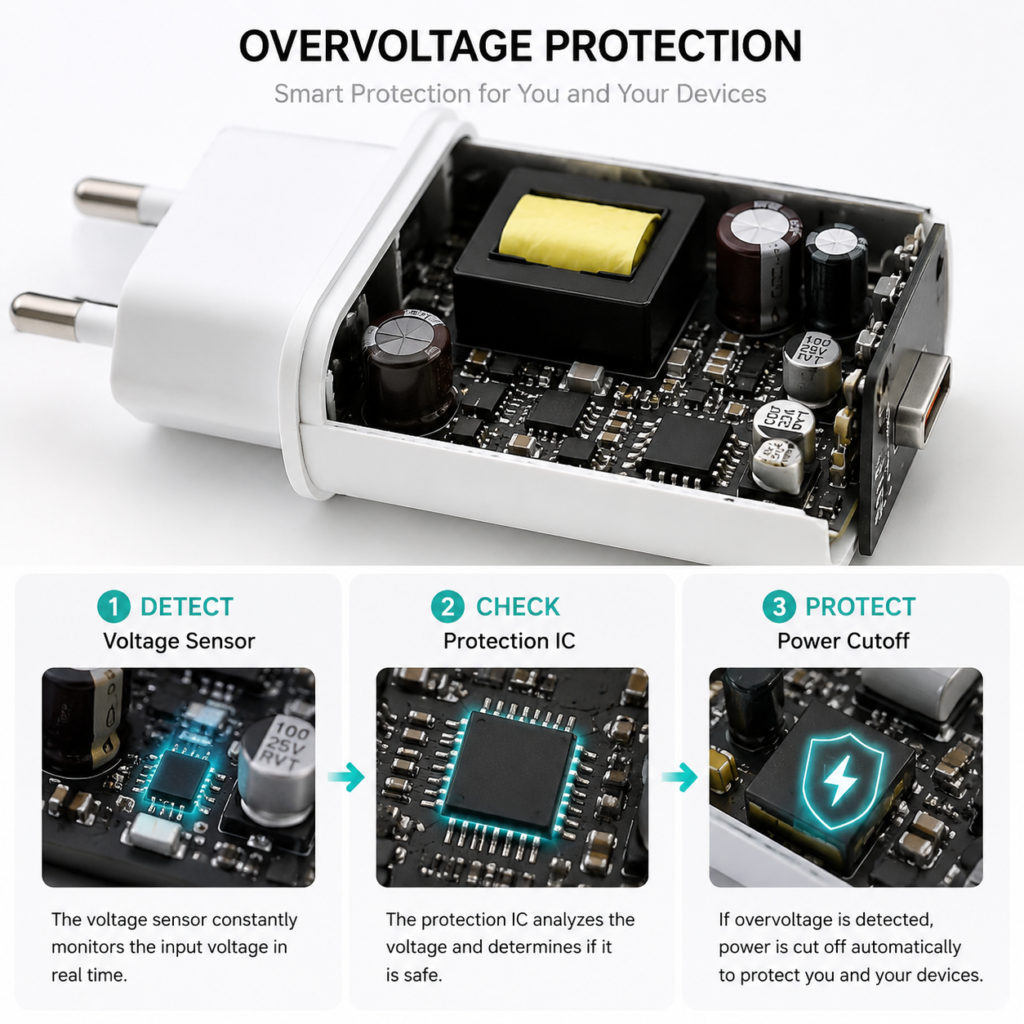
Every OVP system follows the same core four-step logic, acting faster than the blink of an eye:
- Detection: The system continuously monitors voltage levels.
- Comparison: It compares the measured voltage against a pre-set safe threshold.
- Trigger: The moment voltage crosses the threshold, protection activates.
- Action: It either clamps the voltage down, diverts excess energy to ground, or disconnects power entirely.
3.2 Two Layers of Protection
Reliable systems use defense in depth, with protection placed at two key points:
- Input-side protection: Stops external surges and grid faults before they enter a device or home wiring.
- Output-side protection: Guards against internal power supply failures, ensuring abnormal voltage never reaches sensitive load components like phone batteries or computer CPUs.
3.3 Two Core Protection Mechanisms
OVP technologies fall into two fundamental categories, each with its own strengths:
- Clamping protection: Think of it as a pressure relief valve. It lets normal voltage pass freely, but automatically limits any excess voltage to a safe ceiling while diverting extra energy as heat. Power stays on the whole time, making it ideal for transient surges.
- Crowbar / switch-type protection: This is the emergency stop. When triggered, it either short-circuits the line to blow a fuse or physically opens the circuit, cutting power completely. It is the safer choice for sustained overvoltage conditions that clamping circuits cannot handle.
3.4 Key Parameters Explained in Plain English
You don’t need an engineering degree to judge protection performance. Focus on these five metrics:
- Trigger voltage: The exact voltage level where protection kicks in.
- Clamping voltage: The maximum voltage that gets through to your device after protection activates — lower is safer.
- Surge current rating: How much instantaneous electrical current the protector can absorb, measured in kiloamps (kA).
- Response time: How fast protection activates, usually measured in nanoseconds. Faster is always better.
- Energy capacity / lifespan: How much total energy the component can absorb over its lifetime before wearing out.
4. Common OVP Solutions: From Simple Components to Whole-Home Systems
4.1 Discrete Protection Components
These are the basic building blocks found inside nearly every electronic device:
- Metal Oxide Varistor (MOV): The workhorse of household surge protectors. It acts like a variable resistor that drops its resistance sharply at high voltage. Low cost and capable of absorbing large energy surges, it degrades slowly over time with repeated use.
- TVS Diode (Transient Voltage Suppressor): The precision sprinter of protection components. It reacts in nanoseconds and clamps voltage very tightly, making it perfect for sensitive electronics, USB ports and signal lines. It handles less total energy than an MOV, but reacts far faster.
- Gas Discharge Tube (GDT): Designed for the biggest surges. It uses ionized gas to conduct massive lightning-level currents, but reacts relatively slowly. It is almost always paired with MOVs or TVS diodes in multi-stage protection systems.
4.2 Integrated Smart Protection Chips
Modern electronics increasingly use all-in-one protection solutions:
- Dedicated OVP ICs: Compact chips that combine voltage sensing, comparison logic and switch control in one tiny package. They are found in nearly every smartphone charger and battery management system.
- eFuse (Electronic Fuse): The next evolution in circuit protection. Beyond just overvoltage, it integrates overcurrent, overheating and reverse-polarity protection in a single, resettable chip. Widely used in USB-C ports, laptops and 48V automotive systems, eFuses deliver faster, smarter and more reliable protection than old-fashioned physical fuses.
4.3 Surge Protection Device (SPD) Classes: Type 1, 2, 3
For whole-building protection, SPDs are categorized by where they sit in the electrical system, working together in a cascading defense chain:
- Type 1 (First level): Installed at the main utility service entrance. Built to handle the energy from direct lightning strikes, it absorbs the biggest surges before they enter the building’s electrical panel.
- Type 2 (Second level): Mounted inside the home breaker panel. This is the primary protection for most households, cleaning up whatever surge energy makes it past Type 1 and handling internal switching surges.
- Type 3 (Third level): Point-of-use protectors like surge-protecting power strips. Placed right next to valuable devices, they provide the final, most precise voltage clamping for sensitive electronics.
4.4 Quick Match: Which Solution Fits Your Use Case?
| Scenario | Recommended Solution | Key Priority |
|---|---|---|
| USB ports / signal lines | TVS diode array | Fast response, low capacitance |
| AC wall power input | MOV + GDT + fuse | High energy absorption, safety certification |
| Car / truck 12V systems | TVS + crowbar circuit | Load dump pulse resistance |
| Whole home protection | Type 2 SPD + Type 3 strips | UL 1449 certified, proper grounding |
| Smartphone fast charging | OVP IC + eFuse | Precision voltage cutoff |
5. OVP in Daily Life: Where You’ll Find It (And Why It Matters)
5.1 Home Electrical Systems
Your home is under constant threat of voltage surges, from distant thunderstorms to the air conditioner cycling on. A properly layered setup — a Type 2 SPD at the panel plus Type 3 strips at entertainment centers and work desks — creates a safety net for every device plugged in. Refrigerators, smart home hubs, Wi-Fi routers and game consoles all benefit enormously from even basic surge protection.
5.2 USB-C Fast Charging & Consumer Electronics
USB Power Delivery (PD) chargers push voltage up to 20V (and 48V in PD 3.1) to deliver 100W, 140W or even 240W of power. With higher voltage comes higher risk, which is why good chargers use a two-layer OVP strategy:
- Protocol-layer protection: The charger and phone negotiate voltage through PDO (Power Delivery Object) handshakes and PPS (Programmable Power Supply) dynamic adjustment. No agreement means no high-voltage output.
- Hardware-layer protection: Dedicated OVP chips independently monitor the VBUS power line. If a protocol glitch ever sends the wrong voltage, the hardware cuts power in microseconds — no negotiation required.
Budget no-name chargers often skip proper OVP hardware entirely, relying only on software protection that can fail. This is why cheap chargers are the single biggest risk for damaging expensive phones and laptops.
5.3 Automotive & On-Board Power
Car electrical systems face a unique threat called load dump: when the battery is disconnected while the alternator is charging, causing a sudden voltage spike that can reach 40V or more on a 12V system. Modern vehicles use robust TVS protection and eFuses to shield engine ECUs, infotainment systems and sensors from these events. Electric vehicles add another layer: high-voltage battery packs use sophisticated BMS (Battery Management System) OVP to prevent overcharging and thermal runaway.
5.4 Other Common Scenarios
- Office & IT equipment: Servers, monitors and network switches rely on rack-mount SPDs and UPS-integrated surge protection to avoid downtime and data loss.
- Home solar & energy storage: Solar inverters require specialized DC-side and AC-side SPDs rated for photovoltaic systems, since solar arrays are exceptionally exposed to lightning surges.
6. Standards & Certifications: How to Spot Genuine, Reliable Protection
6.1 Core International Standards
Reputable protection products are tested against recognized global standards. Here are the most important ones to recognize:
| Standard | Applies To | What It Covers |
|---|---|---|
| UL 1449 | Surge protection devices (North America) | Safety, performance and durability requirements for SPDs; defines VPR (Voltage Protection Rating) and surge current ratings |
| IEC 61643-11 | Low-voltage SPDs (global) | International benchmark for SPD performance, testing and classification for power systems |
| IEC 61000-4-5 | Electronic equipment | Standardized surge immunity testing using 1.2/50μs voltage and 8/20μs current waveforms |
| IEC 62368-1 | Audio / video / IT equipment | General product safety standard that includes OVP requirements for consumer electronics |
| ISO 7637-2 | Automotive electronics | Defines electrical transient pulses, including load dump, that vehicle components must survive |
6.2 What Certification Marks Actually Mean for You
Marks like UL Listed, CE, TÜV and USB-IF are not just marketing stickers. They mean an independent lab has verified the product meets minimum safety and performance thresholds. For surge protectors, UL 1449 certification is the gold standard in North America — without it, you have no independent proof the device actually works as advertised. For USB-C chargers, USB-IF certification confirms proper OVP implementation and safe PD protocol behavior.
7. Buying Guide: Pick the Right Protection Without the Jargon
7.1 How to Choose a Home Surge Protector
Follow this simple three-step process:
- Assess your risk level: If you live in a lightning-prone area, own a detached home, or have high-value electronics, step up to higher-rated protection. Apartment dwellers in urban areas can often start with quality Type 3 strips.
- Prioritize the right specs: Clamp voltage matters more than joule rating alone. Look for 330V–400V clamping for 120V systems. Aim for at least 10–20kA surge current and 600+ joules for basic use, 1500+ joules for home theater or office setups.
- Pick your tiered setup:
- Entry level: UL-listed surge power strips for computers and TVs.
- Balanced: Type 2 whole-panel SPD professionally installed + premium strips for critical gear.
- Maximum protection: Type 1 + Type 2 + Type 3 cascade, plus data line protection for cable/ethernet.
7.2 How to Pick a Safe Charger / Power Adapter
- Check the spec sheet: Look for explicit mentions of Over Voltage Protection (OVP), Over Current Protection (OCP), Short Circuit Protection (SCP) and Over Temperature Protection (OTP).
- Look for certifications: UL, FCC, CE and USB-IF certified chargers are vastly more likely to have proper, tested OVP circuits.
- Avoid ultra-cheap no-name chargers: Budget chargers frequently fake OVP labels, use undersized components, and skip hardware protection entirely. The few dollars you save are never worth the risk of bricking a $1000 smartphone.
7.3 Recommendations for Different User Types
- Homeowners: Budget for a Type 2 whole-house SPD installation and add quality strips for entertainment and home office gear.
- Renters: Invest in 2–3 high-quality Type 3 surge strips for your most valuable devices.
- Tech enthusiasts / content creators: Add signal-line surge protection for Ethernet, HDMI and coaxial cables.
- Lightning-prone region residents: Upgrade to full Type 1 + Type 2 + Type 3 protection and consider whole-panel lightning grounding upgrades.
8. Testing & Maintenance: Make Sure Your Protection Actually Works
8.1 Simple Checks Anyone Can Do At Home
You don’t need lab equipment to verify basic protection health:
- Verify the protection status indicator light is lit and the correct color.
- Inspect the device for physical damage, discoloration, bulging casings or unusual heat.
- Confirm the product has valid certification marks and a legible rating label.
8.2 Professional Testing Methods
For deeper verification, technicians use specialized tools:
- USB power meters / PD analyzers: Test output voltage stability and simulate fault conditions to confirm OVP trigger points.
- Oscilloscopes: Measure actual clamping voltage and response time during surge events.
- Surge generators: Inject calibrated surge pulses to test full SPD performance under real-world conditions.
8.3 Installation Safety Rules You Must Follow
- Whole-house Type 1 / Type 2 SPDs must be installed by a licensed electrician. Improper wiring creates worse hazards than no protection at all.
- Never daisy-chain surge protectors or plug them into extension cords. This degrades performance and creates fire risk.
- Grounding is everything. None of this works if your home’s electrical ground is faulty or missing. A proper, low-resistance ground path is the foundation of all surge protection.
8.4 How to Tell If Your Protector Has Failed
Replace your surge protector immediately if you notice any of these:
- The protection indicator light goes out or turns red.
- The casing feels warm or hot under normal use.
- You see cracks, melting or burn discoloration.
- The device has survived a major nearby lightning strike or grid fault — even if the light still works, internal MOVs may be severely degraded.
Most manufacturers recommend inspection after significant surge events and replacement every several years under normal use. There is no universal lifespan, since wear depends entirely on how many surges the device absorbs.
9. Common Myths & Misconceptions Busted
9.1 Confused Protection Features: What’s the Difference?
| Protection Type | Abbreviation | What It Protects Against |
|---|---|---|
| Over Voltage Protection | OVP | Voltage that is too high |
| Over Current Protection | OCP | Current that is too high |
| Over Temperature Protection | OTP | Temperatures that are too high |
| Under Voltage Protection | UVP | Voltage that is too low |
| Short Circuit Protection | SCP | Direct short circuits |
It is also important to distinguish:
- Surge protector vs voltage regulator: Surge protectors handle fast, short spikes. Voltage regulators handle slow, sustained voltage dips and swells. They do completely different jobs.
- OVP vs lightning protection: OVP handles electrical overvoltage of all kinds. Lightning protection is a full building system including lightning rods, grounding and bonding — SPDs are only one small part of it.
9.2 Popular Myths Debunked
- ❌ Myth: “A surge power strip will protect me from direct lightning.” ✅ Fact: Plug-in strips handle only residual induced surges. Direct lightning strikes require full external lightning protection systems.
- ❌ Myth: “Once I install a whole-house SPD, I’m set forever.” ✅ Fact: SPD components wear out over time. They need periodic inspection and replacement, just like smoke alarms.
- ❌ Myth: “All power strips have surge protection.” ✅ Fact: Most cheap power strips are just extension cords with multiple outlets. They offer zero surge protection whatsoever.
- ❌ Myth: “OVP slows down fast charging.” ✅ Fact: OVP sits completely idle during normal operation. It only activates during faults and has zero effect on charging speed.
- ❌ Myth: “Unplugging everything is the only real protection.” ✅ Fact: Unplugging works for storms you see coming, but most surges happen when you’re not home or not paying attention. Layered protection works 24/7.
10. Frequently Asked Questions (FAQ)
Do I really need surge protection in my home?
Yes, especially if you own expensive electronics. Even small, repeated surges gradually damage devices over time. For the cost of a few quality surge strips, you can dramatically extend the life of your TVs, computers and appliances.
Do smartphones have built-in overvoltage protection?
Yes. Modern phones have multiple layers of protection including PMIC (Power Management IC) OVP, battery protection ICs and port-level protection. However, this internal protection is designed for minor anomalies. Severe sustained overvoltage from a faulty charger can still overwhelm it.
Can a surge protector stop a direct lightning strike?
No. Plug-in surge protectors and even whole-house Type 2 SPDs are not designed for direct lightning hits. Full lightning protection requires an integrated system of air terminals, down conductors, grounding and bonding. SPDs handle conducted and induced surge energy that enters through power lines.
How often should I replace my surge protector?
There is no fixed expiration date. Replace it immediately if the indicator light fails, the unit shows physical damage, or after a major nearby lightning event. Under normal household conditions, plan for replacement every 3–5 years as a conservative guideline.
Do higher wattage chargers have more overvoltage risk?
Not when properly designed. Higher-power chargers actually tend to have more robust protection systems because they operate at higher voltages. The real risk comes from cheap, uncertified chargers of any power rating that skip proper OVP hardware.
Does overvoltage protection use extra electricity?
Virtually none. Under normal conditions, protection components have only tiny leakage currents measured in microamps. The idle power draw is negligible on your electric bill.
11. Final Thoughts & Action Checklist
Overvoltage protection is one of those things you never notice — until it saves you from an expensive repair or replacement. In an era where every room is full of sensitive electronics, from smart thermostats to electric car chargers, OVP has evolved from a nice-to-have feature into a basic necessity for electrical safety.
You don’t have to upgrade everything at once. Start with this simple action plan:
For Homeowners
- Have an electrician inspect your electrical panel and grounding system.
- Install a UL 1449 Type 2 whole-house SPD.
- Add premium surge strips at your entertainment center and home desk.
For Renters
- Pick up 2–3 UL-listed surge protector strips.
- Use them for your laptop, monitor, TV and router.
- Avoid using no-name chargers for your phone and laptop.
For Vehicle Owners
- Stick to name-brand, certified car chargers.
- If you drive an EV, verify that your home charging station has proper surge and overvoltage protection.
Quick 30-Second Home Check
✅ Is your ground system intact and up to code?
✅ Are your surge protector status lights all on?
✅ Have you replaced any protector older than 5 years?
✅ Are all your high-value devices plugged into protected outlets?
Answer yes to all four, and you’re well ahead of most households when the next surge hits.