
Scroll through any social media feed or online marketplace, and you’ve probably seen them: $5 20W fast chargers with free shipping, $10 “65W GaN” chargers from brands you’ve never heard of, dollar store “universal chargers,” or free no-name chargers thrown in with a cheap phone case or pair of earbuds. A lot of people think, “It’s just a charger—if it works, it’s fine. The expensive ones are just a scam.”
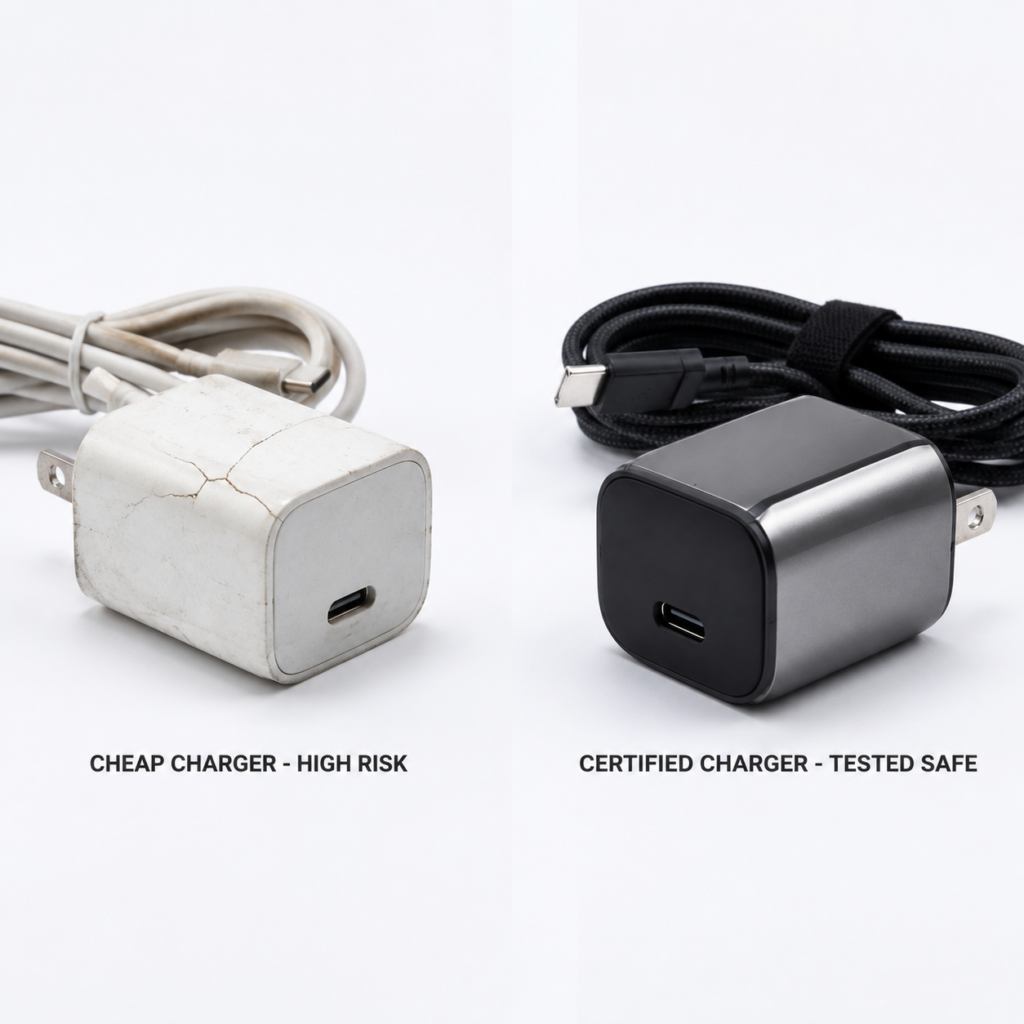
But here’s the hard truth: fire safety agencies and consumer protection groups around the world regularly flag cheap, uncertified power adapters for defects like overheating, short circuits, failed insulation, and false labeling. Real, life-disrupting accidents caused by bad chargers happen far more often than you might think.
In this guide, we’ll break down exactly why cheap chargers are dangerous, how to spot high-risk models before you buy, what harms they can cause, how to shop for safe options, and simple habits to keep your home and devices safe. By the end, you’ll go from grabbing the cheapest charger off the shelf to picking and using chargers with confidence.
Why Are Cheap Chargers So Dangerous? They Cut Corners on the Parts That Matter Most
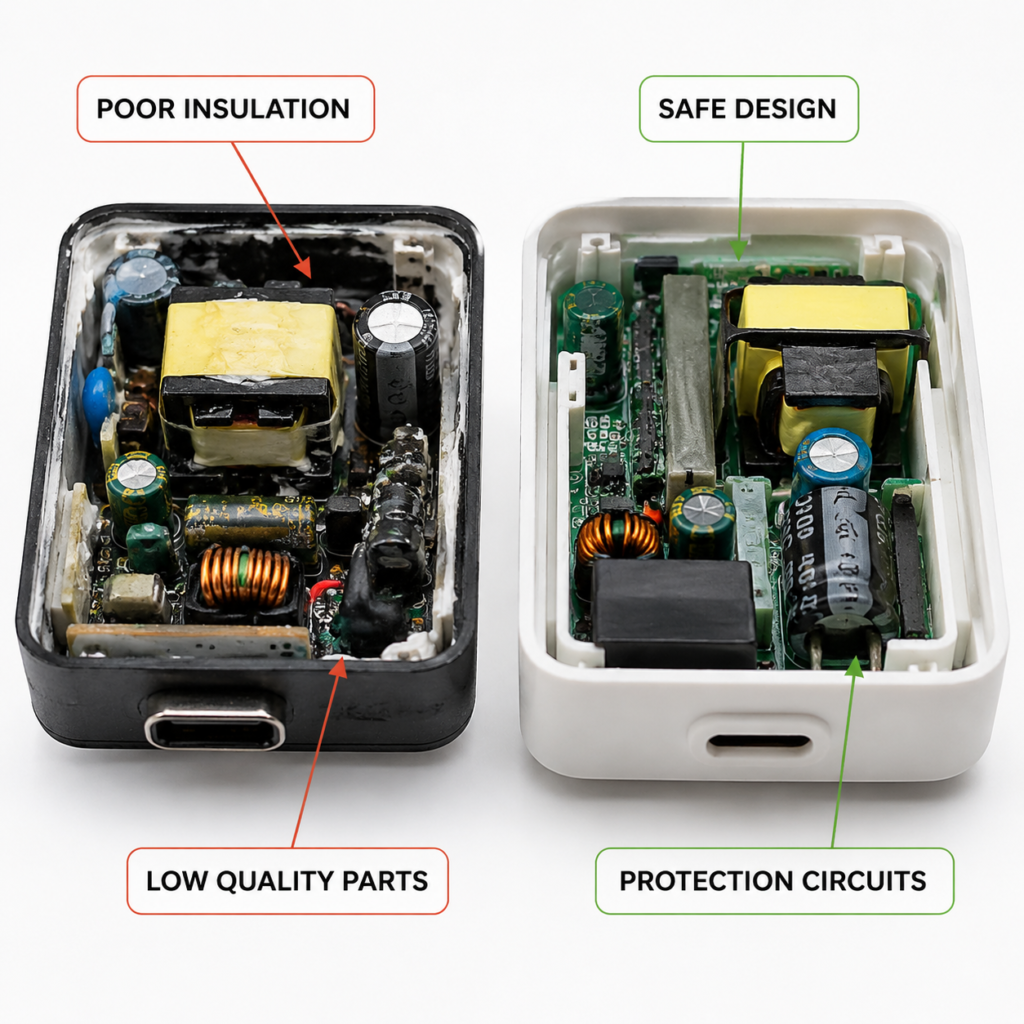
People often wonder how chargers can have such a huge price range. The answer is simple: cheap manufacturers slash costs by cutting corners on every part that affects safety—from materials to design to production.
Substandard, Cut-Rate Components
Think of a charger like a house: a cheap, poorly made one is a structural disaster waiting to happen.
- Control circuits and protection systems. Reputable chargers use name-brand controller ICs paired with fully designed protection circuits that react instantly to faults. Low-cost chargers may use cheaper controller ICs or poorly implemented protection circuits that fail to respond correctly during abnormal conditions. Risks also stem from subpar PCB layout, improper component sizing, and insufficient electromagnetic compatibility design, not just the chip itself.
- Core internal parts: capacitors, transformers, rectifiers, fuses. Many cheap chargers use underrated or defective parts: capacitors can’t handle high heat or voltage, so they bulge or leak over time; fuses don’t blow when they should, so faults can spiral into overheating or fire.
- External parts: shell, prongs, cables. Cheap chargers often use non-flame-retardant plastic for the shell, which melts and burns easily (and may drip flaming plastic) when overheated. Prongs and internal cable wiring are often too thin, causing overheating, warping, or poor contact with use.
Missing or Reduced Safety Features
Safety protection is a top priority in legitimate charger design, but cheap manufacturers strip these features out to save money.
- Incomplete basic protections: The four core safety features every reliable charger needs are overvoltage, overcurrent, overheating, and short circuit protection. Many cheap chargers skip or skimp on these. During abnormal conditions such as grid voltage spikes, poor chargers may fail to regulate output properly, which can damage connected devices or create overheating and fire risks. Note that end-of-charge power adjustment is primarily managed by the device’s internal battery management system, not the charger alone.
- Poor high-low voltage isolation: One side of a charger connects to dangerous household mains power (110V/220V), while the other outputs low-voltage power (around 5V) for your phone. Legitimate chargers leave a safe gap between high and low voltage circuits and use certified insulation to separate them. Cheap chargers often cram components too close together, use inadequate insulation materials, provide insufficient creepage distance, or implement poor isolation design between high-voltage and low-voltage circuits. If isolation fails, high voltage can leak to the low-voltage side—you may feel a tingle when touching your phone’s metal frame or charging port, and the risk of electric shock skyrockets in damp areas like bathrooms.
- Unstable output: Legitimate chargers deliver steady, consistent voltage. Cheap chargers often produce fluctuating output with excessive ripple. Excessive ripple and unstable regulation can increase stress on a device’s internal charging components and may reduce long-term reliability.
No Quality Control, Fake Certs, and Zero Support
Cheap chargers made in unregulated small workshops have little to no standardized quality control processes.
- Fake or stolen certifications: Many bad chargers have printed certification logos that are completely made up or stolen from legitimate products. The certification number won’t match any official listing, or the product model/manufacturer won’t line up.
- No safety testing: Reputable brands run rigorous tests (aging tests, voltage withstand tests, temperature rise tests, drop tests) to make sure chargers are reliable. Cheap workshop-made chargers skip all of these—quality is totally random, and you might get a dud that fails on the first use.
- No after-sales support: Most cheap chargers have no clear manufacturer information. If it fries your device or causes a fire, you’ll have no way to file a claim or get compensation.
Cheap Charger vs. Certified Charger: Key Differences
| Category | Cheap Uncertified Charger | Certified Brand Charger |
|---|---|---|
| Component quality | Cost-optimized with minimal performance margins | Safety-tested, rated for long-term reliable operation |
| Protection features | Limited or incomplete protection circuits | Full OVP (overvoltage), OCP (overcurrent), SCP (short circuit), and OTP (overtemperature) protection |
| Thermal design | Minimal heat dissipation, untested temperature limits | Validated thermal performance under full load |
| Safety isolation | Inadequate creepage distance or insulation | Compliant isolation design per international standards |
| Certification | May have fake or unsubstantiated certification marks | Verified by independent third-party testing bodies |
| Support & warranty | Limited or no after-sales support | Manufacturer-backed warranty and customer support |
The Real Risks of Cheap Chargers (It’s Not Hype)
You might be thinking, “I’ve used a cheap charger for years and nothing’s happened.” Safety risks are always a matter of probability—and it only takes one failure to cause serious harm.
Direct Threats to Personal Safety
- Electric shock: If high-low voltage isolation fails, you may feel a tingling sensation when touching your device’s metal frame or charging port. In damp environments like bathrooms or kitchens, the risk of serious, life-threatening shock is much higher.
- Burns: Cheap chargers can get dangerously hot when running at full power—prolonged contact can cause low-temperature burns. Overheating prongs can also warp wall outlets, increasing burn and fire risk.
- Fire: Bulging capacitors, short circuits, or overheating transformers can ignite the charger’s plastic shell or nearby flammable items. If you charge on your bed, couch, or near blankets while you sleep, the risk of a house fire rises drastically.
Device and Property Damage
- Broken devices: Overvoltage, overcurrent, or fluctuating power can fry the motherboard, battery, or charging port of your phone, earbuds, tablet, or laptop. The repair cost is almost always far more than a decent charger costs.
- Damaged home wiring: Short circuits or overheating prongs can burn out wall outlets, trip circuit breakers, or even damage your home’s internal wiring in severe cases.
- Property loss: If a fire starts when no one is around, it can spread to furniture, clothes, and other belongings, causing thousands of dollars in damage.
Annoying (and Easy to Miss) Minor Issues
Beyond serious safety risks, cheap chargers cause plenty of frustrating day-to-day problems:
- Glitchy fast charging: Bad protocol recognition leads to slow charging, random disconnections, or your phone displaying a “this accessory is not supported” warning.
- Poor electromagnetic compatibility design can interfere with nearby Bluetooth, Wi-Fi, or other wireless devices.
3 Easy Ways to Spot a Bad Charger (No Tech Knowledge Needed)
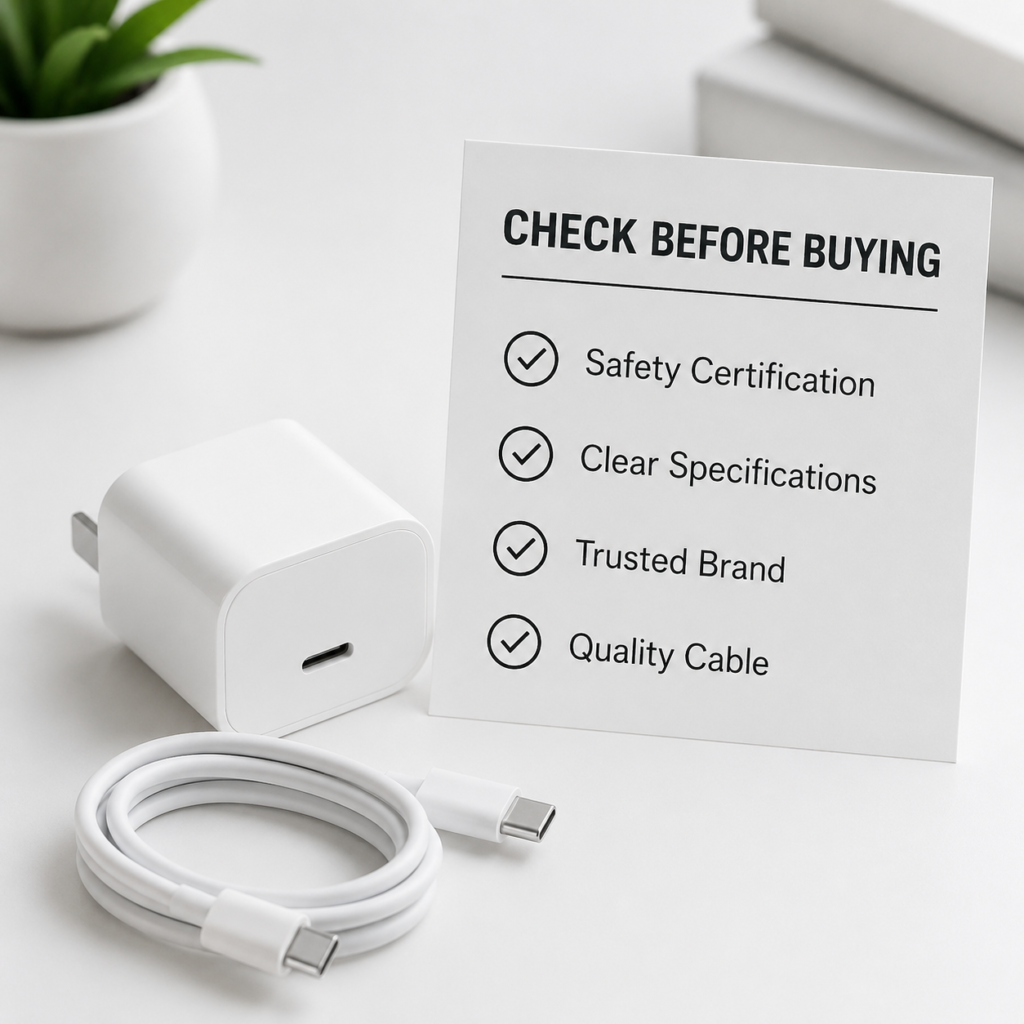
You don’t need to be an electrical engineer to tell a safe charger from a dangerous one. Use these three checks before you buy, when you unbox a new charger, and every time you use one.
Check Labels and Safety Certifications
This is the fastest, most reliable check. When you get a new charger, look for these details:
- Valid, recognized certification marks: The mark should be printed or laser-etched (not a peeling sticker). Look for third-party safety certifications appropriate for your region:
- United States & Canada: UL, ETL
- European Union: CE (note: CE marking is a manufacturer’s declaration of compliance, not an independent safety certification), TÜV
- Japan: PSE
- USB-C devices: USB-IF certification, which validates compliance with USB power delivery standards Always look up the certification number on the issuing body’s official website to confirm the brand, model, and manufacturer match the listing.
- Complete product information: Legitimate chargers always clearly list the brand, model, manufacturer name and address, input/output power specs, and applicable safety standards. If all it says is “fast charge” or “universal charger” with no other details, skip it.
- Clean, consistent printing: If the text is blurry, has typos, conflicting specs (e.g., “65W” printed on the front but output specs that add up to only 20W), or peeling stickers, it may indicate poor quality control or counterfeit products.
Shop Smart: Price and Channel Matter
You can greatly reduce your risk of purchasing an unsafe charger by buying from reputable sellers and established brands and being realistic about cost:
- Be wary of rock-bottom prices: If a charger is drastically cheaper than similar models from known brands, it is very likely cutting safety corners. Don’t fall for “factory direct” or “loss leader” marketing—a genuine 65W GaN charger priced far below the market average should be treated with caution, because safety components, independent testing, and certification all add measurable production costs. Note that GaN technology improves charging efficiency and allows for smaller charger sizes, but GaN alone does not guarantee safety. The overall safety of a charger still depends on circuit design, complete protection features, and rigorous quality control.
- Buy from trusted sellers: Stick to brand official websites, first-party retail listings (like Amazon Basics, Best Buy, or Walmart), official brand flagship stores, and reputable physical stores. These sellers have strict product vetting, so you’re far less likely to get a dud.
- Pick the right charger for your needs: Use the original charger that came with your device if possible, or a well-reviewed third-party brand. You don’t need the highest wattage or fanciest GaN tech if your phone only supports 20W charging—overpaying for extra power you won’t use can lead you to buy a cheap, unsafe high-wattage charger just to save a buck.
Watch for Red Flags While Using It
Even if a charger looks fine out of the box, stop using it immediately if you notice any of these:
- Right after plugging it in: a burning smell, buzzing/crackling noises, warped plastic, or blackened/loose prongs. Unplug it right away (use a dry cloth if it’s hot to avoid burns).
- While charging: the charger gets so hot you can’t hold it comfortably, it keeps disconnecting and reconnecting, fast charging keeps failing, or your device says the accessory isn’t supported.
- Don’t overlook the charging cable: Use a certified charging cable that matches the charger’s power rating, especially for high-wattage USB-C chargers. Look for USB-IF certified cables to ensure proper power handling. Replace cables with cracked insulation, bent connectors, or loose ports right away—damaged cables present their own overheating and short-circuit risks.
Safe Charging Habits + Emergency Steps to Reduce Risk
Even a high-quality, certified charger can be dangerous if used incorrectly. Follow these rules to keep risk as low as possible.
6 Everyday Safe Charging Habits
- Don’t charge near flammable items: Keep chargers and devices off beds, couches, cardboard boxes, stuffed animals, and piles of clothes while charging to lower fire risk.
- Avoid high-risk environments: Don’t charge in bathrooms, near sinks, or other damp areas. Don’t leave chargers in direct sunlight or hot places (like a car dashboard in summer)—heat speeds up component wear and raises fault risk.
- Replace damaged chargers right away: If the shell is cracked, prongs are loose, the cable is frayed, or ports are corroded/blackened, throw it out. Don’t use a damaged charger “just a little longer.”
- Don’t overload power strips: Don’t plug multiple high-power chargers into the same power strip. Overloading causes overheating and raises fire risk.
- Unplug when not in use for long periods: If you’re going out of town or won’t use a charger for weeks, unplug it. Even good chargers wear out faster when left plugged in 24/7, and cheap ones can fail even when not charging a device.
- Do regular checks: Every 3–6 months, go through all the chargers in your home. Check the shell, prongs, cables, and ports for damage. Toss any that look off.
What to Do If Something Goes Wrong (3 Steps)
- Overheating, smoking, or burning smell: Unplug the charger immediately. Don’t touch the hot part directly—use a dry cloth or oven mitt to avoid burns.
- Fire: Unplug it first if you can do so safely. If you can’t reach the plug safely, get out and call your local fire department right away. Use a dry chemical fire extinguisher or fire blanket to put out small fires—never pour water on an energized electrical device because it may create an additional electric shock hazard.
- Electric shock: Do not touch the affected person until the power source is fully disconnected. Turn off the electricity at the circuit breaker if safely accessible, and call emergency services immediately.
4 Common Charging Myths Debunked
Finally, let’s clear up four widespread misconceptions that lead people to take unnecessary risks with chargers.
Myth 1: If it charges my phone, it’s safe
Fact: Being able to charge just means the charger outputs electricity—it doesn’t mean its insulation, flame resistance, or safety circuits work properly. Most safety issues only show up during abnormal conditions, like a power spike, short circuit, or long hours of high-load use. Just because it works fine today doesn’t mean it’s risk-free.
Myth 2: Charging small devices like earbuds or watches is totally safe, even with a cheap charger
Fact: The charger’s internal safety risks don’t go away just because you’re plugging in a low-power device. A bad charger still has faulty insulation, overheating, and short circuit risks even when charging earbuds. It can still leak electricity, catch fire, or fry your device with unstable voltage.
Myth 3: If it has a certification logo printed on it, it’s legit
Fact: Printing a fake logo costs almost nothing. Many cheap chargers have stolen or made-up certification marks. Always look up the certification number on the official regulator’s website to confirm it matches the product—you can’t trust a logo alone.
Myth 4: A charger not plugged into a device is totally harmless
Fact: As long as a charger is plugged into a live wall outlet, its internal circuits are active. Cheap, low-quality components can fail even when no device is connected, causing overheating or fire. Many unattended charger fires are caused by chargers left plugged in with nothing attached. Unplug chargers you don’t use regularly.
Take 10 minutes to go through the chargers in your home right now: toss any no-name, uncertified, or overheating models, and replace them with reputable, certified options. If you’re unsure about a product’s certification, look it up on the issuing body’s official website—it takes 2 minutes and can save you from a broken device, a burn, or even a house fire. The few dollars you save on a cheap charger are never worth the risk.