
Ever bought a USB-C charging cable that stopped staying snug in the port just a few months in, cutting out mid-charge if you so much as nudge your phone? Or shopped for an HDMI cable and saw a bold “10,000 insertion cycle lifespan” claim, with no clue if that number actually holds weight? These everyday tech frustrations all tie back to insertion/extraction cycle testing — also called mating cycle testing or connector durability testing.
Many people assume this test only measures “how many times you can plug a cable in before it breaks,” but it’s far more nuanced. It evaluates performance across mechanical, electrical, and signal dimensions, and understanding it can help you avoid costly duds — whether you’re a regular shopper picking out cables, or a small business owner validating product quality.
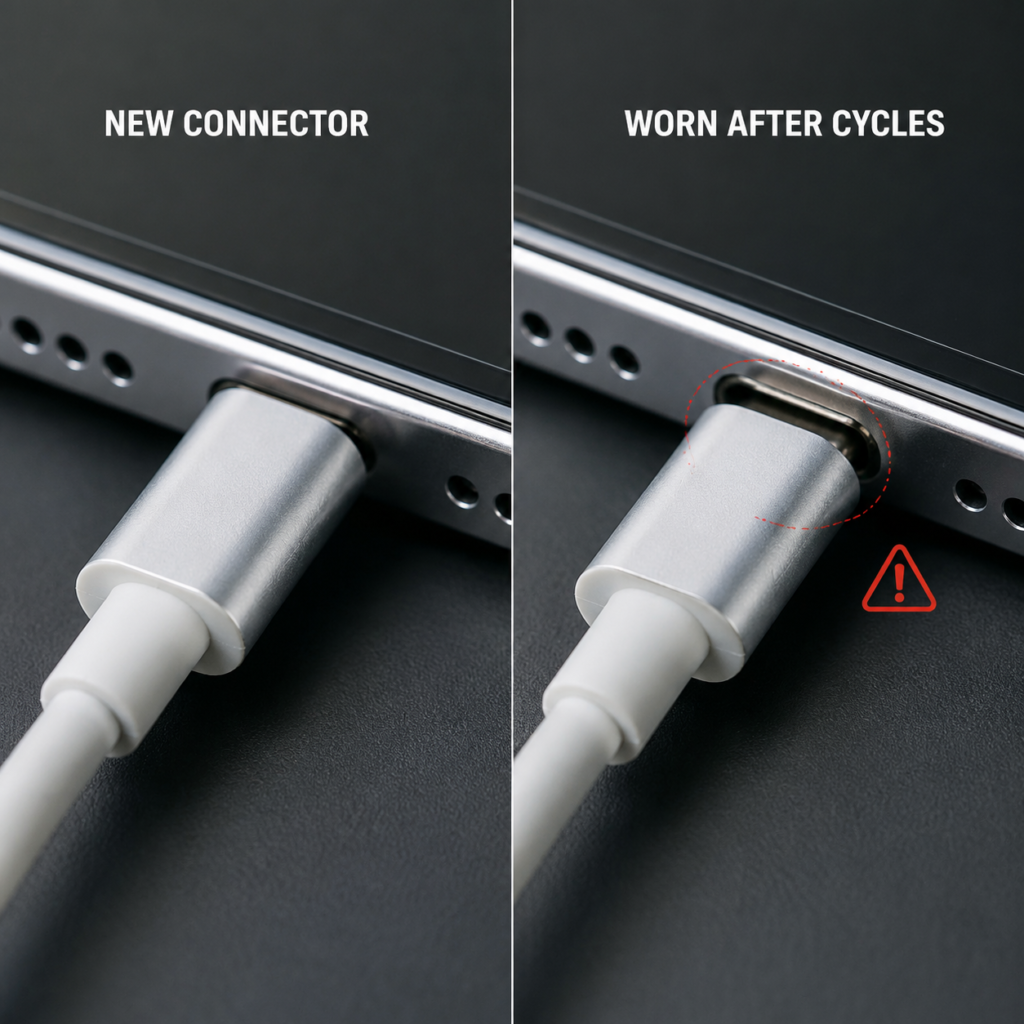
What Is Insertion/Extraction Cycle Testing?
At its core, insertion/extraction cycle testing simulates repeated plugging and unplugging to evaluate the mechanical durability of connectors and their attached cable assemblies.
But the goal isn’t just to check if the connector still fits after thousands of cycles. Testers also measure contact resistance, insulation performance, signal integrity, and real-world functionality to confirm the product still works reliably after repeated use.
A key note: this test specifically assesses the durability of the connector interface itself. It does not measure the full lifespan of the entire cable. Separate tests evaluate things like flex resistance, tensile strength, and tolerance to high temperatures or humidity — these should not be confused with insertion/extraction lifespan.
What Products Require This Testing?
Nearly any cable or connector designed for repeated plugging and unplugging undergoes some form of this testing. Common categories include:
- Consumer electronics: USB-C, USB-A, Lightning, HDMI, DisplayPort, 3.5mm audio cables, and other everyday connectivity gear
- Networking & industrial: RJ45 Ethernet assemblies, internal equipment wiring harnesses, industrial charging connectors, and custom specialty connectors
There is no universal cycle count requirement across all product types. Exact test parameters and pass criteria are set by the relevant interface specification, product standard, certification rules, or the manufacturer’s internal technical requirements.
How to Interpret Insertion/Extraction Lifespan Standards
If insertion lifespan is so important, there must be a universal official passing score all cables have to meet, right? This is one of the most common misconceptions about this type of testing.
There Is No Universal “Passing” Cycle Count for All Cables
Rated insertion cycle counts can come from international standards, national standards, industry specifications, connector manufacturer datasheets, or even a brand’s own internal quality requirements. There is no single number that applies to every cable on the market.
Common certification schemes like USB-IF, HDMI, MFi, UL, and CCC each have different scope and audit criteria. A “certified” label does not automatically guarantee a uniform insertion lifespan across all products. When shopping for cables or reviewing test reports, always confirm the standard number, version, applicable interface type, test sample details, and specific failure criteria. A standalone cycle count number is meaningless without this context.
Common Product Reference Guide
Different cable types have different priorities when evaluating insertion lifespan. Use this quick reference when comparing products:
| Product Category | Key Factors to Verify | Usage Note |
|---|---|---|
| USB-C/USB-A Cables | Connector specifications, product certifications, rated cycle count, and supporting test reports | Requirements vary by terminal design, build structure, and certification version |
| HDMI/DisplayPort Cables | Interface specification version, mechanical durability, signal integrity, and functional retention | Cycle counts cannot be evaluated in isolation from the full product specification |
| Lightning Cables | Certification status, connector build quality, and the manufacturer’s test methodology | Certification does not guarantee a uniform lifespan across all use cases |
| RJ45 Ethernet Assemblies | Applicable connector standard, rated cycle count, and termination method | Fixed-installation setups are not designed for frequent plugging/unplugging |
Rated Cycles Don’t Equal Real-World Service Life
Many people see a rated cycle count and do quick math to estimate years of use: for example, 10,000 cycles at 2 insertions per day = roughly 13 years of use.
This formula (estimated years = rated cycles ÷ daily insertions ÷ 365) is only a very rough theoretical estimate — it is never a real lifespan guarantee. Rated cycles are a pass/fail metric measured under controlled test conditions with specific samples, and they do not mean every unit from the same batch, paired with every device port, in every use case will hit that number.
Real-world lifespan depends on dozens of factors: if you jam the cable in at an angle every time, or yank the cable body to unplug, it might fail after just a few thousand cycles. If you handle it carefully and use it in a clean, dry environment, it might last well past its rated count. Wear on your device’s own port, dust or moisture in the port, and frequent hot-plugging can also shorten or extend usable life.
How Do Professional Labs Run Insertion/Extraction Cycle Tests?
You might be thinking: it’s just plugging and unplugging over and over — how complicated can it be? The rigor of formal testing lies in the details. Change even one parameter, and results can shift dramatically.
Pre-Test Setup & Confirmation
Before any testing begins, all parameters are locked in — no adjustments are made mid-test. Teams first confirm:
- Core parameters: Applicable standard, target cycle count, number of test samples, insertion direction (straight vs. angled), insertion/extraction speed, stroke length, and test temperature/humidity
- Test state: Unpowered mating, or powered/loaded mating? Will data, audio/video, or power run continuously during testing?
- Baseline data: Full records of sample batch numbers, initial appearance, insertion/extraction force, contact resistance, insulation performance, and functional status, to use as a comparison for post-test results.
Typical Test Workflow
Formal insertion/extraction testing follows a fixed process to ensure results are repeatable and reliable:
- Sample Preparation & Initial Inspection: First, technicians check samples for cosmetic defects, correct dimensions, and undamaged terminals, then run full initial electrical and functional tests to confirm samples are conforming. Testing a pre-damaged sample would produce invalid results.
- Equipment Calibration: The automated insertion/extraction tester’s force, displacement, speed, and counting functions are calibrated to ensure every cycle uses consistent force, depth, and speed. Technicians also adjust the sample fixture to avoid clamping too tight or off-center, which would add extra stress to the cable and cause damage from the fixture, not the mating cycles themselves.
- Cycle Testing: Repeated insertions and extractions run per the pre-defined plan. Some standards or test plans require periodic pauses — for example, stopping every 1,000 cycles to check for obvious mechanical damage and confirm testing can continue.
- In-Process Monitoring: Testing isn’t just counting cycles. Teams monitor key metrics in real time or at set intervals: whether insertion/extraction force changes drastically, if contact resistance exceeds limits, if there are intermittent disconnections, if signal transmission has anomalies, or if the connector shows cracks or deformation.
- Post-Test Re-Inspection: Once the target cycle count is reached, technicians re-test every metric measured in the baseline — mechanical, electrical, signal, and functional — and compare results to the initial data.
- Result Determination: Samples are judged pass/fail based on the pre-defined failure criteria, and a full test report is compiled.
Common Test Equipment
A fully compliant insertion/extraction test requires a range of specialized gear:
- Core test equipment: Automated insertion/extraction cycle testers with force and displacement sensors, which precisely control speed, stroke, and force, and log real-time changes in insertion/extraction force.
- Electrical performance test gear: Contact resistance testers, insulation resistance testers, and high-voltage insulation (dielectric withstand) testers, to check if the connector’s electrical performance degrades over cycles.
- Functional & signal test gear: USB protocol analyzers, network testers, audio/video signal analyzers, or corresponding electronic loads, to verify that data transfer, charging, and A/V transmission work properly throughout testing.
- Environmental test gear: Temperature/humidity chambers, salt spray chambers, and other environmental test units. These are only used if the test plan explicitly calls for testing under specific environmental conditions; standard tests run at room temperature and humidity.
What Counts as a Pass for Insertion/Extraction Cycle Testing?
Many people assume the only pass criteria is “the connector still fits after N cycles,” but formal testing requires meeting both mechanical and electrical/signal performance benchmarks.
Mechanical Requirements
First, the connector must have no cracks, deformation, or loose components that interfere with normal use. Locking latches or retention clips must still function correctly, and terminals cannot be abnormally deformed, dislodged, or excessively worn.
Additionally, mechanical parameters like insertion/extraction force and retention force must stay within the ranges defined by the applicable standard or product specification. If post-test insertion force is out of spec or the connector is hard to plug in, that counts as a mechanical failure.
Electrical & Signal Requirements
These are more critical than mechanical specs, since the entire purpose of a cable is to carry power or signals. Requirements include:
- Basic electrical metrics (contact resistance, insulation performance, high-voltage insulation resistance) meet applicable standards or the manufacturer’s technical specifications
- Power delivery, data transfer, networking, audio, and video functions work normally
- No prohibited anomalies, such as sustained disconnections, abnormal overheating, screen flickering, audio static, or reduced transfer speeds
Common Failure Modes
Tests typically see three broad categories of failures, each with distinct symptoms and root causes:
| Failure Type | Typical Symptoms | Common Causes |
|---|---|---|
| Mechanical Failure | Loose fit, broken latch, cracked housing | Poor material quality, flawed structural design, improper fixturing, or uneven insertion force |
| Contact Failure | Intermittent connection, overheating, random disconnections | Wear, oxidation, contamination, or terminal deformation |
| Signal/Functional Failure | Charging dropouts, reduced transfer speeds, screen flickering, data loss | Changes in contact parameters or degraded high-speed signal integrity |
What Factors Impact Insertion/Extraction Lifespan?
Have you ever wondered why two USB-C cables can have wildly different lifespans — one failing after a year, the other working perfectly after three or four? The difference comes down to two broad categories of factors.
Product Design & Manufacturing
A product’s design and build quality are the foundation of its insertion lifespan:
- Terminal material, surface finish, plating type, and plating thickness all affect wear and corrosion resistance. You can’t judge lifespan just by labels like “gold-plated” or “tin-plated” — plating quality and thickness matter far more than the material name alone.
- Structural design is equally critical: how well the alignment guide helps you plug the connector in straight, how well the terminal’s spring design retains clamping force after repeated use, how strong the housing is, and whether there’s a strain relief structure at the cable-connector joint to protect solder joints from pulling force.
- Manufacturing consistency also plays a big role: mold precision, alignment between the connector and cable during assembly, and consistent soldering or crimp quality — all these small details add up to affect final lifespan.
Usage Environment & Operation
How you use and store your cables can have an even bigger impact on lifespan than differences in product quality:
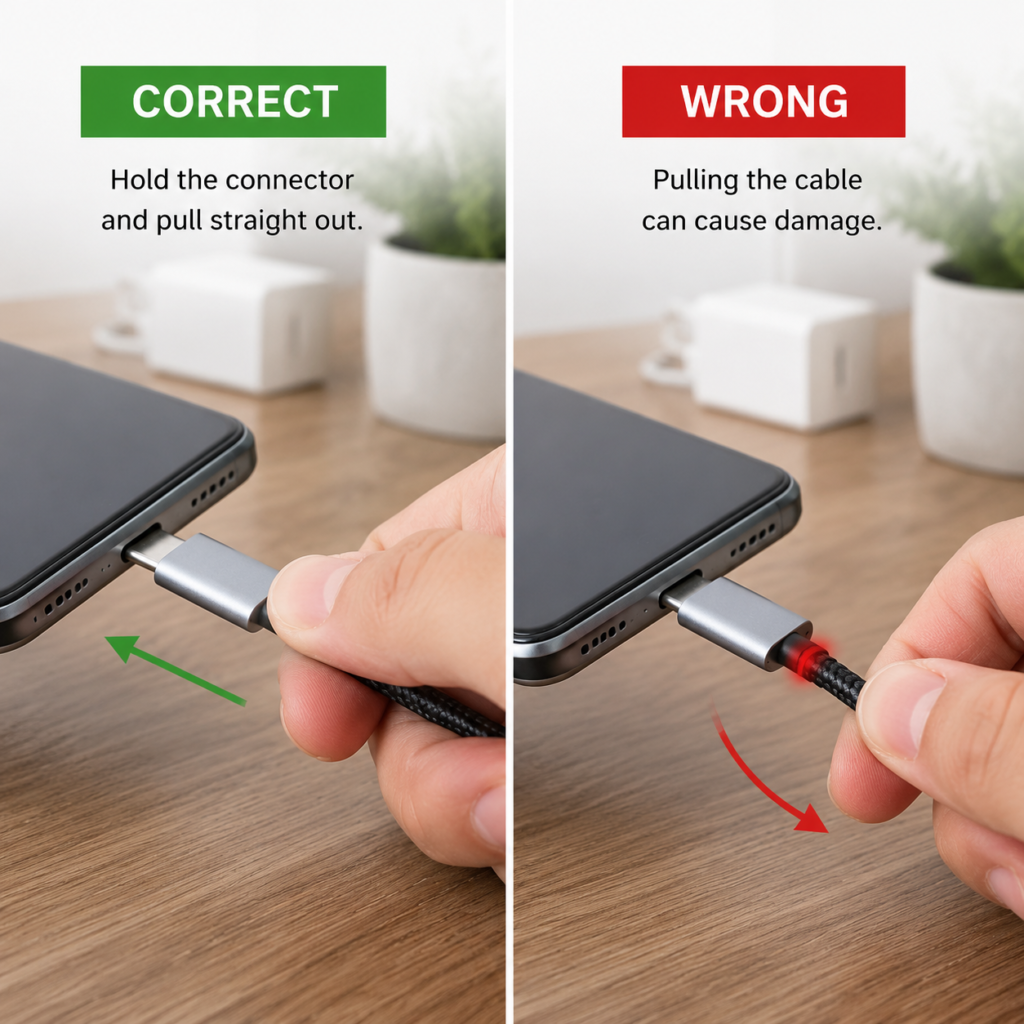
- Poor usage habits: plugging in at an angle, forcing the connector, or yanking the cable body to unplug all put extra stress on terminals and solder joints, speeding up failure drastically.
- Environmental factors: dusty, humid, salty, high-temperature, or corrosive environments accelerate terminal oxidation and wear, making contact performance degrade faster.
- An often overlooked factor: the condition of your device’s own port. If the port is already worn, deformed, or full of dust, even the highest-quality cable will fail early. This also applies to lab testing — if the test receptacle is defective, the test results will be inaccurate.
- As for the common question “does hot-plugging damage cables?” — there’s no one-size-fits-all answer. Risk depends on the interface’s structural design, power level, load state, voltage/current, and the device’s control logic. Many consumer interfaces are designed to support hot-plugging, but real-world risk still varies by use case. For high-power charging or abnormal load scenarios, always follow the device’s instructions to avoid unnecessary risk.
Shopping & Care Tips for Consumers
Now that you understand what affects insertion lifespan, you can make smarter buying choices and take simple steps to make your cables last longer.
What to Check When Buying Cables
Don’t fall for flashy “10,000+ cycles” marketing claims without context. Focus on verifying these details:
- Clear, tied specifications: Does the listing clearly state the test standard the rating is based on, the rated cycle count, and which specific product model that rating applies to? A generic “10,000 cycles” claim with no tied model number is meaningless.
- Test transparency: Does it disclose sample size, test conditions, failure criteria, and specific test results? For example, did they test 10 samples and all passed, or just 1? Was the test run to a formal industry standard, or a casual in-house test? Did they only check if the connector still fits, or did they also measure contact resistance and signal performance?
- Relevant certifications (with context): Does the product have certifications or third-party test reports matching its type? Note: a certification label is not a replacement for specific test data. For example, an MFi-certified Lightning cable meets MFi program requirements (which may include insertion testing), but that doesn’t guarantee it hits a specific cycle count — you still need to check supporting test data for that.
- Red flags for hype: If you see over-the-top claims like “ultra-high cycle count” or “permanent durability,” always ask the seller for verifiable test documentation — odds are it’s just marketing fluff.
Proper Usage Habits to Extend Lifespan
Even a top-quality cable will last far longer if you use it correctly:
- Align the connector with the port and plug it in straight. Avoid jamming it at an angle or twisting it, which wears down terminal contacts quickly.
- To unplug, grip the rigid connector housing and pull straight out. Never yank the flexible cable body — over time, this can break the joint between the cable and connector, or loosen internal solder joints.
- Keep ports clean and dry. When cleaning ports, never use metal objects to dig out debris, and don’t pour liquid directly on the port. Use a dry soft brush or lint-free cloth to gently wipe away dust.
- If you notice the cable fits noticeably loose, gets abnormally hot during use, has a strange smell, disconnects frequently, or has damaged outer insulation, stop using it immediately and inspect both the cable and your device’s port for damage.
Limitations of At-Home Checks
It’s important to set realistic expectations: visual checks and a few test plug-ins at home can only catch really obvious loose fits or complete functional failures. They cannot prove a cable actually meets its rated cycle count.
For example, a cable rated for 10,000 cycles might work fine after 100 plug-ins, but that doesn’t mean it will still perform to spec after 10,000. Key metrics like contact resistance, insulation performance, and high-speed signal quality require professional lab equipment to measure accurately — you can’t test these at home.
How to Read an Insertion/Extraction Cycle Test Report
If you’re a small business owner validating product quality, or you want to fact-check a seller’s claims, don’t just look for the “Pass” stamp on the last page of the report. Focus on verifying these key details:
- Test basis: What standard was used, what version of the standard, and does it apply to the interface type in question? Watch out for outdated standard versions or unrelated standards being used to inflate credibility.
- Sample information: How many samples were tested, what are their batch numbers and model numbers, and how were samples selected? Were they randomly sampled from production, or hand-picked perfect units provided by the manufacturer?
- Test parameters: What was the total target cycle count? What were the insertion speed, stroke length, and direction? Was testing done powered or unpowered? Was data or power transmitted continuously during testing?
- Environmental conditions: What temperature and humidity was the test run at? Were there any special stressors like dust, corrosion, or extreme temperatures?
- Test data: What were the pre- and post-test values for insertion/extraction force, contact resistance, insulation performance, and functional tests? Is there a clear side-by-side comparison?
- Determination details: Is there a clear, documented set of failure criteria? Were there any anomalies during testing, with supporting photo evidence? What is the final conclusion?
The more complete the report, the easier it is to verify its credibility. If key information is missing, treat the conclusion with skepticism and ask for supplementary documentation if possible.
Frequently Asked Questions
Can I convert rated cycle count directly to years of use?
No. Rated cycles are a pass requirement measured under specific controlled test conditions, and cannot be directly equated to real-world lifespan across all use cases. The rough math calculation is only a theoretical estimate, not a guarantee. Real lifespan is affected by your usage habits, the condition of your device’s port, the operating environment, and load conditions — it could be much shorter than the theoretical estimate, or even longer.
Does a higher cycle count always mean a more durable cable?
Not necessarily. The value of a cycle count rating is always tied to its test basis, sample size, pass criteria, and test conditions. For example: a product rated for 5,000 cycles tested to a formal international standard with 10 samples, passing all mechanical, electrical, and signal criteria, is far more reliable than a product rated for 20,000 cycles tested informally in-house by the manufacturer with 1 sample, only checking if the connector still fits. Comparing standalone numbers is meaningless without context.
Will a cable fail immediately once it hits its rated cycle count?
No. Rated cycles are just the pass/fail threshold under specific test conditions with specific samples — meaning under the defined test environment, insertion method, and mating port, the product still meets requirements at that count. Past that number, performance might hold for a long time, or it might degrade gradually (for example, contact resistance slowly increases, or the fit gets looser over time). It won’t suddenly break the second it hits the rated count, so you can’t use the rated number to guarantee remaining lifespan in all scenarios.
Is hot-plugging always worse for cables?
Not necessarily. Risk level depends on the interface’s structural design, power level, load state, voltage/current, and the device’s control logic. Many consumer interfaces are designed to support hot-plugging, but you should still be mindful of power levels and device state, especially for high-power charging scenarios. Always follow the product’s instructions to avoid abnormal risks.
How do I tell if an advertised insertion lifespan is trustworthy?
The core rule is: look for verifiable evidence. Prioritize products that come with full third-party test reports, which include clear test standards, sample details, test conditions, failure criteria, and specific test data. Don’t just trust big numbers on marketing pages — many unsubstantiated claims are just hype.
Final Takeaways
Insertion/extraction cycle testing is a critical evaluation for cable and connector reliability — but it’s never just a single numbers game. There’s no universal pass threshold that applies to every interface or product type; requirements always depend on the applicable standard, product specification, or technical requirements.
Whether you’re reviewing a test report or shopping for everyday cables, never fixate only on the cycle count. Always consider the test conditions, pass criteria, and sample details together. In daily use, proper plugging/unplugging habits, clean ports, and avoiding cable yanking can reduce a lot of unnecessary damage — but these care tips can never replace formal testing and solid product quality control.