
Introduction
If you or a family member uses a CPAP machine, insulin pump, portable oxygen concentrator (POC), or even a simple home blood glucose meter, you’ve almost certainly faced this moment: the original charger is missing, and you reach for the nearest USB-C phone charger to plug it in. It fits. It seems to charge. But is it actually safe?
Charging a medical device is not the same as charging a phone. A bad charging experience for your phone means a dead battery at worst. For a medical device, it can mean interrupted treatment, inaccurate health readings, or even preventable safety risks.
This guide breaks down everything you need to know about portable medical device charging, written for regular people—not electrical engineers. We’ll cover what chargers are safe to use, how USB-C really works for medical gear, air travel rules, simple battery care tips, and quick checks to keep your devices running reliably when you need them most.
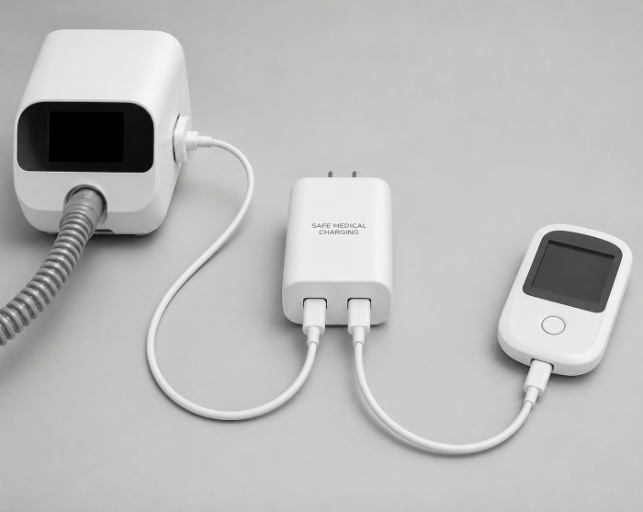
Key Takeaways
✅ Always follow your device manufacturer’s official instructions first—this is the number one rule for medical device safety.
✅ Medical device charging prioritizes patient safety and consistent power over fast charging speeds; a charger that works for your phone may not be safe for medical equipment.
✅ A USB-C plug shape tells you nothing about safety. USB-C is just a connector standard—safety depends on internal isolation, certification and protocol compatibility.
✅ High-risk and life-support devices (like CPAPs, oxygen concentrators and infusion pumps) require manufacturer-approved power supplies; regular consumer power banks are not recommended for these devices.
✅ When shopping for chargers, look for clear medical safety certifications instead of judging by price, size or marketing claims.
1. Can You Use a Phone Charger for a Medical Device?
This is the single most common question people ask, and the short answer is: it depends on your device’s risk level.
1.1 Why Medical Devices Need Extra Charging Safety
Think of a regular phone charger as a screen door between your home’s high-voltage wall power and your device. It keeps out big problems, but it isn’t built to stop tiny, potentially dangerous issues from reaching you. A medical-grade charger is a reinforced, fire-rated safety wall, designed to block stray electrical current, power surges and interference from ever reaching the person touching the device.
If a phone charger has a minor electrical fault, the worst outcome is usually a broken phone. If a medical charger fails, that stray current can pass directly through a patient’s skin (or even to internal devices like pacemakers), cause treatment to stop abruptly, or throw off sensitive sensor readings for things like blood sugar or heart rate.
1.2 Match Your Device to Its Risk Level
Not all medical devices have the same charging requirements. Use this simple breakdown to find what applies to you:
| Risk Level | Common Devices | Charging Guidance |
|---|---|---|
| Low Risk (short-term, no direct sustained skin contact) | Basic digital thermometers, some entry-level blood glucose meters, pill reminders | Standard certified consumer USB chargers are usually acceptable per manufacturer guidance |
| Medium Risk (sustained skin contact, health monitoring) | Home blood pressure monitors, pulse oximeters, wearable ECG monitors, hearing aids | Manufacturer-recommended chargers are preferred; certified third-party medical chargers work as backups; avoid cheap unbranded chargers |
| High Risk (treatment delivery, continuous use) | Insulin pumps, CPAP/BiPAP machines, portable nebulizers, sleep apnea devices | Only use manufacturer-approved or IEC 60601-1 certified medical-grade chargers; regular consumer power banks are not recommended for daily use |
| Life Support / Critical Care | Portable ventilators, infusion pumps, cardiac monitors, patient-controlled pain pumps | Only factory-original chargers and approved backup batteries; always keep a fully charged backup power source ready |
2. How to Tell If a Charger Is Actually Medical-Grade
You don’t need a degree in electrical engineering to spot a safe charger. You just need to know what to look for.
2.1 The Core Global Safety Standard: IEC 60601-1
Virtually every legitimate medical-grade power supply in the world is built to meet IEC 60601-1, the global baseline standard for medical electrical equipment safety.
For high-risk devices that touch patients, this standard typically requires dual patient protection (often marked 2×MOPP)—think of this as two separate locks on a door, rather than one. It adds extra layers of insulation between wall power and the patient-facing side of the device, tightly controls stray electrical current, and requires rigorous testing for long-term reliability. Exact requirements vary by device type and use case, but the mark is a reliable sign the charger was built for medical use.
2.2 10-Second Safety Check for Any Charger
Before you plug any charger into your medical device, run these three quick checks:
- Check the manufacturer approved list first: The safest option is always a charger explicitly listed as compatible in your device manual or official manufacturer website.
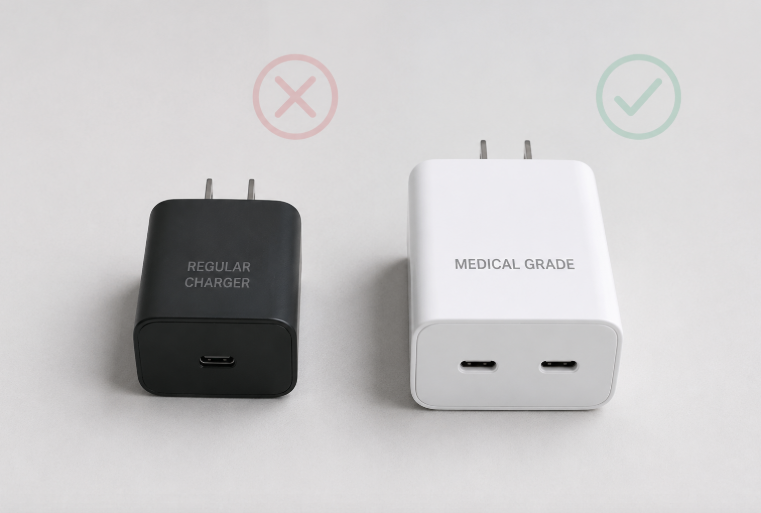
- Look for medical safety markings: Legitimate medical chargers will print text like “IEC 60601-1 compliant”, “Medical Grade”, or “2×MOPP” directly on the charger housing or official product page.
- Look for third-party safety marks: Recognized independent testing marks like UL, ETL, TÜV or CSA mean an outside lab tested the charger for safety, rather than the manufacturer just claiming it works.
Red flags to skip:
- No safety markings at all, only marketing terms like “fast charge” or “universal”
- Prices that seem too good to be true (medical-grade components and testing cost more to produce)
- Chargers that only show a basic CE mark without noting medical compliance—standard consumer CE marking does not mean it meets medical safety rules.
3. USB-C Charging for Medical Devices: What You Need to Know
USB-C is quickly becoming the standard port for almost all new portable medical devices, but there are critical facts most people don’t know.
3.1 USB-C Is Just a Shape—Not a Safety Guarantee
The oval USB-C plug tells you how the cord fits into the port. It tells you nothing about how safe the charger is, how much power it can deliver, or if it will work correctly with your device. A $5 unbranded USB-C phone charger has the exact same plug shape as a $60 medical-grade USB-C charger, but it does not have the same safety protections.
3.2 How USB-C Power Delivery (PD) Works for Medical Gear
When you plug in a USB-C charger, the charger and device have a quick digital “handshake” to agree on a safe, matching power level—this system is called USB Power Delivery, or PD.
- Safe medical USB-C chargers are programmed to automatically fall back to a low, safe 5V power level if they can’t confirm full compatibility, to avoid damaging the device or delivering unstable power.
- Most medical devices do not work with proprietary phone fast-charging systems (like OnePlus Warp Charge, Xiaomi HyperCharge or Samsung Super Fast Charge 2.0). They are built to work only with standard USB-C PD.
3.3 Do You Need a Special USB-C Cable?
For high-power devices (like CPAP machines or oxygen concentrators that use 60W or more), you will need a USB-C cable with a built-in E-Marker chip (usually labeled “5A” or “100W/240W PD”). Regular, basic USB-C cables can’t carry that much power safely, and may cause charging errors or slow charging.
For low-power devices (glucose meters, oximeters), good-quality standard USB-C cables work perfectly fine.
3.4 A Note on Wireless Charging
Wireless charging is convenient for small, low-power devices like hearing aids or some insulin pumps, because it has no exposed ports to get wet or gunked up. It does create small magnetic fields, however: if you have an implanted medical device (like a pacemaker or defibrillator), always follow your device manufacturer’s guidance for safe distance from wireless chargers to avoid interference.
4. Simple, Safe Battery Care for Medical Devices
You don’t need fancy battery tricks to keep your medical device batteries working well.
All modern medical device batteries have a built-in Battery Management System (BMS)—think of this as a 24/7 security guard for your battery. It automatically controls charging speed, stops charging when the battery is full, cuts power if the battery gets too hot, and prevents damage from over-discharging.
For simple, safe care:
- Avoid fully draining your battery for long periods when you can, but always prioritize having your device charged and ready for use over battery lifespan tips. There is no benefit to running a CPAP or insulin pump battery all the way down to “save battery health”.
- For long-term storage, follow your device manual’s guidance. Most manufacturers recommend storing batteries at a partial charge in a cool, dry place, and topping them up every few months.
- Stop using a battery immediately if it becomes swollen, unusually hot to the touch, or starts leaking. Contact the manufacturer for an official replacement—never use third-party knockoff batteries, which often skip safety testing.
5. Charging Tips for Every Common Scenario
5.1 At Home
- Keep your primary charger in a fixed, well-ventilated spot away from sinks, showers, beds or soft blankets that can block airflow and trap heat.
- Label chargers for different devices if multiple people in your home use medical gear, to avoid mixing them up.
- Keep one fully tested backup charger for high-risk devices, in case your primary one breaks or gets lost.
5.2 In Hospitals or Clinical Settings
- Only use hospital-provided chargers or your own approved medical chargers. Public wall USB ports in hospital rooms are not designed for medical devices, and are not recommended for treatment gear.
- Wipe down charger surfaces with disinfectant wipes approved in your device manual to avoid cross-contamination.
- Follow nursing staff guidance about charger placement to avoid interference with other medical equipment in the room.
5.3 In the Car / Emergency Transport
- Standard car USB ports are not built for medical devices—they have unstable power and no safety isolation. Always use a car charger explicitly approved by your device manufacturer, which includes protection against vehicle power surges.
- If you use your device in an ambulance or emergency transport, choose devices that support “hot swap” battery changes, so you can switch batteries without interrupting treatment.
5.4 Air Travel & International Trips
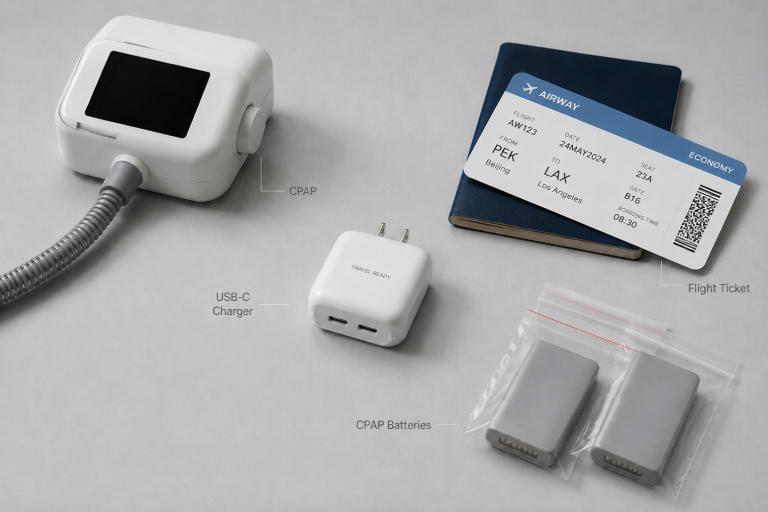
- FAA/IATA battery rules (global standard):
- Batteries under 100Wh are allowed in carry-on bags with no prior approval
- Batteries 100–160Wh require advance approval from your airline, with a limit of 2 spare batteries per person
- All spare lithium batteries must go in your carry-on bag—never put loose batteries in checked luggage. Cover battery terminals with tape or original packaging to avoid short circuits.
- Voltage note: Almost all medical-grade chargers work with 100–240V global voltage. You will only need a cheap plug adapter for other countries, not a heavy voltage converter.
- TSA/security tip: Bring a printed copy of your doctor’s note (in English for international trips) and your device manual to make security screening faster. You do not need to remove medical devices from your bag for screening in most countries.
5.5 Power Outages / Off-Grid Use
- For high-risk devices, only use portable power stations explicitly approved for medical use. Regular consumer power banks often have unstable power output that can disrupt medical device function.
- Keep backup disposable batteries on hand for devices that support them, for multi-day outages.
- If you use solar chargers, only use models tested and approved by your device manufacturer.
6. How to Choose Safe Charging Accessories
6.1 Chargers
- Life-support/high-risk devices: Buy only factory-original chargers from the manufacturer or authorized sellers.
- Medium-risk monitoring devices: Third-party chargers are acceptable if they explicitly state IEC 60601-1 medical compliance and list your exact device model as compatible.
- Skip cheap no-name chargers from unknown third-party sellers, even if they list the correct wattage.
6.2 Charging Cables
- Choose cables with thick, durable strain relief at the ends to avoid fraying and breakage.
- For devices that get disinfected regularly, pick cables with chemical-resistant outer jackets that hold up to alcohol or bleach wipes.
- Replace cables immediately if you see fraying, exposed wires, or loose connections.
6.3 Portable Power Banks / Backup Power
- Do not use standard consumer power banks for life-support devices.
- For backup use, look for power banks explicitly labeled for medical device use, with low-noise, stable power output.
- Check the wattage rating to make sure it can supply enough power for your device (most CPAP machines need 65W or more, for example).
7. Simple Troubleshooting for Common Charging Issues
You don’t need to be a technician to fix most common charging problems:
- 7.1 Device won’t charge at all
- First test the wall outlet with a lamp or phone to make sure it has power
- Try a different compatible cable to rule out a broken cord
- Gently clean lint or dust out of the charging port with a dry wooden toothpick
- If the battery was fully drained, leave it plugged in for 30 minutes—some devices take time to wake up from a full discharge
- Contact manufacturer support if it still won’t charge
- 7.2 Charging is much slower than usual
- Double check that you are using the correct wattage charger for your device
- Move the device to a room-temperature spot—extreme cold or heat will automatically slow charging to protect the battery
- Turn off high-power features (like heated humidifiers on CPAP machines) while charging
- Slow charging on an older device usually means the battery is reaching the end of its life and needs replacement
- 7.3 Charger or device gets unusually hot
- Unplug it immediately and move it to a cool, open area to cool down
- Check that you are using the correct approved charger and cable
- Make sure the charger and device are not covered by blankets, clothing or other items blocking airflow
- If it stays uncomfortably hot after cooling, stop using it and contact support
8. Common Charging Mistakes to Avoid
| Common Mistake | Risk | Safe Alternative |
|---|---|---|
| Using any USB-C charger that fits | Wrong voltage or missing safety isolation can damage devices or create risk | Only use chargers approved for your specific device model |
| Using a regular phone power bank for CPAP/oxygen concentrators | Unstable power output can interrupt treatment | Use a manufacturer-approved medical portable power station for backup |
| Assuming higher wattage = safer charger | Safety depends on certification and design, not power numbers | Check for medical safety marks instead of buying the biggest charger |
| Using wireless chargers right next to implanted devices like pacemakers | Magnetic fields may interfere with some implanted devices | Follow your doctor/device maker’s guidance for safe distance |
| Waiting until the battery is completely dead to charge | Deep discharges can shorten battery life and leave you without power in an emergency | Keep high-risk devices topped up whenever possible |
| Buying cheap replacement batteries/chargers from random online sellers | Knockoff parts often skip safety testing and can overheat | Buy replacement parts only from authorized sellers |
| Covering chargers/devices while charging | Trapped heat causes buildup that can damage devices | Charge on hard, flat, open surfaces with nothing covering the device |
9. Frequently Asked Questions (FAQ)
- Can I charge my CPAP machine with a regular USB-C laptop charger?
Only if the charger is explicitly approved by your CPAP manufacturer for your specific model. Many laptop chargers lack medical-grade isolation and may not deliver the consistent, stable power CPAP machines need. - Do I need a voltage converter for international travel with my medical device?
Almost all medical-grade chargers support 100–240V global voltage, so you will only need a plug adapter for your destination country, not a voltage converter. Always check the fine print on your charger label to confirm. - Can I bring my portable oxygen concentrator battery on a plane?
Yes, for most standard batteries under 100Wh. Batteries between 100–160Wh require advance airline approval. All spare batteries must travel in your carry-on bag, not checked luggage. - Are third-party medical chargers safe?
Third-party chargers are safe if they are certified to IEC 60601-1 standards and explicitly listed as compatible with your device by the manufacturer. Uncertified third-party chargers are not recommended for high-risk devices. - Can I use public USB ports (at airports, cafes, hospitals) to charge my medical device?
Public USB ports are not recommended for high-risk/treatment devices, as they often have unstable power and no safety isolation. Use your own wall charger in a power outlet, or an approved power bank. - Why are medical-grade chargers so much more expensive than phone chargers?
They use higher-quality safety components, reinforced isolation, and go through far more rigorous independent safety testing and certification, all of which adds to manufacturing cost. - Can I charge my device while I am using it for treatment?
Using an approved, certified charger is usually safe, but high-precision monitors may show minor reading interference while charging. Check your device manual for specific guidance. - What should I do if my battery is swollen?
Stop using it immediately. Do not charge it or puncture it. Dispose of it per local hazardous waste rules, and contact the manufacturer for a replacement.
10. Final Thoughts + Quick Safety Checklist
Charging portable medical devices does not need to be complicated. The single most important rule you can follow is to always use the accessories and guidance provided by your device manufacturer. You don’t need an engineering degree to stay safe—just look for proper safety certifications, skip untested cheap accessories, and keep backup power ready for emergencies.
As USB-C becomes the universal charging standard for more medical devices, always remember: a plug that fits is not the same as a charger that is safe.
Save this quick checklist to keep with your device for easy reference:
- 10.1 Before buying a charger
- It is explicitly approved for your exact device model
- It lists IEC 60601-1 / medical-grade compliance
- It has recognized third-party safety certification (UL/ETL/TÜV)
- You are buying from an authorized, reputable seller
- 10.2 Daily use checks
- You are using approved chargers and cables only
- Charging area is cool, dry and well-ventilated
- Cords and chargers have no cracks, fraying or damage
- High-risk devices are kept charged for emergency use
- 10.3 Travel prep
- Pack your primary charger + backup charger
- Bring the correct plug adapters for your destination
- Spare batteries are protected and packed in carry-on
- Bring a copy of your doctor’s note/device prescription
- 10.4 Emergency prep
- Backup battery/power bank is fully charged
- You have a backup power plan for outages
- You know how to swap batteries without interrupting treatment (if applicable)