
Summary
Charger potting compound is a polymer-based encapsulation material poured into the internal gaps of power adapters, curing into a solid protective layer that serves as an important reliability and protection layer inside modern fast chargers and GaN power supplies. Unlike basic housing seals or thin surface coatings, potting delivers six major protective benefits — electrical insulation, thermal management, environmental sealing, mechanical reinforcement, flame retardancy, and vibration/noise reduction — with additional EMI improvement in specific designs, plus added anti-tamper protection.
This guide breaks down how power adapter encapsulation works, compares the four main material types, explains design differences across charger categories, teaches you to spot quality potting without disassembly, and clears up the most common misconceptions. By the end, you will understand exactly why this invisible layer makes such a dramatic difference in charger safety, reliability, and lifespan.
1. Introduction: Why Modern Fast Chargers Rely on Potting Protection
1.1 A Relatable Starting Point
We have all been there: you drop a charger on a hard floor, accidentally splash water near it, or notice it gets uncomfortably hot during a fast-charging session. Some chargers shrug off these incidents and work reliably for years. Others fail within months, develop electrical faults, or even become safety hazards.
What most users never see is the difference hidden inside the plastic case: a professionally engineered electronic potting compound design.
1.2 Five Inherent Risks Inside Every Modern Charger
Today’s fast chargers pack high-voltage AC input circuits, high-frequency switching controllers, MOSFET or GaN power devices, transformers, capacitors, and inductors into an increasingly compact body. Under daily use, they face five persistent threats:
- High-voltage breakdown and arc discharge
- Concentrated heat buildup at power components
- Moisture, dust, and corrosive contaminants
- Mechanical vibration and impact from drops or transport
- High-frequency switching noise and electromagnetic compatibility challenges
1.3 What Is Potting Compound, and What This Guide Covers
In engineering terms, potting compound is a polymer material used to encapsulate electronic components, providing electrical insulation, mechanical protection, environmental sealing, and thermal management. It starts as a liquid resin, flows into every gap around the PCB and components, then cures into a solid or rubber-like integrated structure.
This guide walks you through how it works, what materials are used, what real benefits it delivers, how to identify quality designs, and how to choose the right charger for your use case.
2. Charger Potting Basics: Principles, Process, Materials, and Protection Differences
2.1 Core Working Principle
Potting works by replacing the air gaps inside a charger with a purpose-engineered polymer. Air is a poor thermal conductor and can become an unreliable insulation medium under high-voltage, contaminated, or humid conditions.
By filling every void with a consistent dielectric material, potting significantly reduces unwanted air gaps, creates a continuous heat transfer path, and locks all components into a single stable assembly — delivering both structural and functional protection in one step.
Key takeaway: Potting does not add new features to a charger; it replaces empty air with a material that improves safety, heat flow, and durability.
2.2 Standard Manufacturing Process
A controlled production process is what separates quality potting from cheap filler:
- Material preparation: Depending on the chemistry, manufacturers may use single-component or two-component resin and hardener systems, precisely proportioned for consistent curing.
- Vacuum degassing: Trapped air bubbles are removed to avoid insulation weak points and thermal dead spots.
- Precision dispensing: Compound is injected into the charger housing to target critical areas or fill the full cavity.
- Controlled curing: Room-temperature or heated curing according to material specification.
- Quality testing: Electrical withstand, insulation resistance, and thermal performance verification.
2.3 Four Main Potting Material Families
Four polymer chemistries dominate the charger and electronics industry, each with distinct tradeoffs:
- Epoxy resin — Rigid, high dielectric strength, cost-effective
- Silicone — Flexible, wide temperature range, repairable
- Polyurethane (PU) — Balanced toughness, excellent impact and moisture resistance
- Acrylic — Fast-curing, low shrinkage, used in specialized sensor and small-component applications
2.4 Potting vs. Basic Housing Seal
A plastic case with a gasket only blocks large particles and liquid from the outside. It does nothing to protect components from condensation inside the case, from vibration loosening solder joints, or from reducing the possibility of voltage arcing across air gaps under abnormal conditions. Potting protects the electronics themselves from the inside out.
2.5 Potting vs. Conformal Coating: Key Differences
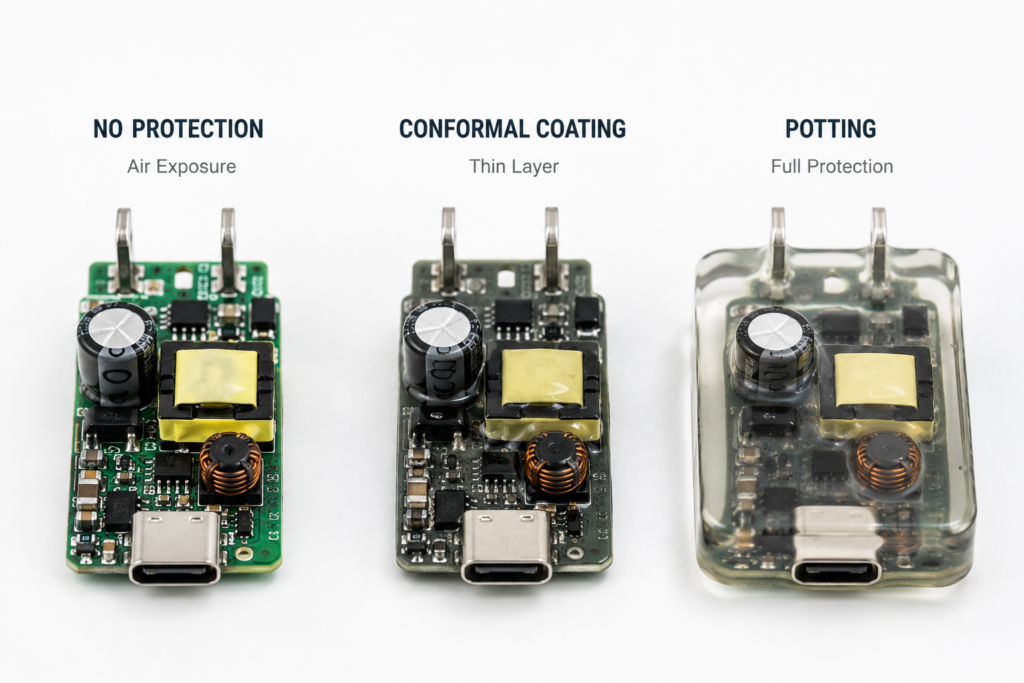
Conformal coating is a thin film sprayed or dipped onto a PCB, like a raincoat for the circuit board. Potting fully submerges the assembly in resin, like encasing it in a protective bunker.
| Feature | Potting Compound | Conformal Coating |
|---|---|---|
| Coverage method | Full 3D encapsulation | Thin surface film |
| Thickness scale | Millimeters | Micrometers |
| Mechanical protection | Excellent | Limited |
| Environmental protection | Excellent when combined with proper enclosure design | Moderate |
| Repairability | Difficult to impossible | Relatively easy |
| Weight added | Significant | Minimal |
| Best for | Harsh environments, high vibration, high voltage | Light indoor moisture and dust protection |
Key takeaway: If you only need basic dust protection for an indoor charger, coating is enough. If you need durability, heat spreading, and high-voltage safety, potting is the stronger solution.
3. Core Functions: Six Primary Benefits + Added Advantages
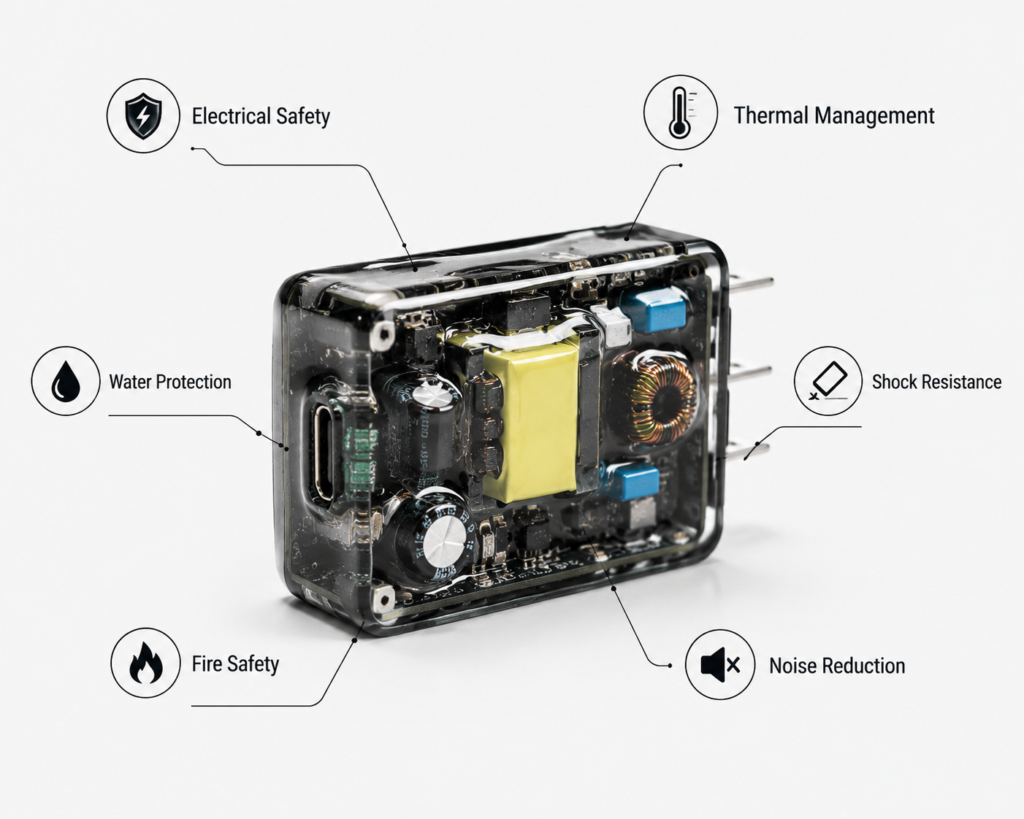
3.1 High-Voltage Electrical Insulation
Chargers contain mains-level AC voltages and high-frequency switching nodes with hundreds of volts of stress. Potting compounds typically offer dielectric strength in the range of 15–25 kV/mm, creating a robust insulating barrier. Typical values vary widely depending on resin chemistry, fillers, thickness, and testing conditions.
By filling gaps between live parts and the housing, potting improves effective insulation margins and helps maintain required creepage and clearance performance. This helps chargers meet UL and IEC safety standards, suppresses corona discharge and arcing, and reduces short-circuit and electric shock risk even in dusty or humid conditions.
Key takeaway: Potting is not just glue; it is a critical safety component that reinforces the electrical barrier between you and high-voltage internal parts.
3.2 Precision Thermal Management
Air is a thermal insulator. Standard unfilled resins have thermal conductivity around 0.2–0.3 W/m·K, while thermally conductive formulations loaded with ceramic fillers commonly reach around 0.6–2.5 W/m·K in practical charger applications.
Potting does not magically “cool” a charger — instead, it improves the continuity of the heat transfer path. Heat flows from hot components through the potting material to the outer housing, then to ambient air. This spreads hot spots more evenly across the housing, reduces peak component temperatures, and slows thermal aging. For high-power-density GaN chargers with limited internal airflow, this is a critical design tool.
Actual thermal performance depends on the complete thermal path, including PCB layout, component placement, and housing materials.
Key takeaway: Potting does not create cooling; it creates a better, more continuous path for heat to escape.
3.3 Multi-Dimensional Environmental Sealing
Once cured, potting forms a continuous barrier against water vapor, dust, oil, salt spray, and corrosive gases.
It is important to note that IP ratings depend on the complete product design — housing, seals, connectors, and potting together. When properly implemented, potting is a major contributor to achieving IP65, IP67, or higher ingress protection levels. It prevents PCB corrosion, metal pin oxidation, and leakage current caused by humidity, making chargers viable for humid environments such as kitchens, workshops, outdoor equipment, and industrial applications.
Key takeaway: Potting seals the circuit board itself, so even if moisture gets past the case, the electronics stay protected.
3.4 Mechanical Structural Reinforcement
Transformers, large capacitors, and inductors are heavy relative to their solder joints. Under drop impact or continuous vibration, they can tear solder pads and cause intermittent or permanent failures.
Cured potting locks every component to the PCB and the housing, distributing shock and vibration energy across the entire assembly instead of concentrating it at solder points. This is why chargers designed to pass IEC 60068 vibration and shock testing often use some form of potting or encapsulation.
Key takeaway: A potted charger behaves like one solid block, instead of a loose collection of parts held only by tiny solder joints.
3.5 Flame Retardant Safety
Some flame-retardant potting compounds are formulated to meet UL 94 V-0 requirements, the most widely recognized vertical burn standard for electronics plastics.
V-0 means the material self-extinguishes within 10 seconds after the flame is removed, with no flaming drips. In the event of an internal component failure and ignition, the potting layer slows flame spread, reduces molten dripping, and limits toxic smoke release — adding a vital layer of fire safety.
Key takeaway: Flame-retardant potting does not make a charger fireproof, but it buys critical time and reduces the severity of a failure.
3.6 Vibration Damping and Audible Noise Reduction
This function works on two levels:
- Mechanical noise reduction: High-frequency switching causes magnetostriction in transformers and inductors, creating the faint “coil whine” many users hear. Potting immobilizes these magnetic components and dampens vibration, significantly reducing audible noise.
- Secondary EMI assistance: Potting alone is not a primary EMI shield — shielding cans, PCB layout, and filter circuits carry that load. But certain filled formulations can help attenuate stray electromagnetic radiation and improve overall EMC performance as a secondary benefit.
Key takeaway: The biggest noise benefit is physical — stopping parts from buzzing — not electromagnetic shielding.
3.7 Added Benefit: Anti-Tamper and Design Protection
As a secondary advantage, fully potted assemblies hide component part numbers and PCB traces, raising the barrier to reverse engineering and counterfeiting. This is primarily a benefit for brands, not end users, but it contributes to the overall value of a well-engineered charger.
4. Reliability Standards and Testing
4.1 Industry Compliance Standards
Reputable charger potting materials and finished products are validated against global standards:
- UL 94 — Flammability safety
- IEC 62368-1 — Audio/video and information technology equipment safety (replacing legacy IEC 60950-1 in many applications)
- RoHS / REACH — Restriction of hazardous substances
- IEC 60068 — Environmental testing suite
4.2 Core Reliability Test Items
Potting performance is verified through a battery of accelerated life tests:
- Temperature cycling (alternating hot and cold)
- Damp heat and humidity exposure
- Vibration and mechanical shock
- Drop impact testing
- Dielectric withstand and insulation resistance testing
- Salt spray corrosion testing (for outdoor/automotive grades)
4.3 How Potting Improves Test Pass Rates
Potting reduces the three biggest failure modes in reliability testing: solder joint fatigue from vibration, corrosion from humidity, and electrical breakdown from moisture contamination. For chargers intended for harsh environments, potting is often the difference between passing certification and failing repeatedly.
Key takeaway: The certifications printed on a charger’s label are backed by real lab tests — and potting is one of the design tools that helps products pass them.
5. Application-Specific Potting Requirements by Charger Type
5.1 Smartphone and Laptop GaN Fast Chargers
GaN chargers pack extreme power density into tiny bodies. Their priorities are high thermal conductivity, low mechanical stress on tiny components, and stable performance at elevated temperatures. Silicone-based solutions are widely used in high-power-density GaN designs because of their flexibility and thermal stability; low-stress flexible materials are often preferred to reduce mechanical stress during thermal cycling.
5.2 Automotive and Outdoor Portable Chargers
These chargers face constant vibration, wide temperature swings, moisture, and road salt. Key requirements include thermal shock resistance, vibration damping, and robust moisture sealing. Polyurethane and flexible silicone formulations dominate here.
5.3 Industrial and Energy Storage Chargers
Industrial chargers demand extreme long-term reliability, high-voltage insulation, and chemical resistance. They prioritize high dielectric strength, long-term aging stability, and corrosion resistance. High-grade epoxy and specialty silicone systems are typical.
5.4 Low-Speed Electric Vehicle and Consumer High-Power Chargers
These cost-sensitive products need solid baseline protection and regulatory compliance. The focus is basic environmental sealing, acceptable flame rating, and controlled production cost. Standard epoxy potting is the most common solution.
6. Four Potting Materials: Comparison and Selection Logic
6.1 Core Material Traits at a Glance
| Material | Main Advantage | Main Limitation | Typical Use |
|---|---|---|---|
| Epoxy | High strength, low cost | Rigid, difficult repair | Cost-sensitive chargers, indoor low-power designs |
| Silicone | Flexible, high temperature stability | Higher cost | GaN fast chargers, automotive, wide-temperature use |
| Polyurethane | Excellent impact resistance | Lower high-temperature stability | Outdoor equipment, high-vibration scenarios |
| Acrylic | Fast curing, low shrinkage | Limited full-charger usage | Specialized small-component encapsulation |
6.2 Strengths, Weaknesses, and Ideal Use Cases
- Epoxy — Best for rigid, high-voltage, cost-sensitive indoor chargers; less ideal for extreme temperature cycling
- Silicone — Best for high-power-density GaN chargers, wide-temperature environments, and designs that may need repair
- Polyurethane — Best for impact, vibration, and outdoor moisture exposure; limited at very high temperatures
- Acrylic — Specialized for fast-curing production and small-component encapsulation; less common in full charger bodies
6.3 Selection Bottom Line
- High-power GaN consumer chargers → Silicone
- Budget indoor chargers → Epoxy
- Outdoor, automotive, high-vibration → Polyurethane or silicone
- Industrial long-life high-voltage → Premium epoxy or silicone
7. Design Spectrum: No Potting vs. Partial Potting vs. Full Potting
7.1 No Potting (Bare Board Design)
Common in cost-sensitive chargers and low-complexity designs.
- Advantages: Lower material cost, lighter weight, easy repair
- Disadvantages: Weak protection against moisture, dust, vibration, and impact; higher failure rate in real-world use; limited safety margin
7.2 Partial Potting / Selective Dispensing
The dominant approach in mid-range and premium consumer chargers. Manufacturers pot only the high-voltage and high-heat zones, using thermal pads and heat sinks for the rest.
- Advantages: Balances protection, weight, cost, and manufacturability
- Disadvantages: Not fully submersible; un-potted areas remain vulnerable
This is why it is inaccurate to say “full potting is standard on all high-end chargers.” Many premium consumer chargers use targeted potting combined with other thermal and mechanical designs.
7.3 Full Potting
Standard for industrial, outdoor, automotive, and heavy-duty chargers.
- Advantages: Maximum protection, highest reliability, best environmental sealing
- Disadvantages: Heavier, more expensive, epoxy versions are essentially non-repairable
7.4 Four Real-World Reasons Brands Skip Full Potting
- Cost control in price-competitive market segments
- Weight targets for travel and consumer accessories
- Repair and rework considerations during manufacturing
- Thermal design constraints — poorly executed potting can trap heat instead of spreading it
8. How to Spot a Quality Potted Charger Without Opening It
8.1 Visual and Weight Cues
- For the same power rating, a potted charger will often feel denser and more substantial in hand
- Subtle potting fill ports, vent residue, or faint epoxy overflow along housing seams may indicate professional manufacturing, although appearance alone cannot confirm internal potting.
- Clean, precise seam lines generally suggest controlled manufacturing
8.2 Usage Experience Cues
- Shake the charger gently. A well-potted unit typically makes no rattling or loose-part sounds
- Under full load, temperature rises evenly across the housing rather than spiking in one hot spot
- Little to no audible coil whine, even at high power
8.3 Certification and Brand Cues
- Chargers bearing UL, CE, FCC, and IEC-compliant marks have passed standardized safety tests
- Established brands with documented reliability track records generally implement more consistent potting quality
- Product spec sheets that mention “encapsulated” or “potted construction” are explicit indicators
9. Common Misconceptions Cleared Up
9.1 Myth: Potting compound is only for waterproofing
Reality: Waterproofing is one benefit. Electrical insulation, thermal spreading, and mechanical shock resistance are equally important — and often more critical to charger lifespan and safety.
9.2 Myth: Higher thermal conductivity number always means better cooling
Reality: Real-world cooling depends on filler uniformity, gap filling, interface wetting, housing design, and total heat path. A moderately conductive material applied properly often outperforms a high-conductivity material applied poorly with trapped air bubbles.
9.3 Myth: Every charger should be fully potted
Reality: Low-power indoor chargers on fixed desks can work reliably with conformal coating or no potting at all. Full potting adds unnecessary cost and weight for mild use cases.
9.4 Myth: Harder potting means better protection
Reality: Rigid epoxy offers great dielectric strength but can crack or stress solder joints under extreme temperature cycling. Flexible silicone survives thermal shock and vibration better, which is why it is preferred for GaN fast chargers.
9.5 Myth: Potting always makes chargers run hotter
Reality: Cheap non-conductive filler can trap heat. Quality thermally conductive potting improves heat transfer to the housing and reduces peak component temperatures.
10. Practical Buying Guide: When to Insist on Potted Chargers
10.1 Scenarios Where Potting Is Highly Recommended
- Outdoor, automotive, and electric vehicle chargers
- Chargers used in kitchens, workshops, and other humid or dusty environments
- High-power-density fast chargers, especially compact GaN models and chargers above roughly 65W
- Industrial, power tool, and frequently moved equipment chargers
- Use in coastal, high-humidity, or polluted air environments
10.2 Scenarios Where Basic Protection Is Acceptable
- Low-power chargers (under 20W) used only indoors on stable surfaces
- Spare or occasional-use chargers on a tight budget
10.3 Quick Quality Checklist
- Look for recognized safety certifications
- Match power rating to your real needs
- Prefer established brands with transparent specifications
- Evaluate weight and build feel in hand
- Check user reviews for reports of overheating or early failure
11. Frequently Asked Questions
Q1: Are potted chargers safer than regular chargers?
In most real-world environments, yes. Potted designs offer stronger electrical insulation, better moisture resistance, improved mechanical durability, and often flame-retardant properties — all of which reduce common failure modes and safety risks. No single feature guarantees safety, but quality potting is a strong indicator of a more robust design.
Q2: What safety risks come with an unpotted charger?
Unpotted designs are more vulnerable to moisture-induced leakage, solder-joint fracture from drops, dust buildup causing arcing, and accelerated thermal aging. In extreme cases, this can lead to short circuits or fire risk, especially in harsh operating conditions.
Q3: Can a potted charger be repaired?
It depends on the material. Silicone potting can be carefully dug away for component-level repair. Rigid epoxy potting is effectively non-repairable — the unit is replaced as a whole.
Q4: Why do GaN fast chargers so often use potting?
GaN chargers achieve much higher power density, meaning smaller size and more concentrated heat. Component spacing is also tighter, raising insulation challenges. Potting solves both problems at once by improving heat spreading and extending effective insulation performance.
Q5: Is potting compound safe for everyday use?
Fully cured, compliant potting compounds are chemically stable and non-toxic. All reputable brands use materials meeting RoHS and REACH requirements. The liquid uncured resin requires factory handling precautions, but consumers never encounter it.
Q6: Can I add potting compound to my charger at home?
Strongly not recommended. DIY potting can trap air bubbles, block designed heat paths, alter safety clearances, and create overheating or electrical hazards. It will also void any product warranty.
Q7: How much weight and cost does potting add?
Roughly 10–20% additional weight and 15–30% additional production cost, depending on material type and fill volume. For most users, the gains in safety, reliability, and service life justify the premium.
Q8: Why do some expensive chargers still have no visible potting?
Many premium chargers use selective or partial potting instead of full encapsulation, combined with thermal pads, heat sinks, and conformal coating. This balances protection, weight, and manufacturability without filling the entire case with resin.
Q9: Does a heavier charger always mean better potting?
Not always. Weight can come from larger heat sinks, metal housings, or simply oversized plastic. Weight is one clue, but it should be judged alongside build quality, certifications, and real-world thermal performance.
12. Future Trends in Charger Potting Technology
12.1 Advanced Thermally Conductive Composites
Next-generation fillers such as aluminum nitride, alumina ceramics, and nanocomposites are pushing thermal conductivity higher while maintaining electrical insulation, enabling even more compact high-power fast chargers.
12.2 Repairable and Reversible Potting
Industry is developing semi-potting architectures and thermally reversible materials that balance robust protection with serviceability — addressing one of potting’s historic drawbacks.
12.3 Deep Integration with Wide-Bandgap Semiconductors
As GaN and SiC power devices become standard, potting materials will be co-engineered with power packages and module designs, becoming an integral part of the thermal and electrical system rather than an afterthought.
12.4 Lightweight and Sustainable Materials
Lower-density formulations and more environmentally conscious resin systems are emerging, aligned with global pressure for lower carbon footprints and circular-economy requirements.
13. Final Takeaways
Potting compound is far more than simple filler inside a charger case. It is a multi-functional protection system that reinforces electrical safety, improves thermal performance, seals out the environment, strengthens mechanical integrity, enhances fire safety, and reduces noise.
For consumers, the quality of a charger’s internal potting is one of the most reliable hidden indicators of overall build quality and long-term dependability. As fast chargers grow smaller, more powerful, and more present in our daily lives, this invisible protective layer will only grow in importance.
The next time you shop for a charger, remember: what you cannot see inside the plastic case is often what matters most.