
Introduction: The “Fast Charging Brain” Inside Your Charger
1.1 The Core Backbone of USB-C Fast Charging Popularity
Today, smartphones, laptops and tablets all use USB-C ports, with fast charging ranging from tens to hundreds of watts that can top up most of the battery in just minutes. Many people think fast charging only relies on high-power adapters, but the real core that makes charging “fast and safe” is the USB PD controller chip hidden inside chargers and devices. It acts as the command center of the fast charging system — without it, high-power charging simply cannot be implemented safely.
1.2 What Is a USB PD Controller Chip?
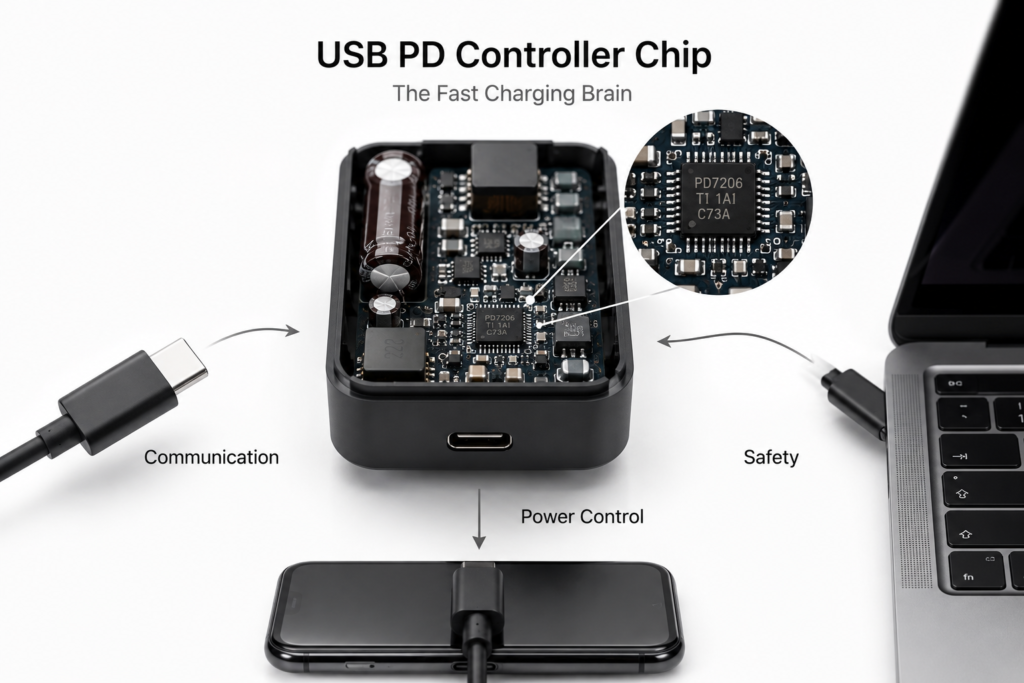
A USB PD controller chip is a microprocessor dedicated to handling USB PD fast charging protocol communication. Simply put, it works as both a translator and a dispatcher between the charger and your phone: it identifies what device is plugged in, negotiates the right voltage and current for charging, and monitors the charging status the whole time, balancing speed and device protection.
The Evolution of USB PD Standards and Controller Chips
2.1 Iterative Upgrades of the USB PD Protocol
USB PD is a universal fast charging standard developed by the USB-IF Association. Each generation brings higher power and more flexible charging capabilities, and PD controller chips evolve alongside the protocol.
| PD Protocol Version | Release Year | Max Power | Key Features & Typical Uses |
|---|---|---|---|
| PD 2.0 | 2014 | 100W | Established the Type-C interface standard, supports 5V–20V fixed voltage levels, meets basic laptop charging needs |
| PD 3.0 | 2017 | 100W | Added PPS programmable voltage regulation for fine-grained adjustment, greatly improving smartphone charging efficiency and thermal performance |
| PD 3.1 | 2021 | 240W | Introduced Extended Power Range (EPR) with 28V/36V/48V high-voltage levels, covering gaming laptops, monitors, power tools and more |
2.2 Technology Evolution Trends of PD Controller Chips
Early PD chips only supported simple negotiation of fixed voltages. Modern chips are evolving in three main directions: first, broader compatibility with more fast charging protocols beyond standard PD; second, higher integration to pack more functions into a single chip for smaller charger designs; third, expansion from smartphones to laptops, home appliances and industrial equipment.
Core Functions of PD Controller Chips
3.1 Device Recognition and Protocol Communication
The moment you plug in the charging cable, the PD controller chip starts working: through the CC pins inside the interface, it first detects whether a device is connected and whether it supplies or receives power, then confirms which charging protocols the device supports to establish a stable communication link, avoiding miscommunication between different devices.
3.2 Power Negotiation and Intelligent Voltage Regulation
After identifying the device, the chip tells the charger to list all available power levels, then selects the most suitable voltage and current combination based on the device’s needs. For example, it uses high-power fast charging when the phone battery is low, and automatically reduces power when the battery is nearly full, making dynamic adjustments throughout the process to balance speed and battery safety.
3.3 Full-Link Safety Protection Mechanism
The PD controller chip also acts as a safety guard for charging. It monitors voltage, current and temperature in real time during charging. If over-voltage, over-current, over-temperature or short circuit occurs, it will cut off power immediately to prevent device damage or safety hazards.
Internal Structure and Working Process
4.1 Core Functional Modules Inside the Chip
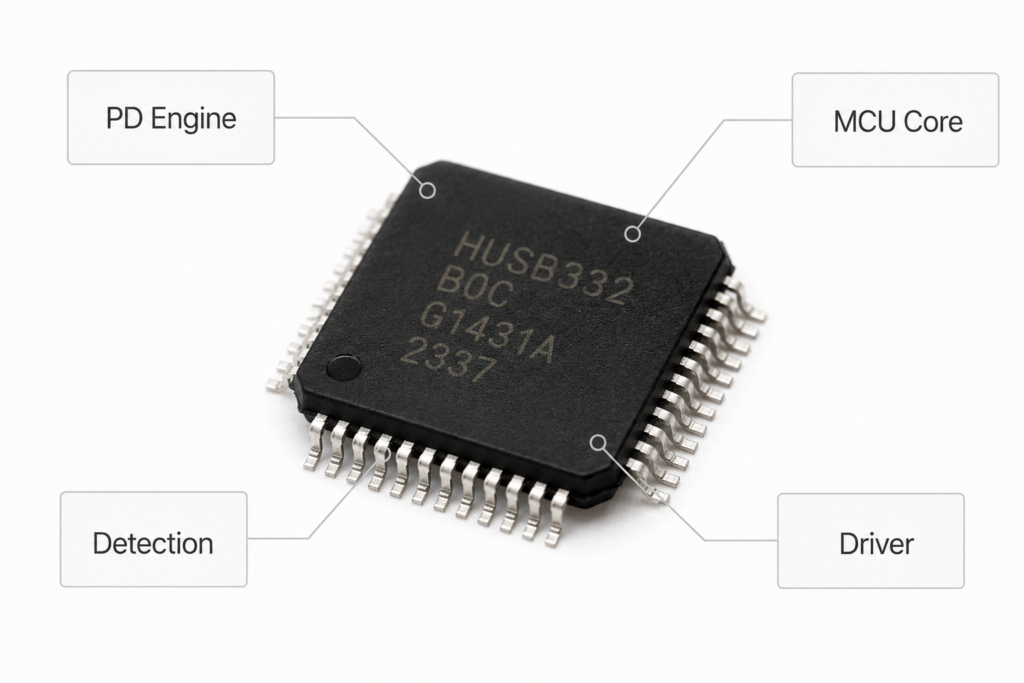
Despite being only the size of a fingernail, a PD controller chip integrates multiple functional modules: a communication module for protocol parsing, a control core for operation and decision-making, a detection module for voltage and current sampling, and a driver module for sending switch commands. All modules work together to complete the entire charging process.
4.2 The Complete Fast Charging Workflow
A full fast charging preparation takes only hundreds of milliseconds: first, insertion detection to recognize device connection and plug orientation; second, handshake and negotiation to confirm mutually supported power levels; third, formal power delivery at the agreed parameters; fourth, dynamic adjustment during charging to regulate power based on battery level and temperature until charging is complete.
Chip Classification and Major Manufacturers
5.1 Common Classification of PD Controller Chips
By integration level, PD controller chips fall into two main categories:
- Standalone PD controller chips: Only handle protocol communication and require pairing with other power chips. They offer high flexibility and are mostly used in high-end high-power devices.
- Integrated PD controller chips: Combine protocol control and power management functions in one package, with fewer external components and lower cost. They are the mainstream solution for consumer chargers.
5.2 Leading International Manufacturers and Solutions
International manufacturers have early industry experience and mature technology, dominating the high-end market. Representative vendors include Texas Instruments (TI), Infineon, STMicroelectronics and NXP. Their chips are widely used in brand-name laptops, premium chargers and industrial equipment, with excellent stability and compatibility.
5.3 Leading Domestic Manufacturers and Solutions
Domestic Chinese chip makers have developed rapidly in recent years, quickly capturing the consumer market with high cost-performance. Representative vendors include Southchip, Injoinic, Hynetek and WCH. They offer solutions ranging from 20W smartphone chargers to 240W high-power adapters, and are the core choice for most affordable fast charging products on the market.
Typical Application Scenarios in Daily Life
6.1 Smartphone Fast Charging and GaN Chargers
PD controller chips are inside every smartphone fast charger and GaN (Gallium Nitride) charger we use daily. From 20W phone adapters to 100W multi-port chargers, they identify phones of different brands and match the corresponding fast charging modes.
6.2 Laptop PD Power Adapters
More and more thin-and-light laptops and gaming laptops are switching to USB-C charging. PD adapters from 65W to 240W all rely on PD controller chips. They enable fast charging for laptops and are compatible with phones and tablets, so you don’t need to carry multiple power adapters when going out.
6.3 Power Banks, Car Chargers and Docking Stations
PD controller chips power bidirectional fast charging on power banks, fast charging output on car chargers, and power delivery on USB-C docking stations. They enable automatic switching of power direction, so one port can both receive power and supply power to other devices.
6.4 Synergy Between PD Chips and GaN Technology
The compact size and high power of GaN chargers depend on the coordination of PD controller chips. GaN power devices switch at very high speeds and require precise control signals from PD chips to operate stably. Together they deliver high power in a small form factor.
Practical Guide to Buying Fast Charging Devices
7.1 Protocol Compatibility and Power Matching
When buying a charger, first check if it supports USB PD protocol and if its power matches your device. For example, 20W–65W is usually enough for smartphones, 65W+ is recommended for thin-and-light laptops, and 100W–240W PD 3.1 chargers are required for gaming laptops.
| Device Type | Recommended Power | Supported PD Version | Typical Usage |
|---|---|---|---|
| Standard Smartphones | 20W–65W | PD 3.0 | Daily commuting, emergency top-up |
| Thin-and-Light Laptops | 65W–100W | PD 3.0 | Office work, business trips |
| Gaming Laptops | 140W–240W | PD 3.1 | High-performance work, gaming |
| Power Banks | 30W–100W | PD 3.0 | Outdoor use, on-the-go charging |
7.2 Safety Certifications and Protection Capabilities
Prioritize products with formal safety certifications (such as USB-IF certification). Reliable PD controller chips come with full protection features, while cheap unbranded products may cut corners on protection circuits and pose safety risks.
7.3 Power Distribution Performance of Multi-Port Devices
For multi-port chargers, pay attention to the power distribution logic. Quality PD solutions intelligently allocate total power based on the number and needs of connected devices. Cheaper alternatives may drop power significantly or even fail to trigger fast charging when multiple devices are plugged in at the same time.
Common Questions and Misconceptions
8.1 Differences Between PD Controller Chips and Other Charging Chips
Many people confuse PD controller chips with power chips. PD controller chips handle “communication and decision-making” for protocol negotiation; PWM power chips handle “voltage conversion” to turn high-voltage AC into suitable DC power; and the charging management IC inside phones manages the actual battery charging process. Each has its own role and together they form a complete fast charging system.
8.2 Common Causes of Charging Disconnection and Negotiation Failure
Repeated disconnection or failure to trigger fast charging doesn’t always mean a broken charger. Common causes include: charging cables that don’t support the required power, dirty contacts on the port, protocol incompatibility between the device and charger, or over-temperature protection triggered by the chip due to high heat.
8.3 Does Fast Charging Damage Batteries?
Genuine standard PD fast charging does not cause noticeable damage to batteries. The PD controller chip and battery management system in modern devices work together, using staged charging and intelligent temperature control to regulate the process. Extreme heat and long-term full-charge storage are the main causes of accelerated battery aging. The extra wear from normal fast charging use is very limited.
Future Development Trends
9.1 Higher Power and Higher Integration
In the future, PD controller chips will continue to support power levels beyond 240W. At the same time, integration will keep increasing, packing more external components into a single chip to make chargers smaller and more affordable.
9.2 Upgraded Intelligent Power Management
PD chips will become “smarter”: beyond just identifying device types, they will dynamically optimize charging strategies based on usage scenarios — for example, slowing down charging overnight to protect battery health, or intelligently distributing optimal power across multiple devices — to further improve user experience.
9.3 Popularization of the Unified USB-C Power Ecosystem
As the USB-C interface becomes the universal standard, PD controller chips will spread to more devices: from home appliances and power tools to small electronics, all will gradually adopt USB PD power delivery, building a unified charging ecosystem where one port works for everything.