
Wall outlets deliver electricity that flips direction 50–60 times per second (called alternating current, or AC). But your phone, laptop, TV, and nearly every other gadget run on electricity that flows steadily in one direction (called direct current, or DC).
An AC-DC power supply is the translator in between. It turns wavy, high-voltage wall power into smooth, low-voltage power your devices can safely use. Every phone charger, laptop brick, and household appliance has one built in.
60-Second Quick Summary
- Core job: Converts high-voltage wall AC into stable, low-voltage DC matched to your device. Think of it as an electrical translator + safety guard.
- Two main designs: Old linear supplies are simple but wasteful and bulky. Modern switching power supplies (SMPS) are small, light, and 85–95% efficient — they are the universal standard today.
- Key upgrades: GaN semiconductors shrink charger size and reduce heat. PFC circuits on larger supplies keep the power grid clean and meet global energy rules.
Part 1: Why We Need AC-DC Conversion
Think of the power grid as a tidal river — water surges back and forth. Your electronics are like a garden irrigation system that needs steady, one-way flow.
The grid uses AC because it is easy to boost to super-high voltages for low-loss long-distance transmission. But chips, batteries, and circuits all need steady, fixed-voltage DC to work reliably. AC-DC conversion is the essential link between the power grid and every device you own.
Part 2: The Two Main Types of Power Supply
There are two basic ways to turn high voltage into low voltage. Think of them as two ways to reduce water pressure in a hose:
Linear power supply — squeeze the hose
You partially kink the hose to slow the flow. All the extra pressure turns into wasted heat.
- ✅ Ultra-smooth output, zero electrical buzz, extremely simple design
- ❌ Very inefficient (only 30–60% of power reaches the device), huge and heavy
- Used today only for: high-end audio gear and tiny precision devices where electrical noise must be kept near zero
Switching power supply (SMPS) — flick the tap on and off super fast
Instead of squeezing, you flip the tap on and off hundreds of thousands of times per second. If it is on half the time, you get about half the total power. Almost no energy is wasted because the valve is either fully open or fully closed.
- ✅ 85–95% efficient, tiny and light, works with any wall voltage worldwide
- ❌ Creates very minor voltage ripple and faint electrical noise
- Used for: phones, laptops, TVs, appliances — literally every modern consumer device
Isolation: Why wall chargers are safe to touch
Every plug-in power supply uses a small transformer that transfers energy magnetically — there is no direct wire connection from the wall side to your device. Think of two fans facing each other: one blows air, the other spins from the wind, but they never touch.
This is called galvanic isolation, and it is a mandatory safety requirement for any power supply that plugs directly into a wall outlet.
Part 3: Step-by-Step: Inside a Switching Power Supply
Here is the 5-step journey electricity takes from the wall plug to your device. Every modern switching supply follows this same basic path:
- EMI noise filter
Acts like a two-way dust mask. Made of inductors and capacitors, it cleans up static and interference coming from the grid, and also stops the supply’s own high-speed switching noise from leaking back into your home wiring. - Bridge rectifier — the one-way turnstiles
Four diodes (one-way electrical valves) arranged in a “bridge” shape force all current to flow in the same direction. This turns alternating AC into pulsing DC. For reference: 120V AC input becomes roughly 155V peak DC; 230V AC becomes roughly 310V peak DC. - Bulk storage capacitor — the water tank
A large electrolytic capacitor smooths out the pulsing DC into a steady high-voltage stream. It also acts as an energy reservoir, keeping the voltage stable for the high-speed switching stage downstream. - High-speed switch + high-frequency transformer
A tiny transistor (silicon MOSFET or GaN) flips on and off tens to hundreds of thousands of times per second, chopping the high-voltage DC into high-frequency pulses.
You might wonder why we turn DC back into AC. The answer is size: higher-frequency AC can pass through a much smaller transformer. A heavy 60Hz transformer is replaced by a tiny 100kHz transformer. This is the #1 reason today’s chargers are so much smaller than old ones.
The high-frequency transformer steps the voltage down to a safe low level, while maintaining full electrical isolation between the wall and output sides. - Output rectification, filtering & regulation
The low-voltage high-frequency pulses are converted back to DC (using diodes or more efficient synchronous rectifiers). Output capacitors smooth out remaining ripples. A feedback loop sends voltage information back across the isolation barrier to the primary controller, which adjusts the switch timing to keep output voltage rock-steady — even if your device suddenly draws more power.
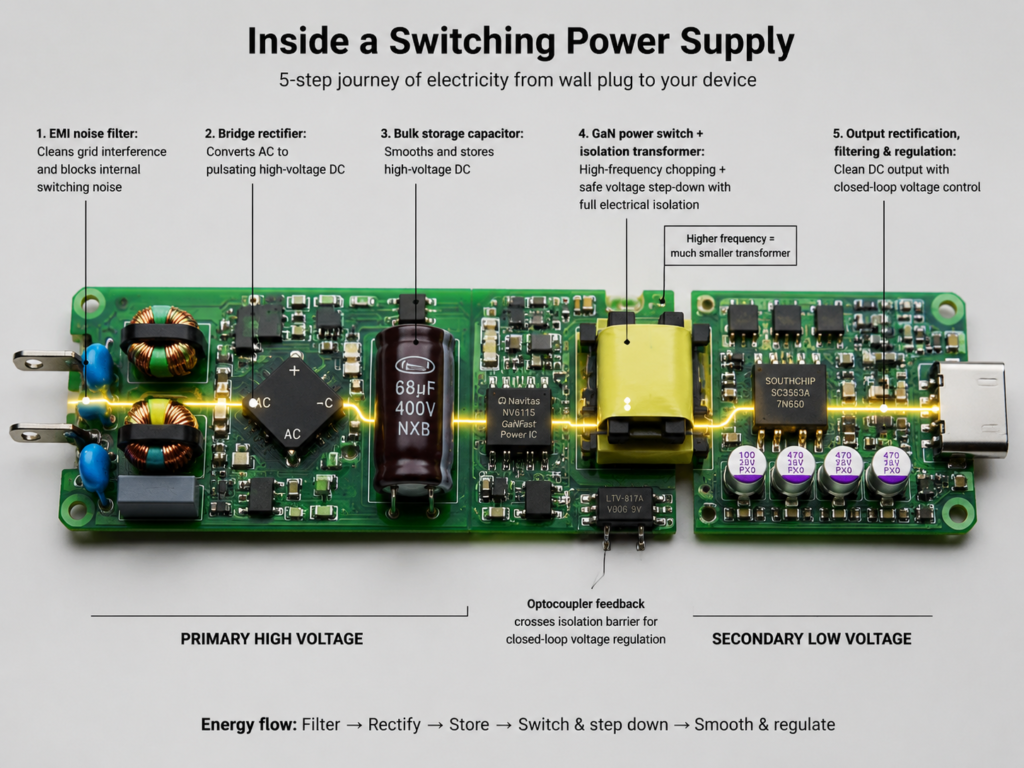
Real example: Inside a 65W GaN USB-C charger
100–240V AC input → fuse + surge protection → EMI filter → bridge rectifier → ~320V DC storage capacitor → GaN high-speed switch → isolation transformer → synchronous rectifier → output filter → USB PD control chip → dynamic 5V/9V/15V/20V output
This is why one charger can power phones, tablets, and laptops: the AC-DC front end is flexible, and the control chip tailors the output to what the device requests.
Part 4: Common Circuit Designs (Quick Cheat Sheet)
Not all switching power supplies use the exact same internal layout. Engineers pick different designs based on power level, efficiency goals, and cost. The three most common types are:
- Flyback: The most popular design for 1W–100W. Simple, low cost. Used in most phone chargers and small appliance adapters.
- Active-Clamp Flyback (ACF): An upgraded, more efficient flyback for 50W–150W. Works perfectly with GaN semiconductors. Found in premium fast chargers.
- LLC Resonant: For 100W and up. Achieves very high efficiency with “soft switching” technology. Used in laptop adapters, TV power boards, and high-power consumer gear.
Part 5: Key Technologies Explained
GaN: Better switch = smaller charger
Gallium nitride (GaN) is a newer semiconductor material that switches much faster than traditional silicon, with almost no energy lost each time it turns on and off.
Myth bust: GaN does not make your device charge faster on its own. It lets engineers build smaller, cooler, more efficient chargers for the same wattage. Actual charging speed depends on your device, cable, and fast-charging protocol support.
PFC: Keeping the power grid clean
Without PFC, basic power supplies draw current in sharp spikes instead of a smooth wave. This wastes grid capacity, creates interference, and lowers overall energy efficiency.
Power Factor Correction (PFC) reshapes the input current to follow the voltage smoothly — like stepping in rhythm with a swing. There are two types: – Passive PFC: Low cost, basic performance, found in cheap entry-level supplies. – Active PFC: Used in most modern medium-to-high power supplies, achieving power factors of 0.9 or higher. It also helps supplies work reliably across worldwide voltage ranges.
In most countries, supplies above roughly 75W are required to meet harmonic pollution limits, which usually means active PFC is needed. Exact rules vary by device type and region.
Part 6: Safety & Standards (Quick Overview)
Legitimate power supplies must meet regional rules for safety, energy efficiency, and electromagnetic compatibility. Common global standards include:
- Safety: IEC 62368-1 / UL 62368-1 — sets rules for shock and fire protection
- Energy efficiency: DoE Level VI (US), CoC Tier 2 (EU) — mandates minimum efficiency and low standby power draw
- Electromagnetic compatibility (EMC): FCC Part 15 (US), EN 55032 (EU) — limits electrical noise that could interfere with other devices
FAQ
Why do chargers get warm during use?
Even a good 90% efficient charger wastes 10% of its power as heat — from the switch, transformer, and rectifier. Higher wattage and higher room temperature mean more heat. A warm charger is normal; an uncomfortably hot or melting charger is not.
Are GaN chargers always better than silicon ones?
They are smaller, lighter, and more efficient for the same wattage. If you value portability, they are worth the premium. If size does not matter, a good silicon charger is cheaper and just as safe.
Why do bigger supplies need PFC?
To reduce harmonic pollution on the power grid and improve overall energy efficiency. Rules vary by country and device type, but 75W is a common threshold for consumer electronics.
Can I use a higher-wattage power supply with my device?
Yes, as long as the output voltage matches. The device only draws the power it needs. A higher-wattage supply just has extra capacity it will not use — it will not damage your device or make it charge faster.
What is the difference between AC-DC and DC-DC?
AC-DC turns wall AC into DC. DC-DC turns one DC voltage into another DC voltage (for example, 20V down to 5V). In a USB PD charger, the front-end AC-DC creates a base DC voltage, and a DC-DC stage fine-tunes it to the different fast-charging voltage levels.
Final Summary
- AC-DC conversion turns wavy wall AC into smooth DC for electronics. It is the essential front end of every plug-in device you own.
- Modern switching power supplies dominate the market because they are small, light, efficient, and work with any worldwide grid voltage.
- The basic flow is always: filter noise → rectify to DC → store energy → switch at high frequency → step down safely → smooth output → regulate voltage.
- GaN improves size and efficiency, not raw charging speed. PFC keeps the grid clean and is required on most medium-to-large supplies.
- For everyday use, pick a certified product with enough wattage for your devices — more watts or fancier technology is not always better if you do not need it.