
If you’ve ever looked inside a high-end RF cable, aerospace wiring harness, or industrial high-temperature sensor, you’ve probably encountered silver-plated copper (SPC) conductors. They are the premium, performance-first alternative to bare copper and tinned copper — and also one of the most misunderstood conductor types, since many people wonder if silver plating is just an expensive marketing feature.
60-Second Quick Summary
- What it is: Silver-Plated Copper (SPC) is a premium bimetallic conductor — a pure copper core coated with a thin layer of solid silver. It is neither solid silver nor ordinary bare copper.
- Core value: DC conductivity is nearly identical to pure copper. At high frequencies where the skin effect applies, it delivers lower signal loss. It also offers superior temperature compatibility and more stable long-term contact performance.
- Best and worst uses: Ideal for RF communications, high-temperature industrial equipment, and high-reliability connections. It is not cost-effective for low-frequency power, basic household wiring, or general indoor use.
Part 1: Absolute Beginner Basics
1.1 What Is Silver-Plated Copper (SPC)?
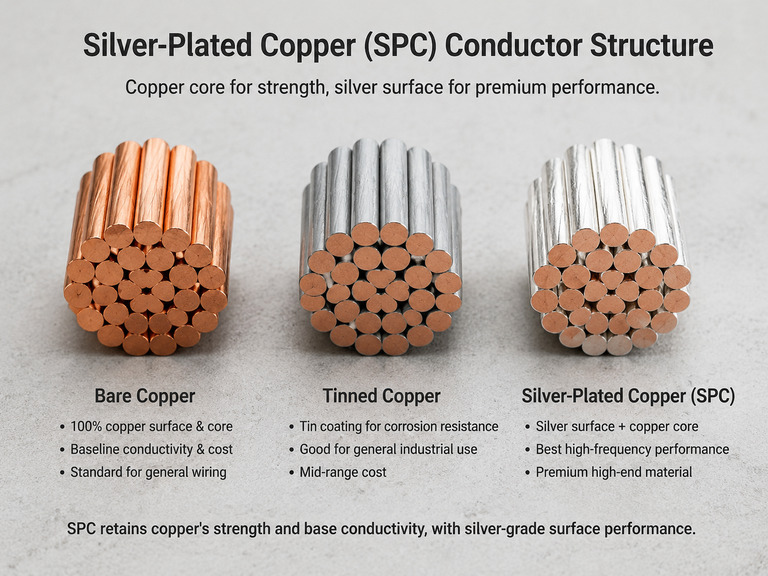
Silver-plated copper is a two-layer composite conductor built like a premium coated tool: the strong inner core is high-purity copper (usually oxygen-free copper, OFC), and the entire outer surface is evenly coated with a thin layer of pure silver.
In simple terms: Copper on the inside for strength and base conductivity, silver on the outside for high-end surface performance.
The two metals are tightly bonded through electroplating or chemical deposition, so the silver layer will not flake or peel off under normal use.
1.2 Why Was Silver-Plated Copper Invented?
To understand why SPC exists, you first have to understand the tradeoffs between the two pure metals:
Pure copper
- ✅ Excellent base conductivity and mechanical strength
- ✅ Affordable and widely available
- ❌ Loses performance at very high frequencies
- ❌ Oxidizes over time, raising contact resistance
- ❌ Limited performance at extreme high temperatures
Pure silver
- ✅ Highest electrical conductivity of all common metals
- ✅ Stable contact performance even when surface films form
- ✅ Compatible with very high temperature insulation systems
- ❌ Extremely expensive
- ❌ Very soft and mechanically weak for structural use
SPC was developed to combine the strengths of both materials while minimizing their drawbacks:
- Copper provides mechanical strength, structural support, and baseline conductivity at a reasonable cost
- Silver provides superior surface conductivity, better high-frequency performance, stable contact resistance, and improved high-temperature compatibility
The result is a conductor that delivers many of the surface-performance benefits of solid silver while retaining the strength and cost advantages of a copper core.
1.3 Key Advantages
- Superior high-frequency performance
When the skin effect takes hold at high frequencies, the silver outer layer can reduce AC conductor loss when the operating frequency and plating thickness make the skin effect dominant. This advantage is most noticeable in RF, microwave, and high-speed signal applications. - Excellent high-temperature compatibility
Silver withstands extreme heat far better than tin plating. This makes SPC the standard pairing with PTFE, FEP, and ETFE high-temperature insulation systems. - Stable long-term contact resistance
Silver maintains a low, consistent contact resistance over time, even after thermal cycling and years of service. This is critical for high-reliability connectors and terminals. - Outstanding solderability
Silver wets quickly and cleanly with solder, producing strong, reliable joints. It performs especially well in high-temperature and high-reliability soldering processes.
1.4 How It Compares to Common Conductors
- vs. bare copper: Lower high-frequency loss, more stable long-term contact performance, and better high-temperature tolerance — but significantly more expensive.
- vs. tinned copper: Better high-frequency performance and much higher temperature rating. It has weaker sulfur resistance and costs considerably more.
- vs. solid silver wire: Far higher mechanical strength, much easier to manufacture and terminate, and dramatically lower cost — while retaining most of the surface-level performance benefits.
Part 2: How It Works
Silver plating delivers very different benefits depending on whether you are working with DC/low-frequency power or high-frequency signals.
2.1 DC & Low Frequencies
At DC and low frequencies, electric current spreads evenly across the full cross-section of the wire, like water flowing through an entire pipe.
- Almost all current flows through the thick copper core; the thin silver layer contributes almost nothing to total conductivity.
- Overall DC performance is roughly identical to an equivalent bare copper conductor.
- This is why silver plating provides almost no benefit for 50/60 Hz power lines and basic low-frequency wiring.
2.2 High Frequencies & the Skin Effect
This is where silver plating earns its reputation as a high-performance material.
Think of the inside of a wire like an 8-lane highway.
At slow speeds, cars spread out evenly across all lanes.
At very high speeds, almost all traffic drifts to the outer lanes.
Electric current behaves exactly the same way. As frequency rises, an increasing proportion of current flows near the outer surface of the conductor. This is called the skin effect.
Since the very outside of an SPC wire is pure silver — the most conductive common metal — high-frequency current travels through an even better conductor than it would on bare copper.
The payoff:
When the operating frequency is high enough and the silver layer is thicker than the effective skin depth, the AC loss of SPC is lower than that of plain copper. The higher the frequency, the bigger the advantage.
This is why SPC is standard for coaxial cables, radar systems, and 5G RF jumpers — but rarely used for ordinary power cords.
2.3 Contact & Corrosion Performance
Silver also improves performance at connection points:
- Better contact: Silver is a soft metal. When crimped or mated, it conforms more fully to the mating surface, creating a larger, more stable contact area.
- Stable resistance: Thin silver oxide and sulfide films generally have much lower contact resistance than the oxide layers formed on bare copper, so contact resistance stays consistent over time. This is a major upgrade over bare copper, which forms high-resistance oxide layers as it tarnishes.
- Sulfur caveat: Silver is relatively stable in clean, dry air, but readily reacts with sulfur-containing compounds to form silver sulfide (Ag₂S), which causes visible dark tarnish. This mostly affects appearance and has only a minor effect on electrical performance.
Part 3: How to Identify Silver-Plated Copper
- Visual inspection: SPC has a bright, silvery-white metallic luster. Bare copper is reddish-brown, and tinned copper has a duller, matte silver-gray finish.
- Check the spec sheet: Products marked “SPC”, “silver-plated copper”, or “silver-coated copper” use this construction. Look for ASTM B298 compliance on industrial-grade products.
- Scratch test: Lightly scrape the surface with a sharp tool. The silvery outer layer will wear away to reveal the reddish copper core underneath. Only perform this on scrap wire you own, and never on energized conductors.
- Price and application: SPC is almost always found in premium RF, aerospace, and high-temperature products. It is almost never used in budget consumer cables.
Part 4: Core Performance Specifications
4.1 Electrical Performance
DC Conductivity
At 20°C, the DC resistance of SPC is nearly identical to standard annealed copper. High-quality SPC typically measures close to or slightly above 100% IACS, because the thin silver layer has a negligible effect on total cross-sectional conductivity.
High-Frequency Performance
- Around 1 MHz and above, skin effect becomes increasingly significant for many practical wire sizes, and the silver layer begins to reduce AC loss.
- The higher the frequency, the greater the performance advantage over bare copper.
- At RF, microwave, and millimeter-wave frequencies, the difference is large enough to be a critical design factor.
Contact Resistance
SPC maintains low and stable contact resistance over its service life. Long-term drift is far lower than with bare copper, especially in thermal cycling and unsealed environments.
4.2 Mechanical Performance
- Tensile strength & elongation: Essentially identical to bare copper of the same temper. The silver layer is extremely thin and has almost no effect on bulk mechanical properties.
- Flex life: Bending endurance and flexibility match equivalent bare copper conductors. Silver plating does not make the wire stiffer or more brittle.
4.3 Environmental & Processing Properties
- Temperature compatibility: Silver melts at approximately 961°C, far above almost any cable insulation rating. In practice, SPC is commonly paired with PTFE, FEP, and ETFE insulation for continuous service at 150–200°C. As always, the actual cable temperature limit is set by the insulation system, not the conductor itself. Silver plating itself is not intended to increase current-carrying capacity; it is primarily selected for high-frequency performance, contact reliability, and compatibility with high-temperature insulation systems.
- Corrosion resistance: Excellent oxidation resistance in clean, dry environments. Vulnerable to sulfur tarnish, but this is mostly a cosmetic issue.
- Solderability: Excellent. Solder wets quickly and forms uniform, strong joints. Well suited for high-temperature and high-reliability soldering processes.
Part 5: Where to Use SPC & Where NOT to Use It
✅ Where SPC Shines
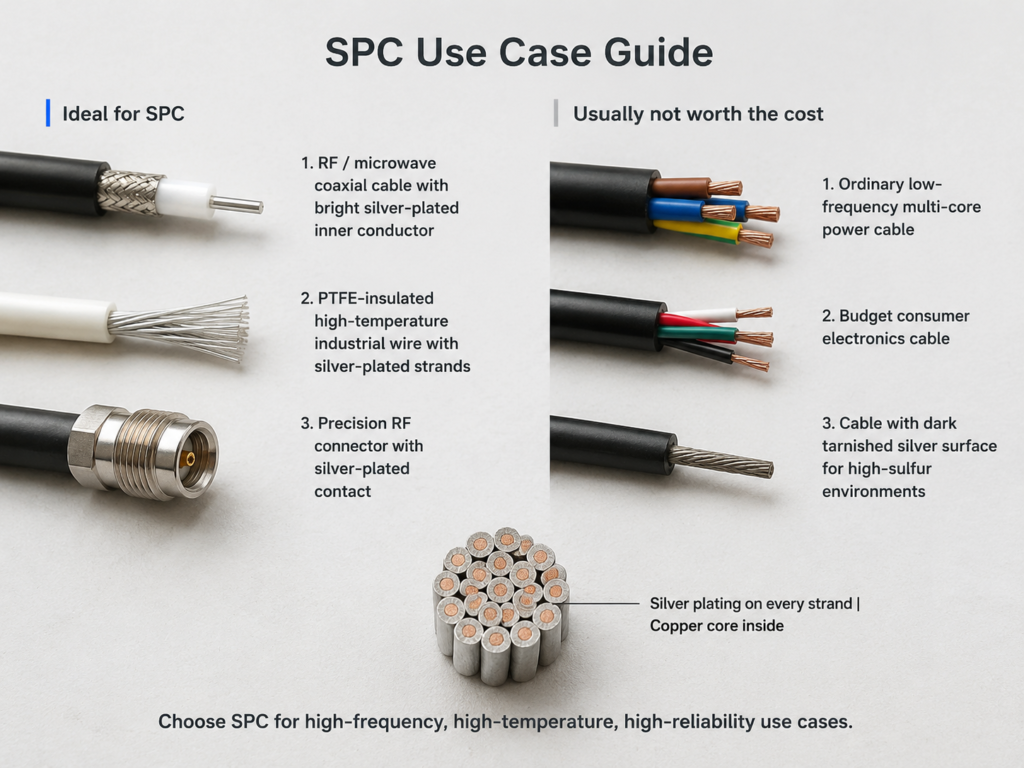
- RF, microwave & high-speed communications
Coaxial cable inner conductors, 5G base station jumpers, radar feed lines, and test equipment cables — where reducing high-frequency signal loss is a top priority. - High-temperature industrial & aerospace
High-temperature sensor leads, aerospace and defense internal wiring, and engine compartment harnesses that must survive long-term heat exposure. - Precision connectors & high-reliability electronics
High-end connector contacts, high-frequency relays, and precision component leads where stable low contact resistance is required over decades of service. - Specialty components
High-frequency transformer windings, precision test instrumentation leads, and high-performance shielding braids.
❌ Where SPC Is Usually Not Worth It
- Ordinary power & low-frequency wiring
At mains frequencies and DC, silver plating provides almost no electrical benefit. The extra cost would be pure waste. - Budget consumer electronics
For basic USB cables, speaker wire, and household accessories, bare copper or tinned copper delivers more than enough performance at a fraction of the cost. - Environments with high sulfur exposure
Near rubber materials, industrial fumes, or polluted urban air, silver will tarnish faster. Tinned copper is usually a better choice for these environments. - Cost-sensitive general-purpose projects
SPC is a premium material. If your application does not specifically require high-frequency, high-temperature, or ultra-high-reliability performance, it is almost never the most cost-effective choice.
Why Aerospace & High-Temperature Cables Use SPC
The short answer is the combination of three demands: high temperature, high frequency, and extremely long service life.
PTFE and FEP high-temperature insulations are already rated for 150–200°C continuous use. Pairing them with SPC conductors matches the insulation’s temperature capability while preserving high-frequency signal performance and long-term contact reliability. For military and aerospace applications governed by standards like MIL-W-16878, this combination has been the default choice for decades.
Part 6: Engineering Deep Dive
6.1 Common Manufacturing Processes
- Electroplating (industry standard)
The copper wire acts as the cathode and pure silver as the anode. Silver is deposited onto the copper surface through an electrochemical reaction. This process produces very precise, dense, well-bonded coatings and is used for nearly all industrial-grade SPC. Both traditional cyanide silver plating and modern cyanide-free formulations are in common use. - Electroless silver plating
Silver is deposited through an autocatalytic chemical reaction, with no electric current required. It produces extremely uniform coatings even on very fine wires and complex shapes, but bond strength is slightly lower than electroplating. It is used mostly for ultra-fine electronic wire and specialty component leads.
6.2 Plating Grades (ASTM B298 Weight Class System)
Per ASTM B298-12(2024), grades are defined by the weight percentage of silver relative to the total conductor weight. Higher grades mean thicker plating for more demanding applications. Custom silver percentages are also available by agreement between manufacturer and purchaser.
- Class A: ≥ 1.25% silver by weight. Light plating for general electronic wiring and standard connection applications.
- Class B: ≥ 2.50% silver by weight. Medium plating for general high-frequency signal and standard RF transmission.
- Class C: ≥ 4.00% silver by weight. Medium-heavy plating for industrial high-frequency equipment and high-reliability connections.
- Class D: ≥ 6.10% silver by weight. Heavy plating for military-grade RF and high-temperature environment wiring.
- Class E: ≥ 10.00% silver by weight. Extra-heavy plating for extreme high-frequency and harsh-environment high-reliability use cases.
6.3 Conductor Construction & Sizing
Construction Types
- Solid SPC: Single round wire. Best high-frequency performance. Used for coaxial inner conductors and fixed wiring.
- Stranded SPC: Multiple filaments concentrically stranded. More flexible than solid. Used for RF patch cords and internal equipment wiring.
- Extra-flexible SPC: Very fine filaments with multiple stranding steps. Maximum flexibility. Used for high-flex drag chain cables and mobile RF test leads.
Product Forms
- Solid round SPC wire: Base single filament, used for stranding, braiding, and winding.
- Stranded SPC conductor: Finished multi-strand conductor, balancing current capacity and flexibility.
- SPC braid: Woven mesh structure, used for high-frequency shielding and flexible grounding straps.
- SPC magnet wire: Coated with high-temperature enamel insulation, used for high-frequency transformers and inductors.
Sizing Standards
- Single filament diameter: 0.02 mm to 3.00 mm, covering precision electronics to industrial interconnects.
- AWG American Wire Gauge: 40 AWG to 10 AWG, matching standard electronics and telecommunications sizing.
- Stranded cross-sections: 0.035 mm² to 50 mm², covering signal-level to medium-power applications.
6.4 Selection & Installation Best Practices
Core Selection Criteria
- Frequency profile: The strongest case for SPC is at 1 MHz and above. For low-frequency and high-current power use, the value is very low.
- Operating temperature: Best paired with high-temperature insulation systems. At room temperature, it is often performance overkill.
- Reliability requirements: Prioritize SPC for precision, long-life maintenance-free, and low-contact-resistance applications.
Common Misconceptions
- Myth: SPC always conducts better than pure copper
False. DC and low-frequency performance is roughly equal. The measurable advantage only appears at high frequencies. - Myth: Thicker plating is always better
False. Once the silver layer exceeds the effective skin depth for your operating frequency, extra thickness provides no further electrical benefit and only adds cost. - Myth: Silver plating never tarnishes
False. Silver darkens in sulfur-containing environments. This is mostly cosmetic and has only a small effect on electrical performance.
Handling & Maintenance Tips
- Store and use SPC away from rubber, sulfur-bearing compounds, and vulcanized materials to prevent tarnish.
- Avoid scraping or scoring the silver layer during installation. Control soldering temperature and dwell time to avoid excessive silver dissolution.
- For high-reliability installations, periodically verify contact resistance at terminations to confirm stable connection quality.
Side-by-Side Comparison: Bare Copper vs Tinned Copper vs SPC vs Pure Silver
| Property | Bare Copper | Tinned Copper | Silver-Plated Copper | Pure Silver |
|---|---|---|---|---|
| DC conductivity | ★★★★★ | ★★★★☆ | ★★★★★ | ★★★★★ |
| High-frequency performance | ★★★☆☆ | ★★☆☆☆ | ★★★★★ | ★★★★★ |
| Temperature compatibility | ★★★☆☆ | ★★★☆☆ | ★★★★★ | ★★★★★ |
| Contact stability | ★★☆☆☆ | ★★★★☆ | ★★★★★ | ★★★★★ |
| Corrosion / sulfur resistance | ★★☆☆☆ | ★★★★☆ | ★★★☆☆ | ★★★☆☆ |
| Solderability | ★★★☆☆ | ★★★★☆ | ★★★★★ | ★★★★★ |
| Cost (lower = better) | ★★★☆☆ | ★★★★☆ | ★★☆☆☆ | ★☆☆☆☆ |
FAQ
Does silver-plated copper conduct better than pure copper?
For DC and low frequencies, performance is essentially identical — there is no meaningful advantage. The conductivity benefit only appears at high frequencies, where the skin effect concentrates current in the higher-conductivity silver surface layer.
Why not just use solid silver wire?
Solid silver is prohibitively expensive, mechanically soft, and too weak for most structural cable applications. Silver-plated copper uses copper as the structural core to keep costs manageable and maintain strength, while still delivering most of the surface-level performance benefits of silver.
Does silver plating tarnish or oxidize?
Silver is very stable in clean dry air, but it gradually darkens in sulfur-containing environments due to silver sulfide formation. This tarnish is mostly a cosmetic issue and has only a minimal effect on electrical performance.
Are all high-frequency cables made with silver-plated copper?
No. Ordinary high-speed data cables work perfectly well with bare copper or tinned copper. Silver-plated copper is reserved for premium RF, microwave, and millimeter-wave applications where minimizing loss is critical and justifies the higher cost.
Should I choose tinned copper or silver-plated copper?
Choose tinned copper for general-purpose signals, corrosion resistance, and cost-sensitive applications. Choose silver-plated copper when you need the best possible high-frequency performance, high-temperature compatibility, or the highest long-term contact reliability.
Why isn’t every cable made with silver-plated copper?
Because silver plating adds significant manufacturing cost, and for low-frequency power, basic signals, and normal room-temperature environments, the performance gain is negligible. Bare copper or tinned copper already meet requirements at a much lower price. SPC only makes economic sense in high-frequency, high-temperature, or ultra-high-reliability scenarios.
Does SPC meet industry standards?
Yes. Silver-plated soft copper wire is formally standardized under ASTM B298, which defines five plating weight classes (A through E) and sets requirements for resistivity, tensile strength, and coating quality. Military and aerospace applications commonly follow additional specifications such as MIL-W-16878. Whether a specific grade is acceptable for an installation always depends on the applicable codes and project requirements.
Final Summary
- Silver-plated copper is a premium bimetallic conductor with a copper core and a bonded pure silver outer layer. It is a performance-upgrade alternative to bare copper — not a budget alternative.
- Its biggest advantage is high-frequency performance. Thanks to the skin effect, it delivers lower signal loss than bare copper at RF and microwave frequencies, provided the silver layer exceeds the effective skin depth at the operating frequency.
- It also offers superior temperature compatibility and more stable long-term contact resistance, which is why it is the standard choice for aerospace, military, and high-temperature wiring.
- For DC power, low-frequency wiring, and general consumer use, SPC is almost never worth the added cost. Bare copper or tinned copper are the preferred choices for those applications.
- SPC is a fully standardized, legitimate high-end conductor material. It delivers real, measurable benefits in the right use cases — but it is wasted when used indiscriminately in ordinary cables.