
If you’ve ever experienced random file transfer glitches over an Ethernet connection, faint static in your headphones, or occasional screen flicker on your monitor, the culprit is often electromagnetic interference. The shielding built into cables is the key design feature that prevents these issues.
Today, foil shielding and braided shielding are the two most common shielding technologies used in consumer cables. They differ in construction, performance, and ideal use cases. This guide breaks down the differences in plain terms to help you choose the right cable for your needs.
1. Why Do Cables Need Shielding?
1.1 What Is Electromagnetic Interference (EMI)?
We are surrounded by invisible electromagnetic signals in daily life. Phones, Wi-Fi routers, Bluetooth devices, power chargers, monitors, and even appliance motors all emit electromagnetic radiation.
When these stray electromagnetic waves penetrate the inside of a data or Ethernet cable, they disrupt the electrical signals carrying information. It’s similar to trying to have a conversation in a noisy room—the message gets distorted. High-speed data cables are especially vulnerable, as their delicate signals are more prone to packet loss, video artifacts, or audio noise when interfered with.
1.2 The Core Purpose of Cable Shielding
Think of cable shielding as an electromagnetic protective suit for the internal conductors. It serves two main functions: first, it blocks external EMI from reaching the signal wires inside; second, it contains the signal’s own electromagnetic radiation to prevent it from interfering with nearby electronics.
Shielding also reduces bit error rates during data transmission and improves overall reliability. It is also a key factor in helping electronic devices meet electromagnetic compatibility (EMC) standards.
Because different applications have different requirements for shielding performance, flexibility, and cost, the industry has developed several mature solutions, most notably foil shielding, braided shielding, and combination designs.
2. Foil Shield
2.1 Construction
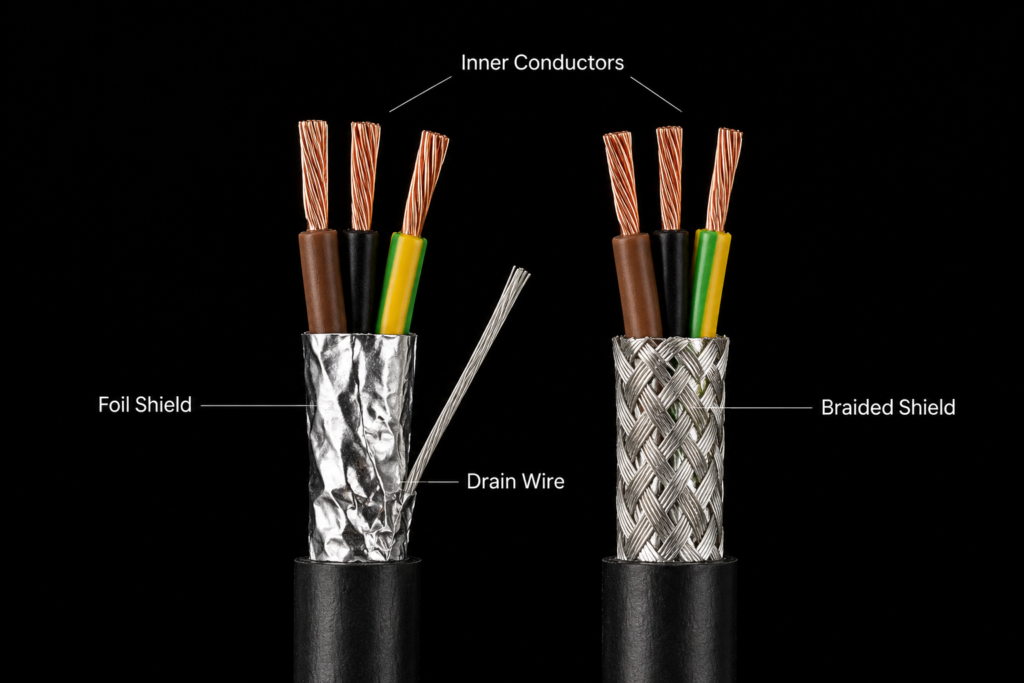
Foil shielding is one of the most widely used shielding types in consumer cables. It consists of a thin aluminum-polyester laminate: a very thin layer of aluminum foil bonded to a polyester (PET) backing for structural support. This laminate is wrapped longitudinally around the conductor bundle, like wrapping food in plastic wrap, to form a continuous metallic barrier.
Since the foil itself is extremely thin, a thin drain wire is typically run along the length of the shield and kept in tight contact with the aluminum layer. This drain wire provides a reliable conductive path to ground, which carries away unwanted interference currents.
2.2 Key Advantages
The biggest advantage of foil shielding is its near 100% coverage with no significant gaps. This makes it highly effective at blocking high-frequency interference, such as radio frequency signals from phones, Wi-Fi, and Bluetooth devices.
Foil shielding is also thin and lightweight, so it adds very little to the overall diameter and weight of a cable. It is relatively inexpensive to manufacture, making it ideal for slim data cables and Ethernet cables.
2.3 Main Limitations
Aluminum foil is somewhat brittle and does not hold up well to repeated flexing. If a cable is bent or folded frequently, the foil layer can crack or develop gaps at the overlap, breaking the continuity of the shield and reducing its effectiveness.
Additionally, since its conductive path relies on a single drain wire, foil shielding is less effective at blocking low-frequency magnetic interference from sources like motors, transformers, and power adapters.
3. Braided Shield
3.1 Construction
A braided shield is made from multiple strands of fine wire—usually bare copper or tinned copper—woven together in a crosshatch pattern to form a flexible mesh sleeve around the conductors. Its shielding performance depends primarily on braid density: the tighter the weave, the smaller the gaps, and the better the shielding.
3.2 Key Advantages
The standout feature of braided shielding is its excellent flexibility and resistance to repeated bending. The mesh structure can flex and deform without breaking, making it ideal for cables that are frequently plugged, unplugged, and moved around.
Because the entire braid is conductive, it provides a large contact area for grounding and has high mechanical strength, with better tensile and crush resistance than foil shielding. It also performs significantly better at suppressing low-frequency magnetic interference from motors, chargers, and transformers.
3.3 Main Limitations
Due to the nature of the weaving process, a braided shield can never achieve 100% coverage—there will always be small gaps between the strands. Typical consumer cables have braid coverage ranging from 70% to 95%. Cheaper, lower-quality cables may have coverage below 70%, resulting in noticeably worse shielding performance.
Braided shielding also uses more copper material, so it adds more weight and bulk to a cable and generally costs more to produce than foil shielding.
4. Head-to-Head Comparison: Foil vs. Braided Shielding
The table below summarizes the key differences between the two technologies across the most important performance factors:
| Comparison Category | Foil Shield | Braided Shield |
|---|---|---|
| Shield Coverage | Near 100% continuous coverage with minimal gaps | Typically 70%–95%; small gaps inherent to weave design |
| High-Frequency EMI Rejection | Excellent; highly effective against RF from phones, Wi-Fi, Bluetooth | Moderate; gaps allow some high-frequency leakage |
| Low-Frequency EMI Rejection | Limited; weaker against magnetic interference from motors/transformers | Superior; strong performance against low-frequency magnetic fields |
| Flex Life | Poor; prone to cracking with repeated bending | Excellent; mesh structure withstands frequent flexing |
| Mechanical Strength | Low; brittle and easily damaged | High; good tensile and crush resistance |
| Size & Weight | Thin and lightweight; small overall cable diameter | Thicker and heavier; larger overall cable diameter |
| Cost & Positioning | Lower cost; budget-friendly high-frequency protection | Higher cost; durable, all-around performance |
In short: foil shielding excels at high-frequency protection and offers great value for stationary use, while braided shielding shines in low-frequency environments and holds up better for portable, frequently moved cables.
5. Premium Option: Foil + Braid Double Shielding
Since each technology has its strengths, many high-performance cables combine both to create a double-shielded design that delivers protection across the full frequency spectrum.
5.1 Construction
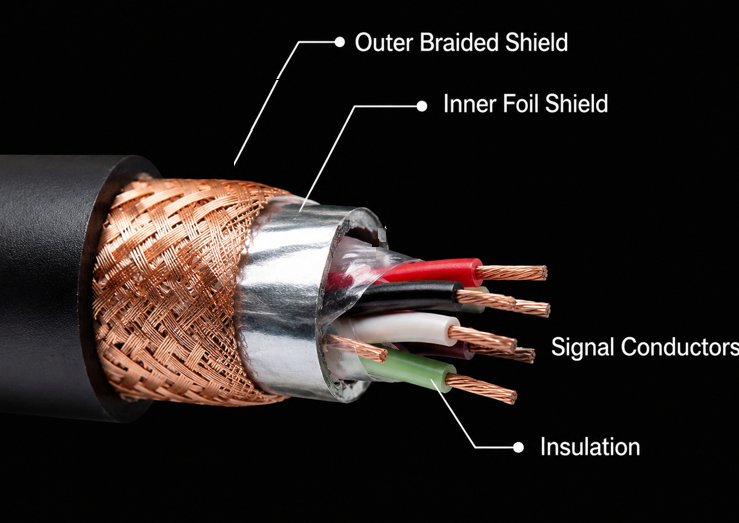
Double shielding typically uses an inner foil layer and an outer braid layer. The inner foil provides 100% coverage for high-frequency rejection, while the outer braid adds low-frequency shielding and boosts overall mechanical durability. The two layers work together for enhanced performance.
5.2 Key Benefits
Double shielding is like adding a second layer of protection. It combines the high-frequency strengths of foil with the low-frequency and durability benefits of braid, resulting in significantly better overall shielding effectiveness and more reliable high-speed signal transmission.
5.3 Common Applications
Double shielding is standard on USB4 cables, Thunderbolt cables, HDMI 2.1 cables, DisplayPort cables, high-end Ethernet cables, and industrial communication cables—any application where signal stability is critical.
6. How to Choose the Right Shielding for Your Use Case
6.1 Recommendations by Scenario
You don’t always need the highest-end shielding option. Choose based on how and where you’ll use the cable:
- Stationary home wiring and standard data cables: Choose foil shielding. For in-wall Ethernet cables or desktop cables that rarely move, foil provides more than enough high-frequency protection at a better price.
- Portable cables and use near power equipment: Choose braided shielding. For cables you carry around, plug and unplug often, or use near chargers and motors, the flex durability and low-frequency protection of braid are much more practical.
- High-resolution video, high-speed data, and high-interference environments: Choose foil + braid double shielding. For gaming monitor cables, Thunderbolt cables, or use in offices, factories, or server rooms with complex EMI environments, the extra stability of double shielding is well worth it.
6.2 How to Identify Shielding Type
You don’t need to cut open a cable to tell what kind of shielding it has. Check the product details:
- Look at the product specifications. Reputable brands will clearly label Foil Shield, Braided Shield, or Double Shield.
- Check for manufacturer-provided cross-section diagrams. Higher-quality products often show the internal cable structure.
- Don’t judge shielding by cable thickness alone. A thicker cable usually means thicker insulation or larger conductors, not necessarily better shielding. Performance depends on the internal structure, not the outer appearance.
7. Common Misconceptions
7.1 Is foil shielding always better than braided shielding?
Not necessarily. Neither is universally better—they are optimized for different scenarios. Foil performs better in high-RF environments, while braid is more practical for low-frequency, high-flex use cases.
7.2 Is higher braid coverage always better?
Up to a point, yes—more coverage generally means better shielding. But beyond a certain density, the performance gains diminish while the cable becomes stiffer, heavier, and more expensive. For typical home use, around 85% braid coverage is sufficient for most needs.
7.3 Does double shielding make a cable faster?
No. Shielding improves interference resistance and transmission stability, but it does not increase the maximum speed rating of a cable. Speed limits are determined by the interface standard, conductor gauge, and controller chips. Good shielding simply helps the cable reliably reach its rated speed.
7.4 Do regular charging cables need double shielding?
No. For basic charging only, there is almost no high-speed data to protect, so foil shielding or even unshielded construction works fine. Premium shielding only matters on cables that also carry high-speed data or video signals.
8. Summary
Foil shielding and braided shielding are the two foundational cable shielding technologies, each with distinct strengths and ideal applications:
- Foil shielding offers near-full coverage, excels at high-frequency EMI, is low-cost and compact, and works best for stationary wiring and standard high-speed data use.
- Braided shielding is highly flexible and mechanically robust, performs well against low-frequency magnetic interference, and is ideal for portable, frequently flexed cables.
- Foil + braid double shielding combines the benefits of both for full-spectrum protection, and is the standard for high-performance cables.
When shopping for cables, don’t automatically reach for the most layers of shielding. Pick the option that matches your use case, check the product specifications, and consider overall build quality—that’s how you’ll get the best value and performance.