
Have you ever picked up two Ethernet cables of the same gauge and wondered why the budget option feels suspiciously light? Or why cheap speaker wire costs half as much as name-brand alternatives? One common reason is the use of copper clad aluminum — better known as CCA. It is one of the most widely used cost-saving materials in the cable industry, and also one of the most misunderstood.
60-Second Quick Summary
- What it is: Copper Clad Aluminum (CCA) is a bimetallic conductor — copper on the outside, aluminum on the inside. It is neither pure copper nor pure aluminum.
- Core tradeoff: It is cheaper and lighter than pure copper. At high frequencies, its performance is very close to pure copper. For DC power and continuous high current, it performs significantly worse.
- Best and worst uses: Great for high-frequency signals, temporary wiring, and weight-sensitive applications. Never use it as a drop-in replacement for pure copper in home wiring, high-power fast charging, or permanent high-reliability installations.
Part 1: Absolute Beginner Basics
1.1 What Is Copper Clad Aluminum (CCA)?
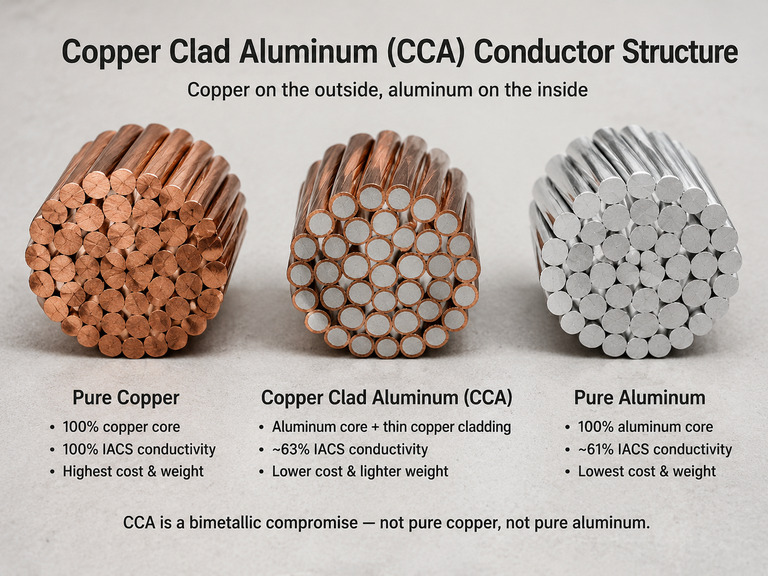
CCA is a two-metal composite wire built like a chocolate-filled candy: the thin, shiny outer shell is pure copper, and the entire solid center is aluminum. The two metals are fused at the atomic level — called a metallurgical bond — so they will not peel apart or delaminate under normal use.
In one sentence: Copper on the outside, aluminum on the inside.
It is a simple two-layer design: a continuous pure copper cladding forms the working surface, and a solid aluminum core makes up most of the conductor’s volume to cut cost and weight.
1.2 Why Was CCA Invented?
To see why CCA exists, think of it like choosing materials for a car body:
Pure copper is like an all-steel frame
- ✅ Extremely strong and reliable
- ✅ Easy to repair and work with
- ✅ Resists wear and corrosion
- ❌ Very expensive
- ❌ Very heavy
Pure aluminum is like an all-aluminum frame
- ✅ Very cheap
- ✅ Very lightweight
- ❌ Hard to join and repair reliably
- ❌ Forms a tough oxide layer that weakens connections
- ❌ Not as strong overall
CCA was developed to combine some of the advantages of both metals while reducing their individual drawbacks — like a mixed-material car body:
- Copper handles the surface, where conductivity, solderability, and corrosion resistance matter most
- Aluminum fills the core, where it cuts cost and drops weight without hurting surface performance
The result is a material that delivers near-copper performance in the jobs where it counts, at a much lower price and weight.
1.3 Key Advantages
- Dramatically lower cost
Material costs are typically 30–50% lower than equivalent pure copper conductors. This is the single biggest reason CCA exists — it delivers most of the user-facing benefit at a fraction of the material bill. - Far lighter weight
It weighs only 37–41% as much as pure copper of the same size. For large commercial installations, that adds up to huge savings in shipping, labor, and mounting hardware. - Surprisingly good high-frequency performance (when the copper layer is thick enough relative to the skin depth)
For high-speed data and radio signals, CCA performs so close to pure copper that most users will never tell the difference. - Much easier to work with than pure aluminum
The copper surface can be soldered and terminated with standard tools, unlike bare aluminum which requires special techniques.
1.4 Key Limitations
- Higher electrical resistance
Overall conductivity is only around 60–65% of pure copper. The aluminum core simply cannot carry current as well. - More voltage drop over distance
For power transmission, more voltage gets wasted as heat along the length of the cable. - Runs hotter under the same load
Higher resistance always means more heat generated when current flows through the wire. - Lower safe current capacity
The same wire size can safely carry less current than an identical pure copper conductor. - Not a drop-in replacement for copper
You cannot simply swap pure copper for CCA at the same gauge and expect the same performance, safety, or service life.
Part 2: How It Works (Beginner Level)
CCA is a bit of a two-faced material: it behaves one way for DC power, and a completely different way for high-frequency signals.
2.1 DC & Low Frequencies
At DC and low frequencies, electric current spreads out evenly across the entire cross-section of the wire — like water flowing through a full pipe.
- Both the outer copper skin and the inner aluminum core carry current together.
- Since aluminum conducts worse than copper, overall performance lands squarely between pure copper and pure aluminum.
- This is the main reason CCA is a poor choice for DC fast charging and heavy power cables.
2.2 High Frequencies & the Skin Effect
This is the clever trick that makes CCA a legitimate engineering material, not just a cheap knockoff.
Think of the inside of a wire like an 8-lane highway.
At slow commuting speeds, cars spread out across all lanes evenly.
At very high speeds, almost all drivers drift to the outer lanes, leaving the inner lanes nearly empty.
Electric current has exactly the same habit. As frequency rises, an increasing proportion of current flows near the outer surface of the conductor. This is called the skin effect.
Since the very outside of a CCA wire is pure copper, high-frequency current spends almost all of its time running through the copper layer. The aluminum core carries much less current as frequency increases.
The payoff:
When the operating frequency is high enough and the copper layer is thicker than the effective skin depth, the AC resistance of CCA can approach that of pure copper — at a fraction of the cost and weight.
This is why CCA shines for cable TV, RF antennas, and basic data cables, but falls flat for high-current DC power.
Part 3: How to Identify a CCA Cable
- Check the label and spec sheet: Products marked “CCA” or “Copper Clad Aluminum” are CCA by design. Markings like “OFC”, “Bare Copper”, or “Solid Copper” indicate pure copper conductors.
- Look at the cut cross-section: Snip the end of the wire cleanly. If the center of the conductor is silvery-white instead of copper-colored all the way through, it is almost certainly CCA.
- Scratch test: Lightly scrape the surface of the wire with a knife or sandpaper. The copper surface will wear away to reveal the silvery aluminum core underneath. Only perform this on scrap wire or cable you own, and never on energized conductors.
- Weight comparison: For the same length and gauge, CCA is noticeably lighter than pure copper — often by 40% or more.
Part 4: Core Performance Specifications (Intermediate Level)
4.1 Electrical Performance
Conductivity & Copper Grades
Conductivity is measured in % IACS (International Annealed Copper Standard), where pure annealed copper = 100% IACS. This benchmark is used worldwide as a universal yardstick for conductor materials.
Different manufacturers may offer additional copper ratios outside these common classes. CCA is graded by how much copper makes up the total volume of the conductor:
- Class 10 (10% copper by volume)
- Copper volume: 8–13%
- Conductivity: ≥ 63% IACS
- The most common general-purpose grade, best balance of cost and performance
- Class 15 (15% copper by volume)
- Copper volume: 13–18%
- Conductivity: ≥ 65% IACS
- Better high-frequency performance, used for mid-to-high end signal cables
Current-Carrying Capacity (Ampacity)
- For the same cross-section, CCA carries roughly 80–85% as much current as pure copper.
- To match the same safe ampacity as pure copper, you need to step up to a larger CCA conductor size.
- Real-world ampacity also depends on insulation temperature rating, ambient temperature, and installation method — it is never determined by wire size alone.
High-Frequency Performance
- The higher the frequency, the closer CCA performs to pure copper.
- At standard RF and cable TV frequencies, the difference is negligible for most practical purposes.
4.2 Mechanical Performance
- Density: ~3.3–3.6 g/cm³ — only about 40% the weight of pure copper. The weight savings are impossible to miss in long cable runs.
- Strength & flexibility: Falls between pure aluminum and soft copper. It bends more easily than aluminum, but not as smoothly as soft annealed copper.
4.3 Environmental & Processing Properties
- Corrosion resistance: Better than bare aluminum, because the copper layer seals the core from moisture. Still worse than tinned copper.
- Solderability: Far better than pure aluminum. Soldering temperature must still be controlled to avoid overheating and melting the aluminum core.
- Galvanic corrosion risk: If the copper layer is scratched or cracked, the exposed copper-aluminum boundary will corrode rapidly in humid environments. Connections always require special treatment.
Part 5: Where to Use CCA & Where NOT to Use It
✅ Where CCA Works Great
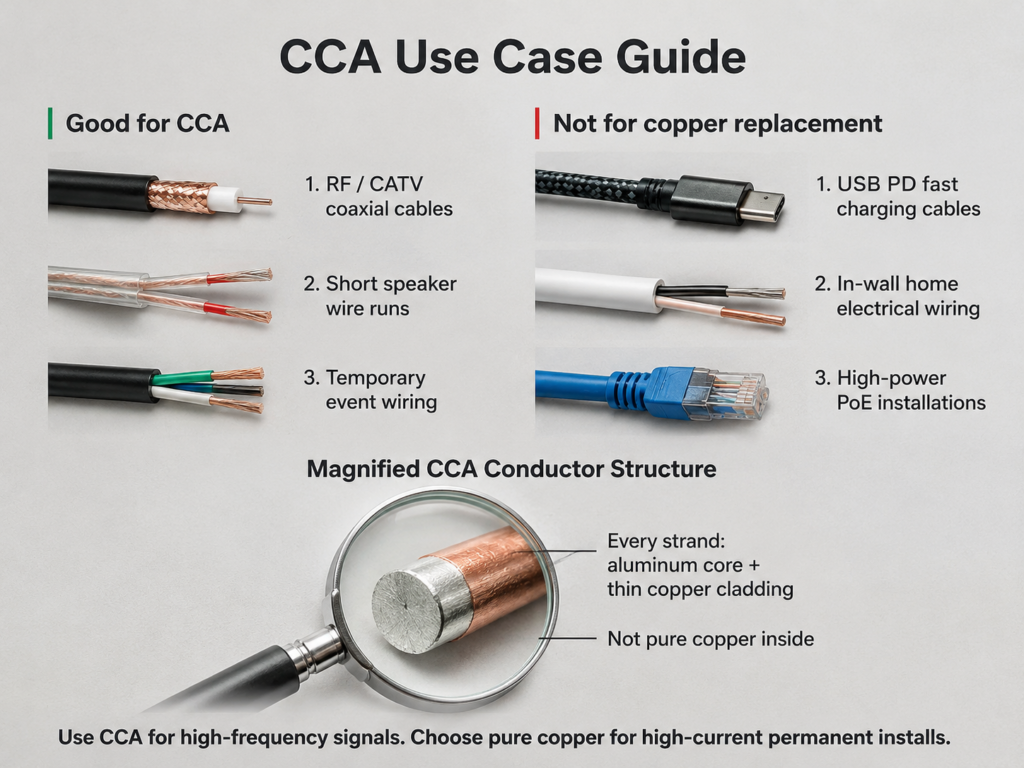
- RF & CATV coaxial cables
High-frequency signals stay almost entirely in the outer copper layer, so performance is nearly identical to pure copper at a much lower cost. - Basic speaker wire (short runs)
For short home theater or background music runs at modest power levels, CCA is a common and perfectly functional budget option. - Temporary wiring & event cabling
Stage lighting, construction power, and festival installations — short service life, weight savings matter, and cost is a top priority. - Weight-sensitive applications
Automotive auxiliary wiring, portable gear, and overhead runs where cutting weight is a key design goal. - Cable shielding braids
Shield layers operate at the conductor surface, so CCA braid delivers most of the shielding benefit at lower cost and weight.
❌ Where You Should Never Cut Corners With CCA
- USB PD fast charging (100W, 140W, 240W)
USB PD charging is very different from USB data transfer. Fast charging carries mostly DC current at high continuous amperage. Lower conductor resistance directly reduces voltage drop and heat buildup. For this reason, premium USB-C charging cables typically use pure copper or tinned copper conductors instead of CCA. - In-wall home wiring & permanent branch circuits
Permanent hidden wiring is designed for decades of trouble-free service. CCA runs hotter under load, has higher voltage drop, and carries higher long-term connection failure risk. Many modern building codes and industry best practices specify copper conductors for residential branch circuits. - High-power PoE (PoE+, PoE++)
Unlike ordinary Ethernet that only carries data, PoE pushes continuous electrical power through the same cable. Higher conductor resistance causes larger voltage drop and higher cable temperature. For this reason, permanent structured cabling systems almost always specify solid pure copper conductors rather than CCA. - EV chargers, solar & energy storage systems
These are high-current, long-service-life, safety-critical installations. Pure copper is the undisputed industry standard choice. - Long-distance power transmission
Higher resistance means more power lost as heat over distance. CCA is not a cost-effective choice for long power runs.
Part 6: Engineering Deep Dive
6.1 Common Manufacturing Processes
- Clad-weld & drawing process
A copper strip is wrapped tightly around an aluminum core, welded shut along the seam, then drawn down through a series of dies to reduce diameter and form a strong metallurgical bond. This is the dominant industrial method, producing uniform copper layers and excellent bond strength. Used for medium and large cross-section power and communication cables. - Electroplating process
Copper is electrochemically deposited onto aluminum wire. Electroplated CCA exists but is less common than clad-weld products and is mainly used for very fine conductors and specialty applications. It produces very precise, thin copper layers. Used for fine electronic wire and shielding braid filaments. - Cast bonding process
Molten aluminum is injected into a copper tube and allowed to solidify, then drawn to final size. It produces a very thick copper layer with exceptional bond strength. Used for large-size overhead power conductors.
6.2 Temper Grades
- Soft (Annealed / Type A): Annealed after final drawing. Good ductility and flexibility. Used for equipment cords, stranded flexible conductors, and electronic harnesses.
- Hard (Type H): Not annealed after final drawing. Higher tensile strength and rigidity. Used for overhead conductors and fixed-installation solid conductors.
6.3 Conductor Construction & Sizing
Construction Types
- Solid CCA: Single round wire. Lowest cost, used for fixed wiring and coaxial inner conductors.
- Stranded CCA: Multiple filaments concentrically stranded. More flexible than solid. Used for power cables and equipment cords.
- CCA braid: Fine filaments woven into a flexible mesh. Used for cable shielding and flexible grounding jumpers.
Sizing Standards
- Metric cross-sections: 0.12 to 630 mm²
- AWG American Wire Gauge: 36 AWG to 4/0 AWG. Gauge sizes correspond to the same cross-sectional areas as pure copper wire gauges.
6.4 Selection & Installation Best Practices
- Choose CCA intentionally for high-frequency signal and temporary use. Avoid it for DC high-current and permanent installations.
- Never use CCA as a 1:1 drop-in replacement for pure copper at the same gauge. Upsize accordingly to match equivalent current capacity.
- Always use bimetallic copper-aluminum terminals for connections. Never directly twist copper and aluminum conductors together.
- Avoid excessive bending and pulling during installation, which can crack or tear the copper layer.
- Inspect connections periodically for temperature rise and corrosion, especially in outdoor or humid environments.
Side-by-Side Comparison: Pure Copper vs CCA vs Pure Aluminum
| Property | Pure Copper | CCA | Pure Aluminum |
|---|---|---|---|
| Electrical conductivity | ★★★★★ | ★★★☆☆ | ★★☆☆☆ |
| Weight (lower = better) | ★☆☆☆☆ | ★★★★☆ | ★★★★★ |
| Cost (lower = better) | ★☆☆☆☆ | ★★★★☆ | ★★★★★ |
| High-frequency performance | ★★★★★ | ★★★★☆ | ★★☆☆☆ |
| High-current DC performance | ★★★★★ | ★★☆☆☆ | ★★☆☆☆ |
| Solderability | ★★★★★ | ★★★★☆ | ★★☆☆☆ |
| Long-term reliability | ★★★★★ | ★★★☆☆ | ★★☆☆☆ |
FAQ
Is CCA just as good as pure copper?
No. It performs close to pure copper for high-frequency signals where the skin effect applies, but for DC and high-current use, conductivity is only around 60% of pure copper. It cannot replace pure copper at the same cross-section.
Does CCA wire delaminate easily?
No. Properly manufactured CCA is metallurgically bonded and will not delaminate under normal use. Excessive bending, pulling, or poor termination practice can damage the copper layer, however.
How can I identify a CCA cable?
Cutting or scraping the conductor usually reveals a silver-colored aluminum core beneath the outer copper layer. Product labels and spec sheets may also explicitly state “CCA” or “Copper Clad Aluminum.”
Why do so many cheap data cables use CCA?
Because it is cheaper and lighter, and for basic low-current high-frequency data transfer, the performance is perfectly acceptable. The downsides only become obvious under high-current fast charging loads.
Does CCA meet industry standards?
Yes. CCA itself is a standardized conductor material with established material specifications. Whether it is acceptable for a specific installation depends on the application and the applicable industry standards or electrical codes.
Is CCA unsafe?
Not inherently. CCA is safe when used within its intended applications and current ratings. Problems almost always occur when it is silently substituted for pure copper in high-current or permanent wiring where it was never designed to be used.
Can I use CCA for home electrical wiring?
It is not recommended. Home wiring is a permanent, hidden installation with high reliability and safety requirements. Under high current loads, CCA runs hotter and presents greater long-term risk. Pure copper conductors are the standard recommended choice.
Final Summary
- Copper clad aluminum is a bimetallic conductor with an aluminum core and a bonded copper outer layer. It is a cost-effective alternative to pure copper — not an equivalent replacement.
- Its biggest strength is high-frequency performance. Thanks to the skin effect, it approaches pure copper performance at high frequencies at a much lower cost and weight.
- For DC power and continuous high current — including USB PD fast charging and high-power PoE — CCA performs significantly worse than pure copper and is generally not recommended.
- CCA is a legitimate, standardized material with appropriate use cases. The real problem is not CCA itself — it is when manufacturers sell CCA cables as if they were pure copper, without clear labeling, for applications where pure copper is required.
- For permanent installations, high-power use, and long-term reliability, pure copper or tinned copper conductors remain the preferred choice.