
If you’ve ever cut open an old power cord and found the copper inside dark, tarnished, or even green with oxidation, you’ve seen firsthand why protective conductor coatings matter. For cables designed to last in humid, outdoor, or industrial environments, the most common and effective solution is tinned copper.
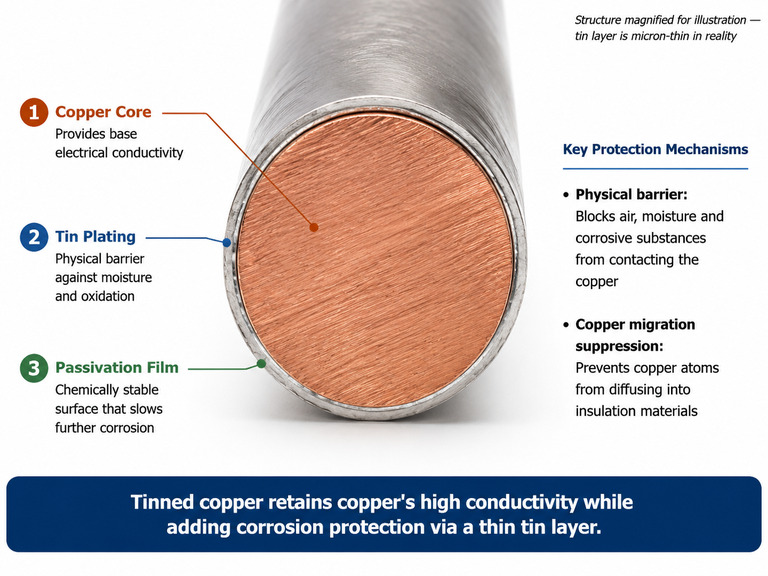
A tinned copper conductor is an uninsulated copper wire coated with a thin, uniform layer of metallic tin. Although the copper core is bare underneath the plating, it is always covered by insulation in finished cables. It preserves the high conductivity of copper while adding corrosion resistance and improved solderability. It is the most widely used protected conductor variant in electronics, automotive wiring, marine cables, and industrial systems, especially for applications requiring long-term reliability in harsh conditions.
This guide breaks down everything you need to know about tinned copper: how it’s made, what it does (and doesn’t do), real-world applications, and how to choose between tinned and bare copper for your use case.
1. Core Basics: What Is Tinned Copper?
1.1 Definition & Core Purpose
Tinned copper conductors are manufactured from base materials such as Electrolytic Tough Pitch (Cu-ETP) copper, with a thin, uniform layer of metallic tin plated onto the surface.
- It preserves the high conductivity of the copper core, while the tin layer provides corrosion protection and manufacturing benefits.
- It is widely used in electronics, communication cables, automotive wiring harnesses, marine cables, and industrial cables. It is especially common in humid, corrosive, or high-reliability environments.
1.2 How the Tin Layer Protects Copper
The protection works through two key mechanisms:
- Physical barrier protection: The continuous tin layer and the stable tin dioxide (SnO₂) passivation film that forms on its surface greatly reduce contact between air, moisture, and corrosive substances and the underlying copper. This slows copper oxidation dramatically.
- The tin itself oxidizes very slowly, and the resulting SnO₂ is chemically stable, so it continues to protect the copper core underneath.
- Copper migration suppression: The tin layer blocks copper atoms from diffusing into rubber, PVC, and other insulation materials, slowing down insulation aging over time.
1.3 Key Benefits
- Significantly improved resistance to oxidation, humidity, and mild corrosion compared to bare copper
- Greatly improved solderability, reducing the chance of cold solder joints and loose connections
- Longer service life, with noticeably better durability than bare copper in complex or humid environments
2. Manufacturing Methods & Plating Grades
2.1 Common Production Processes
- Hot-dip tinning
- Annealed copper wire is drawn through a bath of molten tin, forming a continuous tin coating as it cools.
- Characteristics: Strong coating adhesion, moderate thickness uniformity. Best suited for larger cross-sections and general protection requirements.
- Typical uses: Power cable conductors, grounding stranded wire.
- Electroplating (electrolytic tinning)
- Tin is deposited onto the copper surface through an electrochemical process. Thickness can be controlled very precisely, better than hot-dip tinning.
- Characteristics: Thin, uniform coating with excellent adhesion. Enables highly accurate thickness control.
- Typical uses: Electronic wiring harnesses, precision component leads, high-frequency applications.
2.2 Plating Thickness Classes
Exact thickness values vary by standard and manufacturer. These are general industry categories:
- Light plating: ~1 micrometer thick. Used for general electronic wires and indoor shielding braids. Best balance of cost and performance.
- Medium plating: Several micrometers thick. Used for industrial cables and wiring in humid environments. Balances protection and cost.
- Heavy plating: 10+ micrometers thick. Used for coastal salt-spray environments, chemical exposure, and long-term outdoor service.
2.3 Key Quality Metrics
- Adhesion: No exposed copper or flaking after a standard wrap test.
- Solderability: Meets wetting area requirements after a standard dip test, with consistent soldering performance.
- Coating continuity: No exposed copper spots after corrosion testing.
- Thermal aging resistance: No significant yellowing or darkening after high-temperature baking.
3. Construction & Sizing Standards
3.1 IEC 60228 Conductor Classes
Just like bare copper, tinned copper conductors follow the same IEC 60228 classification system. Classes 3 and 4 are rarely encountered in modern low-voltage power cables, so the four classes you will see most often are:
- Class 1: Solid tinned conductor
- Single solid round tinned copper wire. Rigid, for permanent fixed installations.
- Common uses: High-temperature wiring, fixed internal instrument wiring.
- Class 2: Stranded tinned conductor
- Multiple wires concentrically stranded. More flexible than solid conductor.
- Common uses: Power cables, control cable fixed conductors.
- Class 5: Flexible tinned conductor
- Fine strands with short lay lengths. High flexibility.
- Common uses: Equipment power cords, flexible connection cables.
- Class 6: Extra-flexible tinned conductor
- Even finer strands with multiple twisting steps. Best bending performance.
- Common uses: High-flex drag chain cables, handheld equipment cords.
3.2 Product Forms
- Solid round tinned copper wire: Single conductor, the base product form.
- Tinned copper stranded wire: Multiple strands twisted together, balancing current capacity and flexibility.
- Tinned copper braid: Woven mesh structure, used specifically for grounding and shielding applications.
- Tinned copper busbar: For high-current power distribution connections.
3.3 Sizing Systems
- IEC metric cross-sections: 0.5 to 630 mm², following the same standard size series as bare copper conductors.
- AWG American Wire Gauge: AWG sizes follow a logarithmic scale, not a linear one. Common sizes range from 14 AWG to 4/0 AWG, with the same cross-sectional area equivalents as bare copper.
- Individual strand diameters: 0.05 mm to 5.00 mm, covering everything from precision electronics to power transmission.
4. Key Performance Properties
4.1 Electrical Performance
- Electrical conductivity: Tin has lower conductivity than copper, so overall conductivity is slightly lower than an equivalent bare copper conductor. For the vast majority of low-frequency power and ordinary signal applications, the difference is practically negligible.
- Resistivity at 20°C: Soft tinned copper wire has a resistivity very close to bare copper; no special correction is needed for typical applications.
- Skin effect at high frequencies: At very high frequencies, current concentrates at the conductor surface. Since tin is less conductive than copper, this theoretically increases AC loss slightly. For nearly all USB cables, power cords, and general industrial cables, this effect is effectively irrelevant.
4.2 Mechanical Performance
- Tensile strength: ~200 N/mm² for soft temper, ~380 N/mm² for hard temper — essentially the same as bare copper of the same temper.
- Elongation: 15–30% for soft tinned copper, depending on the base material annealing level.
- Bending life: The tin layer mainly improves corrosion resistance. The actual bend life of the conductor is determined by the copper temper, individual strand diameter, and stranding structure.
4.3 Environmental & Thermal Performance
- Temperature rating: A cable’s maximum operating temperature is determined by its insulation system, not by the tinned copper conductor itself. Tin melts at 232°C, but this temperature is almost always far above the insulation’s rating, so real-world cable temperature is always limited by the insulation.
- Corrosion resistance: Excellent resistance to humidity, salt spray, and mild acids/alkalis — far better than bare copper.
- Insulation compatibility: Reduces copper migration and lowers the risk of copper sulfide corrosion in sulfur-containing rubber insulation systems.
5. Common Real-World Applications
5.1 Wire & Cable Industry
- Conductors for rubber-insulated cables, marine cables, and mining cables, built for wet and harsh operating conditions. Marine and offshore engineering are classic, well-established use cases for tinned copper.
- Conductors for high-temperature and fire-resistant cables, improving long-term operational stability.
- Braided shielding layers in shielded data cables — including HDMI, DisplayPort, Ethernet, and USB — to prevent the shield from oxidizing and losing effectiveness over time.
5.2 Grounding & Lightning Protection
- Underground ground grids and grounding down conductors, resisting soil moisture and corrosion.
- Equipotential bonding conductors and equipment grounding wires, maintaining stable low-resistance connections over time.
- Lightning protection and grounding systems in coastal and chemical plant areas.
5.3 Electronics & Electrical Connections
- Electronic component leads and PCB jumper wires, improving soldering yield in manufacturing.
- Automotive wiring harnesses and engine bay wiring, resisting oil exposure and temperature cycling.
- Many connectors use tinned copper wire paired with tinned or gold-plated terminals for stable long-term electrical contact.
5.4 Renewable Energy & Industrial
- Photovoltaic ribbon (tinned copper ribbon) for solar modules, and conductors for energy storage systems.
- Internal busbars and connection wires in variable frequency drives and switchgear.
- Conductors for drag chain cables and high-flex industrial robot cables.
5.5 Why Many USB & Charging Cables Use Tinned Copper
If you’ve ever wondered why so many USB and charging cables use tinned copper instead of bare copper, there are practical reasons:
- Improves oxidation resistance and extends the service life of the cable.
- Improves the reliability of terminal crimping and soldering, keeping contact resistance low.
- Handles mild corrosion from everyday use, such as humidity and skin oils from handling.
- Using tinned copper for the shielding braid prevents oxidation from degrading shielding performance over time.
Whether to use tinned copper depends on the manufacturer’s design, target service life, cost, and intended operating environment. It is not a mandatory requirement of the USB specification.
6. Selection Guide & Common Myths
6.1 How to Choose
- Environmental conditions: Choose medium or heavy plating for humid, coastal, or chemical environments. Light plating is sufficient for dry indoor use.
- Manufacturing requirements: Prefer tinned conductors for production processes that involve a lot of soldering.
- Current rating: Select conductor size according to the applicable electrical code, the same way you would for bare copper.
6.2 When to Choose Bare vs Tinned Copper
Manufacturers select bare or tinned copper based on the operating environment rather than electrical performance alone.
- Choose bare copper for: Dry indoor environments, cost-sensitive projects, short-term installations, high-current main lines.
- Choose tinned copper for: Outdoor, underground, or humid environments, products with soldered assembly, long-term maintenance-free requirements, and shielding layer applications.
6.3 Common Myths Debunked
- Myth: Tinned copper conducts better than bare copper
False. Tin has lower conductivity than copper, so overall conductivity is slightly lower. Its real advantages are corrosion resistance and solderability. - Myth: Thicker plating is always better
False. Thicker tin generally improves corrosion resistance but also adds cost. Choose the appropriate plating thickness for your actual use case. - Myth: With tin plating, you never need maintenance
False. In highly corrosive environments, you should still inspect connections periodically for proper contact and coating integrity. - Myth: Tinned copper is only for marine cables
False. It is widely used in automotive, industrial, medical, rail, and consumer electronics — not just marine applications. - Myth: Oxygen-free copper (OFC) with tin plating is required for high-end audio or USB cables
False. Standard ETP copper with tin plating performs identically for nearly all consumer power, data, and audio applications. OFC is a specialty material for specific industrial and high-vacuum use cases, and plating it with tin provides no meaningful real-world benefit for ordinary consumer cables.
6.4 Installation & Maintenance Tips
- Avoid scraping or damaging the tin layer during installation. Crimp and solder connections according to standard procedures.
- Never connect tinned copper directly to aluminum conductors, to prevent galvanic corrosion.
- Periodically inspect connections for tin coating flaking or exposed copper oxidation.
7. Relevant Standards
- IEC 60228:2023 Conductors of insulated cables
- ASTM B33/B33M Standard Specification for Tinned Soft or Annealed Copper Wire for Electrical Purposes
- ASTM B8/B8M Standard Specification for Concentric-Lay-Stranded Copper Conductors (applicable to tinned variants)
- BS EN 60228 (European equivalent standard)
- NFPA 70 (NEC) North American electrical sizing and ampacity requirements
FAQ
Does tinned copper conduct electricity better than bare copper?
No. Tin has lower electrical conductivity than copper, so tinned copper is slightly less conductive overall. Its primary benefits are improved corrosion resistance and better solderability.
Do all USB data cables use tinned copper?
No. Many high-quality USB cables use tinned copper conductors, but budget cables may use bare copper or even copper-clad aluminum (CCA). It depends on the product design and cost target.
Is a thicker tin coating always better?
No. A thicker coating generally improves corrosion resistance but also increases cost. The right plating thickness should be chosen based on the actual application environment.
Final Summary
- Tinned copper is the most widely used corrosion-resistant conductor variant for electrical wiring and cables worldwide. It retains copper’s excellent base conductivity while adding tin plating for improved corrosion resistance and solderability.
- It is available in the same IEC 60228 classes and sizing systems as bare copper, from solid Class 1 to extra-flexible Class 6.
- The conductivity difference between tinned and bare copper is negligible for most everyday uses. Its real value is longer service life in humid, outdoor, and industrial environments.
- Many USB and charging cables use tinned copper for improved durability, but it is not a requirement of the USB specification itself.
- For dry indoor use, bare copper offers the best value. For harsh conditions, long service life, or soldered assembly, tinned copper is almost always the better choice.