
1. Introduction: Why Insulation Materials Define Cable and Appliance Performance
We interact with phone charging cables, appliance power cords, and home wiring every day, but few people notice the thin plastic layer wrapping the metal conductor inside. This insulation layer is the unsung hero of electrical safety and performance.
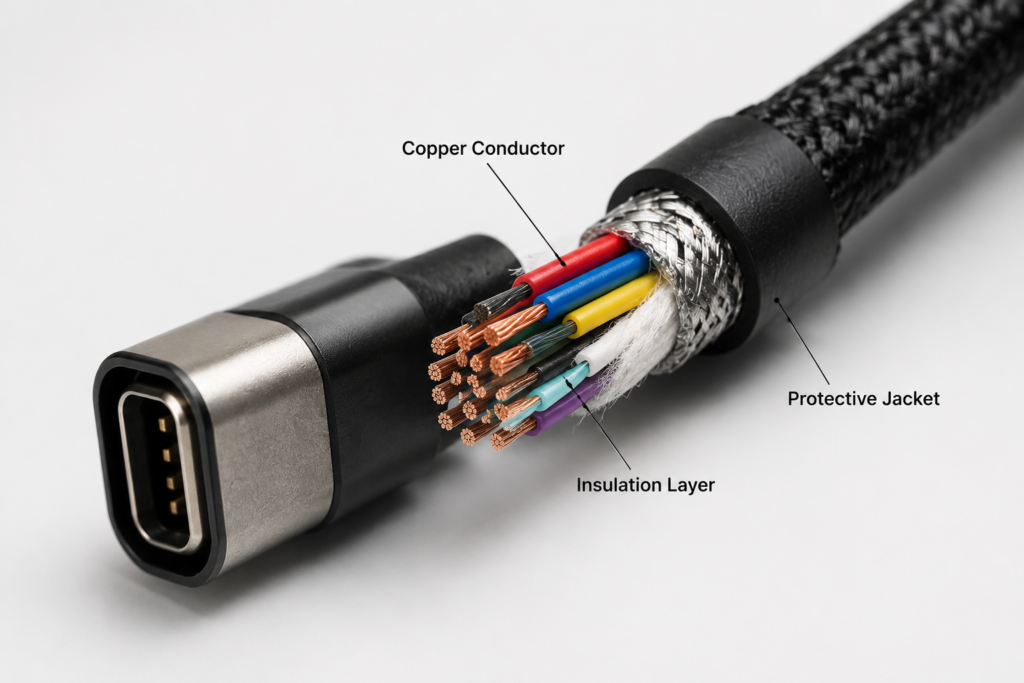
The core function of insulation is to isolate live conductors, preventing electric leakage and short circuits, and fundamentally avoiding electric shock and fire risks. Beyond safety, it directly affects the service life of wires, as well as the signal quality of data cables and network cables—signal loss and transmission stability are closely tied to insulation materials.
As electrical technology advances, insulation materials have evolved continuously. Early solutions relied on general-purpose plastics like PE and PP, prioritizing cost-effectiveness and widespread adoption. Later, to meet demands for high-temperature, corrosion-resistant, and high-frequency applications, high-performance fluoropolymers such as FEP emerged. The industry has shifted from “cost-first” to “performance-and-scenario-first” design.
Put simply, the three materials have clear roles: PE is the most widely used, cost-effective base option; PP is an upgraded choice balancing light weight and performance; FEP is a high-end solution for extreme environments. Together, they cover nearly all scenarios from everyday household use to cutting-edge industrial applications.
2. Basics: How to Understand Insulation Material Performance
How Polymer Materials Provide Insulation
Insulation materials block electricity because of their molecular structure. In these polymers, electrons are tightly bound to atoms and cannot move freely like the free electrons in metals. This gives them extremely high electrical resistance, so current barely passes through, isolating conductors and preventing leakage.
PE, PP, and FEP are all non-polar polymers with stable molecular structures. They not only have strong insulation capabilities but also cause minimal energy loss during signal transmission, making them ideal for wire insulation.
Key Performance Indicators for Everyday Readers
You don’t need to memorize complex technical terms to judge insulation materials. Just focus on three dimensions:
- Electrical performance: Core factors include insulation capability (how well it blocks electricity), signal loss (whether data transmission slows or degrades), and voltage resistance (how much voltage it can withstand without breaking down).
- Mechanical performance: Core factors include flexibility (how soft and bendable the wire is for installation), strength (how easily it breaks when pulled), and wear resistance (whether it wears out with long-term friction).
- Environmental performance: Core factors include temperature range (whether it works properly in extreme cold or heat), chemical resistance (whether it fails when exposed to oil or chemicals), and aging resistance (whether it becomes brittle and cracks over time).
3. Polyethylene (PE): The Most Widely Used Cost-Effective Insulation
Material Basics and Common Types
PE, short for polyethylene, is one of the most common plastics in daily life—plastic bags and bottles are mostly made of it. It is also the most used insulation material in the wire and cable industry.
Common PE insulation grades fall into three categories:
- LDPE (Low-Density Polyethylene): Soft and easy to process, the most common type for ordinary wires;
- HDPE (High-Density Polyethylene): Higher crystallinity, stiffer, with better wear and environmental resistance;
- XLPE (Cross-Linked Polyethylene): Treated with a special cross-linking process for greatly improved heat and mechanical performance, the core material for high-voltage power cables.
Core Performance Characteristics
PE has stable insulation performance, barely leaks electricity in daily environments, has low signal transmission loss, excellent water and moisture resistance, mature processing technology, and low mass-production cost.
Key Advantages and Inherent Limitations
- Advantages: Extremely cost-effective with low material and processing costs; stable insulation performance; good water and moisture resistance; excellent flexibility for easy installation.
- Limitations: Standard PE has limited heat resistance, with a long-term working temperature generally below 90℃; average flame retardancy, with dripping when burning; prone to aging and brittleness with long-term sun exposure.
Typical Everyday and Industrial Applications
PE insulation is widely used in home wiring, phone charging cables, standard network cables, coaxial TV cables, and low-voltage power cables. High-voltage transmission lines and new energy cables generally use the upgraded XLPE.
4. Polypropylene (PP): Lightweight High-Performance Insulation
Material Basics and Structural Characteristics
PP, short for polypropylene, is a polyolefin in the same material family as PE, with slight differences in molecular structure. It has lower density and a stiffer feel—takeout food containers and heat-resistant plastic bowls are often made of PP.
Compared to PE, PP has higher crystallinity, better heat resistance and mechanical strength, and superior performance in high-frequency signal scenarios.
Core Performance Characteristics
PP has excellent insulation capability, especially extremely low signal loss at high frequencies. It has noticeably better heat resistance than standard PE, plus low density, light weight, and good chemical resistance.
Key Advantages and Inherent Limitations
- Advantages: Better heat resistance, working reliably at around 100℃ long-term; outstanding high-frequency signal transmission; lightweight, ideal for portable devices; better oil and chemical resistance than standard PE.
- Limitations: Becomes brittle at low temperatures with reduced impact resistance; less flexible than PE, resulting in stiffer wires; narrow processing temperature window with stricter production requirements.
Typical Everyday and Industrial Applications
PP insulation is mainly used in automotive wiring harnesses, power capacitor films, high-frequency communication cables, internal insulation parts for home appliances, and heat-resistant electronic wires.
5. Fluorinated Ethylene Propylene (FEP): High-End Fluoropolymer for Extreme Environments
Material Basics and Place in the Fluoropolymer Family
FEP, short for fluorinated ethylene propylene, is a high-performance fluoropolymer. It belongs to the same material family as the well-known Teflon (PTFE), and fluorine atoms in its molecules give it near-unmatched stability.
Compared to PTFE, FEP can be processed with standard melt extrusion technology, making it more suitable for mass production of wires and cables. It is the mainstream fluoropolymer insulation for high-end cables.
Core Performance Characteristics
FEP has exceptional heat resistance, operating stably at 200℃ long-term. It resists nearly all acids, alkalis, and solvents, has top-tier insulation and high-frequency signal performance, and is inherently flame-retardant, self-extinguishing when removed from fire.
Key Advantages and Inherent Limitations
- Advantages: Extremely high temperature rating with strong adaptability to both hot and cold; exceptional chemical stability, unaffected by nearly all common chemicals; top-tier high-frequency low-loss performance; excellent aging and weather resistance with an extremely long service life.
- Limitations: Very expensive raw material, costing several times or even dozens of times more than PE; high processing temperatures and difficulty, requiring specialized equipment; average mechanical strength with a tendency for cold-flow deformation.
Typical Everyday and Industrial Applications
FEP insulation is essential for aerospace on-board cables, semiconductor manufacturing equipment wiring, high-temperature industrial sensor wires, high-end RF communication cables, medical device connecting wires, and cables for extreme chemical environments.
6. Side-by-Side Comparison of the Three Insulation Materials
The table below summarizes the most relevant performance differences for everyday readers:
| Performance Category | Polyethylene (PE) | Polypropylene (PP) | Fluorinated Ethylene Propylene (FEP) |
|---|---|---|---|
| Long-Term Working Temp | Standard: ≤90℃; XLPE: 105–125℃ | 100–120℃ | ~200℃ |
| Insulation Capability | Good | Good | Excellent |
| High-Frequency Signal Loss | Relatively low | Very low | Very low |
| Flexibility | Good (best with LDPE) | Moderate, fairly stiff | Moderate |
| Chemical Resistance | Fair, not resistant to strong solvents | Good | Excellent |
| Price Level | Low | Medium | High |
Overall, PE excels in cost-effectiveness and popularity, PP balances heat resistance and high-frequency performance, and FEP is a premium choice with top-tier all-around performance—each suited to different use cases.
7. Scenario-Based Selection: Choosing the Right Insulation
Everyday Digital, Home Appliance, and Residential Wiring Scenarios
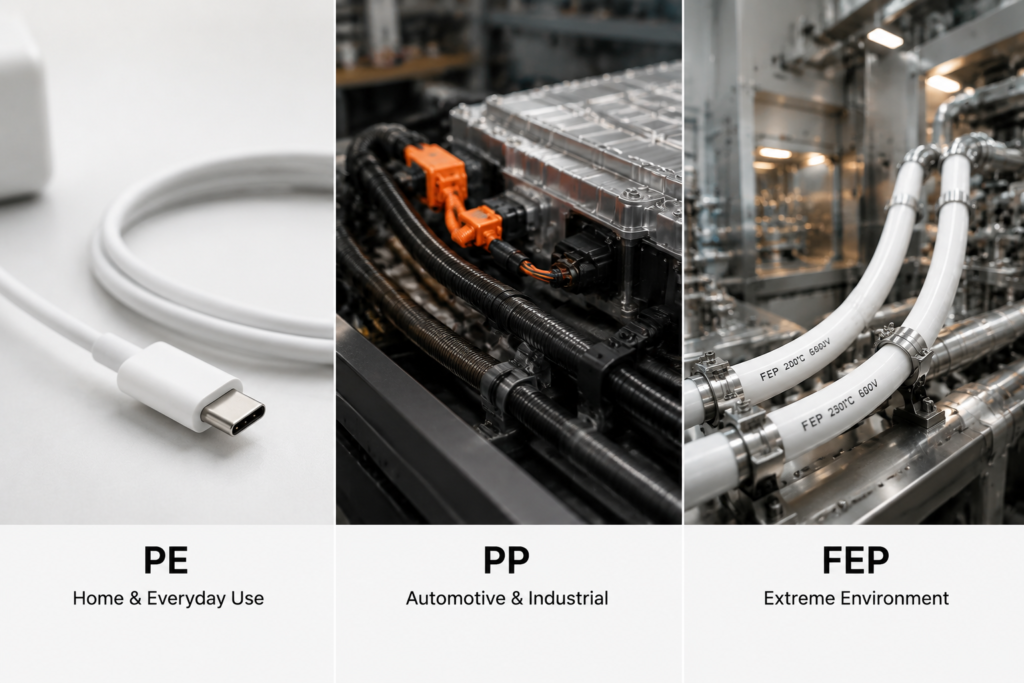
For standard home use, phone charging cables, appliance power cords, and 100M/1000M network cables at room temperature, PE insulation is fully sufficient. It offers stable performance and low cost, covering more than 90% of daily electrical needs as a practical, cost-effective option.
Automotive, Power, and General Industrial Scenarios
For automotive wiring harnesses, general industrial equipment, and power applications with moderate heat requirements, PP insulation offers better value. It balances heat resistance, light weight, and electrical performance at a much lower cost than fluoropolymers. For high-voltage power transmission, modified XLPE is the preferred choice.
Extreme Conditions: High Temperature, Corrosion, and High Frequency
For extreme environments such as chemical plant production lines, high-temperature furnace equipment, aerospace systems, and high-end 5G RF devices, FEP insulation is mandatory. Only it can maintain long-term electrical safety and signal quality under the combined stresses of high heat, strong corrosion, and high-frequency transmission.
Common Selection Misconceptions Clarified
- More expensive is not always better: Using FEP for everyday home use is severe overkill with no real-world benefit.
- Wire softness does not equal insulation ability: Flexibility only affects installation feel and has no direct link to electrical isolation performance.
- Heat resistance does not equal cold resistance: PP handles heat well but becomes brittle at low temperatures, so caution is needed in cold environments.
8. Industry Developments and Future Trends
High-Speed Communications Driving Demand for Low-Loss Materials
With the spread of USB4, 10 Gigabit networks, 5G base stations, and high-speed data center interconnects, transmission speeds keep increasing, raising the bar for low-loss insulation materials. Demand will continue to grow for foamed, low-loss modified PE and PP, as well as FEP for high-end applications.
New Energy Boosting Demand for Heat-Resistant Insulation
New energy applications such as electric vehicle high-voltage systems, high-power charging stations, and energy storage stations typically feature high voltage and significant heat generation, demanding higher temperature and voltage ratings from insulation materials. This will drive technical upgrades and expanded use of XLPE, heat-resistant PP, and FEP.
Shift Toward Eco-Friendly, Recyclable Materials
As global environmental requirements rise, halogen-free flame-retardant and recyclable insulation materials are a major industry trend. Recyclable modification and eco-friendly flame-retardant upgrades for PE and PP are the mainstream direction. The fluoropolymer sector is also exploring more recyclable, lower-impact materials that deliver performance while supporting sustainability.
9. Conclusion
Recap of the Three Materials’ Core Roles
- PE is a versatile, cost-effective insulation material covering most everyday consumer scenarios, the “workhorse base option” of insulation.
- PP is a lightweight, high-performance insulation material that excels in heat-resistant and high-frequency scenarios, the “balanced choice” for mid-range applications.
- FEP is an insulation material for extreme environments and high-end applications, with top-tier all-around performance as a “premium solution” for special operating conditions.
Core Principle for Insulation Selection
There is no universally “best” insulation material—only the best fit for a given scenario. When choosing, simply match the material to your actual working temperature, electrical requirements, operating environment, and budget. This ensures safety and performance while achieving the best value for money.