
If you’ve ever cut open a power cord, USB cable, or electrical wire, you’ve seen the copper wires at the core — those are almost always bare copper conductors. They are the foundational component that carries electrical current inside nearly every cable and wiring product.
A bare copper conductor is an uninsulated copper wire that carries electrical current. Although it is called “bare,” it is almost always covered by insulation when used inside finished cables and cords.
It is the most common conductor material used in electrical wiring and cables worldwide.
Many shoppers assume “all copper wire is the same” or that more strands automatically means better quality. In reality, copper conductors come in different purity grades, hardness levels, strand structures, and size standards, and each is built for a specific job.
Think of bare copper wire like rope for electricity. A thick solid metal rod is strong but stiff, while a fine braided rope is flexible but serves a very different purpose. This guide breaks down everything you need to know about bare copper conductors in plain English, from sizing standards to real-world use cases.
1. What Is a Bare Copper Conductor?
1.1 Core Definition
A bare copper conductor is an uninsulated copper wire — solid or stranded — that acts as the core current-carrying component inside cables and electrical systems.
- It has no plastic insulation or outer jacket on the copper itself. Inside finished cables, it is always wrapped in insulation for electrical safety.
- It is manufactured from electrolytic copper through wire drawing and stranding processes, and is the global standard material for electrical wiring.
- Everyday products like household power cords, USB cables, and building wiring all use bare or tinned copper conductors under their insulation.
1.2 Purity & Material Grades
- Standard grade: Electrolytic Tough Pitch copper (Cu-ETP)
The most widely used copper grade for wires and cables worldwide. It is the default material for almost all consumer and industrial electrical wire. - High-purity grade: Oxygen-Free Copper (OFC / Cu-OF)
Has lower oxygen content and is used in specialty applications such as high-end audio, vacuum equipment, and precision electronics. It is not the standard material for ordinary power or data cables, despite common marketing claims. - Commercial copper conductors are commonly manufactured with copper purity around 99.9%, depending on the applicable material standard.
- Conductivity benchmark: 100% IACS (International Annealed Copper Standard). At 20°C, the resistivity of standard annealed copper is ≤ 0.017241 Ω·mm²/m. This benchmark is widely used for comparing the conductivity of different conductor materials.
1.3 Temper / Hardness States
Copper wire comes in different hardness levels, chosen for the mechanical demands of the installation:
- Hard-drawn copper: High tensile strength, low ductility. Used for overhead lines and applications where the wire is under constant tension.
- Half-hard copper: Balanced strength and flexibility. Used for general-purpose fixed wiring.
- Annealed soft copper: High ductility, easy to bend and form. Used for flexible cords, grounding systems, and applications requiring frequent movement.
2. Conductor Structure & Classification
Copper conductors are formally classified by their construction, most clearly defined in the international standard IEC 60228.
Important clarification first
Classes 3 and 4 are rarely encountered in modern low-voltage power cables.
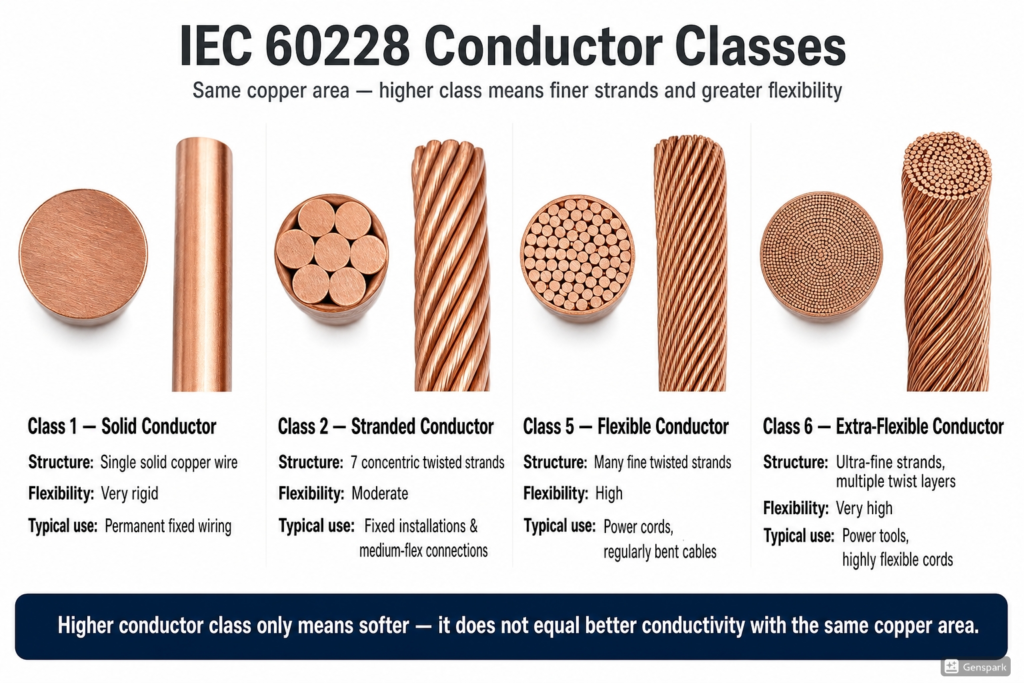
Class 5 and Class 6 describe only softness / flexibility — they do not mean higher quality or better conductivity than Class 2.
2.1 IEC 60228 Conductor Classes
- Class 1: Solid conductor
- Single solid round copper wire. Rigid and not designed for repeated bending.
- Primary use: Permanent fixed wiring, power cable cores.
- Common cross-section range: 0.5 ~ 1600 mm²
- Class 2: Stranded conductor
- Multiple wires of equal diameter twisted together in concentric layers. More flexible than solid wire.
- Primary use: Fixed installations to medium-flexibility connections.
- Common cross-section range: 0.5 ~ 3500 mm²
- Class 5: Flexible conductor
- Many fine strands twisted with short lay lengths for high flexibility.
- Primary use: Power cords for mobile devices, cables that are bent regularly.
- Maximum individual strand diameter for larger sizes: 0.51 mm
- Class 6: Extra-flexible conductor
- Even finer strands and multiple twisting layers for the highest flexibility.
- Primary use: Handheld power tools, stage lighting cables, highly flexible cords.
- Maximum individual strand diameter for larger sizes: 0.41 mm
2.2 Common Concentric Stranding Patterns
These are common construction examples rather than mandatory strand counts. Exact strand counts can vary slightly by manufacturer.
- 7 strands: 1 center wire + 6 outer wires. The most common structure for small cross-section wires.
- 19 strands: 1 + 6 + 12 three-layer construction. Standard for medium cross-sections.
- 37 strands: 1 + 6 + 12 + 18 four-layer construction. Used for larger, flexible conductors.
- 61+ strands: Very large cross-sections, balancing high current capacity with bending flexibility.
3. Sizing Standards: Metric mm² vs AWG
There are two dominant sizing systems used worldwide. They are not directly interchangeable — always use official conversion tables for engineering work.
3.1 IEC Metric System (mm²)
- Nominal cross-section is measured in square millimeters.
- Standard sizes: 0.5, 0.75, 1, 1.5, 2.5, 4, 6, 10, 16, 25, 35, 50, 70, 95, 120, 150, 185, 240, 300, 400, 630
- Larger sizes from 800 to 3500 mm² are used for power transmission mains.
3.2 AWG American Wire Gauge System
- Core rule: AWG numbers are logarithmic rather than linear. Smaller AWG number = thicker wire. Every 3 AWG step down roughly doubles the cross-sectional area.
- AWG is a North American sizing standard and is not a direct replacement for IEC metric sizes.
- Common approximate conversions:
- 10 AWG ≈ 5.26 mm²
- 12 AWG ≈ 3.33 mm²
- 14 AWG ≈ 2.08 mm²
- 4/0 AWG ≈ 107.2 mm²
- Actual current-carrying capacity (ampacity) is defined by NEC or local electrical codes, not just the wire size.
4. Key Performance Parameters
4.1 Electrical Performance
- DC resistivity: ≤ 0.017241 Ω·mm²/m for annealed copper at 20°C.
- Ampacity (current-carrying capacity): Depends directly on conductor cross-section, ambient temperature, and installation method. There is no universal “amps per mm²” ratio.
- Skin effect: At high frequencies, current concentrates near the outer surface of the conductor.
- Conventional stranded conductors improve flexibility but do not eliminate the skin effect.
- For high-frequency applications, special constructions like Litz wire are used to reduce AC losses.
4.2 Mechanical Performance
- Tensile strength: ~380 N/mm² for hard-drawn copper, ~200 N/mm² for soft annealed copper.
- Bend life: Soft flexible conductors survive many more bending cycles before breaking.
- Elongation: ≥30% for soft copper, only ~1–2% for hard-drawn copper.
4.3 Physical & Environmental Properties
- Density: 8.96 g/cm³
- Coefficient of thermal expansion: 17 × 10⁻⁶ /°C
- Thermal conductivity: 401 W/(m·K) — excellent heat dissipation
- Corrosion resistance: Stable in dry environments. Oxidizes and tarnishes in humid, acidic, or alkaline conditions, and requires tin plating or other protection.
5. Bare Copper vs. Tinned Copper
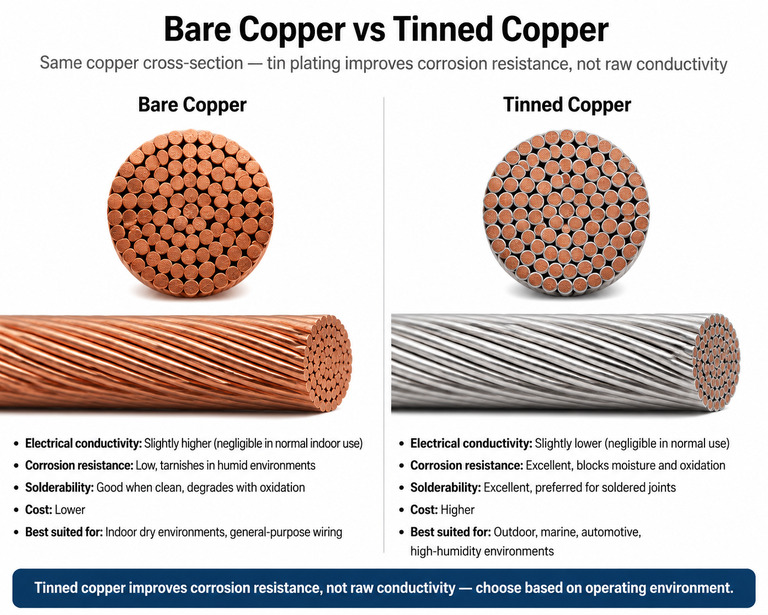
Tinned copper is bare copper with a thin layer of tin plated onto the surface. Here’s how they compare:
| Property | Bare Copper | Tinned Copper |
|---|---|---|
| Electrical conductivity | Slightly higher | Slightly lower (difference is negligible in most use cases) |
| Corrosion resistance | Low — tarnishes in humidity and forms insulating patina over time | Excellent — tin blocks moisture and oxidation |
| Long-term conductivity stability | Moderate in dry environments, degrades in wet conditions | Excellent even in harsh environments |
| Solderability | Good when clean, but oxidizes over time | Excellent, preferred for soldered connections |
| Cost | Lower | Higher |
| Best suited for | Indoor dry environments, general-purpose wiring, grounding | Outdoor, marine, automotive, solar, high-humidity, and long-storage applications |
5.1 Why most cables still use bare copper
Manufacturers select bare or tinned copper based on the operating environment rather than electrical performance alone.
- Lower manufacturing cost and better overall value
- Slightly better conductivity, with the difference being almost unnoticeable in normal indoor use
- Fully adequate service life in dry indoor environments
- Tinned copper is recommended only for high-humidity, corrosive, or long-term storage conditions
5.2 Why Most USB & Charging Cables Use Bare Copper
If you’ve ever wondered why nearly all consumer USB and charging cables use bare copper instead of tinned copper, there are four practical reasons:
- Lower manufacturing cost, which keeps final product prices competitive
- Excellent electrical conductivity for both power and data signals
- Easy to draw into fine strands and process into flexible multi-conductor cables
- Fully suitable for typical indoor consumer electronics use cases
Tinned copper is generally reserved for automotive, outdoor, marine, and industrial cables where moisture and corrosion are real long-term risks.
6. Common Real-World Applications
6.1 Power Transmission & Distribution
- Overhead distribution lines: Hard-drawn stranded copper for short, high-load sections
- Substation busbars: Large solid or stranded bare copper for high-current distribution
- Equipment lead wires: Soft stranded copper for flexible transition connections
6.2 Grounding & Lightning Protection
- Ground grids and electrodes: Bare stranded copper or solid round copper for low-resistance grounding paths
- Lightning down conductors: Large cross-section bare copper to safely discharge lightning current
- Equipment equipotential bonding: Multi-strand soft bare copper conductors
6.3 Electrical & Electronics
- Internal busbars in transformers and switchgear
- Component leads and coil windings in electronics
- Automotive wiring harnesses (almost always insulated, using bare or tinned copper cores)
- Consumer electronics: USB cables, charging cables, HDMI cables, and internal device wiring
6.4 Other Uses
- Some RF antenna conductors, busbar and slip ring applications
- Industrial hardware, craft wire, and general purpose electrical components
7. Selection Tips & Common Myths
7.1 How to Choose the Right Conductor
- Current requirement: Always calculate required ampacity per local electrical codes (NEC, IEC, etc.) with appropriate safety margin.
- Mechanical stress: Use hard-drawn copper for overhead or tensioned installations; use soft flexible conductors for frequent bending.
- Environment: Use tinned copper in corrosive or high-humidity locations; do not leave bare copper exposed.
- Code compliance: Conductor size must be selected based on official standards, not rules of thumb. Always account for ambient temperature, installation method, number of bundled wires, and continuous load.
7.2 Common Myths Debunked
- Myth: Thicker wire is always better
False. Oversized wire adds cost and bulk with no practical benefit. Match the conductor size to the actual load and installation requirements. - Myth: More strands = better conductivity
False. More strands only means the wire is more flexible. If the total copper cross-section is the same, the DC conductivity is essentially identical. - Myth: Stranded wire eliminates the skin effect
False. Standard stranded wire does not fix skin effect. Only specially constructed Litz wire addresses high-frequency AC losses. - Myth: Class 6 conductors are higher quality than Class 2
False. They are just softer. Class 2 is the correct choice for fixed wiring; Class 6 is for high-flex applications. One is not universally “better” than the other. - Myth: Oxygen-free copper (OFC) is required for USB or charging cables
False. Standard electrolytic tough pitch (ETP) copper performs identically for typical power and data use cases. OFC is a specialty material designed for specific industrial, high-vacuum, and high-end audio applications, and provides no meaningful benefit for ordinary consumer cables.
Final Summary
- Bare copper is the most widely used conductor material in electrical cables and wiring worldwide. It comes in different purity grades, hardness levels, and strand structures for different jobs.
- The IEC 60228 standard defines conductor classes (1, 2, 5, 6) by flexibility, not quality. Higher class numbers only mean the wire is softer, not better.
- There are two main sizing systems: metric mm² (IEC) and AWG (North American). They have approximate conversions but are not direct equivalents.
- Conventional stranded copper improves flexibility but does not eliminate high-frequency skin effect. Tinned copper improves corrosion resistance at a slightly higher cost.
- When selecting copper conductor, match the size, material, and construction to the actual current, mechanical, and environmental requirements. Following official electrical standards is always more reliable than marketing claims.