
If you’ve ever cut open a USB cable and been surprised by how many individual wires are inside, you have already seen the three core types of conductors at work: power wires, data wires, and ground wires. Each type has a completely different job, and they are not interchangeable.
Think of a multi-conductor cable like the utility systems running through a building:
- Power wires are the electrical grid — they deliver energy to run everything.
- Data wires are the internet and communication lines — they carry information back and forth.
- Ground wires are the safety and reference system — they provide a stable baseline and a safe escape path for fault current.
This guide breaks down each type of conductor, how they are built, what they do, and how they work together inside USB-C and other multi-function cables.
1. Power Conductors
Power conductors are the current-carrying backbone of any cable. Their only job is to deliver electrical energy from one end to the other.
1.1 Core Function & Properties
- Their primary role is to transfer electrical power, used to carry direct current (DC) or alternating current (AC) electrical energy to supply operating voltage to devices. They form the main current path for power systems.
- Current-carrying capacity is directly related to conductor cross-sectional area: a thicker wire has lower electrical resistance and can safely carry more continuous current. Real-world ampacity also depends on insulation temperature rating, installation method, and ambient temperature — it is never determined by wire thickness alone.
- Copper offers high electrical conductivity, so it can use a smaller cross-sectional area for the same current-carrying capacity. Aluminum is lighter and lower cost, making it preferred for large fixed power distribution lines. Most small cables and consumer electronics use copper conductors.
1.2 Construction & Materials
- Two common conductor types:
- Solid conductors: single-piece wire, lower cost and rigid. Used mostly for fixed building wiring and permanent installations.
- Stranded conductors: many thin copper strands twisted together. More flexible and resistant to bending fatigue. Used for charging cables, device cords, and any cable that gets moved regularly.
- Every conductor is wrapped in an insulation layer rated for a specific voltage and thickness, required to meet local electrical safety standards.
- Wire color coding varies by region, there is no single global standard. In IEC-style systems, AC line conductors are commonly brown and neutral is light blue. In North American systems, line conductors are often black, red, or blue, and neutral is white or gray.
1.3 Common Applications
- Power conductors are the core component of chargers, charging cables, building wiring, industrial power systems, and transmission lines.
- In multi-function composite cables like USB-C, they are routed and separated from high-speed signal pairs to reduce electromagnetic interference from the power line affecting data transmission.
2. Data & Signal Conductors
Data conductors are built for signal quality, not raw power capacity. They carry information, not large amounts of energy.
2.1 Core Function & Properties
- Their job is to transmit electrical signals, which can be either digital or analog.
- Digital signal transmission: used by USB, HDMI, Ethernet, RS-485, CAN and other communication protocols. High-speed designs almost always use differential pair architecture, with strict requirements for impedance matching, skew, and crosstalk. High-speed interfaces such as USB, HDMI, and PCIe generally require the differential impedance to meet their respective standard requirements; otherwise, signal integrity can be degraded.
- Analog signal transmission: used for audio cables, VGA video, industrial sensor signals and more. The key requirements are low signal attenuation and good noise rejection. Analog signals are typically more sensitive to noise, so they also benefit greatly from proper shielding design.
- Data conductors are almost always thinner than power conductors inside the same cable. Design priority is signal integrity, not current-carrying ability.
2.2 Construction & Materials
- Conductors are almost always high-purity copper or tinned copper, coated with a precision insulation layer. For high-frequency and high-speed use, low-dielectric, low-loss insulation materials are used to reduce signal attenuation and preserve signal integrity.
- Shielding options vary by use case:
- Unshielded twisted pair cables rely on twisting to cancel out crosstalk.
- Shielded cables add aluminum foil and/or braided copper shields to block external electromagnetic interference.
- There is no global color standard for data wires. Lower-speed cables often use color-coded pairs; higher-speed cables are usually identified by position and numbering.
2.3 Common Applications
- Data conductors form the signal backbone of computer peripherals, communication equipment, audio/video transmission, and industrial control systems.
- When properly isolated from power conductors and combined with twisting, shielding, and grounding design, they greatly reduce crosstalk and external interference for reliable transmission.
3. Ground Conductors
Ground conductors are the most misunderstood type of wire. They do not normally carry working current — they provide safety and a stable reference point. There are two distinct types with very different jobs.
3.1 Two Types of Ground
- Protective ground (Safety ground / PE): Provides a low-resistance path for fault current. If insulation fails and a live part touches a metal case, the fault current flows through the protective ground and triggers circuit protection to cut power, protecting people and equipment from electric shock.
- Functional / Signal ground: Serves as the 0V reference potential for circuits and is also the return path for operating current in many electronic circuits. It ensures all parts of the system share the same voltage reference and operate stably.
Conductor size is selected based on rated current, fault current requirements, and applicable design standards — there is no universal fixed ratio to power wire size.
3.2 Construction & Materials
- Most ground conductors use stranded copper for flexibility and low DC resistance. For large industrial installations, copper busbars or flat copper strips may be used instead.
- Color coding rules:
- Protective earth (PE) wires in building and power systems are almost universally insulated in green-yellow stripe. Green-yellow striping is reserved exclusively for protective earth (PE) conductors and must never be used for any other type of wire.
- Functional and signal ground wires inside electronic equipment have no universal color standard.
3.3 Common Applications
- Protective ground is a required safety feature in three-prong power cords, building wiring, and industrial control cabinets, and must comply with local electrical safety codes.
- Functional / signal ground is used inside signal cables as the reference return path. It is often connected to the cable’s metal shield and equipment chassis to improve interference rejection.
4. How All Three Work Together Inside a Cable
Nearly all modern multi-function cables contain all three types of conductors. They work as a system, not just individual wires.
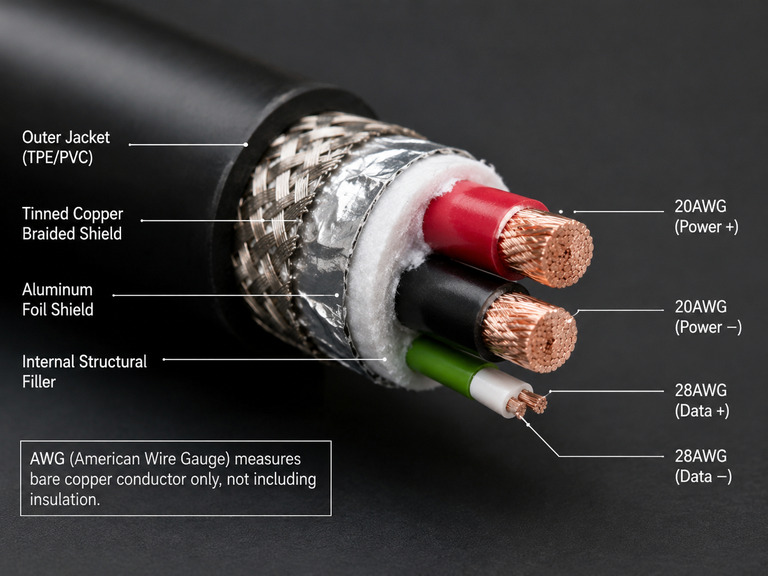
4.1 Combined Cable Design
- In a composite cable, each type of conductor has its own job: power delivers energy, data carries information, and ground provides reference potential and a fault current path. When paired with shielding structures, they improve both system safety and interference resistance.
- USB-C cables are a typical example of multi-conductor composite cables, combining power conductors, data conductors, ground conductors, and shielding layers all within a single jacket.
4.2 Interference Reduction Mechanisms
- Ground conductors work together with shielding layers to provide a low-impedance path for interference currents, reducing both incoming EMI and outgoing signal radiation.
- High-speed differential data pairs, paired with a solid ground reference design, effectively suppress common-mode noise and reduce electromagnetic emission.
4.3 Key Design Rules
- Wire sizing: Power conductors must meet ampacity and temperature rise requirements; protective ground conductors must meet safety standards.
- Functional ground design must take signal frequency, impedance, return path, and EMC requirements into account.
- Insulation rating: All conductors and insulation systems within the same cable must meet the rated voltage defined by the product design and comply with applicable safety standards.
- Physical layout: High-power conductors and high-speed signal pairs must be properly separated to prevent power ripple and line-frequency noise from coupling into the signal path.
5. Ground Wire vs. Shielding Layer: What’s the Difference?
This is one of the most common points of confusion. A shielding layer is not a ground wire, and they serve different purposes.
Different Roles
- A ground conductor is a functional electrical conductor. Its core jobs are safety protection, voltage reference, and current return path.
- A shielding layer is a structural barrier. Its core job is to block electromagnetic interference from coupling in or radiating out. It is not classified as a functional signal or power conductor.
Different Construction
- A ground conductor is a solid or stranded copper wire that runs the full length of the cable, with defined electrical connection requirements.
- A shielding layer is a wrapping structure — usually aluminum foil, braided copper mesh, or both — that surrounds the inner wire bundle.
How They Connect
- In most designs, the shielding layer is connected to the ground conductor at one or both ends. It relies on the ground path to actually drain away interference current.
- They work together, but they are not the same thing. You cannot safely use a shielding layer as a replacement for a proper protective ground conductor.
Final Summary
- Inside every multi-function cable there are three categories of conductors: power conductors deliver energy, data conductors carry information, and ground conductors provide safety and a stable voltage reference.
- Power conductor thickness helps determine how much current a cable can safely handle, but real performance also depends on material quality, temperature, and design.
- Data conductors are optimized for signal integrity, not current capacity. High-speed designs use differential pairs, tight impedance control, and shielding to maintain clean transmission.
- Ground conductors come in two types: protective ground for electrical safety, and functional/signal ground for circuit reference. They work with shielding layers to reduce interference, but they are not the same thing as the shield itself.
- The number, size, and arrangement of internal wires is what truly determines a cable’s real-world capabilities — you can never judge a cable just by its outer appearance.