
When buying a fast charger, most people first notice the wattage, gallium nitride (GaN) technology, and the number of supported protocols, but few pay attention to the real “brain” inside the charger — the multi-protocol main control chip.
It is invisible to users, yet it determines whether your phone can activate fast charging, how fast it charges, and how safe the whole charging process is. This article explains the main control chip of multi-protocol chargers in plain language, so that everyone can understand how it works.
1. What Is the Main Control Chip of a Multi-Protocol Charger?
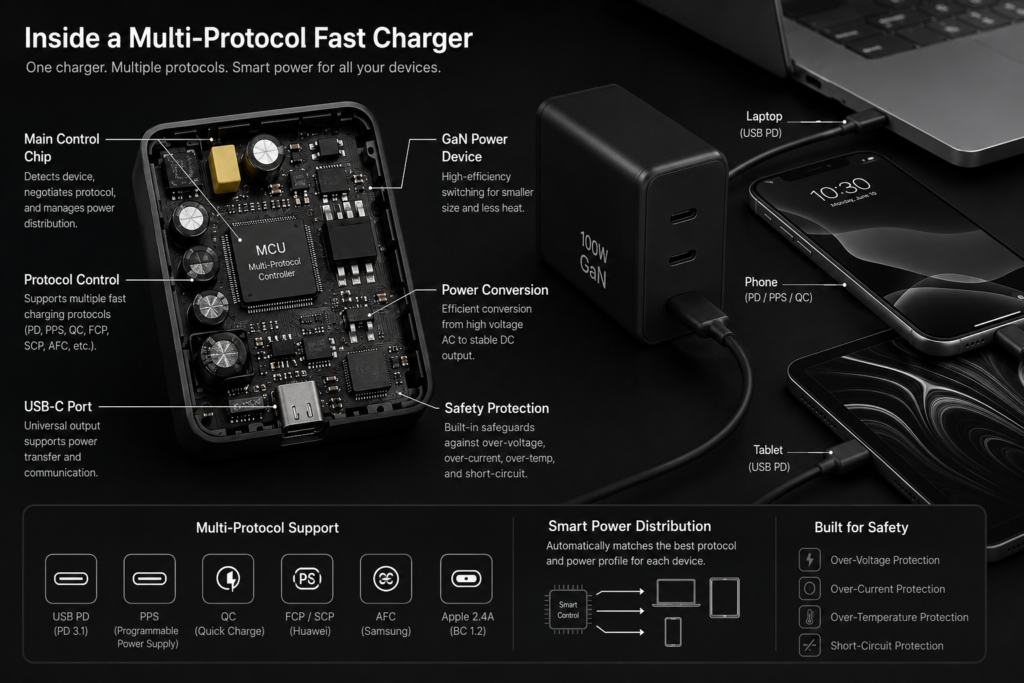
1.1 What Is a Charger Main Control Chip
As the name suggests, the main control chip is the core component that issues commands inside the charger. You can think of it as the brain of the charger.
Many people mistakenly believe that the chip provides power itself, but this is not the case. The power of the charger comes from the power conversion circuit. The main control chip does not output electricity directly. Its core job is to manage the entire charging process: when to start charging, what voltage and current to use, when to reduce speed, and how to cut off power in case of abnormalities.
This is why every fast charger must have a main control chip. Without it, the charger cannot communicate with the phone, can only output fixed 5V slow charging, and may even damage the device due to mismatched parameters.
1.2 What Does “Multi-Protocol” Mean
A fast charging protocol is like a “common language” between the charger and the device. Only when both sides speak the same language can fast charging be activated; otherwise, only the slowest basic charging mode can be used.
Early chargers mostly supported only one fast charging protocol, such as only Qualcomm Quick Charge or only a certain brand’s proprietary protocol. When switching to a phone of another brand, only slow charging was available.
The “multi-protocol” main control chip has built-in communication rules for multiple fast charging protocols in one chip, and can “communicate” with devices of different brands and systems. Whether it is an iPhone, an Android phone or a laptop, it can automatically match the corresponding fast charging mode when plugged in, without preparing multiple chargers.
This is also the reason why multi-protocol solutions are becoming more and more popular now: there are more and more devices, and everyone hopes that one charger can handle all digital products.
1.3 Why Should Average Users Care About It
Many people think that chips are something manufacturers should care about and have nothing to do with themselves, but this is not true. The main control chip directly affects every charging experience:
- It determines compatibility: Whether the protocols supported by the chip are complete directly determines whether your mobile phone, tablet, and computer can trigger fast charging;
- It determines charging speed: Whether the protocol matching is correct and whether the power scheduling is reasonable determine whether the charging is at full speed or sluggish;
- It determines safety: Protection functions such as over-voltage, over-current, and over-temperature are mostly executed by the main control chip. Products with mature chip solutions are more reliable for charging;
- It determines service life: The main control chip that supports firmware upgrade may continue to support new protocols through updates when you replace new devices in the future, without needing to replace the charger immediately.
2. What Core Chips Are Inside a Multi-Protocol Charger?
When you take apart a charger, you will see more than one chip, but the core functions can be divided into four categories. Most high-end solutions now highly integrate these functions into a single main control chip, making the charger smaller and more stable.
2.1 Main Control Core
The decision-making center of the entire charger. All charging process instructions are issued from here, and it coordinates the work of other modules as a whole.
2.2 Protocol Control Module
It is equivalent to a “translator”, responsible for identifying which fast charging protocols the connected device supports, completing two-way communication with mobile phones and computers, and confirming the charging rules recognized by both parties.
2.3 Power Conversion Control Part
It is equivalent to a “voltage regulator”. According to the negotiated protocol, it controls the power circuit to output the corresponding voltage and current, such as rising from 5V to 9V or 20V, and accurately controls the output power.
2.4 Safety Protection Module
It is equivalent to a “security guard”, which monitors the charging status in real time. Once abnormal conditions such as excessive voltage, excessive current, excessive temperature, or short circuit occur, it immediately cuts off the output to protect the device and the charger itself.
It should be noted that the current mainstream highly integrated main control chips have integrated the above four functions into one chip, instead of four independent chips working separately.
3. How Does the Main Control Chip Work?
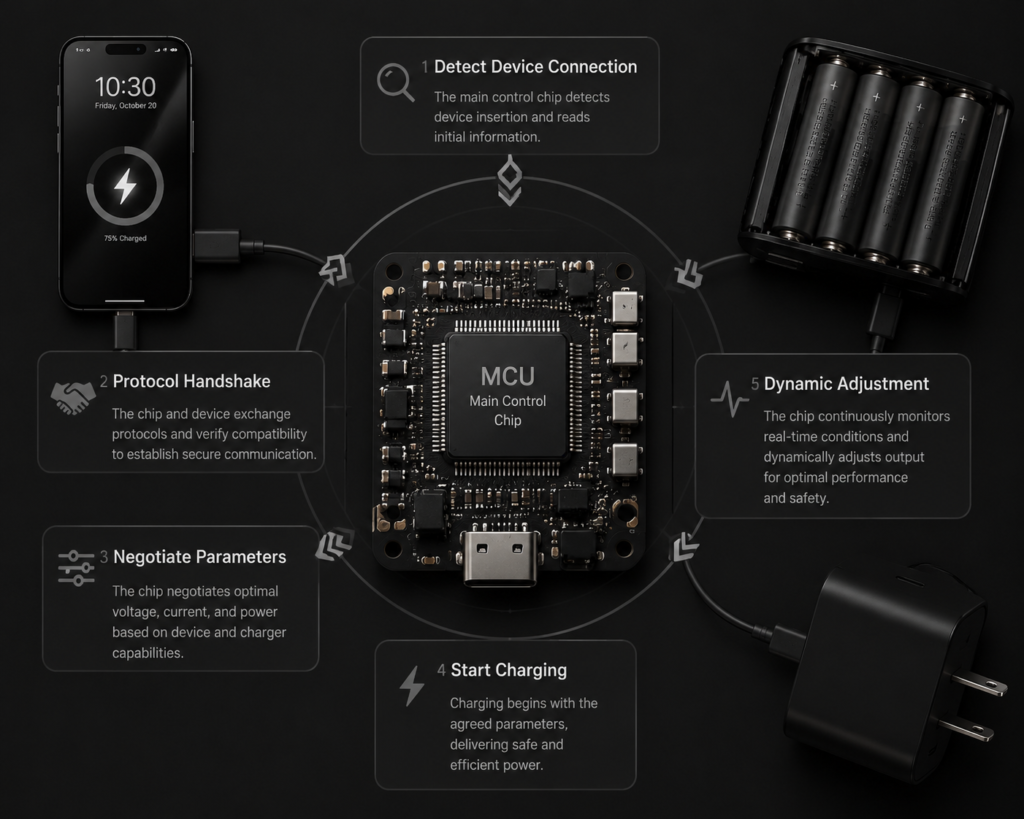
Charging is not about outputting full speed directly as soon as the cable is plugged in. It is a complete process of “detection-negotiation-execution-adjustment”, which is led by the main control chip throughout the process.
Step 1: Detect Device Connection
When you plug the charging cable into the USB-C port, the main control chip will immediately detect that a device is connected, confirm that the physical connection of the interface is normal, and prepare to start communication.
Step 2: Protocol Handshake
Next, the main control chip will actively “ask” the connected device: “What fast charging protocols do you support?” The device will also reply with its own capability list. This mutual confirmation process is called the “protocol handshake”.
Step 3: Negotiate Charging Parameters
After both parties confirm the mutually supported fast charging protocol, they will further negotiate specific charging parameters: what voltage to use, how much current, and the maximum output power.
The chip will prioritize the fastest solution supported by both parties to ensure the highest charging efficiency.
Step 4: Start Charging
After the parameter negotiation is completed, the main control chip issues an instruction, the power circuit starts to output power of the corresponding specification, and officially enters the fast charging state. At the same time, the chip will continuously monitor data such as voltage, current, and temperature.
Step 5: Dynamic Adjustment
The whole charging process is not fixed power output. The main control chip will adjust the power dynamically according to the battery level and device temperature:
- Use high-power fast charging when the battery level is low;
- Gradually reduce the power when the battery is nearly full to protect the battery;
- If the temperature of the mobile phone is too high, it will also actively reduce the speed to lower the temperature and avoid potential safety hazards.
4. What Fast Charging Protocols Do Multi-Protocol Main Control Chips Support?
Different main control chips support different numbers and versions of protocols. At present, common fast charging protocols on the market are mainly divided into two categories: general standards and manufacturer proprietary protocols.
4.1 USB PD
The full name is USB Power Delivery, which is currently the most widely used general fast charging standard in the world, developed by the USB-IF organization.
From wireless earphones and mobile phones to tablets and laptops, almost all Type-C interface devices support USB PD. It can be said that the PD protocol is the basic standard configuration of multi-protocol chargers.
4.2 PPS
The full name is Programmable Power Supply, which is an advanced function in the USB PD protocol.
Compared with ordinary PD, PPS supports finer voltage adjustment, and can gradually adjust the voltage in very small steps. It can better match the direct charging scheme of mobile phones, with higher charging efficiency, lower heat generation, and is more friendly to the battery. Many Android phones’ fast charging now relies on the PPS protocol.
4.3 Qualcomm Quick Charge (QC)
A fast charging protocol launched by Qualcomm, which is common in Android phones equipped with Snapdragon processors. The QC protocol has been developed for many years and has a high penetration rate. Many early Android fast chargers took QC support as the standard.
4.4 UFCS
The full name is Unified Fast Charging Standard, jointly launched by the China Communications Standards Association and many domestic mobile phone manufacturers.
Its core function is to break brand barriers, so that cross-brand fast charging can be realized between mobile phones and chargers of different brands, instead of being limited to each brand’s own proprietary protocol.
4.5 Proprietary Protocols of Various Manufacturers
In addition to general standards, major mobile phone brands have their own proprietary fast charging protocols, such as:
- Apple Fast Charge
- Samsung Super Fast Charging (SFC)
- Huawei FCP / SCP
- OPPO VOOC / SuperVOOC
- vivo FlashCharge
- Xiaomi HyperCharge
These proprietary protocols usually achieve higher charging power, but most are only compatible with devices of their own brands. A good multi-protocol main control chip will be compatible with both general protocols and mainstream proprietary protocols, taking into account both versatility and fast charging speed.
5. How Does the Main Control Chip Recognize Devices of Different Brands?
Many people wonder: why does the same charger output one power level when plugged into an iPhone and another power level when plugged into an Android phone? In fact, this is the result of automatic identification and intelligent matching by the main control chip.
The entire identification process is divided into four steps:
- Automatically detect device access: After the device is plugged in, the chip senses the connection immediately;
- Read the list of protocols supported by the device: The chip sends a query to the device to obtain all fast charging protocols it supports;
- Prioritize the highest-level common protocol: Among the protocols supported by both parties, select the one with the fastest speed and the highest power;
- Output corresponding voltage and current: Adjust the output parameters to start charging according to the selected protocol.
We can take several common examples:
- iPhone connected: iPhones support the USB PD protocol. After the chip recognizes it, it will output power at the corresponding power under the PD protocol to activate Apple fast charging;
- Samsung phone connected: Samsung phones support both PD and its own SFC protocol. If the charger supports SFC, it will give priority to SFC for full-speed fast charging; if not, it will use PD fast charging as the second best option;
- Huawei phone connected: If the charger supports Huawei SCP/FCP protocol, it will activate the corresponding proprietary fast charging; if not, it will charge via universal PD or PPS;
- Laptop connected: Most laptops only support the USB PD protocol. The chip will negotiate the highest voltage gear supported by the laptop (such as 20V) and output the corresponding power.
In short: the final charging solution is the best one in the intersection of the protocols of the charger and the device.
6. Why Are Multi-Protocol Main Control Chips Getting More and More Complex?
A few years ago, the main control chip of the charger was very simple, but now it is becoming more and more sophisticated. There are four main reasons behind this.
6.1 More and More Protocols Need to Be Supported
In the early days, there were only a few types of fast charging such as PD and QC. Now major brands have launched proprietary protocols, coupled with new standards such as UFCS, the protocol library to be built into the chip is becoming larger and larger.
6.2 Higher and Higher Supported Power
In the past, most mobile phone chargers were 20W or 45W. Now 65W and 100W are very common, and high-end products even reach 140W and 240W (USB PD 3.1 EPR standard). The higher the power, the higher the requirements for the control accuracy and safety protection of the chip.
6.3 USB-C Interface Has Become the Mainstream
With the full popularization of the USB-C interface, chargers must support not only charging, but also data transmission, reversible plugging, dual-role and other functions. The logic that the main control chip needs to process is much more complex than that of the old USB-A interface.
6.4 Simultaneous Charging of Multiple Devices Has Become a Rigid Demand
Now people have more and more digital devices, and dual-port, three-port and even four-port chargers have become the mainstream. A single main control chip must manage multiple interfaces at the same time, and dynamically reallocate the total power according to the number of connected devices and power requirements, which greatly increases the difficulty.
7. What Is the Relationship Between the Multi-Protocol Main Control Chip and Gallium Nitride (GaN)?
Now many chargers promote both “gallium nitride” and “high-end main control chip”. Many people confuse the two. In fact, they are completely different things with different divisions of labor.
7.1 The Main Control Chip Is Responsible for “Control”
The main control chip is the brain of the charger, responsible for issuing instructions, making decisions, managing protocols, and providing protection, belonging to the “control layer”.
7.2 Gallium Nitride (GaN) Is Responsible for “Power Conversion”
Gallium nitride is a new type of semiconductor material, used to make power switching devices, responsible for converting high-voltage alternating current into low-voltage direct current that can be used by devices, belonging to the “power layer”.
7.3 The Two Are Partners Working Together
Simply put, gallium nitride determines whether the charger can be made small and how high the conversion efficiency is; while the main control chip determines whether the charger can fast charge, how good the compatibility is, and how safe it is.
Without a good main control chip, even the best gallium nitride devices cannot give full play to their full performance; without gallium nitride, high-end main control chips cannot make the charger small and light. The two complement each other and are indispensable.
Clarification of Common Misconceptions
- Gallium nitride is not a fast charging protocol, it is just a power device material;
- The main control chip is not gallium nitride, the two are completely different components;
- Gallium nitride chargers must have a main control chip, but the main control chip is not only used in gallium nitride chargers.
8. How Does One Main Control Chip Manage Multiple USB Interfaces?
Most current multi-port chargers only use one main control chip to manage 2-4 USB interfaces. How does it do this? The core logic is “total power sharing, dynamic and intelligent allocation”.
8.1 Fixed Total Power, Shared by Multiple Ports
Any charger has a rated total power, such as 65W and 100W. The sum of the output power of all interfaces cannot exceed this total power limit.
8.2 Detect One by One, Identify Independently
The main control chip will independently detect the device connection status of each interface, and respectively identify the protocol and power demand supported by each device without interference.
8.3 Dynamic Allocation and Intelligent Adjustment
When only one device is connected, this interface can use all the total power to achieve full-speed single-port output;
When a second or third device is connected, the main control chip will re-divide the total power according to the power demand of each device to ensure that each device can obtain reasonable charging power.
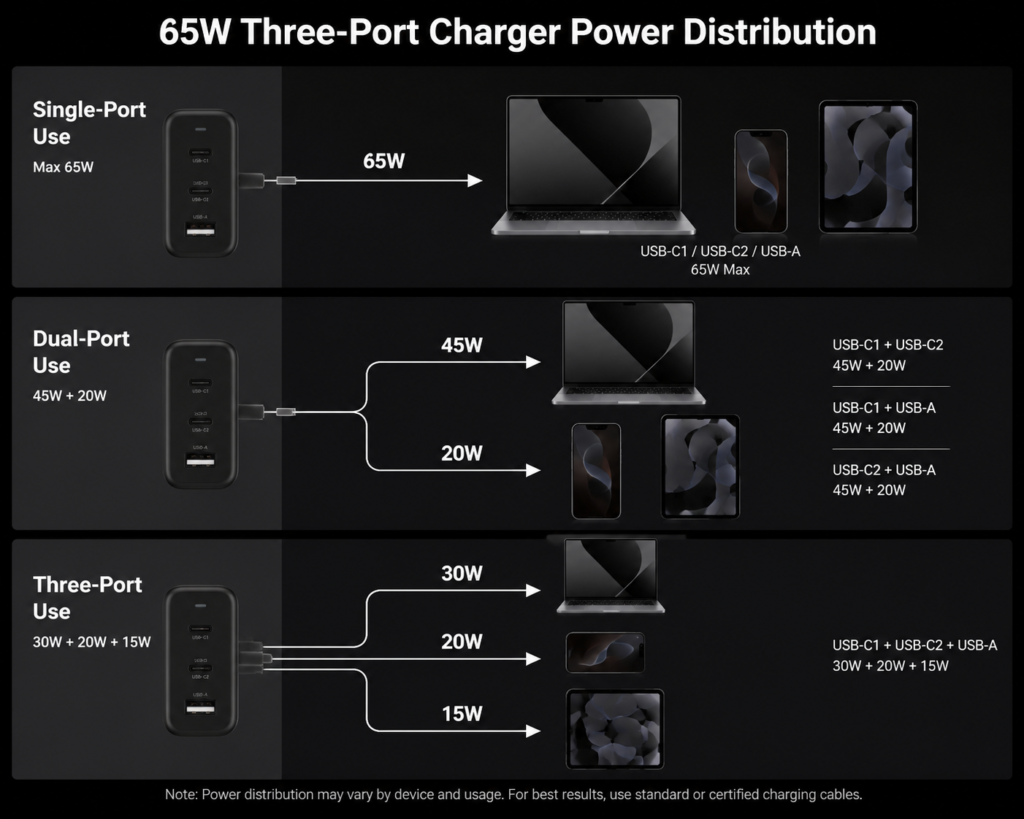
Take a common 65W three-port charger as an example:
- Only one device plugged in: single port up to 65W full-speed output;
- Two devices plugged in: usually allocated as 45W + 20W, which can charge a laptop and a mobile phone at the same time;
- Three devices plugged in: usually allocated as 30W + 20W + 15W, all three devices can charge at a good speed.
This is why the charging power of the first device will decrease after the second device is inserted — the total power is so much. After a new device is connected, the chip will reallocate the power to ensure that all devices can charge normally.
9. Key Factors Affecting the Performance of the Main Control Chip
To judge whether a main control chip is good or not, mainly look at these core indicators.
- Number of supported protocols: The more mainstream protocols supported, the wider the range of compatible devices;
- Version of supported protocols: For example, PD 3.1 supports higher power than PD 3.0, and newer versions usually have stronger functions;
- Maximum output power: The highest power that the chip can carry, which determines how many watts the charger can make;
- Dynamic power allocation capability: The core capability of multi-port chargers, the more reasonable the allocation logic, the better the multi-device charging experience;
- Whether it supports firmware upgrade: Some high-end chips support firmware update, which can add new protocols and optimize logic in the future, extending the service life;
- Safety protection capability: The more complete the protection mechanism, the safer the charging. Good chips will be equipped with multiple safety protections;
- Chip integration: The higher the integration, the fewer peripheral components, the smaller the charger volume can be made, and the lower the failure rate.
10. What Should Consumers Pay Attention to When Buying a Multi-Protocol Charger?
After understanding the principle of the main control chip, ordinary people do not need to delve into the specific chip model when buying a charger, just focus on these points.
10.1 Whether It Supports the USB PD Protocol
This is currently the most versatile protocol, which can be used by mobile phones, tablets, laptops, and game consoles. Chargers that do not support PD can basically be ignored.
10.2 Whether It Supports PPS
PPS is very practical for Android phones, and many Android models’ fast charging relies on PPS. Chargers that support PPS will have much better compatibility with Android devices.
10.3 Whether It Supports UFCS (If Required)
If you have multiple domestic mobile phones of different brands, chargers that support UFCS unified fast charging can realize cross-brand fast charging, which is very practical. If you only have a single brand device, you don’t have to force it.
10.4 Whether It Meets Your Own Power Demand
There is no need to blindly pursue high power, choose according to your own devices: 20-30W is enough for only charging mobile phones; choose 45W for charging mobile phones + tablets; choose 65W and above for charging laptops.
10.5 Whether It Has Perfect Safety Protection
Formal products will be marked with over-voltage, over-current, over-temperature, short-circuit and other protection functions, which are the foundation of charging safety.
10.6 Prioritize Reliable Brands
Chargers from mature brands have more stable main control chip solutions, better firmware optimization, and more guaranteed quality control and after-sales service.
10.7 Don’t Just Believe the Publicity of “Supporting Dozens of Protocols”
Many merchants use “supporting dozens of protocols” as publicity, but more protocols do not mean better experience. Many niche protocols are usually not used at all. The key is to see whether mainstream protocols such as PD and PPS are supported and whether the versions are up-to-date.
To sum up, when choosing a charger, you can’t just look at the parameter numbers. You should comprehensively consider actual compatibility, output power, safety certification and product quality. The one suitable for your devices is the best.
11. Common Misconceptions
Myth 1: The more protocols, the faster the charging
False. The charging speed depends on what protocols your device supports and whether the corresponding protocol power of the charger is sufficient.
If your phone only supports PD fast charging, even if the charger supports 20 other protocols, it will not make the charging faster.
Myth 2: All protocols can work at the same time
False. One interface can only charge one device with one protocol at the same time, and cannot run multiple protocols at the same time. Multi-protocol means compatibility with multiple protocols, not running multiple types at the same time.
Myth 3: All devices can run at maximum power
False. The maximum power of the charger is the upper limit, and the actual charging power is determined by the device. For example, a 65W charger charging a 27W iPhone can only run up to 27W at most, and will not be faster just because the charger has high power.
Myth 4: The more expensive the main control chip, the better
False. The price of the chip itself does not represent the experience. The key lies in the adaptation and optimization of the manufacturer. An expensive chip with poor adaptation may have worse compatibility and stability than a mature low-cost solution.
Myth 5: GaN is the main control chip
False. Gallium nitride is a power material, and the main control chip is a control chip. The two are completely different. You can’t ignore the importance of the main control chip just because a charger uses gallium nitride.
12. Summary
The multi-protocol main control chip is essentially the “brain” of the fast charger.
It silently undertakes all the work of device identification, protocol negotiation, power control and safety protection. Every smooth fast charging experience we have is inseparable from a mature and stable main control chip behind the scenes.
The more complete the supported protocols, the more devices the charger is usually compatible with; but the number of protocols is only a reference, and the actual experience, stability and safety are equally important.
For ordinary consumers, a truly easy-to-use multi-protocol charger should not only have sufficient power, but also have a mature and reliable main control chip solution. Choosing products that support mainstream protocols, have perfect safety protection and come from reliable brands is far more meaningful than simply pursuing “a large number of protocols”.