Whether you’re charging a smartphone, transferring files to a flash drive, connecting a keyboard and mouse, or hooking up an external monitor or hard drive, USB is a ubiquitous part of modern technology. As the world’s most widely adopted connectivity standard for electronic devices, USB has redefined how hardware interacts through its plug-and-play convenience, cross-device compatibility, and all-in-one functionality — completely eliminating the fragmented port landscape of early computing.
From the debut of USB 1.0 in 1996 to today’s high-performance USB4 standard, three decades of iteration have delivered far more than faster transfer speeds. They have reshaped the entire ecosystem of device connectivity. This article walks through the full history of USB: its origins, generational upgrades, physical form factor evolution, power delivery advancements, and future outlook.
1. The Predecessor Era: Why USB Was Born Out of Interface Chaos
Before USB emerged in the 1990s, computer peripheral connectivity operated in a fragmented, unstandardized state. A wide range of proprietary and legacy ports coexisted, creating major pain points for both users and manufacturers.
1.1 Overly fragmented ports with poor compatibility
Early PCs were packed with dedicated connectors: serial ports, parallel ports, PS/2 ports for keyboards and mice, and custom proprietary interfaces for specialized peripherals. Every device required its own matching port. Accessories were not interchangeable across systems, and compatibility issues were rampant.
1.2 Steep learning curve and poor user experience
None of these early interfaces supported hot swapping. Connecting or disconnecting a device required fully powering down the computer first — forced hot-plugging could permanently damage motherboards and hardware. Additionally, every peripheral required manual installation of custom drivers, a complex and error-prone process far beyond the skill of casual users.
1.3 Urgent industry demand for a unified standard
The fragmented port ecosystem drove up manufacturing and R&D costs for hardware makers, and stifled innovation in the peripheral market. A universal, simple, and reliable connectivity standard had become an urgent industry-wide priority.
2. The Birth of the Standard: Tech Giants Unite to Redefine Connectivity
To solve the port chaos, Intel took the lead in 1994–1995, partnering with five other industry leaders — Microsoft, IBM, Compaq, DEC, and Nortel — to co-develop the USB specification. They founded the USB Implementers Forum (USB-IF), the governing body responsible for defining, updating, certifying, and promoting the USB standard worldwide.
From its inception, USB was built on four core design principles that would become the foundation of its global success:
Hot-swappable: Devices can be connected and disconnected while the system is powered on, with no shutdown or reboot required.
Plug-and-Play (PnP): The system automatically detects hardware and loads appropriate drivers, eliminating complex manual setup.
Standardized power delivery: The port carries built-in power, eliminating the need for separate power adapters for most peripherals.
Usability first: Simplified operation logic designed to be accessible for everyday users.
3. Three Decades of Technical Evolution: From Low-Speed Peripherals to All-in-One High Performance
Since 1996, USB has gone through four major generational leaps, evolving from a niche interface for low-speed peripherals into a full-featured connectivity standard supporting high-speed data, high-resolution video, and high-power charging.
For quick reference, below is a complete comparison of core specifications across all USB generations:
USB Version
Release Year
Max Transfer Rate
Max Power Delivery
Visual Identifier
Primary Use Cases
USB 1.0
1996
12 Mbps (Full Speed)
5V / 500mA (2.5W)
White plastic insert
Basic low-speed peripherals: mice, keyboards
USB 1.1
1998
12 Mbps (Full Speed)
5V / 500mA (2.5W)
White plastic insert
First widely adopted standard; basic PC peripherals
Large file transfers, high-bandwidth peripherals, basic device charging
USB 3.1 Gen 2
2013
10 Gbps
5V / 3A (15W)
Red / teal plastic insert
High-speed external SSDs, high-resolution video peripherals
USB 3.2 Gen 2×2
2017
20 Gbps
5V / 3A (15W)
Type-C only
Dual-lane high-speed transfers; premium professional peripherals
USB4
2019
40 Gbps
USB PD compatible
Full-featured Type-C
All-in-one data, video, and charging for thin-and-light laptops
USB4 v2.0
2022
80 Gbps
240W USB PD compatible
Full-featured Type-C
8K video output, instant large file transfers, high-power device charging
USB transfer speeds have increased by over 6,000x from USB 1.0 to USB4 v2.0 over 26 years.
3.1 USB 1.x Era: Laying the Foundation (1996–1999)
Released in 1996, USB 1.0 was the first official specification, offering two speed tiers: 1.5 Mbps Low Speed and 12 Mbps Full Speed. It was designed primarily for low-bandwidth devices like mice and keyboards. Plagued by protocol bugs and hardware compatibility issues, the initial release never achieved mass market penetration.
The 1998 release of USB 1.1 fixed all critical flaws of the 1.0 spec, delivering vastly improved reliability and compatibility. It became the first USB standard to see widespread industry adoption, officially launching the era of mainstream USB adoption.
3.2 USB 2.0 Era: The Mainstream Revolution (2000)
USB 2.0, released in 2000, was a landmark milestone in USB history. It boosted transfer speeds to 480 Mbps — a 40x improvement over USB 1.1 — and shattered the limits of low-speed connectivity.
With a power rating of 5V/500mA (2.5W) and its iconic black plastic port, USB 2.0 transformed the peripheral industry overnight. USB flash drives rendered floppy disks obsolete; external hard drives, webcams, printers, and scanners all migrated to USB. It also spawned smaller form factors: Mini-USB and Micro-USB, which became standard for cameras, MP3 players, and early Android smartphones.
3.3 USB 3.x Era: The SuperSpeed Generation (2008–2017)
As demand grew for large file transfers and high-definition media, USB 2.0 became a performance bottleneck. The USB 3.x family ushered in the super-speed era.
USB 3.0 (2008): Delivered 5 Gbps transfer speeds — 10x faster than USB 2.0. Recognizable by its signature blue port, it increased power output to 5V/900mA (4.5W) to support higher-power peripherals and basic charging.
USB 3.1 (2013): Introduced two tiers. Gen 1 retained the original 5 Gbps speed (rebranded USB 3.0), while the new Gen 2 doubled performance to 10 Gbps, typically marked with red or teal ports.
USB 3.2 (2017): Introduced dual-lane transmission, topping out at 20 Gbps. Notably, the full 20 Gbps bandwidth was only available over Type-C connectors, cementing Type-C as the future of USB.
3.4 USB4 Era: Convergence and All-in-One Functionality (2019–Present)
USB4 represents a paradigm shift for the standard: rather than simply increasing speed, it unifies protocols, features, and use cases. Launched in 2019 and built on the Thunderbolt 3 protocol, USB4 supports 20 Gbps base speed and up to 40 Gbps at maximum.
The 2022 USB4 v2.0 update pushed dual-lane speeds to 80 Gbps and added full Thunderbolt 4 compatibility. For the first time, a single cable could handle high-speed data, 8K video output, and high-power charging — erasing the functional boundaries of traditional ports.
4. Form Factor Evolution: From Bulky Proprietary Connectors to the Universal Type-C
Alongside protocol upgrades, USB’s physical design has evolved dramatically — completing a transformation from bulky, one-way, application-specific connectors to compact, all-featured, universal ones.
Below is a comparison of mainstream USB connector types:
USB connectors have shrunk in size and grown in functionality, culminating in the all-purpose reversible Type-C standard.
4.1 Classic Legacy Connectors: Type-A / Type-B
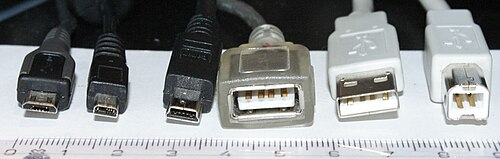
Type-A is the most recognizable PC host port, in use since 1996. Its robust build quality has kept it a staple for desktop devices for decades. Type-B, the squarish port once common on printers and scanners, has largely disappeared from modern devices.
4.2 Miniaturized Connectors: Mini-USB / Micro-USB
Mini-USB was the first attempt at a smaller USB form factor, used widely in early digital cameras and MP3 players, but it faded due to poor durability. The subsequent Micro-USB, with its slim profile and low cost, became the dominant charging and data port for Android phones from 2007 to 2019, powering the smartphone boom.
4.3 The Type-C Revolution: The Ultimate Connector Form Factor (2014–Present)
Introduced in 2014, USB Type-C is the culmination of USB form factor evolution and today’s global industry standard. Its core advantages are unmatched:
Fully reversible design eliminates the frustration of plugging it in the wrong way
Compact size ideal for smartphones, tablets, and thin laptops
Highly integrated functionality, supporting high-speed data, 4K/8K video output, and high-power charging in one connector
Native support for USB4, DisplayPort Alt Mode, and USB Power Delivery
5. Power Delivery Advancement: From 5V Low Current to 240W Fast Charging
Early USB was designed only to power small peripherals. But with the rise of mobile devices and the USB Power Delivery (USB-PD) standard, USB has become a universal charging solution for phones, tablets, laptops, and monitors alike.
Below is a comparison of USB-PD fast charging protocol iterations:
6. Expanded Capabilities: Beyond Data Transfer and Charging
Modern USB is far more than a simple data and charging port. Through protocol extensions, it has become the core foundation for full-scenario device interconnection.
6.1 OTG (On-The-Go) Technology
OTG enables direct device-to-device communication without a host PC. Smartphones and tablets can connect directly to USB drives, mice, keyboards, and card readers — enabling file transfers and peripheral control on the go, greatly expanding the utility of portable devices.
6.2 Docking Station Ecosystem
A single Type-C port can expand into Ethernet, HDMI, multiple USB ports, and card readers via a hub or docking station. This solves the port scarcity problem on thin-and-light laptops, supporting office work, display output, and multi-peripheral setups.
6.3 Full Multimedia Coverage
Powered by DisplayPort Alt Mode, USB ports can output 4K and 8K high-definition video, replacing dedicated video ports. It also carries lossless digital audio, gradually replacing the 3.5mm headphone jack. With adapters, it can even provide wired Ethernet connectivity — truly one port for everything.
7. Industry Impact & Future Trends
7.1 Transformative Historical Legacy
USB ended decades of fragmented computer ports and established a global connectivity standard for electronics. It lowered manufacturing costs for hardware makers, simplified the user experience, and accelerated growth across peripherals, smartphones, laptops, and IoT devices. It stands as one of the most successful technology standardization efforts in history.
7.2 Current Industry Trends
Type-C unification is now irreversible. Smartphones, tablets, laptops, and wearables are converging on a single connector. USB4 and Thunderbolt are deeply integrated, making high-speed data, video output, and fast charging standard features on modern consumer electronics.
7.3 Future Development Directions
Future USB technology will continue to break new ground: transfer speeds are expected to exceed 120 Gbps for near-instant large file transfers; wireless USB technology will gradually roll out, cutting the cord; AI-optimized transmission efficiency and power management will deeply adapt to IoT and smart home scenarios, advancing toward the ultimate vision of “one interface to connect everything.”
8. Final Thoughts
From the modest, low-speed USB 1.0 of 1996 to today’s all-powerful USB4, thirty years of iteration have turned a simple peripheral interface into the backbone of global electronics. USB’s success rests on industry collaboration, user-centric design, backward compatibility, and continuous innovation.
It solved the port chaos of the past and has continuously adapted to new eras — smartphones, thin-and-light computing, IoT, and high-resolution media — pushing the boundaries of what a single connector can do. As technology advances, USB will keep evolving, remaining the central connectivity fabric of the smart device era.