
Think of charging like filling a swimming pool.
With an old charger (5W), you’re using a garden hose – it takes all night. With Quick Charge 5, you’ve got a fire truck’s high‑pressure pump – you can fill the same pool in the time it takes to make a cup of coffee.
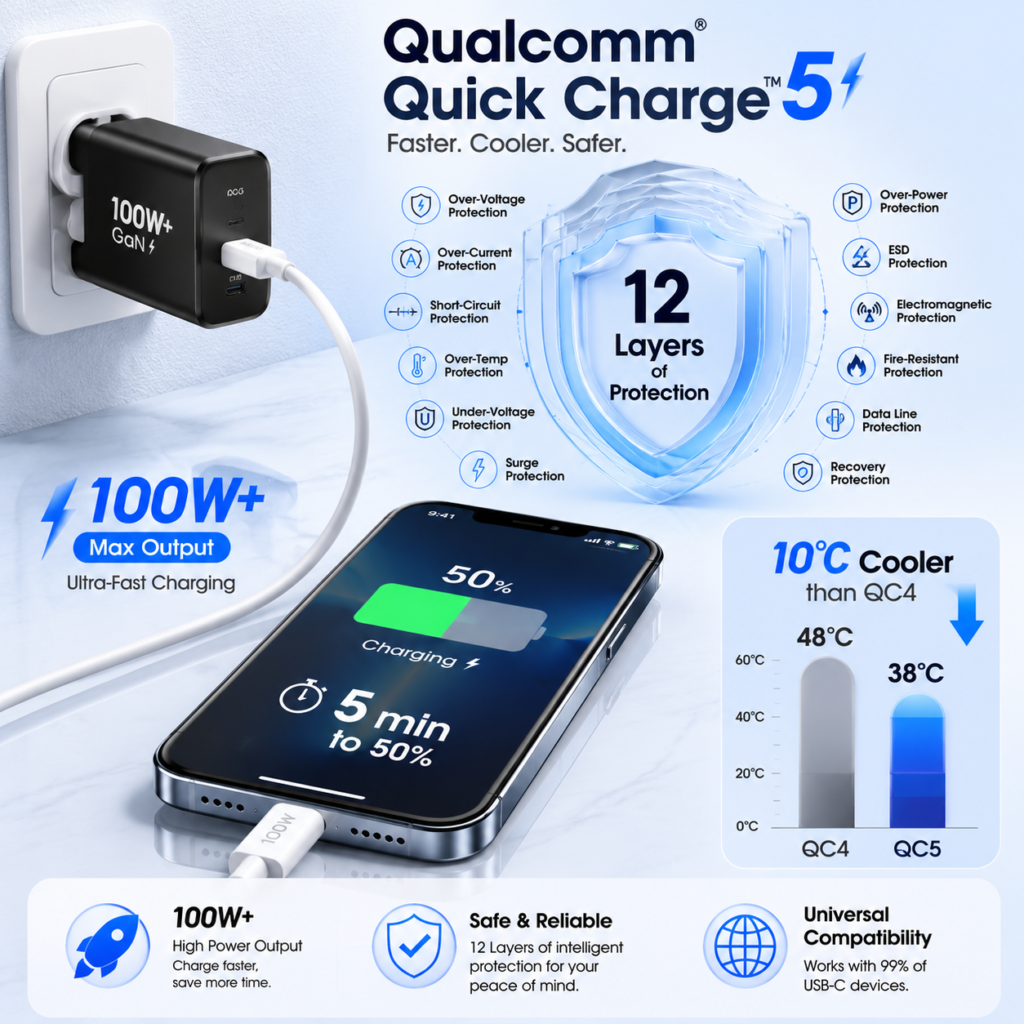
That’s not an exaggeration. QC5 is Qualcomm’s first commercially available platform that pushes over 100 watts of power into a smartphone. It can take a 4500mAh battery from 0% to 50% in just 5 minutes, and all the way to 100% in 15 minutes.
But how does it actually work? What do you need to make it happen? And does all that speed kill your battery? Let’s walk through it step by step.
Where Did QC5 Come From? (A Very Short History)
Qualcomm has been refining fast charging since 2013. QC1.0 was a modest 10W. Each generation got faster, but the real turning point was QC4+, which finally started supporting the universal USB Power Delivery (USB PD) standard.
Then, on July 27, 2020, Qualcomm officially announced QC5. It was built for flagship Snapdragon 865, 865+, and 888 phones.
Fast forward to 2025: Qualcomm released QC5+, pushing power to 140W (20V × 7A). Same blistering speed, even better temperature control.
Quick note: There’s been chatter about QC6.0, but as of mid‑2026, Qualcomm hasn’t officially announced it – so we’re only covering confirmed tech.
The Magic Under the Hood: How QC5 Delivers 100W+
1. Two Battery Cells = Two Lanes on a Highway
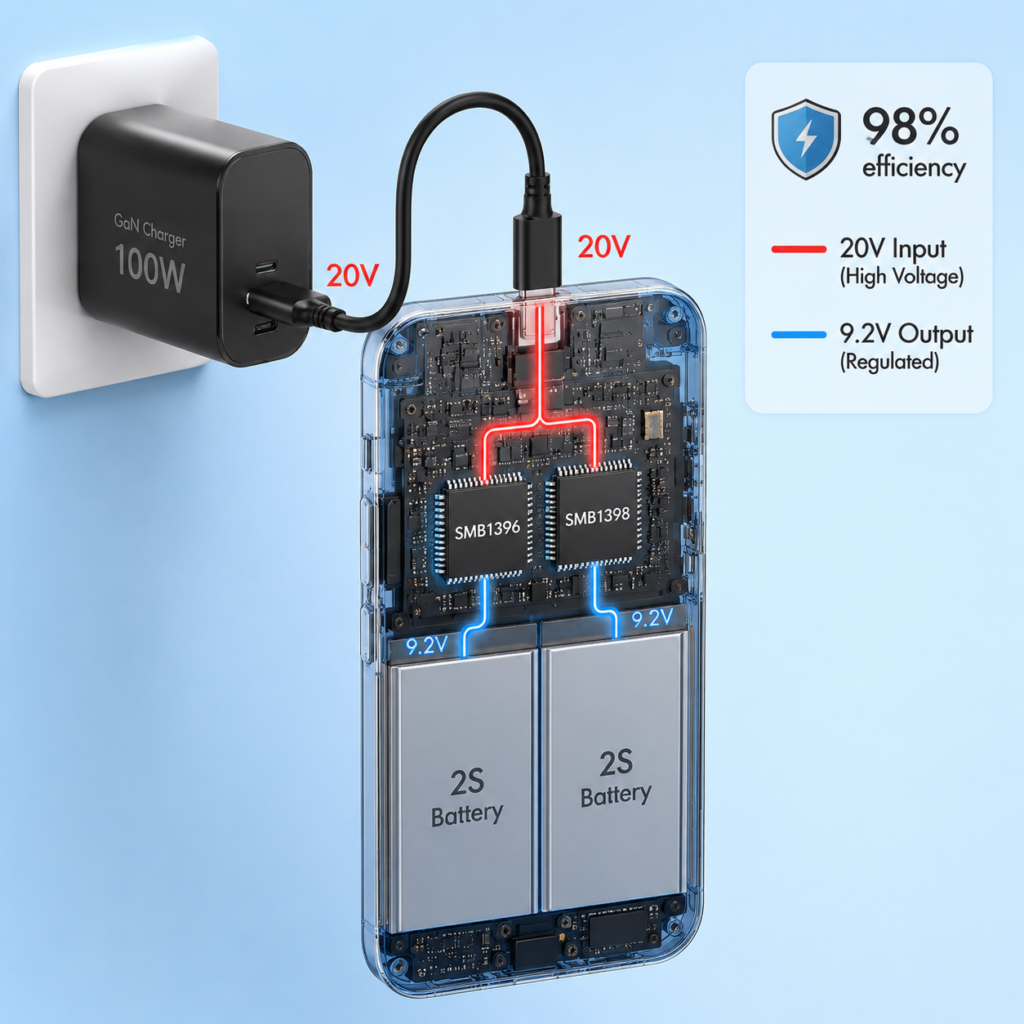
Most phones use a single battery cell. QC5 phones use two cells connected in series – think of them as two batteries stacked together.
Why? Because by doubling the battery’s internal voltage, the phone can accept higher input voltage from the charger (up to 20V). This gets around the biggest bottleneck: the cable itself.
Most USB cables can only carry 3–5 amps of current. By using higher voltage instead of just pumping up the current, QC5 delivers more power without melting your cable.
2. The Brain Chips: SMB1396 & SMB1398
Inside every QC5 phone are two specialised chips:
- SMB1396 – a switch‑capacitor converter (a fancy way of saying “voltage splitter”)
- SMB1398 – a power management IC that directs power safely into both cells
Imagine the charger sends high‑pressure water (high voltage) into the phone. The first chip cuts that pressure in half, and the second chip directs the two streams into each battery cell. These chips run at over 98% efficiency – almost no energy is wasted as heat.
⚠️ Important: The Chip Is Not Enough
This is a common misunderstanding. Snapdragon 865/865+/888 are just the “software” foundation – they can talk the QC5 language. But to actually hit 100W+, the phone maker must include:
- A dual‑cell (2S) battery design
- The SMB1396 charge‑pump chip
- The SMB1398 power management IC
Think of it this way: the Snapdragon chip is your driver’s licence – it proves you’re allowed on the highway. But the dual battery + SMB1396/1398 are the turbocharged engine that actually gets you to 100W+. Some phones claim “QC5 support” but only charge at 30W because they skipped the hardware. Always check the full spec sheet.
3. Smart Voltage: Like a Continuous Gearbox
QC5 is built on USB PD‑PPS (Programmable Power Supply). Instead of the charger blasting a fixed voltage, the phone and charger talk to each other constantly – adjusting voltage in 20mV steps from 3.3V up to 20V.
Old chargers were like a car with only 1st or 5th gear. QC5 gives you a smooth, continuously variable transmission – always the perfect gear for the moment.
4. Safety: 12 Layers of Protection
Pushing 100W is no joke, so QC5 has 12 independent protection levels covering voltage, current, and temperature – including over‑voltage, over‑current, and over‑temperature cutoffs.
And here’s a pleasant surprise: QC5 runs 10°C cooler than QC4, so even if you’re gaming while charging, your phone stays surprisingly comfortable.
It’s also UL‑certified (Underwriters Laboratories) – the very first QC5 certificate was issued by UL to Baseus, a well‑known accessory brand.
What Do You Actually Need to Use QC5?
The Cable – This Is Non‑Negotiable
You cannot use any old USB‑C cable. To get 100W+ speeds, you need:
- USB‑C to USB‑C cable (not USB‑A to C)
- Rated for 5A (5 amps)
- With an E‑Marker chip (this is like an ID card that tells the charger, “Yes, I can safely handle 5A”)
If your cable doesn’t have that chip, the system automatically limits current to 3A – which drops max power to 60W (20V × 3A). You’ll never see 100W.
Also important: don’t confuse charging speed with data speed. A cable might support 5A charging but only USB 2.0 data (480 Mbps). Another might do 10Gbps data but only 3A charging. When buying, look specifically for “5A” or “100W / 240W power delivery” on the label.
The Charger – You Have Options (That’s the Good News)
Because QC5 is built on the open USB PD‑PPS standard, you’re not locked into a specific brand’s charger. Any third‑party charger that supports PD‑PPS with a 5A profile can trigger QC5 speeds.
Here are some real, confirmed third‑party QC5‑compatible chargers as of mid‑2026:
| Brand | Model | Max Power | PPS Support |
|---|---|---|---|
| Lenovo | 100W GaN charger | 100W | Yes (5A PPS) |
| Baseus | QC5 100W GaN | 100W | Yes – first UL‑certified QC5 charger |
| Ugreen | Nexode Pro 100W | 100W | Yes |
| Anker | 100W GaN II | 100W | Yes |
Heads‑up: Even if a charger says “100W PD”, it might not support the exact PPS voltage range your phone needs. Always check the product page for explicit “QC5” or “5A PPS” support.
Which Phones Actually Support QC5 (the Real List)?
Here’s the official list from Qualcomm (confirmed):
| Brand | Models |
|---|---|
| Xiaomi | Mi 10 Ultra (the very first QC5 phone), Mi 11T Pro |
| ASUS | ROG Phone 5, 5 Ultimate, 5s, 5s Pro |
| Black Shark | 4, 4 Pro, 4s Pro, 5, 5 Pro, 5 RS |
| Nubia | REDMAGIC 6 Pro, 6S Pro |
Note: Some phones like the OnePlus 9 Pro have their own 65W private protocol – they are not QC5 100W‑class devices, even though they charge fast. Always read the fine print.
Battery Health: Will 100W Charging Destroy Your Battery?
This is the question everyone asks. Qualcomm’s official claim is that with their Battery Saver and Smart Adapter Identification technologies, the battery will still hold over 80% of its original capacity after 800 full charge cycles.
That sounds great – but 800 cycles is a lab‑benchmark, not a real‑world promise. It’s like car fuel economy ratings: perfect roads, perfect temperature, perfect driving style. In real life:
- High ambient heat accelerates chemical aging
- Cheap, uncertified chargers and cables introduce voltage ripples that stress the battery
- Heavy gaming while charging generates extra heat, which also takes a toll
So treat that 800‑cycle number as “best‑case scenario”. Use quality accessories, keep your phone out of direct sunlight while charging, and you’ll get excellent longevity – but don’t be shocked if your actual experience varies.
How Does QC5 Compare to Private Fast‑Charging Solutions?
QC5 isn’t the only fast game in town. Here’s a balanced look:
| Technology | Max Power | Type | Strengths |
|---|---|---|---|
| QC5 / QC5+ | 100W+ / 140W | Open (USB PD‑PPS) | Works with many chargers & cables; future‑proof |
| OPPO SuperVOOC 2.0 | 240W | Private (proprietary) | Blazing peak speeds (9 min to full); tightly optimised thermals with original charger |
| Huawei SuperCharge | 100W+ | Private | Excellent integration with Huawei devices |
| Xiaomi HyperCharge | 120W+ | Private | Seamless within Xiaomi ecosystem |
The trade‑off: Private protocols often charge faster and have better temperature tuning because the manufacturer controls the entire chain – charger, cable, and phone. But they lock you into using their specific (and often expensive) accessories. QC5 gives you freedom – you can pick any quality PD‑PPS charger and cable – but the peak speed may be slightly less aggressive than a fully tuned private solution. It’s a classic choice between flexibility and absolute top speed.
The Future: Toward a Universal Charging World
QC5 and QC5+ are stepping stones toward USB PD 3.1, which supports up to 240W. The ultimate goal is a single charger that can fast‑charge your phone, laptop, tablet, and earbuds – all at full speed, no matter the brand.
That’s the vision, and QC5 is a major step in that direction.
The Bottom Line
Quick Charge 5 is not the absolute fastest charging tech on paper – but it’s the smartest for most people because it’s open, safe, and practical.
You get:
- 5 minutes to 50% / 15 minutes to full
- 10°C cooler than QC4
- 12 safety layers
- Works with any PD‑PPS charger (no brand lock‑in)
- Backward compatible with older Quick Charge devices
Is it worth upgrading for? If you’re tired of hunting for outlets and waiting around, absolutely – just make sure you pair it with a 5A E‑Marker cable and a QC5‑certified or high‑quality PPS charger. Then sit back and watch your battery fill up before your eyes.
This article is based on official Qualcomm announcements, independent test reports (e.g., ChargerLAB), and public product listings as of July 2026. Always verify with your device’s specifications before purchasing accessories.