
1. The Evolution of Samsung Fast Charging Technology
Early Charging: From Standard to Basic Fast Charging
In the early days of smartphones, Samsung devices used standard 5V/2A charging with around 10W of power, taking over 3 hours to fully charge a battery. As battery capacities grew, traditional charging speeds could no longer keep up with user needs, prompting the development of dedicated fast charging technology.
The Birth of Adaptive Fast Charging (AFC)
In 2015, Samsung launched Adaptive Fast Charging (AFC) with a peak power of 15W (9V/1.67A), nearly doubling charging speed compared to standard charging. AFC technology allowed the charger and phone to communicate and automatically match the optimal voltage and current. It was widely used in the Galaxy S6 to S10 series and greatly improved user charging experience at the time.
The Leap from AFC to Super Fast Charging
With the popularization of the USB PD universal fast charging protocol, Samsung introduced Super Fast Charging in 2019, fully switching to a solution based on USB PD 3.0 PPS. The first generation delivered 25W of power, followed by the 45W Super Fast Charging 2.0. This upgrade not only boosted charging speed but also significantly improved compatibility with third-party accessories.
Timeline of Samsung Fast Charging Iterations
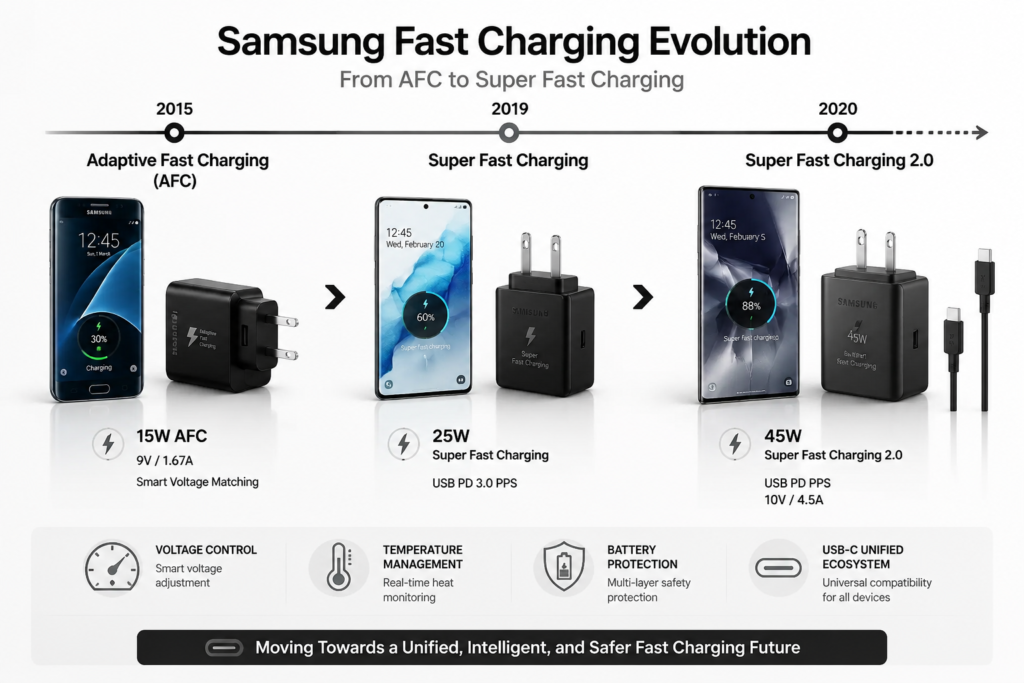
- 2015: Launch of 15W AFC fast charging
- 2019: Debut of 25W Super Fast Charging
- 2020: Release of 45W Super Fast Charging 2.0
- Present: Dual-tier system with 25W for mainstream models and 45W for flagships
2. Core Technologies of Samsung Super Fast Charging
How Super Fast Charging (SFC) Works
Samsung Super Fast Charging is essentially an optimized fast charging solution built on the universal USB PD protocol. Its core logic is real-time communication between the charger and the phone to dynamically adjust voltage and current, maximizing charging speed while keeping the battery safe.
USB Power Delivery (PD) Protocol and Samsung’s Implementation
USB PD is the global universal fast charging standard, supported by almost all laptops, phones, and tablets. Samsung builds its Super Fast Charging on USB PD 3.0 with exclusive optimizations, ensuring compatibility with regular PD chargers while enabling full-speed charging with official accessories.
The Role of Programmable Power Supply (PPS)
PPS is a key feature of USB PD 3.0, similar to an inverter air conditioner: traditional fast charging only has a few fixed voltage levels, but PPS can adjust voltage and current in small increments in real time based on battery temperature and charge level. This improves charging efficiency and reduces heat, making it the foundation of Samsung’s Super Fast Charging.
Charge Pump Technology and Multi-Stage Voltage Step-Down
During charging, the high voltage from the charger must be converted to a lower voltage suitable for the battery, and this conversion generates heat. Samsung integrates charge pump technology in its high-power charging systems, acting as a high-efficiency “voltage converter” with over 97% conversion efficiency. This greatly reduces energy loss and heat during voltage conversion, making high-power charging more stable.
Samsung’s In-House Power Management IC (PMIC)
The PMIC is like the “control center” for phone charging: it monitors battery level, temperature, voltage, and current, and sends real-time adjustment commands to the charger. Samsung’s self-developed PMIC offers higher precision, quickly responding to changes in battery status during fast charging to balance speed and safety.
3. Fast Charging Specifications Across Samsung Device Lineups
Different Samsung devices come with different fast charging specifications. The table below summarizes the configurations of major product lines:
| Product Line | Representative Model | Wired Charging Power | Wireless Charging Power |
|---|---|---|---|
| Galaxy S Series | Galaxy S24 Ultra | 45W | 15W |
| Galaxy S Series | Galaxy S24 / S24+ | 25W | 15W |
| Galaxy Note Series | Galaxy Note20 Ultra | 45W | 15W |
| Galaxy Z Fold Series | Galaxy Z Fold5 | 45W | 15W |
| Galaxy Z Flip Series | Galaxy Z Flip5 | 25W | 15W |
| Galaxy A Series | Galaxy A54 | 25W | Not supported |
Official vs. Third-Party Accessory Compatibility
Most flagship Samsung phones no longer include a charger in the box, so users need to purchase one separately. Any reputable third-party charger that supports USB PD 3.0 PPS can trigger Samsung Super Fast Charging. However, for full 45W speed, the charger must support the 10V/4.5A PPS profile to reach peak power.
4. Deep Dive into Samsung’s 45W Super Fast Charging 2.0
Hardware Architecture of 45W Fast Charging
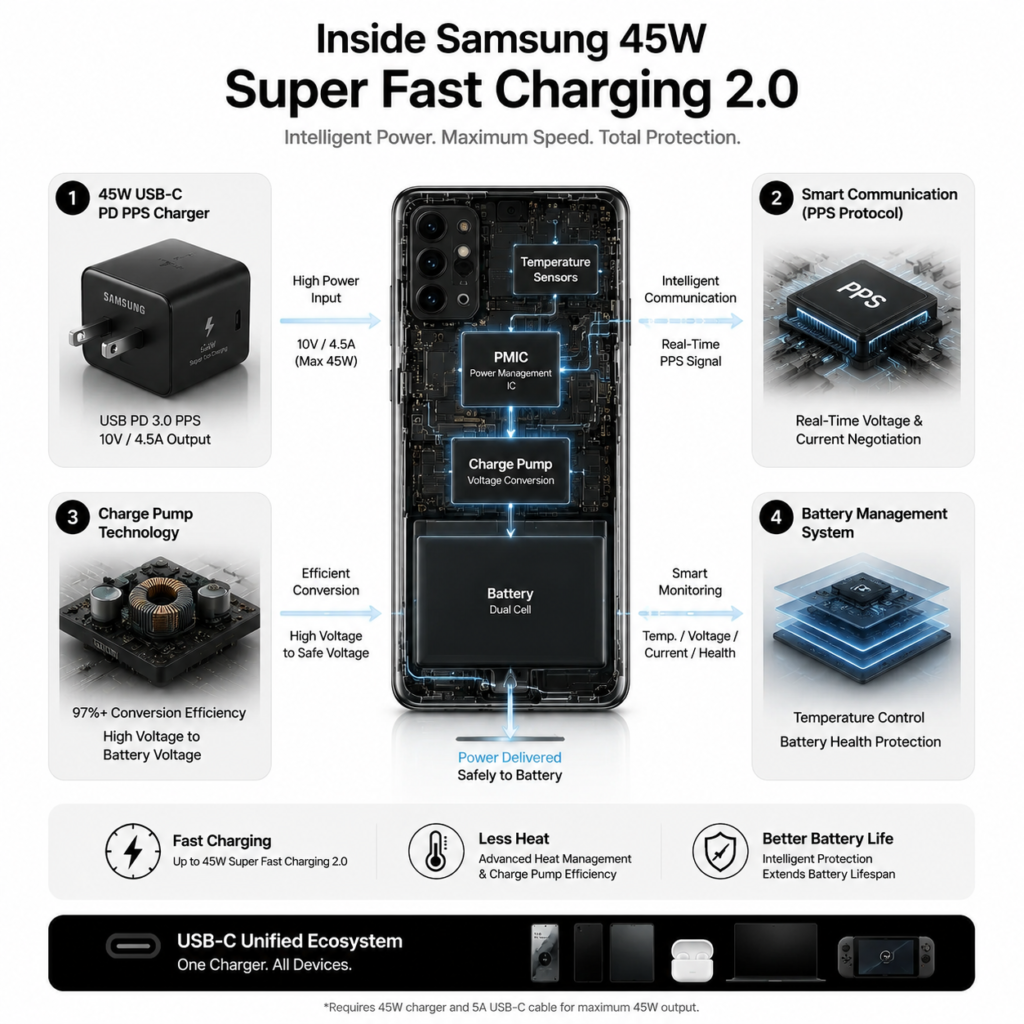
The 45W fast charging system consists of three essential parts: a charger supporting 10V/4.5A PPS output, a 5A-rated USB-C cable, and the phone’s charge pump and PMIC chip. If any component does not meet the standard, charging power will drop.
10V/4.5A High-Voltage High-Current Design
Samsung’s 45W solution uses a 10V / 4.5A output, following a high-voltage high-current approach. Compared to solutions that only increase current, this design achieves high power with standard cables, eliminating the need for custom wires and reducing replacement costs for users. Combined with charge pump technology, heat management remains at a reasonable level.
Temperature Control During Charging
During fast charging, the phone constantly monitors battery temperature, body temperature, and charger temperature. When temperature exceeds a threshold, the system automatically reduces charging power and gradually restores it once the temperature drops. This is the main reason charging is slower in summer than in winter.
Battery Health Management and Charging Curve Optimization
Samsung’s 45W charging does not run at full 45W power the entire time. It uses a “fast at first, steady later” charging curve: high power for quick top-up from 0–50%, gradually reduced power from 50–80%, and trickle charging after 80% to slowly fill the battery and protect its lifespan.
Comparison with Apple, Huawei, and OPPO Fast Charging
Different brands adopt different technical routes. The table below provides a straightforward comparison:
| Brand | Representative Solution | Peak Power | Key Technical Feature |
|---|---|---|---|
| Samsung | Super Fast Charging 2.0 | 45W | Based on universal PD PPS, strong compatibility |
| Apple | PD Fast Charging | 27W | Pure universal PD protocol, conservative power |
| Huawei | SuperCharge | Up to 100W | Proprietary protocol, high power |
| OPPO | SuperVOOC | Over 100W | High-current proprietary protocol, ultra-fast speed |
5. Samsung Fast Charging Ecosystem and Accessory System
Official Charger Lineup (25W / 45W / 65W Multi-Port)
Samsung offers a full range of official chargers: the compact 25W single-port charger works with most models; the 45W single-port charger is required for full-speed flagship charging; and the 65W multi-port charger can power phones, tablets, and laptops at the same time, ideal for users with multiple devices.
Wireless Charging and Wireless PowerShare
Beyond wired charging, Samsung has built a wireless charging ecosystem. Flagship models generally support 15W wireless fast charging with official wireless chargers. Additionally, Samsung phones feature Wireless PowerShare, which can reverse-charge small devices like earbuds and smartwatches — very useful in emergency situations.
Certified Third-Party Accessories
In addition to official accessories, Samsung partners with third-party brands to offer officially certified chargers and cables. Certified accessories provide better compatibility and safety, reliably trigger Super Fast Charging, and are usually more affordable than official options.
Cable Specifications and Compatibility Notes
25W charging works with standard 3A USB-C cables. However, 45W charging requires a USB-C cable rated for 5A current with an E-Marker chip inside; otherwise, full speed will not be activated. When shopping, look for the “5A” and “E-Marker” labels.
6. Safety and Battery Protection in Samsung Fast Charging
Multi-Layer Safety Protection (Over-Voltage, Over-Current, Over-Temperature)
Samsung’s fast charging system includes multiple hardware-level protections: over-voltage protection prevents high voltage from damaging the battery, over-current protection limits maximum input current, and over-temperature protection reduces power or stops charging entirely when temperatures are abnormal. These layers of protection eliminate charging safety risks at the hardware level.
Intelligent Battery Management System
Samsung’s intelligent battery management system learns user charging habits. For example, if you charge your phone overnight, the system will pause charging at 80% and top up the remaining battery right before you wake up, avoiding prolonged full-charge states that wear down the battery.
Night Charging Optimization and Battery Lifespan Extension
Many users worry that fast charging damages batteries. Samsung uses a combination of software optimization and hardware control to greatly reduce battery wear from fast charging. With normal daily fast charging use, battery health typically remains above 80% after two years, meeting industry-standard battery lifespan benchmarks.
Samsung’s Expertise in Charging Safety
Samsung has decades of technical expertise in battery and charging technology. Each generation of fast charging undergoes thousands of safety tests, including extreme temperatures, short circuits, and abnormal accessory scenarios, to ensure safe and reliable charging in mass-produced devices.
7. Future Outlook and Industry Trends
Next-Generation Samsung Fast Charging Roadmap
While many Android flagships now exceed 100W charging power, Samsung is developing higher-power fast charging technology. Industry reports suggest that next-generation Samsung flagships will further increase charging power while improving efficiency and heat management, narrowing the gap with Chinese manufacturers.
Silicon-Carbon Anode Batteries and Higher-Power Charging
Battery materials are the main bottleneck for faster charging. Silicon-carbon anode batteries can handle higher charging currents while increasing battery capacity. Samsung is actively developing this technology, which will lay the hardware foundation for even faster charging in the future, delivering both shorter charge times and larger battery capacities.
Samsung’s Role in Unified Charging Standards
Regions like the European Union have mandated unified charging ports and standards, with USB PD set to become the mainstream. As a key contributor to the USB PD protocol, Samsung will continue to promote universal fast charging standards, allowing users to charge all their devices with a single charger.
Real-World Impact of Super Fast Charging on User Experience
Fast charging exists to ease battery anxiety, not just to chase higher power numbers. Samsung’s charging strategy prioritizes practicality, stability, and safety. While its peak power is not the highest in the industry, its real-world fragmented charging experience is excellent enough to meet the daily needs of most users.