
Before you buy a charging cable, Type-C cord, headphone cable, or data cable, check the test conditions and failure criteria first
If you’ve ever shopped for charging cables, Type-C cords, headphone cables, or data cables, you’ve probably seen bold claims like “10,000 swing cycles” or “20,000 bend tests” on product listings. It’s easy to assume a higher number means a tougher, longer-lasting cable. But why do some cables rated for 20,000 bends stop charging after just three months of use? The answer lies in the fine print of the swing test itself: many brands only advertise the flashy number, without disclosing the test conditions or what counts as a “failure.”
What Is Cable Swing Testing?
Put simply, cable swing testing uses specialized fixtures to hold a cable in place, then repeatedly bends it back and forth under preset conditions including swing angle, bend radius, weight load, swing speed, and even temperature and humidity. The test evaluates dynamic bend durability across every part of the cable: from fine internal copper strands and insulation layers, to connectors and strain relief (the reinforced section where the cord meets the connector).
Many people mix up swing testing with other types of bend tests, but they have distinct technical focuses:
- Swing testing: Centers on repeated back-and-forth bending under controlled, preset conditions. It is one of the most common dynamic bend durability tests for consumer cables.
- Dynamic bend testing: A broader category that includes swing testing, plus torsion, repeated folding, and other types of dynamic mechanical stress tests.
- Static bend testing: A cable is bent and held in a fixed shape (such as a tight loop) for several days to check if the outer jacket cracks or electrical performance changes. No repeated movement is involved.
- Drag chain (energy chain) testing: Designed for industrial cables, simulating repeated movement inside equipment cable tracks. Its test conditions are completely different from those used for consumer electronics cables.
Note that different labs and brands may use different naming conventions. You can’t judge how strict a test is just by seeing the words “swing” or “bend” — always check the specific test parameters.
The goal of swing testing is to simulate the repeated bending cables go through in daily use, and catch potential issues early. Common failure modes include:
- Internal conductor breakage or rising contact resistance, leading to slow charging, unstable data transfer, or intermittent connectivity.
- Outer insulation cracking, abrasion, or punctures, which reduce insulation performance and create safety risks.
- Shielding layer damage, which lowers interference resistance — for example, causing static in headphones or video artifacts on HDMI cables.
- Loose solder or crimp connections at the connector, or failed strain relief structures that leave stress concentrated at the base of the connector.
- Full functional failure, such as no charging, no data transfer, or complete audio/video dropouts.
Often the outer jacket of a cable looks perfectly intact, but the internal components are already damaged. That’s why some cables stop working for no visible reason.
Why “10,000 Swing Cycles” Alone Doesn’t Prove a Cable Is Durable
Many brands use “10,000+ bends” as a core selling point, but the real value of that number depends entirely on the test conditions. Comparing cycle counts without checking conditions is like comparing race times without knowing if the race was a 100-meter dash or a marathon — it’s meaningless.
To tell if a swing test result is actually useful, verify these eight key conditions:
| Test Condition to Verify | Why It Matters |
|---|---|
| Swing angle and angle definition | Wider swing angles put far more stress on the cable. A 180-degree back-and-forth swing is significantly harsher than a 90-degree swing. |
| Bend radius, fixture size, and clamping length | A tighter (smaller) bend radius damages internal conductors much faster; clamping length also changes where stress is concentrated on the cable. |
| Load, tension, and force direction | Adding a hanging weight or steady tension at the cable end drastically increases stress at the bend point, more closely mimicking real-world pulling and tugging during use. |
| Swing frequency and test environment | Excessively fast swing speeds can alter how the cable absorbs stress; temperature and humidity directly affect jacket flexibility and conductor fatigue resistance. |
| Total cycle count and counting method | Confirm whether one “cycle” counts a single one-way bend or a full back-and-forth bend — the two methods produce numbers that differ by 100%. |
| Sample size, sampling method, and batch consistency | Results from a single sample can be anomalous. Batch-sampled test data is far more representative of overall product quality. |
| Pre- and post-test electrical and functional checks | A passing result can’t be based only on appearance. Cables must be tested for conductivity, contact resistance, charging performance, and data transfer function after cycling. |
| Failure criteria | There is a massive gap between “fails only when fully non-functional” and “fails when contact resistance rises by a set percentage or the jacket cracks.” Strictness varies enormously between tests. |
Many swing test marketing claims rely on misleading framing. Common tactics include:
- Advertising a big “10,000 bends” number with zero test conditions. Often these tests are run with a tiny swing angle and no weight load, nothing like real-world use.
- Only checking for outer jacket damage, not internal conductivity, contact resistance, or actual function. Even if most internal copper strands are broken, the test counts as a pass as long as the plastic outside doesn’t crack.
- Comparing results from completely different test conditions. For example, a brand might brag about 10,000 cycles at 90 degrees to criticize a competitor’s 5,000 cycles at 180 degrees, intentionally misleading buyers.
- Using a single sample’s result to represent an entire product line, with no mention of sampling method or sample size, making the result highly prone to chance.
- Converting lab cycle counts directly to “years of use.” A claim like “10,000 bends = 5 years of use” ignores that everyone bends their cables different amounts, in different environments. There is no universal conversion formula.
If you want to compare swing test results between two cables, first confirm that their test method, sample structure, swing angle, bend radius, load, swing frequency, test environment, and failure criteria are nearly identical. Only then do cycle counts have meaningful comparative value. If conditions differ, results are only a rough reference — you can’t use simple rules like “halve the angle, double the cycles” to adjust numbers, because cable damage does not follow a linear pattern.
There’s No Universal “Passing Score” for Cable Swing Tests
A common question is: Is there a standard number of swing cycles a “good” cable should reach? The answer is no — because cables for different uses have completely different structures, requirements, and use cases. A single cycle count can’t fairly measure all of them.
For example, a thin headphone cable and a thick power cord have completely different conductor counts, wire gauges, insulation, shielding, and connector designs. Consumer charging cables, automotive wiring harnesses, and industrial drag chain cables operate in wildly different environments with very different stress levels. Their test methods and pass/fail requirements are naturally different too — forcing them to use the same cycle count standard is unfair.
When evaluating a cable, match the test requirements to its intended use:
- Consumer electronics cables (charging cables, standard data cables, headphone cables): Focus on connector joint durability, conductivity, contact resistance, and real-world charging/data function.
- Audio/video and networking cables (HDMI, Ethernet, DisplayPort): In addition to the above, check signal integrity — does transfer speed stay consistent? Are there video artifacts or stuttering? Does shielding performance hold up?
- Power cords: Prioritize safety ratings first: rated voltage/current, temperature rise, insulation performance, and flame resistance. Bend durability is secondary to safety.
- Industrial or automotive cables: Must meet strict industry, vehicle, or equipment-specific standards. Their requirements are far higher than consumer cables, so consumer cable cycle counts cannot be applied to them.
Many shoppers look for certifications like USB-IF, Apple MFi, HDMI, UL, or CE when buying cables. But keep in mind: these certifications have different core focuses — some test compatibility, some test safety, some test transmission performance — none are a universal “bend durability certification.” For example, MFi is Apple’s compatibility program for Lightning accessories, designed to ensure accessories work properly with Apple devices; it does not guarantee exceptional bend life. UL is a safety certification that evaluates fire resistance, insulation, and other safety metrics, and usually does not specifically test bend durability. Never rely solely on a certification logo to judge how long a cable will last — always pair it with specific durability test data.
How to Pick a More Durable Charging or Data Cable
You don’t need to become a test engineer to find a tough cable. These simple tips will help you avoid most common pitfalls.
Look for full, transparent test details first
If a brand advertises a swing cycle count, prioritize products that share complete test information: not just a number, but the test method, standard used, specific conditions, sample size, failure criteria, and final results. The more transparent the information, the more trustworthy the claim. If all you see is a giant “10,000 BENDS!” banner with no other details, it’s almost certainly a marketing gimmick.
Check the connector and strain relief design
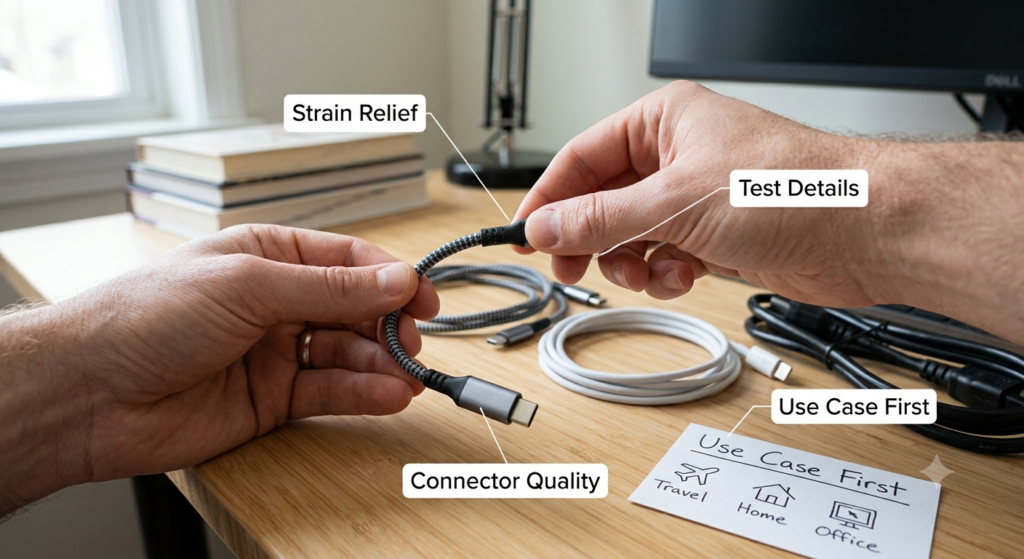
The most common place for a cable to break is right where the cord meets the connector. That’s why the design of this joint matters so much. Look for a strain relief structure — a longer, flexible reinforced section at the base of the connector — that spreads out bending stress instead of letting the cable kink sharply right at the connector. Also check that the overmolding or crimping looks even, with no gaps, rough edges, or loose parts. Poor workmanship here almost always means poor durability.
Don’t judge durability by “thick, soft, or braided” alone
A lot of people assume thicker cables are tougher, softer cables bend better, or braided jackets automatically last longer. But these are only rough clues, not guarantees. A thick cable might just have a thick outer jacket with thin, low-quality internal conductors. A soft cable might have a flexible jacket but poorly constructed internal strands that break easily. Braided jackets are more abrasion-resistant, but abrasion resistance isn’t the same as bend resistance — if the internal wires, connectors, and strain relief are low quality, the braid will look perfect while the inside breaks.
Choose specs for your actual use case
First, think about how you’ll use the cable:
- If you carry it around every day, stuff it in pockets or bags, and bend it constantly, prioritize bend durability.
- If it stays on your desk and barely moves, you don’t need an ultra-high cycle count — focus on getting the right power rating, data speed, and connector type first.
- For car use, look for high-temperature resistance. For cold outdoor use, look for low-temperature rated jackets.
Always make sure the cable meets your core needs first — charging power, data transfer speed, connector type, safety certifications — before you compare durability ratings. Don’t put the cart before the horse.
How Is a Proper Cable Swing Test Performed?
You might be wondering how a legitimate swing test works, and why some results are trustworthy while others are not. Proper testing follows a rigorous process with clear requirements from start to finish.
Pre-test setup
First, testers confirm the sample batch and sample size — they don’t just grab one random cable off a shelf. Then they run initial baseline checks: record appearance, dimensions, connector condition, conductivity, contact resistance, insulation performance, and functional metrics like charging power, data transfer speed, or audio/video quality. Some tests also require pre-conditioning samples in a controlled temperature/humidity environment for a set period to ensure consistent test conditions.
During testing
All parameters are set strictly according to the relevant standard or company specification: fixture setup, clamping length, bend radius, swing angle, end load weight, swing frequency, and total cycle count. Testers monitor the test in real time, recording if any failures occur mid-test (open circuits, abnormal resistance spikes, visible damage, functional issues) and what cycle count they happen at.
Post-test evaluation
After the test runs, testers run a full second round of checks: appearance changes, electrical performance (conductivity, resistance, insulation), and real-world function. They record the failure cycle count, failure location (middle of the cable vs. connector base), failure mode (conductor breakage vs. jacket crack), and the exact criteria used to declare a failure. A legitimate test report will include all of this information — it won’t just say “PASSED” or “10,000 cycles.”
A note about test standards
There is no single universal swing test standard that applies to all cables. Different cable types follow their own product, industry, certification, or in-house company standards. For example, some brands incorrectly cite unrelated standards to sound more authoritative: GB/T 26572 is a Chinese RoHS restricted substances standard for electrical and electronic products, with no relation to cable bend testing. IEC 60794-1-21 is an international standard for mechanical bending of fiber optic cables, and does not apply to standard copper consumer electronics cables. If a brand cites a random standard to back up its swing test claims without explaining how it applies, be skeptical.
How to Reduce Cable Wear in Daily Use
Even the most bend-resistant cable will wear out fast if you treat it roughly. Follow these tips to extend the life of your cables:
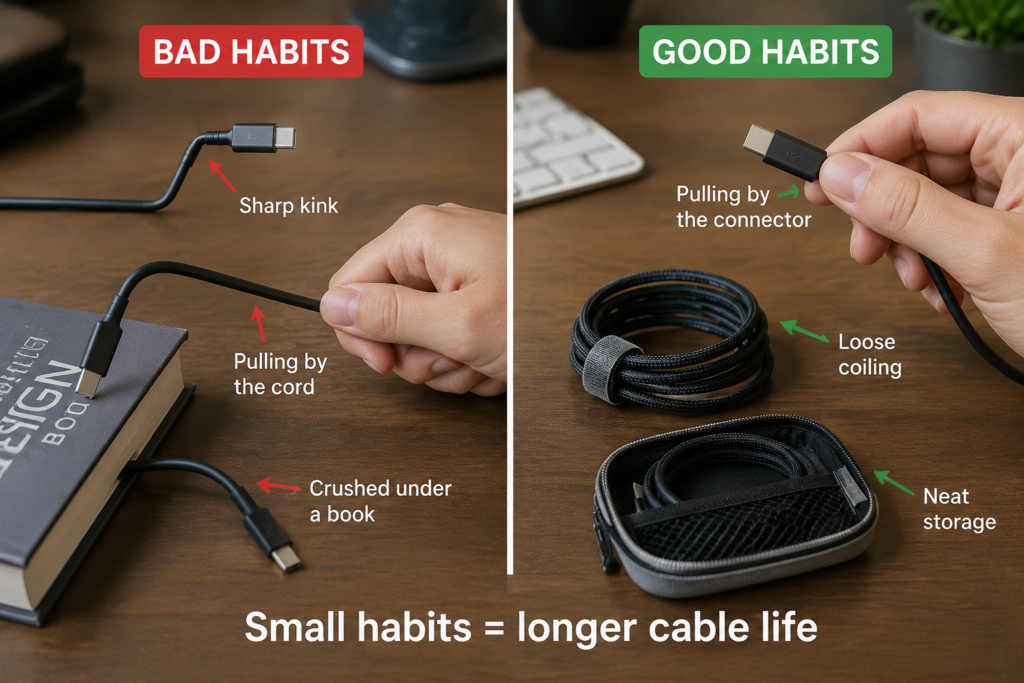
- Avoid sharp bends and kinks. When storing cables, coil them in loose loops, don’t fold them into tight squares, and don’t cinch them so tight with zip ties that they deform. The wider the bend radius, the less stress on the cable.
- Always pull by the connector housing, not the cord itself. Yanking the cable body puts massive stress on the internal conductors at the connector joint, and they’ll break much faster.
- Don’t let the connector bear constant extra weight or tension. For example, don’t let your phone hang off the edge of a table while charging, and don’t rest heavy objects on the connector base. Over time, this constant stress will break the joint.
- Avoid stepping on, crushing, or pinching cables in doors, drawers, or car doors. Keep them away from direct sunlight and high heat, which can make the jacket brittle and prone to cracking.
- If the outer jacket is damaged, or you notice intermittent charging or unstable data transfer, replace the cable immediately. Don’t keep using a damaged cable — it can pose a safety risk.
A cable’s real lifespan depends on its design, how often you use it, the environment you use it in, and how you handle it. Even a cable that passes tens of thousands of lab swing cycles won’t last a set number of years — good usage habits are the most reliable way to extend its life.
FAQ: Common Questions About Cable Swing Testing
Are swing testing and bend testing the same thing?
In casual speech, people often use the terms interchangeably, but they have different technical definitions. Swing testing is a specific type of dynamic bend testing that uses repeated back-and-forth swinging. Dynamic bend testing is a broader category that can also include torsion, folding, and other types of repeated mechanical stress. Always check the full test method instead of relying on the name alone.
Can I do a swing test at home?
You can do a rough side-by-side comparison of two cables by bending them repeatedly at the same angle with the same amount of force, to get a general sense of which feels sturdier. But you can’t consistently control bend radius, swing speed, load, or measure internal metrics like contact resistance or insulation performance. Home tests can’t replace professional lab testing.
Is a higher swing cycle count always better?
Only if the test conditions and failure criteria are exactly the same. If the test conditions are different, a higher number doesn’t mean anything for comparison.
Why does my cable stop charging even though the outer jacket looks fine?
Most likely, the internal conductors have broken, or the crimp/solder connections at the connector have come loose, causing contact resistance to spike so high that power can’t flow through. It could also be a charging protocol issue, but if you bend the cable frequently, internal conductor damage is the most common cause.
Are braided cables always more durable?
Braided outer jackets are more abrasion-resistant, so they’re less likely to get scuffed or torn. But that doesn’t mean the internal conductors, connectors, or strain relief are more bend-resistant. Some braided cables have the exact same cheap internal construction as regular PVC cables — they just look tougher on the outside.
Does a certification mean a cable has good bend durability?
No. Different certifications test different things: some test safety, some test compatibility, some test transmission performance. Not all certifications include bend testing, and even if they do, passing only means the cable meets the certification’s minimum requirement — not that it has exceptional durability.
Are thicker or softer cables always more bend-resistant?
Not necessarily. Bend resistance depends mostly on internal conductor structure (for example, many fine copper strands are more bend-resistant than a single thick copper wire), strain relief design, and bend radius design. Thickness and softness are just surface-level traits. A thick cable might just have a thick outer jacket with thin, fragile internal wires.
Does cold weather affect cables?
Yes. Different jacket materials have different low-temperature ratings. Standard PVC, for example, gets hard and brittle below freezing, so bending it in cold weather can cause it to crack easily. If you’ll be using a cable in cold environments, check the product’s operating temperature range and pick a low-temperature rated cable.
If a cable passes a swing test, does that guarantee it will last a certain number of years?
No. Lab tests use fixed, controlled conditions, but real-world use varies wildly from person to person: how often you bend the cable, how sharp your bends are, how much you pull on it, and what temperature you use it in. There’s no way to convert lab cycle counts directly to a guaranteed lifespan.
Can I trust “10,000 swing” claims on cheap cables?
Don’t trust the number alone. If the seller provides full test conditions, a source for the test report, and clear failure criteria, the claim has some reference value. If all you get is a “10,000 bends” claim with no other details, it’s almost certainly an inflated marketing claim.
Do Type-C and Lightning cables have the same swing test requirements?
Not necessarily. The two connectors have different physical designs, and their associated certification programs, product categories, and standard versions differ too. You can’t apply a single universal cycle count to both — always check the specific test standard and conditions for the cable you’re looking at.
At the end of the day, “10,000 swing cycles” is never an absolute measure of durability — it’s just a number generated under very specific test conditions. To judge how tough a cable really is, you have to look at the full picture: test conditions, bend radius, sample size, failure criteria, real-world functional performance, and the credibility of the test report.
Next time, we’ll break down another common cable marketing claim: insertion/extraction cycle life, and what to look for when brands say their cables last for “10,000 plugs and unplugs.”