
Have you ever been mid-hair dry, only to hear a loud pop and watch every light in the house go dark? You fumble your way to the breaker panel, and sure enough, one switch is flipped down. A family member might say, “That’s a short circuit” – but what exactly is a short? Why does it trip breakers? Can it start a fire? And which of your home’s devices (breakers, fuses, GFCI outlets) actually protects against shorts? Is it safe to just flip the switch back on?
These might seem like small, trivial questions, but they tie directly to your whole home’s electrical safety. In this guide, we’ll break down short circuit protection in plain language, from how it works to real-world troubleshooting. Whether you’re planning a breaker panel upgrade for a renovation or dealing with a random trip, you’ll walk away with a clear understanding of what’s going on.
Critical safety note first: Any work involving breaker panel modifications, protection device replacement, or hidden wiring repairs must be completed by a licensed local electrician. Never work on live circuits, as this poses a severe risk of electric shock or fire.
How Short Circuit Protection Works (and Key Parameters to Check Before Buying)
Short circuit protection devices come in all shapes and sizes, from fuses to circuit breakers, but they all follow the same core logic, acting like a “current security guard”:
- Continuously monitor the current in the circuit.
- Check if the current exceeds the pre-set protection threshold.
- If it does, melt (for fuses) or trip (for breakers) to open the faulty circuit.
- Extinguish the electric arc generated when the circuit opens, to prevent the arc from causing a fire.
Regular users don’t need to understand the internal mechanics of these devices. You just need to know a few key parameters to pick the right product and avoid most safety pitfalls.
2.1 Rated Voltage and Rated Current: Bigger Isn’t Always Safer
Rated voltage is straightforward: it’s the voltage level and current type (AC/DC) the protector is designed for, and it must match your electrical system. For example, standard residential AC mains runs at 120V/240V (depending on your region), so you can’t use a 12V DC protector for your home wiring.
Rated current is the most misunderstood parameter by far. Many people assume a higher-amp breaker is safer – for example, swapping a 16A breaker for a 32A one to “stop it from tripping.” But in reality, the core job of a circuit breaker is to protect your wiring, not your appliances. If the wires in your walls can only safely carry 20A, a 32A breaker won’t trip even when current hits 25A and the wires are already smoking and overheating. That actually increases fire risk. Rated current must always match the current-carrying capacity of your wiring – bigger is not better.
2.2 Short Circuit Breaking Capacity: The Most Overlooked Critical Parameter
Many people shop for breakers based only on amp rating and price, and completely ignore breaking capacity. That’s a major safety risk.
Put simply, breaking capacity is the maximum short circuit current the protector can safely interrupt. If the actual short current exceeds this rating, the protector may fail to open the circuit at all, or even crack, weld its contacts shut, and make the danger worse.
Common residential breaking capacity ratings are 6kA, 10kA, and higher. The rule of thumb is: breaking capacity must be higher than the expected short circuit current at the installation point. For example, if your home is close to the neighborhood transformer and has thick service entrance cables, the potential short current will be higher, so a 10kA product is more reliable. Don’t cheap out on a unit with insufficient breaking capacity. Regular users don’t need to calculate expected short current themselves – a licensed electrician can assess it for you. But you should know this parameter exists, and never shop by amp rating alone.
2.3 Trip Curves: What Do B, C, and D Types Mean?
You’ve probably seen B, C, or D markings on the front of circuit breakers. That’s the trip curve, which describes how sensitive the protector is to high current spikes:
- Type B: The most sensitive, tripping instantly at 3–5x the rated current. It works well for lighting and low-power electronics with almost no startup surge, but is rarely used in homes because it’s too prone to false trips.
- Type C: The most common residential type, tripping instantly at 5–10x the rated current. It can handle the mild startup surge of regular appliances like fridges and washing machines, but still trips fast during a real short circuit. It’s ideal for general outlet circuits and standard appliance circuits.
- Type D: The least sensitive, tripping instantly at 10–20x the rated current. It’s designed for loads with very high startup surge, like motors, pumps, and central AC outdoor units. Important note: purely resistive loads (appliances that generate heat via resistance, like electric water heaters, ovens, and space heaters) have no extra startup current, so there’s no reason to use Type D for these. Type C is more than sufficient, and Type D’s low sensitivity actually reduces short circuit protection safety.
2.4 Current Limiting and Arc Extinguishing: Extra Critical for DC Systems
Protectors with good current limiting ability can trip before the short circuit current reaches its peak. This reduces thermal and mechanical stress on downstream wiring and equipment – think of it as “cutting the fault off early to minimize damage.”
Arc extinguishing ability is just as important. When a circuit opens, it creates electric sparks (arcs). If the arc isn’t put out quickly, it can ignite nearby flammables, or even cause the protector’s contacts to weld shut. A key note here: AC current cycles between positive and negative, so it has natural zero-crossing points where the arc weakens on its own, making arcs relatively easy to extinguish. DC current has no natural zero crossings, so arcs are much harder to put out. That’s why for DC systems like home solar panels, battery storage, and EV high-voltage circuits, you must use DC-specific protection products. Never use an AC breaker as a substitute, or you risk arc failure and fire.
Common Protection Devices: What Do Fuses, Breakers, GFCIs, and RCBOs Do?
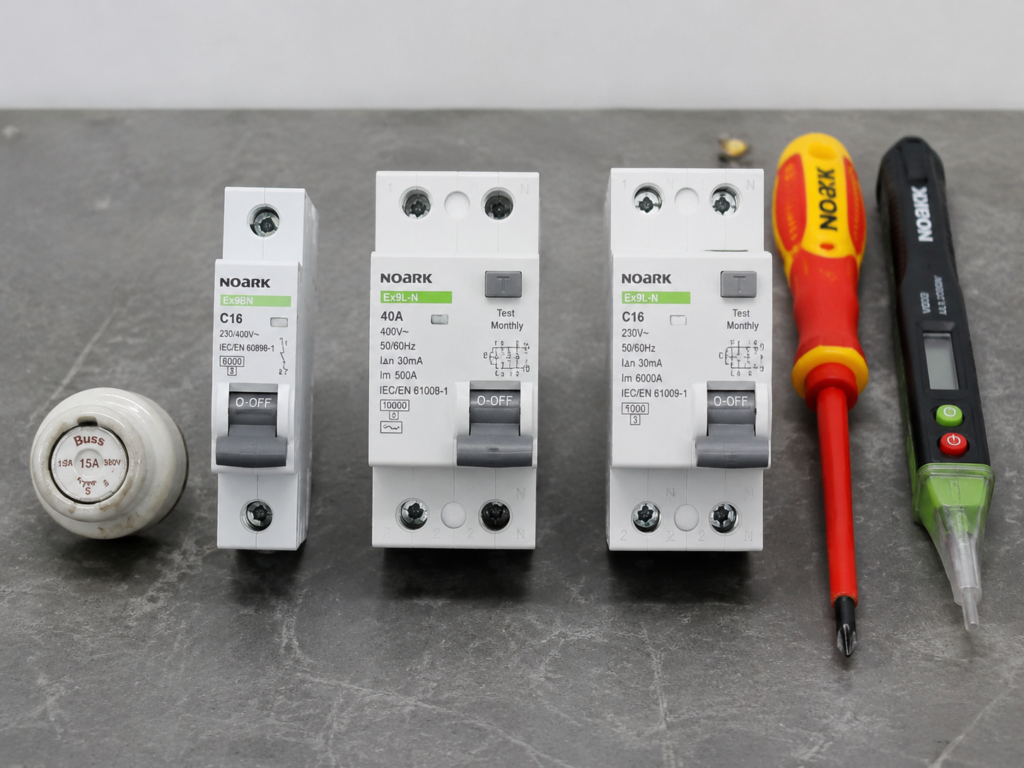
There are so many names for short circuit protection devices on the market that it’s easy to get confused. Let’s break them down one by one.
3.1 Fuses: The Classic One-Time Short Circuit Protection
Fuses are the oldest short circuit protection device, with a very simple principle: when current exceeds the rated threshold, the metal fuse element inside (made of copper, silver, zinc, or alloys depending on the fuse type and use) melts from the heat, opening the circuit. The key requirement is that it melts reliably at the designed current and breaking capacity.
Fuses come in many types: old plug fuses common in older homes, industrial cartridge fuses, DC fuses for solar systems, automotive high-voltage fuses for EVs, and self-resetting PPTC fuses in small electronics (these open on overcurrent, then reset automatically when they cool down, no replacement needed).
There is one non-negotiable rule for fuses: never replace a fuse with copper wire, steel wire, or aluminum wire. These metals have melting points and fuse characteristics that do not match fuse design requirements. They won’t melt reliably at the rated current, and may only melt after the wiring has already overheated, insulation failed, or a fire started – or they may not melt at all. They offer zero protection and are a major fire risk. Never cut corners this way.
3.2 Circuit Breakers (MCBs): The Workhorse of Home Breaker Panels
The most common device in modern homes is the air circuit breaker, usually just called a circuit breaker (or MCB, short for miniature circuit breaker, for residential-sized units). It uses an electromagnetic mechanism and a thermal trip mechanism to open the circuit, so you don’t have to replace it after a trip like you do with a fuse. Once you fix the fault, you just flip the switch back on, which is far more convenient.
There are three main types of circuit breakers:
- MCB (Miniature Circuit Breaker): The small, slim switches in a row in your home breaker panel. These are the mainstay for residential and similar settings, and usually provide both overload and short circuit protection.
- MCCB (Molded Case Circuit Breaker): Larger, with higher current ratings, used in commercial and industrial higher-current applications.
- ACB (Air Circuit Breaker / Frame Breaker): The largest type, used as the main breaker in large commercial or industrial distribution systems.
A common misconception to clear up: standard circuit breakers only handle overload and short circuits – they do not provide ground fault (leakage) protection, so they can’t prevent electric shock on their own.
3.3 MCB vs. RCCB (GFCI/RCD) vs. RCBO: What’s the Difference?
These three terms are often mixed up, but the table below makes their roles clear:
| Device Name | Primary Protection Functions | Functions It Does NOT Provide |
|---|---|---|
| MCB (Standard Circuit Breaker) | Overload protection, short circuit protection | Ground fault (leakage) protection |
| RCCB (Residual Current Circuit Breaker / RCD / GFCI) | Ground fault (leakage) protection | Overload protection, short circuit protection |
| RCBO (Residual Current Breaker with Overcurrent Protection / GFCI Breaker) | Ground fault protection, overload protection, short circuit protection | None (all three core protections) |
In simple terms: a standard GFCI/RCD (RCCB) only prevents electric shock. It can’t handle short circuits or overloads on its own, so it has to be paired with a circuit breaker. An RCBO (often called a GFCI breaker in North America) combines a standard breaker and GFCI into one single unit, so it handles all three protections. It’s ideal for outlet circuits, kitchens, bathrooms, and other damp areas, as it saves space and adds an extra layer of safety.
3.4 These Extra Protection Devices Cannot Replace Short Circuit Protection
There are other common protection devices with their own specific uses, but none can take the place of short circuit protection:
- AFDD (Arc Fault Detection Device / AFCI in North America): Detects low-level fault arcs from loose wiring or poor connections. These arcs have too little current to trigger a standard breaker, but they are a common cause of electrical fires. However, AFDDs cannot handle high-current short circuits, so they cannot replace a circuit breaker.
- SPD (Surge Protective Device): Handles transient overvoltage and surge current from lightning strikes or grid fluctuations (the “lightning protection” you may have heard of). It also cannot replace short circuit protection.
- Smart Circuit Breakers: Offer remote current monitoring, remote tripping, and alert notifications, which are very convenient. But their core safety performance still depends on whether their basic parameters meet safety standards and they are installed correctly. Don’t ignore basic safety requirements just because a device is “smart.”
How to Choose the Right Protection: Home, Commercial, and Renewable Energy
Short circuit protection isn’t about buying the most expensive product, or the one with the highest amp rating. It has to follow three core principles:
- Rated current must match wire gauge, installation method, and load power – the priority is protecting the wiring, not just matching appliance power.
- Breaking capacity must be higher than the expected short circuit current at the installation point, to ensure the device can safely interrupt a short if it happens.
- Upstream and downstream protection must be selective: when a fault occurs, the downstream (branch circuit) protector trips first, and the upstream (main breaker) does not. This prevents a small fault from cutting power to the whole house or building, and makes it easier to locate the issue.
4.1 Reference Home Breaker Panel Configuration
Many people don’t know how to set up their breaker panel during renovations. Below is a common reference setup, but important note: this is not a one-size-fits-all answer. The final configuration must be designed by a licensed electrician, based on local utility service capacity, service entrance wire gauge, number of circuits, and local electrical codes.
- Main Service Breaker: Usually a 2-pole breaker or disconnect switch plus branch protection, with a current rating determined by the utility’s provided service capacity.
- Lighting Circuits: Usually 10A or 16A, Type B or C depending on fixture startup current, wiring conditions, and local design practices. Low-surge lighting (like standard LED bulbs) can use Type B, but Type C is also very common in residential settings. Final rating and type must be determined by a licensed electrician per code.
- General Outlet Circuits: Usually 16A or 20A, recommended to have residual current protection (via RCBO or an “MCB + RCCB” combination).
- Kitchen, Bathroom, and Outdoor/Patio Circuits: Due to damp, high-moisture environments, these should have dedicated circuits with RCBO or GFCI + breaker combination for extra safety.
- High-Power Appliances (AC, Water Heater, Oven, etc.): Each should have its own dedicated circuit, with a rating based on the appliance’s power draw and wire gauge, to avoid overloading when shared with other devices.
4.2 Common Home Sizing Mistakes to Avoid
- Mistake 1: Higher amp breakers are safer. As we’ve repeated multiple times: breakers exist to protect wiring. A breaker that’s too big won’t trip even when the wires are overheating and burning, which is far more dangerous. If your breaker trips frequently, find the root cause first – is it overload, or an actual fault? Don’t just swap in a bigger breaker.
- Mistake 2: Only using one whole-house GFCI/RCD for all circuits. If you only have a main GFCI, a single trip cuts power to the entire house, and you can’t tell which circuit has the fault. Also, if the main GFCI fails, you lose all ground fault protection for the whole home. It’s far better to install GFCI protection on critical branch circuits like outlets, kitchens, and bathrooms – smaller fault impact, and much easier to troubleshoot.
- Mistake 3: Using AC breakers for DC systems. The DC side of home solar, battery storage, and EV high-voltage circuits all require DC-specific fuses or breakers. Never use standard AC breakers, or you risk arc failure and fire.
- Mistake 4: Buying uncertified, no-name products. Products with no certification, vague parameters, or unknown sources may be cheap, but they often have insufficient breaking capacity or poor arc extinguishing. During a short, they can crack, catch fire, or fail to trip at all. Always buy compliant, certified products.
4.3 Commercial and Industrial Applications
Short circuit protection for commercial and industrial settings is far more complex, requiring rigorous calculation and verification by a professional electrical engineer:
- First, calculate expected short circuit current – the maximum possible short current at the fault point – to ensure the protector’s breaking capacity is sufficient.
- Then verify thermal stability (whether equipment, wiring, and busbars can withstand the instantaneous high heat of a short without damage) and dynamic stability (whether they can withstand the electromechanical force of the short current without deforming or breaking).
- Also, ensure selective coordination so the downstream protector closest to the fault trips first, and upstream protectors don’t, to minimize outage scope.
- For special environments like explosive, damp, high-temperature, or dusty areas, you need products with matching ingress protection ratings and specialized certifications.
All of this must be designed by a professional electrical engineer. Regular users don’t need to handle this themselves, but knowing these terms can help when working with professionals.
4.4 Renewable Energy and EV Applications
Many homeowners now interact with renewable energy systems, so here are key reminders for these use cases:
- The DC side of home solar systems must use DC-specific fuses or DC circuit breakers, with rated voltage and breaking capacity matched to the solar system. Never use AC products as substitutes.
- Lithium battery devices (like home energy storage systems and portable power banks) require multiple layers of protection working together: BMS (Battery Management System), protection ICs, fuses, and more. Don’t rely on a single protection device.
- Electric vehicle high-voltage circuits use automotive-grade high-voltage DC fuses or specialized protection components. Never replace them with non-compliant, off-the-shelf products.
Tripped Breaker? Safe Troubleshooting and Regular Maintenance
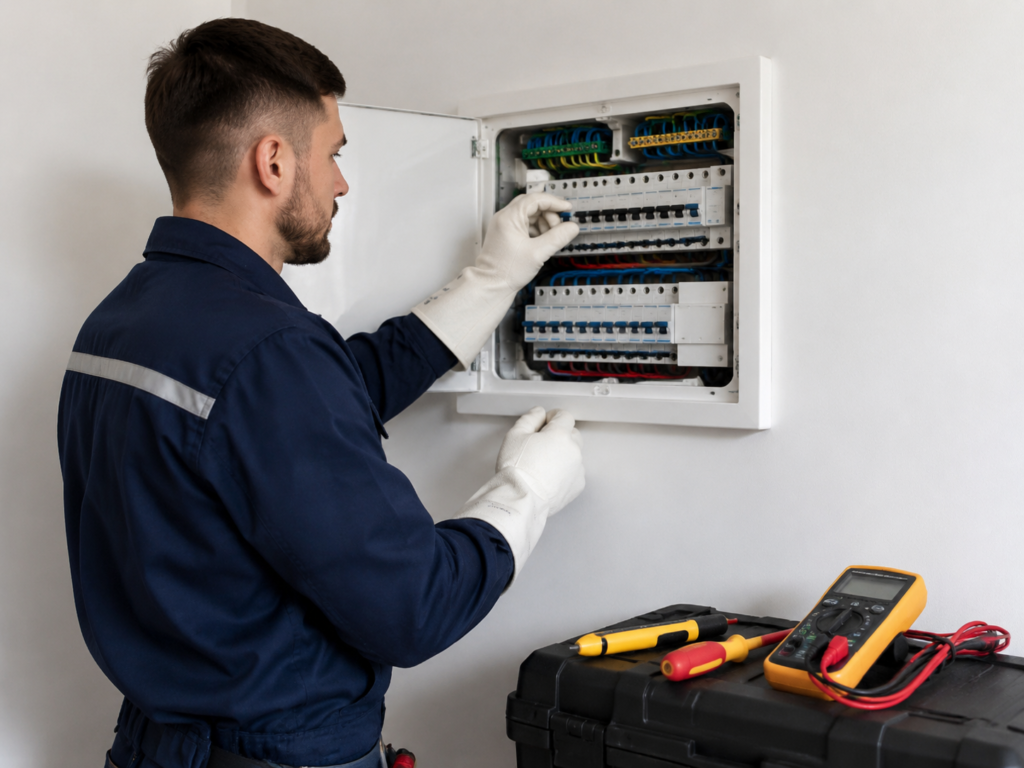
Don’t panic when a breaker trips. Following the right steps will help you find the cause most of the time. But remember: any work involving opening the breaker panel or inspecting hidden wiring must be done by a licensed electrician – don’t do it yourself.
5.1 Basic Installation Requirements to Reduce Faults
First, let’s cover installation best practices to reduce the chance of faults from the start:
- Hot (L), neutral (N), and protective ground (PE/ground) wires must never be mixed up. Using ground as a neutral, for example, creates a severe shock hazard.
- Terminal connections must be tight. Loose connections increase contact resistance, causing long-term overheating and arcing, which can damage the switch and even trigger short circuits and arc faults.
- Breaker panels must be installed in a dry, ventilated, easy-to-access location. Don’t install them in closed closets, or near showers/splash zones where water can easily get in.
5.2 Step-by-Step Safe Troubleshooting for Tripped Breakers
Follow these steps when a breaker trips, to stay safe and locate the fault fast:
- Disconnect all loads first: Unplug all appliances on the faulty circuit, or turn off their power switches, to avoid current surge when resetting.
- Identify which breaker tripped: Check if it’s the main breaker, a branch circuit breaker, or a GFCI/RCBO. If a GFCI (RCCB) or RCBO tripped, note that reset methods vary by product: the standard method is to push the handle fully to the OFF position, hold for 1–2 seconds, then flip to ON. Some products have a separate reset indicator or button – always follow the markings on the device housing and the user manual. Important: the button marked “T” or “TEST” is for monthly testing, not a general reset button – don’t press the test button to try to reset the device.
- Locate the faulty circuit by testing branches one by one: If the main breaker tripped, turn off all branch breakers first, then flip each branch breaker on one by one. The branch that causes the main breaker to trip again is the faulty one.
- Test appliances one by one to identify fault type: Once you’ve found the faulty circuit, flip the breaker on, then plug appliances back in one by one. If plugging in a specific appliance causes an immediate trip, that appliance is likely the problem. If the breaker won’t stay on even with all appliances unplugged, the issue is with the wiring itself.
- Stop immediately and call an electrician if you see these signs: If you smell burning plastic, see sparks, the breaker won’t stay on at all, it trips instantly when reset, or the breaker housing is hot – do not keep trying to reset it. Stop using the entire circuit immediately and call a licensed electrician. Repeated reset attempts can turn a small fault into a major fire.
5.3 GFCI/RCD Testing and Routine Maintenance
Ground fault protectors usually have a test button marked “T” or “TEST”. It’s recommended to press it once a month (or per the manual’s recommended interval) to confirm the ground fault trip mechanism works correctly.
Note: a successful trip from the test button only means the GFCI’s test mechanism works. It does not prove its short circuit or overload protection is working, nor does it mean a past trip was definitely caused by a ground fault. Breaker trips can be from shorts or overloads too, so you have to judge based on the specific situation.
If you notice frequent tripping, discolored breaker housing, blackened terminals, or a loose switch handle, have an electrician inspect or replace the device immediately – don’t keep using it.
5.4 Quick Diagnosis of Common Trip Scenarios
Here are the most common trip patterns to help you narrow down the cause:
- Trips immediately when you plug in a specific appliance: First suspect the appliance is faulty – it could have an internal short, a ground fault, or a startup current too high for the circuit.
- Won’t stay on even with all appliances unplugged: Most likely a wiring issue – damaged wire insulation causing a short, moisture damaging insulation, or a drilled-through wire in the wall. Always call an electrician for this; don’t try to fix it yourself.
- Only trips when multiple high-power appliances are running: Most likely overload – the breaker rating is too low, or the wire gauge is too thin to handle all the appliances at once. Have an electrician assess if you can upgrade the circuit; never just swap in a bigger breaker on your own.
- Main breaker trips but branch breakers don’t: This is called an “upstream nuisance trip”, usually caused by poor selective coordination between upstream and downstream protection, or a faulty branch breaker that failed to trip when it should have, so the main breaker acted first. You’ll need an electrician to adjust or replace the protectors.
How to Buy Reliable Short Circuit Protection Products
Short circuit protection is safety equipment – buying the wrong one can turn it into a hazard. Always prioritize compliance when shopping.
6.1 Common Safety Standards
Different countries and regions have different safety standards. The main international standards are published by the IEC (International Electrotechnical Commission):
- Fuses: IEC 60269 series
- Residential miniature circuit breakers: IEC 60898 series
- Industrial circuit breakers: IEC 60947-2
- RCCBs (GFCI/RCD): IEC 61008 series
- RCBOs (GFCI breakers): IEC 61009 series
For products manufactured in China, corresponding national standards include GB/T 13539 (fuses), GB/T 10963.1 (residential MCBs), GB/T 14048.2 (industrial breakers), GB/T 16916 (RCCBs), and GB/T 16917 (RCBOs), most of which are aligned with IEC standards.
6.2 Simple Ways to Spot Legitimate, Safe Products
You don’t need to understand complex standards to shop safely. Just check these points to avoid most low-quality products:
- Check for compliance markings: Verify the required mandatory certification, compliance marks, or third-party listing per the laws of the region where the product will be installed: for example, CCC certification and relevant GB/T standards for the Chinese market, CE marking and applicable EN/IEC standards for the EU, UL or ETL listing for the US market. Exact requirements depend on local regulations and electrical installation codes. Never buy products with no compliance markings.
- Check parameter labels: Genuine products have clear, legible markings on the housing or packaging for rated voltage, rated current, short circuit breaking capacity, number of poles, trip curve, manufacturer, and model number. If parameters are blurry, incomplete, or missing entirely, don’t buy it.
- Check AC/DC marking: Confirm if the product is rated for AC (alternating current) or DC (direct current) use – never mix them up. Especially for DC applications, always pick products clearly marked DC.
- Buy from reputable brands and channels: Shop at local established hardware stores, official brand websites, or authorized retailers. Don’t buy cheap unbranded products or used/refurbished parts to save a few dollars – safety equipment is not the place to cut costs.
6.3 Why Compliance Is Non-Negotiable
Non-compliant short circuit protection products may look identical to genuine, certified ones on the outside, but they can hide serious hazards: insufficient breaking capacity that fails to interrupt a short and cracks the housing, low-quality contacts that weld shut, poorly designed arc chutes that spray arcs and ignite nearby items, or failure to trip when needed and false trips when not. Saving a few dollars on a cheap breaker isn’t worth the cost of even a small electrical fire – it’s a terrible tradeoff.
Frequently Asked Questions
Q: What’s the difference between short circuit protection and overload protection?
A: A short circuit is an instantaneous high-current fault – for example, hot and neutral wires touching directly, where current can jump to dozens or hundreds of times the rated value instantly. Short circuit protection is designed to trip extremely fast per product standards and trip characteristics, with action time depending on fault current magnitude, trip curve, current limiting ability, and device type. It is always far faster than overload protection, to prevent fires. Overload is a sustained mild overcurrent – for example, a 16A circuit continuously carrying 20A of load. It won’t cause immediate danger, but over time it will overheat and age the wiring. That’s why overload protection uses delayed tripping, to avoid false trips from normal short-term current fluctuations.
Q: Can I just flip a tripped circuit breaker back on right away?
A: We don’t recommend repeatedly resetting a breaker directly. First unplug all appliances on the circuit, do a quick check for obvious faults (like damaged wiring, wet appliances, burning smells), then try resetting. If it trips instantly, or there’s a strange smell, sparks, or hot housing, never reset it again – call a licensed electrician immediately. Repeated resetting will worsen the fault and can even cause a fire.
Q: Can I replace a fuse with copper wire?
A: Absolutely not. Copper, steel, and aluminum have melting points and fuse characteristics that don’t match fuse design requirements. They won’t melt reliably at the rated current, and may only melt after the wiring has already overheated, insulation failed, or a fire started – or they may not melt at all. They offer zero protection and are extremely dangerous. Many old home electrical fires were caused by replacing fuses with copper wire.
Q: If I have a GFCI/RCD, do I still need short circuit protection?
A: Yes. A standard GFCI (RCCB) only detects and interrupts ground faults – it has no overload or short circuit protection, so it can’t be used as the only overcurrent protection for a circuit. When a short circuit happens, the paired MCB, fuse, or upstream protection device has to interrupt it. The correct setup is to pair an RCCB with a circuit breaker, or use a compliant RCBO that integrates all three protections.
Q: What’s the difference between AC and DC short circuit protection?
A: AC current cycles between positive and negative, with dozens of zero-crossing points per second where the arc weakens naturally, making it easier to extinguish. DC current flows in a constant direction with no natural zero crossings, so arcs are much harder to put out. You must use specially designed DC protection devices for DC systems, never substitute AC products, or you risk arc failure and fire.
Q: If my AC trips the breaker every time I turn it on, is that definitely a short circuit?
A: Not necessarily. There are many possible causes: the AC’s startup surge is high and the breaker is undersized, causing a false trip; there are other high-power appliances on the same circuit, pushing total power over the circuit capacity (overload); the AC has an internal ground fault that triggered GFCI protection; or yes, it could be an internal short in the AC. Try turning off all other appliances on the same circuit and running the AC alone. If it still trips, we recommend calling a professional HVAC technician or electrician to troubleshoot – don’t guess.
Final Thoughts
Short circuit protection isn’t as simple as “installing a breaker.” It boils down to five key points: compliant devices, matched parameters, properly sized wiring, graded protection coordination, and regular inspection. Missing any of these can leave a hidden safety hazard.
For regular homeowners, you don’t need to be an electrical expert. Just learning the basics, being able to do simple fault diagnosis, and knowing when to stop and call a professional can drastically reduce your risk of electrical fire. After all, electrical safety never relies on a single switch – it relies on every step being done correctly and carefully.