
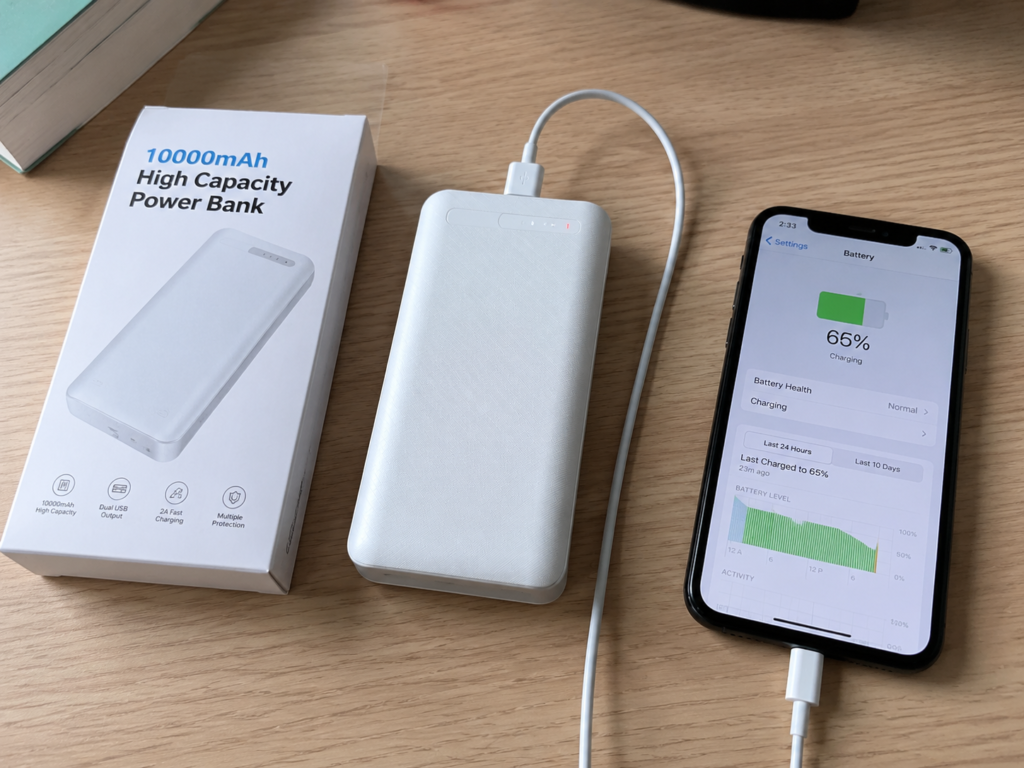
Have you ever bought a power bank with a huge “10,000mAh” printed on the box, figured it’d charge your 3,000mAh phone 3 times no problem, only to get 1.5 charges tops when you’re out and about? Is it a fake capacity claim, or are you just misreading the specs?
Most misunderstandings about power bank capacity stem from the mAh unit — it feels familiar, but it’s not a universal “battery life ruler.” mAh values at different voltages can’t be compared directly. Understanding real capacity doesn’t just help you avoid fake labeling scams; it helps you pick a product that actually fits your needs.
This guide breaks down everything from basic spec definitions, to at-home test methods you can do with cheap tools, to how to verify if public review data is trustworthy. We’ll even show you how to spot a legitimate capacity ranking, so you can go from only staring at the big number on the box to confidently judging whether a power bank’s capacity claims are real.
First: Understand Capacity Specs — Don’t Mistake Nominal Capacity for Usable Charge
A lot of people only look at the biggest mAh number on the packaging and assume that’s how much charge they’ll get for their phone. That’s the single biggest mistake you can make. Power banks have several different capacity definitions for different stages of the charging process — mix them up, and you could end up with 30% less usable charge than you expected.
Nominal, Rated, and Usable Capacity: What’s the Difference?
Think of a power bank like a water tank for electricity. The internal battery cells are the tank itself, and the USB output port is the pipe coming out of it. The “water level” you measure at different points has a different name:
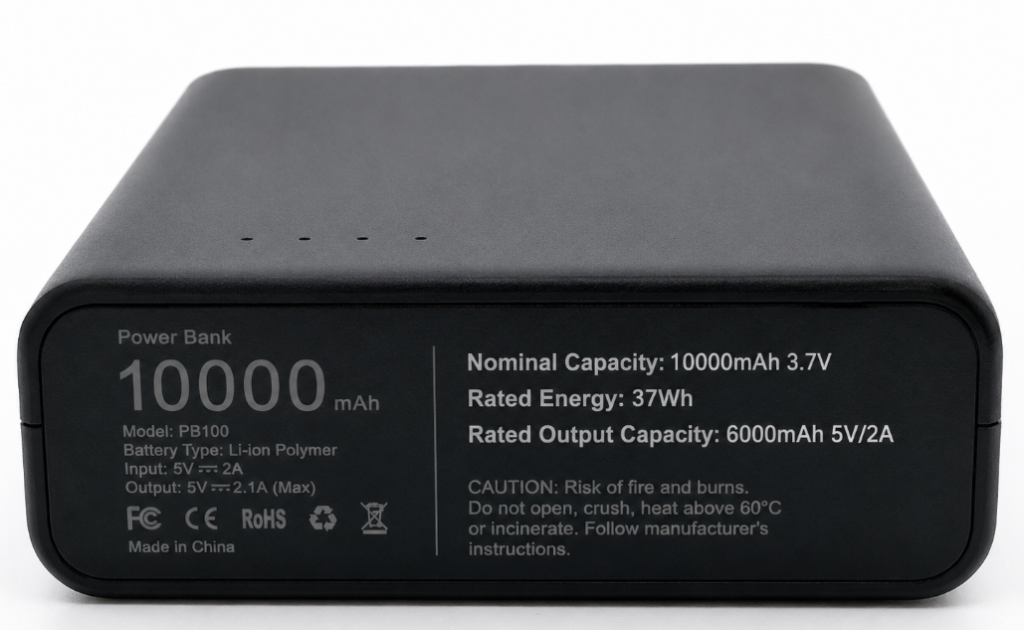
- Nominal capacity: This is the total volume of the tank — the capacity of the internal battery cells, rated at the cell’s standard platform voltage (usually 3.6V or 3.7V). It’s the big, bold mAh number on the front of the box. This is a cell-level measurement, not the amount of charge you’ll get out of the USB port. It only makes sense when paired with its voltage.
- Nominal energy (Wh): Calculated by multiplying nominal capacity in Ah (1Ah = 1,000mAh) by the cell’s platform voltage. For example, a 10,000mAh 3.7V power bank has a nominal energy of 10Ah × 3.7V = 37Wh. Watt-hours (Wh) are the universal unit for comparing energy across different voltages — like using liters to compare the total water volume of tanks of different shapes. It’s far more reliable than mAh.
- Rated capacity: The minimum capacity a manufacturer guarantees to output at a specified voltage and current, usually labeled something like “Rated Capacity: 5V=xxxxmAh”. This is the guaranteed minimum you’ll get from the USB port, and it’s far more useful than nominal capacity for real-world use.
- Output usable energy: The total energy (Wh) that actually comes out of the USB port. It’s lower than nominal energy due to losses from the boost circuit, heat, and cable resistance.
- Actual device charge: The energy that ends up in your phone or tablet battery. This is even lower than output usable energy, because it deducts losses from the phone’s own charging management circuit and heat.
The core rule to remember: Always prioritize Wh for judging real capacity, and never compare mAh values across different voltages. It’s like trying to compare the total water in a 3-meter tall tank to the flow from a 5-meter tall pipe — the pressure is different, so even though the units sound the same, they mean completely different things.
Why Can’t a 10,000mAh Power Bank Charge a 3,000mAh Phone 3 Times?
Nearly everyone buying their first power bank asks this: 10,000 divided by 3,000 is over 3, so why do you only get 1.5 to 2 charges in real life? This usually isn’t fake labeling — it’s because you’re dividing mAh values from two different voltages.
Let’s use the water tank analogy to do the math: 10,000mAh is the total water in the 3.7V “tank”, but phone charging uses 5V “pipe flow”. Different voltages mean you can’t just divide the mAh numbers directly.
First, calculate the theoretical maximum: Convert the 3.7V 10,000mAh to 5V capacity using the formula (nominal mAh × cell voltage) ÷ output voltage. That’s 10,000 × 3.7 ÷ 5 = 7,400mAh — and that’s a perfect zero-loss scenario that never happens in real life.
Next, deduct the power bank’s own losses: The boost circuit uses power, heat wastes energy, and cables add resistance. Most legitimate, compliant power banks have an energy conversion efficiency between 75% and 90%. For a 10,000mAh model, that works out to roughly 27.75–33.3Wh of actual 5V output, or 5,550–6,660mAh at 5V.
Finally, deduct phone-side losses: When your phone charges, its charging management circuit generates heat, and background apps use power. That usually eats up another 10%–15% of the output.
All told, 1.5–2 charges for a 3,000mAh small-battery phone is normal. For a phone like the iPhone 14 (~3,200mAh), you’ll get roughly 1.4–1.8 charges. Legitimate 10,000mAh power banks almost always list a 5V rated capacity between 5,800–6,500mAh, which lines up perfectly with this math.
How to Tell Normal Loss Apart From Fake Capacity Labeling
With all these losses, how do you know if a product is just working as expected, or if the manufacturer deliberately lied about capacity? There are clear boundaries:
- Normal loss: Energy lost to boost conversion, heat, cable resistance, fast charging protocol switching, or wireless charging coil losses. This corresponds to an energy efficiency (measured output Wh ÷ nominal Wh) of 75%–90%.
- Highly suspected fake capacity: No rated capacity listed on packaging, or vague, unclear rated capacity labeling; measured output Wh is far below the reasonable range; if energy efficiency is still below 70% after accounting for room temperature, accurate test equipment, good cables, and no significant product aging, it’s almost always a case of fake capacity or severe quality issues.
- Physically impossible fake capacity: If a product’s 5V output mAh claim is higher than the theoretical maximum of
(3.7V nominal mAh × 3.7) ÷ 5, it’s a scam. For example, a 10,000mAh 3.7V power bank claiming a 7,500mAh 5V rated capacity violates the law of conservation of energy — you don’t even need to test it to know the label is wrong. Skip these entirely.
What Factors Affect Real-World Capacity?
The same power bank can deliver different amounts of charge depending on how and where you use it. The biggest factors are:
- Cell quality: This is the most important factor. Good cells have full rated capacity, long cycle life, strong low-temperature performance, and slow degradation. Cheap, low-quality cells may underperform even when brand new, and lose capacity noticeably after just a few months.
- Circuit efficiency: The design of the power bank’s boost and fast charging management circuits directly impacts energy loss. Well-designed circuits are more efficient and run cooler.
- Output power: High-power fast charging generates more heat, so it’s usually slightly less efficient than low-power slow charging — like turning a tap on full blast and losing more water to splashing.
- Ambient temperature: Lithium batteries are very sensitive to temperature. Cold temperatures reduce cell activity and lower available capacity (how much depends on the exact temperature, cell type, and discharge power). High temperatures speed up aging and can trigger safety protection shutoffs.
- Age and use: The more charge cycles a power bank goes through, the lower its capacity retention — just like a phone battery wears out over time. Whether degradation is abnormal depends on total cycle count and the product’s safety status.
What Do Certifications Mean? Which Ones Have Nothing to Do With Capacity?
A lot of people check for certifications when buying a power bank, but most certifications are for safety or compatibility, not capacity. Don’t mix them up:
- Capacity labeling standards: For products sold in China, the GB/T 35590 recommended standard sets clear rules for power bank rated capacity, labeling, and test conditions. Different countries and platforms have different rules for labeling, safety, shipping, and certification, so you can’t apply one set of rules globally. Always prioritize Wh, rated capacity with a listed output voltage, and full manufacturer information when verifying claims.
- Safety compliance certifications: Examples include China’s CCC, GB 4943.1, and GB 31241, the US’s UL 2056, and the EU’s CE mark. These mainly confirm the product meets local safety or compliance rules and reduces safety risk — they do not guarantee capacity meets claims, and they don’t mean the product will never fail under all conditions.
- Compatibility certifications: Apple’s MFi certification, for example, only means the product has passed Apple’s wired accessory compatibility authorization and works with Apple devices that use the corresponding port. It is not a capacity certification, and it does not prove higher real capacity.
10-Second Spec Check for Packaging & Product Pages
You don’t have to dig through pages of fine print to filter out most sketchy products. Just quickly look for these 6 things before you buy:
- Find rated energy (Wh) first: It’s the most universal comparison unit, and it’s the metric used for airline carry-on rules. Legitimate products always list this clearly.
- Find rated capacity: It must include the output voltage, like “5V=6000mAh”. A rating that just says “6000mAh rated capacity” with no voltage has very little reference value.
- Check nominal capacity voltage: Nominal capacity must list the cell voltage, like “3.7V 10,000mAh”. A bare “10,000mAh” number is far less reliable.
- Check input/output and fast charging protocols: These determine charging speed and device compatibility — they don’t affect capacity, but they do impact user experience.
- Check compliance info: Look for local mandatory certification numbers, applicable standards, and the manufacturer’s name and contact information. Avoid unbranded products with no traceable manufacturer.
- Check cycle life claims: If a cycle life is listed, make sure it includes test conditions (e.g. “≥80% capacity retention after 300 cycles”). Cycle life claims with no test conditions have almost no reference value.
How to Test Power Bank Real Capacity: Lab-Grade & At-Home Methods
Now that you understand the specs, you’re probably wondering: How do I know if the manufacturer’s claims are true? Below we cover how real capacity testing works, from strict lab standard procedures to simple tests you can do at home.
The Most Accurate Testing Metric: Always Use Wh
When testing capacity, always use Wh (watt-hours) as your universal unit. mAh is tied to voltage, so mAh values from different output voltages can’t be compared directly. There are two common calculation methods — don’t mix them up:
- Energy conversion efficiency (professional standard): Measured output Wh ÷ nominal energy Wh. Most compliant products fall between 75%–90%. This is the most accurate metric, because it compares total energy and is unaffected by voltage differences.
- Simple capacity ratio (consumer standard): 5V output mAh ÷ 3.7V nominal mAh. Qualified products usually hit 60%–65% or higher. A lot of online reviews reference a “60%+ conversion rate” — they’re almost always using this simpler metric, which gives very different numbers than the professional standard. Always check which formula a review uses before judging a product.
Additionally, any fake capacity claim must include test conditions: output voltage, output power, ambient temperature, and test equipment used. Without that context, results are meaningless. For example, testing a power bank outside in cold winter weather will give a much lower capacity reading than testing it at room temperature — that’s not fake labeling.
Lab Standard Test Procedure
Why are professional lab test results so reliable? Because they strictly control all variables to eliminate interference. The standard process looks roughly like this:
- Environment: Tested in a constant temperature room set to ~25°C (77°F). The power bank is fully charged then left to rest for 30+ minutes to stabilize its temperature and voltage.
- Equipment: Electronic load (a specialized adjustable power-draining device, far more consistent than a phone), high-precision USB power meter or power analyzer, temperature logger, and regulated power supply.
- Procedure: Discharge at constant current or constant power at the product’s rated output level until the power bank shuts off automatically. Record the total output Wh over the entire process.
- Sample requirements: Test at least 3 brand-new samples per model, repeat tests, and average results to avoid duds or individual variation skewing the outcome.
- Required report fields: A legitimate lab report will include at minimum: nominal Wh, rated capacity, measured output Wh, conversion efficiency, discharge power, surface temperature rise, ambient temperature, test equipment model, and sample IDs.
At-Home Low-Cost Test Methods
You don’t need lab equipment to get a rough idea of a power bank’s real capacity. There are two main methods, with very different accuracy levels:
USB Power Meter Method (Relatively Accurate)
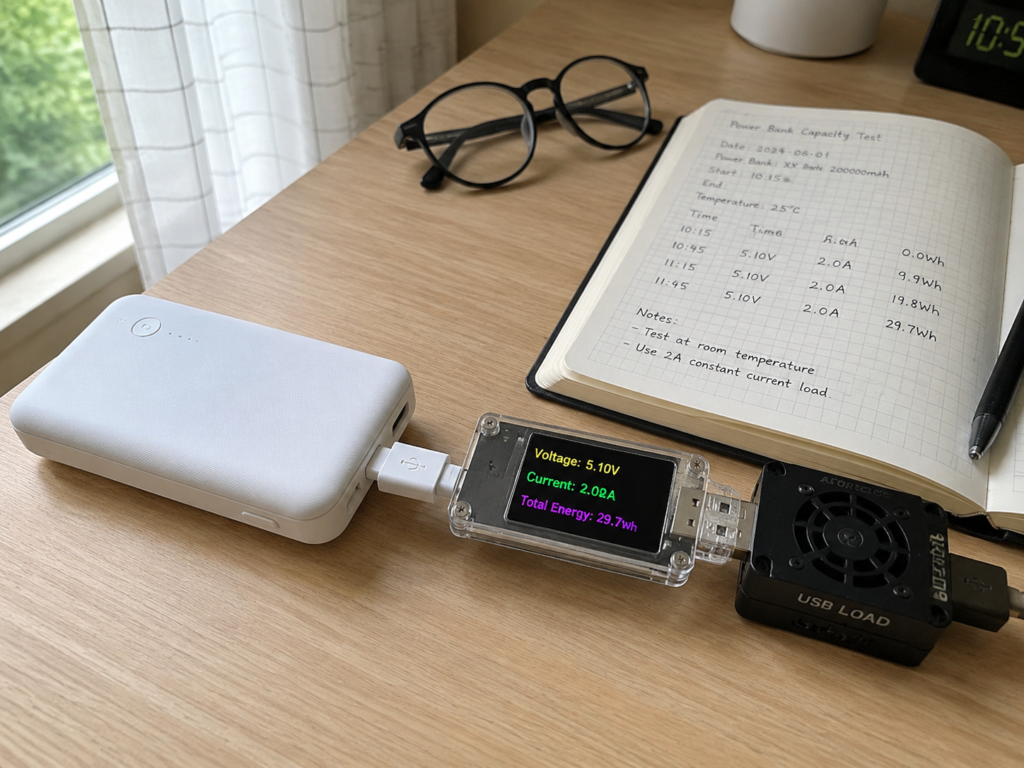
This is the most reliable at-home test method, and it’s low cost — you can buy a reputable branded USB power meter for $10–$20.
- Tools needed: Branded USB power meter (look for good user reviews; typical accuracy is ±1% to ±3%), stable load (like an old phone, or a dedicated USB load stick — avoid devices that go into sleep mode automatically), and a good quality USB cable (to avoid cable loss skewing results).
- How to do it: Fully charge the power bank, connect it to the load through the power meter, and discharge at a fixed power level (like 5V 2A, or 10W) until the power bank turns off automatically. Record the total output Wh shown on the power meter.
- How to judge: Divide the measured Wh by the nominal Wh to get energy efficiency. After accounting for cold temperatures, power bank age, bad cables, and device error, if efficiency is still below 70%, the product is highly likely to have fake capacity or severe quality issues.
Phone Estimation Method (Only Catches Extreme Fakes)
If you don’t have a power meter, you can use your phone to get a very rough estimate, but the accuracy is low. This method only catches extremely obvious fakes (like a 20,000mAh claimed model that can’t even charge your phone once).
- How to do it: Use the same phone, charge from a fixed low percentage (like 20%) to a fixed high percentage (like 80%), and count how many full cycles you can complete. Keep all background apps closed, and don’t use the phone while charging.
- Limitations: Phone battery percentage isn’t perfectly linear, and background power drain, fast charging heat, and battery health all affect results. Error can be as high as 10%–20%.
- Use case: Only for screening obviously fake products. Never use this method to claim a product has fake capacity, and never use it to create ranking lists.
Common Test Error Sources
When testing capacity at home, watch out for these error factors, or you’ll get inaccurate results and misjudge the product:
- Equipment error: Cheap no-name power meters can have 5%+ error, or even more. Rigorous testing requires calibrated equipment.
- Discharge power difference: Testing at 10W slow charge vs 65W fast charge will give different efficiency results — higher power generates more heat, so efficiency is usually lower.
- Protocol mismatch: If fast charging handshake fails (for example, using a non-PD cable with a PD power bank), output voltage and power will change, so results won’t match expected values.
- Ambient temperature: Cold temperatures drastically reduce lithium battery discharge capacity. Testing outside in winter can give very different results than testing at 25°C (77°F) room temperature.
- Cable loss: Cheap cables have high voltage drop, which will make the power meter reading lower than it should be. It looks like low capacity, but it’s actually the cable’s fault.
- Load variation: Using a phone as a load has far more error than using an electronic load, because a phone’s charging power changes dynamically instead of staying constant.
How to Verify Public Test Data: Don’t Trust Random “Real-World Test” Claims
At-home tests only work for power banks you already own. When you’re shopping for a new one, you’ll probably rely on test data posted by other people. But online “real-world test” content is hit or miss — not everything labeled “tested” is trustworthy. Learning to verify data sources and completeness will help you avoid being misled by partial or biased information.
Public Data Reliability Tiers
We can sort public capacity test data into three reliability tiers based on how standardized the testing is and how transparent the data is. The lower the tier, the less you should rely on it as a sole source of judgment:
- Tier A (Highest Reliability): Official market regulator random inspection results, performance test reports from CNAS/CMA accredited third-party labs, and public performance test results from official certification bodies. These tests follow strict procedures, control for environment, equipment, and sample variables, and usually include full test conditions, sample sizes, and raw data. They can be used as a key reference for whether capacity meets claims.
- Tier B (High Reliability): Public tests from professional tech media or independent third-party review outlets. If the content clearly lists test equipment model, ambient temperature, discharge power, full product model, and even includes full discharge curves or raw logs, it’s fairly reliable for comparing products side by side. If there’s only a conclusion with no supporting process data, even from a well-known outlet, its reference value drops significantly.
- Tier C (For Reference Only): Ecommerce user reviews and self-posted tests from regular people online. These have no standardized test equipment, environment, or method, so error can be huge. Only use them as a secondary reference — never base a fake capacity claim on a single user review or casual self-test.
Note that public safety databases like the EU’s RAPEX rapid alert system or the US CPSC’s consumer product safety announcements can be used to check for recalls, overheating, fire, or other compliance risks, but they only reflect safety issues, not capacity. Whether capacity meets claims still has to be judged based on rated capacity, measured Wh, and corresponding test conditions.
Required Fields for Valid Capacity Test Data
No matter what tier the test data comes from, you can check it against this list of required fields. The more key fields are missing, the lower the reference value — and the more likely it is that key information is being intentionally hidden to mislead buyers:
- Basic product info: Brand, full model (exact model with suffix, not just “Brand X 10,000mAh model” — the same brand and capacity can have multiple models with different specs), nominal capacity, cell voltage, nominal Wh, and official rated capacity.
- Core test data: Measured output Wh, energy conversion efficiency, output power level used for testing, and product surface temperature rise during testing.
- Supporting info: Product weight, reference price at time of test, test date, ambient temperature, test equipment model, number of test samples, and link to raw data source.
- Compliance info: Corresponding mandatory safety certification number, applicable standard number, and manufacturer information.
If a test doesn’t even list output power, ambient temperature, test equipment model, or sample size, it’s only a very rough reference. It’s not suitable for side-by-side product comparisons, and definitely not suitable for use in ranking lists.
Capacity Trends by Price Range
Besides looking at the data itself, you can judge if a capacity claim is reasonable based on the product’s price range. Different price points have different cost margins, so they prioritize different capacity and performance features:
- Budget tier (under $15): This segment has tight cost margins and is the highest risk for fake capacity and safety issues. Always verify rated capacity, mandatory safety certifications, and full manufacturer details first, then cross-check weight against capacity claims. If a product is extremely cheap, boasts unusually high specs, and has no legitimate brand info or certification marks, it’s almost always a risky buy.
- Mid-range ($15–$45): This is the sweet spot for most casual users. Legitimate products in this range usually balance capacity, fast charging speed, safety compliance, and price fairly well. As long as specs are complete and backed by reliable test data, the chance of getting a dud is relatively low.
- Premium tier ($45+): Products in this range usually focus on high-power fast charging, higher-quality cells, or longer service life. Don’t just fixate on base capacity — also pay attention to high-power output stability, temperature control, cycle life data, multi-device compatibility, and warranty policy.
Capacity Differences by Power Bank Type
Power banks with different designs and intended uses have different capacity priorities, so you can’t compare all of them with the same set of rules:
- 18650 cell models: Usually have consistent capacity and moderate cost, but size and shape are limited by standard cell dimensions, so they tend to be blocky and uniform.
- Polymer cell models: Can be made thinner and lighter with more flexible shape designs, but quality varies wildly. High-quality polymer cells have high energy density, while cheap ones may have heavy fake capacity — focus on cell grade and protection circuit design.
- Magnetic/wireless charging models: Wireless output has far more loss than wired, so usable energy in wireless mode is noticeably lower than wired mode. For these, check measured wireless output Wh specifically — don’t use wired capacity numbers to judge wireless battery life.
- High-power fast charging models: For example, 65W+ models that can charge laptops. Besides total capacity, check if they can sustain high power output consistently without throttling due to heat. A big nominal capacity doesn’t help if it can’t deliver that power in fast charging scenarios.
What a Reliable Capacity Ranking Actually Looks Like (Don’t Fall for “Top 10” Clickbait)
A lot of people rely on ranking lists to buy power banks, but most “Top 10” roundups online are paid promotional content with no real test data to back up claims. The #1 spot might just be the brand that paid the most for placement, not the best product.
Note: The framework below is a data-driven, verifiable ranking template — no unsubstantiated product lists are included here. Every product on a legitimate ranking should have attached test data and source links. You can use these rules to judge existing lists or build your own comparison sheet.
General Scoring Rules
A good ranking doesn’t just sort products by raw capacity size. It combines multiple factors, since power banks are daily-use items where safety and durability matter just as much:
| Scoring Category | Weight | What It Measures |
|---|---|---|
| Measured Capacity Performance | 40% | Measured output Wh and energy conversion efficiency — the most core metric |
| Cycle Life | 20% | Capacity retention after a set number of charge cycles, determines how long the product lasts |
| Safety & Compliance | 20% | Mandatory certifications, protection mechanisms, safety test results — the baseline requirement for any product |
| Fast Charging Performance | 10% | Protocol compatibility, output stability, temperature control during charging |
| Warranty & User Feedback | 10% | Warranty policy, complaint rates, verified user reviews |
What a Transparent Top List Should Include
A genuine, useful ranking doesn’t just show rank, brand, and price. It needs at least the core test fields we covered earlier, otherwise its reference value is very low:
- Basic info: Rank, brand and full model, nominal capacity, nominal Wh
- Capacity data: Official rated capacity, measured output Wh, conversion efficiency
- User experience info: Reference price, weight, key strengths, ideal use case
- Reliability info: Test source, test date, link to raw data
Key Metrics for Use-Case-Specific Rankings
Good rankings don’t use a one-size-fits-all sort, because different users care about different things:
- iPhone Magnetic Power Bank Rankings: Focus on wireless output efficiency, magnetic hold strength, heat control, and compatibility with MagSafe, Qi, or Qi2 standards. Note that these compatibility certifications affect charging match and user experience, not capacity. For models with Lightning input, you can also reference MFi certification for wired compatibility.
- 20,000mAh+ High-Capacity Rankings: First check if nominal Wh is over 100Wh (over that limit, you can’t carry it on planes without prior approval). Then look at rated capacity, weight, and fast charging power — for big power banks, weight and self-charging speed have a huge impact on usability.
- Mini Portable Power Bank Rankings: Focus on the ratio of real output Wh to size and weight (energy density), plus compatibility with low-power devices like Bluetooth earbuds and smartwatches (make sure it doesn’t shut off automatically after a few seconds of charging small devices).
- Laptop Fast Charging Rankings: Focus on whether PD fast charging power is sufficient, if it can sustain rated power output consistently, if it throttles due to heat, and how many ports it has. Capacity isn’t the only priority here.
Common Fake Capacity Tricks, Buying Tips, & Maintenance to Extend Lifespan
We’ve covered a lot of testing and judgment methods. To wrap up, here’s a summary of the most common fake capacity gimmicks, how to avoid them, and how to make your power bank last longer.
Common Fake Capacity Gimmicks
Fake capacity sellers rely on the same few tricks. Once you know what to look for, you can avoid most scams:
- Word salad with no key specs: Packaging only says “ultra-high capacity”, “peak capacity”, or “theoretical capacity”, but no rated capacity, rated Wh, or voltage is listed. They intentionally confuse buyers with vague marketing terms.
- Dirt-cheap ultra-high capacity unbranded products: Think “$10 20,000mAh” deals that make no sense cost-wise, with no safety certification, manufacturer info, or applicable standards. These are almost always fake capacity, and can even be safety hazards.
- Weight doesn’t match capacity claims: A legitimate 10,000mAh power bank usually weighs 180–250g (6.3–8.8 oz), and a 20,000mAh model is roughly 350–450g (12.3–15.9 oz). If a 20,000mAh claimed model weighs less than 200g (7 oz), be very suspicious — lithium batteries have a physical energy density limit, they can’t magically be lighter.
- Rated capacity exceeds physical limits: Like a 10,000mAh 3.7V power bank claiming 7,500mAh 5V rated capacity, which is over the 7,400mAh theoretical maximum. This violates basic physics, so skip it entirely.
Buying Tips to Avoid Fakes
- Buy from official brand stores, authorized retailers, and other legitimate channels first. Avoid no-name third-party sellers with no traceable manufacturer info.
- Before buying, search for “[full model number] + capacity test / teardown / review”. Prioritize content with complete test data and clear sources, don’t just look at star ratings and sales numbers.
- When buying on international platforms, look for local compliance marks (like UL in the US, CE in the EU), but don’t mistake these safety certifications for capacity certifications. MFi is also not a capacity guarantee.
- Be skeptical of claims that don’t make cost sense — if a deal seems too good to be true, it usually is.
Maintenance Tips to Extend Your Power Bank’s Life
Power bank capacity degrades gradually with use. Good habits can make your power bank last 1–2 years longer:
- For long-term storage, keep it at 40%–60% charge, not fully charged or fully drained. Top it up every 3–6 months to avoid damaging the cells from over-discharge.
- Avoid high heat and direct sunlight — don’t leave it in a hot car in summer, next to a heater, or discharge at high power in very cold temperatures. Both extreme heat and cold speed up cell aging.
- Use good quality, properly rated cables. Cheap cables not only cause more energy loss, but can also be safety hazards.
- Minimize pass-through charging (charging the power bank while it’s charging your phone). This mode generates more heat, puts extra strain on the circuit and cells, and shortens lifespan.
FAQ: Common Power Bank Capacity Questions
Here are answers to the most frequently asked questions about power bank capacity:
How many times can a 10,000mAh power bank actually charge my phone?
Most mainstream 10,000mAh power banks have a nominal energy of ~37Wh, with usable 5V wired output usually between 27.75–33.3Wh. For a 3,000mAh small-battery phone, that’s roughly 1.5–2 full charges. For a 4,500–5,000mAh flagship phone, it’s usually 1–1.4 charges. Exact count depends on your phone’s battery health, charging power, and whether you use the phone while charging.
What’s a normal conversion rate for a power bank?
It depends on the calculation method. For energy efficiency (Wh / Wh), 75%–90% is the normal range. For the simple capacity ratio (5V output mAh ÷ 3.7V nominal mAh), 60%–65% or higher is normal. Always check which formula a review uses, otherwise you might misjudge a product.
Are magnetic power banks more likely to have fake capacity?
Not necessarily. A lot of people think magnetic power banks don’t last long because wireless charging has far more loss than wired. For the same cell capacity, wireless output usable energy is 15%–25% lower, so it feels like less battery life — that’s normal, not fake capacity. To judge if a magnetic power bank has fake capacity, still look at its rated capacity, measured wireless output Wh, and test conditions, not just how it feels.
What spec do I check for bringing a power bank on a plane?
Check rated energy in Wh, not just mAh. General airline carry-on rules are: power banks with ≤100Wh can be carried on; 100Wh–160Wh require prior approval from the airline; over 160Wh are usually prohibited. Note that power banks almost always need to be carried in your carry-on, not checked luggage. Rules can vary by airline, departure, and destination, so always confirm with your airline and local security rules before flying.
How much difference between nominal and rated capacity is normal?
Rated capacity is calculated at the output voltage, so you can’t compare it directly to 3.7V nominal mAh — you have to convert to the same voltage first. For a 10,000mAh 3.7V power bank, a 5V rated capacity between 5,800–6,500mAh is normal. If the 5V rated capacity is close to the 7,400mAh theoretical max, double-check the specs. If it’s over the theoretical max, it’s almost certainly a labeling error or fake.
When should I replace my power bank?
If you notice a significant capacity drop (e.g. after years of use, it only lasts half as long as when it was new), unusual heat during charging or discharging, a bulging or deformed case, loose ports with bad connection, or unstable charging that cuts in and out, stop using it and replace it. It’s normal for capacity to drop after a few years of regular use — whether to replace it depends on your battery life needs and the product’s safety status.
Power bank capacity can seem complicated at first, with all the voltage, efficiency, and loss physics involved. But it’s actually simple once you remember one core rule: don’t just stare at the big mAh number on the box. Prioritize Wh and rated capacity with a clearly listed output voltage, buy from legitimate channels, and cross-check with verifiable third-party test data, and you’ll be way less likely to get tricked by fake capacity claims. At the end of the day, you buy a power bank for peace of mind when you’re out and about — understanding how to judge real capacity helps you pick a product that actually fits your needs.