
Have you ever had these experiences: when you plug in an electric heater, there’s a sudden pop and the whole house goes dark; or the charging cable you’ve used for half a year feels hot at the root, with a faint smell of burnt plastic? Or when camping, the extension cord connected to the outdoor light suddenly sparks? Many people’s first reaction is “Is it a short circuit?”, but they can’t clearly explain what a short circuit is, how dangerous it is, or how to deal with it.
First, a most critical warning: short circuits do not always spark; hidden hazards inside walls, inside plugs, or under carpets are even more dangerous; even mobile phone charging cables and 12V low-voltage car cables can cause fires if they fail, so never be careless just because “it looks fine”.
For ordinary families, renters, outdoor enthusiasts, or RV users, cable short circuits are one of the most common and most easily underestimated electrical risks—they may only cause a circuit breaker to trip, or they may instantly trigger a fire, and many hazards can actually be detected and avoided in daily life. In this article, we start from the most basic plain-language definition, step by step to help you understand the causes and hazards of short circuits, learn self-inspection methods that can be done without professional tools, and the correct way to handle them when you notice warning signs or a fire breaks out.
Basic Understanding: What Exactly is a Cable Short Circuit
Plain-Language Definition and Core Characteristics
To understand short circuits, we must first start with a normal current loop. The electrical appliances we use daily need to form a complete loop to work: current starts from one end of the power supply, passes through the appliance (that is, the “load”, the component that converts electrical energy into heat, light, or power), and then returns to the other end of the power supply. The entire process follows the designed path. A short circuit, to put it simply, is when conductors that should be insulated from each other are accidentally connected together, and the current does not pass through the load, but directly takes a “shortcut” back to the power supply. The corresponding professional term is “short circuit”.
In this case, the resistance of the entire loop becomes very small, and the current may instantly surge to tens to hundreds of times the normal operating current, but the specific value depends on the power supply capacity, cable length, the total resistance of the entire line to current (professionally called “loop impedance”), protection devices, and power supply type, and there is no unified fixed value. Heat is concentrated and released in a very small contact area, usually accompanied by sparks or arcs—an arc can be understood as an abnormal discharge formed by current in the air, which may have a very high temperature. In some scenarios, DC arcs are less likely to self-extinguish because they do not have the natural zero-crossing point of alternating current. When a short circuit occurs, it is usually accompanied by a circuit breaker tripping and the smell of burnt plastic. A special reminder here: not all short circuits are visible to the naked eye. Short circuit hazards in hidden locations such as pre-embedded cables in walls, connectors inside plugs, and wiring harnesses deep inside appliances may look completely normal from the outside and are easily overlooked.
Several Common Forms of Short Circuits
There are five common forms of short circuits in daily scenarios, and the scenarios where they occur and the protections they trigger are quite different. The first is a live-neutral short circuit, which is the most common type in household AC circuits, that is, the live wire that carries current and the neutral wire that returns current come into direct contact, usually immediately triggering the circuit breaker in the distribution box or blowing a fuse. The second is a live-ground short circuit. If the live wire touches a grounded cable or the metal casing of an appliance, it may trigger both overcurrent protection and residual current protection, depending on the type of protection device installed in the home. The third is a DC positive-negative short circuit, common in low-voltage DC systems such as batteries, vehicles, solar photovoltaics, and energy storage. Although the voltage is mostly lower than household mains, the current that the battery can output may be very large, and the destructive power should not be underestimated. The fourth is a short circuit between internal cores of the same cable. For example, multi-core charging cables and data cables may look intact on the outside, but the insulation layer between the internal cores has been worn through, and two cores touch each other inside. This type of fault is difficult to detect directly from the outside. The fifth is a short circuit at the connector, which is also one of the most common types in daily life—for example, when stripping insulation for wiring, too much insulation is removed, and loose copper wires touch adjacent conductors; or terminals are loose, and connectors get water or dust in them, which can form an abnormal path where it should not conduct electricity.
Two Development Types: Sudden and Chronic Accumulative
According to the development process, there are two main types of short circuits: sudden and chronic accumulative. Sudden short circuits are mostly caused by instantaneous external force damaging the insulation, such as a nail piercing a wire in the wall, a wire being crushed when closing a door, or a heavy object breaking the outer sheath of the wire. They often cause sparks and a loud bang on the spot, and the circuit breaker trips directly, making them easy to detect. Chronic accumulative short circuits develop slowly, a bit like the process of a shoe sole being worn through—at first, there is only slight surface wear that does not affect walking, and over time, a hole wears through, letting in water and dust. The insulation layer is exposed to heat, moisture, and wear year-round, or connectors have long-term poor contact that gets worse and worse. In the early stages, there may only be occasional slight heating, a faint burnt smell, or appliances that work intermittently. Many people don’t take it seriously, but if left unattended, it will eventually develop into a full short circuit. Here we need to correct a common misconception: short circuits are not only those that spark. Many hidden, early-stage short circuit hazards have no obvious appearance changes and no sparks, but already pose safety risks.
Locations Where Short Circuits May Occur
Many people think that short circuits only occur on visible cable bodies, but in fact, they can occur anywhere in the entire loop. There are four common categories. The first is the middle section of the cable, that is, the middle part of the cable body. If the outer sheath is pierced, crushed, or worn through, and the inner wire cores come into direct contact, a short circuit will occur. The second is plugs and connectors, which are the weakest links in the entire loop. For example, wires at the root of plugs are repeatedly bent and cracked, copper wires are exposed, terminals are not crimped tightly enough, plugs are deformed and cannot be inserted firmly, and connectors in junction boxes get water or dust in them, all of which easily form abnormal paths. The third is equipment ports, which are the most easily overlooked locations—chargers, power adapters, internal wiring harnesses of appliances, car cigarette lighter interfaces, etc., if they have internal burning, dust accumulation, or water ingress, short circuits may also occur, and because they are hidden inside the equipment, they are more difficult to detect in advance. The fourth is hidden blind spots, such as pre-embedded wires in walls, extension cords under carpets, wires behind furniture, wires caught in door gaps, wires inside wire ducts, outdoor junction boxes, wires behind piles of debris in garages, and wiring in the side walls of RVs. These places that are usually not visible or not specifically checked are precisely where hazards are most likely to accumulate.
Quick Distinction: Differences Between Short Circuits and Similar Faults
People who are new to electrical safety often confuse short circuits with several other common faults. In fact, their characteristics are very different and can be easily distinguished. For the convenience of beginner users to compare and remember, here is a clear comparison table:
| Fault Type | Core Characteristic | Typical Manifestations | Main Risks |
|---|---|---|---|
| Short Circuit | Conductors touch directly, current takes a “shortcut” bypassing all loads | Instantaneous large current, sparks, loud bang, immediate tripping, burnt smell | Fire, burns, equipment burnout |
| Overload | Current follows the normal path, but total power exceeds the bearing limit of the cable/power strip | Continuous heating, gradual insulation aging, may trip after prolonged overload | Insulation damage, inducing short circuits |
| Residual Current (Leakage) | Current leaks outside the designed loop (casing, ground, human body, etc.) | May have no obvious sensation, residual current device will trip | Electric shock, indirectly causing fire |
| Poor Contact | Connector/socket is not tightly connected, local resistance becomes abnormally large | Local heating, sparking, buzzing sound, intermittent equipment operation | Burning insulation, inducing short circuits |
| Open Circuit | Wire core is broken, current cannot flow at all | Equipment does not work, completely no power | Generally no large current, virtual contact break point may spark |
Let’s elaborate on the differences between each fault: First, a short circuit is when conductors accidentally touch directly, and the current bypasses all loads and takes an “empty path”, so the current is particularly large, the temperature rises particularly fast, and the destructiveness is the strongest. Common manifestations include sparks, tripping, and burnt smell. Second, overload: the current still follows the normal path and passes through all appliances, but the total power is too large, exceeding the limit that the cable or power strip can bear. It usually heats up slowly, and over time will bake the insulation, which may also induce a short circuit. The third is residual current (leakage): the current does not follow the designed loop, but leaks to the appliance casing, ground, wet countertop, or even the human body. The main risk is electric shock, and the current is not necessarily particularly large, but it is equally dangerous. The fourth is poor contact: the connector or socket is not tightly connected, the resistance increases, and local heating and sparking occur when power is applied. Over time, it will burn the surrounding insulation and gradually develop into a short circuit. The fifth is open circuit: the wire core is broken, the current cannot flow, and the appliance cannot work. Generally, no large current is generated, but if the break point is only in virtual contact, it may also spark and heat up, posing certain risks.
For ordinary beginner users, there is no need to dwell on exactly which fault it is. As long as you encounter frequent tripping, burnt smell, sparks, blackened plugs, or a particularly hot section of cable, whether it is a short circuit, severe overload, or poor contact, you should stop using it immediately and do not continue to use it reluctantly.
Scope of Application and Learning Objectives of This Article
Before formally starting to talk about risks and handling methods, let’s first clarify the scope of application of this article to avoid misuse. This article is mainly aimed at ordinary users, covering daily environments such as household, office, rental, outdoor consumer scenarios, and vehicle/RV low-voltage systems; covered cables include civilian cables such as charging cables, power cords, extension cords, power strip cables, outdoor light cables, vehicle cables, and data cables with power supply (such as fast charging cables, PoE network cables). This article does not cover professional content such as industrial power distribution design, professional construction specification details, laboratory testing procedures, and high-voltage power system design. If after reading this, you can understand what a short circuit is, can troubleshoot common hazards by yourself, know to stop using first when encountering problems, can do basic prevention, and know when you must find a professional electrician, then the goal of this article is achieved.
Why Ordinary Users Must Pay Attention to Short Circuit Risks
Many people think that a short circuit is just a tripped breaker, no big deal. In fact, the destructive power of a short circuit is far more than that. Especially many hidden hazards in daily scenarios can easily lead to major accidents inadvertently.
Core Source of Destructive Power: Instantaneous Concentrated Release of Energy
The core reason why short circuits are dangerous is energy is concentrated and released in a very short time and a very small area. Because the loop impedance is extremely low during a short circuit, the current will instantly reach tens to hundreds of times the normal operating current. The specific magnitude is affected by power supply capacity, cable length, loop impedance, protection devices, and power supply type, and there is no fixed value. This huge electrical energy will be concentrated in very small areas such as breakage points and contact points and converted into heat, instantly breaking through the temperature resistance limit of insulating materials.
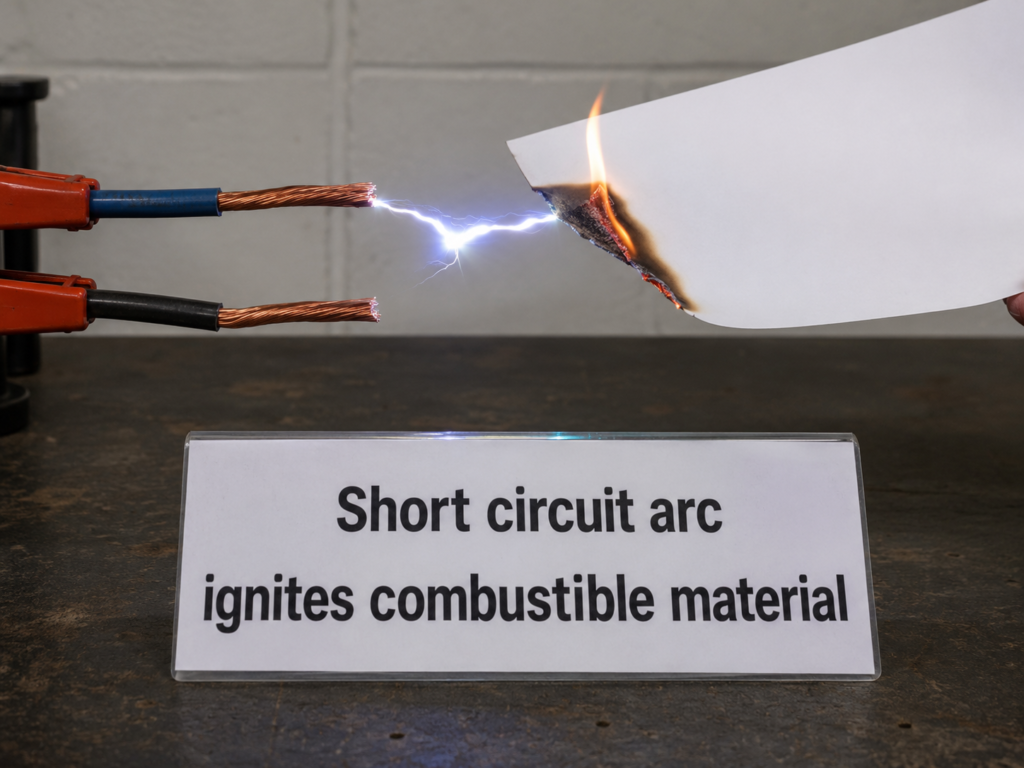
The arc generated during a short circuit has an extremely high temperature and can easily ignite surrounding plastic, paper, cloth, wood, dust, and even oil. Especially the arc of DC systems, because there is no natural zero-crossing point of alternating current, is more difficult to self-extinguish in some scenarios. The continuous arc will continuously heat surrounding combustibles, resulting in a higher fire risk.
Specific Hazards to People and Property
The hazards of short circuits cover multiple levels: personal safety, equipment, property, and power supply systems:
- To personal safety: High-temperature arcs may directly cause skin burns, exposed live parts may cause electric shock, and sudden loud bangs or flashes may also cause people to fall in fright, resulting in secondary injuries. If a fire is caused, toxic smoke may also lead to poisoning or suffocation.
- To electronic equipment: Instantaneous large current may burn out chargers, device charging ports, and internal power boards of appliances. For devices with batteries such as mobile phones, power banks, and energy storage batteries, it may even induce battery thermal runaway in severe cases.
- To household property: The high temperature or arc generated by a short circuit can easily ignite surrounding combustibles such as carpets, curtains, furniture, and wall decorations; if the fault occurs in hidden locations such as inside walls, under carpets, or behind furniture, it is difficult to detect in time and more likely to develop into a large-scale fire.
- To the power supply system: A short circuit will directly cause the circuit breaker to trip and the fuse to blow. In severe cases, it may burn sockets and plugs, and even damage components such as switches and busbars inside the distribution box, affecting the power supply safety of the entire loop.
Characteristics of Risks That Are Easily Underestimated
Many people have deviations in their understanding of short circuit risks, leading to hazards being ignored. The most common points are:
First, damage is often hidden in visual blind spots. Places that are not usually specifically checked, such as the root of plugs, behind bedside tables, under carpets, door gaps, under furniture feet, and inside wire ducts, are precisely where insulation damage and short circuit hazards are most likely to accumulate.
Second, aging is a gradual process. The insulation performance of cables will slowly decline with time and environment. “Looks usable” does not mean that the insulation performance is still qualified. Many old cables that have been used for many years may look intact on the outside, but their internal insulation capacity has dropped significantly.
Third, having tripped does not mean it is safe. A tripped protection device only indicates that there was an abnormal current or leakage in the loop, and does not mean that the cable or equipment has returned to a safe state. If the root cause is not found, problems may occur the next time it is used.
Fourth, not tripping does not mean it is safe. Ordinary circuit breakers are mainly sensitive to instantaneous large currents or continuous overload, while intermittent arcs and local overheating caused by poor contact sometimes do not trigger immediate tripping, but can also ignite surrounding combustibles, and the risk is not low.
Differences in Destructive Power Across Different Scenarios
In different usage scenarios, the destructive power of short circuits varies greatly and cannot be generalized:
- Household socket circuits: Short-circuit current may reach hundreds to thousands of amperes, but the specific value is greatly affected by the incoming power supply capacity, line length, wire diameter, and protection device specifications. The short-circuit current of old houses and long lines may be relatively smaller, but there is still a fire risk.
- Mobile phone/digital fast charging cables: Although the operating voltage is relatively lower than household mains, the current of current fast chargers is generally large. If the cable sheath is damaged, the root is bent and broken, or the port is burned, it may still cause local high temperature, bringing risks of burns or even fire.
- Vehicle/RV/marine low-voltage systems: The voltage of such systems is usually only 12V or 24V, with low electric shock risk, but the short-circuit current that the battery can output is very large. The short-circuit point may melt metal wire cores and terminals in a very short time, and then ignite surrounding combustibles such as plastic, cloth, and oil.
- Outdoor/photovoltaic DC systems: Such scenarios face problems such as rain immersion, UV aging, and water ingress at connectors at the same time. Coupled with the characteristic that DC arcs are difficult to self-extinguish, the overall risk is much higher than ordinary indoor low-voltage cables.
Finally, a special note: there is no unified hazard data applicable to all cables. The specific risk level shall be subject to product labeling, local electrical codes, actual load size, and protection device configuration.
Common Causes of Short Circuits in Daily Scenarios
Since short circuits are so dangerous, how exactly do they happen? Short circuits in daily scenarios basically come down to four types of causes, many of which are small habits that are not usually noticed.
Insulation Layer Damage Caused by Physical Injury
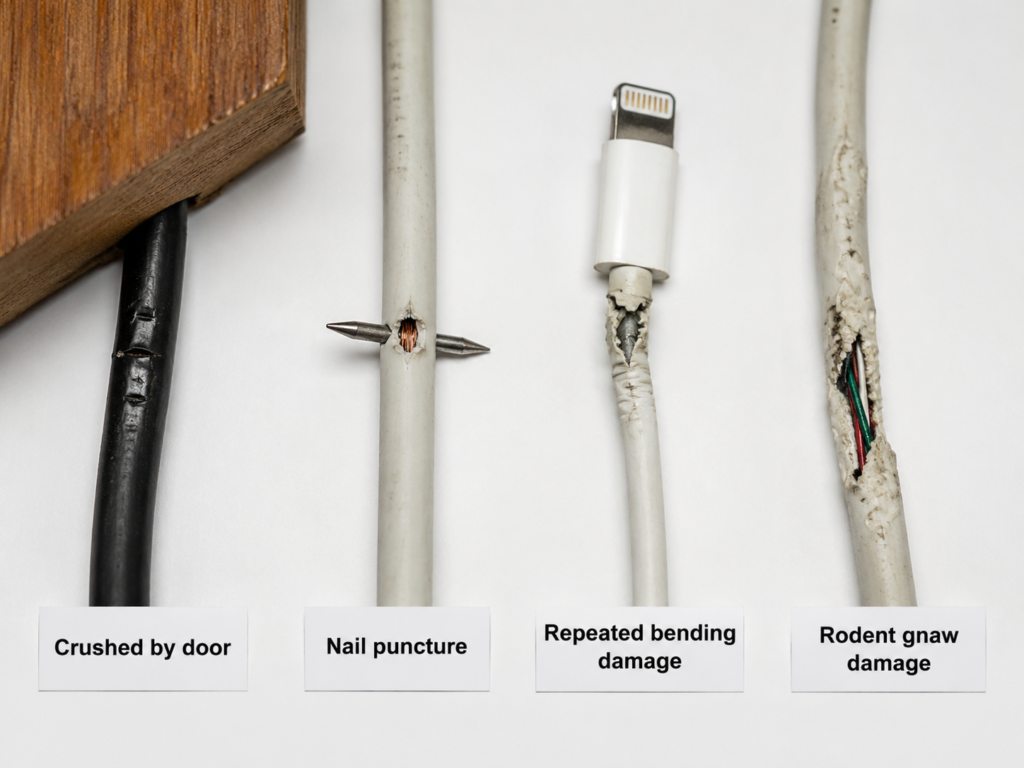
The most common cause is physical damage destroying the insulation layer—as long as the insulation is broken, the inner wire cores may touch each other.
For example, external force extrusion: a wire caught in a door gap when closing the door, an extension cord pressed by a sofa or bed frame, office chair wheels repeatedly rolling over wires on the floor, heavy objects falling on the wire—over time, the insulation layer will crack or deform, and the inner wire cores come into direct contact.
There is also puncture and scraping: a nail piercing a wire in the wall, a wire rubbing back and forth against a metal table corner or sharp edge, a screw scraping the outer sheath—all may directly pierce the insulation layer.
Repeated bending is also a big problem, especially at the root of charging cables, the tail of plugs, and the outlet of chargers. Bending back and forth every day, the outer sheath slowly cracks, and the inner wire cores may also break or be exposed.
Many people like to pull the cable body instead of pinching the plug when unplugging. This tension force will cause the inner wire core to separate from the terminal, or the insulation layer to be torn, or even directly break the wire core.
In addition, there is biological damage: mice, squirrels, and pets gnaw on cables and bite through the outer sheath; insects, dust, and dirt entering junction boxes may also form abnormal conductive paths.
Decline in Insulation Capacity Caused by Environment and Aging
Even without physical damage, harsh environments will slowly reduce the performance of the insulation layer, eventually leading to short circuits.
For example, high temperature: when cables are close to heat sources such as stoves, heaters, electric heaters, and engine compartments, the insulation layer will become soft, brittle, and deformed. Over time, it will crack and the insulation performance will decline.
Moisture and water ingress: in humid environments such as bathrooms, kitchens, outdoors, and basements, water vapor will penetrate the insulation layer, or cause connectors to corrode and rust, reducing insulation performance, and in severe cases, directly causing short circuits.
Ultraviolet rays and sunlight: ordinary indoor wires are designed for indoor use. If left outdoors in the sun for a long time, the outer sheath will slowly chalk and crack, and crumble when pinched by hand, simply unable to provide insulation.
Oil and chemical corrosion: kitchen oil, detergents, gasoline, engine oil, corrosive gases will slowly corrode the cable sheath, making the insulation layer brittle and cracked.
There is also poor heat dissipation: many people press extension cords under carpets, tie several cables tightly together, or cover them with something. The heat generated by the cables during operation cannot be dissipated, and the temperature continues to rise, accelerating insulation aging, and over time, the insulation will be baked and damaged.
Improper Handling of Connectors/Connection Parts
Connectors are the weakest link in the entire loop, and many short circuits are caused by poor handling of connectors.
For example, exposed connectors: when stripping insulation for wiring, too much insulation is removed, and loose copper wires touch adjacent conductors, metal casings, or wet surfaces accidentally, causing a direct short circuit.
Loose connection: if the terminal is crimped too loosely or the plug is not inserted tightly, the resistance at the connector will increase, causing local heating and sparking when power is applied, slowly burning the surrounding insulation layer, and eventually developing into a short circuit.
Oxidation and dust accumulation: if the connector gets water, dust, rust, or oil, an oxide layer or dirt will form on the surface. At first, it may just be poor contact, but over time, it may also form an abnormal conductive path, or local heating will burn the insulation.
Many people like to DIY wiring, twisting wires of different diameters and different materials together casually, and wrapping them with tape twice to finish. There are neither formal wiring terminals nor stress relief, and they will loosen or heat up before long, which is very dangerous.
If terminal selection is wrong, for example, the terminal’s rated current is insufficient, the crimping tool is inappropriate, or copper and aluminum wires are mixed without special treatment, it will increase the risk of short circuit—direct connection of copper and aluminum will cause a chemical reaction that slowly corrodes the metal (professionally called electrochemical corrosion), and poor contact will occur quickly.
Induced by Improper Use and Inferior Products
Many other short circuits are completely caused by improper use or purchasing inferior products.
For example, overload use: plugging several high-power appliances such as electric heaters, induction cookers, ovens, and air conditioners into one power strip at the same time. The current far exceeds the bearing capacity of the power strip and cable, the wire will get hotter and hotter, and eventually bake the insulation layer and cause a short circuit.
Mismatched wire diameter: using very thin wires to power high-power appliances, such as using thin extension cords with insufficient rated current, cheap adapter cables, or small-specification power strips to power high-power equipment such as electric heaters, ovens, and air conditioners. The wire will quickly heat up and burn out, which is why high-power appliances are equipped with special thick wires.
Coiled use: many people use extension cord reels without fully unrolling the wire before plugging in high-power equipment. Coiled wires have very poor heat dissipation, and the temperature will rise rapidly, easily burning the insulation layer.
Inferior cables are even more of a disaster area: many cheap cables have falsely labeled wire cores, claiming to be 1 square millimeter but actually only 0.5 square millimeters; using copper-clad aluminum or even copper-clad iron to pass off as pure copper wires, which have poor conductivity and are prone to heating; the insulation layer is uneven in thickness, even with bubbles and cracks, and breaks before long; some don’t even have clear markings, so you have no idea how much power they can withstand.
There is also unauthorized wiring: temporary extension cords are used for several years without being removed, even passing through walls, buried underground, or pressed under carpets as fixed wires; several power strips connected in series are not only prone to overload but also have more connectors, increasing the probability of problems; placing power strips on wet ground or combustible materials makes it easy to catch fire once a problem occurs.
Intermediate Proficiency: Dimensions for Judging Short Circuit Risk Level
After understanding the causes, you may ask: How do I judge whether the short circuit risk of the cables I have or the wiring in my home is high or low? In fact, you don’t need professional tools, you can roughly judge from several dimensions to help you make basic decisions.
Influence of Cable’s Own Properties
The characteristics of the cable itself are the basis of risk, mainly looking at these points:
- Wire core material: Under the same cross-sectional area, qualified pure copper wires have better conductivity, more stable connectors, and are less prone to heating; copper-clad aluminum and inferior aluminum wires have poor conductivity, and connectors are more prone to oxidation and heating, with higher short circuit risk. It should be noted that weight and flexibility can only be used as a reference for initial vigilance, and cannot be used as a reliable basis for confirming the material—different insulation thicknesses, wire core structures, and stranding methods will affect weight and softness. Ordinary users should first check product labels, safety certifications, and manufacturer instructions, try to purchase from formal channels, and consult the manufacturer or professionals if necessary.
- Wire diameter: The thinner the wire, the smaller the current it can withstand, and the easier it is to burn through the insulation due to overload heating. But it’s not that the thicker the better. Thick wires must match the corresponding terminals, sockets, and protection devices. If the wire is very thick but the protection device is selected too large, or the terminal is not crimped tightly, there will still be problems.
- Insulation layer material: The most common ordinary PVC insulation has a temperature resistance rating of about 70°C, and it is easy to soften and age above this temperature; high-temperature resistant PVC can reach about 105°C, suitable for slightly higher temperature scenarios; materials such as rubber, silicone, and cross-linked polyethylene (a plastic with better temperature resistance) have better temperature resistance or are more flexible in specific scenarios, for example, outdoor cables and high-temperature environment cables use these materials.
- Flame retardant performance: Flame retardant wire means the material is not easy to burn continuously, which can reduce the risk of flame spread, but it does not mean it will not catch fire—when encountering arcs, high temperatures, or external fire sources, it will still be ignited, just burns slower, and cannot replace overcurrent protection.
- Manufacturing quality: Uniform insulation layer, no bubbles, no cracks, and clear markings are more important than simply “looking very thick”. Inferior wires may look thick on the outside, but are uneven in thickness and crack when bent, which is even more dangerous.
Risk Addition of Usage Environment
The same cable, when used in different environments, has very different risks:
- High-risk environments: Humid, outdoor, high-temperature, oily, dusty, salt spray (seaside), corrosive gas, and combustible dust environments will all accelerate insulation aging, or increase the possibility of abnormal conduction, and the short circuit risk is much higher than ordinary indoor environments.
- High-risk locations: Cables passing through sharp edges, door gaps, moving parts (drawers, doors), areas frequently stepped on by feet, places where pets can gnaw, and positions with vibration in vehicles or machinery are more likely to be worn and pulled, and the insulation layer is damaged faster.
- Heat dissipation conditions: If cables are placed in enclosed spaces, covered, tightly bundled, or pressed under carpets, the heat cannot be dissipated, and normal temperature rise will become dangerous high temperature, accelerating aging or even directly burning the insulation.
- Distance to combustibles: When flammable materials such as cardboard boxes, curtains, bedding, wood chips, and foam plastics are placed next to cables, once a short circuit causes a fire, it will spread quickly, with more serious consequences.
Influence of Installation and Usage Methods
Installation and usage methods also directly affect the risk level:
- Protection method: Using PVC pipes, metal pipes, or wire ducts for fixed wiring can greatly reduce the risk of mechanical damage, for example, nails are less likely to pierce them, and mice are less likely to gnaw them; outdoor wiring also needs to consider waterproofing, sun protection, and drainage, and connectors cannot be soaked in water.
- Stress state: Cables that are long-term tight, pressed by heavy objects, frequently pulled, or repeatedly bent are more likely to damage the insulation layer and terminals, with higher short circuit risk.
- Usage habits: Frequent overloading, series-connected power strips, using damaged cables, long-term repair of damage with tape, and pulling the cable body when unplugging—these bad habits will slowly increase the risk. A cable that could have been used for ten years may break in two or three years.
- Boundary between temporary and fixed: Temporary extension cords are designed for short-term use and cannot replace fixed wiring for a long time, especially cannot be used for a long time through walls, buried underground, or pressed under carpets—many people, for convenience, pull an extension cord and use it for several years, which is very dangerous.
Influence of Protection Device Matching Degree
Protection devices are the last line of defense against short circuits, but only if they are selected correctly and matched properly, otherwise they are useless. Many people can’t figure out the function of various switches in their homes, so let’s sort them out simply here:
- Miniature Circuit Breaker (MCB): The most common switch in home distribution boxes. It has two core protection functions: ‘magnetic trip’ is simply an “emergency stop mechanism” triggered by electromagnetic suction, specifically for instantaneous large currents like short circuits. When the fault current reaches its operating condition, it will quickly cut off the circuit; ‘thermal trip’ is a “slow-heat protection” triggered by the thermal deformation of the internal metal sheet, specifically for long-term overload situations. It trips only when the temperature slowly rises to the threshold. The actual operating time depends on the circuit breaker type, different response sensitivity designs (professionally called trip curves), fault current magnitude, and loop impedance, and there is no unified fixed value.
- Fuse: A special metal wire that melts itself to cut off the circuit when the current exceeds the rated value. It is for one-time use and must be matched according to cable and load specifications. You cannot casually replace it with a larger one or use copper wire instead.
- Residual Current Device (RCD/GFCI): Detects leakage current (that is, current leaking outside). For example, if a person touches a live part and current flows from the human body to the ground, the RCD will immediately trip when it detects an abnormality to prevent electric shock. Note: Ordinary RCDs only protect against leakage and electric shock, and are not responsible for short circuit protection between live and neutral wires—don’t confuse them.
- Combined RCD/RCBO: Combines RCD and MCB in one, with both residual current protection and overcurrent (short circuit + overload) protection. Tripping during a short circuit is because its overcurrent protection part is working.
- Arc Fault Detection Device (AFDD/AFCI): Can identify abnormal arcs in the line (such as intermittent sparks caused by poor contact). This type of arc often does not trigger ordinary MCBs, but can easily cause smoldering fires. Installing this can trip in advance. However, it is only supplementary protection and cannot replace circuit breakers, fuses, and RCDs.
There is a very important matching principle here: the rated current of the protection device shall not be greater than the safe ampacity of the cable. That is to say, if the wire can only withstand 10A current, the protection device can only use a maximum of 10A, so that the protection trips before the wire is burned out. At the same time, breaking capacity, loop impedance, local codes, and installation conditions must also be considered—breaking capacity is simply the maximum fault current that this switch can safely “withstand and cut off”. If the fault current exceeds its breaking capacity, the protection device may not be able to disconnect normally, and may even be dangerous itself. Never privately replace a circuit breaker or fuse with a larger specification just to ‘not trip’—in that case, the protection will not act during a short circuit or overload, and the cable will be burned first, even causing a fire.
Risk Differences of Different Cable Types
Different types of cables have different common risk points, and you can pay targeted attention:
- Mobile phone/digital charging cables: Frequent bending, sheath damage, and loose ports are the most common; fast charging current is large, and inferior cables are more prone to heating.
- Home appliance power cords: Higher power, more serious consequences after plug and cable body heating or damage, so key inspection is required.
- Extension cords/power strip cables: More movement, more stepping, large load changes, overload and heat dissipation problems are most easily overlooked.
- Outdoor/landscape lighting cables: Rain, dirt, UV rays, and water ingress at connectors are the main causes, and outdoor-grade products must be used.
- Vehicle/RV/marine cables: Vibration, metal friction, oil, high temperature, and large battery current are superimposed, and fuses need to be arranged near the power supply end.
- Ordinary data cables/network cables: Low fire risk under low power; but network cables with power supply function (professionally called PoE network cables), USB-C fast charging cables, and monitoring power cables have significantly higher risks.
Of course, you can’t judge the risk only by cable type, but also by combining load size, usage environment, cable quality, and protection devices for comprehensive judgment.
Reminder on Regional and Product Differences
Household voltage, plug types, grounding methods, protection configurations, and certification requirements vary across different countries and regions. Product parameters cannot be judged without reference to manuals, local codes, and actual loads.
Common safety certifications such as CCC, UL, ETL, CSA, VDE, BS, TUV, etc., are relatively authoritative third-party certifications. It should be noted that CE is a European Union conformity mark, which in many cases is a manufacturer’s self-declaration and cannot be simply equated with third-party safety certification. Don’t think a product is safe enough just because you see CE.
If you are not sure whether a certain cable or device is compliant or usable, the safest way is: stop using it first, then consult a local licensed electrician or the product manufacturer, don’t guess blindly.
Beginner-Operable: Short Circuit Risk Self-Inspection Methods Without Professional Tools
After talking about so many risks, you may already want to quickly check the wires in your home. Don’t worry, next we will talk about short circuit risk self-inspection methods that ordinary users can do without professional tools—but before starting, we must first draw a few red lines that absolutely cannot be touched.
Safety Prerequisites for Self-Inspection
The safety prerequisites for self-inspection are very important, you must remember them firmly:
- Never disassemble sockets, strip insulation, or disassemble distribution boxes while powered on, even if you think you know how. A little carelessness can cause electric shock.
- Do not chisel walls or disassemble and repair problems with pre-embedded wires in walls, fixed sockets, or distribution boxes by yourself. You should find a professional electrician.
- If you find burnt smell, sparks, smoke, or blackened plugs, cut off the power first and stay away. Do not approach to test, to prevent arc burns or fire.
- The goal of self-inspection is to find obvious external hazards, not to prove that the line is “absolutely safe”—problems such as inside walls, inside terminals, and decreased insulation resistance cannot be detected by the naked eye and touch.
Key Points for Quick Visual Inspection
The most basic self-inspection is visual inspection, focusing on the following aspects:
- Check the cable body: Look for cracks, hardening, discoloration, bulges, peeling, exposed copper wires, bite marks, or crushed areas. Especially check the root of plugs and frequently bent positions carefully.
- Check plugs/sockets: Look for blackening, burn marks, deformation, looseness, burn marks on prongs, exposed copper wires at the root of plugs, and whether the plug is loose when inserted into the socket.
- Check connectors: If there are exposed connectors, see if they are roughly wrapped with tape, if the junction box has water or dust ingress, and if there are signs of loose terminals.
- Check wiring: See if the wire is caught by doors, pressed by furniture, passes through metal sharp edges, is pressed under carpets, or is close to heat sources (stoves, heaters) or water sources (faucets, shower areas).
- Check protection devices: See if the circuit breaker trips frequently, if the fuse blows repeatedly, if the power strip overload protection acts frequently—these are all hazard signals.
Sensory Auxiliary Inspection (Premised on Power Off and Safe Distance)
In addition to visual inspection, you can also use touch, smell, and hearing methods to assist in inspection, but you must pay attention: you must first cut off the power, or maintain a safe distance, and absolutely never touch abnormal parts while powered on.
- Touch the appearance: After power off, touch the cable body to see if there is abnormal softness, stickiness, unevenness, or local hardening. These are signs of insulation aging or overheating.
- Touch temperature: If the cable has just been used, touch the cable body and plug after power off. Normal slight warmth is normal, but if it is still hot after a few minutes, or a certain section is obviously hotter than other parts, it is a danger signal and must be stopped.
- Smell: Smell closely. The easiest to detect is the burnt smell of plastic, the smell of burnt rubber, and a fresh pungent smell similar to after a thunderstorm (that is the smell of ozone generated by arcs). As long as there is abnormal electrical odor or smoke smell, you should be vigilant.
- Listen: If there is a buzzing sound or slight crackling sound in the plug or socket when powered on, it is likely poor contact or arcing, and must be stopped immediately.
If you encounter a situation where the circuit breaker cannot be closed, trips as soon as it is closed, or trips again shortly after being pushed up, never try to close it repeatedly. You should first unplug all loads, then find a professional to troubleshoot—repeated closing will only make the fault worse.
It should be noted that touch and visual observation can only be used for preliminary screening. They cannot judge hazards inside walls or terminals, nor can they detect whether the insulation resistance is qualified—insulation resistance is simply the “ability of the insulation layer to block current”. The higher the value, the better the insulation performance. This indicator must be measured with professional instruments and cannot be judged by daily observation at all.
Self-Inspection Priorities for Different Scenarios
Self-inspection priorities vary across different scenarios, and you can conduct targeted troubleshooting:
- Indoor home: Focus on checking cables in the kitchen and bathroom, cables of high-power appliances such as air conditioners, electric heaters, and induction cookers, power strips and extension cords, and bedside charging cables—many people put their phones on the bed while charging, with pillows and quilts next to them, which can easily catch fire if something goes wrong.
- Office scenarios: Focus on checking whether workstation power strips are connected in series, whether devices such as computers, printers, and shredders are concentrated on one power strip, and whether wires on the floor are repeatedly rolled by chair wheels.
- Outdoor/garage: Focus on checking garden lights, terrace sockets, power tool extension cords, RV connection cables, and outdoor junction boxes to see if there is water ingress, damage, or aging.
- Rental/old houses: Focus on checking sockets with blackened walls, temporary wires privately pulled by previous residents, old aluminum wires, and circuits that trip frequently but have not been repaired—old houses often have more serious line aging problems, so extra attention is needed.
- Households with pets: Focus on checking ground charging cables, cables behind sofas, and all cables that pets can reach. Many pets like to gnaw on wires, which can easily bite through the insulation layer and cause short circuits.
Self-Inspection Frequency Recommendations
Self-inspection doesn’t need to be done every day, but it should be regular. Different cables have different inspection frequencies:
- Before each use: For cables that are frequently moved and easily damaged, such as charging cables, portable extension cords, and power tool cables, take 10 seconds to glance at them before each use to see if there is any skin damage or looseness, which can avoid many risks.
- Monthly regular inspection: Power strips at home, exposed sections of fixed wiring, outdoor cables, and wires near the kitchen and bathroom should be inspected at least once a month; if in scenarios such as outdoor, humid, high-temperature, high-load, pet-accessible, or where cables are frequently moved, the inspection frequency should be appropriately increased.
- After special events: After moving, renovation, thorough cleaning, home flooding, pet gnawing on wires, or moving furniture, immediately recheck the relevant cables to see if they are damaged by impact or pressure.
- High-load seasons: Before using electric heaters in winter and air conditioners and dehumidifiers in summer, focus on checking the plugs, sockets, and extension cords of these high-power appliances, and confirm there are no problems before use.
Risk Reduction: Full-Process Pitfall Avoidance Measures from Selection to Use
Of course, hazards found in self-inspection should be dealt with, but the best way is to do a good job of prevention throughout the whole process from selection, wiring to use, to minimize the risk. Next, we will talk about full-process pitfall avoidance measures that ordinary users can take.
Simple Judgment Methods for Cable Selection
Many people only look at price and length when buying cables. In fact, choosing the right cable can reduce the risk by more than half. Remember these simple judgment methods:
- Check markings: Regular cables will have clear markings, such as wire diameter (or specification), rated voltage, rated current or power, temperature resistance grade, manufacturer information, and applicable scenarios. All of these must be present. If a cable has no markings at all, or the markings rub off easily, it’s best not to buy it.
- Check certification: Prioritize products that comply with local regulations and have formal safety certifications, such as UL/ETL in the United States, CSA in Canada, VDE/TUV in the European Union, BS in the United Kingdom, CCC in China, etc. Products with these certifications have more guaranteed safety. Reminder again: many CE marks are manufacturer self-declarations, not third-party safety certifications. Don’t think it’s safe just by looking at CE.
- Check material: Prioritize cables with qualified pure copper wire cores, which have good conductivity and stable connectors. It should be noted that weight and flexibility can only be used as a reference for initial vigilance, and cannot be used as a reliable basis for confirming the material—different insulation thicknesses, wire core structures, and stranding methods will affect weight and softness. Ordinary users should first check product labels, safety certifications, and manufacturer instructions, try to purchase from formal channels, and consult the manufacturer or professionals if necessary. Also be wary of falsely labeled wire cores, for example, labeled 1 square millimeter but actually only 0.5 square millimeters. This type of cable is prone to heating when carrying large loads.
- Check scenario: Different scenarios require different cables. For high-power appliances, choose cables with sufficient wire diameter and rated current; for outdoor use, choose waterproof and UV-resistant outdoor cables; for high-temperature environments, use cables with higher temperature resistance grades. You can’t casually use ordinary indoor cables as a substitute.
- Check structure: Good plugs have a sheath and stress relief at the root (a section of thick soft glue at the connection between the plug and the cable), so that the wire core is not directly bent when bending; the cable body is flexible but not loose, and the prongs are firm and do not wobble—if the prongs are loose, poor contact will occur before long.
Finally, a reminder: ordinary users should not use a lighter to burn cables to test flame retardancy. First, it is easy to cause a fire; second, combustion will produce toxic smoke and damage the product. To know the flame retardant grade, just check the product manual and certification.
Beginner Method for Selection by Load
Many people don’t know how thick a cable or how much current a power strip they should buy. Here is a rough estimation method for single-phase AC circuits, for reference only:
Current (ampere, A) ≈ Power (watt, W) ÷ Voltage (volt, V)
For example: under 220V mains, the current of a 2200W electric heater is about 10A; under 120V mains, the current of a 1200W electric heater is about 10A.
Note: This formula can only help you roughly understand the load size, and cannot replace local electrical codes and product rated values. Actual purchase shall be subject to the rated current marked on the product. The selection principle is: the rated current of cables, plugs, power strips, and extension cords shall not be lower than the actual load current, and it is best to leave a safety margin.
Special reminder: For high-power appliances such as electric heaters, induction cookers, ovens, air conditioners, and water heaters, it is best to plug them directly into fixed wall sockets, and try not to use ordinary power strips or thin extension cords.
Safe Practices for Wiring and Storage
Paying attention to these points during wiring and storage can also reduce many risks:
- Protection first: For fixed wiring, try to use compliant conduits, wire ducts, or special sheaths to protect the cables, reducing the risk of wear, accidental contact, and rat gnawing. For outdoor wiring, use waterproof junction boxes, do a good job of fixing and drainage, and don’t let connectors soak directly in water.
- Avoid risk points: Wiring should be as far away as possible from heat sources, water sources, sharp edges, moving parts (doors, drawers), and frequently stepped areas. If it must pass through, be sure to do a good job of protection.
- Leave margin: Cables should not be pulled too tight, nor should they be tied in tight knots. Leave a little natural bending space at the root of the plug, so that the wire core and terminals are not directly pulled when plugging/unplugging or shaking.
- Adequate heat dissipation: Do not bundle multiple cables tightly, especially cables carrying large loads. Leave some gaps for heat dissipation; when using an extension cord reel with high-power equipment, be sure to fully unroll it, do not use it coiled, otherwise the heat cannot be dissipated and it is easy to overheat.
- Outdoor wiring: Outdoor-grade cables and accessories must be used, and ordinary indoor cables cannot be used as a substitute. Otherwise, with wind, sun, and rain, they will age before long.
Must-Do Pitfall Avoidance Operations in Daily Use
Developing good habits in daily use can avoid the vast majority of short circuit risks:
- No overload: Do not connect multiple high-power appliances to one power strip at the same time, and do not connect multiple power strips in series—series connection is not only prone to overload but also has more connectors, increasing the probability of problems.
- Correct plugging and unplugging: When unplugging, pinch the plug body to pull, do not pull the cable body; if the plug is loose or the socket cannot clamp tightly, stop using it and replace it in time. Reluctant use can easily lead to poor contact.
- Replace damaged ones in time: Cables and power strips with damaged insulation, exposed copper, blackened plugs, or deformed cable bodies should be directly scrapped. Don’t wrap them with tape and continue to use—ordinary tape has insufficient insulation and wear resistance, especially in positions under stress, humidity, or high temperature. Wrapping is useless and can easily lead to complacency.
- Use dedicated models for humid areas: For bathrooms, outdoors, and humid positions in the kitchen, sockets and cables with waterproof structure should be used, combined with residual current protection, and local installation requirements should be followed. You can’t casually put ordinary power strips in the bathroom.
- No unauthorized modification: Do not cut off the ground pin of the plug, do not shave the plug to fit an unsuitable socket, do not privately modify sockets, do not use mismatched adapters for long-term power supply. These operations will greatly increase the risk.
Ability Boundary: What to Do by Yourself, What to Find a Professional Electrician For
Be sure to know your own ability boundary, don’t force it:
- Can be handled by yourself: Replace pluggable charging cables, extension cords, and power strips; organize wiring and move cables to a safe position; clean up combustibles around cables. These are usually within the scope of ordinary users, but before operation, you should first disconnect the relevant power supply and keep your hands and the environment dry. If you find signs of cable damage, burnt smell, blackening, or heating, do not touch the faulty part, directly replace it or find a professional to handle it.
- Handle with caution: Operations such as replacing equipment power cords, connecting terminals, and installing outdoor light cables—if you don’t understand the specifications and wiring methods at all, it’s best not to do it yourself. It’s safer to find a professional.
- Must find an electrician: Wall wiring faults, distribution box modification or faults, socket burning, frequent tripping with unknown cause, fixed outdoor wiring, fixed lines after water ingress—as long as it involves fixed wiring, distribution boxes, grounding systems, or repeated tripping with unknown cause, do not handle it by guessing. You must find a local licensed electrician to troubleshoot.
Remember a principle: as long as you are unsure or think there may be danger, don’t touch it. Finding a professional is always the safest way.
Emergency Handling: Correct Practices When Detecting Short Circuit Warning Signs or Fire
Even if you do a good job usually, you may encounter emergencies. If you really encounter short circuit warning signs or cable fire, knowing the correct handling method can minimize losses and even save your life.
Handling of Short Circuit Warning Signs
Many short circuits have signals before they occur, such as frequent tripping, burnt smell, small sparks, blackened plugs, local hot cables, buzzing sounds from plugs and sockets, and smoke. These are typical warning signs. Once they appear, do these things immediately:
- Stop using the relevant appliances. If the plug can be safely unplugged, unplug it, but if there are already sparks or smoke, don’t approach, stay away first.
- Turn off the circuit breaker of the corresponding loop. If you don’t know which one is the corresponding loop, directly turn off the main power supply, don’t find it troublesome.
- Never try to close the switch repeatedly—many people push it up after tripping, and push it again after tripping, which will only make the fault more and more serious, and even cause a fire.
If the cause cannot be found, or it involves fixed lines in the wall or distribution box problems, be sure to contact a professional electrician for troubleshooting, don’t mess around by yourself.
Emergency Steps for Cable Fire
If a fire really breaks out, don’t panic, follow the steps:
- Cut off the power immediately: Turn off the corresponding loop if possible, if not, turn off the main power switch; if you cannot safely cut off the power, do not approach the live fire source, evacuate quickly.
- No splashing water on live fire: Water is conductive. Splashing water on a live fire not only cannot extinguish the fire, but may also cause electric shock. Do not cover with a wet cloth either.
- Correct fire extinguishing: When ordinary users encounter a cable or appliance fire, prioritize cutting off the power, and use dry powder or carbon dioxide fire extinguishers suitable for electrical fires to fight it; for small-scale fires and when it is confirmed that there is no live risk around and no energy storage devices such as batteries, dry sand can also be used to cover. If it is impossible to confirm that the power is completely cut off, there are energy storage devices such as batteries/UPS/photovoltaic/vehicle power supplies on site, the ground is wet, or the fire shows signs of spreading, absolutely do not use water. Evacuate immediately and call the local emergency rescue number.
- Prevent electric shock: Before the fire is completely extinguished, do not touch cables, power strips, or metal casings of appliances, and do not step on wet ground to prevent electric shock.
- Evacuate and call for help: If the fire grows, smoke is thick, power cannot be cut off, or the fire cannot be controlled, evacuate immediately and call the local emergency rescue number. Personal safety is always the first priority.
Reuse Judgment After Short Circuit
After the short circuit is handled, you cannot restore power casually. First, judge which ones can still be used and which must be thrown away:
- Directly scrap: Charging cables, power strips, and extension cords with burning, deformation, cracks, exposed copper wires, or blackened plugs should be thrown away directly. Don’t think about repairing them—the internal insulation may have been burned, and it is easy to have problems when used again.
- Find the root cause: Don’t just cut off the blackened section of wire and be done. You must figure out the root cause of the short circuit—is it insulation damage? Too thin wire diameter? Loose connector? Water ingress? Or overload? If the root cause is not found, problems will occur again next time.
- Fixed lines require professional inspection: After a short circuit in wall wires, sockets, distribution boxes, or outdoor fixed wiring, professionals must inspect and confirm that there are no problems before power can be restored. Ordinary users should not conduct power-on tests after disassembling and repairing by themselves.
The boundary for ordinary users is: at most replace pluggable cables or power strips, then do a simple test with low-power equipment. Absolutely do not conduct power-on after disassembling and repairing fixed lines by yourself.
Dangerous Operations That Must Never Be Done
Finally, let’s emphasize a few dangerous operations that must never be done. Many people make them in a hurry, so be sure to remember:
- Do not touch faulty cables, plugs, sockets, or metal casings while powered on.
- Do not cover live faulty parts or fire sources with water or wet cloths.
- Do not repeatedly force the switch to close “to try”.
- Do not temporarily wrap damaged areas with ordinary tape, paper, or cloth and continue to power on.
- Do not use coins, iron wires, or copper wires to replace fuses.
- Do not privately increase the circuit breaker specification to restore power.
Misconception Clarification: Don’t Let Wrong Cognition Amplify Short Circuit Risk
Finally, let’s clarify several common misconceptions about short circuits. Many people turn small hazards into big risks because of these wrong cognitions.
Misconception: The thicker the cable, the less likely it is to short circuit
Truth: Thick wires are only less prone to overheating under overload conditions, but they can still suffer from short circuits once the insulation layer is damaged. Moreover, if thick wires are paired with mismatched protection devices or terminals — for example, using an oversized MCB, or having loosely crimped terminals — they will cause connection overheating and protection failure, and carry the same level of safety risk.
Misconception: An intact insulation sheath means absolute safety
Truth: Prolonged exposure to high temperatures, humidity, and natural aging gradually degrades the insulating performance of dielectric materials. A cable that looks undamaged on the outside may still have hidden leakage or short-circuit risks. For example, old wiring that has been in service for 20 to 30 years may retain an intact outer jacket, but its insulation resistance has already dropped significantly.
Misconception: RCDs protect against all types of short circuits
Truth: Standard RCD/GFCI devices are designed primarily to detect leakage current and prevent electric shock. They do not provide short-circuit protection between live and neutral conductors. Short-circuit protection is delivered mainly by circuit breakers, fuses, or combined residual-current breakers with overcurrent protection (RCBO).
Misconception: Low-voltage cables carry no short-circuit fire risk
Truth: Low voltage generally means lower electric shock hazard, but it does not equal low energy. High-current low-voltage systems can still generate extreme heat and ignite fires during a short circuit. For instance, a 12V automotive battery can deliver a massive short-circuit current strong enough to melt wire conductors and ignite surrounding plastics, fabrics, or oils.
Misconception: Wrapping damage with electrical tape is a permanent fix
Truth: Standard electrical tape deteriorates over time, loses adhesion, and cannot reliably replace a full, intact insulation layer for long-term use. Damaged cables in high-stress, humid, high-temperature, or outdoor locations should be replaced entirely — relying on tape to keep them in service creates a false sense of safety.
Misconception: No breaker trip means the cable is safe
Truth: Circuit breakers may be incorrectly sized, aged, or have insufficient breaking capacity. Intermittent arcing and localized overheating from poor contact often do not immediately trip a standard breaker. If you detect a burnt plastic odor, unusual heat, discoloration, or buzzing/hissing sounds, stop using the cable immediately and inspect it, even if no breaker has tripped.
Misconception: A tripped breaker means protection worked perfectly and you can keep using the circuit
Truth: A trip confirms that abnormal current or leakage has already occurred, and the wiring or devices may already have sustained damage. You must identify the root cause of the trip and resolve the underlying hazard before restoring power.
Misconception: Flame-retardant cables cannot catch fire
Truth: “Flame-retardant” means the material resists sustained burning and slows flame spread — it does not mean the cable is immune to ignition. Arcs, extreme heat, or external fire sources can still ignite flame-retardant insulation. These cables must still be properly matched to the load, protection devices, and operating environment.
Summary: Core Skills You Will Gain
By the end of this article, you will have mastered practical knowledge to handle most short-circuit risks in everyday scenarios:
First, you can explain what a cable short circuit is in plain language, and tell the difference between short circuits, overloads, leakage, poor contact, and open circuits — you will no longer confuse these common electrical faults.
Second, you can recognize the early warning signs of a short circuit, such as burnt odors, sparks, blackened plugs, localized cable overheating, and frequent breaker tripping, and you will know to stop use immediately instead of continuing to operate a faulty cable.
Third, you can perform a basic visual and tactile screening of short-circuit hazards on everyday cables, and you understand the safety boundaries of self-inspection — you will not tamper with live parts or fixed wiring inside walls and distribution panels.
Fourth, you know how to select appropriate cables for different scenarios, and can avoid falsely rated, low-quality products without legitimate safety certifications, rather than choosing cables based only on price.
Fifth, you can roughly assess short-circuit risk level from four dimensions: cable properties, operating environment, installation and usage practices, and protection device compatibility, to make basic safety decisions.
Sixth, you understand the basic functions and limitations of MCBs, fuses, RCDs, RCBOs, and AFDD/AFCI devices — you will no longer assume RCDs prevent all types of short circuits.
Seventh, you can take correct emergency actions when you spot short-circuit warning signs or an electrical cable fire, and avoid dangerous mistakes such as spraying water on live fires or repeatedly resetting a tripped breaker.
Eighth, you know your own ability boundary: which issues you can handle on your own, and which require a licensed professional electrician — you will not attempt repairs beyond your knowledge level.
Electrical safety is simpler than it sounds. Often, taking 10 extra seconds to inspect a cable, or fixing one small daily habit, is enough to prevent a major accident. There is no need to be overly anxious, but never be complacent. Safety always comes first.