
When you buy charging cables or data cables, do you always struggle to choose between braided and PVC ones? Do you think braided cables have a better texture, are more durable, and are worth the higher price? But many people buy braided cables at high prices, only to have the connector break after a short time, making them less durable than cheap PVC cables. The problem is not at all about whether the outer jacket is good or bad, but that you don’t understand the real difference between the two, and even attribute many performances that have nothing to do with the outer jacket to it.
Common cable outer jackets are roughly divided into two categories: one is braided cables with a fabric texture, which merchants often promote as “wear-resistant, durable, and high-end texture”; the other is smooth or matte PVC cables, which mostly emphasize “soft, lightweight, and cost-effective”. Many people default to braided cables being better, but in fact, the two are classified by different dimensions, and the charging speed, transmission speed, and safety you care about most are mostly unrelated to the type of outer jacket.
Conclusion First: Choose Right After Reading This
If you’re in a hurry, read the conclusions in this section first, which can basically cover 80% of daily purchasing needs.
One-Sentence Conclusion
Braided cables are more suitable for scenarios with frequent movement, dragging, friction, and where appearance texture and anti-tangle are valued; PVC cables are more suitable for fixed use, limited budgets, pursuit of softness and lightness, and scenarios requiring frequent wiping and cleaning.
Core reminder: The outer jacket mainly affects wear resistance, hand feel, cleaning, storage, and partial environmental adaptability; charging speed, data speed, heat generation, and safety certification are mainly determined by the inner conductor, chip, protocol, and shielding structure, and cannot be judged solely by whether the outer layer is braided or PVC.
Quick Comparison Table
The following comparison defaults to consumer-grade civilian cables of the same brand, same internal specifications, and same length:
| Comparison Dimension | Braided Cable | PVC Cable | Key Remarks |
|---|---|---|---|
| Wear and Scratch Resistance | High-quality models are usually better | Ordinary soft PVC is average | Thickened wear-resistant PVC can have wear resistance comparable to cheap low-end braided cables |
| Bending Life | High-quality models with reinforced strain relief are more durable | Ordinary models are average | Braided cables without connector reinforcement may not be more bend-resistant than good PVC cables |
| Hand Feel | Stiffer, textured | Softer, smooth/matte | The difference in hand feel between ultra-fine braided cables and high-elastic PVC cables will be very small |
| Anti-Tangle | Usually not easy to form tight knots | Ordinary round cables are easy to tangle | The anti-tangle effect of flat PVC cables is no worse than that of ordinary braided cables |
| Cleaning Difficulty | Easy to trap dust and seep stains, more obvious on light colors | Dense surface, easy to wipe | Braided cables with anti-fouling coating are better, but the coating will wear off |
| Weight and Diameter | Usually thicker and heavier | Lighter and thinner | Compared under the premise of the same internal specifications and same length |
| Price | Usually more expensive | More cost-effective | Compared under the premise of the same brand and same internal configuration |
| Fast Charging/High Speed/Shielding | Not determined solely by the outer jacket | Not determined solely by the outer jacket | The core of these performances depends on the inner conductor, protocol, and shielding structure, and has nothing to do with the outer jacket |
Direct Application for Common Scenarios
- Fast charging cables for mobile phones: First check the power, protocol, chip, and certification (such as PD, USB-IF). Choose braided if you carry it in your bag every day for commuting, choose PVC for fixed use on the bedside/desk.
- Mouse and keyboard cables: For light and smooth needs (such as e-sports mice), prioritize soft PVC, paracord cables, or high-flex cables; choose braided if frequently dragged and stepped on.
- HDMI/USB high-speed cables/network cables: First check the standard version (such as USB 3.2, HDMI 2.1, Cat6), cable length, shielding structure, and certification. The outer jacket is only a bonus for wear resistance and wiring experience.
- Home appliance power cords/power strip cords: Prioritize rated voltage and current, conductor cross-sectional area, applicable local safety certifications (such as UL/ETL in North America, VDE/ENEC in the EU, CCC in China, etc.), and flame retardant grade. Never replace them with consumer-grade charging cables.
First Clarify Basic Concepts
Many people directly ask “which is better, braided or PVC cables?” In fact, the two are not classified by the same dimension: braiding is the outer coating structure of the cable, usually referring to an additional layer of fiber braided mesh such as nylon or PET on the outermost layer of the cable, with obvious mesh patterns on the surface; PVC is the abbreviation of polyvinyl chloride, a very widely used plastic material for cable outer jackets.
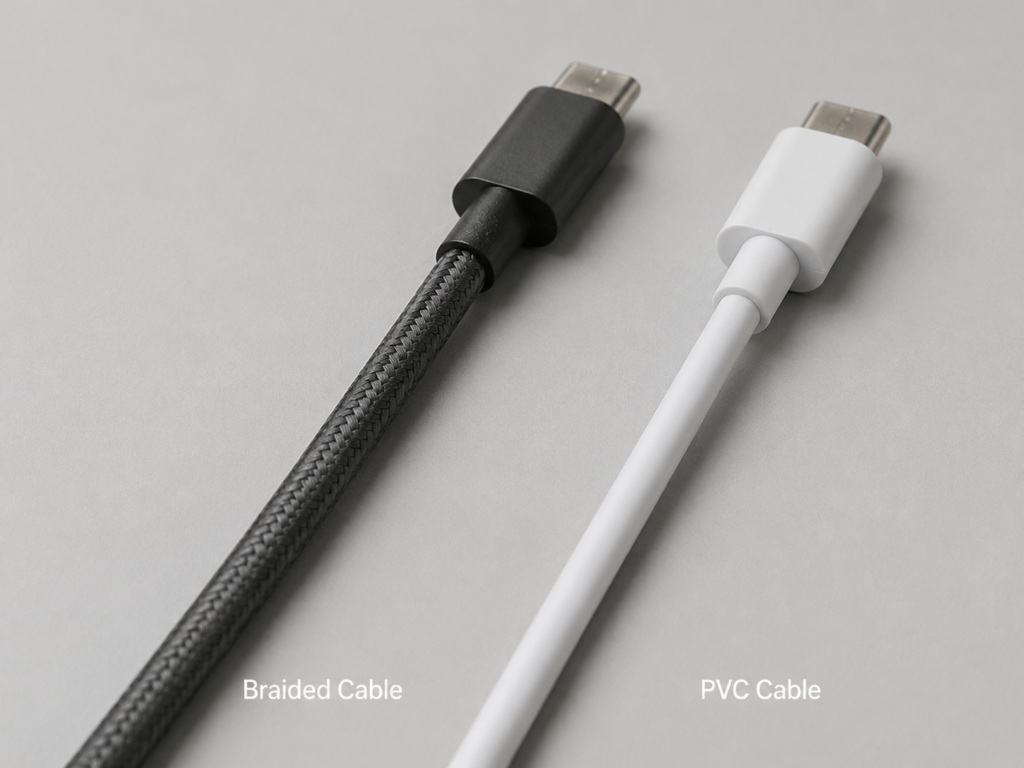
Braided cables are not entirely made of braided material. Their inner layer usually still has a soft inner jacket such as PVC, TPE, or TPU. The outer braid is mainly responsible for dispersing friction, improving wear resistance and appearance texture; PVC cables can also be made very wear-resistant, very soft, or have flame-retardant, cold-resistant and other properties by adjusting the formula and increasing the thickness of the outer jacket, and are not inherently “low-end”.
This article only discusses consumer-grade civilian cables (including charging cables, data cables, peripheral cables, audio and video cables, home network cables, and some low-voltage home cables), and defaults to comparing the experience differences of outer jackets under the premise of the same brand/same level, same interface, same cable length, and same internal specifications; industrial special cables, fire-resistant cables, military/medical cables, high-temperature silicone cables, power engineering cables with mandatory standards and other products with special specifications are not within the scope of this article.
Cable Structure Disassembly: What Does the Outer Jacket Affect?
To understand the function of the outer jacket, you must first know the structure of an ordinary cable from the inside out:
- Conductor core: Usually copper, tinned copper, or alloy copper, it is the core for transmitting electricity and signals, determining resistance, heat generation, current-carrying capacity, and signal loss.
- Insulation layer: A thin layer wrapping each conductor to prevent short circuits between cores. Common materials include PE, PP, PVC, FEP, etc.
- Inner jacket/filling layer: A structure that fixes multiple conductor cores, making the cable body neater, and affecting flexibility and tensile resistance.
- Shielding layer: Usually aluminum foil, copper mesh, tinned copper braided mesh plus ground wire, used to resist external electromagnetic interference and make signals more stable.
- Outer jacket layer: The outermost layer we can touch (braided or PVC), which directly contacts the outside world, mainly affecting wear resistance, hand feel, cleaning, appearance, and partial environmental adaptability.
- Connector and strain relief: The place where the cable connects to the plug, and the tapered soft rubber section behind the plug (strain relief). This is the most easily damaged part of the entire cable, and its impact on actual service life is often higher than that of the outer jacket material.
Typical Structure of Braided Cables
Braided cables are not entirely braided: the inner layer is usually still a soft rubber jacket such as PVC, TPE, or TPU, with a layer of fiber mesh woven on the outside. The main function of this fiber mesh is to disperse surface friction, prevent scratches and resist wear, and at the same time improve appearance texture.
But if the end of the braided layer (near the connector) is not fixed by pressing, heat shrinking, or rubber coating, it will easily fuzz and fray after long-term use. The quality of braided cables varies greatly: braiding density, fiber material, number of strands, braiding tightness, and inner jacket thickness all affect the actual service life.
Typical Structure of PVC Cables
PVC outer jackets can be divided into many types such as ordinary soft PVC, cold-resistant PVC, flame-retardant PVC, wear-resistant modified PVC, low-smoke low-halogen PVC, etc.: basic PVC cables have a single layer of ordinary soft PVC outer jacket directly wrapping the inner wire set, with low cost and very mature processing technology; mid-to-high-end PVC cables will improve different performances by adjusting the formula, adding plasticizers, flame retardants, cold-resistant agents, wear-resistant agents, or doing surface matte treatment. Higher-end ones will also use multi-layer co-extrusion technology, thickened jackets, and internal filling to improve hand feel and durability.
It should be noted that PVC essentially contains chlorine, even low-smoke low-halogen PVC is not a halogen-free material; the commonly heard LSZH (Low Smoke Zero Halogen) outer jacket, simply put, is a material that produces less smoke when burned and does not release chlorine-containing harmful gases, usually made of polyolefin, not PVC, and the two should not be confused.
The quality of PVC cables also varies greatly: whether it is new or recycled material, the quality of plasticizers, outer jacket thickness, flame retardant grade, and processing stability will all make the service life of products also called “PVC cables” differ by several times.
Core Basic Understanding
By now you should have clarified several key judgments:
- Whether the cable body is wear-resistant mainly depends on the outer jacket; whether the connector will break mainly depends on the strain relief and stress buffer design.
- Charging speed mainly depends on the thickness of the conductor core, interface specifications, protocol support, E-Marker chip (simply put, an identification chip that can tell the charger how much power to output), and compatibility between the device and the charger, and is not determined solely by the outer jacket.
- Data transmission speed mainly depends on standards such as USB, HDMI, Thunderbolt, network cable categories, and internal structure, and is not determined solely by the outer jacket.
- Anti-interference ability is mainly determined by the internal metal shielding layer, and you cannot just look at whether there is fiber braiding on the outer layer.
- Safety mainly depends on rated parameters, conductor cross-sectional area, temperature rise, flame retardant grade, and authoritative certification, and you cannot just look at whether the appearance is high-end.
Daily Experience Comparison: Durability, Hand Feel, Storage and Cleaning
Starting from the real scenarios of daily cable use, we compare the experience differences between the two. Each conclusion will explain the premise and reversal situations to avoid absolutization.
Wear and Scratch Resistance
The wear resistance mentioned here refers to the speed at which the outer jacket is damaged after the cable body is dragged against table corners, sundries in the bag, on the ground, or after repeated friction.
Under normal circumstances, high-quality nylon or PET braided cables are more scratch-resistant than ordinary soft PVC cables, and are less prone to surface peeling or whitening. For example, if you put a charging cable in your backpack every day, rubbing against keys, power banks, and cosmetics, the braided cable may still be intact after half a year, while the ordinary PVC cable may have been fuzzed or even peeled.
But this conclusion is not absolute: if it is a cheap braided cable with very low density and loose weaving, its wear resistance may not be as good as thickened wear-resistant PVC, or PVC cable with matte wear-resistant coating. Moreover, the wear test conditions of different brands vary greatly (friction materials, pressure, speed are all different), so you can’t just look at numbers like “10,000 times of wear resistance” said by merchants.
If the cable is fixed on the bedside or desk and hardly moves, the difference in wear resistance between braided and PVC is almost imperceptible.
Bending and Tensile Life
Bending life refers to whether the cable will have core breakage, cracking, or poor contact after repeated bending, pulling, and winding.
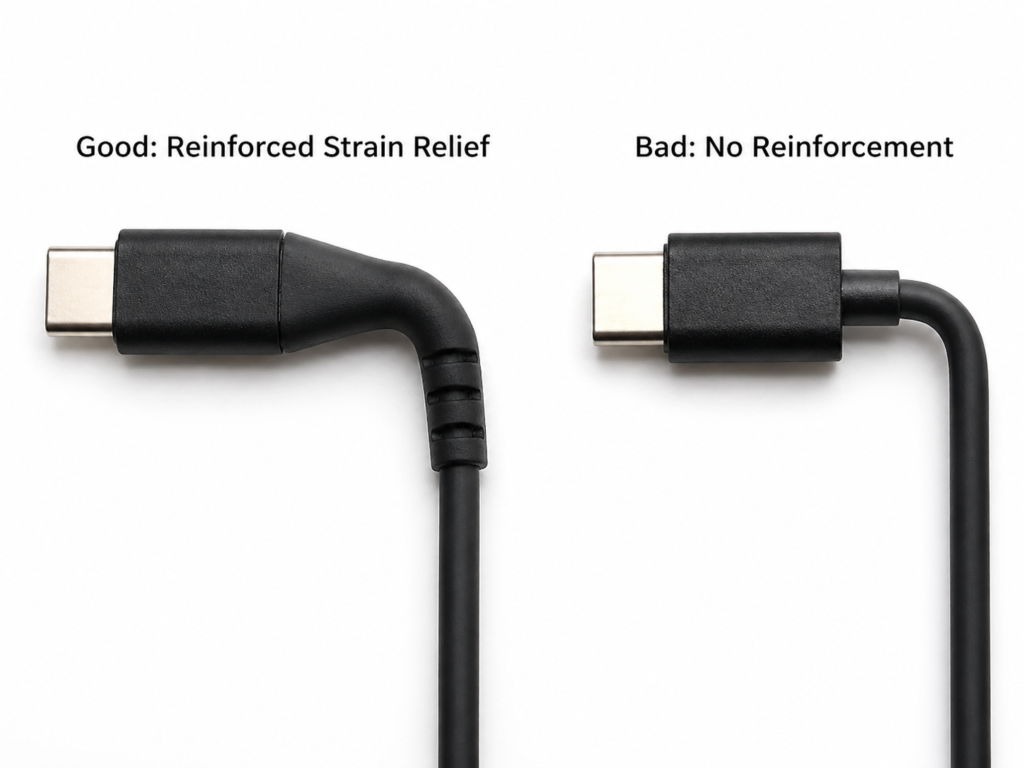
Generally speaking, high-quality braided cables with extended and reinforced strain relief are more tensile-resistant and more resistant to daily rough use than ordinary PVC cables—after all, there is an extra layer of fiber mesh on the outside, which can disperse part of the tensile force.
But bending life definitely does not only depend on the outer jacket: whether the conductor core is stranded with multiple fine copper wires, how fine the copper wires are, whether the inner jacket is soft, the length of the strain relief, and the injection molding quality of the connector all have a great impact. Take a counterexample: a high-flex PVC cable has a 2-3 cm tapered strain relief at the connector, the cable body is soft, and the stress can be dispersed when bending; while another braided cable has no strain relief, the cable body is as hard as a stick, and every bend is concentrated at the root of the connector. Then it won’t take long for the connector of the braided cable to break the core, making it less durable than the PVC cable.
Common misconception: A thicker cable body does not mean stronger bending resistance. If the cable body is too hard, all the force during bending is concentrated at the connection between the connector and the cable body, making it easier to break instead.
Appearance and Hand Feel
Braided cables are characterized by obvious texture, strong sense of quality, not easy to leave fingerprints, and look more delicate, so many cables that focus on appearance and desk setup use braided outer jackets. In terms of hand feel, braided cables are generally stiffer and have a certain weight.
PVC cables are characterized by a smoother surface, soft and smooth touch, and easier to achieve color and transparent effects. For example, many transparent cables are made of PVC or TPE. In terms of hand feel, PVC cables are softer and have better drape.
Of course, this difference is not absolute: the hand feel of ultra-fine braided cables and high-elastic PVC cables will be very close.
Selection suggestions: If you care about desktop matching and want a durable texture, it’s no problem to choose braided; but for scenarios like mouse cables that require frequent movement and the least resistance possible, be cautious about choosing braided cables that are too thick or too hard, otherwise there will be an obvious pulling feeling when dragging, which will affect the user experience instead.
Anti-Tangle and Storage
Braided cables are not easy to form tight knots when naturally rolled up because they are stiff, which is their advantage; but because they usually have a thicker diameter and higher weight, they take up more storage space and occupy more space in the bag.
The advantages of PVC cables are light, thin, and soft, suitable for short cables, spare cables, or fixed use in a certain place; but ordinary round PVC cables crumpled into a ball in the bag are easy to tangle, and it takes a long time to untangle.
Reversal situation: Flat PVC cables, cables with magnetic storage, or high-elastic soft rubber cables may have better anti-tangle performance than ordinary round braided cables.
Cleaning and Stain Resistance
PVC has a very obvious advantage in this regard: because the surface of PVC is dense plastic, dust, drinks, and oil generally stay on the surface, and can be wiped clean with a damp cloth or suitable cleaner.
The fibers of braided cables have pores, which are easy to trap dust and absorb oil, especially light-colored braided cables (white, light gray, light pink, etc.). After long-term use, they are easy to turn yellow, and after being splashed with drinks or sauces, they will seep into the fibers and cannot be wiped off, looking very dirty.
Of course, there are now braided cables with waterproof and oil-proof coatings, which have better stain resistance, but the coating will slowly wear away with friction, and has a limited service life.
If used in places that are easy to get dirty, such as kitchens, children’s tables, dining tables, and near car cup holders, prioritize easy-to-wipe PVC or dark-colored braided cables.
Special Performance Comparison: Temperature, Shielding, Environmental Protection and Price
High and Low Temperature and Sun Exposure
Ordinary PVC cables will harden or even become brittle in low-temperature environments (such as winter in the north); long-term exposure to sunlight, or being baked in a car at high temperature in summer, will easily cause yellowing, cracking, stickiness, and may soften at high temperatures, accelerating aging.
The outer layer of braided cables is fiber, which generally does not peel or become sticky on the surface like ordinary PVC, but the temperature resistance of the entire cable still depends on the inner jacket, insulation layer, connector rubber material, and the certification level of the product—you cannot judge weather resistance solely by the label of “braided” or “PVC”.
If used in car sun exposure, long-term outdoor use, or in cold regions, be sure to check the temperature range marked on the product, whether weather-resistant materials are used, and the relevant tests of the brand. For example, cables with special cold-resistant PVC, TPU, silicone, or weather-resistant outer jackets may be much more reliable than ordinary consumer-grade braided cables in extreme environments.
Shielding and Anti-Interference
This is the most easily confused concept, and it must be clarified: outer fiber braiding does not provide effective electromagnetic shielding. Anti-interference ability mainly depends on the internal metal shielding structure, such as aluminum foil shielding, metal braided shielding, aluminum foil plus ground wire, aluminum foil plus metal braided double shielding, etc.
Many merchants promote “braided shielded cables”, but in fact they refer to the outer nylon braid as the shielding layer, which is a concept substitution. The real shielding braid is the internal copper mesh or tinned copper mesh, which is completely different from the outer fiber braid.
To judge whether the shielding is good, it depends on the shielding coverage, grounding method, cable standard, cable length, and interface technology, which are much more important than the type of outer jacket. For example, when buying long HDMI cables, USB high-speed cables, network cables, audio cables, if you need to route them near power cables, be sure to prioritize the internal shielding structure and standard certification, and don’t be misled by the claim of “braided shielding”.
Environmental Protection and Combustion Risk
PVC is characterized by containing chlorine, which may release irritating or harmful gases when burned; however, PVC with different formulas has great differences in flame retardancy, smoke density, and toxicity. Some PVC can achieve low smoke, low halogen, and flame retardancy, but strictly speaking, it still contains chlorine and is not a halogen-free material.
The outer fibers of braided cables (such as nylon, PET) generally do not contain halogens, but braided cables are usually multi-material composite structures (fiber + inner soft rubber + metal + plastic connector), so disassembly and recycling are not necessarily easy, and it cannot be simply said to be more environmentally friendly.
Concept clarification: The commonly heard Low Smoke Zero Halogen (LSZH) material produces less smoke when burned and does not release halogen-containing harmful gases. It is mostly used for wiring in public places and does not belong to the category of PVC.
If you have high requirements for environmental protection, or wiring in public places with flame retardant requirements, be sure to check the product’s RoHS, REACH, LSZH certification, flame retardant grade, and relevant local regulations, don’t just look at whether the outer jacket is braided or PVC.
Price and Cost-Effectiveness
Under normal circumstances, for cables of the same brand, same internal specifications, and same certification, braided cables are more expensive than PVC cables. The premium mainly comes from the outer braiding material, braiding process, and appearance positioning—after all, braided cables look more delicate, and the pricing will be a little higher.
But this price difference cannot be compared across grades: for example, no-name braided cables may be much cheaper than brand-name original PVC cables, but the internal conductor core, chip, and certification are far worse, so there is no comparability at all.
Semi-professional judgment: If a braided cable just changes the outer jacket from PVC to braided, and the internal conductor core, chip, protocol, and certification are exactly the same as the PVC model, then the extra money you spend only buys better wear resistance and appearance texture, and does not mean that charging speed, transmission speed, or safety are improved.
These Performances Are Not Determined Solely by the Outer Jacket: Avoid Being Misled by Marketing
Many merchants treat braided outer jackets as a “universal selling point”, implying that the overall performance of the cable is better, but in fact, several core performances you care about most cannot be judged solely by the type of outer jacket.
Charging Speed and Power
How fast the charging is and how much power it can support mainly depend on the thickness of the copper core (measured by AWG wire gauge in the industry, the smaller the value, the thicker the copper core, the greater the current it can withstand), copper material quality, interface specifications, protocol support, E-Marker chip, and compatibility between the device and the charger.
When judging, be sure to check the clearly marked power of the product (such as 60W, 100W, 240W), supported protocols (PD, QC, etc.), and whether there are official certifications such as USB-IF and MFi.
Don’t believe vague statements like “braided fast charging cable”—braiding is just the outer jacket, which does not mean it necessarily supports fast charging; conversely, PVC cables can also support very high power. For example, many original 100W fast charging cables for laptops have PVC outer jackets.
Data Transmission Speed
Data transmission speed mainly depends on the standards that the cable complies with, such as USB 2.0/3.2/USB4, Thunderbolt, HDMI 2.0/2.1, DP versions, and categories such as Cat5e/Cat6/Cat6A for network cables.
When judging, look at the clear bandwidth and speed ratings, whether there are certification labels, cable length limits, and whether your device ports support it.
Don’t think that a thick cable or good-looking braid must support high-speed data—many cheap braided charging cables only have two power wires inside, no data core at all, can only charge, and can’t even transmit low-speed data of USB 2.0.
Heat Generation and Safety
The reasons for cable heat generation are generally too thin conductor core, too large resistance, poor connector contact, falsely marked power, or long-term high-load use.
To judge whether it is safe, for mobile phone cables, check the power certification, chip, and brand; for power cables, check the rated voltage and current, conductor cross-sectional area, flame retardant grade, and applicable safety certifications in the sales region (such as UL/ETL in North America, VDE/ENEC in the EU, CCC in China, etc. CE is a compliance self-declaration mark of the EU, not equal to a third-party authoritative safety certification).
Be sure to remember: ordinary USB charging cables must never replace home appliance power cords; if the cable is damaged, generates heat, or has poor contact, stop using it immediately, don’t make do with it, as there are safety hazards.
Scenario-Based Purchasing Suggestions
Combined with common usage scenarios, the following are more specific purchasing references:
Charging Cables for Mobile Phones/Tablets/Laptops
- High-frequency commuting, often carried in bags: choose high-quality braided cables, focus on the connector reinforcement design, as well as the marked power, protocol, and certification.
- Fixed use on bedside, desk: PVC or soft rubber cables are cost-effective, soft and easy to store.
- High-power laptop charging (100W/140W/240W): first confirm the power rating, whether there is an E-Marker chip, and whether there is USB-IF certification. Choose the outer jacket type after the hard indicators meet the standards.
Mice, Keyboards, Headphones and Gaming Peripherals
- Mouse cables: don’t blindly choose braided cables. Too hard or too thick braided cables will increase the dragging feeling, making gaming uncomfortable instead. E-sports mice are more suitable for high-flex cables, paracord cables, or soft PVC/TPE cables.
- Keyboard cables: if you care about desktop appearance and move frequently, you can choose braided cables; if fixed on the desk and not moved, PVC cables are completely sufficient.
- Headphone cables: need to balance softness, stethoscope effect, and weight. Braided cables are not necessarily more comfortable, and many high-end headphone cables use high-flex PVC or TPE.
HDMI, USB High-Speed Cables, Thunderbolt Cables and Network Cables
- Purchasing priority: standard version > cable length limit > shielding structure > connector workmanship > outer jacket type, don’t reverse the priority.
- Exposed wiring, frequent stepping, friction and movement: choose wear-resistant braided outer jacket, more durable.
- Concealed or fixed wiring: PVC or LSZH outer jackets are more common, focus on flame retardant grade, shielding structure and certification.
- Strong interference environment (near power cables, routers, motors): be sure to choose cables with clearly marked internal shielding structure, don’t just look at the outer braid.
In-Car, Outdoor and Dirty Environments
- In-car short cables: heat resistance, bending resistance and connector stability are more important. Pay attention to the temperature rating when the car is hot in summer, don’t just look at the outer jacket.
- Temporary outdoor use: braided cables have an advantage in wear resistance, but long-term sun exposure depends on the weather resistance grade, and ordinary braided cables will also age.
- Dirty environments (kitchen, dining table, children’s table): prioritize easy-to-wipe PVC cables, or dark anti-fouling braided cables.
Home Fixed Wiring and Home Appliance Power Cords
- Fixed scenarios: PVC cables have low cost, mature technology, and good flexibility, which is the most common choice.
- Power cables: must check rated voltage, current, conductor cross-sectional area, plug specifications, safety certification and flame retardant grade, never choose by appearance.
- Never use mobile phone charging cables or ordinary data cables for power supply tasks beyond the design range, such as powering high-power appliances, which is very dangerous.
Special Needs
- Mild pet chewing: braided cables are more resistant to slight friction and chewing than ordinary PVC, but they are not bite-resistant cables. Once damaged, they must be replaced immediately to avoid electric shock to pets.
- Need for quiet or low friction: PVC, TPE, silicone or high-flex cables may be more suitable than thick braided cables, and will not make noise due to friction on the desktop.
- Extreme stain resistance: prioritize dark PVC or wipeable outer jackets.
- Unified desk setup appearance: braided cables have more color and texture options, and are more decorative.
Quality Identification and Pitfall Avoidance
Knowing how to choose, you also need to know how to avoid inferior products. The following are several methods to quickly judge the quality without disassembling the cable, as well as the common pitfalls of each type of cable.
Quick Judgment Without Disassembling the Cable
- Feel the cable body: High-quality braided cables are tightly braided and not loose, there is no obvious gap when pinched, and they are not stiff; high-quality PVC cables are soft but not sticky, and have no obvious pungent odor.
- Check the connector: The longer the strain relief and the smoother the transition, the more it can disperse bending stress and reduce the probability of fracture at the root of the connector. Those with the connector almost perpendicular to the cable body and no transition will most likely not last long.
- Check the markings: Regular products will clearly mark the power, data standard, cable length, material, certification, and applicable devices on the package or cable body. Be careful of those that don’t write any parameters and only say “fast charging cable” or “high-speed cable”.
- Check the appearance: If the outer jacket has no obvious bulges, depressions, burrs, color differences, and the connector is not skewed or loose, it is a basically qualified cable.
Common Pitfalls of Braided Cables
- Sparse braiding: Large mesh, loose to the touch, easy to fuzz, and the wear resistance may not be as good as thickened PVC.
- Strong outside, weak inside: The appearance looks high-end, with braiding and metal connectors, but the internal conductor core is very thin, and the connector solder joints are poor, so it will still heat up and disconnect after long-term use.
- False shielding promotion: Referring to the outer nylon braid as a shielding layer, which actually has no anti-interference ability at all. Pay special attention when buying high-speed cables and audio-video cables.
- Too hard cable body: It looks sturdy, but in fact, the stress during bending is concentrated at the root of the connector, making it easier to break instead.
- Light colors are not stain-resistant: Light-colored braided cables such as white, light gray, and light pink are easy to turn yellow and dirty after a few months. If you mind, choose dark colors.
Common Pitfalls of PVC Cables
- Made of recycled materials: There is an obvious pungent odor when opening the package, the color is dark, the surface is uneven, it is easy to age and crack after long-term use, and harmful substances may be precipitated.
- Too thin outer jacket: It will show white or peel after a slight scratch, and has very poor tensile and wear resistance.
- Excessive plasticizer: It is abnormally soft when you first get it, even a little sticky to the touch. After long-term use, it will become sticky, hard, or have plasticizer precipitation.
- Falsely marked fast charging: The appearance looks quite thick, but the actual internal conductor core is very thin, or there is no corresponding protocol chip, so it cannot stably fast charge at high power at all.
How to Read Parameters
Many people only look at the numbers when reading parameters, but in fact the conditions behind the numbers are more important:
- AWG wire gauge: An industry standard for measuring conductor thickness. The smaller the value, the thicker the conductor, the lower the resistance, and the greater the current it can carry, but the flexibility of the entire cable may decrease.
- Bending times: Don’t just look at “10,000 bends without damage”, it should be combined with bending angle, load, bending radius and test position—the difficulty of 90-degree bending and 180-degree bending is completely different.
- Power rating: 60W, 100W, 240W, etc. should be judged in combination with the interface type and whether there is an E-Marker chip. It is not that it will definitely be achieved just because it is marked.
- Data standard: USB 3.2, HDMI 2.1, Thunderbolt 4, etc. cannot be judged by appearance, be sure to check the official rating and certification.
- Shielding structure: Aluminum foil, metal braid, double shielding, ground wire, etc. should be clearly stated in the product, don’t guess by yourself.
- Certification marks: For mobile phone cables, pay attention to USB-IF, MFi, Thunderbolt certification; for power cables, check the applicable safety certifications in the sales region, such as UL/ETL in North America, VDE/ENEC in the EU, CCC in China, etc.
Maintenance Methods and Replacement Standards
If you buy a good cable, correct maintenance can make it last longer; you must also know under what circumstances it must be replaced to avoid safety hazards.
Daily Maintenance
- Braided cables: Usually just wipe gently with a damp cloth, avoid oil seeping into the fibers for a long time, do not use strong acid or strong alkali cleaners; when unplugging, hold the plug to pull, do not grab the cable body and yank, otherwise the braided layer is easy to fuzz, and the connector is also easy to break.
- PVC cables: Can be wiped with a damp cloth or a cleaner suitable for PVC, avoid long-term sun exposure, do not approach high-temperature places (such as radiators, ovens), and do not wrap in tight knots for a long time, otherwise it is easy to crack.
- General precautions: Leave a natural bending radius when storing, do not fold into sharp bends, and do not press under table legs, chair wheels or door gaps for a long time, otherwise both the outer jacket and the internal conductor core are easily damaged.
Common Faults and Causes
- Braided cable fuzzing: Generally caused by low braiding density, poor end fixation, or long-term friction. Slight fuzzing does not affect use, and you should pay attention if severe fuzzing exposes the inner layer.
- Braided cable getting dirty: Fiber pores absorb dust, oil or drinks, more obvious on light-colored cables. You can gently brush with a soft brush and neutral cleaner, don’t soak in water to wash.
- PVC cable cracking: Generally caused by material aging, hardening at low temperature, long-term sun exposure, repeated bending, or poor quality recycled materials.
- Connector disconnection: Mostly related to strain relief design, solder joint quality, connector injection molding process, and frequent pulling during use, not just a problem with the outer jacket.
Situations That Require Immediate Replacement
If any of the following situations occur, don’t make do with it, replace immediately:
- The outer jacket is damaged, exposing the internal insulation layer, metal shielding layer or conductor.
- During charging or transmission, the cable body or connector obviously heats up, has a burnt smell, or frequently disconnects intermittently and has poor contact.
- The connector is deformed, the metal part is exposed, the plugging is loose, or there are ablation marks.
- Abnormal temperature rise occurs when used with high-power devices (such as laptops, high-power appliances), stop using immediately and replace with compliant cables.
Finally: Four-Step Purchasing Method for Clearer Cable Selection
We have condensed all the content into a simple four-step purchasing method. Buy cables in this order in the future, and you are less likely to choose the wrong one:
- Step 1: Determine the purpose. First figure out what you are buying this cable for: charging, data transmission, audio and video, network, peripherals, or power cord? The core requirements for different uses are completely different.
- Step 2: Determine hard specifications. Confirm the power, transmission standard, cable length, interface type, certification, and compatibility with devices. These are hard indicators. If they are not met, no matter how good the outer jacket looks, it is useless.
- Step 3: Determine the scenario. Think about how you usually use it: will it be frequently moved, rubbed, bent? Will it get dirty often? Are there high temperature, low temperature, or sun exposure situations?
- Step 4: Determine the outer jacket. Choose braided if you need wear resistance, anti-tangle, and good appearance; choose PVC if you need lightness, softness, easy wiping, and limited budget.
Situations to Prioritize Braided Cables
- Often placed in bags, cars, or dragged on the desktop, easily rubbed by sundries.
- Care about appearance texture, anti-tangle and cable body wear resistance.
- Used as exposed wiring, needing more scratch resistance and more resistance to daily rough use.
Note: Even if you choose braided cables, you must first confirm the power, data standard, connector reinforcement and internal quality, don’t just look at the outer jacket.
Situations to Prioritize PVC Cables
- Fixed use, limited budget, needing multiple spares.
- Need for softness, lightness, easy wiping.
- The use environment is easy to get stained with oil, drinks or dust.
- For home power cords and fixed wiring scenarios, prioritize electrical parameters and certification, and PVC is a very cost-effective choice.
In the final analysis, the core of cables is to transmit electricity and signals, and the outer jacket is just a shell that protects the internal structure and improves the user experience. Next time you buy a cable, don’t be fooled by the marketing labels of “braided = high-end” and “PVC = low-end”. First choose the right purpose and hard specifications, then pick the outer jacket according to your own usage scenario, which is the most cost-effective and practical choice.