
1. Overview of Apple Fast Charging
1.1 Definition and Core Metrics of Fast Charging
Fast charging reduces full-charge time by increasing charging power, measured in watts (W). Higher power generally means faster charging in theory. Beyond power, heat generation, battery wear and accessory compatibility are also key factors for charging experience.
1.2 Technical Goals: Balance of Speed, Efficiency and Safety
Unlike the industry’s pure pursuit of higher power, Apple does not prioritize extreme charging speed. Its core goal is to strike an optimal balance among charging speed, energy efficiency, device safety and battery lifespan, and ensures long-term reliability through hardware-software synergy.
2. Development History of Apple Fast Charging
2.1 The 5W Slow Charging Era and Apple 2.4A 12W Solution
Early iPhones shipped with 5W chargers for years, taking 2–3 hours to fully charge. Meanwhile, 12W chargers for iPads adopted the Apple 2.4A proprietary protocol, which charged iPhones noticeably faster and formed the prototype of Apple’s fast charging ecosystem.
2.2 Introduction of USB PD and Key Product Milestones (iPhone 8 to iPhone 15)
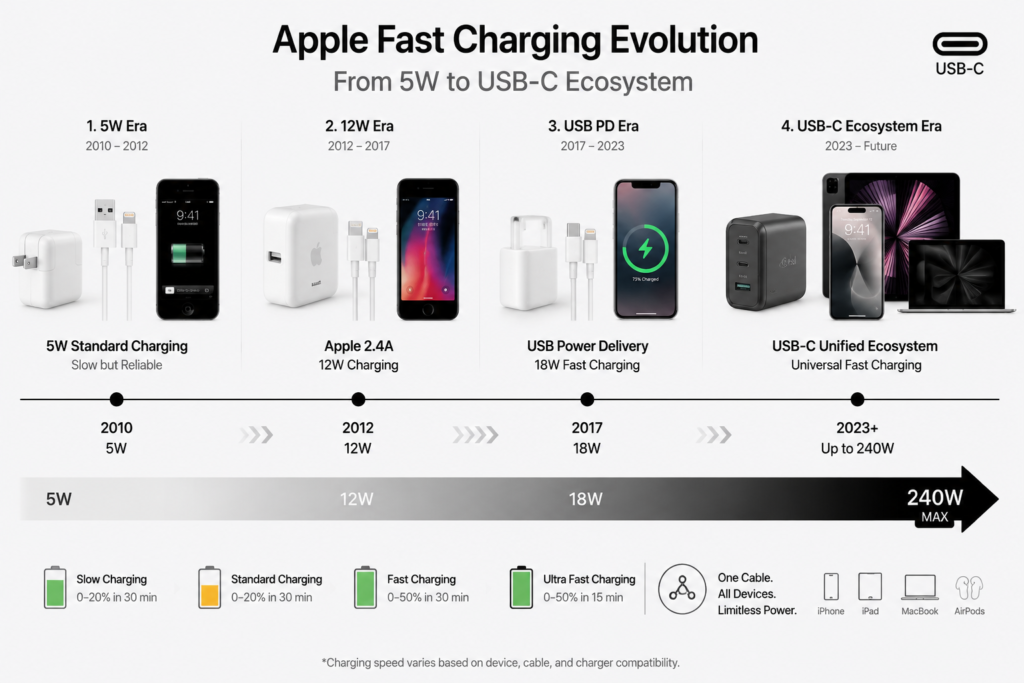
In 2017, the iPhone 8 and iPhone X first supported USB PD universal fast charging, enabling 50% charge in 30 minutes. Peak power gradually rose from 18W to around 27W in later models. In 2023, the iPhone 15 series switched fully to USB-C, enabling universal fast charging across the entire ecosystem.
2.3 Evolution of MagSafe Wireless Charging and the Qi2 Standard
The 2020 iPhone 12 launched MagSafe magnetic wireless charging, which solved alignment issues with a magnet ring and supported up to 15W power. With the rollout of the Qi2 standard, magnetic wireless charging has become a universal industry specification, and Apple’s ecosystem is deeply integrated with Qi2 for cross-brand compatibility.
3. Core Wired Fast Charging Protocols and Principles
3.1 Features and Limitations of Apple 2.4A Protocol
Apple 2.4A is an early proprietary protocol with a maximum power of 12W. It offers stable compatibility but has a low power ceiling. It has been largely replaced by USB PD and only remains for older device compatibility.
3.2 Basics of USB Power Delivery (USB PD)
USB PD is the global universal fast charging standard and the core foundation of Apple’s wired fast charging. Its biggest advantage is cross-brand compatibility — any USB PD-compliant charger can fast-charge Apple devices.
3.3 USB PD PPS Support on Apple Devices
PPS (Programmable Power Supply) is an advanced USB PD feature that fine-tunes voltage based on battery status for higher efficiency and lower heat. Latest iPhone and iPad models all support PPS for better thermal performance and charging experience with compatible chargers.
3.4 Handshake, Negotiation and Three-Stage Charging
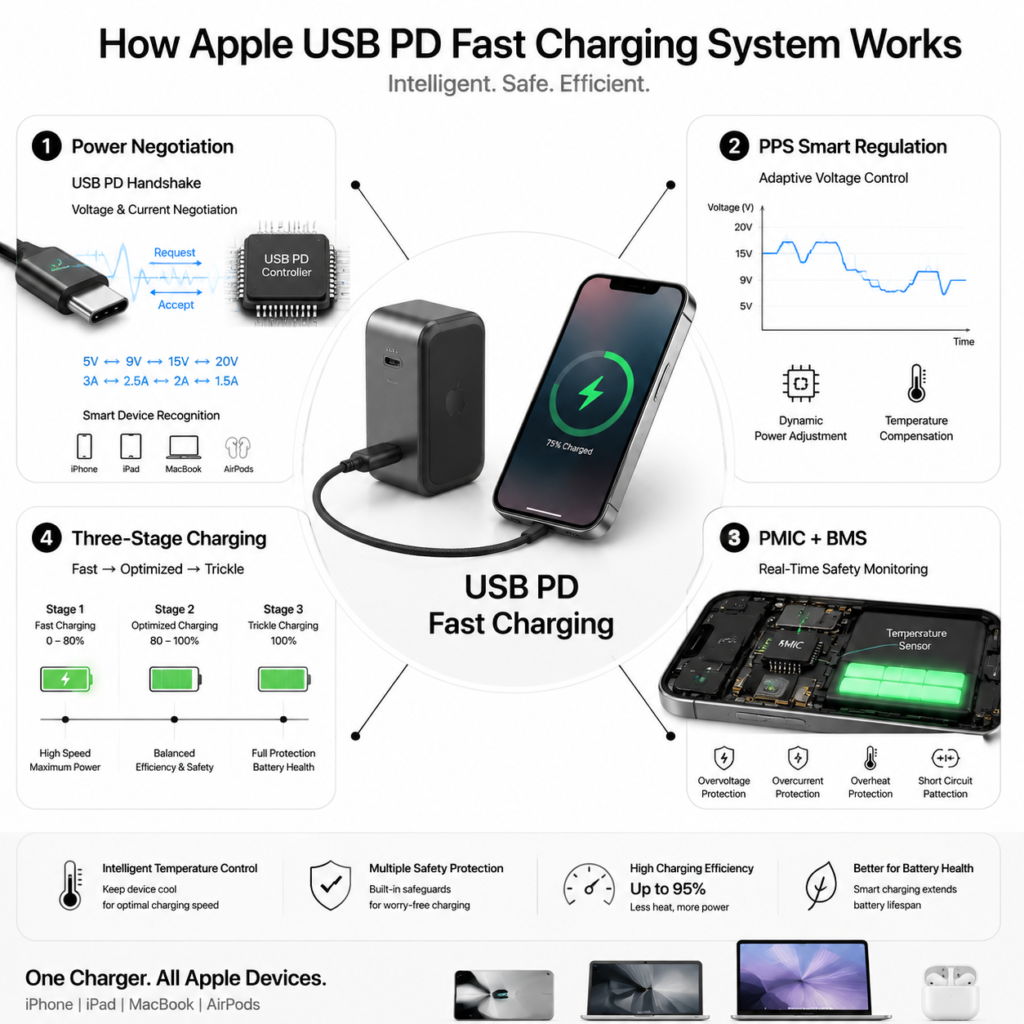
Before charging starts, the charger and device perform a “handshake” to confirm mutually supported power levels. Charging follows three phases: constant-current fast charging at low battery, reduced current at around 80% charge, and trickle charging near full capacity to protect the battery.
4. Wireless Fast Charging System
4.1 Basics of Qi Standard Wireless Charging
Qi is the global universal wireless charging standard based on electromagnetic induction. Standard Qi chargers deliver up to 7.5W to iPhones, but require precise alignment — even a small offset can slow or stop charging.
4.2 MagSafe Innovation and Conditions for 15W Charging
MagSafe adds a magnet ring around the charging coil for automatic alignment and up to 15W wireless fast charging. Only Apple-certified MagSafe accessories can deliver full 15W speed; ordinary magnetic accessories only reach standard Qi power levels.
4.3 Integration of Qi2 With Apple’s Ecosystem
The Qi2 standard incorporates MagSafe’s magnetic technology, making magnetic wireless charging a universal specification. Qi2-certified devices and accessories work across brands, and future Apple devices will fully support the Qi2 standard.
4.4 Efficiency Loss and Heat Optimization for Wireless Charging
Wireless charging inherently has more energy loss and generates more heat than wired charging. Apple uses its power management chip to monitor temperature in real time, reducing power automatically when temperatures rise to balance speed and battery safety.
5. Wired Charging Hardware and MFi Ecosystem
5.1 Official Charger Power Ratings and GaN Technology
Apple’s official chargers come in 20W, 30W, 35W, 70W and 140W variants for different devices. New high-end chargers use GaN (Gallium Nitride) technology for smaller size, lower heat and higher efficiency compared to traditional silicon-based designs.
5.2 Lightning vs. USB-C Fast Charging Specifications
Lightning is Apple’s proprietary interface with a peak fast charging limit of around 27W. USB-C is the industry universal interface that supports higher power and faster data transfer, and is now standard on all new Apple devices.
5.3 Roles of PMIC and BMS
Two core modules manage charging inside every Apple device: the PMIC regulates input voltage and current into battery-compatible power; the BMS monitors battery level, temperature and health in real time to adjust power and ensure safety.
5.4 MFi Certification and Cable Requirements
MFi (Made for iPhone/iPad) is Apple’s third-party accessory certification program. Certified cables have official-approved chips for stable fast charging and no compatibility pop-ups. Uncertified cables may fail to fast charge and even risk damaging the interface.
6. Fast Charging Specs Across Product Lines
| Product Category | Peak Wired Power | Max Wireless Power | Core Protocols |
|---|---|---|---|
| Latest iPhone Models | 20-27W | 15W (MagSafe-certified) / 7.5W (Standard Qi) | USB PD, Apple 2.4A |
| iPad Pro / iPad Air | 20-30W | Not supported | USB PD |
| MacBook Series | 30W-140W | Not supported | USB PD |
| Latest Apple Watch | — | Fast wireless charging | Apple proprietary wireless |
6.1 iPhone Fast Charging Power Evolution (iPhone 8 to Latest)
All iPhones since iPhone 8 support USB PD wired fast charging, with peak power rising from 18W to 27W. iPhone 12 and later models add MagSafe magnetic wireless charging.
6.2 iPad Fast Charging Configurations
Entry-level iPads have lower fast charging power. Mid-to-high-end models like iPad Pro and iPad Air generally support 20-30W PD fast charging, with even faster speeds when paired with higher-wattage chargers.
6.3 MacBook and Apple Watch Charging Systems
All MacBooks use USB-C and support 30W-140W PD fast charging, with chargers downward compatible with iPhones and iPads. Apple Watch has supported fast wireless charging since Series 7, reaching 80% in about 45 minutes.
7. Safety and Battery Health Management
7.1 Temperature Monitoring and Multi-Layer Safety Protection
Apple fast charging features end-to-end safety mechanisms that monitor voltage, current and battery temperature in real time. If overheating, voltage anomalies or short circuits are detected, it immediately reduces power or stops charging to eliminate risks at the hardware level.
7.2 Optimized Battery Charging and Trickle Control
iOS includes Optimized Battery Charging, which learns user charging habits via machine learning. It pauses charging at 80% and finishes topping up just before the user typically unplugs, reducing time spent at full charge and slowing battery aging.
7.3 Does Fast Charging Damage the Battery? Facts and Myths
Standard PD fast charging with certified accessories does not significantly accelerate battery aging. The real causes of battery damage are high heat, long-term full charge storage, full discharge and extreme cold. Normal use of compliant chargers has minimal impact on battery lifespan.
8. Accessory Tips, Myths and Practical Advice
8.1 How to Choose Chargers and Cables
For chargers, choose reputable brands with USB PD support. 20W or higher is sufficient for iPhones — higher wattage will not damage the phone nor charge it faster. Lightning devices require MFi-certified cables; USB-C devices work with standard cables from reputable brands.
8.2 Third-Party Accessories: Compatibility, Risks and Identification
Certified third-party accessories deliver similar stability and performance to official ones. Uncertified counterfeits may fail to fast charge, cause frequent pop-ups, or even lead to overheating and short circuits. Look for MFi and Qi2 marks on packaging when purchasing.
8.3 Common Fast Charging Myths Debunked
Claims like “high-wattage chargers break phones”, “only original chargers can fast charge” and “using the phone while charging always damages the battery” are all myths. Phones control input power themselves, genuine third-party PD chargers work at full speed, and light use while charging causes no noticeable damage.
8.4 Healthy Charging Habits and Troubleshooting
Battery care tips: keep battery between 20% and 80%, avoid draining completely; remove thick cases while charging for better heat dissipation; keep Optimized Battery Charging enabled; avoid prolonged charging in hot environments. If fast charging fails, check cable certification, charger protocol and interface dust first.
9. Apple Fast Charging vs. Industry Alternatives
| Comparison Dimension | Apple Solution | Mainstream Android Solution |
|---|---|---|
| Core Technical Route | Universal USB PD | Proprietary brand protocols (PD compatible) |
| Peak Phone Power | 20-27W | 65W to 240W |
| Accessory Compatibility | High, works with all PD chargers | Low, full speed requires original/matching accessories |
| Core Priority | Safety, battery lifespan, ecosystem versatility | Charging speed, extreme fast-charge experience |
9.1 Core Technical Differences From Android
Most Android brands use self-developed proprietary protocols with high voltage or high current, many reaching 50% charge in under 10 minutes. Apple sticks to the universal USB PD standard, focusing on ecosystem compatibility and long-term stability rather than peak power.
9.2 Public vs. Proprietary Protocol Ecosystems
Proprietary fast charging requires original same-brand accessories for full speed and has poor cross-brand compatibility. Public protocols like USB PD work across brands and devices, with one charger powering phones, tablets and laptops.
9.3 Differences in Balancing Speed, Heat and Battery Life
Apple prioritizes battery lifespan and safety, strictly controlling temperature via algorithms and trading some speed for long-term health. Android focuses on charging speed experience, while reducing lifespan impact through improved battery materials and cooling technology.
10. Future Outlook of Apple Fast Charging
10.1 Wired Power Growth and USB PD 3.1 Prospects
With the popularization of USB PD 3.1, the ceiling for wired fast charging power will rise. Future iPhones are expected to see steady gains in wired charging power, shortening charge times while maintaining thermal safety and battery health.
10.2 Wireless Charging Efficiency Improvements and New Form Factors
The rollout of Qi2 will drive adoption of magnetic wireless charging. Future wireless charging will see higher efficiency and power, plus more integrated solutions for desktop and in-car scenarios for more seamless charging.
10.3 Ecosystem Changes With Unified USB-C
After Apple’s full product line switches to USB-C, charging accessories are unified across phones, tablets and laptops. Users no longer need multiple chargers, reducing costs and greatly improving the versatility and convenience of the fast charging ecosystem.
10.4 Potential Impact of Solid-State Batteries and New Technologies
Battery materials are the core bottleneck for fast charging capability. If technologies like solid-state batteries reach mass production, batteries will withstand much higher charging power, bringing leaps in speed, safety and lifespan, and opening new room for Apple’s fast charging innovation.