
A beginner‑friendly tech deep‑dive for WordPress bloggers and everyday users
Introduction: What’s Really Behind the Fast Charging You Use Every Day?
Imagine this: you wake up with your phone at 5% battery. You plug it in while brushing your teeth – just 15 minutes later, you grab it with over 50% charge and head out the door. This isn’t sci‑fi; it’s the everyday reality of Qualcomm’s QC4/4+ fast charging.
But here’s the catch: a phone with a QC4‑capable chip doesn’t always support QC4 charging. Flagships like the Xiaomi Mi 6 and Samsung Galaxy S8, both powered by the Snapdragon 835, never got QC4 support. Why? This article breaks it all down in plain English – no engineering degree required.
1. Technology Background & Positioning: Where Did QC4 Come From?
1.1 Release Timeline
| Version | Announcement Date | First Companion Chip |
|---|---|---|
| QC4 | November 2016 | Snapdragon 835 |
| QC4+ | June 2017 | Snapdragon 835 (first phone: Nubia Z17) |
QC4 and QC4+ were released just 6 months apart. Think of QC4 as the “early prototype” and QC4+ as the “fully polished final version” with all the fixes and extras.
1.2 Key Changes from QC3.0
If QC3.0 were a two‑lane country road, QC4/4+ would be an eight‑lane highway – not just wider, but with a completely different traffic management system.
| Comparison | QC3.0 | QC4/4+ |
|---|---|---|
| Port type | MicroUSB / Type‑C | Type‑C only |
| Charging architecture | Single‑lane | Dual‑lane parallel (optional on QC4, mandatory on QC4+) |
| Speed gain over QC3.0 | — | 20% faster |
| Efficiency gain | — | Up to 30% higher |
| Voltage step | 200mV increments | 20mV increments |
💡 For beginners: The two biggest changes in QC4 are – new socket (Type‑C) and two “water pipes” charging at once (dual‑charge).
2. Core Technologies: What Makes QC4/4+ So Special?
2.1 INOV 3.0 – Intelligent Voltage Negotiation (Like a Smart Thermostat)
INOV stands for “Intelligent Negotiation for Optimum Voltage”.
Think of it this way: QC3.0’s voltage adjustment was like an old‑fashioned air conditioner – either on or off, with big jumps (200mV per step). QC4’s INOV 3.0 is like a modern inverter AC – it can fine‑tune voltage in 20mV steps, delivering exactly what the battery needs in real time.
Real‑world benefits:
- Finer voltage control → less wasted heat
- Real‑time thermal management – the system picks the optimal power level based on current temperature
- Charging temperatures are up to 5°C lower than QC3.0
2.2 Dual‑Lane Parallel Charging – Two Hoses Filling the Pool
This is the biggest hardware upgrade in QC4/4+.
Analogy: Single‑lane charging is like filling a swimming pool with one garden hose; dual‑lane is like using two hoses at the same time – it’s faster, and each hose works under less pressure, so there’s less stress on the system.
| Feature | QC4 | QC4+ |
|---|---|---|
| Dual‑charge | Optional (manufacturer decides) | Mandatory |
| Smart thermal balancing | No | Yes |
| Charging speed | Baseline | ~15% faster than QC4 |
| Charging temperature | 5°C cooler than QC3.0 | Another 3°C cooler than QC4 |
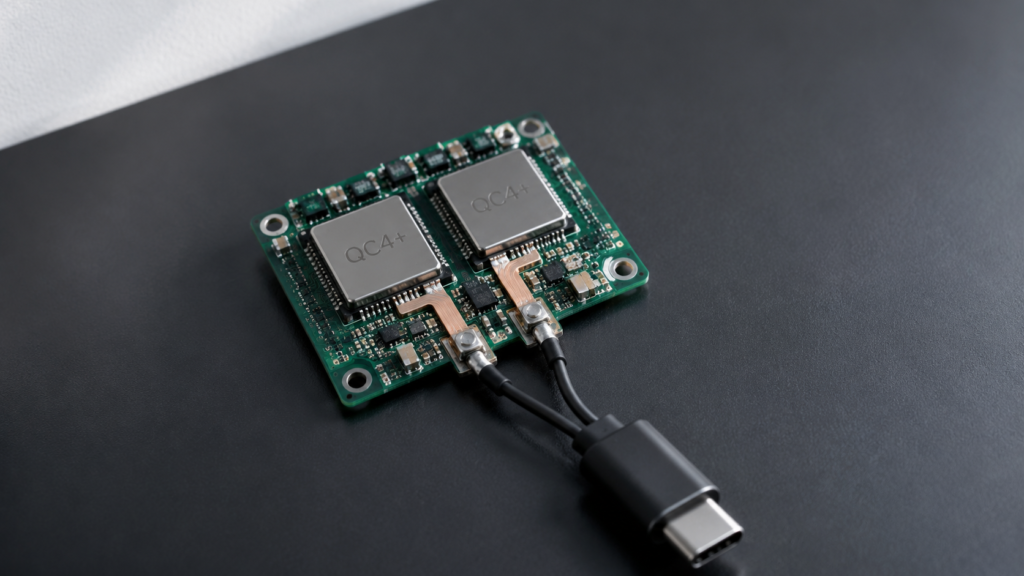
What is “smart thermal balancing”? The system has two charging ICs working together – it automatically routes more current through the cooler path, just like you’d instinctively choose the cooler shower head on a hot day.
2.3 Full Thermal Management & Underlying Protocols
QC4+ is compatible with USB‑PD 3.0 and PPS (Programmable Power Supply).
💡 For beginners: PPS is like a smart power manager that can adjust on the fly – voltage in 20mV steps, current in 50mA steps. The charger and phone can “talk” to each other constantly, tweaking parameters second by second.
Safety protections in QC4/4+ include:
- Three‑level current protection + four‑level voltage protection
- Real‑time monitoring of over‑voltage, over‑current, over‑temperature, and short circuits
- Hardware‑based battery authentication (QC4+ only) – can detect non‑genuine batteries and automatically limit power
3. Compatibility & Standards: One Charger for Everything
3.1 USB‑PD Universal Compatibility
This is arguably the most groundbreaking change in the QC4 family.
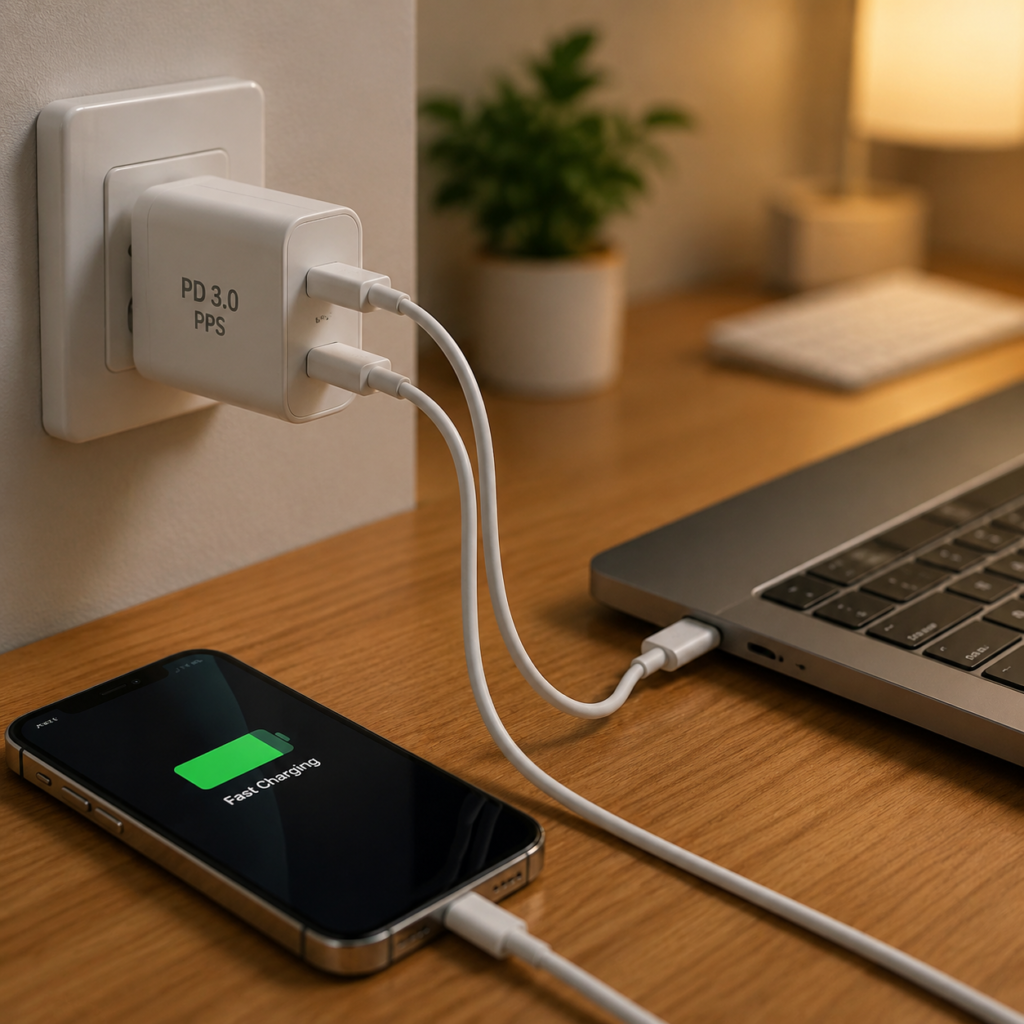
Older QC versions used proprietary protocols – you had to use a Qualcomm‑specific charger to get fast charging. QC4 natively supports USB‑PD, and QC4+ is fully compatible with USB‑PD 3.0/PPS.
What this means for you: You can charge your QC4/4+ phone with your laptop’s PD charger, and you can use a QC4/4+ charger to top up a PD‑compatible laptop in a pinch. One charger to rule them all.
3.2 Backward Compatibility
| Compatibility | QC4 | QC4+ |
|---|---|---|
| QC2.0/3.0 | ❌ Not supported | ✅ Supported |
| Standard 5V slow charging | ✅ Supported | ✅ Supported |
| USB‑PD 2.0 | ✅ Supported | ✅ Supported |
| USB‑PD 3.0/PPS | ❌ | ✅ Supported |
⚠️ Beginner warning: QC4/4+ only works with USB Type‑C ports. Old MicroUSB devices cannot trigger this fast charge. To get QC4+, you need all three: a Type‑C phone + a Type‑C charger + a Type‑C cable.
4. Performance & Safety: How Fast? How Safe?
4.1 Real‑World Charging Speeds
| Metric | Data |
|---|---|
| 15‑minute charge | Over 50% battery |
| 5‑minute charge | 5 hours of extra usage |
| QC4 peak power | ~22‑28W (typical: 5V/3A, 9V/3A) |
| QC4+ standard power | ~28W (9V/3A) |
| QC4+ custom power | Some manufacturers push to 45W (non‑standard) |
💡 Note: 45W is a custom implementation by certain brands – not a universal QC4+ spec. It’s like car manufacturers offering different engine tunes for the same model.
4.2 Multi‑Layer Safety Mechanisms
QC4/4+ are “armoured” with safety features:
- Full‑time monitoring of over‑voltage, over‑current, over‑temperature, and short circuits
- Battery health tracking – measures internal resistance and health status to adjust the charging curve dynamically
- Cable quality detection – identifies cable type and quality
- QC4+ adds – simultaneous temperature monitoring on both the phone and the charger
5. Devices: Why Doesn’t Your Snapdragon 835 Phone Support QC4?
5.1 Hardware Requirements
To support QC4/4+, you need all of the following:
- Chip: Snapdragon 835 or newer
- Power management IC: SMB1380/SMB1381 (or equivalent)
- Licensing key: Qualcomm must authorise the feature
- Manufacturer decision: The final on/off switch is entirely up to the phone maker
5.2 Real‑World Examples (Must‑Read for Beginners)
This is where it gets confusing:
| Device | Chip | QC4/4+ Support? |
|---|---|---|
| Xiaomi Mi 6 | Snapdragon 835 | ❌ No |
| Samsung S8 | Snapdragon 835 | ❌ No |
| Sony XZ Premium | Snapdragon 835 | ❌ No |
| Nubia Z17 | Snapdragon 835 | ✅ Yes (first QC4+ phone) |
| Razer Phone | Snapdragon 835 | ✅ Yes (the only device officially listed by Qualcomm) |
⚠️ Key takeaway: Chip support ≠ phone support. It’s like your PC’s CPU might support Wi‑Fi 6, but if the motherboard lacks the Wi‑Fi 6 card, you can’t use it.
Qualcomm once published an official list of QC4/4+‑compatible devices – it contained exactly one phone: the Razer Phone. Even the Nubia Z17, which debuted QC4+, was never officially listed.
6. QC4 vs QC4+ – Quick Reference (Cheat Sheet for Beginners)
| Aspect | QC4 | QC4+ |
|---|---|---|
| Release | Nov 2016 | June 2017 |
| Positioning | Basic transitional version | Fully enhanced version |
| Peak power | 22‑28W | 28W standard (up to 45W custom) |
| Dual‑charge | Optional | Mandatory |
| USB‑PD | PD 2.0 | PD 3.0 + PPS |
| QC2.0/3.0 backward | ❌ | ✅ |
| Battery authentication | ❌ | ✅ |
| Smart thermal balancing | ❌ | ✅ |
| Speed | Baseline | ~15% faster than QC4 |
One‑sentence summary:
- QC4 = made the leap from proprietary to open, but wasn’t fully baked
- QC4+ = the “complete package” – everything QC4 should have been
7. Industry Impact: Why QC4/4+ Matters
7.1 Breaking Down the Wall Between Proprietary and Open Standards
Before QC4, Qualcomm’s fast charging was a closed proprietary system – if you bought a QC3.0 phone, you’d better buy a QC3.0 charger, or you wouldn’t get fast charging.
The QC4 family was the first to bridge Qualcomm’s private protocol with the open USB‑PD standard. It’s like Apple finally swapping Lightning for USB‑C – late to the party, but heading in the right direction.
7.2 Paving the Way for QC5
The dual‑charge architecture, INOV algorithms, and PPS support in QC4/4+ laid the hardware and software foundation for 100W‑class QC5 with dual‑pump technology. Without QC4’s groundwork, the even faster and safer chargers we see today wouldn’t exist.
Final Thoughts
The story of QC4 and QC4+ teaches us one important lesson: a standard on paper is one thing; real‑world implementation is another.
For a phone to actually use QC4+ fast charging, you need:
- Qualcomm to provide the chip and license ✅
- The phone manufacturer to invest in hardware design and certification ❓
- You to buy the right charger and cable ❓
All three links must be present. So next time you shop for a phone, don’t just look at “Snapdragon 8xx” – ask the seller: “Does this phone actually support QC4+?” – it’ll save you from a lot of disappointment.