
1. Introduction: Getting to Know USB PD 3.1
1.1 What Is USB PD 3.1?
USB PD 3.1 is the next-generation USB Type-C power delivery standard officially released by the USB Implementers Forum (USB-IF) in 2021. Its core mission is to break the long-standing 100W power limit of traditional USB power delivery, and build a unified power system that works for smartphones, tablets, laptops, peripherals, and even small home appliances — making the Type-C interface suitable for far more than just low-power devices.
1.2 Why Should Everyday Users Care About PD 3.1?
Understanding PD 3.1 matters for your daily tech use, for three key reasons:
First, it is the industry trend. Today, thin-and-light laptops, desktop monitors, and docking stations are all shifting to Type-C “one-cable” solutions, where a single cable handles power, data, and video output. High-power PD has become the mainstream standard for desktop setups.
Second, policy is pushing adoption. The EU’s common charger mandate has accelerated global standardization of consumer electronics ports, and Type-C with PD fast charging is becoming the universal rule across the industry.
Third, it saves you from bad purchases. Many people run into issues like incompatible chargers and cables, slow charging that never hits advertised speeds, or even worries about damaging devices with the wrong accessories. Understanding the basics of PD 3.1 helps you avoid most buying mistakes and get what you actually need.
2. A Brief History of USB PD Standards
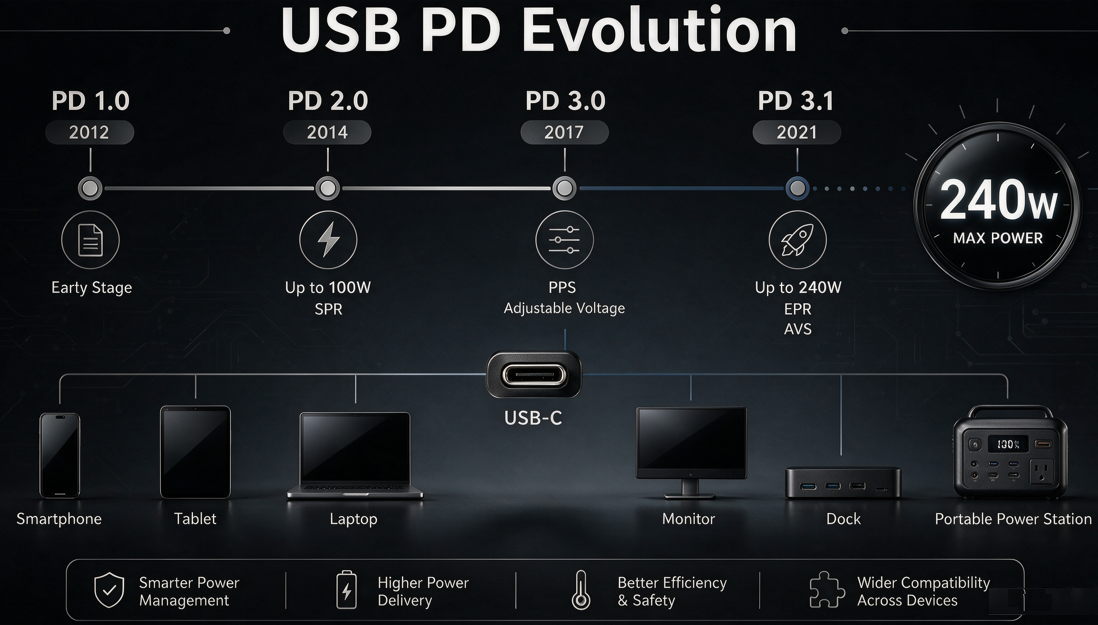
The USB PD standard has evolved steadily, with each generation raising power limits and improving compatibility. Here is a simple timeline to track its progress:
- PD 1.0 (2012): The first generation of USB power delivery protocol. Its architecture was still immature, and it never saw widespread consumer adoption.
- PD 2.0 (2014): The foundation of modern PD fast charging. It introduced the Standard Power Range (SPR) with four fixed voltage levels — 5V, 9V, 15V, and 20V — topping out at 100W. This remains the core standard for most PD devices today.
- PD 3.0 (2017): Built on PD 2.0, it added Programmable Power Supply (PPS) functionality, which supports fine-grained voltage adjustments. This made PD compatible with more smartphone fast charging protocols, greatly expanding its real-world use.
- PD 3.1 (2021): It is not a replacement for older standards. Instead, it maintains full backward compatibility with all previous PD versions, while adding the Extended Power Range (EPR) system, pushing the maximum USB power limit up to 240W.
3. How PD 3.1 Compares to Other Fast Charging Standards
There are many fast charging standards on the market, and it can be hard to tell them apart. Here is a straightforward comparison.
3.1 PD 3.1 vs. PD 3.0 / PPS
The core difference lies in the voltage system:
PD 3.0 only includes the Standard Power Range (SPR), topping out at 100W for low-voltage charging.
PD 3.1 keeps all the low-voltage levels and PPS features of PD 3.0, and adds three high-voltage levels under the EPR system for up to 240W. It works with every older PD device, while also supporting new high-power hardware.
3.2 Compared to Other Public Fast Charging Protocols
Besides PD, there are other public charging standards like Qualcomm Quick Charge, MediaTek Pump Express, and Huawei FCP. Most of these are designed mainly for smartphones and work with a limited set of devices.
PD, by contrast, is the most universal public power standard available. It works with everything from earbuds and phones to laptops and home appliances, and it is the standard backed by global regulatory efforts.
3.3 Compared to Proprietary Smartphone Fast Charging
Many Chinese smartphone brands now offer 100W+ proprietary fast charging systems. These deliver very high peak speeds, but almost always require the brand’s own official charger and cable to reach full performance.
Nearly all modern smartphones support basic PD fast charging. While it will not match the peak speed of a proprietary system, it works perfectly for everyday use. With a single PD charger, you can charge phones, tablets, and laptops from different brands — a level of versatility no proprietary standard can match.
4. Core Specifications of PD 3.1
You do not need to memorize complex formulas. These key specs will give you a clear picture of what PD 3.1 can do.
Maximum Power
PD 3.1 delivers up to 240W of power, at 48V and 5A. That is a 140% increase over traditional 100W PD, enough to power almost any high-power consumer electronics device.
Voltage Adjustment Features
PD 3.1 keeps two voltage adjustment systems, each built for different use cases:
- PPS for Standard Power Range: Supports fine 20mV voltage steps across 3.3V to 21V, ideal for precise charging on smartphones and other low-power devices.
- AVS for Extended Power Range: An EPR-exclusive technology that supports 100mV voltage steps across 15V to 48V, built for high-power laptops and other devices with fluctuating power demands.
Voltage Levels
PD 3.1 uses two separate voltage systems:
- SPR (Standard Power Range): Includes 5V, 9V, 15V, and 20V fixed levels, with a maximum of 100W. This is the set of levels most people encounter every day.
- EPR (Extended Power Range): Adds three new fixed high-voltage levels — 28V, 36V, and 48V — plus dynamic voltage adjustment between 15V and 48V, for up to 240W total power.
Typical Use Cases
- SPR levels: For smartphones, tablets, wireless earbuds, small peripherals, and other everyday electronics.
- EPR levels: For high-end gaming laptops, mobile workstations, portable power stations, small desktop appliances, and professional peripherals.
5. How the PD 3.1 Protocol Works
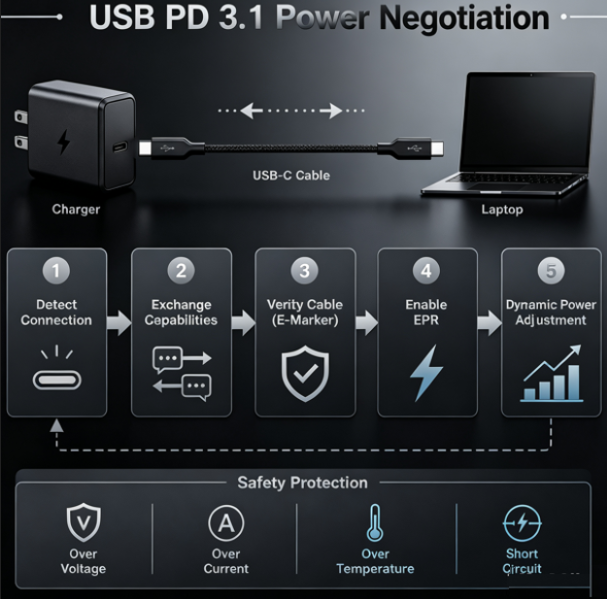
PD does not just blast full power the moment you plug in a cable. It follows a full “negotiate, confirm, deliver” process, which is why it is so safe and reliable.
5.1 Physical Connection and Role Detection
When you plug in a Type-C cable, dedicated pins inside the interface first run basic checks: they automatically detect the cable’s orientation, and identify the role of each device — whether it is a power source (like a charger), a power-consuming device (like a phone), or a dual-role device that can both send and receive power.
5.2 SPR Basic Power Negotiation
After basic detection, the power source and the device share lists of their supported power levels, find the highest level both support, and agree on a standard power mode. This mode caps out at 100W.
5.3 EPR High-Voltage Negotiation
If the device needs EPR high-voltage power, an extra verification step takes place. The power source and device first confirm that both support EPR, then read parameters from the cable’s built-in chip to make sure the cable can handle the required voltage and current. High-voltage power only turns on if all three parties match and approve.
5.4 Dynamic Voltage Adjustment and Smart Power Delivery
Power does not stay fixed during charging. The device sends requests to the power source based on its real-time workload, adjusting voltage and current on the fly. For example, a laptop will draw more power under heavy load, and less when idle or asleep — balancing efficiency and safety.
5.5 Power Cut and Reset Protection
If an abnormality occurs during charging — such as a short circuit, overheating, or voltage/current exceeding safe limits — the system immediately cuts power to prevent damage. Once the issue is resolved, it restarts the negotiation process to restore power.
6. Key Technologies Behind PD 3.1
Two core technologies make PD 3.1’s high power and strong safety possible.
AVS Adjustable Voltage Supply
AVS is the core technology exclusive to the EPR system. It allows fine voltage adjustment in 100mV steps across a wide 15V to 48V range.
This lets the power source precisely match the real-time power needs of high-power laptops, avoiding wasted energy from “overpowering” a device. It also creates more stable power delivery that can handle shifts in a device’s workload.
Safety Verification System
PD 3.1 does not rely on encrypted authentication for safety. Instead, it uses a three-way data verification system: the output capability of the power source, the voltage/current rating of the cable, and the power needs of the device — all three must match before power is delivered at that level.
This system prevents dangerous situations like an underrated cable carrying too much power, and it is the foundation of PD’s safety record.
Four Layers of Hardware Protection
On top of protocol-level verification, PD 3.1 includes four hardware-level protections: over-voltage protection, over-current protection, over-temperature protection, and short-circuit protection. These physical safeguards block nearly all electrical risks, making everyday use very safe.
7.Regular PD Cables vs. EPR 240W Cables
Many shoppers overlook cables, but they are the key to actually reaching high power levels.
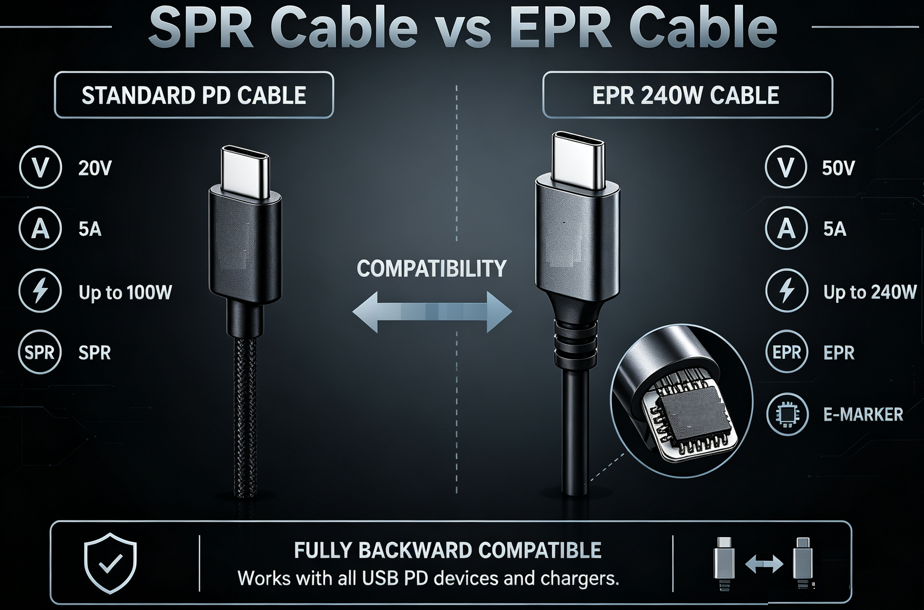
Standard 5A PD Cables
These are the traditional PD fast charging cables most people own. They are rated for 20V, support up to 100W SPR power, and cannot carry EPR high-voltage power. Using one with a high-power device will result in slower, limited charging speeds.
Note: Not all SPR cables require the E-Marker chip, but SPR cables that support 100W fast charging (i.e., 5A cables) must have it.
EPR 240W Cables
These are cables built for PD 3.1 EPR. They have a 50V voltage rating and support up to 240W power delivery. Inside the cable is an E-Marker chip that stores the cable’s voltage rating, current capacity, length, and certification details. Devices can read this information to decide whether high-voltage power is safe to use.
Clearing Up a Common Misconception
Many people worry: “Will charging my old phone or device with a 240W EPR cable damage it with high voltage?”
This is a myth. EPR cables are fully backward compatible with all PD devices. The charging voltage is negotiated between your device and the charger — older devices will only request the low voltage levels they support. The cable simply carries whatever power is agreed upon, it never forces high voltage on its own. Charging a phone or earbuds with a 240W cable is completely safe.
8. Common Use Cases and Power Requirements
PD 3.1 covers more use cases than you might think, with different power levels matching different types of devices.
8.1 Laptops of All Kinds
- Thin-and-light / business laptops: Most draw 65W to 100W, which works perfectly with the traditional 20V SPR level. This is the most common PD charging scenario today.
- High-end gaming laptops / mobile workstations: Can draw 180W to 240W under full load, requiring 48V EPR power. As PD 3.1 spreads, gaming laptops will be able to replace bulky proprietary power bricks with a single Type-C cable.
8.2 Peripherals and Expansion Devices
High-end docking stations, desktop hubs, high-speed external drives, and professional video capture cards used to require separate power adapters. With PD 3.1 power delivery, a single Type-C cable handles both data and power, greatly simplifying desk setups.
8.3 Home Appliances and Emerging Devices
Small desktop appliances, light power tools, and portable power stations are also starting to use PD 3.1 as their power standard. Over time, most small electronics around us will likely move to the Type-C PD power system.
9. Buying Guide: Avoid Compatibility Pitfalls
Follow these tips to avoid most common mistakes when shopping for PD accessories.
9.1 Choosing a Charger
You do not need the highest wattage just for the sake of it — buy what matches your devices. If you only have a phone, tablet, and thin-and-light laptop, a 100W PD charger is more than enough. Only step up to 140W or 240W models if you own a gaming laptop or high-power docking station.
Higher-wattage chargers work fine with lower-power devices; they automatically adjust to the right level and will not cause damage. They do cost more, though, so there is no reason to pay for power you will never use.
9.2 Choosing the Right Cable
To get full 240W EPR performance, a cable must meet two requirements: it must have a built-in E-Marker chip, and it must clearly state support for EPR 240W and 50V voltage rating.
Stick to reputable brands, and check the product specifications carefully to avoid cheap cables with fake or inflated ratings. Cable gauge also matters — overly long or thin cables may not deliver full power.
9.3 Compatibility Rules
PD 3.1 compatibility follows two simple rules:
- High-power accessories work safely with low-power devices. The device will automatically request the right low-voltage level, with no safety risk.
- Low-power accessories work with high-power devices, but only at the lower power limit. They will not damage the device, but you will not get top charging speed. In short: using a 240W charger to charge your phone is perfectly safe, and using an old PD charger with a new device works fine, just not at peak speed.
10. Summary and Future Outlook
10.1 What PD 3.1 Means for the Industry
PD 3.1 breaks through the low-voltage limits of USB power delivery, extending unified charging from phones and tablets all the way to laptops and small home appliances. It improves the user experience, reduces electronic waste from redundant chargers and cables, and pushes the entire consumer electronics industry toward a universal port standard.
10.2 Future Trends
Looking ahead, the universal PD power system — with high power, low energy loss, and strong safety — will gradually replace proprietary fast charging barriers across brands. In the future, cross-brand, cross-device universal charging will become the norm. Consumers will no longer need separate chargers for every device, finally delivering on the promise of “one port, one cable, for all your power needs.”