
1. Introduction: Fast Charging Enters the High-Power Era
Modern electronic devices such as high-performance laptops, gaming notebooks, and portable power stations require faster and more stable high-power charging. The USB Power Delivery (USB PD) protocol, the mainstream fast charging standard for USB-C ports, has been continuously upgraded to meet growing power demands.
Early USB PD 1.0 and 2.0 only provided fixed voltage levels with a maximum power of 100W, which was sufficient for old smartphones and basic laptops. USB PD 3.0 introduced PPS (Programmable Power Supply), enabling precise and temperature-friendly fast charging for mobile devices.
Released by the USB Implementers Forum (USB-IF) in 2021, USB PD 3.1 raised the power limit from 100W to 240W. Traditional fixed-voltage charging could no longer support such high power, causing excessive heat, large cable power loss, and low efficiency. To solve these problems, USB PD 3.1 launched a core new technology called AVS (Adjustable Voltage Supply), which has become the key to reliable high-power fast charging.
2. What Is AVS? Core Technical Specifications
2.1 Definition of AVS
AVS stands for Adjustable Voltage Supply. It is an intelligent voltage adjustment technology exclusive to the EPR (Extended Power Range) high-power mode in USB PD 3.1.
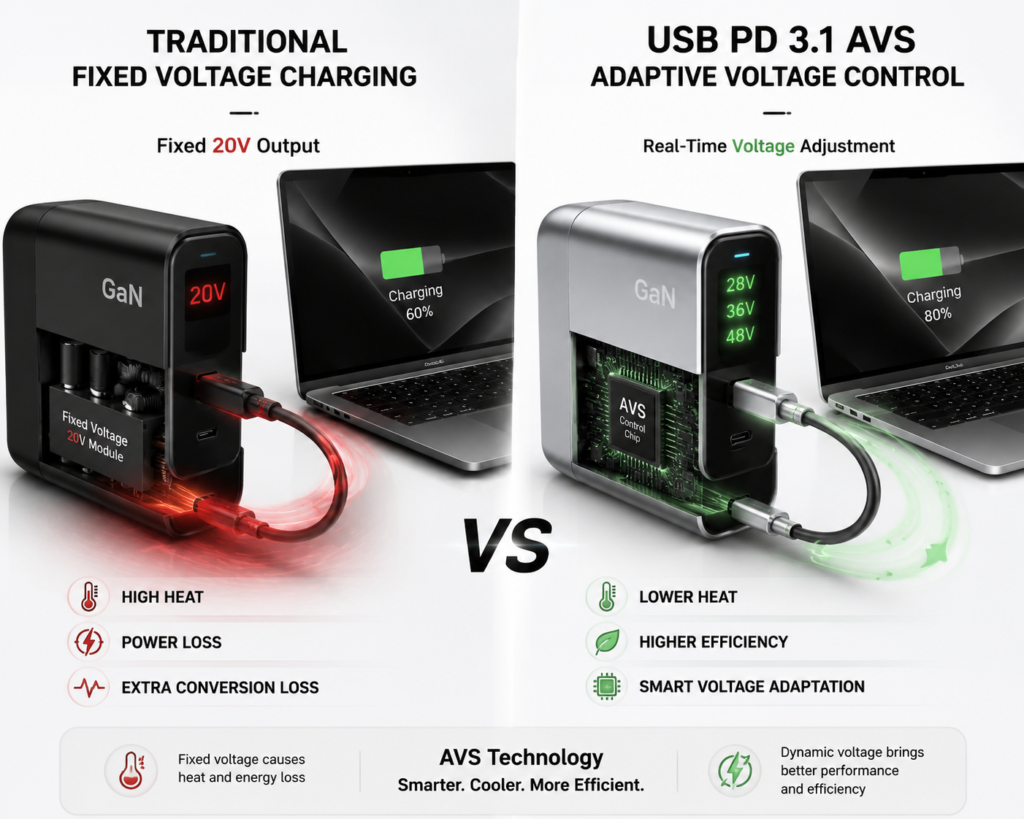
Traditional chargers only output several fixed voltage levels. In contrast, AVS chargers can dynamically fine-tune the output voltage according to the real-time needs of devices, achieving customized power supply instead of rigid fixed-gear output.
2.2 Three EPR AVS Power Levels in USB PD 3.1
Designed for devices above 100W, AVS supports 0.1V precise voltage adjustment and constant power control. The official specifications are divided into three gears to match different power requirements, as shown in the table below:
| AVS Specification Gear | Applicable Power Range | Adjustable Voltage Range | Maximum Supported Current | Core Compatible Devices |
|---|---|---|---|---|
| Gear Ⅰ AVS | 100W–140W | 15V–28V | 5A | Mainstream thin-and-light laptops |
| Gear Ⅱ AVS | 140W–180W | 15V–36V | 5A | High-performance laptops, entry-level gaming notebooks |
| Gear Ⅲ AVS | 180W–240W | 15V–48V | 5A | High-end gaming laptops, workstations, professional high-power devices |
2.3 SPR AVS Extension in USB PD 3.2
Updated in 2024, USB PD 3.2 extended AVS from high-power EPR to mid-and-low-power SPR (Standard Power Range) scenarios. The new SPR AVS supports 9V–20V voltage adjustment for 27W–100W charging, enabling smartphones and tablets to enjoy efficient, low-temperature adaptive fast charging.
3. How AVS Works: Intelligent Negotiation & Dynamic Adjustment
AVS works through automatic intelligent communication between the charger and the device.
First, the charger broadcasts its power capacity, informing the connected device of its supported voltage and power range.
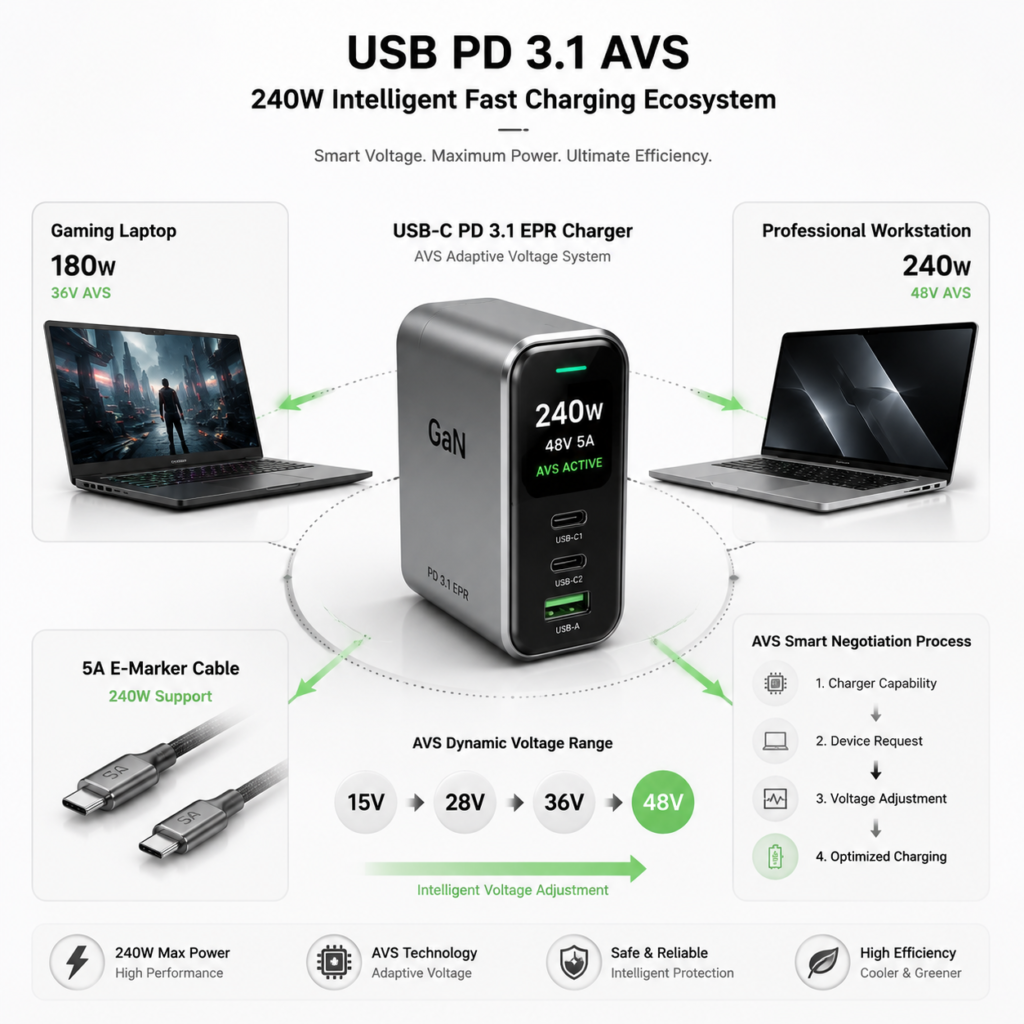
Second, according to its battery level and real-time load, the device requests the optimal voltage from the charger.
Finally, the charger verifies the request, enters AVS mode, and dynamically adjusts the output voltage. During charging, real-time optimization is maintained to ensure stable constant-power output without overheating.
4. AVS vs PPS: Core Differences and Role Division
AVS and PPS are both programmable fast charging technologies, but they serve completely different scenarios:
PPS (Programmable Power Supply): Introduced in USB PD 3.0, designed for small and medium-power devices such as phones and tablets. It features ultra-fine 0.02V voltage adjustment and precise current control, protecting phone batteries and reducing heat during daily fast charging.
AVS (Adjustable Voltage Supply): Introduced in USB PD 3.1, designed for high-power devices such as laptops. It uses 0.1V voltage adjustment and focuses on improving charging efficiency and reducing power loss rather than ultra-precise current control.
In short: PPS is for precise phone charging, while AVS is for efficient high-power laptop charging. The two technologies complement each other to cover all charging scenarios. The core differences between the two are clearly listed in the table below:
| Comparison Dimension | AVS (Adjustable Voltage Supply) | PPS (Programmable Power Supply) |
|---|---|---|
| Full Name | Adjustable Voltage Supply | Programmable Power Supply |
| Introduced Standard | USB PD 3.1 | USB PD 3.0 |
| Core Positioning | High-power efficient fast charging, focused on system voltage regulation | Medium and low-power precise fast charging, focused on battery direct charging control |
| Applicable Power Range | 100W–240W (EPR High-Power Mode) | Within 100W (SPR Standard Power Mode) |
| Voltage Adjustment Range | 15V–28V/36V/48V (three gears optional) | 3.3V–21V |
| Voltage Adjustment Step | 100mV (0.1V) | 20mV (0.02V) |
| Core Control Logic | Constant power limit, no independent current regulation | Independent current loop precise current limiting, supports current step adjustment |
| Typical Application Scenarios | High-performance laptops, gaming notebooks, mobile workstations, high-power energy storage devices | Smartphones, tablets, small and medium-sized portable devices |
| Core Advantages | Reduce high-power charging loss, reduce heat, simplify charger design | High charging accuracy, good temperature control, adapted to battery precise charging needs |
5. Advantages and Technical Challenges of AVS
5.1 Core Advantages
First, higher efficiency and lower heat. AVS matches the exact required voltage, avoiding extra power conversion inside devices and reducing charging heat.
Second, lower cable power loss. AVS increases voltage and reduces current under the same power, greatly cutting down heat and energy loss of USB-C cables during high-power charging.
Third, simpler charger design. AVS simplifies power control logic, enabling smaller, lighter, and more affordable GaN high-power chargers.
Fourth, stronger compatibility. One AVS high-power charger can adapt to various laptops and power devices, reducing the need for multiple dedicated chargers.
5.2 Technical Limitations
High voltage safety requirements: The maximum 48V high voltage imposes stricter standards for device insulation and interface protection.
Strict cable requirements: 240W AVS charging requires professional 5A E-Marker USB-C cables; ordinary cables cannot support high-power AVS mode.
Accuracy trade-off: AVS prioritizes high-power stability and efficiency, so it is less precise than PPS and cannot replace PPS for delicate battery charging of smartphones.
6. Real-World Applications and Ecosystem
AVS is not a theoretical technology but has been widely used in consumer products. Apple’s 140W USB-C power adapter is a landmark commercial product supporting PD 3.1 EPR AVS for MacBook series. Apple’s 40W dynamic charger adopts PD 3.2 SPR AVS for mobile devices. Meanwhile, mainstream third-party GaN chargers from Baseus, Ugreen and other brands fully support the AVS protocol.
Mainstream chip manufacturers have launched dedicated AVS protocol chips, further improving the compatibility and stability of civilian charging equipment.
AVS is mainly applied in two fields: consumer electronics including high-performance laptops, gaming notebooks, and outdoor power stations; professional and industrial equipment such as drones, power tools, and portable industrial control devices.
7. Certification and Standard Evolution
As an official standardized technology, AVS has strict USB-IF certification specifications to ensure charging safety and cross-device compatibility for all formal mass-produced products.
USB PD 3.1 pioneered EPR high-power AVS to fill the gap of 100W–240W fast charging. The upgraded USB PD 3.2 released in 2024 launched SPR low-power AVS, achieving full coverage from mobile phones to workstations.
8. Conclusion and Future Outlook
AVS is the core upgrade of USB PD 3.1 for the high-power fast charging era. It eliminates the shortcomings of traditional fixed-voltage charging, such as high heat, large loss, and poor compatibility. By intelligent dynamic voltage adjustment, it makes high-power charging for laptops more efficient, stable, and cooler.
In the fast-charging ecosystem, PPS undertakes precise low-power charging for mobile phones, while AVS realizes universal efficient high-power charging. With the full popularity of USB-C interfaces, the iteration of GaN charging technology, and unified global charging standards, AVS will become a mainstream fast-charging standard, making “one charger for all devices” a universal reality.