
Chapter 1 Introduction to PPS Technology
1.1 What Is Programmable Power Supply (PPS)?
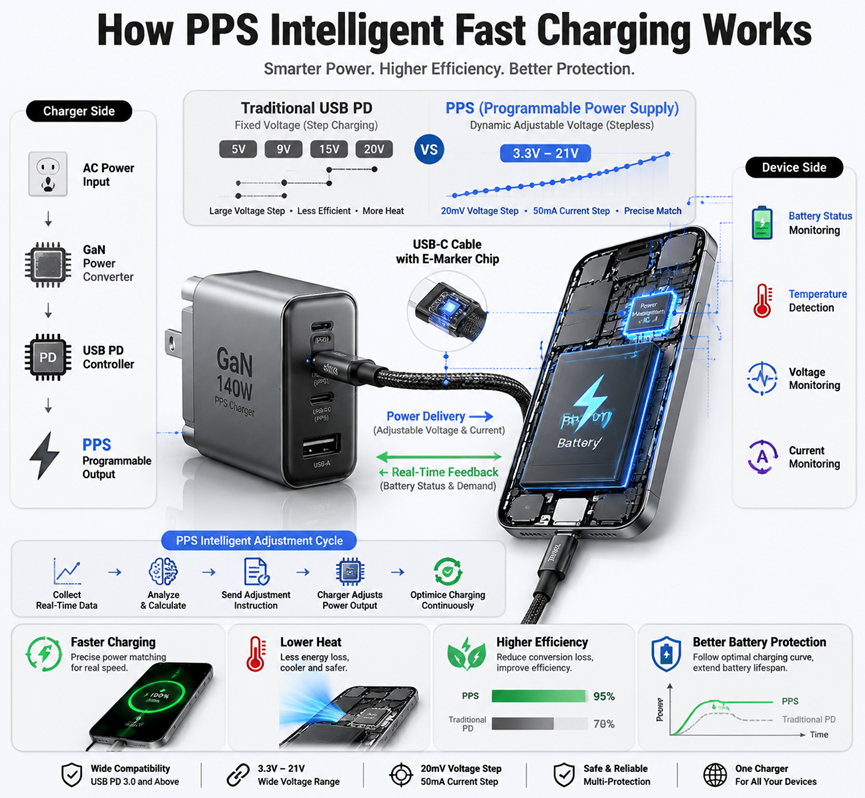
Programmable Power Supply (PPS) is an advanced intelligent fast charging technology within the mainstream USB charging ecosystem. It is not an independent charging standard, but an upgraded functional extension of the USB PD protocol. Unlike traditional fixed-power charging, PPS allows chargers to flexibly and precisely adjust charging power based on the real-time status of smartphones, tablets and other devices, delivering faster, stabler and safer charging performance.
1.2 Technical Background of PPS Development
1.2.1 Fragmentation of Early Fast Charging Standards
Before PPS fast charging gained popularity, major smartphone brands adopted proprietary private fast charging protocols with poor cross-brand compatibility. Chargers and devices from different brands could not work universally, causing user inconvenience and resource waste. The industry urgently needed a unified, efficient fast charging standard.
1.2.2 Limitations of Traditional Fixed-Gear USB PD Charging
Early USB PD fast charging only supported fixed voltage levels including 5V, 9V, 15V and 20V, with no fine-tuning capability. Fixed power output often failed to match actual battery demand; excess power was converted into heat, leading to high device temperatures, low charging efficiency and accelerated battery degradation.
1.2.3 Industry Promotion: Google & USB-IF Standardization
To resolve the chaos and defects of fragmented fast charging standards, Google unified charging specifications for the Android system. Meanwhile, USB-IF, the governing body of USB standards, officially integrated PPS programmable charging functionality into the USB PD 3.0 specification, unifying the global fast charging ecosystem.
1.3 PPS Technical Positioning in the USB PD Ecosystem
1.3.1 Relationship Between PPS and USB PD Protocol
USB PD forms the basic framework for fast charging, while PPS is an advanced extended feature of USB PD. All PPS charging falls under USB PD charging, but standard USB PD lacks the fine adjustment capability of PPS. PPS operates on the basis of the USB PD protocol and is fully compatible with the PD ecosystem.
1.4 PPS Charging Application Scope
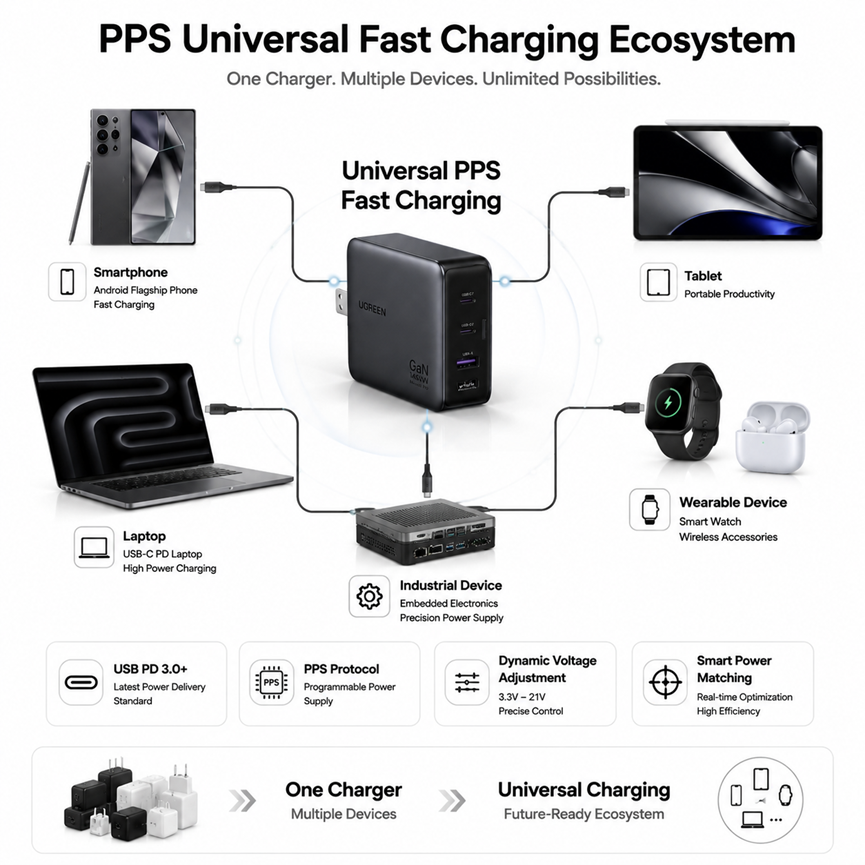
PPS is widely used in mainstream Android flagship phones, tablets, laptops and wearable devices with USB PD support. It also applies to small embedded devices and lightweight industrial power supply scenarios that require precise, stable power output.
Chapter 2 Core Technical Architecture & Hardware Requirements for PPS
2.1 Underlying Protocol Support for PPS
PPS technology is fully developed based on USB PD 3.0 and later protocol versions. It relies on APDO (Augmented Power Data Object) to realize programmable dynamic power output, breaking the limitations of fixed voltage gears and enabling continuous, precise power adjustment.
2.2 Core PPS Technical Specifications
2.2.1 Output Voltage Range
PPS supports a wide voltage range from 3.3V to 21V, covering low-voltage trickle charging and high-voltage fast charging scenarios for various devices.
2.2.2 Voltage Adjustment Step Precision
PPS delivers voltage adjustment accuracy of 20mV (0.02V), achieving near-stepless fine tuning — far more precise than traditional charging with step gaps of 1V or more.
2.2.3 Current Adjustment Step Precision
PPS supports current adjustment in 50mA steps, allowing fine control of charging current to avoid battery damage from excessive current and slow charging from insufficient current.
2.2.4 Data Interaction Frequency
During charging, the charger and device exchange data every 10 seconds. The device updates real-time battery status and power demand, and the charger synchronously adjusts output power dynamically.
2.3 Core PPS Charging Hardware Components (Three-Party Collaboration)
2.3.1 Charging Source (PPS Charger)
2.3.1.1 Core Internal Components
PPS-compatible chargers are equipped with adjustable voltage regulation modules, protocol recognition modules and data detection modules. They can receive device instructions, accurately adjust voltage and current, and monitor operating status in real time to ensure stable, safe charging. Most mainstream GaN chargers support PPS functionality.
2.3.1.2 Mainstream Control Chip Solutions
Common mainstream PPS protocol chips include TI TPS65987D, Cypress CYPD3175 and FS8025B, which form the core hardware for realizing PPS intelligent adjustment.
2.3.2 Sink Device (Charging Terminal)
Smartphones and tablets are fitted with power management ICs and battery management systems. As the “charging manager” of the device, it monitors battery status in real time, calculates optimal charging power, actively sends adjustment instructions to the charger, and dominates the entire PPS charging process.
2.3.3 Transmission Medium: E-Marker Type-C Cable
Activating PPS fast charging requires a standard Type-C cable with an E-Marker chip. Ordinary cables without this chip cannot support high-speed protocol communication and cannot trigger PPS precision fast charging mode.
2.4 Overall Architecture of PPS Charging System
The PPS charging system forms a complete closed loop. The charger converts AC power into stable DC power, outputs precise power per device instructions, transmits power through the Type-C cable, and receives real-time feedback from the device to realize dynamic adjustment throughout the charging process.
Chapter 3 How Does PPS Charging Work? Full Operating Process
3.1 Connection Detection & Role Initialization
After a Type-C cable connects the charger and device, dedicated communication pins immediately detect the connection, identify the power supply end and receiving end, initialize the communication link, and prepare for subsequent protocol negotiation.
3.2 Protocol Negotiation & Capability Broadcasting
3.2.1 Charger Power Capability Broadcasting
After successful connection, the charger broadcasts its supported voltage and current ranges, including traditional fixed PD gears and PPS programmable power ranges.
3.2.2 Device Compatibility Verification
The terminal device verifies whether the charger, cable and itself all fully support the PPS protocol, to confirm whether precision fast charging can be enabled.
3.2.3 APDO Programmable Mode Activation
If all hardware is compatible, the two sides complete the protocol handshake, exit traditional fixed-gear charging mode, activate APDO programmable power mode, and enter the PPS intelligent charging state.
3.3 Dynamic Power Adjustment (Core PPS Mechanism)
3.3.1 Real-Time Battery Status Collection
The device continuously collects battery data including remaining power, real-time voltage, temperature and internal resistance to grasp accurate charging demand.
3.3.2 Adjustment Instruction Generation
Based on real-time battery status, the device’s power management chip calculates the most suitable voltage and current, and generates precise power adjustment instructions.
3.3.3 Charger Response & Output Adjustment
The charger immediately adjusts internal conversion module parameters after receiving instructions, outputting the exact power required by the device.
3.3.4 Closed-Loop Monitoring Throughout Charging
Both the charger and device monitor charging data in real time, automatically calibrating minor fluctuations to ensure accurate, stable power output throughout the process.
3.4 Staged Intelligent Charging Optimization
3.4.1 Constant Current Charging Stage
When battery level is low, PPS outputs stable high current with fine voltage adjustment to replenish power quickly without damaging depleted batteries.
3.4.2 Constant Voltage Charging Stage
As battery level rises and voltage stabilizes, PPS gradually reduces charging current while maintaining stable voltage, balancing charging speed, power loss and heat generation.
3.4.3 Trickle Charging Stage
When the battery is nearly full, PPS greatly reduces power output and supplements charge with tiny current to avoid overcharging and overvoltage, protecting long-term battery health.
3.5 Mode Exit & Fault Protection Mechanisms
When the battery is fully charged, the device automatically exits PPS mode and the charger switches to low-voltage standby. In case of abnormalities such as over-temperature, over-voltage, over-current or short circuit, the system cuts off power immediately to ensure charging safety.
Chapter 4 PPS vs Traditional USB PD: Core Differences
To help you quickly understand the core distinctions between PPS programmable fast charging and traditional USB PD fast charging, key comparison indicators are sorted in the table below:
| Contrast Item | Traditional USB PD Fast Charging | PPS Programmable Fast Charging |
|---|---|---|
| Adjustment Mode | Jump-style fixed gear switching | Smooth continuous stepless adjustment |
| Voltage Adjustment Accuracy | ≥1V step gap, rough adjustment | 20mV (0.02V) ultra-fine adjustment |
| Current Adjustment Accuracy | Drastic change with gear switching | 50mA fine smooth adjustment |
| Control Subject | Charger-dominated, passive device adaptation | Terminal device-dominated, on-demand power supply |
| Energy Conversion Efficiency | Low, with severe secondary conversion loss | High, direct power matching reduces loss |
| Heat Control Performance | Poor, prone to overheating and speed reduction | Excellent, low temperature during fast charging |
4.1 Adjustment Mode
Traditional PD uses jump-style fixed gear switching; PPS adopts smooth, continuous stepless adjustment to fit dynamic battery changes.
4.2 Control Subject
Traditional PD is charger-dominated with fixed output and passive device adaptation; PPS is terminal device-dominated, with active power requests and on-demand power delivery.
4.3 Voltage Adjustment Accuracy
Traditional PD has voltage step gaps of over 1V with low accuracy; PPS achieves 0.02V ultra-fine adjustment for precise matching.
4.4 Current Adjustment Accuracy
Traditional PD current changes drastically with gear switching; PPS realizes smooth current adjustment with 50mA fine steps.
4.5 Energy Conversion Efficiency
Traditional PD causes severe energy loss due to power mismatch and internal secondary conversion; PPS outputs matched power directly, greatly improving energy utilization efficiency.
4.6 Heat Control Performance
Traditional PD generates excess heat from redundant power loss and easily triggers speed reduction; PPS minimizes power loss and maintains low temperatures during fast charging.
Chapter 5 Key Benefits of PPS Fast Charging Technology
5.1 Significantly Improved Charging Efficiency
PPS eliminates power mismatch losses, improves overall charging efficiency, and delivers genuine high-speed fast charging without inflated speed claims.
5.2 Enhanced Battery Health Protection
PPS aligns with the optimal battery charging curve throughout the entire process, avoids continuous impact from high voltage and high current, delays battery aging and extends battery service life.
5.3 Superior Temperature Control Performance
With precise power adjustment and low energy loss, PPS significantly reduces device heat generation, avoiding overheating and forced speed reduction during fast charging.
5.4 Broad Compatibility & Adaptability
Built on the universal USB PD standard, PPS is brand-independent. One PPS charger can adapt to smartphones, tablets, laptops and other devices, enabling universal charging for multiple devices.
5.5 Clear Cost Advantages
For users, a universal PPS charger replaces multiple private-protocol chargers to reduce purchase costs. For the industry, standardized PPS cuts independent R&D costs and promotes popularization of fast charging products.
Chapter 6 Practical PPS Charging Application Scenarios
6.1 Mobile Device Fast Charging
PPS is the core high-power fast charging technology for mainstream Android flagship phones from brands such as Xiaomi and Samsung, balancing speed, temperature control and battery protection.
6.2 Portable Smart Devices
Tablets, smart watches, Bluetooth earphones and game consoles have high requirements for charging precision. PPS’s fine voltage and current adjustment perfectly meets their low-power precise power supply needs.
6.3 Industrial & Embedded Devices
PPS provides stable, precise and adjustable power output, and is widely used in small embedded hardware, smart home devices and lightweight industrial testing equipment.
Chapter 7 Common PPS Charging Issues & Troubleshooting
If you encounter problems using PPS fast charging, you can quickly locate causes and find solutions through the troubleshooting table below:
| Abnormal Phenomenon | Possible Causes | Quick Solutions |
|---|---|---|
| PPS mode fails to activate | 1. Charger, device or cable does not support PPS2. Type-C cable lacks E-Marker chip3. Protocol negotiation failure due to poor contact | 1. Confirm all three hardware components support PPS2. Replace with a standard E-Marker Type-C cable3. Re-plug the cable and restart the device |
| Speed reduction during fast charging | 1. Battery over-temperature protection2. Reaches 80% power threshold and enters slow charging3. Normal adaptive power adjustment | 1. Cool down the device and avoid use while charging2. Normal battery protection mechanism, no action needed3. Wait for system automatic adjustment and speed recovery |
| Slight power fluctuation during charging | Normal real-time calibration of PPS system | No action needed; fluctuation adapts to latest battery status and ensures long-term charging stability |
7.1 PPS Mode Fails to Activate
7.1.1 Three-Party Hardware Incompatibility
PPS requires full compatibility across charger, device and cable. Any incompatible hardware will result in downgrade to ordinary charging mode.
7.1.2 Non-E-Marker Type-C Cable Used
Ordinary Type-C cables without E-Marker chips cannot complete PPS protocol communication and cannot activate precision fast charging.
7.1.3 Protocol Negotiation Failure
System exceptions, charger protocol faults or poor cable contact will cause handshake failure and downgrade the charging mode.
7.2 Charging Speed Drop During Fast Charging
7.2.1 Battery Over-Temperature Protection
Poor heat dissipation triggers over-temperature protection. The system actively reduces power to avoid battery damage, which is a normal protection mechanism.
7.2.2 Battery Level Threshold Triggered
When battery power reaches around 80%, the system automatically enters the slow charging stage to protect battery health.
7.2.3 Dynamic Adaptive Power Adjustment
Minor power fluctuations caused by real-time adjustment of battery internal resistance and voltage belong to normal adaptive operation.
7.3 Minor Power Fluctuation During Charging
Slight power fluctuation during charging is normal calibration behavior of PPS. The system updates parameters every 10 seconds to adapt to the latest battery status and ensure long-term charging stability.
7.4 Legacy Compatibility Issues
Older devices and chargers that only support early PD versions have incomplete adaptation to newer PPS protocols, resulting in unstable fast charging speeds — a legacy compatibility issue of earlier industry products.
Chapter 8 PPS Technology Summary & Future Development Trends
8.1 Core Principle Summary
PPS is an intelligent dynamically adaptive fast charging technology. Based on the universal USB PD protocol, it realizes real-time precise adjustment of charging voltage and current through three-party collaborative communication between charger, device and cable. It solves the pain points of high heat, low efficiency and battery damage in traditional fast charging, and delivers standardized fast charging with high speed, safety and durability.
8.2 Evolution With USB PD 3.1 & Higher Versions
8.2.1 240W Power Expansion of USB PD 3.1
The new USB PD 3.1 protocol increases maximum fast charging power from 100W to 240W, enabling PPS to adapt to high-power charging scenarios for laptops and high-performance devices.
8.2.2 PPS Role in the SPR Standard System
Within the new USB PD SPR standard system, PPS remains the core intelligent adjustment function and a key support for high-power safe and efficient charging.
8.2.3 USB PD 3.2 SPR AVS Mechanism Upgrade
The latest USB PD 3.2 upgrades the AVS intelligent voltage regulation mechanism on the basis of PPS, further improving adjustment accuracy, communication efficiency and charging safety.
8.3 Industry Popularization Trends
8.3.1 Penetration From Flagship to Mid-Range Devices
PPS is no longer exclusive to flagship phones. Mid-range and entry-level devices from major brands have gradually adopted PPS functionality, realizing comprehensive popularization of intelligent standardized fast charging.
8.3.2 Growing PPS-Certified Charger Products
Most third-party chargers on the market have completed PPS certification. The number of compatible products continues to increase, and the universal fast charging ecosystem grows increasingly mature.
8.3.3 Integration With GaN Semiconductor Technology
The combination of PPS intelligent regulation and GaN chips creates smaller, more efficient and lower-temperature chargers, becoming the mainstream development direction of fast charging products.
8.4 Future Outlook
Moving forward, PPS technology will continue to iterate alongside USB PD protocols, advancing toward higher power, higher precision and smarter temperature control. Relying on its advantages of universality, low cost and high adaptability, PPS will fully unify the consumer fast charging ecosystem, covering full scenarios including smartphones, computers, smart hardware and lightweight industrial equipment, and serve as the core foundation of future charging technology.