
1. Introduction
1.1 Background of EU Unified Charging Interface Policy
1.1.1 Long-term Fragmentation of Consumer Electronic Charging Ports
For years, consumer electronics have adopted diverse charging interfaces, including Apple Lightning, Micro USB and USB-C. Chargers from different brands and devices are incompatible with each other. Users have to prepare multiple chargers for their phones, tablets, earbuds and game consoles. Brand ecological barriers have caused great inconvenience to consumers and serious resource waste.
1.1.2 Environmental Problems Caused by Waste Chargers
Due to inconsistent interface standards, a large number of fully functional chargers are discarded with old devices, producing massive electronic waste. Repeated purchases of chargers aggravate resource consumption. To implement green development and circular economy strategies, the EU has promoted unified charging standards to reduce electronic pollution.
1.2 Development History of EU Charging Legislation
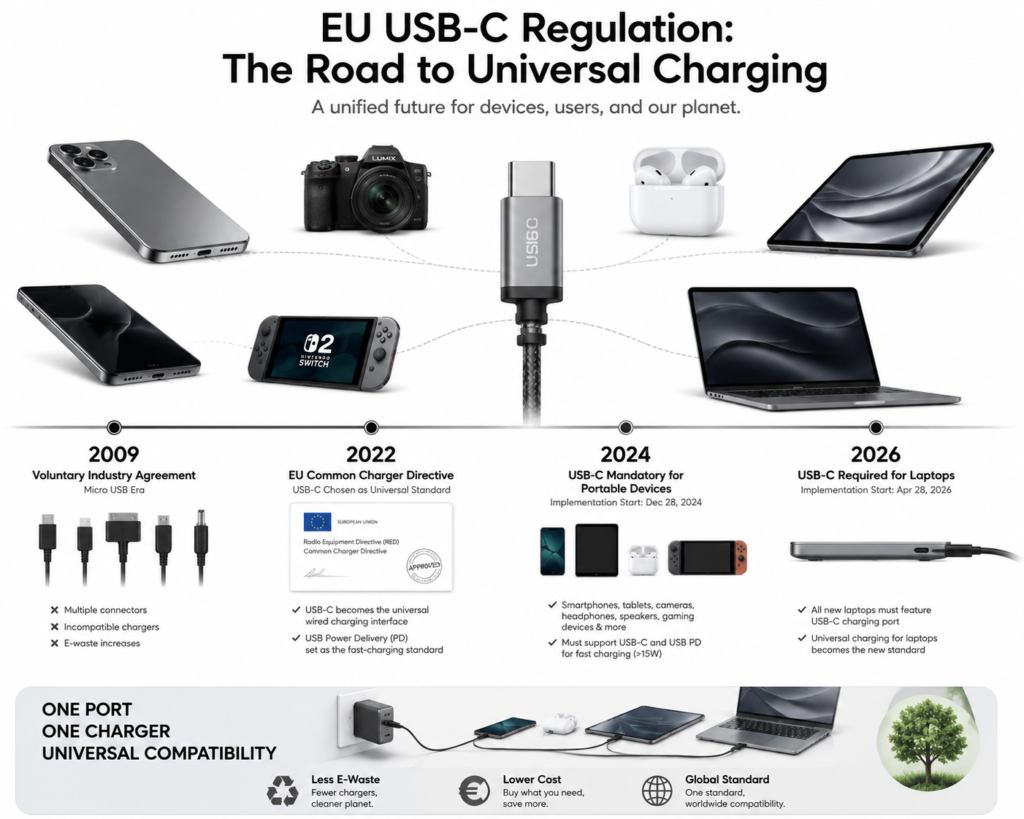
1.2.1 Voluntary Industry Unification Stage (2009–2021)
Since 2009, the EU has encouraged digital brands to sign voluntary agreements to unify charging ports. Micro USB once became the mainstream standard. However, without mandatory legal constraints, brands retained private interfaces and fast-charging protocols to maintain ecological barriers. Voluntary self-regulation failed to solve market fragmentation fundamentally.
1.2.2 Official Adoption of the Common Charger Directive (2022)
In 2022, the EU revised the Radio Equipment Directive (RED) and officially released the Common Charger Directive. The legislation formally designated USB-C as the universal wired charging interface and defined unified USB PD fast-charging standards, marking the start of mandatory industry standardization.
1.2.3 Phased Official Implementation (2024–2026)
The regulation was implemented in phases. Starting from December 28, 2024, USB-C became mandatory for most portable electronic devices. From April 28, 2026, all new laptops sold in the EU must be equipped with USB-C charging ports. The EU will continuously evaluate the policy and expand the coverage of standardized products in the future.
| Phase | Effective Date | Product Scope | Core Rule |
|---|---|---|---|
| Phase 1 | Dec 28, 2024 | Most portable electronics (phones, tablets, earbuds, cameras, etc.) | Mandatory USB-C charging port |
| Phase 2 | Apr 28, 2026 | All new laptops | Must support USB-C charging |
| Future | After 2026 | Expanding product categories | Refined PD compatibility & energy efficiency standards |
2. Core Content of the EU USB-C Regulation
2.1 USB-C as the Universal Charging Interface
2.1.1 Why USB Type-C Is Selected
USB-C is chosen for its comprehensive advantages. It supports reversible plug-in, high-speed data transmission, high-definition video output and high-power charging. With mature global industrial technology and wide compatibility, USB-C is the most suitable universal interface for all consumer electronic devices.
2.1.2 Mandatory Product Coverage
The regulation covers almost all daily consumer electronics: smartphones, tablets, digital cameras, headphones, earbuds, portable speakers, handheld game consoles, e-readers, keyboards, mice, portable navigation devices, and laptops (enforced from 2026). All new products sold in the EU market must be equipped with standard USB-C ports.
2.2 Unified Fast-Charging Protocol Rules
2.2.1 USB Power Delivery as the Universal Standard
All devices with a wired charging power exceeding 15W must support the universal USB PD protocol. Brands are prohibited from limiting or blocking fast charging from third-party compliant USB PD chargers, eliminating the long-standing restriction of only original chargers supporting full-speed charging.
2.2.2 Private Fast-Charging Protocols Are Allowed
Brands can retain their exclusive fast-charging technologies, such as Huawei SCP, OPPO SuperVOOC, vivo FlashCharge and Xiaomi HyperCharge, to provide customized high-speed charging experiences. The only requirement is full compatibility with the universal USB PD standard.
2.3 Separate Sales of Devices and Chargers
To reduce resource waste, manufacturers must provide consumers with two purchase options: devices with chargers and devices without chargers. This policy avoids repeated purchases of idle chargers, lowers consumer costs, and reduces electronic waste from the source.
2.4 New Energy Labeling Requirements
All electronic product packages in the EU must clearly mark key charging information, including whether a charger is included, maximum charging power, USB PD compatibility and official recommended charging specifications, enabling consumers to make informed purchase decisions.
| Aspect | Old Fragmented System | New Unified USB-C Rule |
|---|---|---|
| Charging Port | Mixed interfaces (Lightning, Micro USB, USB-C) | Standardized USB-C for all devices |
| Fast Charging | Brand-locked private protocols | Universal USB PD baseline + optional private protocols |
| User Experience | Multiple chargers for different devices | One charger works across all brands |
| Environmental Impact | High e-waste from redundant chargers | Reduced resource waste & electronic trash |
3. Industrial Impacts on the USB-C Supply Chain
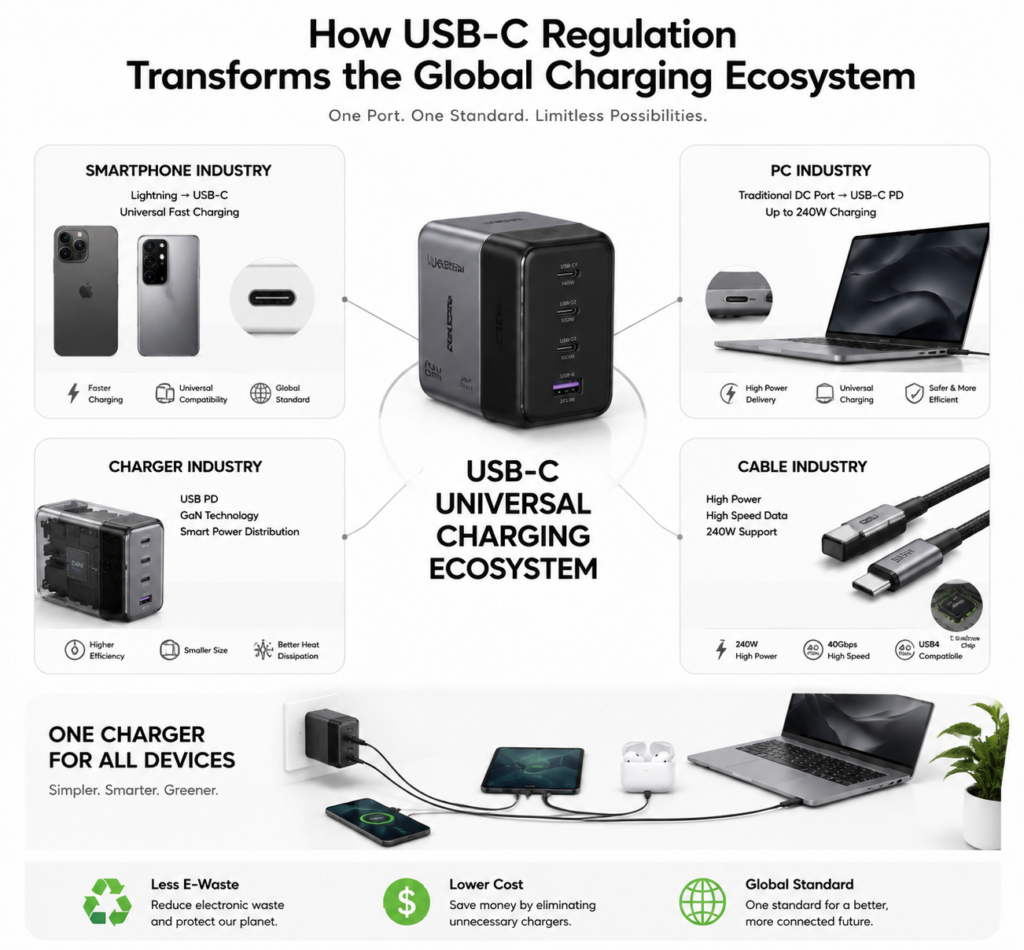
3.1 Smartphone Manufacturers
Apple has completely phased out the Lightning interface in the EU market, with all iPhone models switching to USB-C. Most Android smartphones have already adopted USB-C, requiring only minor optimization of fast-charging compatibility to comply with the new regulation.
3.2 PC Industry
After April 28, 2026, new laptops without USB-C charging ports are banned from EU sales. Traditional round power interfaces will gradually be phased out. USB-C PD fast charging will become the standard for laptops, realizing universal compatibility of chargers for mobile phones, tablets and computers.
3.3 Charger Manufacturers
The unified standard has comprehensively promoted the popularization of USB PD, GaN gallium nitride mini chargers, multi-port USB-C chargers and intelligent power distribution technology. Unified specifications greatly reduce enterprise R&D and production costs, driving chargers to develop towards high efficiency, portability and universality.
3.4 Data Cable Industry
The regulation boosts market demand for USB-C to USB-C cables, E-Marker high-power cables, 240W ultra-high-power cables and USB4 high-speed cables. The cable industry has abandoned fragmented multi-interface production and focused on standardized USB-C products with improved versatility and quality.
4. Synchronous Upgrading of Technical Standards
4.1 USB PD as the Core Fast-Charging Standard
The upgraded USB PD protocol supports 100W SPR and 240W EPR ultra-high power, covering charging requirements for all consumer electronics. The unified protocol delivers stable and safe fast-charging experiences across different brands, ending fast-charging incompatibility and speed limit issues.
4.2 Full Popularization of USB Type-C
Driven by EU regulations, USB-C has achieved the goal of “one interface, one charger for all devices”. Users can charge all portable electronics with a single USB-C charger, realizing the long-awaited universal charging solution.
4.3 Synchronous Development of USB4 Ecosystem
The widespread adoption of USB-C accelerates the development of the USB4 ecosystem. The upgraded USB-C interface integrates data transmission, video output and high-power power supply, becoming an all-in-one universal hardware platform and promoting the iteration of global digital technical standards.
5. Impacts on Ordinary Consumers
5.1 Improved User Experience
Consumers only need one USB-C charger for all daily devices, including phones, earbuds, tablets and laptops. There is no need to store multiple chargers and cables, completely solving the trouble of incompatible interfaces.
5.2 Reduced Purchase and Usage Costs
The separate sales model allows users who already have universal chargers to buy devices without chargers and save purchase costs. It also avoids unnecessary repeated purchases of exclusive chargers, reducing long-term consumer expenditure.
5.3 Enhanced Environmental Protection Value
Unified standards greatly reduce the production and abandonment of chargers and cables, cutting down electronic waste, plastic waste and carbon emissions. The policy supports circular economy and global low-carbon sustainable development.
6. New Challenges for Enterprises
6.1 Overall Product Redesign
Manufacturers need to adjust product motherboard structures, interface layouts and body designs to replace private interfaces with standard USB-C. All new products must complete re-inspection and re-certification, increasing early R&D and transformation costs.
6.2 Comprehensive Fast-Charging Compatibility Testing
Enterprises must conduct all-round compatibility tests for USB PD and PPS protocols to ensure stable fast charging with third-party universal chargers, improving cross-brand interoperability and eliminating charging speed limits and incompatibility failures.
6.3 Unified Global Market Strategy
To comply with EU regulations, global brands are unifying product specifications across Europe, America, Asia and other regions, reducing customized regional versions and optimizing the global supply chain system.
7. Global Standardization Trends
7.1 Global Spillover Effects of EU Regulations
The EU USB-C mandatory regulation has become a global benchmark for the digital industry. More countries and regions are learning from the EU’s standardization reform. USB-C is rapidly becoming the mainstream universal interface for global consumer electronics, ending long-term market fragmentation.
7.2 Future Development of Wireless Charging
Current EU regulations only apply to wired charging, with no mandatory unified standards for wireless charging. The industry will further promote the standardization of Qi2 and magnetic wireless charging technologies to solve cross-brand wireless charging incompatibility and improve the full-scene charging system.
7.3 Next-stage EU Supervision Direction
The EU will continue to evaluate policy effects, expand the product coverage of USB-C standards, refine energy efficiency and interoperability specifications for chargers and cables, and connect with external power supply ecological regulations to build a more complete and rigorous global charging standard system.
8. Conclusion
8.1 Core Industry Changes Brought by USB-C Regulation
The implementation of the EU USB-C charging regulation realizes unified wired charging interfaces and fast-charging protocols, greatly improving the compatibility of consumer electronics. It reduces electronic waste and resource waste from the source, and strongly promotes the integration of global charging standards, reshaping the entire digital industry ecosystem.
8.2 Far-reaching Impacts on the Industrial Chain
Driven by the new regulation, global electronic product designs tend to be unified, the USB PD ecosystem continues to expand, and GaN high-efficiency chargers gain widespread popularity. The USB-C interface has evolved into a core platform integrating power supply, data transmission and video output. The global digital charging industry has bid farewell to closed private ecosystems and entered a new era of openness, unification, high efficiency and environmental friendliness.