
Have you ever had this experience: when you go on a business trip with three or four devices of different brands, your bag is stuffed with a bunch of chargers and cables, yet you still often encounter the situation where “it charges as slow as a snail when plugged in”; or you see a phone advertised as fully charging in 20 minutes, buy a high-wattage third-party charger, but it can’t reach the advertised speed at all.
Most of the problems lie in the “fast charging protocol” — you may have heard terms like private fast charging, universal fast charging, USB PD, SuperVOOC, but you can’t figure out the differences between them, nor do you know which one you should choose.
This article covers from basic definitions to actual purchase, from common misconceptions to troubleshooting, to help you find a fast charging solution suitable for your devices and scenarios.
Conclusion First: How Most People Should Choose
Friends who are in a hurry can read the direct conclusion first, and the reasons will be explained in detail later:
- If you only use phones of the same brand and particularly value the extreme 10-20 minute fast charging speed: prioritize original or officially certified private fast charging kits;
- If you have multi-brand devices, travel frequently for business or leisure, and want to carry fewer chargers: prioritize universal fast charging that supports USB PD + PPS;
- The safest compromise: keep a private fast charging set for your main phone at home, and use a high-quality PD/PPS universal charger when going out or sharing with multiple devices.
| Comparison Dimension | Universal Fast Charging | Private Fast Charging |
|---|---|---|
| Compatibility Range | Cross-brand and cross-device, supports multiple types of products such as mobile phones, tablets, and laptops | Best experience only with the same brand; cross-brand use often drops to low power |
| Peak Speed | Depends on the PD/PPS levels supported by the device; tuning is relatively conservative at the same power | Easier to reach the advertised peak when using a full set of original same-brand accessories |
| Real Speed Reference | Based on the speed in the 20%-80% range, greatly affected by temperature and usage status | Same as left; tuning is usually more aggressive in the low battery stage |
| Accessory Cost | Many third-party options, wide price range, easy to buy overseas | Original/authorized accessories are more expensive; some brands have fewer channels overseas |
| Travel Convenience | Adaptable to overseas public charging, hotels, airports and other scenarios; public interfaces may not support high power | Only the original kit can achieve full speed; hard to replace if accessories are lost |
| Long-term Reusability | Can still be used when changing brands or adding new devices, long life cycle | Can only be reused when switching to a same-brand phone with compatible protocol |
First, Define the Boundaries: Comparison Scope and Core Definitions
This article compares brand-led private wired fast charging protocols and cross-brand universal wired fast charging protocols, covering daily consumer electronics such as mobile phones, tablets, thin and light laptops, power banks, car chargers, and multi-port chargers, focusing on scenarios commonly encountered by ordinary overseas users: cross-brand mixed use, business and leisure travel, shared use in home and office, and third-party accessory purchase.
Wireless fast charging (such as MagSafe, Qi2), laboratory extreme speed testing, internal circuit design of chargers, and deep principles of mobile phone battery materials are not within the scope of discussion. All comparisons are based on the premise of “regular brands, compliant accessories”; false labeling, overheating, and safety issues of inferior counterfeit accessories are not included in normal comparisons.
Universal Fast Charging: Public Charging Rules for Cross-brand Use
You can think of universal fast charging as the “Mandarin” of the charging industry: no matter what brand of device and charger, as long as both support this set of public rules, they can negotiate with each other when plugged in, and increase the charging power if the match is successful.
At present, the core standard in universal fast charging is USB PD (USB Power Delivery). USB PD is the most common universal fast charging foundation for USB-C laptops, tablets and many mobile phones, but how fast a phone can charge also depends on whether it supports PD/PPS and the specific power levels. It also has two important derivatives: one is PD PPS, which simply means that voltage and current can be fine-tuned within a certain range, and many Android phones need this function to reach higher power; the other is USB PD 3.1 EPR, which raises the maximum power to 240W, but requires the entire link of device, charger, and cable to support it, and its popularity is not high yet.
There is also the commonly heard QC (Quick Charge), a fast charging protocol led by Qualcomm, which also has strong compatibility, but it is more biased towards the mobile phone ecosystem, and does not cover all categories of devices such as laptops and tablets like USB PD, so it is not the most widely used universal standard.
The biggest feature of universal fast charging is that it is not tied to a single brand, has good backward compatibility, and one charger can charge multiple types of devices such as mobile phones, tablets, laptops, earphones, and game consoles.
Private Fast Charging: Brand-led, Authorization-controlled Fast Charging Rules
Private fast charging is more like a brand’s own “dialect code”: devices, chargers, and cables all have to pass the brand’s identity verification or authorization check, and only when the code matches can the highest power be triggered.
Common private fast charging includes OPPO’s SuperVOOC, OnePlus and realme’s VOOC series, vivo’s FlashCharge, Huawei’s SCP/SuperCharge, Xiaomi’s Surge Fast Charge/Mi Turbo Charge, and so on.
Here is a misconception to clarify: private fast charging does not mean that the technology is completely undisclosed, but that the rules are led by the brand. To achieve full speed, original or officially authorized accessories must be used. When used across brands, it usually drops to the levels of universal protocols such as PD and QC, or even reverts to the most basic 5V slow charging.
Private fast charging has distinct features: the experience is best when using a full set of same-brand accessories, and the advertised peak power is often very high, but the accessory binding is also high. Overseas users should pay special attention: private fast charging accessories of some domestic Chinese brands are relatively rare in overseas offline and e-commerce channels. If the original charger or cable is lost, it is difficult to buy a replacement that can achieve full speed.
Easily Confused Intermediate States and Boundaries
In actual use, there are many situations between the two, so there is no need for a black-and-white judgment:
The first type is dual-protocol models. Many new phones now support both private fast charging and universal fast charging. The original kit uses the peak of the private protocol, and third-party PD/PPS chargers can also trigger medium-high power universal levels, so it will not be particularly slow.
The second type is semi-open/authorized protocols. For example, QC and fast charging authorized by some brands to third parties are neither completely private nor universally used across the industry. Whether full speed can be achieved depends on the mutual recognition between devices and accessories.
The third type is UFCS (Universal Fast Charging Specification). This is a cross-brand integrated fast charging standard promoted by the Chinese market, which can improve cross-brand compatibility, but currently has very little coverage on overseas models and accessories, so it is not used as the main purchase basis for now.
In addition, the wired fast charging of iPhone and most iPads is based on USB PD, which is not a typical private wired fast charging; MagSafe belongs to the wireless ecosystem, which is not discussed in this article.
Finally, correct a common misconception: higher power does not necessarily mean private fast charging. USB PD 3.1 EPR can theoretically reach up to 240W, but it has high requirements for the entire link of chargers, cables, and devices, and its popularity is currently limited.
Why Distinguish Between the Two Types of Fast Charging
Distinguishing between the two types of fast charging directly affects the usage experience and cost efficiency:
- Experience level: using the wrong protocol may result in spending a high price on a high-wattage charger, but only getting normal fast charging or even slow charging, failing to reach the advertised speed;
- Cost level: original private fast charging accessories are usually more expensive, while universal fast charging has many third-party options, strong substitutability, and more transparent prices;
- Travel level: most USB ports in overseas public charging, hotels, and airports use universal protocols or low-power output, making it difficult to reach the peak of private fast charging;
- Long-term reuse: universal fast charging can continue to be used when changing phones, changing brands, or adding new devices, with a longer life cycle; private fast charging is only suitable for the same brand ecosystem, and changing brands is basically a waste.
Plain Language Principle: Why Fast Charging Depends on Protocols
Many people think that as long as the charger has enough power, it will charge at maximum power when plugged in, but that is not the case. The core logic of fast charging is “negotiate first, then increase speed”:
After plugging in the charger, the device and charger will first confirm the protocols supported by each other, the upper limits of voltage and current, the cable’s carrying capacity, and the temperature status. Only when all matches are successful will the power be increased to start fast charging; if the match fails, it will revert to 5V basic charging or a lower power level.
Moreover, fast charging does not run at full power all the time. The system will dynamically adjust according to battery level, temperature, usage status, and battery health, just like driving a car does not always press the accelerator; it will slow down when encountering red lights, traffic jams, or uphill roads.
Differences in Negotiation Logic Between the Two Types of Fast Charging
The core difference between the two types of fast charging lies in the negotiation process:
Universal fast charging negotiates according to public standards. As long as the device, charger, and cable meet the public voltage, current, and PPS ranges, the power can be increased without verifying the brand identity.
In addition to basic electrical capability verification, private fast charging will additionally verify whether the charger and cable are original or officially authorized by the brand. Only when all verifications pass will the highest peak power be enabled.
This is also why a phone with a private protocol plugged into a third-party PD charger is not unable to fast charge, but can only reach the second-highest level of PD/PPS, failing to reach the highest wattage advertised by the brand.
Must-know Basic Terms
Several common terms when buying accessories, you don’t need to memorize them by rote, just know the general meaning:
- Power (W): the theoretical charging capacity, the formula is power = voltage × current, the actual speed depends on the device’s receiving strategy.
- Voltage (V) and Current (A): you can think of electricity as water, voltage is water pressure, current is the size of the water flow. High voltage low current and low voltage high current can both achieve high power, but they have different effects on internal conversion of the phone, cables, and interface heating.
- Peak Power: the highest power that can be reached in a short time during charging, generally only maintained for a short period in the low battery stage, and does not represent the full-speed speed.
- Fixed Levels: such as 5V/3A, 9V/3A, 15V/3A, 20V/5A, are fixed voltage and current combinations that the charger can stably provide.
- PD PPS: Programmable Power Supply, which can fine-tune voltage and current within a certain range, more suitable for mobile phone charging needs. Many Android phones need PPS to achieve faster speeds.
- E-Marker Chip: an identification chip inside high-power USB-C cables, equivalent to the “ID card” of the cable, which will inform the device of the current/power upper limit that the cable can carry.
- USB PD 3.1 EPR: the high-power version of PD, supporting higher powers such as 140W, 180W, 240W, requiring support from the entire link of charger, cable, and device.
Don’t Be Misled by Peak Power: Real Speed Depends on Daily Range
Don’t be fooled by the “120W” “240W” peak power advertised by merchants.
More reference value for daily use is the charging time from 20% to 80%, or the charging amount in 10 minutes or 15 minutes. Almost all mobile phones will significantly slow down when the battery reaches 80%, which is a normal strategy to protect the battery and reduce heating, not a charger failure.
Charging speed is also affected by factors such as using while charging, high ambient temperature, and thick phone cases, and the system will actively slow down. Even if two phones are both labeled 100W fast charging, the actual charging time may have a significant gap due to different battery capacities, heat dissipation designs, and charging curves.
Item-by-item Comparison of Core Dimensions
The following comparisons are all based on a unified premise: regular brand compliant accessories, devices support the corresponding protocols, testing the commonly used 0-80% or 20-80% range, excluding interference factors such as inferior cables, extreme temperatures, charging while playing, multi-port simultaneous charging, and battery aging.
Note: Protocol is only one of the factors affecting charging speed. Battery capacity, heat dissipation design, charging curve, and charger quality all affect the final speed. Don’t draw conclusions just by the protocol name.
Compatibility Range Comparison
Universal fast charging has a wider compatibility range, can be used across brands and device types. Whether it’s Android phones, iPhones, tablets, laptops, power banks, or handheld consoles, as long as they support the PD protocol, they can basically be charged.
Private fast charging only has the best experience in the same brand ecosystem. When used across brands, it mostly drops to low PD/QC levels, or even 5V normal charging. Of course, there are exceptions: if the phone supports higher PD/PPS levels, the speed with a universal charger will not be bad; if the brand opens third-party authorization, there will be more options for private fast charging accessories.
Charging Speed Comparison
Under the premise of the same phone, similar power, and matching full set of accessories, private fast charging is usually more aggressive in the low battery stage and has a slightly longer peak maintenance time due to the manufacturer’s in-depth tuning.
But if the power gap is large, the result is not certain: for example, a device supporting 65W PD is definitely faster than a combination that can only trigger the 18W old private protocol.
At the high battery stage of 70%-80%, the gap between the two types of fast charging will continue to narrow. The speed from 80% to 100% is basically determined by the battery protection strategy, and has little to do with the protocol. The real speed is still subject to the 20%-80% range and actual usage status.
Comparison of Accessory Cost and Availability
There are many third-party regular brands for universal fast charging, with transparent prices, options ranging from tens to hundreds of yuan, and they are easy to buy in overseas e-commerce and offline stores.
Original or authorized private fast charging accessories are usually more expensive. For overseas users, private accessories of some domestic Chinese brands may be out of stock or have incomplete models, so it is not easy to buy replacement kits that can achieve full speed.
Of course, there are exceptions: if a complete private fast charging kit is included in the box when buying the phone, there is no need to spend extra money in the short term, but the replacement cost after loss or brand change still needs to be considered.
Cable Requirement Comparison
Cables are a key link that is easily overlooked, directly determining whether the target power can be achieved.
The cable rules for universal fast charging are clear: ordinary USB-C 3A cables support up to 60W; 100W requires a 5A C-C cable with an E-Marker chip; for PD 3.1 EPR powers such as 140W/240W, corresponding labeled EPR cables are required.
Private fast charging has stricter cable requirements. High-power solutions mostly require dedicated cables or cables with brand identification chips, and ordinary C-C cables may only trigger low power.
In addition, USB-A to USB-C cables usually do not support high-power PD/PPS, and C-C cables are preferred for high-power fast charging. Don’t judge the cable’s capability just by its thickness or interface shape; it should be based on the labeled power, current, and E-Marker/EPR markings.
Safety and Heating Comparison
Formal and compliant universal fast charging products are usually equipped with overvoltage, overcurrent, overheating, short circuit and other protections, and USB PD also reduces the risk of mismatch through a negotiation mechanism.
The safety strategy of formal private fast charging is usually more complete. Brands will do a full set of custom safety verifications on the charger, cable, and mobile phone end, and the original kit has stronger adaptability.
Many people think that “private fast charging generates more heat” or “universal fast charging damages the battery”, but both are wrong. Heating is mainly determined by power level, battery status, conversion efficiency, ambient temperature, and heat dissipation design, and has no direct relationship with whether it is private or universal.
Some private fast charging uses a low-voltage high-current solution, which can reduce the heat generated by voltage conversion inside the phone, but the current in the cable and interface is higher, so it is more dependent on dedicated cables and good contact quality.
Whether private or universal, inferior uncertified accessories are the biggest risk. False power labeling, overheating, and charging interruption are minor issues, and severe cases may even have safety hazards.
Long-term Reusability Comparison
Universal fast charging has better reusability. Whether you change your phone, change brands, or add a tablet or laptop later, you can continue to use it, with a very long life cycle.
Private fast charging can only be used on devices of the same brand with compatible protocols. If you switch to another brand, the high-power private charger you bought before can basically only be used as a normal slow charger.
Therefore, public charging areas in homes or offices are more suitable for universal fast charging, which can be used by anyone, no need to fight for the original charger; private fast charging is suitable for placing on a personal desk to charge the main phone quickly.
Real Scenario Adaptation: Which Type to Choose for Different Situations
The following gives specific selection suggestions for common scenarios of overseas users:
Single Brand Single Device, Pursuing Extreme Fast Charging Speed
If you only use phones of the same brand from start to finish, and particularly value 10-20 minute fast charging, for example, you often find the battery dead before going out and need to charge quickly, prioritize private fast charging.
But note: you must use original or officially certified chargers and cables, and use them in an environment with suitable temperature to reach the advertised peak speed. Don’t think that buying a third-party high-wattage PD charger can trigger the highest power of private fast charging; it most likely won’t work.
Mixed Use of Multi-brand Multi-devices
If you have multiple devices of different brands at the same time, such as Android phones, iPhones, iPads, laptops, earphones, power banks, and handheld consoles, prioritize universal fast charging.
When purchasing, just choose a multi-port GaN charger that supports USB PD + PPS. The specific power can be selected from 65W, 100W, 140W and other levels according to the number of devices and laptop requirements. Note: multi-port simultaneous charging will redistribute power, so when purchasing, you need to check the single-port and dual/triple-port output specifications, not just the total power.
Overseas Travel/Business Trip
If you often travel or go on business trips overseas, prioritize universal fast charging, and private fast charging can be used as a supplement.
The reason is simple: overseas, whether in e-commerce or offline stores, it is easier to buy PD/PPS chargers and C-C cables, and devices such as laptops and tablets basically support USB-C PD. Bringing one universal charger can handle all devices.
There are two points that are easy to get wrong here: First, 100-240V is the AC input specification of the charger, not the PD protocol itself. If it only supports a single input voltage, it may not work when used across regions, or even have a risk of damage; before going abroad, you should confirm that the nameplate says Input 100-240V, and prepare the corresponding plug adapter. Second, the plug adapter only changes the shape of the prongs, and does not turn a normal charger into a fast charger.
In addition, many USB ports in public scenarios such as hotels, airplanes, airports, and shared power banks only provide 5V or low-power USB-C output. Don’t expect to run full high-power fast charging in public places.
Apple Users
The mainstream wired fast charging of iPhone, iPad and MacBook is mainly based on USB PD; USB-C devices use qualified C-C cables, and Lightning interface iPhones require USB-C to Lightning cables.
MagSafe is a wireless charging ecosystem, which is not discussed in this article. If you care about wireless charging speed, you need to check the compatibility of Qi2 or MagSafe separately.
Android Users of Samsung, Pixel, etc.
If you use Android phones like Samsung and Pixel, when purchasing universal fast charging, focus on whether there is USB PD PPS.
Because many of these models require PPS to achieve good fast charging performance, if they only support the fixed levels of ordinary PD, the speed may be relatively conservative. When buying, check whether the parameter page clearly states the PPS range, such as 3.3-11V/5A, 3.3-16V/3A, etc.
Overseas Users of Chinese Android Phones
If you use a Chinese Android phone (such as Xiaomi, OPPO, vivo, OnePlus, etc.) overseas, the most practical combination is: keep an original private fast charging kit at home, and bring a PD/PPS universal charger when going out.
This way, you can enjoy the extreme speed of private fast charging at home, and you don’t have to worry about not finding replacement private accessories when going out, after all, overseas public charging and third-party accessories are basically in the PD ecosystem.
Special note: the domestic version and overseas version of the same phone may be different in supported protocols, included charger, and maximum charging power. Before buying, be sure to check the official website of the corresponding region, and don’t take it for granted based on domestic parameters.
Shared Use by Multiple People in Home/Office
For public charging areas in homes or offices, prioritize multi-port universal fast charging, and leave high-power ports for laptops or main phones; personal desks can keep private fast charging kits separately to avoid fighting for original accessories.
In-car/Public Charging
For in-car charging, just prioritize PD/QC universal car chargers.
Don’t expect to reach the peak speed of private fast charging in the car, because the temperature inside the car is high in summer, and the cigarette lighter interface and the car charger itself have power limits, and the power supply may also fluctuate, all of which will trigger the system to slow down. Especially after the car is exposed to the sun in summer, slow charging when plugged in is a normal phenomenon, not a charger failure.
Parameter Identification and Purchase Inspection Methods
Before buying fast charging accessories, learning to read parameters can avoid the vast majority of pitfalls.
Quick Identification of Mainstream Protocols
First, distinguish the common logos of the universal and private camps:
- Universal camp: USB PD, PD PPS, USB PD 3.1, EPR, QC;
- Private camp: SuperVOOC, VOOC, SCP/SuperCharge, Mi Turbo Charge/Surge Fast Charge, FlashCharge, etc.;
- Boundary camp: UFCS integrated fast charging, requires both device and accessories to support, currently has very little overseas coverage, so don’t worry too much about it.
Pitfall avoidance tip: if the product only writes “Fast Charge”, “Super Fast”, “full protocol”, “super fast charging”, but does not list the specific protocol name and output levels, it is basically insufficient information, don’t buy it easily.
How to Check What Fast Charging Your Device Supports
Before buying a charger, first figure out what protocols your device supports, otherwise it’s easy to buy the wrong one.
The most reliable method is to check the official product parameter page, and look for descriptions such as “charging protocol”, “maximum charging power”, “standard charger”. Be sure to distinguish between regional versions; domestic version, overseas version, and operator customized version may all be different, don’t check the wrong one.
You can also look at the nameplate of the original charger, the output levels and protocol logos on it can infer part of the capability, but ultimately it should be subject to the official device description.
If you read reviews, don’t just look at the highest wattage; focus on the 20%-80% charging time, peak power maintenance time, and PD/PPS compatibility test results, which are more reference value.
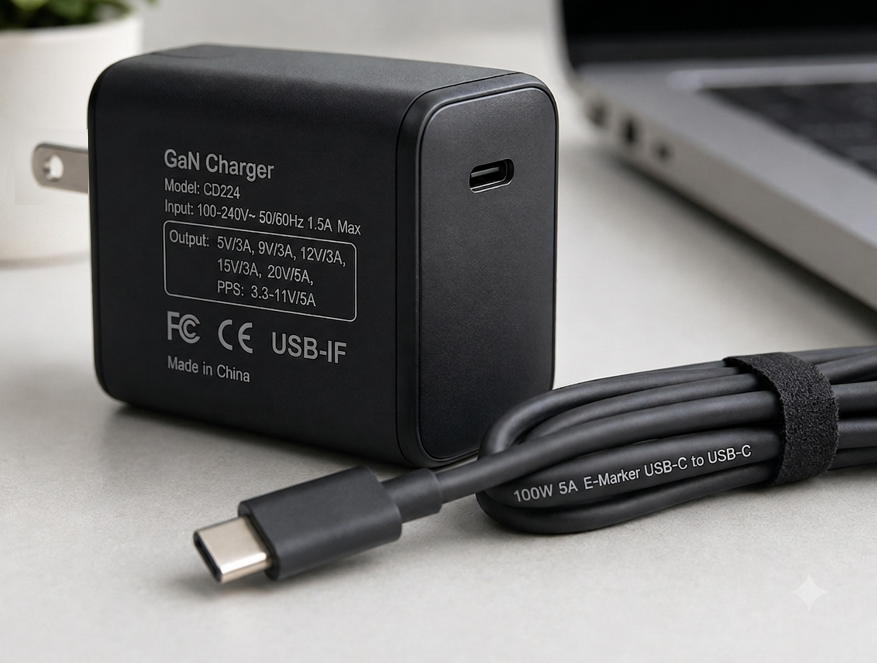
How to Read Charger Parameters
Don’t just look at the total power in W when reading charger parameters, focus on these points:
First, look at the single-port output levels. For example, common 5V/3A, 9V/3A, 12V/3A, 15V/3A, 20V/5A, the more complete the levels, the more compatible devices. For multi-port chargers, pay attention to the single-port output and power distribution rules when multiple ports are used simultaneously.
Second, check whether there is PPS and the PPS range. Android users should pay special attention to this point; without PPS, many phones cannot charge fast.
Third, if you need 140W or higher power, check whether it supports USB PD 3.1 EPR, which requires the entire link to support it.
There is also the commonly heard GaN (Gallium Nitride), which is just a semiconductor device. Its advantage is that it can make chargers smaller and more efficient, but it does not mean that it supports all fast charging protocols. Don’t think that GaN is a universal fast charger.
How to Choose Cables
Just choose according to the power demand:
- Within 60W: a qualified 3A USB-C cable is basically sufficient;
- 100W: choose a C-C cable labeled 100W, 5A, E-Marker;
- 140W/240W: choose cables clearly labeled PD 3.1 EPR and corresponding power;
- Private high-power fast charging: prioritize original or officially certified cables, especially for low-voltage high-current solutions.
Try not to use A-C cables of unknown origin, too thin cables, or cables without power labels for high power, to avoid speed reduction or safety risks.
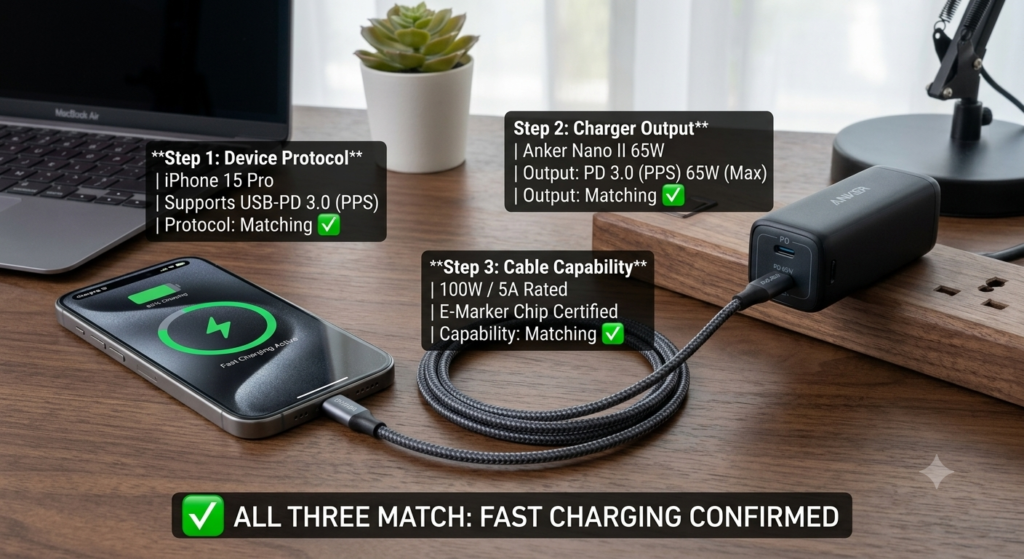
Three-step Purchase Inspection Method
Teach everyone a simple three-step method, check it before buying and you basically won’t buy wrong:
First step, confirm the protocols supported by the device, maximum power, and whether PPS or private protocol is required;
Second step, confirm that the charger supports the corresponding protocol, the single-port output level is sufficient, and the multi-port power distribution meets the demand;
Third step, confirm that the cable can carry the target power and supports necessary identification functions (such as E-Marker, private protocol identification chip).
Remember: among the three items of device, charger, and cable, if any one has a short board, the actual charging power will be pulled to the lowest level, just like the barrel effect.
Certification and Safety Markings
When purchasing overseas, pay attention to two types of certifications:
Protocol certifications such as USB-IF certification and QC certification are bonus items. It’s better to have them, but not all compliant products will have such certifications, so don’t force it.
More important are regional safety certifications, such as CE in Europe, UKCA in the UK, FCC/UL/ETL in the US, PSE in Japan, and RCM in Australia. These are the safety access requirements of the local market, and products with these markings have more guaranteed safety.
In a word: regular brand, clear parameters, after-sales channels, and no false power labeling are much more important than simply pursuing low prices.
Common Misconceptions and Troubleshooting
High-frequency Cognitive Misconceptions
First, correct several of the most common misconceptions:
- Enough power can trigger private fast charging — Wrong. Private fast charging requires matching of four items: device, charger, cable, and protocol. Just having enough power is useless; without brand authorization identification, it still can’t reach full speed.
- Universal fast charging will definitely damage the battery — Wrong. Formal fast charging has complete protection mechanisms. What really damages the battery is long-term high temperature and playing high-load games while charging, which has nothing to do with whether it is universal or private.
- Showing a fast charging icon means full power — Wrong. The fast charging icon only indicates that fast charging mode is entered, but it may cover multiple power levels. The actual power depends on the protocol and current status.
- USB-C interface means fast charging — Wrong. The interface shape does not represent the protocol and power capability. Some USB-C interfaces may only support 5V slow charging. Don’t think that a C port means fast charging.
- Third-party accessories can’t fast charge — Wrong. As long as they support the corresponding universal protocol or have official authorization, third-party accessories can also fast charge normally, and even some universal chargers have better quality than original ones.
- GaN chargers must be faster — Wrong. GaN just makes chargers smaller and more efficient. Whether it’s fast depends on the protocol, levels, and device support, and has nothing to do with whether it’s GaN.
Troubleshooting Steps for Slow Fast Charging
If you encounter sudden slow fast charging, don’t rush to change the charger. Follow this order to troubleshoot step by step, and most problems can be found:
- First check if the battery level exceeds 80%. Slowdown at high battery levels is normal, and all phones do this.
- Check if the ambient temperature is too high, or if you are playing games, navigating, or making video calls while charging, and if the phone case is too thick affecting heat dissipation, all of which will cause slowdown.
- Replace with a cable that is confirmed to be intact and has sufficient power. Many times it’s the cable that’s broken, has poor contact, or has insufficient power.
- Replace with a charger that clearly supports the corresponding protocol to eliminate the problem of charger protocol mismatch or failure.
- If you are using a multi-port charger, check if other devices are plugged in at the same time, causing power redistribution.
- Clean the dust in the phone’s interface, check if the plug is tightly inserted. Poor contact can also cause slowdown.
- Check the settings in the phone system, such as optimized charging, night charging protection, battery health, temperature prompts, to see if any restrictions are enabled.
- Finally, check the official protocol list again to confirm that the device, charger, and cable are really matched, and that you didn’t buy the wrong one.
Pitfall Avoidance for Third-party Accessory Purchase
Pitfall avoidance principles for buying third-party accessories:
Prioritize products from regular brands, with clear parameters, clear protocols, complete certification information, and after-sales channels.
When buying universal fast charging, focus on whether there is USB PD, PPS, single-port output levels, multi-port power distribution, and cable power.
When buying third-party accessories for private fast charging, focus on whether there is official authorization, whether it clearly states support for a certain brand and a certain power, and whether a dedicated cable is required.
Be especially wary of these slogans: “full protocol fast charging”, “universal super fast charging”, “supports the highest power of all brands”, “only marks peak power without specific levels”. Most of these are products with false labeling or opaque information, don’t buy them.
You must stick to the safety bottom line: products without certification, without brand, without parameter table, with rough workmanship, and abnormal heating during use, no matter how cheap, don’t buy them.
Decision Logic and Practical Compromise Solutions
Sort out the following steps clearly, and you can find the most suitable fast charging solution for yourself.
Step 1: Take Inventory of Existing Devices
First list all commonly used electronic devices, and write clearly for each: brand, model, maximum charging power, supported protocols, whether PPS is needed, and whether there is private fast charging.
Then mark the frequently used devices, such as main phone, laptop, tablet, power bank.
Then clarify your speed demand: do you often need 10-20 minutes of short-term fast charging, or do you mostly charge at night or slow charge in the office.
Step 2: Choose According to Scenario
After taking inventory of the devices, choose according to the most commonly used scenarios:
- If you only use a single-brand main phone and particularly pursue the fastest charging speed: prioritize original or officially authorized private fast charging;
- If you have multi-brand devices and often go out: prioritize PD/PPS universal fast charging;
- If shared by multiple people in home or office: prioritize multi-port universal fast charging, and add a private fast charging set for personal use;
- If you live overseas or travel frequently: prioritize universal fast charging, also confirm that the charger supports 100-240V input, and prepare the corresponding plug adapter.
Accessory Purchase Priority
When buying accessories, remember three priorities:
- Safety priority: regular brand > clear safety certification > transparent parameters > price;
- Speed priority: protocol matching > single-port output level > cable capability > nominal total power;
- Reuse priority: PD/PPS universal > single-brand private protocol > vague “full protocol” advertising.
Recommended Combination for Most People
If you don’t know how to choose, this combination is suitable for most people:
In a fixed position at home or office, keep an original or officially certified private fast charging kit for your main phone to enjoy the fastest charging speed;
Put a 65W or 100W PD/PPS GaN multi-port charger and a 100W C-C cable in your bag when going out, which can basically handle devices such as mobile phones, tablets, and thin and light laptops;
Users with laptops should choose the corresponding PD charger according to the laptop’s power demand, such as 65W, 100W, 140W are all fine;
When multi-device users choose multi-port chargers, they need to confirm the power distribution rules for simultaneous output of multiple ports;
Cables are best managed by category, such as 60W, 100W, EPR high power, and private dedicated ones stored separately, don’t mix them to avoid speed reduction.
Whether to Switch to Same-brand Devices for Fast Charging
Many people ask whether they should switch all their devices to the same brand for fast charging?
If you are extremely sensitive to short-term charging, often need to charge within 10 minutes before going out, and can accept the same brand’s ecosystem and accessory costs, then you can consider it.
But if you mostly charge at night, or charge casually in the office, and have multiple devices of different brands, then it’s really unnecessary. PD/PPS universal fast charging is completely sufficient.
After all, fast charging is only part of the mobile phone experience. When choosing a phone, you also need to look at the system, camera, battery life, weight, after-sales service, and whether accessories are easy to buy. There’s no need to force yourself to use a brand you don’t like just for fast charging.
Summary: 4 Things You Can Independently Judge After Learning
After reading this article, you should be able to independently judge these four things:
First, you can understand common protocol logos such as USB PD, PPS, QC, SuperVOOC, SCP, FlashCharge, and distinguish between the universal and private camps;
Second, you can judge whether to choose private fast charging, universal fast charging, or a combination of the two according to your own devices and usage scenarios;
Third, you can use the three-step method of “device protocol – charger level – cable power” to avoid buying wrong accessories and wasting money;
Fourth, when encountering slow fast charging, you can troubleshoot common causes step by step, and won’t be fooled by marketing terms such as “high wattage”, “full protocol”, and “GaN”.
In the end, as long as you confirm that the protocols and power of the device, charger, and cable match, you can avoid most fast charging purchase pitfalls.